
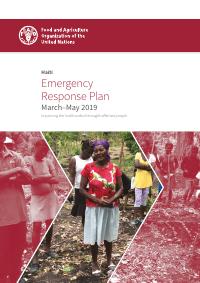
Haiti - Emergency Response Plan (March-May 2019): Improving the Livelihoods of Drought-Affected People
Summary — FAO's emergency response plan for March-May 2019 focused specifically on restoring the livelihoods of people affected by drought conditions in Haiti, warning that without timely assistance the food security situation of vulnerable families would further worsen. It sets out targeted agricultural interventions to help drought-affected households through the plan's three-month window.
Full Document Text
Extracted text from the original document for search indexing.
Haiti
Emergency
Response Plan
March–May 2019
Improving the livelihoods of drought-affected people
Haiti
Emergency
Response Plan
March–May 2019
Improving the livelihoods of drought-affected people
Food and Agriculture Organization of the United Nations
Rome, 2019
REQUIRED CITATION
FAO. 2019. Haiti Emergency Response Plan, March–May 2019. Rome. 10 pp.
Licence: CC BY-NC-SA 3.0 IGO.
The designations employed and the presentation of material in this information product do not imply
the expression of any opinion whatsoever on the part of the Food and Agriculture Organization of the
United Nations (FAO) concerning the legal or development status of any country, territory, city or area or
of its authorities, or concerning the delimitation of its frontiers or boundaries. The mention of specific
companies or products of manufacturers, whether or not these have been patented, does not imply that
these have been endorsed or recommended by FAO in preference to others of a similar nature that are
not mentioned.
The views expressed in this information product are those of the author(s) and do not necessarily reflect
the views or policies of FAO.
© FAO, 2019
Some rights reserved. This work is made available under the Creative Commons AttributionNonCommercial-ShareAlike 3.0 IGO licence (CC BY-NC-SA 3.0 IGO; https://creativecommons.org/
licenses/by-nc-sa/3.0/igo/legalcode/legalcode).
Under the terms of this licence, this work may be copied, redistributed and adapted for non-commercial
purposes, provided that the work is appropriately cited. In any use of this work, there should be no
suggestion that FAO endorses any specific organization, products or services. The use of the FAO logo
is not permitted. If the work is adapted, then it must be licensed under the same or equivalent Creative
Commons license. If a translation of this work is created, it must include the following disclaimer along
with the required citation: “This translation was not created by the Food and Agriculture Organization
of the United Nations (FAO). FAO is not responsible for the content or accuracy of this translation. The
original [Language] edition shall be the authoritative edition.
Disputes arising under the licence that cannot be settled amicably will be resolved by mediation and
arbitration as described in Article 8 of the licence except as otherwise provided herein. The applicable
mediation rules will be the mediation rules of the World Intellectual Property Organization http://
www.wipo.int/amc/en/mediation/rules and any arbitration will be conducted in accordance with the
Arbitration Rules of the United Nations Commission on International Trade Law (UNCITRAL).
Third-party materials. Users wishing to reuse material from this work that is attributed to a third
party, such as tables, figures or images, are responsible for determining whether permission is needed
for that reuse and for obtaining permission from the copyright holder. The risk of claims resulting from
infringement of any third-party-owned component in the work rests solely with the user.
Sales, rights and licensing. FAO information products are available on the FAO website (www.fao.org/
publications) and can be purchased through publications-sales@fao.org. Requests for commercial
use should be submitted via: www.fao.org/contact-us/licence-request. Queries regarding rights and
licensing should be submitted to: copyright@fao.org.
Photo cover: ©FAO/Haiti
Contents
Overview . . . . . . . . . . . . . . . . . . . . . . . . . . . . . . . . . 1
Situation analysis . . . . . . . . . . . . . . . . . . . . . . . . . . . 3
FAO’s strategic approach . . . . . . . . . . . . . . . . . . . . . . . 4
Rationale . . . . . . . . . . . . . . . . . . . . . . . . . . . . . . . . . . . . . . .4
Objective . . . . . . . . . . . . . . . . . . . . . . . . . . . . . . . . . . . . . . . 4
Targeted areas and beneficiaries . . . . . . . . . . . . . . . . . . . . . . . . 4
Planned interventions . . . . . . . . . . . . . . . . . . . . . . . . . . . . . . .5
iii
©FAO/Haiti
Overview
to assist
330 000 people
FAO requires
USD 8.6 million
period
March–May 2019
(3 months)
Haiti is regularly hit by extreme climatic events that have seriously
increased vulnerabilities in the country, particularly in rural areas and
among agriculture-based livelihood communities. Almost every year
since 2014, Haiti has been affected by episodes of drought and erratic
distribution of rainfall. Compounding the humanitarian situation were
the devastating effects of Hurricanes Matthew (October 2016) and Irma
(September 2017). Hurricane Matthew – the strongest since Felix in
2007 – had catastrophic impacts on the food security and livelihoods of
communities living in the departments of Grand’Anse, Sud, Sud-Est and
Nippes, destroying 100 percent of crops and affecting approximately
2.1 million people. Furthermore, although its eye was not directly on Haiti,
floods and strong winds linked to Hurricane Irma damaged crops in the
Nord-Est department.
In 2018, severe drought resulted in a significant decline in agricultural
production and households’ income. The high probability of an El Niño
phenomenon in 2019 will likely increase the persistence of drought in parts
of the country in the coming months.
Moreover, an economic crisis triggered by a depreciation of the Haitian
gourde has caused a significant reduction in households’ purchasing
power, directly affecting their food security. As a result, the population has
been protesting against the Government since 7 February 2019, hampering
logistics, food production and the functioning of market systems. This has
contributed to eroding vulnerable households’ resilience.
1
©FAO/Haiti
Situation
analysis
According to the last Integrated Food Security Phase Classification (IPC)
analysis (December 2018), about 2.6 million Haitians are expected to be
food insecure during the lean season (March–June 2019) – twice as many
people compared with the 2018 lean season. This figure represents about
38 percent of the rural population.
60% of crisis-affected people
rely on agriculture for their
livelihoods
55.2% of the population
has adopted negative coping
mechanisms
According to the 2019 Humanitarian Response Plan, the Food Security
Sector is targeting 1.1 million people with USD 58.9 million. The emergency
response is articulated around three priority objectives:
1. providing emergency food assistance to 571 000 vulnerable people;
2. restoring the livelihoods of 1.1 million vulnerable people; and
3. providing technical support on food crisis prevention and
management.
Projected food insecurity situation (March–June 2019)
IPC acute food insecurity
phase classification
Nor th Atl an ti c Ocean
Minimal
Nord-Ouest
Stressed
Nord
Nord-Est
Crisis
Emergency
Famine
L’Artibonite
Areas with inadequate evidence
Centre
Gran d’Anse
Ouest
Nippes
Sud
Not analysed
Ouest
Carib bean Sea
TH E D O M I NI CAN
REPUBLIC
Sud-Est
0
15 km
Source: IPC, December 2018
The significant decline in food availability and agriculture-based income
leads to increased staple food prices (+10 percent/year), decreasing food
access for the most vulnerable households. This has been exacerbated by
the continuous depreciation of local currency (+15 percent/year).
The socio-political unrest experienced in the country since 7 February
2019 is in part a consequence of the loss of hope by the poorest segments
of the population.
3
©FAO/Haiti
FAO’s strategic
approach
Without adequate and
timely agricultural
assistance, the food
security situation will
continue to deteriorate.
Rationale
The Ministers of Agriculture, Natural Resources and Rural Development,
and of Women’s Affairs and Women’s Rights have requested FAO’s support
to assist vulnerable rural populations, particularly female-headed
households, during the 2019 spring agricultural season starting in April in
order to restore their livelihoods and mitigate the impact of the crisis.
Objective
FAO plans to restore and strengthen the livelihoods and food security of
vulnerable households through improved agricultural production, income
and diet diversification, and cash-based transfers.
Targeted areas and beneficiaries
FAO will provide livelihood support to at least 30 percent of vulnerable
households targeted under the 2019 Humanitarian Response Plan,
corresponding to 66 000 households (330 000 people). Priority will be
given to seven departments with the highest proportion of people
in IPC Phases 3 and 4 as follows: Nord, Nord-Est, Sud-Est, Centre,
4 | Haiti Emergency Response Plan 2019
Return on investment
According to the evaluation of
Nord‑Ouest, Grand’Anse and Ouest. Female-headed households and
families with malnourished children under five, elderly people and/or
people affected by chronic diseases will be prioritized.
previous FAO interventions in Haiti,
it is expected that investing
USD 130 per household,
including:
• 15 kg of cereal and pulse seeds or
60 g of vegetable seeds
• 800 cassava and sweet potato cuttings
• technical assistance
will generate:
2-3 months
of food availability and
USD 50–150 of income
by selling part of the production
Planned interventions
FAO’s approach is to provide access to basic agricultural inputs (seeds,
planting material and tools) to vulnerable households with access to
land to quickly revive their production during the spring campaign – the
main agricultural season that provides more than 60 percent of the
country’s agricultural production. To enable vulnerable rural households
without access to land to generate incomes, FAO will organize cash-forwork activities to rehabilitate assets and infrastructures to improve the
resilience of rural communities against natural disasters.
As a co-leader of the Food Security Sector Coordination, FAO will work
in partnership with all other main stakeholders, to ensure synergies and
complementarity to maximize the impact of interventions. The main
planned activities are to:
obtained
1. Provide seeds and planting material of early maturing and drought-
resistant crop varieties to 30 000 vulnerable households, either through
direct distribution or through subsidized vouchers and seed fairs.
2. Provide inputs and technical assistance for vegetable production
and fish farming to 20 000 vulnerable households, of whom at least
60 percent are female-headed households.
3. Organize cash-for-work interventions (providing approximately
USD 82/household) combined with technical support for the
implementation of sustainable agricultural practices (erosion control,
agroforestry, cleaning of irrigation canal, etc.), the rehabilitation of rural
roads, etc., benefiting about 16 000 vulnerable households without
agricultural land.
5
©FAO/Haiti
6 | Haiti Emergency Response Plan 2019
Saving livelihoods saves lives
Contact
Nathanael Hishamunda
FAO Representative
Port-au-Prince, Haiti
FAO-HT@fao.org
Dominique Burgeon
Director, Emergency and Resilience Division and
Strategic Programme Leader – Resilience
Rome, Italy
TCE-Director@fao.org
Food and Agriculture Organization of the United Nations
© FAO, 2019
CA3648EN/1/03.19
www.fao.org/emergencies
www.fao.org/resilience
How to cite
Food and Agriculture Organization (FAO), Haiti - Emergency Response Plan (March-May 2019): Improving the Livelihoods of Drought-Affected People, https://reliefweb.int/attachments/00b8d52f-e1fd-3d92-90e8-acbe940a5acc/ca3648en.pdf