
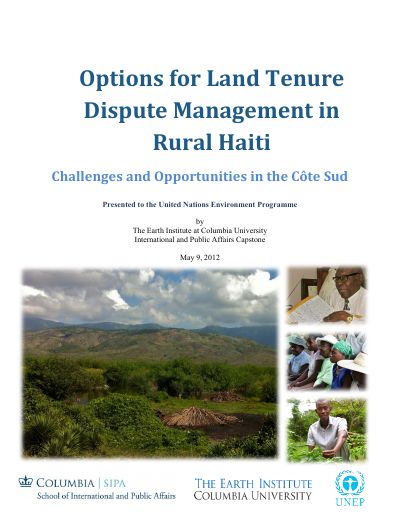
Options for Land Tenure Dispute Management in Rural Haiti: Challenges and Opportunities in the Côte Sud
- Interviewees named six gaps behind confusion and conflict in land tenure, from limited professionalization of legal actors to the absence of land-use planning.
- Land conflicts in southwestern Haiti are prevalent, particularly over inheritance, but rarely violent.
- The authors expect land tenure conflicts to rise as population pressure and land value increase.
- The report recommends civic engagement, legal training, legal aid and counseling, land tribunals, standardized domain modeling and watershed planning.
- The recommendations supplement government-led land tenure reform and are directed to implementing partners such as UNEP, the Millennium Village Project and the Côte Sud Initiative.
The report was presented to the United Nations Environment Programme on May 9, 2012 by graduate students of Columbia University's School of International and Public Affairs. It investigates the conflict potential of the land tenure system around the Millennium Village Project in the Port-à-Piment watershed, a partner of the Côte Sud Initiative, which works with 18 communes in southern Haiti. The analysis rests on qualitative interviews with landowners, lawyers, notaries, surveyors, NGOs and government agencies.
Interviewees attributed confusion and conflict to six gaps: limited professionalization of judges, lawyers, notaries and surveyors; lack of administrative uniformity and documentation; weak enforcement of rulings; limited community access and awareness; no formal recognition of alternative dispute resolution; and no land-use planning. Land conflicts, mostly over inheritance, are prevalent but rarely violent. The report recommends civic engagement, legal training, legal aid, land tribunals, standardized domain modeling and watershed planning, with a proposed implementation sequence.
How to cite
Earth Institute at Columbia University, 2012, Options for Land Tenure Dispute Management in Rural Haiti: Challenges and Opportunities in the Côte Sud, accessed via HaitiDocs, https://www.haitidocs.org/doc/earth-institute-2012-land-tenure-dispute-management-cote-sud
- Rights holder
- Earth Institute at Columbia University