
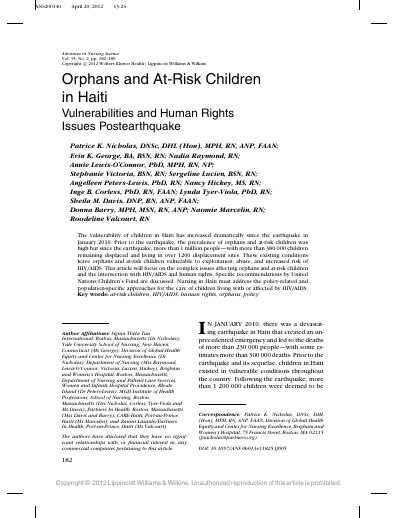
Orphans and At-Risk Children in Haiti: Vulnerabilities and Human Rights Issues Postearthquake
- The vulnerability of children in Haiti increased dramatically after the January 2010 earthquake.
- More than 380,000 children remained displaced and living in over 1,200 displacement sites after the earthquake.
- Prior to the earthquake, 350,000 children lived in orphan-related conditions, and the most vulnerable after it were unaccompanied or orphaned children.
- Orphans and at-risk children are vulnerable to exploitation, abuse and increased risk of HIV/AIDS.
- The authors conclude that nursing in Haiti must address policy-related and population-specific approaches for children living with or affected by HIV/AIDS.
Patrice K. Nicholas and colleagues published this article in Advances in Nursing Science, volume 35, number 2 (2012). It states that the vulnerability of children in Haiti increased dramatically after the January 2010 earthquake, which killed more than 230,000 people, and that more than 380,000 children remained displaced in over 1,200 displacement sites.
The article estimates about 4.5 million children in Haiti, nearly half the population, with 350,000 living in orphan-related conditions before the earthquake. It describes the exposure of orphans and at-risk children to exploitation, abuse and increased risk of HIV/AIDS, and reviews UNAIDS and UNICEF recommendations. It concludes that nursing in Haiti must adopt policy-related and population-specific approaches for the care of children living with or affected by HIV/AIDS.
How to cite
Advances in Nursing Science, 2012, Orphans and At-Risk Children in Haiti: Vulnerabilities and Human Rights Issues Postearthquake, https://doi.org/10.1097/ANS.0b013e318253f005
- Rights holder
- Advances in Nursing Science