Texte Intégral du Document
Texte extrait du document original pour l'indexation.
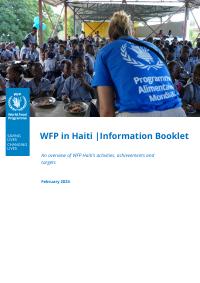
WFP in Haiti |Information Booklet
An overview of WFP Haiti’s activities, achievements and
targets
February 2024
�Table of Content
Executive summary_ _ _ _ _ _ _ _ _ _ _ _ _ _ _ _ _ _ _ _ _ _ _ _ _ _ _ _ _ _ _ 1
Engagement with the Haitian government_ _ _ _ _ _ _ _ _ _ _ _ _ _ 2
Emergency response in Haiti_ _ _ _ _ _ _ _ _ _ _ _ _ _ _ _ _ _ _ _ _ _ _ _ _3
Policy and social protection activities in Haiti_ _ _ _ _ _ _ _ _ _ _ _ 4
School meal programme in Haiti and its transition to homegrown school meal_ _ _ _ _ _ _ _ _ _ _ _ _ _ _ _ _ _ _ _ _ _ _ _ _ _ _ _ _ _ _ 6
Resilience activities in Haiti_ _ _ _ _ _ _ _ _ _ _ _ _ _ _ _ _ _ _ _ _ _ _ _ _ 7
Micro-insurance activities in Haiti_ _ _ _ _ _ _ _ _ _ _ _ _ _ _ _ _ _ _ _ 8
Climate action in Haiti_ _ _ _ _ _ _ _ _ _ _ _ _ _ _ _ _ _ _ _ _ _ _ _ _ _ _ _ _ 9
Contingency stock in Haiti_ _ _ _ _ _ _ _ _ _ _ _ _ _ _ _ _ _ _ _ _ _ _ _ _ _10
Supply chain and logistics in Haiti_ _ _ _ _ _ _ _ _ _ _ _ _ _ _ _ _ _ _ _ 11
The United Nations Humanitarian Air Service (UNHAS)_ _ _ _ _12
Thanks to WFP’s donors_ _ _ _ _ _ _ _ _ _ _ _ _ _ _ _ _ _ _ _ _ _ _ _ _ _ _ 13
February 2024
�Executive Summary
WFP has been working in Haiti since 1969, providing humanitarian assistance during
emergencies and supporting development through long-term solutions to end hunger and
address undernutrition, while strengthening national social protection, education and food
systems. To reach its goal of Zero Hunger, WFP implements flagship programmes such as home
-grown school meals, and has supported the Government of Haiti through policy development
and capacity building. All WFP programmes are implemented in partnership with the
Government of Haiti.
In addition, WFP’s robust logistics and supply chain capacities, including the United Nations
Humanitarian Air Service, enables the humanitarian community to reach people in need,
sometimes in the most hard-to-reach areas.
Trends show a steady deterioration of the food security situation since 2016. The latest
Integrated Food Security Phase Classification (IPC) covering August 2023 to February 2024,
highlights that 44 percent of the population in Haiti, or 4.35 million people, are acutely food
insecure (IPC 3+), of which approximately 1.4 million are in Emergency phase (IPC 4).
In addition to the food security crisis in Haiti, there are more than 310,000 internally displaced
people in the country due to armed group violence, 60 percent of which were displaced in
2023. Haiti is also exposed to natural hazards, which are worsened by climate change, such as
flooding, landslides and droughts.
WFP, in partnership with the government, is implementing its new Country Strategic Plan
2024-2028 (CSP) with a budget of USD 1.5 billion, approved in late 2023. In the initial year, 50%
of beneficiaries will participate in programs promoting resilience and Haiti's development. This
percentage will grow over time as beneficiaries shift from emergency assistance to long-term
initiatives.
In partnership
with:
In 2023, WFP supported 2 million people in Haiti, with 1 million hot meals, 9,000 mt of food
and USD 80 million of cash-based transfers, a record for WFP in the Latin America and the
Caribbean region. WFP also bought USD 8.4 million worth of locally produced food from
smallholder farmers, which aligns with the government’s policy and WFP’s new CSP.
The country office’s goal is to reach 2.25 million people in 2024, and needs USD 104.1 million
REPUBLIQUE D'HAÏTI
to be able to implement its operations in the next 6 months (February – July 2024).
February 2024
1
�Engagement with the Haitian Government
WFP is fully committed to supporting Haiti in its
WFP works with the Ministry of Education to
efforts to achieve the Sustainable Development
improve the scale and quality of the national school
Goals and national development goals through well-
meals programme and facilitate ownership. In line
established
with the National School Meals Policy and Strategy,
partnerships
with
key
state
updated in 2024 with WFP’s support, WFP aims to
institutions.
WFP collaborates closely with the Directorate for
Civil Protection (DGPC) to strengthen its capacity to
anticipate and react to shocks and reach those in
urgent need with high quality assistance and
programme by 2030, contributing to the triple nexus
by boosting the local economy and significantly
reducing WFP’s environmental footprint.
support. For example, the two entities co-lead the
WFP is working with the Ministry of Agriculture,
Logistics Sector together to facilitate coordination
Natural Resources and Rural Development,
and information sharing.
support smallholder
WFP contributes to collective efforts to increase
access to national social protection systems that
safeguard and foster Haitian’s ability to meet needs
including
food
security,
nutrition
and
other
essentials, to reduce the negative effect of risks and
shocks. WFP supported the Government of Haiti in
the development of the National Social Protection
and Promotion Policy (NSPPP), adopted in June 2020,
and its Action Plan, adopted in October 2023. This
productivity
and
to
climate
change adaptation through various initiatives, such
as the delivery of last-mile climate services through
Participatory
Integrated
Climate
Services
for
Agriculture or scaling up parametric microinsurance
against extreme weather events, which additionally
serves as entry point for financial literacy and
promotion of saving and credit groups. WFP and the
Ministry of Agriculture signed a Memorandum of
Understanding in April 2023.
policy provides the institutional framework for all
With
future social protection initiatives. Since its adoption,
supporting
WFP is supporting enhancements to the quantity and
financing in Haiti given its fragile context and
quality of national social protection programming,
complex emergency. This joint collaboration aims to
through established partnership with the Ministry of
scale-up nature-based solutions to reduce the
Social Affairs and the Fund for Economic and
impacts of climate risks and build climate resilience,
Social Assistance, by providing on-demand cash
leveraging WFP’s asset creation and community-
transfer and associated services to governments and
based participatory planning tools.
partners. WFP is working to establish government-toperson payments systems (G2P) for social protection
through end-to-end technical assistance, payments
In
partnership
with :
locally source all the food for its school meals
and insurance services for national programmes.
the
Ministry of Environment,
WFP
advocacy
climate
for
increasing
is
WFP also plans to enhance its collaboration with the
Ministry of Economy and Finance to
enable
inclusive
macro-insurance coverage
reach
Haitians
via
the
Caribbean
to
Catastrophe
Risk
WFP is equally supporting the SIMAST (Ministry of
insurance Facility (CCRIF) as part of its support to
Social Affairs and Labour’s Information System), a
integrating anticipatory actions into the social
social registry developed in 2013 which is the only
protection’s disaster risk management system and
comprehensive social registry in the country, with
disaster risk finance layering.
more than 615,000 households registered.
REPUBLIQUE D'HAÏTI
February 2024
2
�Emergency response in Haiti
Through its emergency programmes, WFP provides
September 2022, and accessing beneficiaries
unconditional
has
food
and cash
assistance to
increasingly
challenging
vulnerable households and ensures contingency
throughout the year. WFP Haiti created an
stocks and preparedness measures are put in place
Access unit to facilitate access to the most
to respond to shocks. WFP’s emergency response is
vulnerable populations affected by violence,
done in coordination with the government,
and to safeguard logistics routes.
through
the
Fund
for
Economic
and
Social
Assistance (FAES), funded by the Inter American
Development Bank and providing emergency social
assistance through hot meal distributions and cash
distributions, and with the Directorate for Civil
Protection for hot meals distributions.
As
part
of
mechanisms,
1
WFP’s
rapid
million
hot
responses
meals
were
distributed across 4 departments to assist
vulnerable people facing:
•
Armed-group violence, leading to urban
displacement in the Metropolitan area of
In 2023, WFP assisted 1.26 million people with
Port
2,504 mt of food, 1 million hot meals and USD 43.3
distributed for this response);
million of cash-based transfers. In 2024, WFP aims
to reach 1.5 million people with its emergency
In partnership
with :
become
•
operations are 30% funded for the next six-months.
Almost half the population in Haiti (4.35 million
people) are acutely food insecure and in need of
food assistance. WFP assists beneficiaires with inkind and cash-based transfers. The transfers aim to
cover around 70 percent of the improved food
basket, while the food rations are calculated to
Prince
(70%
of
hot
meals
Mass deportation and repatriation from
the Dominican Republic the North-East and
operations, with 15,400 mt of food and USD 80.6
million in cash transfers. Currently, WFP emergency
au
Center departments.
•
Natural disasters and the flood of June
2023.
WFP is increasing the digitalization of its
emergency response, with 40% of it done
through digital cash responses, compared to
6,8% for other humanitarian actors on average
in Haiti.
meet a household’s needs for one month.
The security situation in Haiti has worsened
following the beginning of the complex crisis in
IPC evolution from 2020 to 2024
IPC 3+ : 4 million people
IPC 4: 905,471 people
February 2024
IPC 3+ : 4.3 million people
IPC 4: 1.3 million people
IPC 3+ : 4.7 million people
IPC 4: 1.7 million people
IPC 3+ : 4.35 million people
IPC 4: 1.4 million people
3
�Policy and social protection activities in Haiti
Social protection programmes are the set of
Moving forward, WFP and its partners will continue
policies and programmes aimed at preventing or
to
protecting all people against poverty, vulnerability,
systems (G2P) in Haiti, while strengthening the
and social exclusion throughout their lifecycles,
institutional capacity of the government, which will
with a particular emphasis towards vulnerable
take over the management of the Klere Chimen
groups.
programme (ASPIRE project’s name in Creole) in
WFP supported the Government of Haiti in the
development of the National Social Protection
and Promotion Policy (NSPPP), adopted in June
build
inclusive
Government
to
People
the next two years. WFP’s work has centered
around building digital public infrastructure for
more inclusive social protection in Haiti.
2020, and of its Action Plan adopted in October
In 2023, WFP has successfully supported the
2023.
This
policy
provides
the
institutional
Ministry of Social Affairs in delivering the ASPIRE
for
future
social
protection
programme, resulting in the delivery of cash-based
initiatives. Since its adoption, WFP has been
transfers to more than 120,035 people in 2023,
working with the Government on a roadmap for its
contributing to families meeting their food needs
gradual implementation. WFP also supported the
and healthy diets. Despite common perceptions
development of the National School Feeding Policy.
that
framework
all
WFP is equally supporting the SIMAST (the Ministry
of Social Affairs and Labour’s Information System),
a social registry developed in 2013 used to assess
vulnerability
and
target
social
assistance
programmes. It covers 85 communes and 626,321
Haiti
is
a
predominantly
cash-based
society, WFP has sped up assistance delivery
through e-wallets. Within less than a year, the
proportion of Klere Chimen safety net recipients
receiving transfers digitally climbed from 3% (May
2022) to 67% (Dec 2023).
households (of which 78,000 registered in 2023),
WFP
supports
establishing
shock-responsive
amounting to 3.1 million people, or 26% of the
social protection by assisting the Ministry and the
population in Haiti. WFP supports its continued
Directorate for Civil Protection in adopting a
geographical expansion, and the Government’s
framework and early warning system. This involves
goal by 2025 is to increase that figure to 40% of the
utilizing the social protection system to provide
total population registered in the SIMAST, as well
emergency assistance before (Anticipatory Action)
as the assessment of other data collection
or after a shock.
methodologies focusing on innovation to support
data sources (ex. cellular data).
Both the NSPPP and the SIMAST support the
ASPIRE (Adaptive Social Protection for Increased
In partnership
with
Resilience) programme, a nationally led social
protection programme. USD 75 million was
awarded by the World Bank to the Haitian
Government, with WFP as a key implementing
partner, to carry out the social safety net included
in the NSPPP. The programme will also improve
ASPIRE operations Haiti—Dec 2023
the expansion, including the use of non-traditional
health and nutrition outcomes for the households
and promote financial inclusion.
February 2024
4
�The school meals programme in Haiti and its
transition to home-grown school meals
School meals are a priority in Haiti: in a country
450,279 school children in 2023, and aims to
where 44% of the population needs urgent
reach 492,000 in 2024. The school meals
food assistance, a daily meal at school is a
programme is also reactive to shocks, as
simple way to ensure children receive at
WFP
least one nutritious meal every day. School
students when schools are closed due to
meals help keep children in school, and
shock.
improve their graduation rate, so that they
become healthy, productive adults, contributing
to their country’s development, and breaking
the
intergenerational
cycle
of
hunger,
malnutrition and poverty.
The
In partnership
with :
vision
and
distributes
take-home
rations
to
WFP is also supported the MENFP in updating
the National School Feeding Policy and
Strategy (PSNAS), which aims to strengthen
local procurement and management, and
governance of the sector. The PSNAS aims to
goal
of
the
Haitian
use only locally produced food for school
Government through the Ministry of National
canteens in Haiti by 2030. WFP supports this
Education and Vocational Training (MENFP) is to
objective,
ensure all schoolchildren have access to the
traditional school meals programme, which
nutritious food they need to be able to learn,
uses mostly imported goods, to a home-
through the provision of a healthy and
grown school meals programme, through
balanced
complementary
diet
in
schools,
which all the goods (except oil) are locally
prepared
with
almost
exclusively
locally
produced
food
and
respecting
nutritional
standards so that hunger is not a barrier to
education. The overall objectives are: (i) the
provision of quality food services; (ii) supporting
the local economy and local food production;
(iii) the development of good governance
mechanisms;
and
(iv)
participatory
management and community ownership.
and
is
transitioning
from
sourced.
Through home grown school meals, WFP
supports (i) the Haitian economy through
local purchases; (ii) the diversification of
schoolchildren’s diet; and (iii) local farming by
strengthening smallholder farmers’ access to
markets. At the end of 2023, WFP has reached
its goal of providing locally-sourced meals to
225,927 school children (50% of the total) in
Despite access constraints to reach schools in
7
Croix-des-Bouquets and Arcahaie, WFP reached
Grand’Anse, Nippes, Ouest, Nord and Sud.
February 2024
a
departments:
Artibonite,
Centre,
5
�WFP
works
with
170
OPAs
(Organisations
de
and the construction and rehabilitation of latrines in
Producteurs Agricoles) and their 20,000 members, to
the Grand’Anse, Nord and Nord-Est departments.
source food from smallholder farmers. In 2023, 4,340
mt
of
local
products
were
bought,
worth
approximately USD 8.4 million, a record for WFP in
the region and in Haiti.
WFP is also sensitive to the environmental impact
of its programmes. In 2022, the Clean Cooking
project introduced heat retention bags (HRB), gas
stoves and clean cooking trainings to school cooks.
WFP also provides support to the OPAs, helping them
The HRB is a non-electric slow cooker developed for
improve the quality of their products, subsidizing the
people cooking over open fires. WFP trained its
set-up of processing facilities and providing them with
staff, cooperating partners, school cooks and
quality control equipment. In partnership with the
communities around the country, explaining how to
Ministry of Agriculture, Natural Resources and
combine HRBs with any energy source (firewood,
Rural Development, WFP also provides technical
charcoal, gas stoves etc) to cook traditional recipes.
trainings on storage and grain conservation, quality
HRBs decrease energy costs by up to 70 percent
control and reduction of post-harvest losses. Finally,
for recipes prepared in schools and improve the
WFP provides training to respond to calls for tenders,
health of cooks by decreasing indoor pollution in
negotiation and contracting to improve access to
closed spaces by 60 percent. Furthermore, HRB are
markets.
made from recycled plastic, diverting waste from
Additionally, schools are used as a platform to
landfills and reducing environmental pollution.
improve gender norms and promote the equality of
In 2023, 3,290 HRBs were distributed to 1,400 cooks
women and men as well as girls and boys.
Other
and 350 schools in 8 regions. WFP plans to
complementary activities include literacy training, as
distribute another 1,150 HRBs to schools and 350 to
well as guidance on water, sanitation and hygiene
the cooks at the start of the new school year.
practices, the establishment of hand-washing stations
February 2024
6
�Resilience activities in Haiti
Due to Haiti’s high exposure to rapid-onset shocks
WFP delivers complementary activities in the
and stressors resulting from natural hazards, as
same zones, prioritising a gender and nutrition-
well as socio-political and economic instability,
sensitive approach with a social behavioral
WFP is working to reinforce the resilience of
communication change lens.
Haitians through asset creation and livelihood
programmes. WFP works in partnerships with the
Ministry of Agriculture, Natural Resources and
Rural Development and in alignment with its
Agricultural Development Plan.
The asset creation and livelihood programme
aims to support communities in some of the
most vulnerable areas of Haiti by mitigating,
adapting, and recovering from seasonal shocks
and recurring hazards, while also working to
improve their long-term food security, livelihoods
and community resilience.
ecosystem is strengthened through disaster risk
reduction environmental-related solutions, while
reinforcing local
through
agriculture
community-led
conservation
activities,
and
soil
livestock
and
including
water
providing
agricultural inputs, livestock, and technical and
financial assistance to actors throughout the food
value chain. WFP’s resilience projects enable
access to basic social services, stimulate
market dynamics and contribute to conflictreduction through the rehabilitation of rural
In 2023, WFP supported around 210,000 people
roads, installation of potable water abduction
through its resilience activities. WFP was unable to
points and shock-related solutions such as micro-
meet its goal of reaching 250,000 people due to
insurance assistance. Resilience activities also
funding shortfalls. In 2024, WFP aims to reach
provide a source of income for participants who
250,000 people, funding permitting.
receive
Participants receive conditional cash while they
build, rehabilitate or improve productive or
conditional-cash
remuneration
in
exchange for taking part in construction or
rehabilitation conducted through the programme.
protective community assets, as well as tools,
Throughout the definition, design, delivery and
inputs and technical assistance. In 2023, 34,437
documentation for scale-up of its resilience
households (172,185 people) participated in 80-
programming, WFP adopts the Three-Pronged
day cycles and received cash-based transfers of
approach to guarantee that programmes are
around USD 100 per month to cover the cost of
planned to bring together a plethora of actors
food and basic needs. A total of around USD 8.6
through a participatory process and respond to
million were distributed. In addition, 52,825
local
people
In partnership
with :
WFP invests in three main pillars: The local
benefit from WFP's micro-insurance
coverage (see factsheet on micro-insurance for
more details).
needs, therefore boosting community
ownership and acceptance of climate adaptation
and risk management measures.
Assets created/rehabilitated in 2023 (as of December)
6
78 km of rural roads rehabilitated
52.5 km of irrigation canals rehabilitated to enhance
agricultural land
937 hectares of land rehabilitated or benefitting
from irrigation infrastructure
92 km of drainage canals and flood protection dykes
built or rehabilitated
February 2024
7
�Micro-insurance activities in Haiti
In October 2022, WFP Haiti, in partnership with local
The coverage aims to improve the resilience of farmer
insurer, Alternative Insurance Company (AIC), technical
households and their cropping activity through a risk
service provider Weather Risk Management Solutions
transfer mechanism on one hand, and reinforce
(WRMS), and international reinsurance company Scor Re,
livelihood of social protection beneficiaries on the other.
launched
It
an
index-based
micro-insurance
pilot
allows
participants
to
protect
their
the
productive
covering productive activities of smallholder farmers for
investments, better reduce their vulnerability when faced
the duration of one year. This program provides
with risks such as excess rain and rain deficit, while
protection against two major climate risks: excess
understanding and adopting the use of new and well
rainfall and rainfall deficit.
designed
financial
risk mitigation
tools
within
their
households and communities.
In total, 10,565
households
(52,825
people)
in
Grand’Anse, South, Nippes and Artibonite are insured for
the 2023-24 cropping and hurricane seasons. The
households who joined the micro-insurance programme
in 2023 included 1,050 (5,250 people) benefiting from
asset-creation activities in the South, 1,200 households
(6,000 people) benefiting from the ASPIRE project in
Grand Anse
(please see policy factsheet), while the
remaining were part of a larger network of smallholder
farmers and a federation of agricultural cooperatives.
To help build farmers’ adaptive capacity and reduce
their exposure to climate-related risks in the Grand’Anse
department,
the
selected
cooperatives
provided
agricultural insurance participants with technical assistance
and knowledge, risk mitigation and financial education. In
the
South
department,
support
includes
the
implementation of environmental protection activities, such
as soil and water conservation works and reforestation
activities.
Claims pay-out for both excess rainfall and rain deficit
were triggered for some 3,574 households (17,870
people) the last quarter of 2023, and were delivered in
January 2024. WFP’s goal is to cover 70,055 people at the
end of the 2024 hurricane season.
The objectives of risk financing actions in Haiti are
to:
(i)
design
microinsurance
products
that
are
integrated in resilience building strategies promoting
productivity and securing livelihood that are easily
scalable; (ii) introduce insurance components that can be
linked to other financial services and tools (formal and
informal); (iii) guarantee a critical mass through a smart
In
partnerships
with :
subsidy
approach,
aggregation
and
distribution
schemes; (iv) complement other WFP Haiti interventions
aiming at reinforcing smallholder farmers’ capacities
*
*
involved in the home-grown school feeding programme
and livelihood and social protection programmes ; and
(v) explore integration with macro level solutions - such
as the coverage of The Caribbean Catastrophe Risk
Insurance Facility - and Forecast Based Financing (FbF).
February 2024
*USD 40 average value of yearly premium for USD 500 average
yearly value of sum insured for ASPIRE beneficiaries
8
�Climate action in Haiti
Amongst the world's most vulnerable countries to
and supporting vulnerable communities to develop
impacts
environmental
diversified, sustainable and shock-resilient livelihoods;
degradation, Haiti is the third most impacted country
(iii) protecting the most vulnerable households and;
in the world by extreme weather events, such as
(iv) transforming communities and food systems
hurricanes, tropical storms and droughts, between
with innovations for climate, nature and people.
of
climate
change
and
2000 - 2019. Around 96 percent of Haitians live under
the threat of at least two of these risks according to
Through its climate action, WFP aims to change the
the World Bank. Climate change adversely impacts
lives of 2 million people over 5 years. WFP will
lives and livelihoods, increases competition for
partner
resources and exacerbates drivers of insecurity. At
coordination platforms around adaptation to climate
the same time, existing insecurity limits the capacity
change, enhance resilient and inclusive food systems
of the country and its people to adapt and respond to
for sustainable local production, promote gender-
climate change, magnifying its impact, especially on
transformative approaches and support national
the most vulnerable people, such as women and
institutions and Haitian civil society to unlock and
children.
mobilize traditional and innovative climate financing.
with
relevant
stakeholders
to
revive
WFP’s climate action work is coordinated with the
Ministry of environment, Ministry of agriculture,
natural resources and rural development and
Ministry of economy and finance. Its Climate Action
Strategy is aligned with the National Adaptation Plan,
the National Climate Change Policy (PNCC 2019-2030)
and country's Agricultural Development Policy (2010 -
2025).
In partnership
with :
WFP developed a Climate Action Strategy in line
with its Country Strategic Plan 2024-2028. The
strategy embeds climate action as a cross-cutting
dimension throughout all of WFP operations in Haiti
to
support
vulnerable
communities
and
food
systems. WFP strengthens its programmes to better
address climate variability and extreme weather
events, as well as long-term climate change aiming
to support at risk populations to better adapt,
prepare and respond to the increasing climate risk.
WFP is committed to addressing climate change as
one of the root causes of food insecurity in the
country by : (i) anticipating shocks before they turn
into disasters; (ii) restoring degraded ecosystems
February 2024
9
�Contingency stock in Haiti
The contingency stock is a key tool that
These
WFP uses to ensure that crisis-affected
through local suppliers and WFP has put
populations in Haiti can meet their
in place Food Supplier Agreements to
basic food needs in times of crisis.
be able to swiftly trigger food purchases
Having
commodities
with support from Canada and internal
available in country allows WFP to
funding mechanism, worth USD 1.5
respond to sudden-onset disasters and
million.
pre-positioned
crises to meet
the needs of affected
populations quickly and effectively, while
additional assistance is planned and
prepared for in later weeks, if required.
Fully stocked, the 3,971 mt contingency
stock allows WFP to feed up to 300,000
people
with
unconditional
food
assistance, including 50 kg of rice, 12.5
kg of beans, and 3.68 kg of oil per
household
for
one
month.
This
represents 81% (1,693 Kcals per person/
day) of daily caloric needs.
purchases
were
contracted
WFP will solely trigger the local option if
and when needed. This will allow the
stock to be more agile and save costs.
Some funding gaps remain to fully
reach the 3.971 mt.
Following
the
looting
of
WFP
warehouses in Haiti, 650 mt of food are
stored in the Dominican Republic as a
mitigation measure.
Percentage of locally vs internationally
purchased food for the contingency stock
To distribute the emergency rations,
WFP utilizes its own fleet of trucks (25 all
-terrain 4x4 trucks) to access the most
difficult secondary and tertiary roads, its
In partnership
with :
cooperating
partners, and commercial
transporters for main road routes.
In-kind commodities provided by USAID/
BHA helped replenish the majority of the
contingency stock, while 1,728 mt were
locally purchased.
February 2024
Locally purchased
Internationally purchased
10
�Supply chain and logistics in Haiti
Supply Chain and Logistics capacities are key
three-month service suspension due to the
to
complex crisis that started in September
delivering
WFP’s
humanitarian
assistance in the fastest, most efficient
2022,
and cost-effective way possible. WFP’s
transport
humanitarian
service
logistics
support
to
WFP
resumed
services
the
offered
maritime
to
coordination
and
humanitarian community. In 2023,
humanitarian
and
partners
have
used
the
the
27
maritime
development organisation in country is also
service, allowing the passage 2,668 MT of
essential. This role is realized through the
commodities in 132 voyages to the south
Logistics Sector coordination which is co-led
and north of Haiti.
by the Directorate for Civil Protection and
WFP,
on-demand
logistics
services
and
As part of its prepositioning strategy, WFP
preparedness capacity strengthening for the
set up a logistics corridor
national
Dominican Republic, to facilitate quick
system
of
disaster
risks
management system.
with
the
dispatch of humanitarian aid by land and
sea in support of its emergency response. A
In Haiti, WFP has 25 trucks, 1 helicopter
total of 650 mt of contingency stock are
and access to a maritime solution to power
currently stored in the Dominican Republic
its own operations, as well as to the
bounded warehouse. WFP is also assessing
humanitarian community, including other
other
UN agencies, NGOs and government entities
comprehensive response, if required.
logistics
solutions
to
enable
a
through on-demand service provision. In
2023, 218 requests were received from 36
WFP has 4 warehouses in Port au Prince,
partners, including storage, transport and
Cap Haitian and the hurricane—proof
fuel. Through fuel provision, WFP distributed
Miragoane warehouse which covers the
255,273 liters to 14 partners.
southern peninsula, totalling 22,500 mt
storage capacity, which can also be used by
In partnership
with :
WFP contracted a maritime service with a
partners. WFP also has 6,170 mt of mobile
local company to support the humanitarian
storage
community to circumvent armed group
equipment, such as trucks, ready to be
controlled areas. After a
deployed in case of emergency.
February 2024
capacities
and
different
11
�The United Nations Humanitarian Air Service
Operating in Haiti since November 2019, the
Key figures
2022
2023
United Nations Humanitarian Air Service
Flights
1,827
1,698
(UNHAS) supports the humanitarian and
Number of
passengers
12,836
16,146
development community to reach and assist
the most vulnerable populations in remote
Partners supported 152
140
areas, in addition to providing evacuations
Cargo
218,364
128,983
and transporting humanitarian cargo such as
Destinations
53
20+
medical lifesaving equipment.
With port and road access severely limited,
UNHAS currently operates one Sikorsky S-
especially since the complex crisis started in
61 helicopter to support humanitarian
September 2022, the UNHAS air services
response efforts in Haiti. As part of
are absolutely crucial for all humanitarian
capacity-building initiatives, UNHAS has
organizations to have a safe, reliable and
made significant efforts to train partners in
timely means of transport in the country and
the
keep
to
strengthen the crucial Airfield Focal Point
facing
network. These efforts include training
providing
vulnerable
immediate
populations
who
support
are
new
Booking
Hub
system
and
difficulties in accessing their livelihoods or
sessions
get vital supplies. UNHAS also implemented
fundamentals, safety, and security for
the partial cost recovery modality for all
UNHAS operations.
covering
basic
aviation
partners in 2023.
February 2024
12
�Thanks to the generous support from
our partners
REPUBLIQUE D'HAÏTI
Contact: Jean-Martin Bauer, Country Director
jean-martin.bauer@wfp.org
Jurian Steeghs, Head of External Relations and Reporting
jurian.steeghs@wfp.org
Further information: Haiti | World Food Programme (wfp.org)
February 2024
13
�