
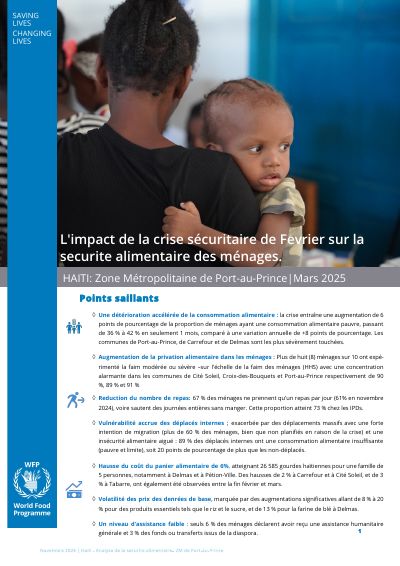
Impact of the February Security Crisis on Household Food Security: Port-au-Prince Metropolitan Area
- The share of households with poor food consumption rose from 36 percent to 42 percent in one month, compared with an annual change of 8 percentage points.
- More than 8 in 10 households experienced moderate or severe hunger on the Household Hunger Scale.
- 67 percent of households eat only one meal a day, compared with 61 percent in November 2024.
- 89 percent of displaced households have insufficient food consumption, 20 percentage points more than non-displaced households.
- The food basket cost rose 6 percent to 26,585 gourdes for a family of five.
- Only 6 percent of households reported receiving general humanitarian assistance.
This bulletin updates a WFP note of November 2024 on the food security impact of the crisis in the Port-au-Prince metropolitan area, after the escalation of armed violence on 14 February 2025. It uses the WFP mVAM and HungerMapLIVE remote phone surveillance system and a retailer price survey. Poor food consumption rose from 36 percent to 42 percent of households in one month. Hunger, reduced meals and coping strategies worsened, with displaced households more affected than non-displaced households. The bulletin also covers market access, the cost of the food basket, school attendance and low levels of humanitarian assistance. It cautions that its indicators should not be compared with IPC classifications.
How to cite
World Food Programme (WFP), 2025, Impact of the February Security Crisis on Household Food Security: Port-au-Prince Metropolitan Area, https://fscluster.org/sites/default/files/2025-04/IMPACTS%20DE%20L%27INSECURITE%20SUR%20LA%20SECURITE%20ALIMENTAIRE%20DANS%20LA%20ZMPAP.pdf
- Rights holder
- World Food Programme (WFP)