
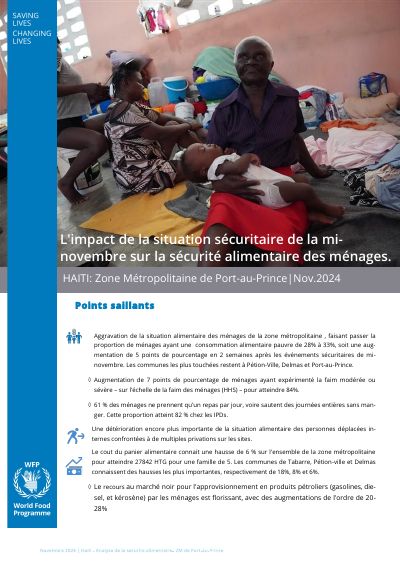
Impact of the Mid-November Security Situation on Household Food Security, Port-au-Prince Metropolitan Area
- The share of households with poor food consumption in the metropolitan area rose from 28 percent to 33 percent in two weeks after the events.
- Households with moderate or severe hunger on the Household Hunger Scale rose by 7 points, from 77 percent to 84 percent.
- 58 percent of displaced households have poor food consumption, 22 points above the metropolitan average of 33 percent.
- The food basket cost rose 6 percent to 27,842 HTG for a household of five.
- Black market prices were 27 percent higher for gasoline, 28 percent for diesel and 20 percent for kerosene compared with pump prices.
- IOM counted 40,965 people forced from their homes as of 23 November 2024.
This brief from the WFP Haiti office assesses how the violence that began on 11 November 2024 affected household food security in the Port-au-Prince metropolitan area. It compares October data with data collected about two weeks after the events, using WFP's remote mVAM monitoring system and a market price survey. The share of households with poor food consumption rose from 28 percent to 33 percent, and those with moderate or severe hunger reached 84 percent. Internally displaced people fare worse, with 58 percent showing poor food consumption. The cost of the food basket rose 6 percent to 27,842 HTG for a family of five, and fuel prices on the black market rose well above pump prices. The document describes its methodology and cautions that its indicators should not be compared with IPC classifications.
How to cite
World Food Programme (WFP), 2024, Impact of the Mid-November Security Situation on Household Food Security, Port-au-Prince Metropolitan Area, https://fscluster.org/sites/default/files/2024-12/PAM%20Impact%20situation%20s%C3%A9curitaire%20mi-novembre%20sur%20la%20s%C3%A9curit%C3%A9%20alimentaire%20des%20m%C3%A9nages%20ZMPAP.pdf
- Rights holder
- World Food Programme (WFP)