
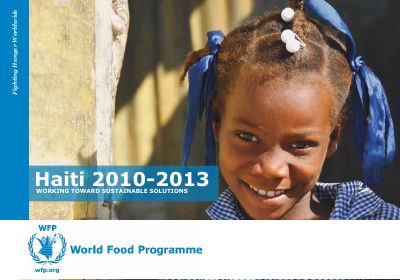
Haiti 2010-2013: Working Toward Sustainable Solutions
- More than 2.5 million people were left in a situation of food insecurity in the days after January 12, 2010.
- Food insecurity prevalence fell from 31 to 27 percent between February and June 2010 in the areas directly affected by the earthquake.
- Rice is a staple food and the country depends on imports for up to 80 percent of it.
- In 2012 a third of all cereals WFP procured for school feeding were rice and corn produced in Haiti.
- The main WFP activities are school feeding, a nutrition program for the most vulnerable, food and cash for work, pre-positioned emergency stocks and capacity transfer to national institutions.
The report opens with a statement from the Haitian side on the food crisis that followed the earthquake and on the Ministry of Agriculture's emergency program. It describes how more than 2.5 million people were left food insecure after January 12, 2010, and how a major food crisis was avoided through remittances, food distribution and partner support. Surveys cited in the report show food insecurity prevalence falling from 31 to 27 percent between February and June 2010.
The report also covers the dependence of Haiti on imported food, rising prices in 2011, and the drought and storms of 2012. It describes the WFP shift toward a school feeding program supported by the Haitian Government and based on locally produced food by 2030.
How to cite
World Food Programme (WFP), 2012, Haiti 2010-2013: Working Toward Sustainable Solutions, accessed via HaitiDocs, https://www.haitidocs.org/doc/wfp-2012-haiti-2010-2013-sustainable-solutions
- Rights holder
- World Food Programme (WFP)