
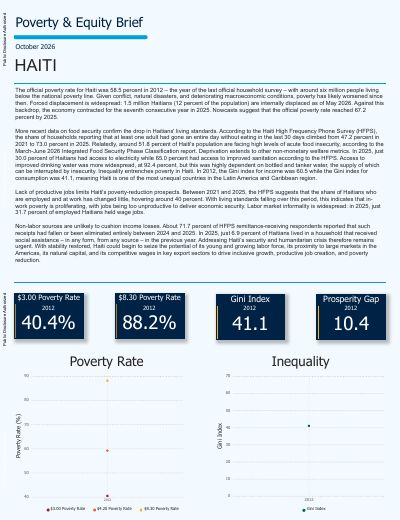
Haiti Poverty and Equity Brief: October 2026
- Official poverty rate 58.5 percent in 2012; nowcast 67.2 percent by 2025.
- Economy contracted for a seventh consecutive year in 2025; 1.5 million people (12 percent) displaced as of May 2026.
- Households with an adult who went a whole day without eating: 47.2 percent (2021) to 73.0 percent (2025).
- About 51.8 percent of the population in high acute food insecurity (March-June 2026 IPC).
- In 2025, 30.0 percent had electricity access and 65.0 percent improved sanitation; only 31.7 percent of employed held wage jobs.
- 7 percent of remittance recipients reported receipts fell or stopped (2024 to 2025); 6.9 percent lived in a household receiving social assistance.
This two-page World Bank brief (October 2026) says the official poverty rate was 58.5 percent in 2012, about six million people below the national poverty line, and that nowcasts built from the 2012 household survey (ECVMAS), economic growth and population growth put it at 67.2 percent by 2025. The economy contracted for the seventh consecutive year in 2025, and 1.5 million Haitians (12 percent of the population) were internally displaced as of May 2026. According to the Haiti High Frequency Phone Survey (HFPS), the share of households in which at least one adult went an entire day without eating in the last 30 days climbed from 47.2 percent in 2021 to 73.0 percent in 2025, and around 51.8 percent of the population faced high levels of acute food insecurity in the March-June 2026 IPC report.
In 2025, 30.0 percent of Haitians had access to electricity and 65.0 percent to improved sanitation; access to improved drinking water was 92.4 percent but depended heavily on bottled and tanker water. The 2012 Gini index was 60.5 for income and 41.1 for consumption. The share of Haitians employed and at work hovered around 40 percent between 2021 and 2025, and only 31.7 percent of employed Haitians held wage jobs in 2025.
About 71.7 percent of remittance-receiving HFPS respondents said receipts had fallen or stopped between 2024 and 2025, and 6.9 percent of Haitians lived in a household that received social assistance in the previous year. The tables give 2012 poverty at the national line (6,019.2 thousand people, 58.5 percent), the $3.00 line (40.4 percent), the $4.20 line (59.2 percent) and the $8.30 line (88.2 percent), a multidimensional poverty measure of 53.2 percent, and rates by group (urban 20.4 percent, rural 58.7 percent at the $3.00 line). Poverty is measured with the cost-of-basic-needs method on the 2012 ECVMAS, and the data are harmonized through SEDLAC.
How to cite
World Bank, Haiti Poverty and Equity Brief: October 2026, http://documents.worldbank.org/curated/en/099637004212520807
- Rights holder
- World Bank