Full Description
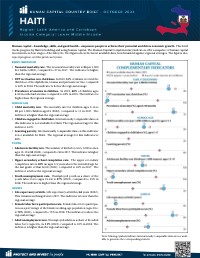
This brief provides an overview of Haiti's human capital development using complementary indicators. These indicators offer a snapshot of investments in human capital at four key stages of life: early childhood, school age, youth, and adulthood. The brief benchmarks Haiti's performance against regional averages and tracks progress over the past five years (2017-2023). Indicators include neonatal mortality rate, vaccination rates, anemia prevalence, child mortality, adolescent fertility, school completion rates, unemployment rates, life expectancy, and labor force participation.
Full Document Text
Extracted text from the original document for search indexing.
¨
Human capital – knowledge, skills, and good health – empowers people to achieve their potential and drives economic growth.This brief
tracks progress by Haiti in building and using human capital. The Human Capital Complementary Indicators offer a snapshot of human capital
investments at four stages of the lifecycle. The figures show the latest available data, benchmarked against regional averages. The figures also
report progress over the previous 5 years.
–
EARLY CHILDHOOD
•
Neonatal mortality rate.The neonatal mortality rate is24per 1,000
live births (2022), compared to 27 in 2017. The indicator is higher
than the regional average.
•
DTP vaccination rate, third dose.In 2023,51%of infants received the
third dose of the diphtheria, tetanus and pertussis vaccine, compared
to 64% in 2018. The indicator is below the regional average.
•
Prevalence of anemia in children.In 2019,60%of children ages
6–59 months had anemia, compared to 62% in 2015. The indicator is
higher than the regional average.
SCHOOL AGE
•
Child mortality rate.The mortality rate for children ages 5-14 is
10per 1,000 children aged 5 (2022), compared to 11 in 2017. The
indicator is higher than the regional average.
•
Children engaged in child labor.Internationally comparable data on
this indicator is not available for Haiti. The regional average for this
indicator is 6%.
•
Learning poverty.Internationally comparable data on this indicator
is not available for Haiti. The regional average for this indicator is
58%.
YOUTH
•
Adolescent fertility rate.The number of births for every 1,000 women
ages 15-19 is52(2022), compared to 56 in 2017. The indicator is higher
than the regional average.
•
Upper secondary school completion rate.The upper secondary
completion rate is18%(at ages 3-5 years above the intended age for
the last grade of that level) (2022), compared to 16% in 2017. The
indicator is below the regional average.
•
Youth unemployment rate.Unemployed youth as a share of the
youth labor force (ages 15-24) is37%(2023), compared to 35% in
2018. The indicator is higher than the regional average.
ADULTS
•
Life expectancy at birth.Life expectancy at birth is64years (2022).
This remains unchanged since 2017. The indicator is lower than the
regional average.
•
Female labor force participation rate.Female labor force participa-
tion as a percentage of the female working-age population (ages 25+)
is72%(2023), compared to 75% in 2018. The indicator is above the
regional average.
•
Adult unemployment rate.Unemployed adults as a share of the adult
labor force (ages 25+) is11%(2023), compared to 10% in 2018. The
indicator is higher than the regional average.
Note: Missing symbols indicate internationally comparable data are not avail-
able to generate the corresponding statistic.