Full Document Text
Extracted text from the original document for search indexing.
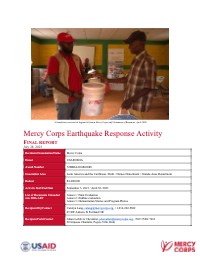
A beneficiary receives his hygiene kit from a Mercy Corps staff (Commune of Beaumont, April 2023)
Mercy Corps Earthquake Response Activity
FINAL REPORT
July 28, 2023
Recipient Organization/Name Mercy Corps
Donor USAID/BHA
Award Number 720BHA21GR00388
Geographic Area Latin America and the Caribbean / Haïti / Nippes Department / Grande-Anse Department
Budget $4,400,000
Activity Start/End Date September 3, 2021 / April 30, 2023
List of Documents Uploaded
into BHA ART
Annex 1: Final Evaluation
Annex 2: Endline evaluation
Annex 3: Humanitarian Stories and Program Photos
Recipient HQ Contact Carolyn Lang, calang@mercycorps.org, +1-914-262-5682
45 SW Ankeny St Portland OR
Recipient Field Contact Johan Lefebvre Chevallier, jchevallier@mercycorps.org, +509 37202 7463
20 Impasse Chanlatte, Peguy-Ville, Haïti
MERCY CORPS 720BHA21GR000388 - Final Report Submitted: July 28. 2023 2
1.0 Overall Performance
Following the 7.2 magnitude earthquake in the southern region of Haiti on August 14, 2021, Mercy Corps
launched an emergency response program to support affected families in meeting their basic needs. Already
facing severe socioeconomic and political challenges, the August 2021 earthquake further exacerbated an
already deteriorating humanitarian situation in Haiti. The earthquake affected more than 800,000 people,
sharply increasing humanitarian needs for thousands of households in the country’s southern region - many
of whom were still recovering from 2016’s Hurricane Matthew. Haiti has also grappled with below-normal
rainfall, tropical storms Elsa and Grace—both in 2021—and the continued fallout from COVID-19.
From September 2, 2021 to April 30, 2023, this program was implemented in 10 communes of Haïti: 7
communes in the Nippes department (L’asile, Fonds-des-negres, Petite Riviere, Anse-a-veau, Arnaud,
Petit-trou, Plaisance) and 3 communes in the Grand Anse department (Beaumont, Pestle, Corail).
The program’s theory of change was as follows: if earthquake-affected households receive multipurpose
cash assistance, WASH support, and livelihood support, then they will be able to recover from the acute
emergency and begin the process of rebuilding their lives.
Mercy Corps’ first actions met target communities’ food security and economic recovery needs.
Mercy Corps distributed unconditional multi-purpose cash assistance (MPCA) to 2,645 households and
cash and voucher assistance to 2,185 smallholder farmer households to procure seeds and farming tools.
1
A total of 4,830 beneficiaries received cash transfers via the LajanCash mobile money platform and have
participated in training sessions on the use of wallet-to-wallet services. As part of its efforts to strengthen
market systems, Mercy Corps also assisted 662 small and medium-sized enterprises (SMEs) with grants
and training in business management.
To address urgent needs related to access to potable water and hygiene items, Mercy Corps
complemented the above interventions with the following actions:
● Rehabilitated two drinking water supply systems, providing access to drinking water for
approximately 1,000 households. Eighteen (18) water points were also identified and assessed for
future rehabilitation, which will be rehabilitated after the program period using private funding;
● Distributed 2,535 NFI kits to households receiving cash and voucher assistance; and
● Conducted direct hygiene promotion to 8,097 individuals and/or heads of households - indirectly
reaching more than 31,000 participants.
At the end of the program, Mercy Corps conducted an evaluation to measure the program's results in
supporting communities to meet their basic needs. Summary results include:
1. Approximately 37% of households reported being able to meet most of their basic needs, an
increase of 17% from the baseline of 20% (target of 26%)
2. Eighty percent (80%) of beneficiaries expressed that this program’s assistance was provided in a
safe, accessible, responsible, and participatory manner
3. Less than half of participants claim to live in a safe and dignified shelter; in contrast, almost all
participant households have adequate access to non-food WASH household items. Participants’
experiences in collecting drinking water and/or water for domestic use vary by geography - with
56% of respondents in Nippes versus 32% in Grand-Anse report using protected springs as water
supply points.
4. Food security results also differ between Nippes and Grand Anse. The Acceptable Food
Consumption Score is higher in the intervention communities of Nippes (77%) than in Grand-
1
Of note, Mercy Corps targeted interventions at the household level. Where indicated, the total for individuals was estimated by multiplying the
average household size in target population (~5) by the number of households reached.
MERCY CORPS 720BHA21GR000388 - Final Report Submitted: July 28. 2023 3
Anse (44%). Of important note, none of the Grand Anse beneficiaries received unconditional
cash, but farmers there received vouchers to buy seeds and farming tools.
5. 97.6% of SME managers declared a net income from their activities.
2.0 Changes and Amendments
The Earthquake Response Activity program was implemented for 20 months, from September 2021 to April
2023. Mercy Corps initially requested $2,000,000 from BHA to assist affected households for six months,
across two intervention sectors - MPCA (three months of unconditional cash transfers) and WASH (hygiene
promotion and distribution of NFI kits). However, based on emerging information about needs in
coordination clusters, and to support long term recovery, Mercy Corps reviewed its original proposal to
shift towards rehabilitation of community-based water systems, and expand upon emergency cash
assistance to emphasize rural livelihood recovery while contributing to overall market resilience. In
September 2021, Mercy Corps was granted a $2,400,000 cost extension for seven additional months,
totalling $4,400,000. The Water Systems sub-sector was added to the WASH sector, and the Economic
Recovery and Market System (ERMS) sector was added to the program.
Driven by contextual challenges and realities, Mercy Corps experienced delays in implementing this
program, which resulted in Mercy Corps requesting approval for two program no cost extensions (NCEs) -
the first to January 2, 2023; and the second and final extension to April 30, 2023. The deteriorating security
situation in the country (see section 5.0) greatly impacted the ability to access target implementation areas
and complete some program activities and was the primary motive behind the first NCE request, and the
second request was driven by the re-emergence of cholera in Haiti in October 2022. New cholera response
activities were added to the program, and the indicator matrix was revised based on a cholera emergency
response plan developed by Mercy Corps in November 2022. This extension enabled Mercy Corps to assist
households dually impacted by the earthquake and the cholera outbreak, and to complement other (private)
funding secured for cholera response activities to compound out response impact.
3.0 Measuring Results
This section summarizes the main achievements by sector against indicators targets, and describes the
activities carried out per subsector.
3.1 Multipurpose Cash Assistance
Sector 1 Multipurpose CASH Assistance
Objective 1
Haitian households receive multipurpose cash assistance to meet their
immediate needs
Dollar Amount Requested $1,627,957
Number of People Targeted 2,000 households (10,000 individuals)
Number of People
Reached
2,645 households (13,225 individuals
2
)
Geographic Area Targeted
Fond-des-Nègres, Asile, Anse-à-Veau, Petite Rivière des Nippes, Petit-Trou-
de-Nippes, Arnaud, Plaisance-du-Sud
2
Purpose 1 activities were targeted at the household level. This estimated individual reach was calculated by multiplying the average household
size (approximately 5) by the number of households reached.
MERCY CORPS 720BHA21GR000388 - Final Report Submitted: July 28. 2023 4
Keywords Cash
Sub Sector 1.1 Multipurpose Cash
Indicator
Baseline Target
Achieved
Semi-
Annual
(April 2022)
Achieved
Annual
(October
2022)
Achieved
Life of
Award
(LOA)
%
achieved
LOA
versus
target
Outcome
Indicator
Percent of households who
report being able to meet the
basic needs of their
households
(all/most/some/none),
according to their priorities
All and
Most:
20.2%
26.3%
All and most:
25.3%
All and most:
35.4%
All and
most: 37%
140.7%
1.1
Total number of households
assisted through multipurpose
cash activities
0 2,000
2,209 total
Female: 1,490
Male: 719
436 total
Female: 287
Male: 149
2,645 total
Female:
1,777
Male: 868
132%
1.2
Percent of beneficiaries
reporting that humanitarian
assistance is delivered in a
safe, accessible, accountable,
and participatory manner
0% 90% 89% 78.6% 80% 89%
1.3
Percent of households living
in safe and dignified shelters
17.9% 80% 24.51% 45.7% 41% 51.25%
1.4
Percent of households
reporting adequate access to
household non-food items
71.5% 80% 77.2 % 99.2% 97% 121.25%
1.5
Percent of households with
poor, borderline, and
acceptable Food
Consumption Score (FCS)
40.9
Accepta
ble
85%
Acceptab
le
N/A N/A
61%
Acceptable
72%
1.6
Total USD value of cash
transferred to beneficiaries
0 $450,000 $401,019 $283,756 $684,775 152%
1.7
Percent of households who
report being able to meet the
basic needs of their
households
(all/most/some/none),
according to their priorities
17.4% 22.6%
All and
most:
25.34%
All and most:
35.5%
All and
most: 37%
164%
Sub-sector 1: Multipurpose Cash
From October 4, 2021 to December 16, 2022, Mercy Corps assisted a total of 2,645 households (of which
1,777 were headed by women) across seven communes of Nippes department. There were three cohorts
of beneficiary households, depending on the time of selection: 891 households (71% female-led) in the
first cohort, 1,318 households (65% female-led) in the second, and 436 households (66% female-led) in
the third.
MERCY CORPS 720BHA21GR000388 - Final Report Submitted: July 28. 2023 5
Needs assessment and planning: Following the earthquake, Mercy Corps deployed an emergency team to
Nippes to conduct a rapid needs assessment, which determined that the informal market and the public
market were functional, and there were no physical barriers to markets that would prevent vulnerable
populations from accessing them or cash-out
points - both critical enabling factors for a cash
response. Mercy Corps then immediately began
organizing meetings with target communities,
local authorities, and community-based
organizations (CBOs) in the seven communes of
Nippes department, to socialize program
objectives and methodology, promote
participatory decision-making related program
implementation, and conduct eligibility surveys to
potential participants.
Beneficiary selection and enrollment: Mercy
Corps selected a household-level vulnerability
scoring methodology, comparable to the
SIMAST’s multidimensional and complex
vulnerability analysis. To identify the most-affected households by the earthquake, surveys were
applied in areas with IPC3+ levels of food insecurity and used weighted scoring criteria weighting food
insecurity and other factors of vulnerability:
Selection Criteria Group Weight Individual Weights
1 Level of damage to household
25%
12.5%
2 Members of household mildly injured, severely injured or
killed during the earthquake
12.5%
3 Household with pregnant women
35%
5.0%
4 Household with nursing women 5.0%
5 Dependency ratio 5.0%
6 Households with people with disabilities and/or elderly
over 65 years
5.0%
7 Female head of household 5.0%
8 Household size 5.0%
9 Household water collection method 5.0%
10 Food consumption score (FCS)
40%
13.33%
11 Expenditure/capita/day: Calculated as the total monthly
expenditure divided by the number of people in the HH,
divided by 30 days
13.33%
12 Reduced Coping Strategy Index (rCSI) 13.33%
Rapid needs and damage assessment (Commune of l’asile, August 16, 2021)
MERCY CORPS 720BHA21GR000388 - Final Report Submitted: July 28. 2023 6
Once the beneficiary identification and selection process were completed, Mercy Corps held sessions with
selected beneficiaries to socialize program activities, explain how to access the mobile money payment
mechanism, and share Mercy Corps’ community accountability reporting mechanism (CARM) to be able
to report questions, comments, or feedback. Selected and trained beneficiaries signed a consent form to
receive cash assistance.
Mercy Corps provided multipurpose cash assistance through Lajan Cash, the mobile money platform of
HaitiPay. HaitiPay, as a financial services provider, has recruited authorized agents as mobile money cash
out points in conjunction with Mercy Corps. Participants were able to access cash on their own schedule.
This experience was largely positive both for Mercy Corps and for the community, and has informed
Mercy Corps’ future practice of using mobile money in rural cash transfer programs. It also increased
participants' financial inclusion via digital means by giving them access to a mobile money account.
Distribution and Post-Distribution Monitoring (PDM):
During MPCA distributions, Mercy Corps staff conducted
random spot checks and interviews with a sample of
beneficiaries at the exit of cash out points to understand
their satisfaction with the modality (more than 90%
expressed satisfaction), the overall program, and how they
would use their assistance. To supplement this participant
experience data, Mercy Corps routinely collected PDM data
from households that received any type of assistance: across
the life of the program, the MEL team carried out nine
PDMs for the MPCA sector for the three cohorts, and two
PDMs for the ERMS sector with farmers and SMEs.
As for the positive impact of the assistance on households, a
PDM conducted in January 2023 showed that 62.6% felt that
the cash transfer received has had a positive impact on their
family. We have seen an improvement in the satisfaction of
basic household needs: 51% of households are able to satisfy
most of their basic needs, and 8% can satisfy all their basic
needs. On the other hand, despite this improvement in
indicators of household living conditions, almost 53% have a poor FCS, which means that households eat
inadequate quantities and quality of food, and their diet is unbalanced.
Market Price Monitoring: In addition to monitoring participant behavior trends, Mercy Corps tracked
macroeconomic trends with the potential to impact the program. Haiti’s Consumer Price Index published
regularly by the Institute of Statistics and Informatics, and information about the Haitian Food Basket
published by the National Council of Food Security illustrated that inflation reached 48.3% in March
2023 (one month before the end of the program), compared with 13.1% in the month of program start.
3.2 WASH
Sector 2 Water Sanitation and Hygiene (WASH)
Objective 2
Haitian households receive emergency WASH assistance and have access to improved
hygiene inputs
Beneficiary cashing out the mobile money under
the observation of a Mercy Corps staff
MERCY CORPS 720BHA21GR000388 - Final Report Submitted: July 28. 2023 7
Dollar
Amount
Requested:
$1,426,059
Number of
People
Targeted:
7,660 households (38,300 individuals)
Number of
People
Reached:
5,801 households (31,301 individuals
3
)
Geographic
Area(s):
Fond-des-Nègres, Asile, Anse-à-Veau, Petite Rivière des Nippes, Petit-Trou-de-Nippes,
Arnaud, Plaisance-du-Sud
Keyword(s): N/A
Sub-Sector
2.1:
WASH Non food Items
Indicator
Baseline Target
Achieved
Semi-
Annual
(April
2022)
Achieved
Annual
(October
2022)
Achieved Life
of Award
(LOA) Total
%
achieved
LOA
versus
target
2.1.1
Percent of households
reporting satisfaction with
the contents of the WASH
NFIs received through
direct distribution (i.e.
kits)
N/A 80% N/A N/A 99% 124%
2.1.2
Percent of households
reporting satisfaction with
the quantity of WASH
NFIs received through
direct distribution (i.e.
kits), vouchers, or cash
N/A 80% N/A N/A 97% 121.25%
2.1.3
Total number of
individuals receiving
WASH NFIs assistance
through all modalities
(without double-counting)
0 2,400 N/A N/A 2,535
4
105%
Sub-Sector
2.2:
Hygiene Promotion
3
WASH interventions were complementary activities to the MPCA and ERMS interventions, so were targeted at the household level. This
estimated individual reach was calculated by multiplying the average household size (approximately 5) by the number of households reached.
4
Per Mercy Corps’ updated ITT submitted as part of its NCE request in November 2023, this figure is estimated by multiplying the number of
households reached (2,535) by the average household size (5 people) - therefore, this intervention indirectly benefited approximately 12,675.
MERCY CORPS 720BHA21GR000388 - Final Report Submitted: July 28. 2023 8
Indicator
Baseline Target
Achieved
Semi-
Annual
(April
2022)
Achieved
Annual
(October
2022)
Achieved Life
of Award
(LOA) Total
%
achieved
LOA
versus
target
2.2.1
Percent of individuals
targeted by the hygiene
promotion activity who
know at least three (3) of
the five (5) critical times
to wash hands
31.9% 80% N/A N/A 47% 58.75%
2.2.2
Number of individuals
receiving direct hygiene
promotion (excluding
mass media campaigns
and without double-
counting)
0
40,000
0 2,296 8,097
5
20%
direct
2.2.3
Percent of households
targeted by the hygiene
promotion activity who
store their drinking water
safely in clean containers
55.1% 80% N/A N/A 73% 91.25%
Sub-Sector
2.3:
Water Supply
Indicator
Baseline Target
Achieved
Semi-
Annual
(April
2022)
Achieved
Annual
(October
2022)
Achieved Life
of Award
(LOA) Total
%
achieved
LOA
versus
target
2.3.1
Number of people directly
utilizing improved water
services provided with
BHA funding
0 3,750 N/A N/A 4,680 124.8%
2.3.2
Number of people gaining
access to basic drinking
water services as a result
of BHA assistance
0 3,750 N/A N/A 4,680 124.8%
2.3.3
Percent of households
targeted by WASH
program that are collecting
all water for drinking,
cooking and hygiene from
improved water sources
N/A 80% N/A N/A 45% 56.25%
5
This figure reflects the total individuals (including 2,296 direct beneficiaries and 5,801 heads of households) who were directly reached. To
estimate the total number of individuals that benefitted from this intervention, the 5,801 heads of household were multiplied by the average
household size of 5, and then added to the 2,296 direct beneficiaries - resulting in a total of approximately 31,301 individuals.
MERCY CORPS 720BHA21GR000388 - Final Report Submitted: July 28. 2023 9
After more than three years with no reported cases of cholera in Haïti, on October 2, 2022, the national
authorities reported two confirmed cases of Vibrio cholerae O1 in the greater Port-au-Prince area. More
than 33,661 suspect cases had been reported by the Ministry of Public Health (MSPP), with 2,439
confirmed cases and 594 deaths.
6
In October 2022, the reappearance of cholera cases in target communes
forced Mercy Corps, in collaboration with BHA, to once again adapt its WASH programming priorities to
meet the emergent response needs of those affected by both the earthquake and cholera outbreaks.
Sub-Sector 2.1: WASH NFIs
Mercy Corps began its WASH needs assessments in Nippes on August 14, 2021. Given the significant
needs in the affected areas, Mercy Corps requested funding from BHA for a focused response on
household WASH NFI kits to meet urgent needs for water filters, soap, water storage containers and
mosquito nets. Mercy Corps proceeded with the purchase of the items, but the blockage of Route
Nationale #2 and complications in the Haitian market prevented the distribution of WASH kits in 2022.
To inform the composition of the kits, in March 2022
Mercy Corps conducted focus group discussions with
recipients of previous NFI kit distributions (funded by
other donors), with the goal of identifying and
documenting lessons learned about participant
preferences. These evaluations illustrated key insights,
such as the fact that participants would rather receive
jerrycans to store water and soap, and that sanitary pads
and children’s toothbrushes were highly desired items.
Initially, only beneficiaries who received cash transfers
would receive WASH kits, but in response to the cholera
outbreak and focus group data from farmers, the need
became clear to increase the number of kits to be
distributed. From February 13 to April 28, 2023, Mercy Corps distributed WASH NFI items to
beneficiaries across all sectors of this program. The kits were transported mainly by sea from Port-au-
Prince to Miragoane, with logistical support from the World Food Programme from December 2022 to
January 2023. 2,535 households received 16 items, listed below:
No Item Description Unit / kit
1 Bath soap Bar (75g) 5
2 Washing soap (laundry) Soap bars / family (200g) 5
3
Toothbrush
Toothbrush - children 2
4 Toothbrush - adult 3
5 Water treatment products Liquid chlorine - 1 small bottle (16 oz) 1
6
Toothpaste
Adult - tube (125-150 ml) 2
7 Children - tube 97.5 ml 1
8 Toilet Paper Rolls/family 4
9 Hygiene pads Packets of 8 heavy flow pads 4
10 Bucket with tap Bucket with tap and lid (for handwashing) 1
11 Jerrycan 20L can for water storage 1
12 Aquatabs Pack of 10 tablets 1
13 Water filter Water treatment item 1
14 Disposable face mask Box of 50 pcs 1
6
Haiti | Earthquake and Cholera Outbreak - Emergency Appeal № MDRHT018 - Operation update #5 - Haiti | ReliefWeb
Beneficiary receiving hygiene kit
MERCY CORPS 720BHA21GR000388 - Final Report Submitted: July 28. 2023 10
15
Plastic Clothes Pins With
Springs
Pack of 12 pcs
1
16 Empty women's toiletry bag 1
In the final program evaluation, most beneficiary households declared that they had adequate access to
non-food household items. These items also complemented the hygiene awareness sessions organized
during the program.
Sub-sector 2.2: Hygiene Promotion
In December 2021, Mercy Corps launched an engagement process to collect feedback from the
community to design hygiene promotion communication materials, focusing on behaviors that prevent the
spread of disease including COVID-19 and later cholera. Mercy Corps community mobilizers met with a
total of 977 households and developed guidance around the following safe hygiene behaviors:
Safe hygiene behaviors Specific activities the behaviors address
Handwashing Washing both hands with soap and water after using latrines, cleaning/
handling children feces, before handling or eating food or water
Safe water collection, transport,
storage and retrieval
Using appropriate and clean containers with lids to collect, transport, and
consume drinking and cooking water
Safe use and maintenance of:
● Household water treatments, technologies, and products
● Communal water infrastructures (alongside management
committees)
Body hygiene Importance and advantages of body hygiene (body, nails, teeth, hair)
Safe food handling and preservation Washing food and dishes, cooking with safe water, eating fresh food, and
covering dishes and left-overs to avoid flies
Vector control Prevention, protection from mosquitoes, flies, rodents, fleas, etc.
Safe laundry Using appropriate and clean containers and soap
Safe dishwashing Washing dishes, covering dishes and left-overs to avoid flies
Slide describing critical times to wash hands
MERCY CORPS 720BHA21GR000388 - Final Report Submitted: July 28. 2023 11
In February 2022, Mercy Corps developed a safe hygiene behavior training slide to promote behaviors
such as hand-washing and actions to reduce the risk of water-borne disease. This training module targets
all program participants, particularly women and men over 18, children (boys and girls aged 6 to 10) and
community leaders. In March 2022, Mercy Corps then selected 35 schools in target areas to be part of
hygiene promotion sessions, and in April Mercy Corps organized a training session for 10 trainers. School
outreach took place in May 2022, during which a total of 2,296 students were reached, including 1,113
girls. The graph below shows the number of students reached by commune and gender. Feedback and
observations from this school outreach and training modules were used to improve training modules for
future community awareness activities.
In response to the cholera outbreak and building upon its hygiene promotion activities described above,
Mercy Corps recruited and trained a total of 103 Community Hygiene Promoters (CHP) to conduct a
hygiene awareness campaign. From November 2022 to February 2023, CHP conducted awareness
sessions on key general hygiene messages and on the fight against cholera in their respective localities.
The core hygiene promotion approach included: demonstration of proper hand washing; participatory
focus groups discussions); and door to door awareness sessions. To carry out these outreach sessions in
different communities, the CHPs used picture boxes and other tools provided by Mercy Corps
Community Mobilisers. A total of 5,801
heads of households participated in
hygiene promotion (including 3,634
women and 2,167 men). To estimate the
total number of individuals reached via
these heads of households, Mercy Corps
multiplied the total number of heads of
households by the average household size
(5 individuals) for an estimated reach of
29,005 participants. When added to the
2,296 students reached in 2022, Mercy
Corps indirectly reached a total of 31,301
individuals through this intervention.
Sub-sector 2.3: Water Systems
In coordination with the Direction Nationale de l'Eau Potable et de l'Assainissement (DINEPA), Mercy
Corps identified two water supply systems in the commune of Fonds-des-Negres that required repair, and
submitted a Bill of Quantity (BOQ) to BHA for approval - the Pascal water system (1st communal
section, Bouzi) and the Nappe water point (4th communal section, Duverger). Mercy Corps then
conducted evaluations with other humanitarian organizations, technical staff from DINEPA, and Mayors
Number of students reached by commune and gender
Workshop with community hygiene promoters (CHP)
MERCY CORPS 720BHA21GR000388 - Final Report Submitted: July 28. 2023 12
and committee leaders of the water systems in target communes around local infrastructure, repair
specifications, and long-term management plans. Mercy Corps also organized community meetings with
the population living near the springs, in order to fully understand their needs. These consultations - such
as a survey of farmers in the ERMS sector in Nippes and Grand Anse - underscored the critical nature of
these interventions: 85.2% of households use rainwater for their needs, only 14.8% have access to a
private or community pipe, and 61.8% of households do not have access to latrines or toilets.
Mercy Corps carried out a detailed technical study of the two drinking water supply systems by collecting
GPS coordinates of catchments, storage tanks, taps, gully crossings and pipe alignments, in order to
calculate water flow rates. The rehabilitation work involved repairing and replacing pipes, rehabilitating
catchments, and rehabilitating water tanks. In both areas, Mercy Corps helped to revitalize the
management structures of the drinking water supply
system by organizing capacity-building training sessions
jointly with DINEPA and equipping them with
management tools.
Pascal water system (Bouzi)
Firstly, Mercy Corps stripped the slab of the catchment,
sedimentation basin, and walls of the protective layer in
order to clean and seal the leaks. Then, Mercy Corps
rebuilt a 25.2-cubic-meter underground tank in
20x20x40-centimeter block masonry with iron rods
inside and a roof slab made of reinforced concrete.
Thirdly, Mercy Corps installed a new polyethylene pipe
line over a length of 4,000 linear meters to supply 6 rehabilitated standpipes.
Nappe water point (Duverger)
Mercy Corps demolished the existing catchment,
excavated the water outlet, and conducted the
masonry work on the catchment box, including a 50-
centimeter wall and a reinforced concrete roof slab.
The exterior of the box was also rendered, plastered
and waxed. Secondly, Mercy Corps rehabilitated the
existing 14.5-cubic-meter capacity tank, stripping the
walls and carrying out the plastering and rendering
work to reinforce the structure. Thirdly, Mercy Corps
installed a new 2,000-meter-long polyethylene
pipeline to supply 3 rehabilitated standpipes.
Following the cholera outbreak, Mercy Corps assessed 18 new water points in the program’s 10 target
communes (illustrated in the map below) in order to improve access to drinking water. These assessments
confirmed that these water points require engineering work to protect the environment of the springs
and/or to rehabilitate the water supply infrastructures, in addition to treatment to prevent the spread of
water-borne diseases. Mercy Corps plans to support these rehabilitation works with its private funds.
MERCY CORPS 720BHA21GR000388 - Final Report Submitted: July 28. 2023 13
3.3 Sector 3 - Economic Recovery and Market Systems
Sector 3 Livelihoods
Objective 3
Small-holder producer associations and small to medium enterprises recover livelihoods
through small grant assistance and business training
Dollar Amount
Requested:
$1,345,984
Number of
People Targeted:
6,000: 33 producer associations (approximately 4,500 farming families) and 300 small and
medium enterprises (approximately 1,500 households)
Number of
People Reached:
5,495: 33 producer associations (2,185 farming families) and 662 small and medium
enterprises (approximately 3,310 households)
Geographic
Area(s):
Petit-Trou-de-Nippes, Arnaud, Plaisance-du-Sud, Pestel, Beaumont, and Corail
Keyword(s):
Cash
Sub-Sector 3.1:
Cash
Indicator
Baseline Target
Achieved
Semi-
Annual
(April
2022)
Achieved
Annual
(October
2022)
Achieved
Life of
Award
(LOA)
Total
% achieved
LOA versus
target
GPS location of water points
MERCY CORPS 720BHA21GR000388 - Final Report Submitted: July 28. 2023 14
3.1.1
Number of
individuals
assisted through
livelihoods
restoration
activities
0 6,000 0 4,950 5,495
7
91.6%
3.1.2
Percent of
beneficiaries
reporting net
income from their
livelihood
59% 80% N/A
Reserved
for
endline
98% 122.5%
3.1.3
Total USD value
of cash transferred
to beneficiaries
0 $250,000 N/A $106,683 $582,603 233%
3.1.4
Percent of
households by
Livelihoods
Coping Strategies
(LCS) phase
(Neutral, Stress,
Crisis,
Emergency)
Neutral:
9%
Stress:
8%
Crisis:
16%
Emergen
cy: 67%
Neutral:
12%
Stress:
25%
Crisis:
16%
Emergen
cy: 47%
N/A
Reserved
for
endline
Neutral:
15%
Stress:
32%
Crisis:
33%
Emergen
cy: 20%
Neutral:
+67%
Stress:+300
%
Crisis: -
106.25%
Emergency
:-70%
Sub Sector 3.1: Livelihoods Restoration
Small-holder producer associations
Identification of Farmer Associations/Building of partnerships: In December 2021, Mercy Corps
organized and hosted community workshops in the target communes (Corail, Beaumont, Pestel, Plaisance
du Sud, Arnaud, Petit-Trou de Nippes) to present to key stakeholders (local authorities, agricultural
associations, small and medium enterprises) its planned response activities and intended outcomes in the
livelihoods sector, as well as the methodology for selecting participants.
Between January 25-31, 2022, Mercy Corps conducted targeting surveys in the departments of Nippes
and Grande-Anse to collect primary data on agricultural associations. Associations were assessed on their
legal status (criteria include: an active bank account in one of the commercial banks such as UNIBANK,
BNC, SOGEBANK, CAPITAL BANK, BUH, etc. and legal recognition by the City Council or the
Ministry of Social Affairs and Labor), the profile of the members (specifically the degree to which they
were impacted by the earthquake), their level of experience in the target area, structure and governance,
7
Mercy Corps reached 5,495 households including 2,185 farmer heads of households, and 3,310 households in SMEs. The estimated total
individual reached can be found by multiplying the number of households reached by the average household size (5) - 14,235.
MERCY CORPS 720BHA21GR000388 - Final Report Submitted: July 28. 2023 15
and commitment to gender equity and protection. From these assessments, Mercy Corps selected 33
farmer associations (see chart).
Working through farmer associations to provide cash transfers to small farmers to sustain their
agricultural season and restore their livelihoods has
been a successful experience for Mercy Corps on
several levels. For example, working jointly with the
associations in the targeting process allowed us to
identify the small farmers most affected by the
earthquake. Another advantage is that the farmers'
associations could describe in advance the needs of
their farmers, which was a strength in the planning
stage. As a result, each association assisted Mercy
Corps in conducting a comprehensive needs analysis
with each targeted farming household to select seeds
and/or tools based on their needs or preferences. In addition, the associations have been instrumental in
mobilizing farmers for planning meetings, and convening them in training centers or distribution sites. In
sum, these structures provided Mercy Corps with the necessary support in planning inputs and
distribution to align with the planting season.
Farm Household Targeting Surveys:
Between April 1-8, 2022, Mercy Corps
organized plot-level assessments for
farmers from agricultural associations.
The weighted criteria for the final
selection of farm households
incorporated a number of different
factors: livelihood coping strategies
index, dependency ratio, poverty
probability index (PPI), and household
assets. Following these assessments, 30
farmers (heads of household) were
selected per association, for a total of
990 farmers, including 576 women and
414 men. Considering that the
cumulative monthly inflation rate
8
from October 2021 to July 2022 reached 23.6% (compared with 8.9%
for the same period last year), and that the needs are significant in the intervention areas, Mercy Corps
assisted an additional number of farm households. As a result, over the duration of the program, Mercy
Corps supported a total of 2,185 farming households, including 1,201 women headed households and 984
men headed households (see chart).
Agricultural Inputs Distribution: From May 16-28, 2022, participating farmers were trained on mobile
payments and how to effectively utilize electronic vouchers (creating and managing their account,
checking balance, purchasing inputs, withdrawing cash, etc.) in preparation for the agricultural input
distributions. Concurrently, a capacity assessment of suppliers was conducted through outreach surveys in
the field prior to distribution. This assessment included business pricing, resupply capacity (time,
quantity, storage capacity), product variety and quality, and other factors. Community Mobilizers
collected seed samples during verification visits to suppliers' stocks to test for germination.
8
https://www.brh.ht/wp-content/uploads/Note-mensuelle-inflation-Juillet-2022.pdf
MERCY CORPS 720BHA21GR000388 - Final Report Submitted: July 28. 2023 16
The distributions of agricultural inputs took place between July 21-27, 2022 in the department of Grande-
Anse, and August 5-6, 2022 for Nippes. Within this period, each participating farm household received a
voucher assistance of $100 USD through their mobile phone. They redeemed these e-vouchers to purchase
preferred agricultural inputs (seeds, farming tools) from accredited local suppliers (see image below).
Among the seeds purchased were black beans, maize, groundnuts, yams, and bananas. As for tools, farmers
purchased the following: hoe, machete, shovel, rake, and pickaxe. Given the significant reliance on
smallholder agriculture as a means of livelihood in the target area, this assistance provided by Mercy Corps
has enabled the farmers to access quality seeds for both short- and long-cycle crops, as well as the
equipment necessary to restore their farms.
Post Distribution Monitoring: A PDM survey was conducted among farmers approximately two months
after the distribution of seeds and agricultural tools in the target departments of Nippes and Grande-Anse.
According to 98% of the recipients, the selection process was fair and impartial. Regarding the process of
planning and organizing the distribution, 76% of recipients were satisfied that they did not use any means
of transportation to collect the seeds because the distribution site was located nearby their place of
residence. As for the quality and quantity of products available from suppliers at the different service points,
the vast majority of farmers—90%—were satisfied with the quality of products offered, while 92% were
satisfied with the quantity of products available. Of the dissatisfied farmers, most said that some products
were out of stock, while others complained that they wanted to buy more seeds to plant their plots, but had
insufficient funds to do so. Almost all farmers (99%) reported feeling safe at the distribution site. They
stated that Mercy Corps staff and associations/suppliers treated them very respectfully and that they felt
comfortable throughout the entire process.
As for the training received on the process of using the mobile phone to perform the transaction, 83% of
participants said they had understood the whole process and on the day of distribution, and 91% of them
had come alone to collect their seeds and farming tools without any concern. As for the food consumption
MERCY CORPS 720BHA21GR000388 - Final Report Submitted: July 28. 2023 17
score (FCS), the distribution of seeds and farming tools was beneficial for the farmers, with an acceptable
FCS of 34.6% and a borderline FCS of 41.4%, with farmers having diversity in their diet over this period.
Small to medium enterprises
SMEs Targeting Surveys: Mercy Corps provided support to a total of 662 SMEs, including 353 female-
owned businesses and 309 male-owned businesses.The selection criteria were as follows: level of
legalization (20%), level of socio-economic impact caused by the earthquake (40%), level of seniority in
the target area (15%), organizational structure/grant utilization (15%), and commitment to gender equity
and protection (10%). The chart below shows the distribution of SMEs by commune and gender:
SMEs Capacity Building / Training Sessions: Mercy Corps' experience in global market recovery has
repeatedly demonstrated the value of business training to provide the skills necessary for resilience.
Mercy Corps conducted training sessions from November-December 2022 for targeted SMEs, focusing
on both core business skills (with an emphasis on accounting, marketing and strategy) as well as
preparedness and early recovery. As a result, training sessions with SMEs in Grande-Anse and Nippes
were conducted on the following modules: Marketing Techniques; Simplified Accounting; and Coaching
on the preparation and development of a contingency plan at the SME level.
Small Grants to support existing SMEs: Mercy Corps distributed small grants to SMEs in early January
2023. Each of the 662 participating SMEs received a one-time $500 grant. These existing SMEs are mostly
businesses that were struggling to fully restart without a financial or capital injection, particularly due to
earthquake damage and constant exposure to recurring shocks (socio-political unrest, inflation, fuel
shortages, epidemic diseases, climate shocks). Of these assisted SMEs, the most commonly identified
ventures are food products stores (53%), followed by the services companies including beauty salons and
barber shops, printing and multiservices (22%), and soft drinks stores/bars (14%):
MERCY CORPS 720BHA21GR000388 - Final Report Submitted: July 28. 2023 18
Post Distribution Monitoring: Following this intervention, a PDM survey was conducted approximately
one month later to assess the impact of the grant on the businesses and their performance. As a result of
the support received, most of the SME owners reported positive changes in a very short period such as
repairs to premises, stock turnover, diversification of products and services, increase in employee
productivity, and growth of customers.
SME owners again reiterated the importance of the business training and coaching: according to PDM
results, 93% of them report being satisfied with the business training modules. They further state that the
training helped them to better manage the operations of their businesses. Coupled with local know-how,
these added skills have led to improvements in their business management. This transfer of knowledge
and skills is essential to building the resilience of SMEs and ensuring a sustainable economic recovery.
Regarding the impact on profit, 87% of small business owners report a net profit on their business after
receiving Mercy Corps financial assistance. The graph below shows the distribution of profits made by
the SMEs during the month of February 2023: monthly profits vary between 550 and 200,000 Haitian
Gourdes
9
(HTG) (3.67-1,333.51 USD) depending on the size of the business. The highest trend (20%) is
observed for businesses with a profit between 25,000 and 40,000 HTG (166.69-266.70 USD).
On the other hand, data collected during the PDM surveys showed that only three (3) categories of
business were able to generate an average monthly profit exceeding 45,000 HTG (equivalent to 300.04
USD). These three categories of business are food stores, bakeries, bars and soft drinks stores (see chart
below). According to this analysis, this implies that these are the businesses with the highest demand in
rural communities. As a result, with the support received through this program, these businesses will have
the capacity to increase their supply (purchase more goods and services to increase their stock or
9
The Gourdes (HTG) is the official currency of Haiti. During the survey period (February 2023), (1) one USD was equivalent to 149.98 HTG.
MERCY CORPS 720BHA21GR000388 - Final Report Submitted: July 28. 2023 19
production capacity) in order to meet consumer demand in their communities. The financial assistance
received will also enable them to cover certain operating expenses (labor, transport, electricity, debt) in
the very short term, and cover other service costs to achieve a positive return on investment. With this
trend, these categories of business may be able to maintain financial viability in the medium and long
term, even after the completion of the program.
4.0 Participation of and Accountability to Affected
Population
Throughout this program, Mercy Corps Haiti has leveraged its CARM system, which has gradually
expanded to include additional channels for community members and partner organizations to provide
information and feedback. During program activities, all community leaders and households were
sensitized on using CARM so they were aware of all means of communications to complain or to report
any suspicious activity, and an accountability focal point was present at these community meetings to
promote the mechanism. Further, CARM was present in all stages of the program implementation, and
hotlines remained operational even during periods of heightened insecurity. Throughout the program,
1,071 complaints were received (57% from women, 43% from men). Three complaint trends are observed
in the program: requests for information, positive feedback and thanks, and requests for program
enrollment.Throughout the program, the most commonly used CARM channel was Mercy Corps’ toll-
free hotline (64% of respondents), followed by sharing CARM feedback in person with the program team
(20%), and Whatsapp (15%). Other channels were SMS messages and Facebook messaging.
5.0 Risk Management
Armed gangs in the Port-au-Prince metropolitan area add an additional layer of difficulty for Haitians and
have compromised humanitarian access, particularly on National Road #2, which provides access to the
departments of the southern peninsula affected by the earthquake, and which is, at the level of Martissant,
is often the site of territorial disputes. Armed gangs have also blocked access to oil terminals in Port-au-
Prince and have significantly impeded fuel distributions throughout the country since October 2021. This
situation has severely affected the functioning of economic life, health services, telecommunications,
public transportation, banking services, and humanitarian and emergency relief operations.
Gang control of much of the capital has also isolated entire neighborhoods and cut off connections
between the capital and the rest of the country. This situation has potential consequences in terms of
MERCY CORPS 720BHA21GR000388 - Final Report Submitted: July 28. 2023 20
protection (including gender-based violence), displacement, food insecurity, malnutrition, and access to
basic services. While the country overall is exposed to multiple vulnerabilities, these are intensified in
areas where crisis factors overlap, such as in the departments of the South, Nippes and Grande-Anse
affected by the earthquake.
To mitigate these risks, Mercy Corps adopted the following measures throughout the life of the program:
● Reinforcing the fuel storage system in Mercy Corps sub-offices
● Closure of offices due to demonstrations, particularly during September 2022.
● Identifying the impact of not being able to be present in the office for all staff, in relation to them
being able to carry out their main responsibilities. If the situation continues, a determination was
made in relation to affected staff, and communicated to all relevant Mercy Corps donors.
● Moving items from Port au Prince to field warehouses by a humanitarian convoy.
● Ensuring that the cash distribution mechanism was able to be distributed electronically, and that
the process of preparing the payment can be managed remotely.
● Training community agents who can support certain activities with limited presence of Mercy
Corps staff during periods of limited access.
● Reviewing security protocols by monitoring the security situation and conducting a Go/No-Go
issued every morning based on a security review for all planned activities.
● Organizing NFI kit distributions by groups of less than 100 participants at a given time.
6.0 Coordination
The implementation of this program was characterized by constant coordination with a variety of actors,
including governmental and humanitarian organizations. In particular, during the first three months of this
emergency response, government institutions held regular meetings with all humanitarian organizations
according to their intervention sectors. Mercy Corps has actively participated in the meetings of the
Departmental Emergency Operation Center (COUD), which is co-managed by the Direction
Départementale de la Protection Civile, under Ministry of the Interior and Territorial Collectivities and
the Vice Delegation at the departmental level. Mercy Corps also remained an active member of the
coordination of organizations working in the food security sector at both the national and departmental
levels. The food security cluster is co-managed by the National Food Security Council (CNSA), which is
part of the Ministry of Agriculture, Natural Resources and Rural Development (MARNDR).
In the WASH sector, Mercy Corps worked closely with DINEPA and the Office régional de l'eau potable
et de l'assainissement (OREPA), through an MOU signed in September 2022 that defined the roles and
responsibilities for the Water Supply sub-sector. For example, the technical specifications of the water
network rehabilitation were reviewed and validated by the Rural Development Unit of DINEPA.
7.0 Lessons Learned
The lessons learned for the life of program include:
● Coordination between the MEL team and the independent CARM system promoted the use
of real-time data for quick course corrections and adaptive management. For example, after
each cash transfer, there was a better understanding of different risks with the process, leading to
adaptations in the following transfers and in Mercy Corps’ Cash Transfer SOP.
● Coordinating with the financial service provider avoided duplication of efforts. Issues or red
flags identified by participants during PDMs were also discovered by the FSP during their remote
monitoring practice (i.e. spot checks) - leading to both the FSP and Mercy Corps working on
adaptations independently. More regular planning and review meetings could have enabled the
identification of common monitoring information and led to a more integrated workflow.
MERCY CORPS 720BHA21GR000388 - Final Report Submitted: July 28. 2023 21
● Mercy Corps has strengthened its system of consultation with community leaders.
Community leaders have been essential in targeting vulnerable households and farmers who have
benefited from cash transfers. Community members also play an important role in informing the
community of Mercy Corps activities and the CARM systems in place.
● Remote MEL options should be identified and approved in Mercy Corps’ country-wide
contingency plans. Despite being planned and budgeted prior to the program start up, during the
implementation period, many MEL activities were limited or made more challenging due to
instability within the areas of intervention. Remote MEL would have been a vital approach for
business continuity in a changing operational environment
● Ensure that specific access mechanisms are in place for people with reduced mobility at kit
and cash distribution sites. This may include access ramps, priority queuing, and staff assistance
to make the process easier. If possible, the idea of organizing home distributions for people with
reduced mobility and who are unable to get to distribution points should be explored.
8.0 Transition Plan/ Exit Strategy
The latest Integrated Food Security Phase Classification (IPC
10
) covering the period from September 2022
to February 2023 indicates that nearly half of Haiti's population, or 4.7 million people, are acutely food
insecure (IPC 3+). Nearly 1.8 million people are now in an emergency situation (IPC 4), an increase of
nearly half a million since the previous analysis, and 19,200 people are facing catastrophic hunger (ICP
5), a first in Haiti and the Latin America and Caribbean region. The Haitian context over the past two
years clearly shows that critical gaps in Haiti's humanitarian needs continue to grow in a much more
complex response environment.
To address continued need, Mercy Corps will continue to work in the program's communes to help reduce
cases of food insecurity, which have increased sharply in the last few months of the program. Mercy
Corps is currently implementing a BHA-funded resilience-focused program named RELE until August
2024, which will also integrate risk and disaster management and support for farmers' associations. As
this program does not have a WASH component, and given the presence of cholera cases in the
communities, Mercy Corps will continue to support hygiene promotion and the rehabilitation of new
water points through its own funds until December 2023.
10
IPC_Haiti_Acute_Food_Insecurity_22Sept_23Jun_Snapshot_French.pdf (ipcinfo.org)