Full Document Text
Extracted text from the original document for search indexing.
2025
www.unicef.org/appeals/haiti
©UNICEF/UNI557556/Erol
Humanitarian
Action for
Children
A mother teaches her daughter how to wash her hands after a handwashing training session organized by local partner ORRAH in
collaboration with UNICEF, in Port-au-Prince, in April 2024.
Haiti
HIGHLIGHTS
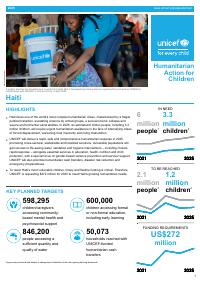
IN NEED
Haiti faces one of the world's most complex humanitarian crises, characterized by a fragile
political transition, escalating violence by armed groups, a socioeconomic collapse and
severe environmental vulnerabilities. In 2025, an estimated 6 million people, including 3.3
million children, will require urgent humanitarian assistance in the face of intensifying crises
of forced displacement, worsening food insecurity and rising malnutrition.
UNICEF will deliver a rapid, safe and comprehensive humanitarian response in 2025,
promoting cross-sectoral, sustainable and localized solutions. Vulnerable populations will
gain access to life-saving water, sanitation and hygiene interventions – including cholera
rapid-response – alongside essential services in education, health, nutrition and child
protection, with a special focus on gender-based violence prevention and survivor support.
UNICEF will also prioritize humanitarian cash transfers, disaster risk reduction and
emergency preparedness.
To reach Haiti's most vulnerable children, timely and flexible funding is critical. Therefore,
UNICEF is requesting $272 million for 2025 to meet Haiti's growing humanitarian needs.
6
3.3
million million
people1 children2
2021
2025
TO BE REACHED
2.1
1.2
million million
people3
KEY PLANNED TARGETS
598,295
600,000
children/caregivers
accessing communitybased mental health and
psychosocial support
children accessing formal
or non-formal education,
including early learning
846,200
50,073
people accessing a
sufficient quantity and
quality of water
households reached with
UNICEF-funded
humanitarian cash
transfers
children4
2021
2025
FUNDING REQUIREMENTS
US$272
million
Figures are provisional and subject to change upon finalization of the inter-agency planning documents.
2021
2025
1
�HUMANITARIAN SITUATION AND NEEDS
Haiti continues to face one of the world's most complex humanitarian crises, characterized by
a fragile political transition (with no further elections scheduled until 2026), escalating violence
by armed groups, a socioeconomic collapse and severe environmental risks. Although the
Multinational Security Support mission, authorized by the Security Council to support security
restoration within Haiti, has begun operations, it is only operating at half-capacity as of yearend 2024. Consequently, more than 80 per cent of Port-au-Prince remains under the control
or influence of armed groups, with frequent clashes, forced displacement and significant
protection risks for children, women and marginalized communities.
In 2025, an estimated 6 million people, including 3.3 million children, will require humanitarian
assistance as compounding crises intensify.5 Currently, 703,000 individuals, including more
than 350,000 children, are internally displaced. While many are sheltered by host communities
in the southern departments, most displaced people in Port-au-Prince live in overcrowded,
unsanitary displacements sites.6
Furthermore, armed group presence and control of all national routes continues to hamper
humanitarian access throughout the country, isolating regions from the capital and driving up
operational logistics costs. More than 5 million people face acute food insecurity, with
emergency (Integrated Phase Classification [IPC] Phase 4) and famine (IPC Phase 5) pockets
emerging, particularly among displaced populations.7 Malnutrition has reached emergency
thresholds, with over 125,000 children under age 5 at risk of severe wasting.8
Violence and insecurity have gravely impacted education, disrupting children's learning and
increasing risks of recruitment by armed groups, social exclusion and gender-based violence.
Up to 94 percent of women and girls face heightened risks of gender-based violence,
compounded by limited access to essential social and protection services.9 During the 2023–
2024 school year, 919 schools were affected by violence and insecurity, with nearly half
closing completely, impacting at least 50,000 students.10
SECTOR NEEDS
4.2 million
people in need of
health assistance14
1.2 million
people in need of
nutrition assistance15
1.6 million
children in need of
protective services16
1.5 million
children and teachers
in need of education
support17
3.8 million
people lack access to
safe water18
Despite the efforts of the Haitian government and partners, around 35 per cent of the Haitian
population continues to lack access to safe drinking water.11 By mid-2024, critical WASH
(water, sanitation and hygiene) infrastructure in Ouest Department had become non-functional
due to armed occupation and displacement. A persistent cholera outbreak, exacerbated by a
collapsing health care system, inadequate hygiene practices and a lack of water and
sanitation infrastructure, has resulted in more than 87,000 suspected cases (including 4,861
confirmed cases)since October 2022,12 despite efforts to control the outbreak.13
Urgent needs remain as 1.2 million children and caregivers require nutrition assistance; 1.6
million children need protection services; 3.8 million people require access to safe water; and
1.5 million children and teachers need emergency education assistance.
In addition, Haiti’s high vulnerability to natural disasters including earthquakes, hurricanes,
droughts and floods further intensifies the urgent need for resources. Despite some progress,
investments in disaster preparedness remain insufficient to mitigate future risks effectively.
STORY FROM THE FIELD
@UNICEF/UNI626388/Opota
UNICEF-supported cash transfers in Haiti
help displaced families rebuild their
livelihoods amidst ongoing violence.
Carole Lafon, a mother of twin children,
lived in Mariani, a neighborhood of Portau-Prince, with her husband and their
children. She sold cosmetic products, and
her husband was a police officer. After an
attack by armed groups that forced them
to flee and tragically took her husband's
life, she found refuge in Léogâne. With
the financial support she received from
the cash transfer program of UNICEF, she
is gradually rebuilding her life. The project
aimed to help more than 10,000
vulnerable households in Haiti's IDP sites.
Read more about this story here
Cash transfers boost businesses and hopes in Haiti.
2
�HUMANITARIAN STRATEGY19
In 2025, UNICEF will ensure the continuity and expansion of lifesaving humanitarian response efforts in Haiti, contributing to nexus
and localization strategies that address increasing needs across
sectors. UNICEF will respond to the severity of the complex crises
by reinforcing and tailoring its support to internally displaced
populations, host communities, deportees and other vulnerable
groups affected by armed violence.
In areas specifically impacted by armed violence and within hard-toreach, spontaneously established internal displacement sites,
UNICEF will prioritize humanitarian access, rapid response and
local partnerships. The goal is to deliver emergency services
through WASH centres, health and nutrition support and child
protection mobile teams. Institutions will receive urgent assistance
to support the referral of cases requiring specialized care. Education
access, both formal and non-formal, will continue to be integrated
with protection programming where possible to enhance safety and
stability for children.
UNICEF's health interventions will prioritize maternal-child primary
health care services, including immunization and treatment of acute
watery diarrhoea at UNICEF-supported facilities. Support for the
health system will include bolstering capacities of community health
care workers and networks. In nutrition, UNICEF will work to
strengthen preventive measures, early screening, treatment of
wasting and promotion of optimal nutrition practices.
To protect children from violence, exploitation and family separation,
UNICEF will deliver specialized care, ensuring safe referrals and
case management for victims of armed and other forms of violence,
alongside individualized care plans. Education programming will
foster learning and promote social cohesion through safe learning
spaces, school supplies and psychosocial support.
UNICEF will ensure access to safe drinking water, sanitation and
hygiene through drinking water trucking, household water treatment
and storage, infrastructure rehabilitation, waste management and
hygiene promotion. Efforts to prevent waterborne diseases,
including cholera, will focus on case-area targeted interventions,
WASH 'shield' strategies and risk communication and community
engagement.
In overburdened host communities and areas with limited social
services due to the flight of human capital (i.e., brain drain),
UNICEF will support rapid system strengthening in health care,
education and protection. This includes incentives for teachers,
social workers and health care providers. Humanitarian cash
transfers will also continue to be used to directly support families as
part of UNICEF's ongoing emergency response.
Gender equality and protection from sexual exploitation and abuse
will be mainstreamed throughout UNICEF's response through
awareness campaigns, and there will be clear reporting channels
and reinforced accountability mechanisms.20 Community platforms
and front-line workers will also be mobilized.
Finally, investment in preparedness and anticipatory action across
sectors will remain a priority to protect and empower vulnerable
populations in the face of recurring crises.21
Progress against the latest programme targets is available in the humanitarian situation reports:
https://www.unicef.org/appeals/haiti/situation-reports
This appeal is aligned with the revised Core Commitments for Children in Humanitarian Action, which
are based on global standards and norms for humanitarian action.
2025 PROGRAMME TARGETS
Health (including public health
emergencies)
652,400 children and women accessing primary health
care in UNICEF-supported facilities
223,000 children vaccinated against measles,
supplemental dose
68,500 individuals receiving treatment for
cholera/acute watery diarrhoea in UNICEF-supported
facilities
250 health professionals recruited and deployed in
UNICEF-supported facilities
Nutrition
609,300 children 6-59 months screened for wasting
129,000 children 6-59 months with severe wasting
admitted for treatment
308,717 primary caregivers of children 0-23 months
receiving infant and young child feeding counselling
119,000 pregnant women receiving preventative iron
supplementation
609,260 children 6-59 months receiving vitamin A
supplementation
Child protection, GBViE and PSEA
598,295 children, adolescents and caregivers
accessing community-based mental health and
psychosocial support22
249,800 women, girls and boys accessing genderbased violence risk mitigation, prevention and/or
response interventions
1,535,300 people with safe and accessible channels to
report sexual exploitation and abuse by personnel who
provide assistance to affected populations
400 children who have exited an armed force and
groups provided with protection or reintegration
support
7,237 unaccompanied and separated children
provided with alternative care and/or reunified
2,000 children who have received individual case
management
362,542 Children, youth, parents and community
leaders sensitized on recruitment of children by armed
groups
Education23
600,000 children accessing formal or non-formal
education, including early learning
240,000 children receiving individual learning materials
20,000 teachers and facilitators trained in basic
pedagogy and/or mental health and psychosocial
support
400,000 children accessing mental health and
psychosocial support in their schools/learning
programmes
Water, sanitation and hygiene
846,200 people accessing a sufficient quantity and
quality of water for drinking and domestic needs
169,244 people accessing appropriate sanitation
services
169,244 people reached with critical WASH supplies
Cross-sectoral (HCT, SBC, RCCE and
AAP)
50,073 households reached with UNICEF-funded
humanitarian cash transfers (including for social
protection and other sectors)24
5,625,000 people reached with timely and life-saving
information on how and where to access available
services
281,250 people sharing their concerns and asking
questions through established feedback mechanisms
Programme targets are provisional and subject to change upon finalization of the inter-agency planning
documents.
3
�FUNDING REQUIREMENTS IN 2025
UNICEF urgently requires $272 million to address the critical needs of 2.1 million people in Haiti, including 1.2 million children. In 2025, the
combined effects of Haiti's humanitarian, security and political crises are expected to intensify nationwide. While the Multinational Security
Support mission and international electoral support may pave the way to stabilization, urgent needs remain. UNICEF aims to continue
providing children with emergency access to essential services and strengthen nexus strategies to build the resilience of their families and
communities.
The requested funds will support life-saving interventions, ensuring access to primary health and nutrition services for vulnerable children,
including those suffering from severe wasting. Adequate funding will also enable UNICEF to expand access to safe water and sanitation
and child protection programming, addressing the needs of children and women affected by violence, displacement and repatriation and
children separated from their families.
In addition, funding will enable UNICEF to facilitate safe access and return to education for children currently deprived of this right. Given
Haiti’s volatile crises and emerging hotspots, comprehensive and flexible humanitarian funding is essential to maintain these critical
operations in a high-cost environment.
Without timely and sufficient funding, the consequences will be dire: 223,000 children under age 5 will lack measles vaccinations; 129,000
will remain untreated for severe wasting; 846,200 will lack access to safe water; 598,295 will not receive mental health and psychosocial
support; and 600,000 children will be unable to learn in a safe environment.
15%
OTHER*
23.2%
CHILD
PROTECTION,
GBVIE AND PSEA
12.9%
NUTRITION
Health (including public health
emergencies)
Nutrition
Child protection, GBViE and
PSEA
Education
US$272
million
14.1%
CROSS-SECTORAL
(HCT, SBC, RCCE
AND AAP)
2025 requirements
(US$)
Sector
35,000,000
63,100,00025
38,600,00026
Water, sanitation and hygiene
Cross-sectoral (HCT, SBC,
RCCE and AAP)
56,900,00027
Emergency preparedness
Total
13,500,00029
272,000,000
20.9%
WATER, SANITATION
AND HYGIENE
14.2%
EDUCATION
26,500,000
38,400,00028
*This includes costs from other sectors/interventions : Health (including public health emergencies)
(9.7%), Emergency preparedness (5.0%).
Who to contact for further information:
Geeta Narayan
Representative, Haiti
T +509 3996 4478
gnarayan@unicef.org
Lucia Elmi
Director, Office of Emergency Programmes (EMOPS)
T +12123267448
lelmi@unicef.org
Mandeep O'Brien
Director, Public Partnerships Division (PPD)
T +1 212 326 7118
mobrien@unicef.org
4
�ENDNOTES
1. Based on the preliminary estimate from the 2025 Humanitarian Needs and Response Plan for Haiti in different programmatic sectors, calculated by the
United Nations Office for the Coordination of Humanitarian Affairs (OCHA) and humanitarian partners, including UNICEF. It is worth noting that an adjusted
methodology in the calculation of people in need was utilized by OCHA; it includes more emphasis on severity for populations affected by areas with
humanitarian shocks, mainly armed violence, natural hazards and epidemics as a priority. In other words, the number of people and children in need this year
are also experiencing more severe situations than in previous years.
2. The proposed inter-agency 2025 figures are yet to be finalized regarding the percentage of children, which is pending aggregated data finalization.
Therefore UNICEF is using the same percentage as was used for the 2024 appeal, pending this new data, so we are estimating that children make up 55 per
cent of people in need.
3. UNICEF estimates a total number of people to be reached of 2,064,260. The method of calculation considers 1,209,260 children (in nutrition, with 609,260
children aged 6–59 months receiving vitamin A supplements; and education, with 600,000 children accessing formal or non-formal education); and 855,000
adults (beneficiaries of humanitarian support across sectors who are also actively participating in community engagement activities including behaviour
change, community-led dialogue, demonstrations and community mobilization as mobilizers). Note that the reduction in adults to be reached is due to an
increased focus on severity for the people in need calculations and therefore targets across sectors. An increased focus on life-saving child activities has
resulted in an increase in the number of children to be reached.
4. Based on the single largest sector targets for various age groups under 18 years, namely in nutrition, with 609,260 children aged 6–59 months receiving
vitamin A supplements; and education, with 600,000 children accessing formal or non-formal education.
5. Based on the preliminary estimate for the 2025 Humanitarian Needs Overview for Haiti in different programmatic sectors, calculated by OCHA and
humanitarian partners, including UNICEF.
6. International Organization for Migration (IOM), Haiti: Report on the internal displacement situation in Haiti – Round 8 (September 2024), IOM, Port-auPrince, 8 September 2024, available at <https://dtm.iom.int/reports/haiti-report-internal-displacement-situation-haiti-round-8-september-2024>.
7. Integrated Food Security Phase Classification (IPC), Haiti: Acute Food Insecurity Situation for August 2024 – February 2025 and Projection for March –
June 2025, IPC, 9 September 2024, available at <www.ipcinfo.org/ipc-country-analysis/details-map/en/c/1157971/?iso3=HTI>.
8. Nutrition needs have been calculated using the latest IPC acute food insecurity indicators and extrapolated from the IPC acute malnutrition data (projected
period June – November 2024) and SMART 2023. A SMART survey update is expected for the year 2025, following this year's focus on response
consolidation.
9. United Nations Population Fund, web information, available at <www.unfpa.org/haiti>, accessed October 2024.
10. National Office for Partnership in Education (ONAPÉ, Ministry of Education), Rapport statistique de données de l’Éducation en Situations d’Urgence –
June 2024 (1er avril – 30 juin 2024), available at <https://drive.google.com/file/d/1UTgEUwjrpfUva2AORcJ3uQTJikiz1iFq/view>.
11. WHO/UNICEF Joint Monitoring Programme for Water Supply, Sanitation and Hygiene, Progress on Household Drinking Water, Sanitation and Hygiene
2000–2022: Special focus on gender, UNICEF and World Health Organization (WHO), New York, July 2023.
12. Ministry of Public Health and Population, Cholera National Sitrep, Port-au-Prince, 5 October 2024. Note that 43 per cent of the confimed cases are in
children under the age of 14 years old.
13. UNICEF, the Pan American Health Organization and partners continue to support the Ministry of Public Health and Population across key pillars of the
cholera response: epidemiology, case management, water, sanitation and hygiene (WASH) (including rapid response and shield strategies) and risk
communication and community engagement. Available at https://mspp.gouv.ht/site/downloads/SITREP%20CHOLERA%20de%20la%2040%20SE.pdf
14. This figure represents the preliminary needs of the Health Cluster as submitted for the 2025 Humanitarian Needs Overview. The 10 per cent decrease
compared with last year is due to a methodology focus of health needs in areas affected by humanitarian shocks: armed violence, natural hazards and
epidemics. In previous years, numbers encompassed all country needs.
15. This figure represents the preliminary needs of the Nutrition Cluster as submitted for the 2025 Humanitarian Needs Overview.
16. This figure represents the preliminary needs of the Child Protection Area of Responsibility as submitted for the 2025 Humanitarian Needs Overview; it only
includes the children in need of protective services.
17. This figure represents the preliminary needs of the Education Cluster as submitted for the 2025 Humanitarian Needs Overview; it includes 1,453,568
school-aged children and 20,765 teachers.
18. This figure represents the preliminary needs of the WASH sector as submitted for the 2025 Humanitarian Needs Overview
19. Supporting government coordination, UNICEF continues to co-lead the Education and Nutrition clusters, the Child Protection Area of Responsibility and the
WASH sector.
20. Sexual exploitation and abuse by aid workers harms survivors and erodes community trust, undermining humanitarian efforts. UNICEF collaborates with
United Nations agencies, non-governmental organizations and governments to strengthen prevention and promote a survivor-centred approach to protection
from sexual abuse and exploitation. In evolving emergency situations, effective inter-agency coordination is crucial to integrate protection from sexual abuse
and exploitation into the response, focusing on prevention, risk mitigation, community engagement and accessible reporting. Strengthening community
feedback mechanisms to provide accurate information on services, people's rights and life-saving information will always be a UNICEF priority.
21. UNICEF anticipatory action is aligned with the CERF anticipatory window for cyclones and includes humanitarian cash transfers, WASH kit distribution and
alerts/community mobilization. In addition UNICEF has developed a contingency plan related to a potential increase in violence in the scenarios developed for
the operations of security forces to liberate areas under the control of armed groups. Regarding preparedness, pre-positioning of emergency stocks, including
for hurricane season, capacity building for counterparts and emergency logistics solutions are considered among the strategies.
22. Following a projected increase in mental health and psychosocial support needs in the 2025 Child Protection Area of Responsibility target, UNICEF is
supporting with 60 per cent of the cluster target. This increase in coverage, in addition to an increase in high-cost case management activities under targets for
assistance to unaccompanied and separated children and children formerly associated with armed forces and groups, has resulted in a large increase in
funding requirements for child protection.
23. In 2025, UNICEF is targeting 60 percent of the cluster target of 1 million. The remaining 40 per cent will be addressed by cluster partners and government
entities.
24. The humanitarian cash transfer calculation is based on structural and situational data, such as poverty data, population movements using displacement
tracking tools, and people in IPC Phase 3 or greater. Composite vulnerability indicators were developed to identify response areas and estimate needs.
25. The sector budget includes: 1) $4,605,804 for protection from sexual exploitation and abuse; 2) $24,980,640 for gender-based violence prevention and
response efforts including full-service provision of prevention, risk mitigation and response to survivors of gender-based violence (legal and medical services
plus psychosocial support, estimated at $300 per beneficiary). Twenty per cent of survivors need the full package of services and 80 per cent benefit from
prevention and sensitization sessions only; 3) $10,855,500 for support to unaccompanied and separated children; 4) $17,948,844 for psychosocial support; 5)
$3,600,000 for individual case management including for children who have exited an armed force and groups and 6) $1,087,623 million for sensitization
26. The education budget is costed at $45 per child accessing education, and $15 per individual learning kit; this is in addition to the school kits, including
school and recreational kits, provided on an as-needed basis to schools and teachers.
5
�27. The WASH budget includes $10,782,720 for the cholera response rapid response team/case area targeted intervention response. A 30 per cent increase in
the budget compared with 2024 is due to an increased cost per beneficiary of key activities including access to safe water ($30 per person) and cholera ($40
per person), notably in hard-to-access areas where there are higher providor and implementation costs.
28. The cross-sectoral budget includes costs related to social and behaviour change, risk communication and community engagement and accountability to
affected populations ($19,086,600); gender ($410,000) and humanitarian cash transfers ($18,927,594).
29. This line item includes $2 million for anticipatory action, and $11.5 million for preparedness, including for a contingency plan related to a potential increase
in violence due to operations in armed-group controlled areas, pre-positioning of emergency stocks including for hurricane season, capacity building for
counterparts and emergency logistics solutions.
6
�