Full Document Text
Extracted text from the original document for search indexing.
2023
www.unicef.org/appeals/haiti
UNICEF Haiti/2022/Joseph
Humanitarian
Action for
Children
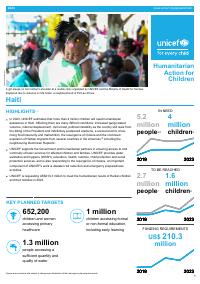
A girl sleeps on her mother’s shoulder at a mobile clinic organized by UNICEF and the Ministry of Health for families
displaced due to violence in Cité Soleil, a neighbourhood of Port-au-Prince.
Haiti
HIGHLIGHTS1,2
IN NEED
In 2023, UNICEF estimates that more than 4 million children will need humanitarian
assistance in Haiti. Affecting them are many difficult conditions: increased gang-related
violence, internal displacement, civil unrest, political instability as the country still reels from
the killing of the President and indefinitely postponed elections, a socioeconomic crisis,
rising food insecurity and malnutrition, the resurgence of cholera and the continued
expulsion of Haitian migrants from several countries in the Americas,3 including the
neighbouring Dominican Republic.
UNICEF supports the Government and humanitarian partners in ensuring access to and
continuity of basic services for affected children and families. UNICEF provides water,
sanitation and hygiene (WASH), education, health, nutrition, child protection and social
protection services, and is also responding to the resurgence of cholera. An important
component of UNICEF's work is disaster risk reduction and emergency preparedness
activities.
UNICEF is requesting US$210.3 million to meet the humanitarian needs of Haitian children
and their families in 2023.
5.2
million
people
4,5
4
million
children
6
2019
2023
TO BE REACHED
2.7
1.6
million million
people
7
children
8
KEY PLANNED TARGETS
652,200
1 million
children and women
accessing primary
healthcare
children accessing formal
or non-formal education,
including early learning
2019
2023
FUNDING REQUIREMENTS
US$ 210.3
1.3 million
million
people accessing a
sufficient quantity and
quality of water
Figures are provisional and subject to change upon finalization of the inter-agency planning documents.
2019
2023
1
�HUMANITARIAN SITUATION AND NEEDS
In Haiti, nearly 59 per cent of the population lives below the poverty line, with limited access to
basic services. Haiti ranks 163 out of 191 countries on the 2021 Human Development
Index,10and is affected by political turmoil; cholera; poverty; institutional and socioeconomic
crises; and natural disasters. Together, these challenges have resulted in persistent
humanitarian needs.
A resurgence of cholera in Haiti was confirmed on 2 October 2022. As of 10 November, 734
cases had been confirmed in four departments.11 The cholera outbreak is layered over major
social unrest and gang-related violence, which has gripped the country since September. At
the same time, severe fuel shortages restrict utilities and the delivery of basic services,
including water and health care. In 2020, 33 per cent of the population was deprived of access
to a basic water service,12 and UNICEF estimates that needs will increase with more people
affected by the current overall deterioration. What's more, the impact of fuel restrictions on
medical facilities and workers prevents some services from being provided, with severe
implications for the management of the cholera outbreak. The fuel restrictions also impact aid
delivery, data collection and transportation of test samples and results.
September 2022 saw a peak in violent protests, which had been building since mid-2021 due
to gang violence and the killing of the President. Civil unrest and gang violence have directly
affected access to education and health services for at least 1.5 million people,13 while more
than 4 million children continue experiencing malnutrition and poor access to education,
protection14 and basic services. The premises of United Nations agencies and nongovernmental organizations have been targets of violent lootings. At least 96,000 people are
internally displaced in Haiti due to gang violence and civil unrest,15 including unaccompanied
children exposed to abuse, exploitation and violence.
A nutrition assessment in Cité Soleil, an impoverished neighbourhood in the Port-au-Prince
metropolitan area, revealed that 20 per cent of children under age 5 are wasted.16 All told, 4.7
million people in Haiti are facing acute hunger.17 Where health services are not closed or
damaged, irregular availability of electricity, water and fuel jeopardizes activities, aggravating
the cholera risks. Around 4 million children aged 5-19 years risk losing learning
opportunities.18 In 2022, 60 per cent of 3,000 schools assessed by UNICEF and the Ministry
of National Education and Vocational Training have been vandalized, and more than 500,000
children have lost access to education.19
Haitians also face natural hazards and the continued expulsion of Haitian migrants from
several countries in the Americas including the neighbouring Dominican Republic.
Furthermore, reconstruction efforts remain limited following the 2021 earthquake in the south,
with more than 250,000 children there still without access to adequate schools9 and several
health centres still in need of reconstruction.
SECTOR NEEDS20
4.5 million
people in need of
health assistance21
778,600
children in need of
nutrition services22
1.2 million
children in need of
protection services23
4 million
children in need of
education support24
3.3 million
people lack access to
safe water25
STORY FROM THE FIELD
Marceline, 12, fled with her mother to
escape fights between armed gangs in
the metropolitan area of Port-au-Prince in
Haiti, to find refuge in Kay Castor.
"We had to flee so that we wouldn't be
victims of the gangs," Marceline says.
"We took detours, so the gunmen couldn't
see us. Otherwise, they would force us to
stay in the area and shoot at us. They
burn houses, kill innocent people."
UNICEF provided children and families
displaced in Kay Castor with psychosocial
support and mobile health clinics, along
with safe drinking water, in cooperation
with local authorities.
UNICEF/Haiti/2022/Seck
Read more about this story here
Marceline, 12, looks at the camera in the Kay Castor temporary displacement site in Port-au-Prince.
UNICEF has provided psychosocial support and mobile health clinics to serve those who are displaced.
2
�HUMANITARIAN STRATEGY26,27,28
In collaboration with the Government, UNICEF will work with
partners to ensure access to and continuity of essential
services while responding to cholera and urban violence and
strengthening disaster risk reduction and preparedness.
Humanitarian cash transfers will be provided to improve
access to basic goods and services.29
In urban areas affected by gang violence, while responding
to the needs of internally displaced people UNICEF will also
invest in UNICEF access and engagement capacities to
better address the needs of those unable to leave including
supporting partners with access opportunities. UNICEF will
focus on mobile teams, distributions of critical supplies and
promoting community engagement, ownership and
resilience.
In response to the cholera outbreak, the case area targeted
interventions (CATI) approach30 will be employed, together
with community sensitization, support to treatment centres
and WASH responses.
UNICEF will support continued access to essential health
care services, immunization and maternal and child health,
including in earthquake-affected areas, and will also
reinforce health supply chain management.
UNICEF will scale up treatment of severe wasting in children
with screening, referral and provision of quality therapeutic
care, including in areas affected by cholera, while promoting
infant and young child feeding practices. UNICEF will
provide nutrition supplies, strengthen end-user monitoring
and information management and will complete a SMART
survey.31
WASH interventions will focus on access to sufficient safe
drinking water, sanitation and hygiene services. Prevention
of waterborne and infectious diseases will be prioritized
through water trucking, household water treatment,
rehabilitation of WASH infrastructure, waste disposal,
hygiene promotion and distribution of hygiene kits. WASH in
schools in the Port-au-Prince metropolitan area will also be
prioritized.
UNICEF will promote safe access and return to learning
through the provision of school supplies, access to multiple
education pathways, psychosocial support and cholera and
disaster risks prevention. Conditional cash grants will be
provided to schools that enroll vulnerable children and
improve educational infrastructure and teachers’ capacity
management, using education as a gateway to strengthen
social cohesion and promote peacebuilding.
Protection of children exposed to violence, including genderbased violence, exploitation and family separation - notably
for internally displaced people and migrants - will be
prioritized. Specialized services and community-based
structures will identify vulnerable children and provide
adequate care and referrals.
UNICEF will continue supporting sectoral and national
coordination, co-leading the WASH, education and nutrition
sectors and the child protection subsector; UNICEF will also
co-lead the cholera response with the Government, the
World Health Organization and the Pan American Health
Organization. Priorities include pre-positioning supplies and
community mobilization to foster social and behavioural
change and information on rights, entitlements and available
services. Gender equality and accountability to affected
populations will be mainstreamed throughout the response.
For the prevention of sexual exploitation and abuse, childfriendly awareness-raising material and reporting channels
will be disseminated.
UNICEF will support the strengthening of existing national
social protection system to appropriately target and swiftly
scale up humanitarian cash transfers to people affected by
urban violence, with a focus on reaching those hardest to
reach in order to improve access to basic goods and
services.
2023 PROGRAMME TARGETS32
Health33
162,400 children vaccinated against measles
652,200 children and women accessing primary
healthcare in UNICEF-supported facilities34
3,600 healthcare workers within health facilities and
communities provided with personal protective
equipment
Nutrition
100,602 children 6-59 months with severe wasting
admitted for treatment35
600,000 children 6-59 months screened for wasting36
467,175 primary caregivers of children 0-23 months
receiving infant and young child feeding counselling
Child protection, GBViE and PSEA37
57,840 women, girls and boys accessing gender-based
violence risk mitigation, prevention and/or response
interventions
1,253,660 people with safe and accessible channels to
report sexual exploitation and abuse by personnel who
provide assistance to affected populations
102,600 children and parents/caregivers accessing
mental health and psychosocial support
6,480 unaccompanied and separated children provided
with alternative care or reunified
Education
1,000,000 children accessing formal or non-formal
education, including early learning38
1,000,000 children receiving individual learning
materials
850 classrooms rehabilitated or reconstructed including
temporary learning centers39
Water, sanitation and hygiene40
1,253,660 people accessing a sufficient quantity and
quality of water for drinking and domestic needs
884,963 people accessing appropriate sanitation
services
884,963 people reached with critical WASH supplies
Social protection
27,200 households reached with UNICEF-funded
humanitarian cash transfers41
Cross-sectoral (SBC, RCCE and AAP)42
2,000,000 people reached through messaging on
prevention and access to services43
24,100 people sharing their concerns and asking
questions through established feedback mechanisms44
Cholera45
1,440,000 people assisted with cholera kits through
rapid response teams benefitting from "cordon sanitaire"
and community response
9,000 suspected cases detected, referred to a cholera
treatment center or rehydrated in the community
4,000 suspected with cholera and severe wasting are
managed according to the national protocol for the
management of cholera cases in children with acute
malnutrition
Progress against the latest programme targets is available in the humanitarian situation
reports: https://www.unicef.org/appeals/haiti/situation-reports
This appeal is aligned with the revised Core Commitments for Children in Humanitarian
Action, which are based on global standards and norms for humanitarian action.
Programme targets are provisional and subject to change upon finalization of the inter-agency planning
documents.
3
�FUNDING REQUIREMENTS IN 2023
In 2023, UNICEF is requesting US$210.3 million to meet the needs of 2.7 million people in Haiti, including 1.6 million children.
The upsurge in violence and social unrest, the resurgence of cholera and the residual needs of the most vulnerable earthquake-affected
population have led to an increase in humanitarian needs and funding requirements in Haiti compared with 2022. At least US$23.5 million in
additional funding is urgently required to respond to the resurgence of cholera cases.
Full funding of this appeal is critical to enable UNICEF to provide life-saving goods and services to children and vulnerable populations in
the context of insecurity and health, social and economic crises. These resources will allow UNICEF to provide access to increasingly
scarce water and sanitation - including in urban areas - the lack of which has been one of the main causes of the cholera epidemic; mitigate
the effects of continuing degradation of such essential social services as health services and life-saving care for children suffering from
severe wasting; and care for the growing number of children and women who are victims of violence, separated children and those in the
hands of armed groups. Funding will also enable UNICEF to ensure access to formal and informal education and to cover essential
emergency WASH and child protection interventions.
Without sufficient and timely funding, UNICEF will be unable to support life-saving assistance and recovery for Haiti's children and families
in need.
23%
OTHER*
11.2%
CHOLERA
14.3%
EDUCATION
21.1%
WATER, SANITATION
AND HYGIENE
US$210.3
million
2023 requirements
(US$)46
Sector
15.7%
CHILD
PROTECTION,
GBVIE AND PSEA
15.2%
NUTRITION
Health
Nutrition
20,182,94147
31,969,89048
Child protection, GBViE and
PSEA
32,933,52049
Education
Water, sanitation and hygiene
30,000,000
44,473,285
Social protection
Cross-sectoral (HCT, SBC,
RCCE and AAP)
10,797,155
Cholera
Total
16,471,22350
23,500,00051
210,328,014
*This includes costs from other sectors/interventions : Health (9.6%), Cross-sectoral (HCT, SBC,
RCCE and AAP) (7.8%), Social protection (5.1%).
Who to contact for further information:
Bruno Maes
Representative, Haiti
T +509 3624 1777
bmaes@unicef.org
Manuel Fontaine
Director, Office of Emergency Programmes (EMOPS)
T +1 212 326 7163
mfontaine@unicef.org
June Kunugi
Director, Public Partnerships Division (PPD)
T +1 212 326 7118
jkunugi@unicef.org
4
�ENDNOTES
1. COVID-19 remains a Public Health Emergency of International Concern as declared by the World Health Organization in January 2020. On 1 July 2022, UNICEF deactivated its Level 3 Sustained Phase for the global COVID-19 pandemic response. All
activities related to COVID-19 pandemic response, including programme targets and funding requirements, have been shifted into regular development programming and operations. While UNICEF’s Level 3 emergency response phase of the COVID-19
pandemic was deactivated, the organization is continuing to respond to the COVID-19 pandemic and its impact on children, their families and their communities and on the social systems they rely on.
2. UNICEF activated its Corporate Emergency Level 2 Scale-up Procedure for Haiti for the following period: 18 October 2022 to 17 February 2023. UNICEF Emergency Procedures are activated to ensure a timely and effective response to all crises. The
emergency procedures provide a tailored package of mandatory actions and simplifications required for all offices responding to Level 3, Level 2 and Level 1 humanitarian situations.
3. Seck, Ndiaga, "Faces of the returnees: Haitian families expelled from Cuba and the U.S. have faces. Here they are!", online article, UNICEF, 12 October 2021, available at <www.unicef.org/haiti/recits/faces-returnees>.
4. Based on the preliminary estimate for the 2023 Humanitarian Needs Overview for Haiti in different programmatic sectors, calculated by the United Nations Office for the Coordination of Humanitarian Affairs (OCHA) and humanitarian partners, including
UNICEF.
5. UNICEF is committed to needs-based targeting, which means covering the unmet needs of children; and will serve as the provider of last resort where it has cluster coordination responsibilities.
6. Estimated by UNICEF, calculated based on the largest sectoral needs figure for children.
7. Based on the single largest sector targets for different age groups: nutrition (under 5 years old); education (school-aged children aged 5-14 years); and WASH (only the proportion of the targeted population that is 15 years and older).
8. Preliminary estimate. Based on the single largest sector targets for different age groups, namely nutrition and education.
9. Due to the lack of recent data, 250,000 was calculated based on the number of school attendees (in basic education grades 1-9) from SitAn/Cambridge Education, 2019, also taking into consideration the annual increase of the school population. The
hypothesis behind this is that, due to the prevailing insecurity, almost all schools are still closed.
10. United Nations Development Programme (UNDP), Human Development Report 2021-2022: Uncertain Times, Unsettled Lives: Shaping our future in a transforming world, UNDP, New York, 2022, available at
<https://hdr.undp.org/system/files/documents/global-report-document/hdr2021-22pdf_1.pdf>.
11. Including in the capital, Port-au-Prince, which reports the highest concentration of cases.
12. World Health Organization (WHO)/UNICEF, Joint Monitoring Programme for Water Supply, Sanitation and Hygiene, accessed 8 November 2022.
13. UN News, "UN releases $5 million for humanitarian needs triggered by gang violence in Haiti", online article, 19 August 2022, available at <https://news.un.org/en/story/2022/08/1125042>.
14. An analysis of the situation of children enrolled by armed groups will be carried out to guide the identification, care and socio-professional reintegration of these children.
15. International Organization for Migration (IOM), "96,000 Haitians displaced by recent gang violence in capital: IOM report", online article, IOM, Port-au-Prince, 28 October 2022.
16. UNICEF, "Haïti: Des milliers d'enfants risquent de mourir de malnutrition aiguë si des soins thérapeutiques adéquats ne sont pas fournis", press release, Port-au-Prince, 5 August 2022, available at <www.unicef.org/haiti/communiqu%C3%A9s-depresse/ha%C3%AFti-des-milliers-denfants-risquent-de-mourir-de-malnutrition-aigu%C3%AB-si-des#:~:text=A%20ce%20jour%2C%209%20506,quart%20de%20million%20d'habitants>.
17. Of those facing acute hunger, 19,000 people are in Integrated Food Security Phase Classification (IPC) Phase 5, or catastrophic level, in Cité Soleil. Source: IPC, Haiti: Acute food insecurity situation September 2022 - February 2023 and projection
for March - June 2023, IPC, 14 October 2022.
18. OCHA, Situation humanitaire et choléra - Flash Update # 3 (au 11 octobre 2022), OCHA, 12 October 2022, available at <https://reliefweb.int/report/haiti/haiti-situation-humanitaire-et-cholera-flash-update-3-au-11-octobre-2022>.
19. UNICEF, "New upsurge of violence threats the delivery of basic services for thousands of children in Haiti", press release, Port-au-Prince, 24 September 2022, available at <www.unicef.org/haiti/en/press-releases/new-upsurge-violence-threatsdelivery-basic-services-thousands-children-haiti>.
20. All sector needs are preliminary figures, based on the ongoing 2023 Humanitarian Needs Overview/Humanitarian Response Plan process for Haiti.
21. This figure represents the needs of the global health sector. This figure is obtained from the ongoing 2023 Humanitarian Needs Overview/Humanitarian Response Plan process for Haiti (preliminary data). It corresponds to approximately 80 per cent of
the Haitian population concentrated in the most vulnerable departments (Artibonite, Nord and Ouest), plus the three departments affected by the earthquake in 2021.
22. Nutrition sector needs have been reviewed based on evidence that emerged in the first half of 2022, such as the Cité Soleil nutritional assessment in April 2022. However, the 2023 Humanitarian Needs Overview/Humanitarian Response Plan process
is underway and may result in a slightly different number of children in need because all other aggravating factors will be considered.
23. This figure has been calculated in the framework of the sectoral coordination group led by UNICEF, based on the estimated number of children needing psychosocial support and/or at risk or suffering from violence in the areas affected by
humanitarian crisis. This may be subject to change once the 2023 Humanitarian Needs Overview/Humanitarian Response Plan figures are finalized.
24. The number of people in need in the education sector has been reviewed and aligned with preliminary figures of the 2023 Humanitarian Needs Overview/Humanitarian Response Plan.
25. The WASH sector needs have been reviewed within the Humanitarian Needs Overview process by the sectoral coordination team co-led by UNICEF, through a more accurate analysis at the municipality (commune) level, based on the level of
vulnerability of the population. The sector needs figure includes all the population living with a certain level of vulnerability (1 to 5), while the sector target includes only the ones living in a vulnerability level of 3 to 5.
26. UNICEF is committed to supporting the leadership and coordination of humanitarian response through its leadership or co-leadership of cluster coordination for the WASH, Nutrition and Education Clusters and the Child Protection Area of
Responsibility. All cluster coordinators costs are included into sectoral programme budgets.
27. This appeal is aligned with the revised Core Commitments for Children in Humanitarian Action, which are based on global standards and norms for humanitarian action.
28. UNICEF is committed to empowering local responders in humanitarian crises in a variety of ways. The revised Core Commitments made investing in strengthening the capacities of local actors in the humanitarian response a mandatory benchmark
for UNICEF action. A more localized response will improve humanitarian action and is fundamental to achieving better accountability to affected populations.
29. Among the recipients of humanitarian cash transfers, 3,600 households will be supported through an education sector cash transfer programme, where the most vulnerable households will be selected through enrolment of school-aged children
affected by the different emergency situations, including displaced victims of urban gang violence. The estimate is based on a social protection sectoral analysis, considering additional humanitarian cash transfers including, child protection and WASH
sector cash transfers.
30. Use of mixed rapid response teams from health and WASH services to directly address the needs of a suspected case of cholera at the household level, through a “cordon sanitaire” of up to 15 neighbouring households.
31. SMART is a specific survey methodology. See: <https://smartmethodology.org/about-smart/>.
32. The programme targets for 2023 are based on estimates from the 2022 Humanitarian Needs Overview/Humanitarian Response Plan updates and the preliminary cholera flash appeal. The targets are aligned with residual humanitarian needs,
particularly those related to the 2021 earthquake, based on detailed and more accurate reviews conducted by the sectoral coordination groups (co-)led by UNICEF in support of government partners. UNICEF is committed to needs-based targeting, which
means covering the unmet needs of children; and will serve as the provider of last resort where it has cluster coordination responsibilities.
33. The target for the child and maternal health subsector has been agreed within the health sector coordination (led by PAHO and WHO) in the framework of the Humanitarian Needs Overview/Humanitarian Response Plan process (preliminary figures
for 2023). The calculation is based on the sector needs of children under age 5 plus pregnant and breastfeeding women, corresponding to around 40 per cent of the total health sector figure. It also takes into account the anticipated operational capacity of
UNICEF in 2023. To be noted, in addition to three southern departments affected by the 2021 earthquake, the health sector also targets the vulnerable populations in the communes of the metropolitan area prone to urban violence, including internally
displaced people in various sites.
34. The targets for the 2023 Humanitarian Action for Children appeal for Haiti have been increased due to the deteriorating conditions and additional health needs to be addressed in the communes of the metropolitan area prone to urban violence and
cholera. The target includes support to internally displaced people in the various displacement sites and host communities.
35. Nutrition targets have been reviewed based on evidence that emerged in the first half of 2022, such as the Cité Soleil nutritional assessment in April 2022. However, the 2023 Humanitarian Needs Overview/Humanitarian Response Plan process is
underway and final estimates may vary.
36. Based on the performance in the first half of 2022 (when 200,265 children were screened) and in light of the occurrence of several aggravating factors, particularly in the metropolitan area of Port-au-Prince, and in agreement with the Government.
37. Child protection targets are based on needs assessed through the Multi-sector Initial Risk Assessment (MIRA) assessment carried out by REACH through 2022 across the country.
38. This target includes people targeted by UNICEF's education sector earthquake response, responses for internally displaced people and migrants and other humanitarian responses, including cash transfers.
39. Benefiting an average of 50 children per classroom.
40. WASH sectoral targets are heavily impacted by the current growing urban violence. They have been reviewed based on data obtained through additional sectoral needs assessments within the ongoing 2023 Humanitarian Needs
Overview/Humanitarian Response Plan process. The budget has been updated in detail by the sectoral coordination led by UNICEF and the Government and supported by non-governmental organization partners. The budget is based on the sectoral unit
cost of WASH response. Cholera-related needs are still being determined and will be updated based on the evolution of the crisis.
41. Among the recipients of humanitarian cash transfers, 3,600 households will be supported through an education sector cash transfer programme, where the most vulnerable households will be selected through enrolment of school-aged children
affected by the different emergency situations, including displaced victims of urban gang violence. The estimate is based on a social protection sectoral analysis, considering additional humanitarian cash transfers including, child protection and WASH
sector cash transfers.
42. Cross-sectoral target includes accountability to affected populations and social and behavioural change activities and indicators.
43. This target includes all social and behavioural change activities carried out in by different sectors (WASH, child protection, health and nutrition).
44. An accountability to affected populations survey in the field (covering 12 municipalities in the three earthquake-affected departments) is planned before the end of 2023, results will be combined with results from other feedback and accountability
mechanisms established for UNICEF response around the country. Additionally, through the U-Report platform, periodic surveys are being carried out to engage with adolescents and youth on accountability issues.
45. Targets estimated for a 6-month period, to be updated according to the evolution of the crisis. The CATI approach comprises the use of mixed rapid response teams from health and WASH services to directly address the needs of a suspected case of
cholera at household level, through a “cordon sanitaire” of up to 15 neighbouring households. When detected, confirmed cases will be covered by case management activities. UNICEF provides hygiene kits to those who exit the treatment centres.
46. Figures are provisional and subject to change upon finalization of the inter-agency planning documents. Humanitarian needs have been assessed with additional and more detailed information collected in the field and corresponding response
planning. All sectoral budgets include a portion of the operational costs (operations, communications and monitoring and evaluation/reporting).
47. The budget and target for the child and maternal health subsector has been agreed within the health sector coordination (led by PAHO and WHO) in the framework of the Humanitarian Needs Overview/Humanitarian Response Plan process
(preliminary figures for 2023). The calculation is based on the sector needs of children under age 5 plus pregnant and breastfeeding women, corresponding to around 40 per cent of the total health sector figure.
48. The nutrition budget and target have been adjusted to the overall sectoral planning agreed in the framework of the 2023 Humanitarian Needs Overview/Humanitarian Response Plan process. The 2023 budget, compared with 2022, includes additional
additional requirements for the response in the metropolitan area, procurement of supplies for the management of severe wasting and sector coordination.
49. The child protection budget includes: 1) US$1 million for prevention of sexual exploitation and abuse; 2) US$9,037,500 for gender-based violence efforts including full-service provision of prevention, risk mitigation and response to gender-based
violence survivors (legal and medical services plus psychosocial support, estimated at US$300 per beneficiary). Fifty-five per cent of survivors need the full package of services and 45 per cent benefit from prevention and sensitization sessions only.
50. The cross-sectoral budget includes costs related to social and behavioural change, risk communication and community engagement, accountability to affected populations and the Humanitarian Country Team.
51. The cholera budget is based on reaching an average of 100 cases per day with WASH and health services, as well as more than 2 million people with messages, based on UNICEF estimates. This ask includes a proportion of the funding
requirements included in the November 2022 Cholera Flash Appeal.
5
�