Full Document Text
Extracted text from the original document for search indexing.
2021 Revision 1 (August 2021)
www.unicef.org/appeals/haiti
UNICEF Haiti/2021/Rouzier
Humanitarian
Action for
Children
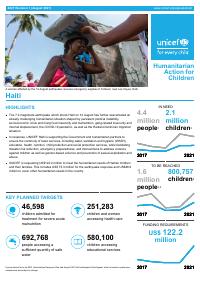
A woman affected by the 14 August earthquake receives emergency supplies in Torbeck, near Les Cayes, Haiti.
Haiti
HIGHLIGHTS
IN NEED
The 7.2 magnitude earthquake which struck Haiti on 14 August has further exacerbated an
already challenging humanitarian situation shaped by persistent political instability,
socioeconomic crisis and rising food insecurity and malnutrition, gang-related insecurity and
internal displacement, the COVID-19 pandemic, as well as the Haitian-Dominican migration
situation.
In response, UNICEF Haiti is supporting the Government and humanitarian partners to
ensure the continuity of basic services, including water, sanitation and hygiene (WASH),
education, health, nutrition, child protection and social protection services, while facilitating
disaster risk reduction, emergency preparedness, and interventions to address violence
against children as well as gender-based violence and prevention of sexual exploitation and
abuse.
UNICEF is requesting US$122.2 million to meet the humanitarian needs of Haitian children
and their families. This includes US$ 73.3 million for the earthquake response and US$48.9
million to cover other humanitarian needs in the country.
4.4
2.1
million million
people
1
children
2
2017
2021
TO BE REACHED
1.6
million
800,757
children
5
people
3,4
KEY PLANNED TARGETS
46,598
251,283
children admitted for
treatment for severe acute
malnutrition
children and women
accessing health care
2017
2021
FUNDING REQUIREMENTS
692,768
580,100
people accessing a
sufficient quantity of safe
water
children accessing
educational services
Figures derived from the 2021 Humanitarian Response Plan and August 2021 Haiti earthquake Flash Appeal, which is based on preliminary
assessments and subject to change.
US$ 122.2
million
2017
2021
�HUMANITARIAN SITUATION AND NEEDS
Humanitarian needs are rapidly growing in the aftermath of the 7.2 magnitude earthquake that
struck southwestern Haiti on 14 August 20216; the three most affected departments include
Sud, Grand’Anse, and Nippes. The earthquake's devastating impact was later compounded
with heavy rains from tropical depression Grace on 17 August.
While assessments are still in progress, official reports indicate more than 2,200 deaths, more
than 12,000 people injured, and 130,000 homes destroyed,7 rendering thousands homeless
and in urgent need of assistance.8 These disasters come as Haiti continues to reel from the 7
July assassination of President Jovenel Moïse and the escalation of gang violence that has
affected 1.5 million people and displaced 19,000 people since June 2021. Despite negotiation
of a humanitarian corridor with armed gangs to access the road connecting the capital Port au
Prince to the South, access constraints remain a key challenge facing humanitarian partners.
The Haitian-Dominican migration dynamic remains a concern due to increased numbers of
Haitian returnees along the border over recent years.9
The combined impact of natural hazard-related disasters, persistent political and
socioeconomic crisis, gang-related insecurity and internal displacement, as well as COVID-19
is being felt by the most vulnerable. According to the Humanitarian Needs Overview (HNO)
2021 released before the earthquake, an estimated 4.4 million people in Haiti10 were food
insecure and an estimated 217,000 children were suffering from global acute malnutrition, an
estimated 2.95 million people, including 1.2 million children and 400,000 pregnant women and
adolescent girls required emergency health care; the earthquake’s impacts are likely to
exacerbate these vulnerabilities.11
SECTOR NEEDS
Nutrition
234,891 children are severely
undernourished17
Health
3.2 million people need health
assistance18
Water, sanitation and hygiene
4.3 million people lack access to basic
WASH services19
With health systems in the three hardest-hit departments facing challenges in keeping pace
with the exponential widening of health needs, maintaining access to life-saving assistance
and the continuation of other essential health services, including maternal and child health, is
a critical response priority.12
Access to safe water for consumption, sanitation services and hygiene promotion remains a
significant need. With thousands displaced and sleeping in the streets and water and
sanitation infrastructure suffering extensive damage, vulnerable populations are becoming
increasingly exposed to the risk of waterborne diseases,13 and acute respiratory infections,
including COVID-19.14
Education
850,000 children at risk of missing their
education20
Over 3 million children have already been unable to attend school for months at a time, due to
political and security challenges over the past two years, as well as COVID-19 related
lockdowns.15 In earthquake affected areas, preliminary assessments led by the Ministry of
Education indicate extensive damage across schools,16 affecting an estimated 100,000
STORY FROM THE FIELD
Cherestale Thérèse, 67, is from in Camp
Perrin, near Les Cayes. The mother of
three and grandmother of five lost almost
everything when the earthquake hit Haiti
on 14 August.
Today, she has come to receive
emergency supplies distributed by WFP,
IOM and UNICEF.
“I'm grateful for the help we received. I just
hope it will continue because we've lost
everything...
Since our house was destroyed, the
tarpaulins we received was very helpful,”
she said.
UNICEF Haiti/2021/ Edler Guillaume
Read more about this story here
Cherestale Thérèse, 67, receives essential emergency supplies in a joinWFP-IOM-UNICEF distribution in
Camp Perrin, near Les Cayes.
�HUMANITARIAN STRATEGY
UNICEF works with partners to ensure the continuity of
essential health, nutrition, WASH, education and child
protection services, and strengthen disaster risk reduction
and emergency preparedness through various modalities
including cash transfers. Following the 14 August
earthquake, greater attention will be placed on providing
immediate life-saving assistance and recovery support to
affected people, while strengthening support to the Internally
Displaced Persons (IDPs) crisis in the metropolitan area.
UNICEF is supporting continued access to essential health
care services, including immunization and maternal and child
health, as well as prevention and treatment of acute
malnutrition. In areas affected by the earthquake, UNICEF is
working to provide essential medicines, medical supplies and
equipment and nutritional commodities, and supporting the
resumption of health care services on damaged or destroyed
health centers, as well as strengthening health supply chain
management.
WASH interventions aim to ensure access to sufficient safe
drinking water for vulnerable communities, provide
emergency latrines, and hygiene services, including critical
hygiene supplies, hand washing facilities, and COVID-19
prevention. The earthquake response is focused on the
rehabilitation/upgrade of damaged WASH facilities together
with hygiene promotion and awareness raising in health
centers and schools to prevent the risks of spread of
infectious diseases including cholera, diarrhoeal diseases,
malaria and COVID-19.
In response to school closures, UNICEF will promote a safe
return to school through provision of school supplies for
school reopening and access to distance learning
programmes where needed. In earthquake affected areas,
UNICEF will prioritize the rapid establishment of temporary
learning spaces and rehabilitate schools to provide a
protective environment for 100,000 boys and girls while
providing mental health and psychosocial support to students
and teachers.
Protection services will be provided to children exposed to
violence, including gender-based violence, exploitation and
family separation. UNICEF will also focus on psychosocial
support, identification, referral and service provision for
vulnerable children, and community and family sensitization
on child protection risks and preventative measures.
To mitigate the negative socio-economic impacts of
humanitarian crises, UNICEF will provide emergency cash
transfers to help the most vulnerable families meet their
immediate needs.
UNICEF supports national authorities and humanitarian
partners to strengthen humanitarian coordination and
disaster preparedness and response. In collaboration with
the Government, UNICEF leads the WASH sector, continues
to co-lead in education, nutrition, child protection sub-sector.
UNICEF maintains stocks of pre-positioned supplies to
respond to humanitarian situations as they arise.
Gender equality, Accountability to Affected Populations
(AAP) and Protection against Sexual Exploitation and Abuse
(PSEA) will be mainstreamed throughout the response.
UNICEF will strengthen reporting systems, survivor
assistance and capacity building of staff and partners.
This appeal is aligned with the revised Core Commitments for Children in Humanitarian
Action, which are based on global standards and norms for humanitarian action.
2021 PROGRAMME TARGETS21
Nutrition
46,598 children aged 6 to 59 months with severe acute
malnutrition admitted for treatment
62,730 primary caregivers of children aged 0 to 23
months receiving infant and young child feeding
counselling
67,310 children aged 6 to 59 months with moderate
acute malnutrition admitted for treatment
176,118 children 6-59 months screened for acute
malnutrition
Health
251,283 children and women accessing primary health
care in UNICEF-supported facilities
35,000 children under 1 year vaccinated against measles
37,000 pregnant women who attended at least two
prenatal visits
3,000 healthcare facility staff and community health
workers trained in infection prevention and control (IPC)
and provided with personal protective equipment (PPE)
Water, sanitation and hygiene
692,768 people accessing a sufficient quantity of safe
water for drinking, cooking and personal hygiene22
692,768 people reached with handwashing behaviour
change programmes
278,563 people accessing and using adequate sanitation
facilities
690,368 people reached with improved capacity to face a
shock through disaster preparedness activities
Child protection, GBViE and PSEA23
57,900 children and caregivers accessing mental health
and psychosocial support
1,552,507 people with access to safe channels to report
sexual exploitation and abuse24
2,650 unaccompanied and separated children reunified
with their primary caregiver or provided with family-based
care/alternative care services
40,000 women, girls and boys accessing gender-based
violence risk mitigation, prevention or response
interventions
Education
580,100 children accessing formal or non-formal
education, including early learning
580,100 children receiving individual learning materials
100,000 school-aged children in earthquake-affected
vulnerable households reached with humanitarian cash
transfers for education25
Social protection and cash transfers
20,000 households reached with humanitarian cash
transfers across sectors26
Cholera
95 per cent of cholera suspected cases (including 'other
acute diarrhoea' cases) identified and responded to
within 48 hours with a complete water, sanitation and
hygiene package
�FUNDING REQUIREMENTS IN 2021
UNICEF has been on the ground delivering life-saving assistance to the most vulnerable, especially children. For this work to continue,
UNICEF requires significant resources. In addition to the US$48.8 million appeal made for 2021, UNICEF is requesting an additional
US$73.3 million to scale up its humanitarian interventions in response to the earthquake in line with Flash Appeal (August 2021), which
outlines funding needs over a 6-month period from August 2021 to February 2022.
UNICEF needs additional resources and support to help prevent further degradation of health services, including routine vaccine coverage,
which is already low, especially in the earthquake affected areas. Funding is urgently required for UNICEF to be able to cover scaled-up
essential emergency WASH and resilience interventions for vulnerable communities; life-saving care to an estimated 46,598 severely
malnourished children; as well as emergency education and distance learning programmes for an estimated 580,100 children at risk of
dropping out of school. Funding for Child protection services is also urgently needed to respond to the needs of children exposed to
violence, including gender-based violence, exploitation and family separation, and to provide cash-based assistance for 20,000 vulnerable
families to help them meet their basic needs over the next few months.
6.9%
CHILD
PROTECTION,
GBVIE AND PSEA
8%
OTHER*
9.2%
NUTRITION
10.8%
HEALTH
Appeal sector
37.6%
EDUCATION
US$122.2
million
27.4%
WASH
Revised 2021 HAC
requirement (US$)
Nutrition
11,200,000
Health
13,220,040
WASH
33,500,000
Child protection, GBViE
and PSEA
8,377,000
Education
46,000,000
Social protection and cash
transfers
4,920,000
Cholera
4,000,000
Cluster coordination
1,000,000
Total
122,217,040
*This includes costs from other sectors/interventions : Social protection and cash transfers (4.0%),
Cholera (3.3%), Cluster coordination (<1%).
Appeal sector
Original 2021 HAC
requirement (US$)
Revised 2021 HAC
requirement (US$)
Funds available
(US$)
Funding gap (US$)
2021 funding gap
(%)
Nutrition
5,200,000
11,200,000
1,020,110
10,179,890
90.9%
Health
4,900,000
13,220,040
1,362,904
11,857,136
89.7%
WASH
12,000,000
33,500,000
4,326,207
29,173,793
87.1%
Child protection,
GBViE and PSEA
2,377,000
8,377,000
842,158
7,534,842
89.9%
Education
15,000,000
46,000,000
6,713,390
39,286,610
85.4%
Social protection and
cash transfers
4,920,000
4,920,000
12,500
4,907,500
99.7%
Cholera
4,000,000
4,000,000
2,332,671
1,667,329
41.7%
500,000
1,000,000
12,500
987,500
98.8%
48,897,000
122,217,040
16,622,440
105,594,600
86.4%
Cluster coordination
Total
Who to contact for further information:
Bruno Maes
Representative, Haiti
T +50936241777
bmaes@unicef.org
Manuel Fontaine
Director, Office of Emergency Programmes (EMOPS)
T +1 212 326 7163
mfontaine@unicef.org
June Kunugi
Director, Public Partnership Division (PPD)
T +1 212 326 7118
jkunugi@unicef.org
�ENDNOTES
1. Prior to the 14 August earthquake, the people in need figure of 4.4 million was derived from the 65 priority communes based mainly on the Integrated Food Security Phase
Classification (IPC) analysis as per the 'Haiti: Humanitarian Needs Overview – Humanitarian Response Plan 2021’', (Haiti HNO/HRP 2021), UNOCHA. Following the earthquake, the
August 2021 Flash Appeal estimated that approximately 650,000 people – 40% of the 1.6 million people living in the affected departments – are in need of emergency humanitarian
assistance. The August 2021 Flash Appeal covers the period from August 2021 to February 2022. Indicators and targets were revised and adjusted in order to include additional
people to be reached in the three most affected departments. Considering that the previous figures also include these three departments, the methodology was adjusted to include
new people reached, avoiding double counting.
2. Ibid. This figure is based on children being 42.5 per cent of the general population, as per demographic data from the 2016-2017 Demographic Health Survey (DHS).
3. The people to be reached figure is derived from the Haiti HNO/HRP 2021. To avoid potential double counting of beneficiaries, this figure includes the following UNICEF targets: the
highest coverage programme target for WASH (adults only); the target for essential health care services; the target for psychosocial support services; the target for formal/informal
education; and nutrition targets. The remaining people in need will be covered by other humanitarian partners (United Nations agencies, non-governmental organizations, donors)
and government institutions. This figure includes 50 per cent women/girls and 50 per cent men/boys, as well as 10 per cent people with disabilities as per demographic data from the
2016-2017 DHS.
4. As per the Inter-Agency Flash appeal (25 August 2021), the UN estimates that at least 650,000 people among the earthquake-affected population are in need of humanitarian
assistance assistance; of which 500,000 people are targeted. It is worth noting that prior the earthquake, a proportion of the communities affected were already part of UNICEF's
targeted population in its ongoing programs including humanitarian action. The revised 'people to be reached ' figure has been adjusted to avoid potential double counting
5. To avoid potential double counting of beneficiaries, the children to be reached figure includes the target for Education (580,100 children), Nutrition (176,118 children), Child
Protection (2,039 children) and social protection (42,500). The remaining people in need targeted by UNICEF, as part of the previous humanitarian situation, was included in the total
figures extracting the proportion that corresponds to the three affected departments in order to avoid overlapping population.
6. The southern departments of Grand'Anse, Nippes and Sud were the worst hit.
7. 59 health facilities have been affected according to the 14 August Haiti earthquake Flash Appeal.
8. According to the 14 August Flash Appeal, more than 610,000 people in the three most affected departments with acute humanitarian needs prior to the earthquake. Of these,
350,000 suffer from extreme and catastrophic levels of needs.
9. According to the IOM Bi-monthly Situation Report no. 40, an estimated 59,500 total cross border movements observed border crossings were reported from in July 2021.
10. This represents nearly 46 per cent of the population (DHS 2016-2017).
11. While assessments were still on-going at the time of writing, UNICEF estimates that 17,891 additional children are likely to be affected by acute malnutrition in the earthquake
affected areas.
12. Based on the estimated population in the three departments, more than 18,600 women are expected to give birth in the next six months and 28,000 are currently pregnant.
Among those women, around 2,800 will likely require caesarean sections or experience complications, with potentially deadly consequences if access to emergency obstetric care is
not made available (14 August Haiti earthquake Flash Appeal, 2021).
13. The cholera epidemic is now coming to an end, with no cases confirmed since February 2019. However, prevention, surveillance and alert response efforts must be maintained,
particularly in earthquake-hit communities, to keep the number of cases at zero and officially declare the end of the epidemic by 2022.
14. As of mid-August 2021, Haiti reports more than 20,500 cumulative COVID-19 cases and more than 570 deaths. However, limited testing and treatment capacities is likely leading
to underreporting. As of 20 August, 24,000 vaccine doses have been administered in Haiti, resulting in only 0.2 per cent of the population being partially immunized.
15. Haiti HNO/HRP 2021. Although all schools reopened by mid-August 2020 with biosafety protocols, due to the deterioration of the political climate and socio-economic conditions,
growing insecurity and the rise of gang-related activities, a significant number of children are at risk of falling behind on their learning and dropping out of school altogether, with
estimates of 500,000 potential dropouts.
16. According to the Flash Appeal, reports from the three most affected departments cite destruction or severe damages in 308 schools.
17. Haiti HNO/HRP 2021 and August 2021 Flash Appeal.
18. Ibid. This corresponds to approximately 23% of the Haitian population. Although the whole of the territory is affected, the majority (65%) of the needs will be concentrated in three
departments: West (1,208,810 people), Artibonite (459,231 people) and North (265,205 people). In addition, the August 2021 Flash Appeal targets 225,000 people, including 28,000
pregnant women and 1,200 people with disabilities.
19. According to the Haiti HNO/HRP 2021, this figure includes 1,885,000 people affected by the food crisis (IPC 3 and 4); 1,425,000 people living in municipalities vulnerable to
disasters that do not have WASH contingency plans; 231,000 people living in a household where one of the members is affected by a water-borne disease; 226,000 people living in a
household in which one of the children under 5 is affected by malnutrition; 40,000 people affected by a hydrometeorological hazard (drought or flood); 15,000 people displaced as a
result of internal conflict. In addition, the August 2021 Flash Appeal targets 500,000 people.
20. Haiti HNO/HRP 2021. In addition, the August 2021 Flash Appeal targets 100,000 boys and girls at risk of missing out on their education.
21. Communication for development, including accountability to affected populations, is integrated into sectoral responses and interventions.
22. In addition to supporting continued access to safe water for people affected by natural disasters, planned activities will focus on community awareness and mobilization and
prevention activities, with the engagement of community and religious leaders, influencers, youth and women's groups to raise awareness on handwashing among vulnerable
communities.
23. Due to space constraints, the following acronyms appear in the appeal: GBViE (gender-based violence in emergencies); PSEA (prevention of sexual exploitation and abuse);
C4D (communication for development); and AAP (accountability to affected populations).
24. This represents 80% of the people to be reached.
25. These cash transfers will support the most vulnerable households with school-aged children to cater for expenses for return to school including school supplies, uniforms, and
other related costs.
26. In line with the national social protection and promotion policy, these multipurpose unconditional cash transfer include four monthly cycles of cash distribution worth US$82 (70
per cent of the monthly improved food basket value per household, as calculated by the Government). The targeting of beneficiary households is based on a set of criteria including
school enrolment of the children, the family's economic vulnerability and the situation of women in the households for the empowerment purpose. For the forthcoming conditional
cash transfer in education, a 3-tier targeting was set (geographic, schooling and economic situation of the households).
�