Full Document Text
Extracted text from the original document for search indexing.
2021
https://www.unicef.org/appeals/haiti
UNICEF Haiti/2020/Belveze
Humanitarian
Action for
Children
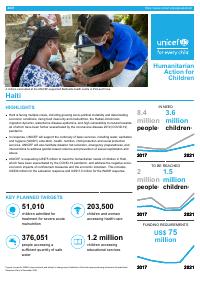
A child is vaccinated at the UNICEF-supported Bethesda health centre in Port-au-Prince.
Haiti
HIGHLIGHTS
IN NEED
Haiti is facing multiple crises, including growing socio-political instability and deteriorating
economic conditions, rising food insecurity and malnutrition, the Haitian-Dominican
migration dynamic, waterborne disease epidemics, and high vulnerability to natural hazards,
all of which have been further exacerbated by the coronavirus disease 2019 (COVID-19)
pandemic.
In response, UNICEF will support the continuity of basic services, including water, sanitation
and hygiene (WASH), education, health, nutrition, child protection and social protection
services. UNICEF will also facilitate disaster risk reduction, emergency preparedness, and
interventions to address gender-based violence and prevention of sexual exploitation and
abuse.
UNICEF is requesting US$75 million to meet the humanitarian needs of children in Haiti,
which have been exacerbated by the COVID-19 pandemic, and address the negative socioeconomic impacts of confinement measures and the economic lockdown. This includes
US$36 million for the education response and US$11.5 million for the WASH response.
8.4
3.6
million million
people
1
children
2017
2
2021
TO BE REACHED
2
1.5
million million
people children
3
4
KEY PLANNED TARGETS
51,010
203,500
children admitted for
treatment for severe acute
malnutrition
children and women
accessing health care
2017
2021
FUNDING REQUIREMENTS
376,051
1.2 million
people accessing a
sufficient quantity of safe
water
children accessing
educational services
Figures (except for WASH) are provisional and subject to change upon finalization of the inter-agency planning documents (Humanitarian
Response Plan) in December 2020.
US$ 75
million
2017
2021
�HUMANITARIAN SITUATION AND NEEDS
Haiti continues to face multiple crises, including growing socio-political instability and
deteriorating economic conditions, rising food insecurity and malnutrition, waterborne disease
epidemics, the Haitian-Dominican migration dynamic, and high vulnerability to natural hazards,
all of which have been further exacerbated by the COVID-19 pandemic.
Deteriorating economic conditions resulting from confinement measures are putting greater
pressure on the livelihoods of vulnerable families, depleting their financial resources8 and
exacerbating existing humanitarian needs. An estimated 4.1 million Haitians (nearly 40 per
cent of the population) are food insecure, and an estimated 168,000 children are suffering
from acute malnutrition, particularly in the metropolitan region of Port-au-Prince.9 An estimated
2.3 million people – including 1 million children and 315,000 pregnant women and adolescent
girls – require emergency health care, which has become difficult to access to due COVID19.7 Access to WASH services remains limited, heightening the risk of waterborne disease
outbreaks.10
In addition to the 60 school days that students lost during the national lockdowns that took
place between September and November 2019,11 4 million children missed out on learning
during the four-month COVID-19 school closures.12 As a result, most schoolchildren have lost
out on an entire year of education.13 Although all schools reopened by mid-August with
sanitary protocols, a significant number of children are at risk of falling behind on their learning
and dropping out of school altogether.14
Limited access to basic social services due to shutdowns and the interruption of routine health
services and psychosocial and recreation activities have increased children's risks of abuse,
exploitation and violence, including gender-based violence. Children in institutions and in
detention may be vulnerable to the rapid spread of the virus if appropriate hygiene and
prevention measures are not established.
The Haitian-Dominican migration dynamic remains a concern, as increased numbers of
Haitian returnees have been observed at the border. An estimated 200,000 crossings have
been reported since mid-March.6 Many of the returning children arrive in Haiti under
precarious conditions, without resources and separated from their families.
The cholera epidemic is now coming to an end, with no cases confirmed since February 2019.
However, prevention, surveillance and alert response efforts must be maintained to keep the
number of cases at zero and officially declare the end of the epidemic by 2022.5
SECTOR NEEDS
Nutrition
168,000 children are severely
undernourished15
Health
2.3 million people need health
assistance16
Water, sanitation and hygiene
1.9 million people lack access to safe
water17
Education
4 million children have missed out on
their education18
STORY FROM THE FIELD
When Raymone heard about COVID-19,
she was afraid. She looked for ways to
protect her three children against the
disease and learned on the radio that
handwashing was key.
“We wanted to put a bucket in the middle
of the village but we couldn't find one. We
looked at the weekly market in vain,” she
says.
Raymone's village of Sevré is difficult to
access, but through its partner, the Haitian
Red Cross, UNICEF has supported the
installation of handwashing stations in
public places to enable communities to
access handwashing facilities to help
prevent the spread of COVID-19.
UNICEF Haiti/2020/Edler
Read more about this story here
Raymone washes her hands in Sevré in southern Haiti at a UNICEF-provided tap bucket for handwashing.
�HUMANITARIAN STRATEGY
In 2021, UNICEF will continue to meet the basic needs of vulnerable
children and communities in Haiti. UNICEF will build on its strong
field presence to support the continuity of essential health, nutrition,
WASH, education and child protection services, and strengthen
disaster risk reduction and emergency preparedness in all sectors.19
In line with the Government of Haiti’s response to COVID-19 and
relevant inter-agency planning, UNICEF will maintain its multisectoral support for risk communication and community
engagement, surveillance and coordination, as well as WASH
prevention and rapid response. These same actions and partners
will support the anticipated phase out of the cholera response plan
in February 2022.
UNICEF will support continued access to essential health care
services, including immunization, prenatal and postnatal care, and
HIV response care. A key focus will be on strengthening the health
system to increase health centre capacities to provide appropriate
care in the most affected and vulnerable communities. National and
local capacities will also be strengthened to manage acute
malnutrition and infant and young child feeding services, and
prevent micronutrient deficiencies.
In education, UNICEF will support the Ministry of Education to
coordinate the response and conduct real-time monitoring, focusing
on ensuring the availability of distance learning programmes, and
access to these programmes among vulnerable children during
present and future school interruptions. Protection assistance will be
provided to children exposed to violence, including gender-based
violence, exploitation and family separation. UNICEF will focus on
strengthening psychosocial response capacities for children in the
urban areas of Port-au-Prince that have been significantly affected
by COVID-19.
To mitigate the negative socio-economic impacts of COVID-19,
UNICEF will strengthen shock-responsive social protection
mechanisms, focusing on emergency cash transfers to help the
most vulnerable families make ends meet. The Government and
sector and inter-agency partners will be supported to strengthen
humanitarian coordination and disaster preparedness and response,
focusing on strengthening the linkages between humanitarian action
and development programmes, long-term system strengthening and
capacity building and mainstreaming climate change adaptation.
UNICEF will also maintain contingency agreements with several
partners, as well as stocks of pre-positioned supplies, to respond to
humanitarian situations as they arise.
Accountability to affected populations and efforts to prevent sexual
exploitation and abuse will be mainstreamed across sectors.
UNICEF will strengthen reporting systems, survivor assistance and
capacity building of staff and partners, focusing on emergency
preparedness.
2021 PROGRAMME TARGETS20
Nutrition
51,010 children aged 6 to 59 months with severe
acute malnutrition admitted for treatment
116,890 children aged 6 to 59 months with
moderate acute malnutrition admitted for
treatment
Health
203,500 children and women accessing primary
health care in UNICEF-supported facilities21
35,000 children under 1 year vaccinated against
measles
37,000 pregnant women who attended at least
two prenatal visits
Water, sanitation and hygiene22
376,051 people accessing a sufficient quantity of
safe water for drinking, cooking and personal
hygiene23
150,432 people accessing appropriately
designed and managed latrines
376,051 people reached with handwashing
behaviour change programmes
376,051 people reached with critical water,
sanitation and hygiene supplies (including
hygiene items) and services24
Child protection, GBViE and PSEA25
28,500 children and caregivers accessing mental
health and psychosocial support
3,080,000 people with access to safe channels
to report sexual exploitation and abuse
1,450 unaccompanied and separated children
reunified with their primary caregiver or provided
with family-based care/alternative care services
60,000 women, girls and boys accessing genderbased violence risk mitigation, prevention or
response interventions
Education
1,200,000 children accessing formal or nonformal education, including early learning
500,000 children receiving individual learning
materials
Social protection and cash transfers
20,000 households reached with humanitarian
cash transfers across sectors26
Cholera
Progress against the 2020 programme targets is available in the
humanitarian situation reports:
https://www.unicef.org/appeals/haiti/situation-reports
This appeal is aligned with the revised Core Commitments for Children in Humanitarian Action, which
are based on global standards and norms for humanitarian action.
95 per cent of cholera suspected cases
(including 'other acute diarrhoea' cases)
identified and responded to within 48 hours with
a complete water, sanitation and hygiene
package
Figures (except for WASH) are provisional and subject to change upon finalization of the inter-agency
needs and planning documents.
�FUNDING REQUIREMENTS IN 2021
In 2021, UNICEF requests US$75 million to meet the humanitarian needs of children in Haiti, which have been significantly exacerbated by
the COVID-19 pandemic.27
The WASH sector requires significant support, with awareness-raising and community mobilization on handwashing taking centre stage in
the fight against COVID-19. There is also an acute need to prevent outbreaks of waterborne diseases through essential emergency WASH
and resilience support for vulnerable communities. With the significant rise in malnutrition rates in 2020, UNICEF also urgently requires
funding to provide life-saving care to an estimated 168,000 severely malnourished children.
Without adequate funding, UNICEF will be unable to support emergency education and distance learning programmes for over 1.2 million
children who dropped out of school due to school closures; prevent the further degradation of vaccine coverage; provide protection
assistance to children exposed to violence, including gender-based violence, exploitation and family separation; and provide cash transfers
to help 20,000 vulnerable families make ends meet.
5.8%
HEALTH
11%
OTHER*
6.2%
CHILD
PROTECTION,
GBVIE AND PSEA
13.3%
NUTRITION
2021 requirements
(US$)
10,000,000
Sector
Nutrition
Health
US$75
million
48.0%
EDUCATION
15.3%
WATER, SANITATION
AND HYGIENE
4,365,000
Water, sanitation and hygiene
Child protection, GBViE and
PSEA
11,468,09528
Education
Social protection and cash
transfers
36,000,00030
4,656,00029
4,000,000
Cholera
Cluster coordination
4,000,000
500,000
Total
74,989,095
*This includes costs from other sectors/interventions : Social protection and cash transfers (5.3%),
Cholera (5.3%), Cluster coordination (<1%).
Who to contact for further information:
Bruno Maes
Representative, Haiti
T +50936241777
bmaes@unicef.org
Manuel Fontaine
Director, Office of Emergency Programmes (EMOPS)
T +1 212 326 7163
mfontaine@unicef.org
Carla Haddad Mardini
Director, Public Partnership Division (PPD)
T +1 212 326 7160
chaddadmardini@unicef.org
�ENDNOTES
1. With the exception of WASH needs, this figure is based on Office for the Coordination of Humanitarian Affairs, 'Haiti: 2019-2020 Humanitarian Response Plan - Revision due to the
COVID-19 Pandemic', OCHA, May 2020. These figures were based on a worst case scenario, taking into account COVID-19. Given that the disease spread to a lesser extent than
anticipated, the number of people in need is expected to decrease in 2021 (acknowledging the possibility of a second wave of the outbreak).
2. Ibid. This figure is based on children being 42.5 per cent of the general population, as per demographic data from the Demographic Health Survey, 2016-2017.
3. To avoid potential double counting of beneficiaries, this figure includes the following targets: the highest coverage programme target for WASH (adults only); the target for essential
health care services; the target for psychosocial support services; the target for formal/informal education; and nutrition targets. This includes 50 per cent women/girls and 50 per
cent men/boys and 399,372 people with disabilities (20 per cent of the population as per national averages). The remaining people in need will be covered by other humanitarian
partners (United Nations agencies, non-governmental organizations, donors) and government institutions. With the exception of WASH, the figures are based on the 2020
Humanitarian Response Plan revised in May, which includes estimated COVID-19 needs that were not as high as anticipated. The final 2021 figures are expected to reflect a
reduction in these figures. This appeal will be adjusted accordingly.
4. To avoid potential double counting of beneficiaries, this figure is based on the following targets: the target for essential health care services; the target for psychosocial support
services; the target for formal/informal education; and the nutrition targets. This figure includes 296,352 children with disabilities (20 per cent of the population as per national
averages). UNICEF is committed to needs-based targeting, which means covering the unmet needs of children; and will serve as the provider of last resort where it has cluster
coordination responsibilities.
5. This is in line with the national plan for elimination of cholera and the applicable World Health Organization (WHO) standards.
6. International Organization for Migration Displacement Tracking Matrix, 'Haiti: COVID-19 border monitoring', IOM DTM, 30 June 2020. These figures take into account all types of
movements (forced, voluntary, daily etc.) observed along the monitored entry points. They do not replace official numbers but rather aim to provide insight on movement trends and
patterns observed at the border.
7. The negative effects of the pandemic on the health care system are already visible. The availability of and access to neonatal and childcare services significantly decreased as the
pandemic took hold, with a 73 per cent decline in the number of monthly visits among children under 5 years, according to the Ministry of Health. Routine vaccination programmes for
polio, measles and other fatal diseases have been interrupted, leading to a 45 per cent decline in coverage from March to April 2020. Rumors against vaccination and other health
services are also leading to a drop in service utilization.
8. This particularly affects the most vulnerable groups, such as the poorest households and women-headed households, which mostly rely on informal labour markets.
9. 'Haiti: 2019-2020 Humanitarian Response Plan - Revision due to the COVID-19 Pandemic'. The metropolitan area has the highest prevalence of severe acute malnutrition (2.5 per
cent) and global acute malnutrition (6.5 per cent). Haiti Ministry of Health, SMART nutrition survey, December 2019.
10. According to 'Haiti: 2019-2020 Humanitarian Response Plan - Revision due to the COVID-19 Pandemic', 60 per cent of households do not have soap or water at home to wash
their hands, 66 per cent are not treating the water before consuming it and 26 per cent lack access to an improved water source (40 per cent in rural areas).
11. The unstable and fragile economic, political and social contexts and recurring civil unrest left the country paralysed for over three months (September to November) and severely
hampered public services and humanitarian access. According to the Ministry of Education, an estimated 3 million students did not have access to school for nearly three months
between September and November 2020.
12. 'Haiti: 2019-2020 Humanitarian Response Plan - Revision due to the COVID-19 Pandemic'.
13. Ibid.
14. The Ministry of Education is still collecting data to provide specific numbers on attendance.
15. 'Haiti: 2019-2020 Humanitarian Response Plan - Revision due to the COVID-19 Pandemic'.
16. Ibid. The effects of the COVID-19 pandemic on health and people's access to health care are already visible. Many activities related to reproductive health and gender-based
violence, including mobile clinics, have been significantly reduced. Routine vaccination programmes for polio, measles and other deadly diseases were interrupted. Surveillance of
diseases such as malaria and diphtheria was also significantly reduced, with attention and resources diverted to the pandemic. Many health and nutrition services, such maternal and
neonatal care, the promotion of infant and young child feeding practices and management of acute malnutrition, were reduced or stopped due to the lack of personal protective
equipment for health professionals. Limited access to family planning can lead to unwanted pregnancies and unsafe abortions, thus endangering the lives of women and girls.
17. This figure has already been updated, based on the 2021 humanitarian response plan elaboration process.
18. 'Haiti: 2019-2020 Humanitarian Response Plan - Revision due to the COVID-19 Pandemic'.
19. UNICEF leads cluster coordination for the WASH, nutrition and education clusters and the child protection area of responsibility.
20. Communication for development, including accountability to affected populations, is integrated into sectoral responses and interventions.
21. UNICEF covers only one part of the sector needs, focusing on the most vulnerable children and women. The remaining caseload is covered by the sector lead (WHO/Pan
American Health Organization (PAHO)), other partners (United Nations agencies and non-governmental organizations) and the Government.
22. This figure has already been updated, based on the 2021 humanitarian response plan elaboration process.
23. In addition to supporting continued access to safe water for people affected by natural disasters, planned activities will focus on community awareness and mobilization and
prevention activities, with the engagement of community and religious leaders, influencers, youth and women's groups to raise awareness on handwashing among vulnerable
communities.
24. This includes designated health care centres and schools.
25. Due to space constraints, the following acronyms appear in the appeal: GBViE (gender-based violence in emergencies); PSEA (prevention of sexual exploitation and abuse);
C4D (communication for development); and AAP (accountability to affected populations).
26. These multipurpose unconditional cash transfer include four monthly cycles of cash distribution worth US$82 (70 per cent of the monthly improved food basket value per
household, as calculated by the Government).
27. Figures (except for the WASH sector) are provisional and subject to change upon finalization of the inter-agency needs and planning documents for 2021.
28. This figure has already been updated, based on the 2021 humanitarian response plan elaboration process.
29. This includes US$3.3 million for child protection interventions; US$1 million for gender-based violence interventions; and US$300,000 for prevention of sexual exploitation and
abuse interventions.
30. This figure is an estimate and is based on the calculation that learning materials and other school fees will cost US$30 per child per year, with the target of 1.2 million children for
the year. This figure is expected to change once the 2021 humanitarian response plan/humanitarian needs overview figures are released. The appeal will be revised accordingly to
align with the humanitarian response plan/humanitarian needs overview assessment findings and targets for the year.
�