Full Document Text
Extracted text from the original document for search indexing.
© UNICEF Haiti/2019/Fanfan
2020
Haiti
www.unicef.org/appeals/haiti
Humanitarian
Action for
Children
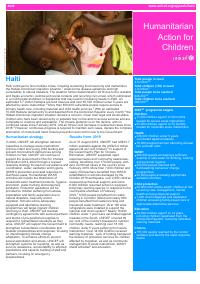
Total people in need
4.6 million10
Total children (<18) in need
1.9 million11
Total people to be reached
648,20012
Total children to be reached
366,00013
Haiti continues to face multiple crises, including worsening food insecurity and malnutrition,
the Haitian-Dominican migration situation,1 water-borne disease epidemics and high
vulnerability to natural disasters. The situation further deteriorated in 2019 due to the unstable
and fragile economic, political and social contexts and recurring civil unrest, which culminated
in a countrywide shutdown in September that may lead to increasing needs in 2020. An
estimated 3.7 million Haitians are food insecure and over 65,500 children under 5 years are
affected by acute malnutrition.2 More than 850,000 vulnerable people require access to
primary health care, including maternal and child health services.3 With an estimated
202014 programme targets
10,000 Haitians denied entry to and deported from the Dominican Republic every month,4 the
Nutrition
Haitian-Dominican migration situation remains a concern. Given their legal and social status,
11,000 children aged 6 to 59 months
children who have been denied entry or expelled may not be able to access services and are
treated for severe acute malnutrition
vulnerable to violence and exploitation. The cholera epidemic is on the decline, with no
55,000 children aged 6 to 59 months
confirmed cases since February 2019, and an 80 per cent decrease in suspected cases since
2018.5 However, continuous progress is required to maintain zero cases, declare the complete treated for moderate acute malnutrition
elimination of cholera and hand cholera prevention and control over to the Government.
Health
336,000 children under 5 years
Humanitarian strategy
Results from 2019
vaccinated against measles
In 2020, UNICEF will strengthen national
As of 31 August 2019, UNICEF had US$10.7
78,000 pregnant women attending at least
capacities to manage acute malnutrition,
million available against the US$23.9 million
two prenatal visits
improve infant and young child feeding and
appeal (44 per cent funded).6 In support of
WASH
prevent micronutrient deficiencies among
the Government's Plan for Cholera
450,000 people accessing a sufficient
children in Haiti. UNICEF will continue to
Elimination, UNICEF supported rapid
quantity of safe water for drinking, cooking
support the Government's Plan for Cholera
response teams and community awarenessand personal hygiene
Elimination 2013–2022 through a revised
raising, benefiting over 170,000 people, with
200,000 people reached with
response strategy focused on surveillance and zero confirmed cases in the country since
handwashing behaviour change
coordination, water, sanitation and hygiene
February 2019. More than 7,000 children and
programmes
(WASH) prevention and rapid response to
nearly 300 teachers benefited from WASH
20,000 people accessing appropriate
diarrhoea cases. Humanitarian WASH
rehabilitation in schools damaged by the
sanitation facilities
activities will include the distribution of
October 2018 earthquake; over 2,900 children
household water treatment products, hygiene received psychosocial support; and some
Child protection
promotion, water trucking and temporary
8,000 children resumed school in equipped
28,000 child victims and/or children at risk
sanitation. Protection assistance will be
temporary learning spaces. In response to the
receiving case management, mental
provided to children suffering from abuse,
countrywide shutdown of February
health and psychosocial support
exploitation and family separation due to
2019,7 8,000 people benefited from water
1,400 unaccompanied and separated
natural disasters, insecurity and/or
trucking in Cornillon (West) and nearly 860
children accessing family-based care or
migration. Schools will be adequately
people benefited from water trucking and
appropriate alternative services
equipped and alternative learning
household water treatment. Over 190 solar
programmes will target migrant children
refrigerators were installed to support the
Education
returning to Haiti. UNICEF will maintain
national cold chain system.8 Nearly 16,600
30,000 children aged 5 to 14 years,
contingency agreements with several partners children under 1 year were vaccinated against
including children repatriated from the
and stocks of pre-positioned supplies to
measles in the South. UNICEF covered 90
Dominican Republic, receiving individual
respond to humanitarian situations as they
per cent of the country's therapeutic nutrition
learning materials
arise. UNICEF will support the Government to commodity needs, reaching over 18,300
strengthen humanitarian coordination and
children under 5 years suffering from acute
Cholera
disaster preparedness and response, focusing malnutrition. Over 34,000 children received
115,300 people reached by the cordon
on mainstreaming climate change
learning materials. Lack of funding hampered
sanitaire provided by the rapid response
adaptation. To enhance efforts to prevent
the delivery of protection services for children
teams
sexual exploitation and abuse, UNICEF will
affected by migration, as well as community
strengthen systems for reporting, as well as
management of acute malnutrition, WASH
survivor assistance, accountability to affected shield activities9 and education.
populations and capacity building of staff and
partners, focusing on emergency
preparedness.
�Sector 2019
targets
Sector results
UNICEF 2019
targets
UNICEF results
6,500
8,526
6,500
8,526
13,000
9,876
13,000
9,870
35,000
37,000
16,568
5,580
NUTRITIONi
Children aged 6 to 59 months treated for severe acute malnutrition
Children aged 6 to 59 months treated for moderate acute
malnutrition
HEALTH
Children under 1 year vaccinated against measlesii
Pregnant women who attended at least two prenatal visitsiii
CHOLERA
People reached by the cordon sanitaire provided by the rapid
response teams
Suspected cholera cases identified and responded to within 48
hours with a complete WASH package
WATER, SANITATION AND HYGIENEvi
People accessing a sufficient quantity of safe water for drinking,
cooking and personal hygiene
People reached with handwashing behaviour change programmes
People accessing appropriate sanitation facilities
CHILD PROTECTION
Unaccompanied and separated children accessing family-based
care or appropriate alternative services
Child victims and/or children at risk receiving case management,
mental health and psychosocial support
People in four at-risk communities reached with key messages on
child protectionviii
EDUCATIONx
Children aged 5 to 14 years, including children repatriated from the
Dominican Republic, receiving individual learning materials
Children aged 5 to 14 years accessing formal education through
rehabilitation and/or equipping of schools
333,000iv
170,175v
333,000
170,175
95%
92%
95%
92%
525,000
17,839
350,000
16,339
225,000
60,000
8,983
8,983
150,000
40,000
7,483
7,483
1,800
298
800
0vii
7,125
2,918
3,300
2,918
10,000
8,012
5,000
7,549ix
87,300
36,818
30,000
34,601
11,520
13,942
5,000
7,929
* Results are through 31 August 2019 unless otherwise noted.
i Pending the finalization of the 2020 Humanitarian Response Plan (HRP)/Humanitarian Needs Overview (HNO), the nutrition sector target is the same as the UNICEF target as UNICEF is the only
agency providing assistance on acute malnutrition and micronutrient deficiencies. While the original HRP/UNICEF target for severe acute malnutrition treatment represented 50 per cent of the
expected caseload, overachievement reflects the growing caseload due to the negative impact of the socio-economic crisis on poor households, and the worsening food insecurity and nutritional
status of children.
ii Vaccinations include measles and rubella, polio, Bacillus Calmette-Guérin, diphtheria, tetanus and pertussis, poliomyelitis and haemophilus influenza.
iii This covers institutional visits only as mobile clinics have stopped since the end of 2017 (Hurricane Matthew).
iv The sector targets for cholera are the same as the UNICEF targets as UNICEF is the lead agency on the cholera rapid response in support of the Government.
v The underperformance on the cholera cordon sanitaire indicator is due to an 80 per cent decrease in the number of suspected cases requiring a rapid response.
vi WASH interventions focused on preparedness as the need for response due to natural disasters was much less than the original planning targets.
vii Since there were no large-scale natural disasters in Haiti in 2019, the need for robust emergency assistance for unaccompanied and separated children has been limited. Though civil society
actors continue to report arbitrary expulsions at the border, underfunding has continued to limit UNICEF's protection services for unaccompanied and separated children at the border. Funding from
the European Union is in the pipeline to support activities at the border, including care for unaccompanied children.
viii This indicator corresponds to the 2019 HRP indicator "At-risk departments reached with key messaging on child protection."
ix The overachievement is due to additional awareness-raising activities in urban settings following increased gang violence, which was not included in the HRP and UNICEF targets.
x Due to an increase in available funding, notably for the 2018 earthquake response, UNICEF was able to reach more beneficiaries than initially planned. Thus, results exceed targets.
Funding requirements
In line with the Haiti HRP 2019–2020, UNICEF is requesting US$18.6
million to meet the humanitarian needs of children in Haiti in 2020.
Funding is urgently needed to treat the rising number of children
suffering from acute malnutrition; maintain support to the Plan for
Cholera Elimination; strengthen routine vaccination and antenatal care
in the southern departments; conduct essential WASH emergency and
resilience work; provide protection and assistance to children being
repatriated or expelled from the Dominican Republic and those
affected by natural disasters; and strengthen emergency
preparedness in all sectors.
Sector
Nutrition
Health
Water, sanitation and hygiene
Child protection
Education
Cholera
Total
2020 requirements (US$)15
3,000,000
2,200,000
4,400,000
2,986,000
2,000,000
4,000,000
18,586,000
1
Dominican Constitutional Court TC168/13 (2013) indicates that those born in the Dominican Republic between 1929 and 2007 to migrant parents in irregular conditions are no longer considered Dominicans and are at risk of statelessness.
This is based on data from the Integrated Food Security Phase Classification (October 2019) and the Haiti Mortality, Morbidity and Utilization Survey (2016–2017).
This figure is provisional and subject to change upon finalization of the inter-agency needs and planning documents. Office for the Coordination of Humanitarian Affairs, ‘Haiti: 2020 Humanitarian Response Plan’ (draft), OCHA, 2019; and
Office for the Coordination of Humanitarian Affairs, 'Haiti: 2020 Humanitarian Needs Overview' (draft), OCHA, 2019.
4
Office for the Protection of Civilians/Haiti Protection Group, ‘National Protection Strategy’, November 2018.
5
Government of Haiti Ministry of Health cholera bulletins, 2018–2019.
6
Available funds include US$7.5 million received against the 2019 appeal and US$3.1 million carried forward from the previous year.
7
From 7 to 15 February, the country was in a general shutdown due to demonstrations, resulting in the closure of shops, markets, schools and health centres, and the suspension of social services.
8
As part of the Cold Chain Equipments Optimized Platform Project, with the financial support of Gavi, the Vaccine Alliance and the World Bank, 721 solar refrigerators will be installed by 2020. The process started in 2017. From January
through August 2019, 193 solar refrigerators were installed, bringing the total number installed to 384 (53 per cent).
9
WASH ‘shield’ activities complement the ‘sword’ (rapid response) through the chlorination of water supply systems, emptying and safe disposal of septic tanks, hygiene promotion activities and the distribution of household water treatment
supplies.
10
This figure is provisional and subject to change upon finalization of the inter-agency needs and planning documents. ‘Haiti: 2020 Humanitarian Response Plan' (draft) and 'Haiti: 2020 Humanitarian Needs Overview' (draft).
11
Ibid.
12
This includes the total children to be reached (366,000 - see endnote #13), plus 57.5 per cent of the WASH target (adult population of 258,800) and 30 per cent of the health target for pregnant women (23,400). Fifty-one per cent of people to
be reached are women/girls (330,582) and 49 per cent are men/boys (317,618); and 15 per cent are people with disabilities (97,230).
13
This includes the largest coverage target for children under 5 years (health: 336,000) and the education target for children aged 5 to 14 years (30,000) to avoid double counting. The number of children to be reached includes 50 per cent girls
and 50 per cent boys (183,000 each); and 15 per cent are children with disabilities (54,900).
14
Programme targets are provisional and subject to change upon finalization of the inter-agency planning documents.
15
Figures are provisional estimates. Financial requirements are subject to change upon finalization of the inter-agency appeals/planning documents.
2
3
Who to contact for
further information:
Maria Luisa Fornara
Representative, Haiti
Tel: +509 3757 4437
Email: mlfornara@unicef.org
Manuel Fontaine
Director, Office of Emergency
Programmes (EMOPS)
Tel: +1 212 326 7163
Email: mfontaine@unicef.org
Carla Haddad Mardini
Director, Public Partnership
Division (PPD)
Tel: +1 212 326 7160
Email: chaddadmardini@unicef.org
�