
Underfunding of Scientific Research and Underperformance of Universities in Haiti: Structural Obstacles to Innovation and Sustainable Development
- Chronic underfunding of research limits Haiti's capacity to produce knowledge and innovate.
- Universities give priority to teaching, give little value to research, and lack equipped laboratories and research centers.
- The authors cite a figure of 0.08 percent of GDP spent on research and development in Haiti.
- Scientific output has grown gradually but remains small compared with Jamaica, Trinidad and Tobago and Grenada.
- Haiti depends heavily on international collaboration, registers few patents and loses scientific skills to emigration.
- The authors call for more research investment, university-industry partnerships and national innovation policies.
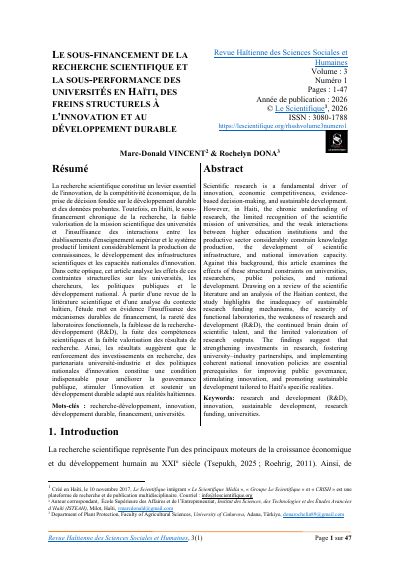
Based on a literature review and an analysis of the Haitian context, the article examines how chronic underfunding of research, the weight of teaching over research in universities and weak links between higher education and the productive sector affect universities, researchers and public policy. It points to missing durable funding mechanisms, few functional laboratories, weak research and development, loss of scientific skills and little use of research results.
The authors cite a figure of 0.08 percent of GDP spent on research and development in Haiti and note that national scientific output has grown gradually but remains small compared with Jamaica, Trinidad and Tobago and Grenada. They conclude that more investment in research, university-industry partnerships and national innovation policies are needed.
How to cite
Le Scientifique, 2026, Underfunding of Scientific Research and Underperformance of Universities in Haiti: Structural Obstacles to Innovation and Sustainable Development, https://lescientifique.org/wp-content/uploads/2026/06/Le-sous-financement-de-la-recherche-scientifique-et-la-sous-performance-des-universites-en-Haiti-des-freins-structurels-a-linnovation-et-au-developpement-durable.pdf
- Rights holder
- Le Scientifique