
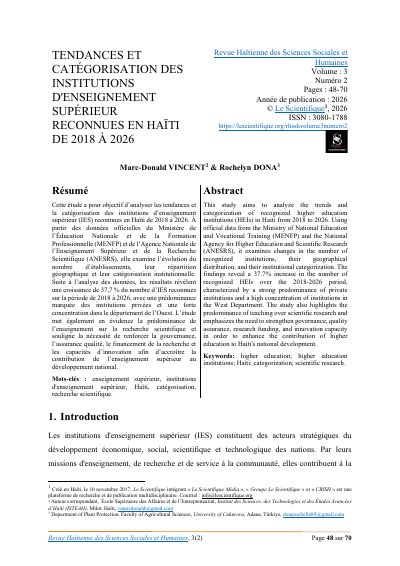
Trends and Categorization of Recognized Higher Education Institutions in Haiti, 2018 to 2026
- Recognized higher education institutions rose from 138 in 2018 to 190 in 2026, a growth of 37.7 percent.
- Private institutions are 90 percent of the recognized institutions, with 171 of 190 in 2026.
- The institutions are strongly concentrated in the West department, which shows territorial disparities in access to higher education.
- Teaching predominates over scientific research in the institutions.
- Compared with some Caribbean countries, the Haitian university system lags in research, innovation and research and development investment.
- The authors recommend stronger quality assurance, more research funding, laboratories and periodic evaluation of institutions.
The study analyzes the number, geographic distribution and categories of higher education institutions (IES) recognized in Haiti from 2018 to 2026, using official data from the Ministry of National Education and Vocational Training (MENFP) and the National Agency for Higher Education and Scientific Research (ANESRS). Recognized institutions grew by 37.7 percent over the period.
Private institutions dominate, with 171 of 190 institutions in 2026, and the institutions are concentrated in the West department. The authors compare Haiti with some Caribbean countries and find that, despite the number of institutions, the Haitian university system lags in research, innovation and research and development investment. They recommend stronger quality assurance, control of master's and doctoral programs, more research funding, laboratories and periodic evaluation of institutions.
How to cite
Le Scientifique, Trends and Categorization of Recognized Higher Education Institutions in Haiti, 2018 to 2026, https://lescientifique.org/wp-content/uploads/2026/07/Tendances-et-categorisation-des-institutions-denseignement-superieur-reconnues-en-Haiti-de-2018-a-2026.pdf
- Rights holder
- Le Scientifique