
The Street Children Problem in Haiti: Humanitarian Stakes, Socio-Economic Impacts and Outlook
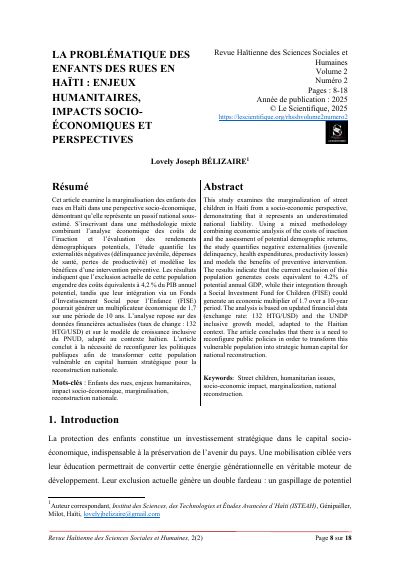
- The author estimates that excluding street children costs the equivalent of 4.2 percent of potential annual GDP.
- Integration through a Social Investment Fund for Children (FISE) could produce an economic multiplier of 1.7 over 10 years.
- The negative externalities counted are juvenile delinquency, health spending and lost productivity.
- The analysis uses an exchange rate of 132 gourdes per US dollar and the UNDP inclusive growth model adapted to Haiti.
- The article concludes that the cost of inaction exceeds the cost of intervention and calls for policies that turn this population into human capital.
The article treats the marginalization of street children in Haiti as an underestimated national liability. Its mixed method combines an economic analysis of the cost of inaction with an assessment of potential demographic returns, and it quantifies negative externalities such as juvenile delinquency, health spending and lost productivity.
The author's results indicate that exclusion of this population costs the equivalent of 4.2 percent of potential annual GDP, and that integration through a Social Investment Fund for Children (FISE) could produce an economic multiplier of 1.7 over 10 years. The analysis uses an exchange rate of 132 gourdes per US dollar and the UNDP inclusive growth model adapted to Haiti. These are the author's model estimates. The article calls for public policies that treat these children as human capital for national reconstruction.
How to cite
Le Scientifique, 2025, The Street Children Problem in Haiti: Humanitarian Stakes, Socio-Economic Impacts and Outlook, https://lescientifique.org/wp-content/uploads/2025/06/LA_PROBLEMATIQUE_DES_ENFANTS_DES_RUES_EN_HAITI__ENJEUX_HUMANITAIRES_IMPACTS_SOCIO-ECONOMIQUE_ET_PERS.pdf
- Rights holder
- Le Scientifique