
Economic and Financial Crime: A Major Structural Handicap Slowing Haiti's Development
- The research combines three one-hour observations at the Direction Générale des Impôts office in Cap-Haïtien with a regression on yearly data for 2012 to 2022.
- The model regresses the human development index on an index of non-compliance with the rule of law, government effectiveness and a corruption perception index, with an adjusted R2 of about 71.6 percent.
- The coefficient table shows only the non-compliance index significant at 5 percent, although the text states that all three predictors are.
- The author concludes that Haiti's underdevelopment is endogenous and comes from corruption and a state that does not assume its responsibilities.
- The article recommends political stability and effective governments that fight smuggling, corruption, theft and rape.
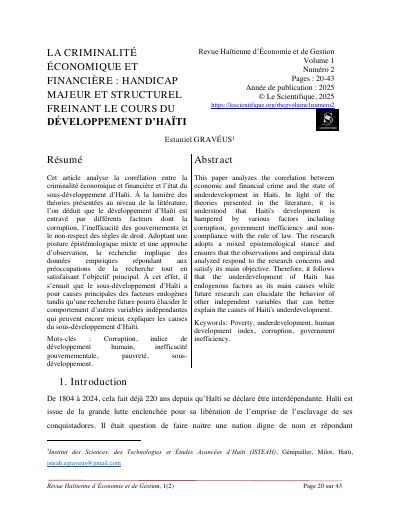
The article asks whether economic and financial crime explains Haiti's underdevelopment. It reviews definitions of economic and financial crime, its causes (social inequality, unemployment, poverty) and its circuits in Haiti, namely theft and rape, kidnapping, smuggling and corruption. The research is mixed. The author made three one-hour non-participant observations at the Direction Générale des Impôts office in Cap-Haïtien and ran a regression on yearly data for 2012 to 2022, using Transparency International and World Bank governance indicators.
The model regresses the human development index on an index of non-compliance with the rule of law, government effectiveness and a corruption perception index, and reports an adjusted R2 of about 71.6 percent. The author concludes that Haiti's underdevelopment comes from corruption and from a state that does not assume its responsibilities, and recommends political stability and effective governments that fight smuggling, corruption, theft and rape. The coefficient table shows that only the non-compliance index is significant at 5 percent, with 11 observations.
How to cite
Le Scientifique, 2025, Economic and Financial Crime: A Major Structural Handicap Slowing Haiti's Development, https://lescientifique.org/wp-content/uploads/2025/05/La-criminalite-economique-et-financiere-handicap-majeur-et-structurel-freinant-le-cours-du-developpement-dHaiti.pdf
- Rights holder
- Le Scientifique