
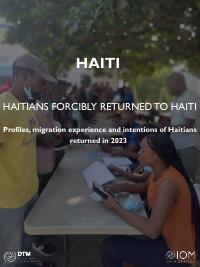
Haitians Forcibly Returned to Haiti: Profiles, Migration Experience and Intentions of Haitians Returned in 2023
Summary — IOM study of the more than 216,000 people returned to Haiti in 2023, their profiles, migration experience and intentions.
Key Findings
- More than 216,000 people were returned to Haiti in 2023, from a range of sending countries.
- Forced return continued at scale while insecurity inside Haiti was itself displacing people.
- Records returnees' stated intentions after return, not only their arrival.
Full Description
An IOM study of Haitians forcibly returned to Haiti during 2023, covering their profiles, migration experience and intentions after return, with the distribution of returns by sending country. It documents forced return at a scale that ran alongside deepening insecurity inside Haiti, which is the tension the data carry: people were being returned in large numbers to a country producing displacement of its own.
Full Document Text
Extracted text from the original document for search indexing.
HAITI
HAITIANS FORCIBLY RETURNED TO HAITI
Profiles, migration experience and intentions of Haitians
returned in 2023
The opinions expressed in this publication are those of the authors and do not necessarily reflect the
views of the International Organization for Migration (IOM). The designations employed and the
presentation of material throughout the report do not imply expression of any opinion whatsoever on
the part of IOM concerning the legal status of any country, territory, city or area, or of its authorities,
or concerning its frontiers or boundaries.
IOM is committed to the principle that humane and orderly migration benefits migrants and society.
As an intergovernmental organization, IOM acts with its partners in the international community to:
assist in meeting the operational challenges of migration; advance understanding of migration issues;
encourage social and economic development through migration; and uphold the human dignity and
well-being of migrants.
The following citation is required when using any data and information included in this report:
“International Organization for Migration (IOM) Haiti, May 2024. Haitians forcibly returned to Haiti in
2023.” For more information on terms and conditions of DTM reports and information products,
please refer to: https://dtm.iom.int/terms-and-conditions
The data collection was conducted by IOM staff and GARR, a national Haitian Non-Governmental
Organization.
Cover: Registration of Haitians forcibly returned by the Bahamas to the town of Cap Haitian © IOM
Haiti / March 2024
This publication was made possible through the support provided by:
TABLE OF CONTENTS
KEY FINDINGS .......................................................................................................................................................................................................... 4
INTRODUCTION .................................................................... .............................................................................................................................. 5
PART I – ANALYSIS OF RETURNEES' PROFILES
Socio-demographic profile .................................................................................................................................................... 8
Migration experience ................................................................................................................................................................. 10
Migration intentions ................................................................................................................................................................... 23
PART II – ANALYSIS BY MAIN SENDING COUNTRIES
People returned by Dominican Republic ................................................................................................................... 26
People returned by Turks and Caicos .......................................................................................................................... 30
People returned by Bahamas .............................................................................................................................................. 34
People returned by United States of America ....................................................................................................... 38
METHODOLOGY AND LIMITATIONS ............................................................................................................................................ 43
KEY FINDINGS
RETURNEES BY ALL COUNTRIES RETURNEES BY MAIN SENDING COUNTRIES
• Dominican Republic: 89% alone vs 11% with family members
90% of persons were returned alone • Turcs and Caicos: 96% alone vs 4% with family members
10% with their family members • Bahamas: 96% alone vs 4% with family members
• United States: 91% alone vs 9% with family members
• Dominican Republic: 37% were single
• Turcs and Caicos: 54% were single
41% of returnees were single • Bahamas: 63% were single
• United States: 62% were single
• Dominican Republic: 48% attended primary school vs 16% had no education
level
43% only attended primary school
• Turcs and Caicos: 69% attended high school vs 6% had no education level
14% had no education level • Bahamas: 54% attended high school vs 4% had no education level
• United States: 64% attended high school vs 1% had no education level
• Dominican Republic: 7% before vs 17% after
10% were employed before leaving Haiti • Turcs and Caicos: 25% before vs 5% after
15% were employed after leaving Haiti • Bahamas: 14% before vs 9% after
• United States: 16% before vs 8% after
• Dominican Republic: 96% born in Haiti and 4% in DR
97% were born in Haiti • Turcs and Caicos: 100% born in Haiti
3% in Dominican Republic • Bahamas: 100% born in Haiti
• United States: 99% born in Haiti and 1% in DR
• Dominican Republic: 62% had an ID (26% of these had a passport)
57% had an Identity Document (ID) • Turcs and Caicos: 21% had an ID (42% of these had a passport)
25% of these had a Haitian passport • Bahamas: 35% had an ID (50% of these had a passport)
• United States: 53% had an ID (72% of these had a passport)
• Dominican Republic: 82% left alone vs 18% in group
78% left Haiti alone • Turcs and Caicos: 56% left alone vs 44% in group
22% in group • Bahamas: 66% left alone vs 34% in group
• United States: 75% left alone vs 25% in group
82% left Haiti by Land • Dominican Republic: 97% by Land, 2% by Air, 1% by Sea
• Turcs and Caicos: 93% by Sea, 5% by Air, 2% by Land
14% by Sea • Bahamas: 51% by Sea, 48% by Air, 1% by Land
4% by Air • United States: 45% by Sea, 36% by Air, 19% by Land
• Dominican Republic: 57% out of Haiti for more than 6 months
51% spent more than 6 months out of Haiti • Turcs and Caicos: 78% out of Haiti for less than 2 weeks
before being forcibly returned • Bahamas: 47% out of Haiti for more than 6 months
• United States: 51% out of Haiti for more than 6 months
• Dominican Republic: 82% left for job opportunites
84% left Haiti to seek job opportunities • Turcs and Caicos: 92%
abroad • Bahamas: 82%
• United States: 80%
• Dominican Republic: 190 USD
Average spending for the trip to leave Haiti: • Turcs and Caicos: 919 USD
401 USD • Bahamas: 3,758 USD
• United States: 6,087 USD
Main departments of origin in Haiti: • Dominican Republic: West (42%), Centre (21%), South-East (18%)
• Turcs and Caicos: North (45%), North-West (19%), West (10%)
West (37%), Centre (18%), • Bahamas: North-West (54%), North (20%), Artibonite (13%)
South-East (15%) • United States: North-West (30%), West (26%), Artibonite (17%)
• Dominican Republic: 23% have been IDPs (63% due to violence)
23% have been Internally Displaced • Turcs and Caicos: 33% have been IDPs (all of them due to violence)
Persons (IDPs) in Haiti in the past (63% • Bahamas: 67% have been IDPs (all of them due to violence)
of these due to violence) • USA: 18% have been IDPs (50% due to violence and
50% due to natural disaster)
• Dominican Republic: 44%
44% intended to leave again Haiti during • Turcs and Caicos: 39%
the following 6 months after their forced • Bahamas: 39%
return • United States: 67%
HAITIANS FORCIBLY RETURNED TO HAITI IN 2023
INTRODUCTION
Forced returns of Haitians to Haiti is one of the main human mobility trends in the country. In search of a better life,
many Haitians attempt to leave the country through regular or irregular pathways. In addition to risking their lives,
those who engage in irregular pathways are often forcibly returned to Haiti by their destination or transit countries.
In 2023, more than 216,000 people were returned to Haiti by different countries.
Many are returned after living several months or years outside Haiti and face challenges reintegrating into their
communities. Furthermore, security and socioeconomic conditions in Haiti exacerbate these reintegration challenges.
Hence, even after being forcibly returned in the country, many people engage again, sometimes multiple times, in
irregular migration, in search of a better life out of Haiti.
This report provides insights on the profiles of Haitians who were forcibly returned in 2023. It presents their socio
demographic and economic profiles, their migration experiences and their migration intentions. Information was
collected through individual surveys conducted with a sample of returnees. Surveys were conducted upon their arrival
in the country (please refer to the last section of the report for more information on methodology).
The goal of this research is to inform the development or adjustment of migration governance policies as well as
transition and development strategies to ensure that migration is a choice, rather than the consequence of a
constraint, and that once engaged, it is safe and carried out with human dignity, and contributes to the socio-
economic development and well-being of migrants and their community of origin and of destination.
Figure 1. Haitians forcibly returned to Haiti in 2023 by sending country and number of interviewed among them
Number of returnees1 Number of returnees interviewed
Dominican Republic 208,169 (96%) 7,409 (83%)
Turks and Caicos 3,338 (2%) 897 (10%)
Bahamas 2,021 (1%) 219 (2%)
United States of America 1,862 (1%) 220 (2%)
Cuba 751 (<1%) 58 (1%)
Turkey 463 (<1%) 72 (1%)
Jamaica 73 (<1%) 24 (<1%)
TOTAL 216,677 (100%) 8,899 (100%)
1. More details on trends and figures of forced returns can be found here
IOM HAITI 5
HAITIANS FORCIBLY RETURNED TO HAITI IN 2023
Figure 2. Distribution of Haitians forcibly returned to Haiti in 2023 by sending country: 216,677 returnees
Figure 3. Distribution of respondents by age and sex (8,899 respondents)
27% 73%
60+ 1%
26 - 59 19% 56%
18 - 25 8% 16%
6 IOM HAITI
PART 1
ANALYSIS
OF RETURNEES
PROFILE
Arrival and registration at Belladère of a returnee by Dominican Republic © IOM / March 2024
HAITIANS FORCIBLY RETURNED TO HAITI IN 2023
I.1. SOCIO-DEMOGRAPHIC PROFILE IOM HAITI 8
Most persons (90%) were returned alone and 10% with their family’s members. This latter percentage was higher for
returnees by Dominican republic: 11% were returned with their family’s members (vs. 5% for returnees by other
countries). For those who were returned with their families, children represented 38% of all family members and 42%
were women.
Figure 4. « Were you returned alone or with Figure 5. Disaggregation by sex and age of persons returned with family members
family members? »
Returnees from all countries Returnees from all countries Returnees from all countries
except Dominican Republic
10% Alone 42% 58% 41% 59%
60+ 1% 1%
With family 18 - 59 16% 39%
members 60+ 3% 4% 6 - 17 16% 14%
90%
0-5 8% 5%
Returnees from all countries Returnees from the
except Dominican Republic Dominican Republic 18 - 59 23% 32% Returnees from the Dominican Republic
42% 58%
5% 11%
6 - 17 10% 13% 60+ 3% 5%
18 - 59 23% 31%
6 - 17 10%13%
95% 89% 0-5 6% 9%
0-5 6% 9%
Figure 6. Observable vulnerabilities (on interviewees or their family members)
3% of returnees were 4% of returnees were 1% of returnees were
breastfeeding women pregnant women in serious medical
conditions
Figure 7. Marital status
Divorced <1% Two-fifth of returnees were single and 32% were living in
Widow 2% cohabitation with a partner, while 22% were married.
No answer 3%
In terms of level of education, most returnees had not
Married 22% achieved a high level of education: almost half of them
In cohabitation 32% (43%) only attended primary school and 14% had no level
of education at all.
Single 41%
Figure 8. Education level
26% 25%
18%
14% 12%
3% 1% 1% <1% <1%
Attended high Attended primary Attended and
No education level
Attended and
Attended university
Attended and
Attended postgrade Attended and Other
completed high completed
school but didn't school but didn't completed
completed primary studies but didn't
university
but didn't complete
complete school
complete postgrade studies
school complete
HAITIANS FORCIBLY RETURNED TO HAITI IN 2023
Figure 9. Professional status before and after leaving Haiti
49%
44%
22% 23%
15%
10%
6% 5% 3% 3% 6%
2% 2% 4% 1% 1% 2% 2%
Self-employed Unemployed and Employed Student Unemployed and Family worker No answer Apprentice Other
looking for work not looking for (without pay)
work
Professional status before leaving Haiti Professional status after leaving Haiti
Half of the returnees (49%) were self-employed before leaving Haiti and only 10% were employed. The latter
percentage increased to 15% when returnees were outside Haiti.
Agriculture, construction and trade were the three main employment sectors, both when in Haiti and after
leaving the country. It should be noted that the percentage of people working in construction increased
from 22% when in Haiti to 29% outside Haiti
Figure 10. Top 5 areas of work for returnees Figure 11. Top 5 areas of work for returnees when
before leaving Haiti (self-employed, employed or out of Haiti (self-employed, employed or
apprentices) apprentices)
Agriculture 41% Agriculture 38%
Construction 22% Construction 29%
Trade 19% Trade 15%
Manufacturing 4%
Fishing 3%
Accommodation and
2%
Manufacturing 2% catering services
9 IOM HAITI
HAITIANS FORCIBLY RETURNED TO HAITI IN 2023
I.2. MIGRATION EXPERIENCE
Figure 12. Native country Figure 13. Possession of Identity Documents (IDs)
3%
Haiti
43% No
Dominican Yes
57%
Republic
97%
Figure 14. Type of IDs (Multiple choice)
Almost all returnees were born in Haiti (97%) and
58% 3% in the Dominican Republic.
The majority of them (57%) had an identity
document (ID). The new electoral card was the
25% 24%
document that most of them had. Only a quarter
of those who possessed an ID had a passport.
5% It should be noted that possession of an ID is
2%
based on returnees' declarations and not on a
New electoral Haitian Old electoral Tax Identity Other check of identity documents by IOM’s teams.
card passport card Number (NIF)
Figure 15. « When you left Haiti, did you travel alone or in a
Three-quarters of returnees traveled alone when they group? »
left Haiti (78%).
Those who traveled in groups were mainly 22%
accompanied by family members: 23% were Alone
accompanied by siblings or cousins; 17% by their
In a group
spouse or partner; 14% by their children, 7% by their
78%
entire family and 4% by their fathers or mothers.
A good proportion (42%) were traveling with non- Figure 16. « If in a group, with whom did you travel? » (Multiple
family members. choice)
Father/Mother 4%
Among returnees who left Haiti with family members,
30% indicated that other family members remained My entire family 7%
outside Haiti.
My Child/Children 14%
Figure 17. « Are there any family members you originally
emigrated with who have remained abroad? » Spouse/Partner 17%
70% 30% Other family member (brother,
cousin, etc.)
23%
No Yes Person not part of my family 42%
10 IOM HAITI
HAITIANS FORCIBLY RETURNED TO HAITI IN 2023
Analysis of the returnees' origin was carried out separately for those returned by the Dominican Republic
and those returned by other countries because the proximity of Haiti and Dominican Republic has an impact
on returnees' origin. Data shows that people who were returned by the Dominican Republic mostly
originated from areas bordering the two countries, while those returned by other countries mainly came
from areas close to the sea.
83% of returnees from the Dominican Republic originated for four Haitian’s departments, all bordering Haiti
and the Dominican Republic: West (42%; especially the municipalities of Cornillon Grand Bois and Fonds-
Verrettes), Centre (21%; mostly Belladère and Savanette), South-East (18%; mainly Anse-à-Pîtres) and North-
East (2%): see figures 18, 21, 23 and 25 for more details.
Figure 18. Top 5 municipalities of origin for returnees from the Dominican Republic
# of security incidents in 2023
Municipality District % of returnees
(source: ACLED)
Cornillon / Grand Bois West 23% 0
7 municipalities of the capital (PAPMA) West 7% 986
Fonds-Verrettes West 7% 0
Anse-à-Pîtres South-East 5% 0
Belladère Centre 4% 0
Savanette Centre 4% 0
Returnees from other countries originated mostly from the Northern part of Haiti: 34% from the
department of North, especially from the municipalities of Cap Haitian and Borgne; and 26% from North-
West, mostly from Port-de-Paix, Saint-Louis du Nord La Tortue and Jean Rabel: see figures 19, 20, 22 and
24.
Figure 19. Top 5 municipalities of origin for returnees from other countries else than the Dominican Republic
# of security incidents in 2023
Municipality District % of returnees
(source: ACLED)
7 municipalities of the capital (PAPMA) West 9% 986
Cap-Haitien North 7% 42
Port-de-Paix North-West 7% 9
Borgne North 6% 2
La Tortue North-West 5% 0
Saint-Louis du Nord North-West 5% 4
Port-Margot North 5% 0
11 IOM HAITI
HAITIANS FORCIBLY RETURNED TO HAITI IN 2023
Figure 20. Origin of people returned by countries other than the Dominican Republic – Department level (admin 1)
(26%)
(34%)
(3%)
(10%)
(2%)
(3%) (1%) (13%)
(6%) (2%)
Figure 21. Origin of people returned by the Dominican Republic - Department level (admin 1)
(1%)
(4%)
(2%)
(9%)
(21%)
(1%) (42%)
(1%)
(1%) (18%)
12 IOM HAITI
HAITIANS FORCIBLY RETURNED TO HAITI IN 2023
Figure 22. Origin of people returned by other countries other than the Dominican Republic – Municipality level (admin 2)
Figure 23. Origin of people returned by the Dominican Republic - Municipality level (admin 2)
13 IOM HAITI
HAITIANS FORCIBLY RETURNED TO HAITI IN 2023
Figure 24. Origin of people returned by countries other than the Dominican Republic and security incidents in Haiti in 2023
(source of information on security incidents: ACLED) - Department level (admin 1)
Figure 25. Origin of people returned by the Dominican Republic and security incidents in Haiti in 2023 (source
of information on security incidents: ACLED) - Department level (admin 1)
14 IOM HAITI
HAITIANS FORCIBLY RETURNED TO HAITI IN 2023
FOOD INSECURITY AND ORIGINS OF RETURNEES
Food insecurity data used in this report comes from the Integrated Food Security Phase Classification (IPC), a
multi-stakeholder initiative to improve analysis and decision-making on food security and nutrition. Using the
IPC classification and analytical approach, governments, UN agencies, NGOs, and other stakeholders work
together to determine the severity and extent of acute and chronic food insecurity and acute malnutrition
situations within countries, according to internationally recognized standards2. On the scale of Acute Food
Insecurity, the latest IPC analysis in Haiti classified that, from March to June 2024, all areas in the country are
either in Phase 3 – Crisis3 or Phase 4 – Emergency4, which shows how serious the food security situation is
in the country.
Among returnees by Dominican Republic, 32% were from Phase 4 areas and 68% from Phase 3 areas (see
figures 27 and 29), while 11% and 89% of returnees by other countries originated respectively from Phase 4
areas and Phase 3 areas (see figures 26 and 28).
Figure 26. IPC phase of returnees' areas of origin: returnees from Figure 27. IPC phase of returnees' areas of origin: returnees
countries other than the Dominican Republic' (% of returnees) by Dominican Republic (% of returnees)
89% 68%
Phase 3
32%
Phase 4
11%
Figure 28. Food insecurity and origin of returnees by countries Figure 29. Food insecurity and origin of returnees by Dominican
other than the Dominican Republic (admin 2 level) Republic (admin 2 level)
2. Further information on the IPC can be found on https://www.ipcinfo.org
3. There are 5 phases, the first being the least serious and the fifth the most one. The Phase 3 implies that households either: • Have food consumption gaps that
are reflected by high or above-usual acute malnutrition; or • Are marginally able to meet minimum food needs but only by depleting essential livelihood assets or
through crisis coping-strategies
4. The Phase 4 implies that Households either: • Have large food consumption gaps which are reflected in very high acute malnutrition and excess mortality; or •
Are able to mitigate large food consumption gaps but only by employing emergency livelihood strategies and asset liquidation
15 IOM HAITI
HAITIANS FORCIBLY RETURNED TO HAITI IN 2023
DEFORESTATION/LAND DEGRADATION AND ORIGINS OF RETURNEES
Deforestation and land degradation data comes from the World Overview of Conservation Approaches
and Technologies (WOCAT), a global network on Sustainable Land Management (SLM) that promotes
documentation, sharing and use of knowledge to support adaptation, innovation and decision-making in
SLM5. Data shows that North-West is the department which has suffered greater deforestation and land
degradation (77% of its land is degraded). This department is the area of origin for 26% of the returnees
from countries other than the Dominican Republic. The second most land-degraded department is the
West (65%) which is the area of origin for 42% of the returnees from the Dominican Republic (see figures
30 to 32 below).
Figure 30. Deforestation/land degradation and origin of returnees
Origins of returnees by Origins of returnees by
Degradation % of other countries else Dominican Republic
Department Size (Km2)
(Km2) degradation than DR (% of returnees)
(% of returnees)
West 4,980.64 3,225.39 64.76% 13% 42%
Artibonite 4,861.75 2,328.07 47.89% 10% 9%
Centre 3,466.93 1,698.43 48.99% 2% 21%
North West 2,093.47 1,602.02 76.52% 26% 1%
South 2,649.22 1,503.76 56.76% 6% 1%
South East 2,040.94 1,226.9 60.11% 2% 18%
North East 1,630.55 940.195 57.66% 3% 2%
North 2,105.32 910.357 43.24% 34% 4%
Nippes 1,225.81 512.376 41.80% 1% 1%
Grande'Anse 1,912.82 380,724 19.90% 3% 1%
Total 26,967.45 14,328.22 53.13% 100% 100%
Figure 31. Deforestation/land degradation and origin of returnees by Figure 32. Deforestation/land degradation and origin of
other countries other than Dominican Republic returnees by the Dominican Republic
5. Further information on the WOCAT can be found on https://www.wocat.net/en/
16 IOM HAITI
HAITIANS FORCIBLY RETURNED TO HAITI IN 2023
IOM HAITI 17
Figure 33. Reasons for leaving Haiti Figure 34. « When did you last leave the country before this forced return? »
Returnees from all countries Returnees from countries other than the
Dominican Republic
Other 2% 34%
3 - 6 months 6%
6 - 12 months 7%
Access to better
basic services abroad
2%
2 weeks - 3 months 10%
> 12 months before being
Violence/insecurity in 17% 17% returned
17%
the provenance
3%
14% < 2 weeks 60%
11%
Returnees from the Dominican Republic
Join family abroad 4%
4% Same day of forced return 4%
3%
No answer 5%
Natural disaster in < 2 weeks 8%
the provenance
5%
> 12 < 2 weeks 6 - 12 3 - 6 2 weeks - No Same day 2 weeks - 3 months 11%
months months months 3 months answer of forced
before return 3 - 6 months 15%
Search for job being
opportunities abroad
84% 6 - 12 months 19%
returned
> 12 months 38%
Half of the returnees (51%) spent more than 6 months out of Haiti before being returned. However, this percentage
was higher for returnees by Dominican Republic (57%) than by other countries (24%). Indeed, the majority of returnees
from other countries spent less than 2 weeks out of Haiti before being returned.
The search for job opportunities was the main reason returnees left Haiti (84%).
Returnees from the Dominican Republic left Haiti in vast majority by land, passing through areas bordering the two
countries, especially Belladère (25%), Cornillon Grand Bois (18%), Anse-à-pitres (16%), Savanette (11%), Ouanaminthe
(9%) and Fonds-Verrettes (8%): see figures 35 and 37.
Those from other countries left Haiti in majority by sea (75%), notably by the Port of Cap Haitian (33%), Borgne (14%)
and La Tortue (10%), see figures 36 and 38. The airports of Port-au-Prince (6%) and Cap Haitian (10%) were also
important exit points. In this case, persons usually take charter flights towards countries which do not require visas for
Haitians. For instance, between August and October 2023, more than 31,000 Haitians left the country by charter flights
towards Nicaragua6.
Figure 35. Exit way when leaving Haiti (for returnees from Figure 36. Exit way when leaving Haiti (for returnees from
Sea other countries)
the Dominican Republic)
97% 2%1% Air
75% 16% 9%
Land
Figure 37. Exit point when leaving Haiti (for returnees from Figure 38. Exit point when leaving Haiti (for returnees from
the Dominican Republic) other countries)
(People returned from countries other than DR)
6. Haiti Libre, https://www.haitilibre.com/article-40963-haiti-politique-13e-jours-de-suspension-des-vols-vers-le-nicaragua.html
HAITIANS FORCIBLY RETURNED TO HAITI IN 2023
DISTANCE BETWEEN MAIN EXIT POINTS AND ORIGIN OF RETURNEES
Returnees from the Dominican Republic – 3 main exit points and origin of returnees
Figure 39. Exit point 1: Belladère Almost half of those who left Haiti via
Belladère (46%) originated from areas in the
same department of Centre, where Belladère
is located, while almost all (98%) of those
who left through Cornillon Grand Bois
originated from the same municipality of
Cornillon Bois, in the department of West.
Persons who left by Anse-à-Pitres were in
majority (89%) from areas in the same
department (30% originated locally from
Anse-à-Pitres).
Thus, Belladère was the most diverse exit
Figure 40. Exit point 2: Cornillon Bois
point in terms of origins of migrants who left
the country through it since a little more than
half (54%) came from areas of the country
not located in the Center department: 22%
came from the Artibonite department and
20% from the West, including from the
Metropolitan Zone of Port-au-Prince, the
capital city (13%).
Figure 41. Exit point 3: Anse-à-Pitres
IOM HAITI 18
HAITIANS FORCIBLY RETURNED TO HAITI IN 2023
DISTANCE BETWEEN MAIN EXIT POINTS AND ORIGIN OF RETURNEES
Returnees from other countries– 4 main exit points and origin of returnees
Figure 42. Exit point 1: Cap Haitian (Port and airport) Almost half of those who left Haiti via Cap
Haitian (43%) originated from the same
department of North, where Cap Haitian is
located. The remaining 57% came from
other departments: 23% from the
neighboring department of North-West,
10% from the West department (mainly
from the capital, 7%), and 9% from the four
departments in Southern Haiti, located on
the opposite side of the country (especially
from the South department, 5%).
Among people who left via Borgne, 46%
originated from the same department
Figure 43. Exit point 2: Borgne
(North). Among those who came from
other departments, 24% were from North-
West, 16% were from the departments in
Southern Haiti (especially from the South
department, 11%) and 9% from the West
department, mainly from the capital (6%).
Half of those who left via La Tortue
originated from the same North-West
department (30% originated locally from La
Tortue), 28% from the North department
and 8% from the Artibonite department.
Figure 44. Exit point 3: La Tortue
IOM HAITI 19
HAITIANS FORCIBLY RETURNED TO HAITI IN 2023
Figure 45. Exit point 4: Airport of Port-au-Prince
42% of returnees who left the country via the
airport of Port-au-Prince were from the
West department, where the airport is
located, including from the Port-au-Prince
Metropolitan Area, the capital city (30%) : the
municipalities of Port-au-Prince (13%),
Carrefour (8%), Croix-des-Bouquets (5%) and
Delmas (4%) were the most represented
municipalities.
The Artibonite (17%), North (10%) and
North West departments (9%) were also
important areas of origin for returnees
having left by the airport of Port-au-Prince.
Arrival and registration at Ouanaminthe of a returnee by Dominican Republic © IOM / March 2024
IOM HAITI 20
HAITIANS FORCIBLY RETURNED TO HAITI IN 2023
TRAVEL EXPENSES
Average spending by people returned by Dominican Republic: 190 USD
Average spending by people returned by other countries: 2,308 USD
On average, Haitians returned by the Dominican Republic spent 190 USD for their entire trip to leave Haiti
while those returned by other countries paid 2,308 USD. Expenses include transportation, acquisition of
documents, accommodation during the trip, smugglers’ payments and other related costs.
The much lower amount spent by the returnees from the Dominican Republic is due to the proximity to
Haiti. Those returned by other countries traveled longer distance, paying boats, charter flights,
accommodations, etc. (see Part 2 for more further analysis by main sending countries).
In order to fund their trips, 23% of returnees sold their belongings, 21% used savings, 21% received loans and
17% received money from their relatives abroad. A fifth of all respondents did not want to answer this
question
Figure 46. Source of funding for the trip (Multiple choice)
23% 21% 21% 20%
17%
5%
Sale of personal Savings Loans No answer Money sent from Money from relatives
belongins relatives abroad in the area of origin
CHALLENGES FACED DURING THE TRIP
42% of returnees indicated that they faced particular challenges during their trip. Hunger and Thirst were the
main ones, mentioned by 61% of returnees who declared facing challenges.
Figure 47. Challenges faced by returnees during their trip (Multiple choice)
Challenges % of returnees
Hunger / Thirst 61%
Arrests 32%
Problems related to lack of identity documents 15%
Attacks / Assaults 13%
Financial problems 12%
Lack of shelter 7%
Problems at sea 5%
Diseases 5%
Lack of correct travel information 4%
Injury 2%
21 IOM HAITI
HAITIANS FORCIBLY RETURNED TO HAITI IN 2023
HISTORY OF INTERNAL DISPLACEMENT
Figure 48. « Have you ever been forced to flee your residence in Haiti Figure 49. « If yes, for which reason? »
to take refuge in another location within the country? »
63%
23% 37%
No
Yes
77%
Violence/Insecurity Natural disaster
Almost a quarter of returnees indicated to have been internally displaced in Haiti mainly for violence related
reasons.
Arrival and registration at Cap Haitian of returnees by Bahamas © IOM / March 2024
22 IOM HAITI
HAITIANS FORCIBLY RETURNED TO HAITI IN 2023
I.3. MIGRATION INTENTIONS
INTENDED FINAL DESTINATION WHEN LEAVING HAITI
Figure 50. Intended final destination of Haitians returned Figure 51. Intended final destination of Haitians returned
by other countries when they left Haiti by Dominican Republic when they left Haiti
Cuba <1%
Chili 1%
Turks and Caicos <1%
Dominican Republic 1%
Bahamas <1%
Other 5%
Other 1%
Bahamas 7%
USA 1%
USA 25%
Chili 1%
Turks and Caicos 61%
Dominican Republic 96%
Most of respondents stated that the country they were returned from was their intended final destination. In
particular, 96% of those returned by DR intended to stay in this country (see Part 2 for more further analysis
by main sending countries).
INTENDED DESTINATION AFTER THEIR FORCED RETURN TO HAITI
Figure 52. Intended destination in Haiti
after their forced return
5%
The vast majority of returnees (95%) intended
to return to their place of origin in Haiti upon
The origin in Haiti
their forced return.
Another location
in Haiti
95%
23 IOM HAITI
HAITIANS FORCIBLY RETURNED TO HAITI IN 2023
FUTURE MIGRATION INTENTIONS
Figure 53. « How many times have you or a member of your household Figure 54. « Do you intend to leave Haiti during the following 6
been forcibly returned to Haiti? (including the current forced return)? » months after the current forced return? »
4 times 6%
More than 4 times 7%
3 times 44% No
18%
56% Yes
2 times 20%
1 time 49%
Figure 55. « If yes, for which country? »
65%
21% Half of respondents have been forcibly returned
5% 4% 3% 2% to Haiti more than once (51%).
Dominican USA Chili Brazil Bahamas Other
Republic When asked about their intentions to leave
Haiti during the 6 months following their forced
return, 44% of all respondents indicated they
Figure 56. « If yes, why? »
would try to leave again, mostly to go to
the Dominican Republic (65%) and to the USA
Studies 1%
(21%). Looking for job opportunities was the
Access to better basic services main reason for doing so. It should be noted
2%
abroad that this motive was also the main reason for
Violence/Insecurity in the
3%
which the majority of persons initially left Haiti
provenance
before being forcibly returned (see figure 33 on
Other 3% the page 17).
Join family abroad 10%
Search for job opportunities
81%
abroad
24 IOM HAITI
PART I1
ANALYSIS BY MAIN
SENDING
COUNTRIES
HAITIANS FORCIBLY RETURNED TO HAITI IN 2023
II.1. PEOPLE RETURNED BY DOMINICAN REPUBLIC IOM HAITI 26
SOCIO-DEMOGRAPHIC PROFILE
Figure 57. « Were you returned alone or Figure 58. Disaggregation by sex and age of Figure 59. Observable vulnerabilities (on
with family members? » people returned with family members interviewees or their family members)
4% of returnees were
11%
42% 58% breastfeeding women
Alone
60+ 3% 5%
18 - 59
5% of returnees were
With family 23% 31%
members pregnant women
89% 6 - 17 10% 13%
0-5 6% 9% 1% of returnees were
in serious medical
conditions
Figure 60. Marital status Figure 61. Education level
Divorced <1% Other <1%
Widow 2% Attended and completed postgrade studies <1%
No answer 4% Attended and completed university <1%
Married 22% Attended postgrade studies but didn't complete 1%
In cohabitation Attended university but didn't complete 2%
35%
Attended and completed high school 11%
Single 37%
No education level 16%
Attended and completed primary school 20%
Attended high school but didn't complete 21%
Figure 62. Professional status before and after leaving Haiti
Attended primary school but didn't complete 28%
54% 51%
20% 15% 17%
7% 6% 3% 5% 2% 3% 7% 3% 1% 1% 1% 1% 3%
Self-employed Unemployed and Employed Student Unemployed and Family worker No answer Apprentice Other
looking for work not looking for (without pay)
work
Professional status before leaving Haiti Professional status after leaving Haiti
Figure 63. Top 5 areas of work for returnees before Figure 64. Top 5 areas of work for returnees when out of
leaving Haiti (for self-employed, employed or apprentices) Haiti (for self-employed, employed or apprentices)
Agriculture Agriculture
46%
38%
Construction
20% Construction 29%
Trade
19% Trade
15%
Fishing Manufacturing 4%
2%
Manufacturing Accommodation and
2% catering services 2%
HAITIANS FORCIBLY RETURNED TO HAITI IN 2023
HISTORY OF MIGRATION
Figure 65. Native country Figure 66. Possession of Identity Figure 67. Type of IDs (Multiple choice)
Documents (IDs)
Other 2%
4%
Haiti
No Tax Identity Number (NIF) 6%
38%
Dominican Yes Old electoral card 22%
62%
Republic
96% Haitian passport 26%
New electoral card 59%
Figure 68. « When did you last leave Figure 69. « When you left Haiti, did you Figure 70. « Are there any family members you
the country before this forced return? » travel alone or in a group? » originally emigrated with who have remained
abroad? »
Same day of 18%
4% Alone
forced return 65% 35%
In a group
No answer 5%
82% No Yes
< 2 weeks 8%
2 weeks - 3
11%
months
3 - 6 months 15% Figure 29. Exit way when leaving Haiti
Land
6 - 12 months 19%
Air
97% 2% 1%
> 12 months 38% Sea
Figure 71. Reasons for leaving Haiti Figure 72. Exit point when leaving Haiti before being returned
Studies 1%
Access to better basic
2%
services abroad
Other 2%
Violence/insecurity in
2%
the provenance
Join family 4%
Natural disaster 7%
Search for job
82%
opportunities abroad
27 IOM HAITI
HAITIANS FORCIBLY RETURNED TO HAITI IN 2023
PLACE OF ORIGIN FOR PEOPLE RETURNED BY DOMINICAN REPUBLIC
Figure 73. Origin of returnees from the Dominican Republic - Department level (admin 1)
(1%)
(4%)
(2%)
(9%)
(21%)
(1%) (42%)
(1%)
(1%) (18%)
Figure 74. Origin of returnees from the Dominican Republic - Municipality level (admin 2)
28 IOM HAITI
HAITIANS FORCIBLY RETURNED TO HAITI IN 2023
TRAVEL EXPENSES
Average spending by people returned by Dominican Republic: 190 USD
Figure 75. Source of funding for the trip (Multiple choice)
28% 24% 22%
17%
13%
5%
Sale of personal belongins Savings Loans Money sent from relatives No answer Money from relatives in
abroad the area of origin
HISTORY OF INTERNAL DISPLACEMENT
Figure 76. « Have you ever been forced to flee your residence in Haiti Figure 77. « If yes, for which reason? »
to take refuge in another location within the country? »
63%
37%
23%
No Yes
Violence/Insecurity Natural disaster
77%
MIGRATION INTENTIONS
INTENDED FINAL DESTINATION WHEN LEAVING HAITI INTENDED DESTINATION AFTER
THEIR FORCED RETURN TO HAITI
Figure 78. Intended final destination of returnees when they left Haiti Figure 79. Intended destination in Haiti after
their forced return
Cuba <1%
Turks and Caicos <1% 6%
The origin
Bahamas <1% in Haiti
Other 1%
Another
USA 1%
94% location in
Chili 1% Haiti
Dominican Republic 96%
FUTURE MIGRATION INTENTIONS
Figure 80. « How many times have you or a member of your household been Figure 81. « Do you intend to leave Haiti during the
forcibly returned to Haiti? (including the current forced return)? » following 6 months after the current forced return? »
4 times 7%
More than 4 times 8%
2 times 18% 44% No
56%
3 times 20% Yes
1 time 47%
Figure 82. « If yes, for which country? » Figure 83. « If yes, why? »
79% Violence/insecurity in the provenance 2%
11% 5% 4% 1% Studies 2%
Access to better basic services abroad 2%
Dominican USA Chili Brazil Other
Other 3%
Republic
Join family abroad 12%
Search for job opportunities abroad 79%
29 IOM HAITI
HAITIANS FORCIBLY RETURNED TO HAITI IN 2023
II.2. PEOPLE RETURNED BY TURKS AND CAICOS IOM HAITI 30
SOCIO-DEMOGRAPHIC PROFILE
Figure 84. « Were you returned alone or Figure 85. Disaggregation by sex and age of Figure 86. Observable vulnerabilities (on
with family members? » persons returned with family members interviewees or their family members)
4%
20% 80% 1% of returnees were
Alone breastfeeding women
18 - 59 16% 72%
With family 1% of returnees were
members pregnant women
96% 6 - 17 3% 5%
2% of returnees were in
0-5 1% 3% serious medical conditions
Figure 87. Marital status Figure 88. Education level
Divorced <1% Other
Attended postgrade studies but didn't complete <1%
No answer 1%
Attended and completed postgrade studies <1%
Widow 2% Attended and completed university 1%
Married Attended university but didn't complete 4%
16%
Attended and completed primary school 6%
In cohabitation 28%
No education level 6%
Single 54% Attended primary school but didn't complete 14%
Attended and completed high school 15%
Figure 89. Professional status before and after leaving Haiti
Attended high school but didn't complete 54%
68%
36% 25% 21% 10% 1% 18%
4% 5% 3% 3% 2% 1% <1% 1% 2% <1% <1%
Self-employed Employed Unemployed and Student Apprentice No answer Other Unemployed and Family worker
looking for work not looking for (without pay)
work
Professional status before leaving Haiti Professional status after leaving Haiti
Figure 90. Top 5 areas of work for returnees before Figure 91. Top 5 areas of work for returnees when out of
leaving Haiti (for self-employed, employed or apprentices) Haiti (for self-employed, employed or apprentices)
Construction 35% Construction 54%
Trade 19%
Manufacturing 13%
Agriculture 11% Accommodation and
10%
catering services
Transportation
7%
and storage Other 5%
Fishing 5% Energy field (electricity, gas,
5%
air conditioning)
HAITIANS FORCIBLY RETURNED TO HAITI IN 2023
HISTORY OF MIGRATION
Figure 92. Possession of Identity Figure 93. Type of IDs (Multiple choice)
100% of returnees Documents (IDs) Tax Identity Number (NIF) 1%
from Turks and Other
21% 2%
Caicos were born No
Old electoral card 2%
in Haiti 79% Yes
Haitian passport 42%
New electoral card 54%
Figure 94. « When did you last leave Figure 95. « When you left Haiti, did you Figure 96. « Are there any family
the country before this forced return? » travel alone or in a group? » members you originally emigrated with
who have remained abroad? »
6 - 12 months 3%
94% 6%
44% Alone
56%
3 - 6 months 3% In a group No Yes
> 12 months 7%
Figure 97. Exit way when leaving Haiti
2%
2 weeks - 3 Sea
9%
months
93% 5% Air
Land
< 2 weeks 78%
Figure 98. Reasons for leaving Haiti Figure 99. Exit point when leaving Haiti before being returned
Other 1%
Studies 1%
Access to better basic
3%
services abroad
Violence/insecurity in
3%
the provenance
Search for job
92%
opportunities abroad
31 IOM HAITI
HAITIANS FORCIBLY RETURNED TO HAITI IN 2023
PLACE OF ORIGIN FOR PEOPLE RETURNED BY TURKS AND CAICOS
Figure 100. Origin of returnees from Turks and Caicos - Department level (admin 1)
(19%)
(45%)
(3%)
(7%)
(2%)
(3%) (10%)
(1%)
(8%) (2%)
Figure 101. Origin of returnees from Turks and Caicos - Municipality level (admin 2)
32 IOM HAITI
HAITIANS FORCIBLY RETURNED TO HAITI IN 2023
TRAVEL EXPENSES
Average spending by people returned by Turks and Caicos: 919 USD
Figure 102. Source of funding for the trip (Multiple choice)
59%
15% 14% 7% 5%
No answer Money sent from relatives abroad Loans Savings Money from relatives in the area of origin
HISTORY OF INTERNAL DISPLACEMENT
Figure 103. « Have you ever been forced to flee your residence in Haiti
to take refuge in another location within the country? »
100% of returnees from Turks and
33% No
Caicos who had been internally
Yes
displaced in Haiti, were such for
67%
violence related reasons
MIGRATION INTENTIONS
INTENDED FINAL DESTINATION WHEN LEAVING HAITI INTENDED DESTINATION AFTER
THEIR FORCED RETURN TO HAITI
Figure 104. Intended final destination of returnees
when they left Haiti
USA 4% 100% of returnees from Turks and
Caicos intended to go back to
their place of origin after their forced
Turks and Caicos 96%
return in Haiti.
FUTURE MIGRATION INTENTIONS
Figure 105. « How many times have you or a member of your household been Figure 106. « Do you intend to leave Haiti during the
forcibly returned to Haiti? (including the current forced return)? » following 6 months after the current forced return? »
4 times 2%
More than 4 times 3% 39% No
3 times 13% 61% Yes
2 times 32%
1 time 49%
Figure 107. « If yes, for which country? » Figure 108. « If yes, why? »
64%
Studies 1%
21% 13% 1% 1% Access to better basic services abroad 2%
Join family 2%
USA Bahamas Other Dominican Republic Brazil
Violence/insecurity in the provenance 3%
Search for job opportunities abroad 92%
33 IOM HAITI
HAITIANS FORCIBLY RETURNED TO HAITI IN 2023
II.3. PEOPLE RETURNED BY BAHAMAS IOM HAITI 34
SOCIO-DEMOGRAPHIC PROFILE
Figure 109. « Were you returned alone Figure 110. Disaggregation by sex and age of Figure 111. Observable vulnerabilities (on
or with family members? » persons returned with family members interviewees or their family members)
4% 1% of returnees were
58% 42% breastfeeding women
Alone
18 - 59 29% 7% 2% of returnees were
With family
6 - 17
pregnant women
members 14%
96%
0-5 29% 21% 1% of returnees were in
serious medical conditions
Figure 112. Marital status Figure 113. Education level
Attended postgrade studies but didn't complete <1%
Divorced <1%
Attended and completed university 3%
No education level 4%
In cohabitation 12%
Attended university but didn't complete 5%
Married 24% Attended and completed high school 13%
Attended primary school but didn't complete 14%
Single 63%
Attended and completed primary school 18%
Attended high school but didn't complete 41%
Figure 114. Professional status before and after leaving Haiti
53% 53%
20% 15% 14% 9% 8% 9%
5% 5% 2% 2% 3% 1% 0.5% 0.5%
Unemployed and Self-employed Employed Unemployed and Student Other No answer Family worker
looking for work not looking for work (without pay)
Professional status before leaving Haiti Professional status after leaving Haiti
Figure 115. Top 5 areas of work for returnees before Figure 116. Top 5 areas of work for returnees when out
leaving Haiti (for self-employed, employed or apprentices) of Haiti (for self-employed, employed or apprentices)
Construction 40% Construction 53%
Trade 14%
Agriculture 9%
Agriculture 14% Accommodation and
7%
catering services
Other 11% Other 7%
Education 5% Manufacturing 5%
HAITIANS FORCIBLY RETURNED TO HAITI IN 2023
HISTORY OF MIGRATION
Figure 117. Possession of Figure 118. Type of IDs (Multiple choice)
100% of returnees Identity Documents (IDs)
Tax Identity Number (NIF) 3%
from Bahamas
No
were born in Haiti 35% Old electoral card 5%
65% Yes
New electoral card 42%
Haitian passport 50%
Figure 119. « When did you last leave Figure 120. « When you left Haiti, did Figure 121. « Are there any family
the country before this forced return? » you travel alone or in a group » members you originally emigrated with who
have remained abroad? »
2 weeks - 3 34%
11% Alone
months 93% 7%
In a group
66%
No Yes
3 - 6 months 13%
> 12 months 21%
Figure 122. Exit way when leaving Haiti
6 - 12 months 26%
Sea
51% 48% 1% Air
< 2 weeks 29% Land
Figure 123. Reasons for leaving Haiti Figure 124. Exit point when leaving Haiti
Join family 3%
Violence/insecurity
15%
in the provenance
Search for job
opportunities 82%
abroad
35 IOM HAITI
HAITIANS FORCIBLY RETURNED TO HAITI IN 2023
PLACE OF ORIGIN FOR PEOPLE RETURNED BY BAHAMAS
IOM HAITI 36
Figure 125. Origin of returnees by Bahamas - Department level (admin 1)
(54%)
(20%)
(3%)
(13%)
(1%)
(<1%) (7%)
(<1%)
(<1%) (<1%)
Figure 126. Origin of returnees from Bahamas - Municipality level (admin 2)
HAITIANS FORCIBLY RETURNED TO HAITI IN 2023
TRAVEL EXPENSES
Average spending by people returned by Bahamas: 3,758 USD
Figure 127. Source of funding for the trip (Multiple choice)
58%
16% 15% 6% 2%
No answer Loans Money sent from relatives Savings Money from relatives in the
abroad area of origin
HISTORY OF INTERNAL DISPLACEMENT
Figure 128. « Have you ever been forced to flee your residence in Haiti
to take refuge in another location within the country? »
100% of returnees from Bahamas
who had been internally displaced
33% No
in Haiti, were such for violence
67%
Yes
related reasons
MIGRATION INTENTIONS
INTENDED FINAL DESTINATION WHEN LEAVING HAITI INTENDED DESTINATION AFTER THE
FORCED RETURN TO HAITI
Figure 129. Intended final destination of
Haitians returned by Dominican Republic
Turks and Caicos 1% 100% of returnees from Bahamas
Dominican Republic 1%
intended to go back to their place
Other
of origin after their forced return in
2%
Haiti
Bahamas 47%
USA 49%
FUTURE MIGRATION INTENTIONS
Figure 130. « How many times have you or a member of your household Figure 131. « Do you intend to leave Haiti during the
been forcibly returned to Haiti? (including the current forced return)? » following 6 months after the current forced return? »
4 times 1%
3 times 5% 39% No
61% Yes
2 times 39%
1 time 55%
Figure 133. « If yes, why? »
Figure 132. « If yes, for which country? »
70% Join family 2%
26%
2% 1% 1%
Violence/insecurity in the
provenance
7%
USA Bahamas Brazil Dominican Other
Republic Search for job opportunities
abroad
91%
37 IOM HAITI
HAITIANS FORCIBLY RETURNED TO HAITI IN 2023
II.4. PEOPLE RETURNED BY UNITED STATES IOM HAITI 38
SOCIO-DEMOGRAPHIC PROFILE
Figure 134. « Were you returned alone Figure 135. Disaggregation by sex and age of Figure 136. Observable vulnerabilities
or with family members? » persons returned with family members (on interviewees or their family members)
<1% of returnees were
45% 55% breastfeeding women
9%
Alone
18 - 59 30% 28% 1% of returnees were
With family
6 - 17
pregnant women
6% 18%
members
91%
0-5 9% 9% 2% of returnees were in
serious medical conditions
Figure 137. Marital status Figure 138. Education level
Attended and completed postgrade studies <1%
Widow 1%
Attended postgrade studies but didn't complete 1%
In cohabitation 13%
No education level 1%
Attended and completed primary school 5%
Married 24% Attended and completed university 7%
Attended primary school but didn't complete 10%
Single 62% Attended university but didn't complete 11%
Attended and completed high school 20%
Figure 139. Professional status before and after leaving Haiti Attended high school but didn't complete 44%
46% 62%
18% 8% 16% 8% 8% 12% 5% 1% 3% 3% 2% 1% 1% 1% 4%
Unemployed and Self-employed Employed Unemployed and not Student Other Family worker Apprentice No answer
looking for work looking for work (without pay)
Professional status before leaving Haiti Professional status after leaving Haiti
Figure 140. Top 5 areas of work for returnees when in Figure 141. Top 5 areas of work for returnees when out of Haiti (for self-
Haiti (for self-employed, employed or apprentices) employed, employed or apprentices)
Trade 18% Construction 41%
Construction 18% Trade 9%
Agriculture 15% Accommodation and
6%
catering services
Other 9% Agriculture 6%
Hygiene, sanitation or waste
Fishing 8% 6%
management
HAITIANS FORCIBLY RETURNED TO HAITI IN 2023
HISTORY OF MIGRATION
Figure 142. Native country Figure 143. Possession of Figure 144. Type of IDs (Multiple choice)
1% Identity Documents (IDs)
Tax Identity Number (NIF) 1%
Haiti
Old electoral card 3%
47% No
Dominican
53% Yes New electoral card 22%
Republic
99%
Haitian passport 72%
Figure 145. « When did you last leave Figure 146. « When you left Haiti, did Figure 147. « Are there any family
the country before this forced return? » you travel alone or in a group » members you originally emigrated with who
have remained abroad? »
3 - 6 months 25%
8% Alone 84% 16%
In a group
75% No Yes
6 - 12 months 9%
2 weeks - 3 months 13%
Figure 148. Exit way when leaving Haiti
Air
< 2 weeks 28%
45% 36% 19% Sea
Land
> 12 months 42%
Figure 149. Reasons for leaving Haiti Figure 150. Exit point when leaving Haiti
Access to better basic
1%
services abroad
Study 1%
Join family 3%
Violence/insecurity in
15%
the provenance
Search for job
80%
opportunities abroad
39 IOM HAITI
HAITIANS FORCIBLY RETURNED TO HAITI IN 2023
PLACE OF ORIGIN FOR PEOPLE RETURNED BY USA
Figure 151. Origin of people returned by USA - Department level (admin 1)
(30%)
(10%)
(3%)
(17%)
(4%)
(<1%) (26%)
(2%)
(5%) (3%)
Figure 152. Origin of people returned by USA - Municipality level (admin 2)
40 IOM HAITI
HAITIANS FORCIBLY RETURNED TO HAITI IN 2023
TRAVEL EXPENSES
Average spending by people returned by USA: 6,087 USD
Figure 153. Source of funding for the trip (Multiple choice)
50%
20% 15% 11% 4%
No answer Money sent from relatives Savings Loans Money from relatives in
abroad the area of origin
HISTORY OF INTERNAL DISPLACEMENT
Figure 154. « Have you ever been forced to flee your residence in Haiti Figure 155. « If yes, for which reason? »
to take refuge in another location within the country? »
50% 50%
18%
No
Yes
Violence/Insecurity Natural disaster
82%
MIGRATION INTENTIONS
INTENDED FINAL DESTINATION WHEN LEAVING HAITI INTENDED DESTINATION AFTER THEIR FORCED
Figure 156. Intended final destination of RETURN TO HAITI
Haitians returned by USA Figure 157. Intended destination in Haiti after their forced
return
Other 3%
3%
The origin
Bahamas 3%
in Haiti
Dominican Republic 3%
Chili 5% Another
Turks and Caicos 6% 97% location in
Haiti
USA 80%
FUTURE MIGRATION INTENTIONS
Figure 158. « How many times have you or a member of your household Figure 159. « Do you intend to leave Haiti during the following 6
been forcibly returned to Haiti? (including the current forced return)? » months after the current forced return? »
More than 4 times 1%
4 times 2% 33%
No
3 times 17%
2 times 67% Yes
30%
1 time 50%
Figure 160. « If yes, for which country? » Figure 161. « If yes, why? »
Access to better basic
75% services abroad
2%
8% 6% 5% 3% 3% Join family 3%
Violence/insecurity in the
USA Other Bahamas Chili Brazil
Dominican Republic 19%
provenance
Search for job opportunities
abroad
76%
41 IOM HAITI
HAITIANS FORCIBLY RETURNED TO HAITI IN 2023
METHODOLOGY AND LIMITATIONS
This research was conducted as part of the IOM’s Displacement Tracking Matrix (DTM)’s Flow Monitoring
framework6. Flow Monitoring aims to collect data on the number and characteristics of migrants observed
through Flow Monitoring Points (FMPs). Important FMPs are identified in coordination with local authorities,
partners and with DTM teams’ contextual analysis. In the case of forced returns, FMPs are the returnees'
arrival points in Haiti. The main points of arrival are the airport of Port-au-Prince, the airport and port of
Cap Haitian and the 4 official crossing border points between Haiti and Dominican Republic (Belladère,
Ouanaminthe, Anse-à-Pîtres and Malpasse). Sometimes, unofficial crossing border points between the 2
countries are also used for forced returns. In total, data collection was conducted on 33 FMPs (see figure
below) including the 7 points mentioned above and 26 unofficial crossing points between Haiti and the
Dominican Republic.
Two main data collection methodologies are used for each FMP: Flow Monitoring Registry (FMR) and
individual surveys (FMS - Flow Monitoring Survey).
The FMR entails collecting data at the different FMPs mainly via direct observations and from key informants.
Individual registration is conducted for all returnees at Port-au-Prince airport, Cap Haitian airport and Cap
Haitian port.
The FMR mainly provides information on the number of returnees, date of arrival, sending country and
arrival point7.
The FMS allows to collect in-depth Figure 162. Data collection points
information on migrants through
interviews with a sample of returnees in
order to understand their profiles,
migration experience and intentions.
This report is based on FMS
information collected from 8,899
returnees in 2023. Migrants participating
in interviews are randomly selected.
Their participation is subject to their
informed consent. Interviews are
conducted upon returnees’ arrival in the
country. Data collection teams conduct
interviews with as many returnees as
possible.
Limitations: Some returnees arrive
during the weekend or outside of IOM
staff members’ working hours. Thus,
those returnees were not interviewed.
6. Further information on the Displacement Tracking Matrix framework can be found on https://dtm.iom.int/about/methodological-framework
7. Information on forced returns from FMR is available on https://bit.ly/3InFQep
42 IOM HAITI
All information products from research carried out by IOM
Haiti is available in the link below. For more inquiries, please
contact the Data and Research unit by email:
DTM.IOM.INT/HAITI
dtmhaiti@iom.int
May 2024
How to cite
International Organization for Migration (IOM), 2024, Haitians Forcibly Returned to Haiti: Profiles, Migration Experience and Intentions of Haitians Returned in 2023, accessed via HaitiDocs, https://www.haitidocs.org/doc/iom-2024-haitians-forcibly-returned