
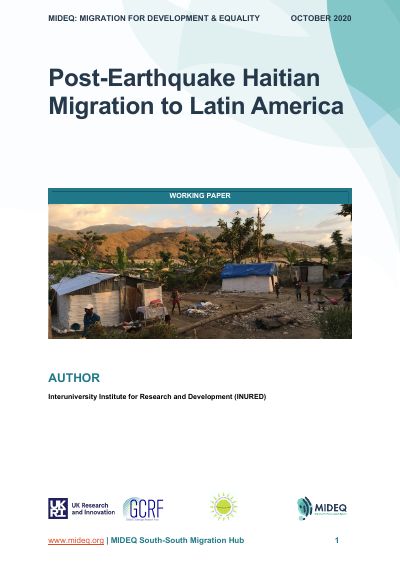
Post-Earthquake Haitian Migration to Latin America
- The paper estimates 881,488 Haitians lived in the United States by 2010, 0.3 percent of the US population.
- It cites a 2010 census recording over 330,000 Haitians in the Dominican Republic.
- It reports that between 2010 and 2018 approximately 129,000 Haitians entered Brazil, and that over 85,000 had emigrated to Brazil by 2017, most under refugee status.
- It states that the post-earthquake shift to South-South migration brought new opportunities and new risks, especially for unskilled workers.
- It concludes that Haiti's government has not adopted migration policies that capture the development value of out-migration and protect migrants.
The paper rests on document analysis of official reports, legislation, organization reports and quantitative data from Haiti, Brazil and other Latin American and Caribbean countries. It places Haiti as a country of net emigration, reviews Haitian migration history to the United States, Canada, the Dominican Republic and Brazil, and examines the shift after the January 2010 earthquake toward South-South destinations.
It covers migration policy in Haiti, the protection of migrants, and forced return migration during COVID-19 together with remittance losses. The conclusion states that Haiti's government has not adopted migration policies that use out-migration for national development while protecting migrants, and that regional migration turns destination countries into transit points. The paper includes maps of destinations and routes in the region for 2010 to 2020.
How to cite
Interuniversity Institute for Research and Development (INURED); Migration for Development and Equality (MIDEQ), 2020, Post-Earthquake Haitian Migration to Latin America, accessed via HaitiDocs, https://www.haitidocs.org/doc/inured-2020-post-earthquake-haitian-migration-latin-america
- Rights holder
- Interuniversity Institute for Research and Development (INURED)|Migration for Development and Equality (MIDEQ)