
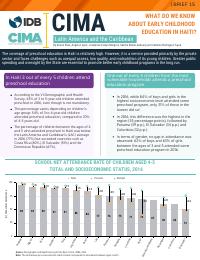
What Do We Know About Early Childhood Education in Haiti? (CIMA Brief 15)
Summary — A short IDB CIMA brief assembling what is known about preschool education in Haiti.
Key Findings
- Gives the share of children aged 3 to 5 who attended a preschool program in 2016.
- Part of the CIMA regional education indicator series, so Haiti is presented comparably to other countries in the region.
Full Description
A short IDB CIMA brief assembling what is known about preschool education in Haiti. Four pages, but it gives the preschool attendance rate, a figure the education statistics rarely isolate.
Full Document Text
Extracted text from the original document for search indexing.
| |BRIEF
BRIEF15
15
CIMA
WHAT DO WE KNOW
ABOUT EARLY CHILDHOOD
EDUCATION IN HAITI?
Latin America and the Caribbean
By Alison Elias, Angela Lopez, JosephineéEvelyn Margron, Sabine RiebleéAubourg and Catalina Rodriguez Tapia
The coverage of preschool education in Haiti is relatively highê However, it is a service provided primarily by the private
sector and faces challenges such as unequal access, low quality, and malnutrition of its young childrenê Greater public
spending and oversight by the State are essential to promote better early childhood programs in the long runê
One out of every 5 children from the most
In Haiti 3 out of every 5 children attend vulnerable households attends a preschool
preschool education education program
According to the VI Demographic and Health In 2016, while 84% of boys and girls in the
Survey, 63% of 3 to 5-year-old children attended
preschool in 2016, even though is not mandatory. highest socioeconomic level attended some
preschool program, only 31% of those in the
This percentage varies depending on children’s lowest did so.1
age group: 54% of 3 to 4-year-old children
attended preschool education, compared to 70% In 2016, this difference was the highest in the
of 4-5 years old. region (53 percentage points), followed by
The percentage of children between the ages of 4 Panama (39 p.p.), El Salvador (34 p.p.) and
and 5 who attended preschool in Haiti was below Colombia (32 p.p.).
the Latin America and Caribbean's (LAC) average In terms of gender, no gap in attendance was
in 2016 (77%) but exceeded countries such as
Costa Rica (60%), El Salvador (51%) and the observed: 62% of boys and 63% of girls
Dominican Republic (67%). between the ages of 3 and 5 attended some
preschool education program in 2016.
SCHOOL NET ATTENDANCE RATE OF CHILDREN AGED 4-5
TOTAL AND SOCIOECONOMIC STATUS, 2016
Total Poorest Richest
100
+6 +8 +10
+6 +7
+15 +14
+18 +39
(%) School Net Attendance
+26 +32
75
+53 +21 +34
50
96 93 92 91 91 86 84
77 76 75 71 70 67
60 60
25 51
0
uay o
xic Per dor le ina zil LAC ma gua bia ti* ic gua ica dor
u Chi Bra y Hai ubl
Uru
g Me Ecu
a
ent Pan
a Par
om
Rep ara Cos lva
Arg a Col Nic ta R El S
an a
Source: Demographic and Health Survey (2016), Rest of LAC, CIMA, 2016ê
inic
Note: The information per socioeconomic status in Haiti corresponds to information between ages 3 and 5ê Dom
Preschool education in Haiti is provided PERCENTAGE OF PRESCHOOL EDUCATION
primarily by the private sector
SCHOOLS, BY TYPE OF FUNDING
According to data from the Ministry of Education,
86% of preschools in Haiti were private and only
14% were public in 2016. Haiti 14 86
Compared to other countries in the LAC region,
where the percentage of private schools is below Ecuador 66 34
35%, Haiti is far above average. For example, in
Ecuador 34% of early education schools are
financed by private sector providers, while in Brazil 74 26
Mexico this percentage is even lower, at 17% (CIMA,
2015).
Uruguay 79 21
This low expenditure on public education is seen
throughout the whole system. Haiti is the country in
the region that spends the least in education. In Colombia 79 21
2017, only 2% of its GDP was allocated to education,2
whereas, on average, the region spends more than Honduras 80 20
5% (CIMA, 2017).
Paraguay 81 10 9
AVERAGE SCORES, BY PRESCHOOL
ATTENDANCE Mexico 83 17
50.35
Guatemala 83 17
50.46
0 20 40 60 80 100
(%) Percentage of schools
CREOLE
Difference Public Private Mix
0.11
Source: Haiti: Situation de la petite enfance; Rest of LAC, CIMA 2015é2016ê
50.48 Getting children into preschool classrooms
50.60 does not guarantee better future learning
outcomes
FRENCH
Difference
0.12 The 2016 Haiti National Evaluation is a learning
assessment for 4th graders, administered by
the Ministry of Education and developed jointly
50.52 with the IDB and IEA. 3
50.55 70% of students who took the assessment
reported having attended preschool.
MATH For these, performance was low and did not
Difference differ much from students who did not attend
0.03 preschool. The differences were not
statistically significant which might indicate
that the quality of preschool education is low.
Attended preschool Did not attend preschool
Source: Haiti National Evaluation, 2016
Note: The scores of the assessment are based on a scale of 0 to 100ê
To ensure the quality of preschool NUMBER OF STUDENTS PER TEACHER IN
programs, having more qualified teachers
is key EARLY EDUCATION, 2013
Haiti
There are several factors that influence the degree
to which preschool program education affects child
development and future learning. Among them, the
quality of the program and the teachers is key.4
Haiti has one of the highest ratios of students per
teacher in early education in the region. In 2013, the
30
ratio was 30 students per teacher, higher than in
countries such as Colombia (24), Nicaragua (22) or Guatemala
Colombia
Guatemala (22).
From 2016-2017, only 35% of all teachers in Haiti had
received training in preschool pedagogy. 24 22
In 2012, less than 50% of teachers who were
working in preschool institutions had any training in
preschool pedagogy. 5 Nicaragua Argentina
22 13
Barbados Uruguay
PARENTAL LEARNING SUPPORT TO
CHILDREN AGED 3-5 13 12
Source: CIMA, 2013ê
12 32
Parental involvement is important to
Haiti
promote better learning amongst
infants
Belize 24 68
One of the most important predictors of child
Paraguay 17 43 43 development, other than the household’s
4
socioeconomic level, is home learning
environments. This refers to parenting practices
Mexico 5 14 62 and engagement in children’s learning activities,
such as reading books, telling stories or playing
with children.6
Cuba 20 18 76
In Haiti, father’s support for child learning,
measured as the percentage of children between
Dominican
6 31 the ages of 3 and 5 whose father engaged in 4 or
minican republic
Republic 52
more activities that promote learning, is low.
Between 2016 and 2017, 12% of infants received
7
El Salvador 628
40 support from their fathers.
This result exceeds some countries’ percentages,
55
such as the Dominican Republic (6.1), and El
Guyana 16 200
Salvador (7.9), but is below others such as Mexico
(14), Guyana (16), and Paraguay (17).
20
50 0
100 20
150 40
200 60
250 80
300
Percentage (%) Mother’s support for child learning in Haiti is also
Father's support Mother's support amongst the lowest in the region: 32% of children
receive mother support, placing Haiti below
Source: Multiple Indicator Cluster Survey (MICS), UNICEF, 2013é2017 countries such as El Salvador (40), Paraguay (43),
Note: Learning support refers to boys and girls between the ages of 3 and 5 whose and Guyana (55).
parents engaged in 4 or more activities that promote their learning and prepare them
for schoolê
PERCENTAGE OF INFANTS Good health and nutrition ensure better
WITH LOW BIRTHWEIGHT, CIRCA 2017 early childhood development
Low birthweight (less than 2,500 grams) and growth
delay resulting from malnutrition are associated with
low learning achievement at school.8
Haiti has the highest percentage of infants born with
low birthweight in the region: 17%, compared to 13% in
Guatemala, and 11% in Honduras. In Haiti, chronic
malnutrition affects 22% of children under the age of 6.9
The risk of suffering growth delay (resulting from
malnutrition) is higher amongst vulnerable households:
boys and girls whose mothers did not attend primary
school have five times greater risk of suffering growth
El Salvador
Honduras
delay, compared to children whose mothers completed
10%
11% secondary school or more.
Mexico
6%
Public spending in early childhood
Guyana
Guatemala
Nicaragua
8%
Venezuela 8%
9%
development is key to overcome Haiti’s
13% Panama challenges
9%
Brazil
9%
In recent years, the country has made important
Colombia
9%
efforts to implement policies aimed at improving
preschool education.
Ecuador
9% The Ministry of Education has:
Integrated a new curriculum for preschool education
Peru
7%
in 2014.9
Bolivia
5% Built/rehabilitated more than 300 new public
preschool institutions, thus ensuring that minimum
Chile Paraguay
6% 6% school infrastructure standards are met.
Uruguay Developed a national strategy for preschool
8% teacher training, but has not implemented it to date.
Argentina
7%
Nevertheless, greater public spending is required to
guarantee the well-being of Haiti’s youngest
children, and to ensure greater quality of preschool
education in the country.
Source: Haiti: Situation de la petite enfance; Rest of LAC: Health Situation in the Americas, Core Indicators
2018ê PAHO
Note: Low birthweight refers to all infants that were born with less than 2,500 grams of weight
Infants born with low birthweight
The Information Center for Improvement in Learning (CIMA, for its acronym in Spanish) of the Education Division of the Interé
American Development Bank seeks0 to5 promote
10 the use
15 of data
20 and indicators in evidenceébased decisionémaking when developing
education policy, with the goal of providing a quality education for allê With this objective, CIMA publishes a series of briefs that
analyze indicators that contribute to the improvement of education quality in the regionê
Web: wwwêiadbêorg/pisa | wwwêiadbêorg/cima | Twitter: @BIDEducacion
Contact: education@iadbêorg
Publication date: April, 2019
References: 1ê Enqu te Mortalit , Morbidit et Utilisation des Services (EMMUSéVI), 2016é2017ê 2ê Fortalecimiento Institucional de la Dirección General de Presupuesto del Ministerio de Economía y
Finanzas de Haití, Informe preliminar CEPAL, August 2018ê 3ê IEA refers to the International Association for the Evaluation of Educational Achievement, the assesment in reference was applied to a
representative sample of 4th grade students in the following subjects: Creole (one of Haiti’s official languages), French, and Mathematicsê 4ê Busso, Matíasê Cristia, Juliánê Hincapi , Dianaê Messina,
Juliánê Ripani, Lauraê "Aprender mejor: Políticas públicas para el desarrollo de habilidadesê" Banco Interamericano de Desarrollo (2017) 5ê Situation de la petite enfance en Haïti 6ê Shuey, Elizabeth Aê,
and Miloš Kankarašê “The Power and Promise of Early Learningê” OECD Education Working Papers, 2018, doi:10ê1787/f9b2e53féenê 7ê Multiple Indicator Cluster Survey (MICS)ê UNICEF, 2013é2017ê8ê
Berlinski & Schady (2015) “Los primeros años el bienestar infantil y el papel de las políticas públicas”ê BID 9ê Situation de la petite enfance
Copyright © 2019 InteréAmerican Development Bankê This work is licensed under a Creative Commons IGO 3ê0 AttributionéNonCommercialéNoDerivatives (CCéIGO BYéNCéND 3ê0 IGO) license
(https://creativecommonsêorg/licenses/byéncénd/3ê0/igo/legalcode) and may be reproduced with attribution to the IDB and for any nonécommercial purposeê No derivative work is allowedê
Any dispute related to the use of the works of the IDB that cannot be settled amicably shall be submitted to arbitration pursuant to the UNCITRAL rulesê The use of the IDB’s name for any purpose other
than for attribution, and the use of IDB’s logo shall be subject to a separate written license agreement between the IDB and the user and is not authorized as part of this CCéIGO licenseê
Note that link provided above includes additional terms and conditions of the licenseê
The opinions expressed in this publication are those of the authors and do not necessarily reflect the views of the InteréAmerican Development Bank, its Board of Directors, or the countries they
representê
How to cite
Inter-American Development Bank (IDB), 2019, What Do We Know About Early Childhood Education in Haiti? (CIMA Brief 15), accessed via HaitiDocs, https://www.haitidocs.org/doc/idb-cima-brief-early-childhood-education-haiti