
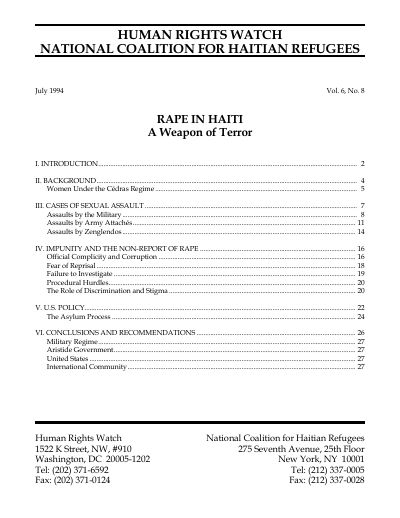
Rape in Haiti: A Weapon of Terror
- The authors conclude that the military and its auxiliaries used rape as a weapon of political persecution targeting women known or perceived to be Aristide supporters.
- The report documents first-hand nearly a dozen rape and attempted rape cases between August 1992 and February 1994.
- The UN/OAS Civilian Mission collected evidence of another sixty-six rapes of a political nature, and the Inter-American Commission documented twenty-one.
- Women were reluctant to report rape because of fear of reprisal, official complicity, procedural hurdles and stigma, and no investigations were conducted.
- The authors fault United States policy on asylum claims by women and on a possible amnesty for officials responsible for abuses.
Human Rights Watch and the National Coalition for Haitian Refugees (NCHR) conclude that, after the coup d'état of September 30, 1991 that overthrew President Jean-Bertrand Aristide, the military and its auxiliaries used sexual assault targeting women known or perceived to be Aristide supporters, and women activists. The report documents first-hand nearly a dozen rape and attempted rape cases between August 1992 and February 1994, from a joint mission in February 1994, and cites the UN/OAS Civilian Mission, which collected evidence of another sixty-six political rapes, and the Inter-American Commission on Human Rights, which documented twenty-one.
It describes assaults by soldiers, by army attachés and by zenglendos, and analyzes impunity: official complicity, fear of reprisal, failure to investigate, procedural hurdles, and stigma. It criticizes United States policy, including the treatment of asylum claims by women, and makes recommendations to the military regime, the Aristide government, the United States and the international community.
How to cite
Human Rights Watch (HRW); National Coalition for Haitian Rights (NCHR), 1994, Rape in Haiti: A Weapon of Terror, https://hrw.org/reports/pdfs/h/haiti/haiti947.pdf
- Rights holder
- Human Rights Watch (HRW)|National Coalition for Haitian Rights (NCHR)