Texte Intégral du Document
Texte extrait du document original pour l'indexation.
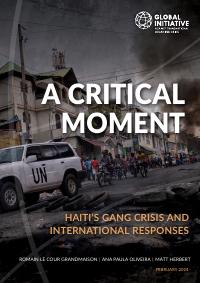
ww A CRITICAL
MOMENT
HAITI’S GANG CRISIS AND
INTERNATIONAL RESPONSES
ROMAIN LE COUR GRANDMAISON | ANA PAULA OLIVEIRA | MATT HERBERT
FEBRUARY 2024
Maur
© 2024 Global Initiative Against Transnational Organized Crime
All rights reserved.
No part of this publication may be reproduced or transmitted in any form
or by any means without permission in writing from the Global Initiative.
Cover photo: Ricardo Arduengo/AFP via Getty Images
Cartography: Rudi de Lange
Please direct inquiries to:
The Global Initiative Against Transnational Organized Crime
Avenue de France 23
Geneva, CH-1202
Switzerland
www.globalinitiative.net
ACKNOWLEDGEMENTS
The authors would like to thank the people in Haiti who made this investigation
possible. Although for security reasons their names cannot appear in the report,
their support and openness has been crucial to this work. The authors would also
like to thank Mark Shaw for his comments, the editor and the Global Initiative
Against Transnational Organized Crime (GI-TOC)’s Publications team for their
support in reviewing and developing the report.
ABOUT THE AUTHORS
Romain Le Cour Grandmaison is a senior exper t at the GI-TOC. His work focuses
on criminal organizations, the state and violence in Haiti, Mexico and Central
America. He has a PhD in political science from Sorbonne University.
Ana Paula Oliveira is a senior analyst in the GI-TOC’s Global Policy team. She
provides analysis on a range of international policy issues, including the impact
of organized crime on human rights law and policy, human rights responses to
transnational organized crime, cybercrime and organized crime violence in the
context of illicit economies. Ana Paula has an LL.M. cum laude in international law
from the Graduate Institute of International and Development Studies in Geneva.
Matt Herbert is the head of research for North Africa and the Sahel at the
GI-TOC, overseeing applied field research and analysis on the political economy
of organized crime in the two regions. He also co-leads the GI-TOC initiative on
the use of targeted sanctions as tools to counter transnational organized crime
and corruption. He has a PhD in international relations from the Fletcher School
of Law & Diplomacy, Tufts Universit y, with a sub-specialization in securit y studies,
and law and development.
FROM VISION TO ACTION: A DECADE OF ANALYSIS,
DISRUPTION AND RESILIENCE
The Global Initiative Against Transnational Organized Crime was founded in 2013. Its vision was to
mobilize a global strategic approach to tackling organized crime by strengthening political commitment
to address the challenge, building the analytical evidence base on organized crime, disrupting criminal
economies and developing networks of resilience in affected communities. Ten years on, the threat
of organized crime is greater than ever before and it is critical that we continue to take action by
building a coordinated global response to meet the challenge.
CONTENTS
Abbreviations and acronyms� ��������������������������������������������������������������������������������������������������������������������������������������������������������������2
Executive summary�����������������������������������������������������������������������������������������������������������������������������������������������������������������������3
Methodology������������������������������������������������������������������������������������������������������������������������������������������������������������������������������������5
Haiti’s gangs: from territorial control to criminal governance�������������������������������������������������������������������������6
The professionalization of gangs� �����������������������������������������������������������������������������������������������������������������������������������������������6
Firearms proliferation and tactical training: The new reality� �����������������������������������������������������������������������������������������12
Gangs, vigilantes and strongmen: The new ecosystem of violence� ������������������������������������������������������������������������������13
The new logics of territorial control and rent extraction� �������������������������������������������������������������������������������������������������17
The international response to gangs in Haiti������������������������������������������������������������������������������������������������������������22
Sanctions: Developing the regime to buttress the deployment�������������������������������������������������������������������������������������� 24
The Multinational Security Support mission: A new model of international intervention
against organized crime�������������������������������������������������������������������������������������������������������������������������������������������������������������29
Potential risks and challenges for the mission���������������������������������������������������������������������������������������������������������������������33
Conclusion and recommendations����������������������������������������������������������������������������������������������������������������������������������38
Coordination and planning between the MSS mission, Sanctions Committee and Panel of Experts������������������ 38
Target criminal ecosystems to counter gangs����������������������������������������������������������������������������������������������������������������������39
Expedite sanctions designations���������������������������������������������������������������������������������������������������������������������������������������������39
Continually map criminal ecosystems������������������������������������������������������������������������������������������������������������������������������������40
Human rights and community at the centre������������������������������������������������������������������������������������������������������������������������40
Fine-tune and repeat messaging���������������������������������������������������������������������������������������������������������������������������������������������40
Notes��������������������������������������������������������������������������������������������������������������������������������������������������������������������������������������������������������41
2
ACRONYMS AND ABBREVIATIONS
BINUH United Nations Integrated Office in Haiti
BSAP Brigade de Sécurité des Aires Protégées (Protected Areas Security Brigade)
EU European Union
G9 G9 Fanmi e Alye (G9 Family and Allies), criminal federation of gangs
G-Pèp G-People, criminal federation of gangs
HNP Haitian National Police
MINUJUSTH United Nations Mission for Justice Support in Haiti
MINUSTAH United Nations Stabilization Mission in Haiti
MSS Multinational Security Support Mission in Haiti
UN United Nations
UNSC United Nations Security Council
UNSG United Nations Secretary General
3
EXECUTIVE SUMMARY
O
ver the course of 2023 and early 2024, security has continued to deteriorate alarmingly
in Haiti’s capital, Port-au-Prince, and in rural areas in the centre and south of the country.
1
Criminal gangs, the main drivers of this degradation, have grown in strength and capacity,
enabling them to supplant in part or in full the control of government forces.
2
The gangs’ domination of critical infrastructure, such as commercial and oil port terminals, major roads,
and population centres has heightened their influence over Haiti’s economy and political system. The
gangs have also imposed governance on major parts of Port-au-Prince, leading both to rising criminal
predation and human rights violations, including gender-based violence.
3
Moreover, 2023 saw the
development of particularly strong vigilante movements while the first weeks of 2024 witnessed
the rise of violent political leaders, adding to an already disastrous security situation. As one United
Nations (UN) report bluntly noted: ‘The situation is unravelling.’
4
The Haitian crisis worsened critically in 2023. UN reports indicate that in 2023, over 4 789 people
were murdered, 1 698 injured and 2 490 kidnapped, with a 2023 homicide rate of 40.9 per 100 000,
more than double the 2022 rate.
5
Besides these figures, the nature of the criminal actors has been
profoundly transformed, posing a series of challenges to international intervention. Over the past five
years, gangs have undergone a radical evolution, going from rather unstructured actors dependent
on resources provided by public or private patronage to violent entrepreneurs who have been able to
convert their territorial power into governance capabilities. This shift has been fuelled by the gangs’
unprecedented access to firearms and the Haitian state’s inability to halt their expansion, profession-
alization and propensity to impose their rule over ever larger territories, as well as by ongoing collusion
by elements of the country’s political and economic elites.
In October 2023, the United Nations Security Council (UNSC) adopted a resolution authorizing a
non-UN multinational security support (MSS) mission to Haiti. After long negotiations, the Kenyan
government agreed to lead the deployment, aimed at supporting the Haitian National Police (HNP)
in addressing gang violence and re-establishing security,
6
although the planned operation is currently
being challenged in the Kenyan courts.
7
This resolution came after the UNSC agreed a sanctions
regime for Haiti in October 2022, and the subsequent imposition of sanctions on key gang leaders,
businessmen and politicians. The UN sanctions have been supplemented by unilateral designations
issued by Canada, the US, and the European Union (EU). Further UN sanctions were levied on gang
leaders in December 2023, as the preparations accelerated for the MSS deployment.
4
Intervention by the UN in Haiti is not new, with the embryonic MSS mission representing the third initiative
in as many decades. However, the proposed international mission stands out, both for Haiti and more broadly
for international responses to organized criminal violence. Historically, the UN has become involved in Haiti in
response to political crises, worsening insecurity and repeated natural disasters.
8
While the 2004-2017 United
Nations Stabilisation Mission in Haiti (MINUSTAH) engaged in counter-gang operations, largely in and around
Por t-au-Prince, this came after the force had been on the ground for several years and was generally intermittent.
9
In contrast, the prospective 2024 intervention will be conducted outside the auspices of the UN and has been
motivated by, and focuses on, criminal gangs as the main threat to peace and security. This reflects the substantial
change in gangs’ power, structure and capacity for territorial governance since the MINUSTAH era. These entities
are nowadays far more economically autonomous and territorially power ful, making them less controllable. As one
Haitian entrepreneur described the contemporar y evolution of the gangs: ‘We saw a lion being born, we fed it and
watched it grow, we tried to domesticate it, but the animal eventually escaped from the cage, and here we are.’
10
Nonetheless, the focus by the UNSC on profit-oriented criminal entities as primary conflict actors in their own
right, in both the resolutions setting up the sanctions regime and the MSS mission, is a substantial conceptual shift
for the UN.
11
Given the growth of transnational organized crime, and expansion of instabilit y and violence linked to
such crime, situations like the present one in Haiti are likely to become more common. The UN’s current initiatives
on Haiti potentially augur a new international approach to how organized crime actors can be tackled both from
a security and human rights perspective. Ensuring international tools are effective in mitigating harm caused by
gangs in Haiti is therefore vitally important for the people of the country, and for the international community.
FIGURE 1 Violence, crime and drivers of insecurity in
Haiti, 2023.
SOURCE: BINUH report (S/2024/62), 15 January 2024
146 584
internally displaced persons
Homicide rate
40.9 per 100 000
(more than double the 2022 rate
of 18.1 per 100 000)
Kidnappings
2 490 victims
(+83% compared to 2022)
48 police officers
have been killed and 75 injured
More than 4.35 million people
(more than 40% of the population),
are facing acute food insecurity.
Detainees in prison
11 822
(rate occupancy of 307%)
Homicides
4 789, including 465 women,
93 boys and 48 girls
(+119.4% compared to 2022)
5
The situation presents an extremely difficult test. Haitian armed groups today are more militarily
powerful, networked, and resilient than those during the MINUSTAH intervention. It is therefore
essential that the various international tools be tailored to the rapidly evolving criminal and violence
dynamics on the ground, and be implemented in a strategically coordinated fashion. Meetings between
Kenyan and Haitian police teams have taken place, as well as trainings, and vetting processes prior
to deployment. However, the proposed mission, the UNSC and the Haitian government have yet
to present a public plan and strategy for the intervention, either for short-term engagement on the
ground or for a long-term political solution.
12
This policy report is intended to further efforts to tailor both the MSS mission and the sanctions regime
to the current operational challenges in Haiti, support Haitian and international decision-makers in
their mission, and provide strategic backing to the country’s civil society.
It begins by detailing the current situation on the ground, including gangs and other violent groups’
operations, governance and territorial domination. The next section details the mandate and oper-
ations of the two primary international tools, the sanctions regime and the MSS mission. The third
section flags key issues which need to be considered for both the sanctions regime and the interna-
tional force, and presents opportunities to align the two more comprehensively, to strengthen public
security responses and public policy initiatives so as to resolve the crisis.
This report is the first of several planned publications on the political economy of violence in Haiti
and the international cooperation that seeks to uproot it. It follows a 2022 Global Initiative Against
Transnational Organized Crime (GI-TOC) report on gang evolution and a 2023 GI-TOC report on
gender-based violence in the country.
13
Methodology
The methodology for this report is primarily qualitative, combining fieldwork observation and inter-
views conducted in Haiti in November 2023, and desk research. It is based on 36 interviews with
UN officials, Haitian civil society members, public and private sector actors, politicians, police forces,
humanitarian actors, diplomats and other locals, and the wider international community. It also draws
on UN Security Council resolutions, reports by UN agencies and the Haiti Panel of Experts, and
research conducted by think tanks and academics on gang dynamics and instability. Finally, the study
also draws on broader research and analysis conducted by the GI-TOC on organized crime in Haiti,
UN action against organized crime, and the use of sanctions to address transnational organized crime.
All interviews and fieldwork activities were conducted by GI-TOC teams. For security reasons, the
names of the interviewees are not given.
6
HAITI’S GANGS: FROM
TERRITORIAL CONTROL TO
CRIMINAL GOVERNANCE
G
angs in Haiti are a longstanding phenomenon.
14
They link to a tradition of non-state armed
groups that stretches back to the 1950s, with the development of the Tonton Macoutes
by President François (Papa Doc) Duvalier.
15
However, the nature of Haiti’s gangs has changed drastically in recent years. Writing during the
MINUSTAH era, in 2008, analysts flagged that ‘Haitian gangs proved to be collections of individuals
who formed around brutal and charismatic leaders, unlike the hierarchical, tightly organized turf-based
institutions found in the United States.’
16
This framing of weak, disarticulated gangs is no longer accurate. Although a vast number of Haiti’s
gangs remain small organizations, the major ones – those which control substantial territory and are
responsible for most current instability – are well-structured, well-armed and operationally competent
entities.
17
While links to politicians and businesspeople remain, the relationship is more even, with
the growing capacity of gangs allowing them to self-fund and put a considerable amount of pressure
on the political and economic system.
As a result, the international community and MSS planners confront a very different and, in many
ways, far more difficult situation than existed under MINUSTAH. This subsection maps out key ground
dynamics, delving first into gang evolution, then gang operations, before finally touching on the formal
and informal Haitian actors arrayed against gangs.
The professionalization of gangs
Gangs have grown significantly in size and diversity in comparison to the 2000s and 2010s. As of early
2024, estimates peg the number of gangs in Haiti at around 20 0,
18
and they operate mainly in the metro-
politan area of Port-au-Prince, including the communes of Port-au-Prince, Delmas, Cité Soleil, Tabarre,
Carrefour and Pétion-Ville. Their size ranges substantially, from a dozen men to several thousands.
7
Jacmel
Hinche
Jérémie
Gonaïves
Les Cayes
Cap-Haïtien
Fort-Liberté
Port-De-Paix
PORT-AU-PRINCE
Les Cayes
Sud
Sud
Nord
Ouest
Ouest
Nippes
Centre
Nord-Est
Nord-Ouest
Nord-Ouest
Grand'Anse
Grand'Anse
L'Artibonite
Sud-Est
HAITI
CUBA
DOMINICAN REPUBLIC
0 60 km
N
Port-au-Prince
Bay
Caribbean Sea
HAITI
Some gangs that had 50 or 100 active members during the MINUSTAH period now stretch to
1 500 to 2 500 members.
19
The most powerful gangs of today did not even exist a decade ago, while
new cliques emerge every week.
Gang leaders are well known in Haiti. These men combine extensive experience as gang members and
access to political and economic networks that provide them with patronage and funding, contacts within
the police and justice system, and connections capable of trafficking high-calibre weapons or drugs.
In many cases, leaders have served in Haiti’s security forces or in political parties or movements.
For example, Jimmy Chérizier (aka Barbecue), head of the G9 Fanmi e Alye (G9 Family and Allies or
G-9) coalition, is a former police officer, while Chery Christ-Rois (aka Krisla), head of Ti Bwa Gang, is
a former political activist.
Increasingly, however, Haiti’s gang leaders have begun to emerge via hierarchic advancement within
the gangs themselves, either to control established entities or leveraging their experience to found
splinter groups. Leaders such as Johnson André (aka Izo or Izo 5 Segond), head of the Village de Dieu
– 5 Segond Gang, or Renel Destina (aka Ti Lapli), who leads the Gran Ravine Gang, have been ‘gang
soldiers’ for most of their lives.
FIGURE 2 Haiti.
8
These ‘young veterans’, as one interviewee called them, have learned from mistakes made by their
former bosses, and thus run much more sophisticated organizations than their predecessors. They
resemble – in their ability to administer territories, extract resources, conduct well-designed mili-
tary-type operations, and organize, deploy and pay hundreds of men – relatively sophisticated drug
cartels, militias, or paramilitary groups, rather than the low-capacity gangs that operated in Haiti in
the 2000s and early 2010s.
Our contacts indicate that across the board, criminal structures in Haiti are much more hierarchical
and strict than before.
20
The larger gangs operate with a leadership team and exploit an organized
division of labour – from soldiers to financial officers and political advisors – while maintaining com-
mand and control structures in field areas.
21
Further, for large and well-known gangs in Port-au-Prince,
recruitment processes have been developed and entail discrete taskings and tests, making it more
difficult to join gangs’ ranks, parallel to forced recruitment. Members who have sought to leave gangs,
including children, risk being killed.
22PORT-AU-PRINCE
Tabarre
Cit