
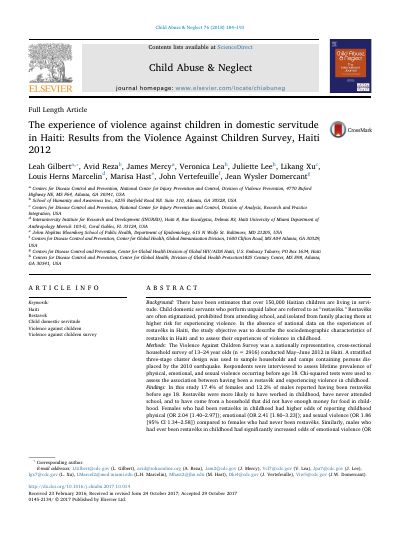
The experience of violence against children in domestic servitude in Haiti: Results from the Violence Against Children Survey, Haiti 2012
- 4% of females and 12.2% of males aged 13 to 24 reported having been restavèks before age 18.
- Restavèks were more likely to have worked in childhood, to have never completed primary school and to come from households without enough money for food.
- Female restavèks had higher odds than other females of childhood physical, emotional and sexual violence.
- Male restavèks had higher odds of emotional and sexual violence but did not differ in childhood physical violence.
- The authors tie the persistence of the practice to weak enforcement of human rights law and poor economic circumstances.
The article reports on the Violence Against Children Survey, a nationally representative household survey of 13 to 24 year olds conducted in May and June 2012, with a sample that includes camps for people displaced by the 2010 earthquake. Respondents were asked whether they had ever worked as a restavèk, meaning an unpaid child domestic servant, and about physical, emotional and sexual violence before age 18. The authors, from the Centers for Disease Control and Prevention and the Interuniversity Institute for Research and Development, describe who becomes a restavèk and compare the two groups.
The survey finds that 17.4% of females and 12.2% of males reported having been restavèks. Restavèks were more likely to have worked, to have never completed primary school and to come from households without enough money for food. Female restavèks had higher odds of physical, emotional and sexual violence, and male restavèks had higher odds of emotional and sexual violence. The authors conclude that the practice persists because of weak enforcement of human rights law and poor economic conditions.
How to cite
Child Abuse & Neglect, 2018, The experience of violence against children in domestic servitude in Haiti: Results from the Violence Against Children Survey, Haiti 2012, https://doi.org/10.1016/j.chiabu.2017.10.014
- Rights holder
- Child Abuse & Neglect