Full Document Text
Extracted text from the original document for search indexing.
global information and early warning system on food and agriculture GIEWS
GIEWS Update 4 June 2025
The Republic of Haiti
Critical levels of acute food insecurity likely to worsen
amid heightened insecurity
Record acute food insecurity level between
March and June 2025
Acute food insecurity conditions have deteriorated
steadily since 2018 and, following an upsurge in
violence in 2024, they have reached a record level in
March–June 2025, driven by high food prices, limited
access to markets and low levels of agricultural
production. A multi-gang coalition, established in 2024,
continues to exert control over the local population,
exacerbating the economic downturn on the
backdrop of a fragile political transition.
According to the latest Integrated Food Security
Phase Classification (IPC) Projection Update,
i
about
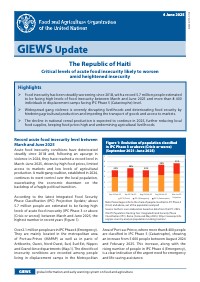
5.7 million people are estimated to be facing high
levels of acute food insecurity (IPC Phase 3 or above
[Crisis or worse]) between March and June 2025, the
highest number in recent years (Figure 1).
Over 2.1 million people are in IPC Phase 4 (Emergency).
They are mainly located in the metropolitan area
of Port-au-Prince (MAPAP) as well as in parts of
Artibonite, Ouest, Nord-Ouest, Sud, Sud
‑Est, Nippes
and Grand‑Anse departments (Map 1). The direst food
insecurity conditions are recorded among people living in displacement camps in the Metropolitan
Highlights
¾F
to be facing high levels of food insecurity between March and June 2025 and more than 8 400
individuals in displacement camps facing IPC Phase 5 (Catastrophe) level.
¾W idespread gang violence is severely disrupting livelihoods and deteriorating food security by
hindering agricultural production and impeding the transport of goods and access to markets.
¾The decline in national cereal production is expected to continue in 2025, further reducing local
food supplies, keeping food prices high and undermining agricultural livelihoods.
ISSN 2707-1723
Figure 1: Evolution of population classified
in IPC Phase 3 or above (Crisis or worse)
(September 2021–June 2025)
Note: Percentages refer to the share of people classified in IPC Phase 3
(Crisis) and above, out of the population analysed
Source: Author's own elaboration based on data from the IPC. 2025.
The IPC Population Tracking Tool. Integrated Food Security Phase
Classification (IPC). Rome. [Accessed May 2025]. https://www.ipcinfo.
org/ipc-country-analysis/population-tracking-tool/en/.
Area of Port-au-Prince, where more than 8 400 people
are classified in IPC Phase 5 (Catastrophe), showing
an increase from 5 600 people between August 2024
and February 2025. This increase, along with the
rising number of people in IPC Phase 4 (Emergency),
is a clear indication of the urgent need for emergency
and life
‑saving assistance.
-
1
2
3
4
5
6
7
Sep 21-Feb 22 Sep 22-Feb 23 Aug 23-Feb 24 Aug 24-Feb 25 Mar-Jun 25
Projection
Millions
IPC 3 (Crisis)IPC 4 (Emergency)IPC 5 (Catastrophe)
44%
48%
44%
48%
51%
2
The latest assessment by the International
Organization for Migration (IOM)
ii
estimates that
about 1.04 million were internally displaced
persons (IDPs) as of December 2024, well above the
314 000 figure estimated one year earlier. Heightened
violence continued to cause displacements in
2025, with 60 000 people fleeing their homes in
the first months of the year.
iii
Most IDPs reside
with host families or in rented accommodations,
straining the already overstretched local resources
and increasing pressure on host communities. About
17 percent of IDPs reside in displacement camps
mostly concentrated in the Metropolitan Area of
Port
‑au‑Prince,
iv
where access to food, potable water
and sanitation systems are severely constrained. The suspension of several emergency food aid and resilience projects in early 2025, due to a significant reduction in financial resources for international assistance, is likely to further worsen local food security conditions.
Heightened violence further deteriorates
food insecurity
Since early 2024, a multi-gang coalition has
expanded its control in and beyond Port-au-Prince.
Repeated attacks on dwellings and essential services,
such as hospitals and schools, and the increased
control over airports, ports, borders and main roads
further deteriorated living conditions of the local
population. Armed violence has also exacerbated
food insecurity by hindering agricultural production,
the delivery of humanitarian assistance and the free
movements of people and commodities. Although
the Multinational Security Support Mission was
deployed in June 2024 to support the fight against
criminal groups, it continues to face significant
challenges due to lack of funding and personnel.
Amid worsening civil security, growing concerns
are emerging about the organization of the next
presidential election, currently planned to take
place in late 2025.
Cereal production expected to decline
further in 2025
Domestic cereal production has been declining since
2018 and is expected to contract further in 2025,
further straining local food supplies and undermining
agricultural livelihoods. Lack of agricultural inputs,
deterioration of assets and persisting insecurity
conditions have led to land abandonment and low
crop yields. Increasing road blocks between rural
areas and the capital city, Port-au-Prince, has limited
the availability of basic food products and driven up
prices, further worsening the food security situation.
Map 1: Projection update for the IPC Acute Food Insecurity situation (March–June 2025)
More than half of the population in Haiti will likely
experience high levels of acute food insecurity —IPC
Phase 3 or above—between March and June 2025.
5.7 M
Key figures for the projection update | March - June 2025
Projection update for the Acute Food Insecurity situation | March - June 2025
Overview
More than half of Haiti’s population—approximately 5.7 million people—are
facing high levels of acute food insecurity, driven by relentless gang violence
and ongoing economic collapse, according to the latest IPC analysis.
The food security situation in Haiti continues to deteriorate. Out of the 5.7
million people facing high levels of acute food insecurity, classified in Crisis
or worse (IPC Phase 3 or above)—the highest number in recent years—over
8,400 people living in displacement camps are experiencing catastrophic
hunger in IPC Phase 5 (Catastrophe). An additional 2.1 million people,
representing 19 per cent of the analysed population, are in IPC Phase 4
(Emergency), facing critical food insecurity, while 3.6 million people (32 per
cent) are classified in IPC Phase 3 (Crisis).
An upsurge in violence in the metropolitan area, the West, and the
department of Artibonite continues to intensify population displacement,
particularly in the Port-au-Prince metropolitan area. According to figures
from the International Organization for Migration (IOM), around 1.04 million
people were internally displaced in December 2024—an increase of 48
per cent compared to June 2024. In addition to forcing households into
mass displacement, the violence continues to cause the loss of income
opportunities in both informal and formal sectors, while also disrupting
supply chains. These shocks add to structural factors such as low agricultural
production linked to under-modernised systems, which only cover a
limited portion of the country’s food needs. Households’ economic access
to food has been further constrained by rising commodity prices and an
inflation rate of 30 per cent in February 2025, against a backdrop of declining
household incomes across both the metropolitan area and the rest of the
country. Moreover, a large number of emergency food aid and population
resilience support projects were suspended in the first quarter of 2025.
Between August 2024 and February 2025, nearly 977,000 Haitians received
humanitarian food assistance on a monthly basis—albeit with rations
reduced by between 25 and 50 per cent. This assistance has been crucial
in preventing further deterioration into the most severe phases, particularly
among urban and displaced populations with no access to livelihood
opportunities due to insecurity. However, since March 2025, funding has no
longer been guaranteed.
Given the uncertainty surrounding funding and the IPC’s criteria for factoring
this into analysis, no humanitarian food assistance has been considered in
this update—just as in the projection made in August 2024. This update
shows an increase of more than 300,000 people in IPC Phase 3 compared
to the current period (August 2024 to February 2025), and a deterioration
of more than 100,000 people compared to the previous projection. This
includes an increase in the IPC Phase 5 (Catastrophe) population in IDP
camps from 5,600 to 8,400 people. Sixteen zones are now classified in
Phase 4 (Emergency), up from fifteen in the previous analysis, following the
reclassification of the Artibonite zone from Crisis to Emergency. The increase
in the number of people in Phase 4 and Phase 5 is a clear indication of the
urgent need for immediate and life-saving assistance.
Humanitarian assistance remains essential, and recovery efforts are urgently
needed to stem the decline in food and nutritional security, particularly
in displacement camps and the Artibonite HT01 region. Haiti’s economy
is characterised by extreme poverty, high levels of informal employment,
and vulnerability to natural disasters. Political instability and violence further
hamper development. It remains the poorest country in the Western
Hemisphere, with a significant portion of the population living below the
poverty line and relying on subsistence farming.
Artibonite
Centre
Grande-anse
Nippes
Nord
Nord-Est
Nord-ouest
Sud
Sud-Est
Ouest
DOMINICAN
REPUBLIC
H A I T I
PV2-Ouest
HT07
Cite Soleil_TP
Tabarre P+PT
Port-au-Prince
Ville des
Gonaives
Haut Plateau HT04
Bas Plateau HT03
Ouest_HT01-La
Gonave
Ouest HT05
Ouest HT06
Ouest HT07+HT03
Sud-Est HT01 Sud-Est HT07
Nord HT02
Nord HT03
Nord- est HT02+HT03
Artibonite HT01+HT05+HT08
Artibonite HT03
Artibonite HT04
Sud HT01
Sud HT07
Sud HT08
Grande-anse HT07
Grande-anse HTO8+Jerémie
Nord-ouest
HT01
Nord-ouest
HT02
Nippes HT01
Nippes HT07+HT08
Croix de Bo uquet
Ville des
Cayes
Petion-Ville
Sud-Est
HT01
Artibonite HT01+HT05+HT08
Lake Peligre
Etang SaumatreC ARIBBEAN SEA
±
0 10050
km
Ouanaminthe
Ville de
Ville du Cap-Haitien
Nord-ouest HT02
Nippes HT01
Grande-anse HTO8+Jerémie
Nippes HT01
Sud HT08
KEY LEGEND
IPC Acute Food Insecurity Phase
Classification
(mapped Phase represents highest severity
affecting at least 20% of the population)
Key Drivers
Poor infrastructure
The lingering impact of the 2021 earthquake continues
to hinder the movement of food and essential goods,
as damaged infrastructure remains a major obstacle to
supply chains and humanitarian access.
Armed gang violence
The recent intensification of armed gang violence
especially in Port-au-Prince continues to severely
disrupt livelihoods and limit the movement of people
and essential goods.
Economic shocks
The combination of a shrinking GDP over the past six years, , low agricultural production, high food prices caused by inflation nearing 30 percent as of February 2025, and unemployment in both informal and formal sectors has significantly limited households’ financial access to food.
Recommended Actions
Published on 14 April 2025
HAITI: IPC Acute Food Insecurity Snapshot | March - June 2025
Publication date: 14 April 2025. Demographic data is based on the Haitian Institute of Statistics and Informatics (IHSI). | Feedback: IPC@FAO.org |
Disclaimer: The information shown on this map does not imply official recognition or endorsement of physical or political boundaries.
Emergency assistance
Given the severity of food insecurity in areas in Phase
4 and 5, immediate emergency aid is critical. Support
should prioritise the poorest households to meet
urgent food needs, save lives, and prevent the collapse
of livelihoods and income sources.
Livelihood support
Households affected by repeated shocks need urgent support to rebuild their livelihoods. Priority actions include providing agricultural and livestock inputs, rural credit, and tools to boost food production, support the 2025 spring season, and restore income- generating activities.
Resilience building
Ensuring long-term food security means linking emergency aid with sustainable development. This requires tackling root causes like weak agriculture, poor service access, and governance gaps. Aligning interventions with the Humanitarian-Development- Peace Nexus can drive lasting improvements beyond short-term crisis response.
None
Stressed
Crisis
Emergency
Catastrophe
32%
23%
26%
19%
11.2 M
Population
analysed
Population Estimates in IPC Phase 3 or above | 2019 - 2025
5 M
6 M
1 M
0
2 M
3 M
4 M
(Millions)
3 - Crisis 4 - Emergency 5 - Catastrophe
Mar - Jun
2020
Mar - Jun
2021
Mar - Jun
2021
Mar - Jun
2022
Mar - Jun
2023
Mar - Jun
2023
Mar - Jun
2024
Mar - Jun
2024
Mar - Jun
2025
Mar - Jun
2019
1 - Minimal
2 - Stressed
3 - Crisis
4 - Emergency
5 - Famine
> 25% of households meet 25-50%
of caloric needs through assistance
> 25% of households meet > 50%
of caloric needs through assistance
IDPs/other settlements
classification
Area receives significant
humanitarian food assistance
(accounted for in Phase classification)
Areas with inadequate evidence
Areas not analysed
Urban settlement
classification
Acceptable
Medium
High
Scarce evidence due to limited or
no humanitarian access
Evidence Level
*
**
***
Map Symbols1 - Minimal
2 - Stressed
3 - Crisis
4 - Emergency
5 - Famine
> 25% of households meet 25-50%
of caloric needs through assistance
> 25% of households meet > 50%
of caloric needs through assistance
IDPs/other settlements
classification
Area receives significant
humanitarian food assistance
(accounted for in Phase classification)
Areas with inadequate evidence
Areas not analysed
Urban settlement
classification
Acceptable
Medium
High
Scarce evidence due to limited or
no humanitarian access
Evidence Level
*
**
***
Map Symbols
1 - Minimal
2 - Stressed
3 - Crisis
4 - Emergency
5 - Famine
> 25% of households meet 25-50%
of caloric needs through assistance
> 25% of households meet > 50%
of caloric needs through assistance
IDPs/other settlements
classification
Area receives significant
humanitarian food assistance
(accounted for in Phase classification)
Areas with inadequate evidence
Areas not analysed
Urban settlement
classification
Acceptable
Medium
High
Scarce evidence due to limited or
no humanitarian access
Evidence Level
*
**
***
Map Symbols
1 - Minimal
2 - Stressed
3 - Crisis
4 - Emergency
5 - Famine
> 25% of households meet 25-50%
of caloric needs through assistance
> 25% of households meet > 50%
of caloric needs through assistance
IDPs/other settlements
classification
Area receives significant
humanitarian food assistance
(accounted for in Phase classification)
Areas with inadequate evidence
Areas not analysed
Urban settlement
classification
Acceptable
Medium
High
Scarce evidence due to limited or
no humanitarian access
Evidence Level
*
**
***
Map Symbols
1 - Minimal
2 - Stressed
3 - Crisis
4 - Emergency
5 - Famine
> 25% of households meet 25-50%
of caloric needs through assistance
> 25% of households meet > 50%
of caloric needs through assistance
IDPs/other settlements
classification
Area receives significant
humanitarian food assistance
(accounted for in Phase classification)
Areas with inadequate evidence
Areas not analysed
Urban settlement
classification
Acceptable
Medium
High
Scarce evidence due to limited or
no humanitarian access
Evidence Level
*
**
***
Map Symbols
Catastrophe
Source: IPC. 2025. HAITI : IPC Acute Food Insecurity Snapshot, March–June 2025. Integrated Food Security Phase Classification (IPC). Rome. 14 April 2025.
https://www.ipcinfo.org/fileadmin/user_upload/ipcinfo/docs/IPC_Haiti_Acute_Food_Insecurity_Mar_Jun2025_Snapshot_English.pdf.
More than half of the population in Haiti will likely
experience high levels of acute food insecurity —IPC
Phase 3 or above—between March and June 2025.
5.7 M
Key figures for the projection update | March - June 2025
Projection update for the Acute Food Insecurity situation | March - June 2025
Overview
More than half of Haiti’s population—approximately 5.7 million people—are
facing high levels of acute food insecurity, driven by relentless gang violence
and ongoing economic collapse, according to the latest IPC analysis.
The food security situation in Haiti continues to deteriorate. Out of the 5.7
million people facing high levels of acute food insecurity, classified in Crisis
or worse (IPC Phase 3 or above)—the highest number in recent years—over
8,400 people living in displacement camps are experiencing catastrophic
hunger in IPC Phase 5 (Catastrophe). An additional 2.1 million people,
representing 19 per cent of the analysed population, are in IPC Phase 4
(Emergency), facing critical food insecurity, while 3.6 million people (32 per
cent) are classified in IPC Phase 3 (Crisis).
An upsurge in violence in the metropolitan area, the West, and the
department of Artibonite continues to intensify population displacement,
particularly in the Port-au-Prince metropolitan area. According to figures
from the International Organization for Migration (IOM), around 1.04 million
people were internally displaced in December 2024—an increase of 48
per cent compared to June 2024. In addition to forcing households into
mass displacement, the violence continues to cause the loss of income
opportunities in both informal and formal sectors, while also disrupting
supply chains. These shocks add to structural factors such as low agricultural
production linked to under-modernised systems, which only cover a
limited portion of the country’s food needs. Households’ economic access
to food has been further constrained by rising commodity prices and an
inflation rate of 30 per cent in February 2025, against a backdrop of declining
household incomes across both the metropolitan area and the rest of the
country. Moreover, a large number of emergency food aid and population
resilience support projects were suspended in the first quarter of 2025.
Between August 2024 and February 2025, nearly 977,000 Haitians received
humanitarian food assistance on a monthly basis—albeit with rations
reduced by between 25 and 50 per cent. This assistance has been crucial
in preventing further deterioration into the most severe phases, particularly
among urban and displaced populations with no access to livelihood
opportunities due to insecurity. However, since March 2025, funding has no
longer been guaranteed.
Given the uncertainty surrounding funding and the IPC’s criteria for factoring
this into analysis, no humanitarian food assistance has been considered in
this update—just as in the projection made in August 2024. This update
shows an increase of more than 300,000 people in IPC Phase 3 compared
to the current period (August 2024 to February 2025), and a deterioration
of more than 100,000 people compared to the previous projection. This
includes an increase in the IPC Phase 5 (Catastrophe) population in IDP
camps from 5,600 to 8,400 people. Sixteen zones are now classified in
Phase 4 (Emergency), up from fifteen in the previous analysis, following the
reclassification of the Artibonite zone from Crisis to Emergency. The increase
in the number of people in Phase 4 and Phase 5 is a clear indication of the
urgent need for immediate and life-saving assistance.
Humanitarian assistance remains essential, and recovery efforts are urgently
needed to stem the decline in food and nutritional security, particularly
in displacement camps and the Artibonite HT01 region. Haiti’s economy
is characterised by extreme poverty, high levels of informal employment,
and vulnerability to natural disasters. Political instability and violence further
hamper development. It remains the poorest country in the Western
Hemisphere, with a significant portion of the population living below the
poverty line and relying on subsistence farming.
Artibonite
Centre
Grande-anse
Nippes
Nord
Nord-Est
Nord-ouest
Sud
Sud-Est
Ouest
DOMINICAN
REPUBLIC
H A I T I
PV2-Ouest
HT07
Cite Soleil_TP
Tabarre P+PT
Port-au-Prince
Ville des
Gonaives
Haut Plateau HT04
Bas Plateau HT03
Ouest_HT01-La
Gonave
Ouest HT05
Ouest HT06
Ouest HT07+HT03
Sud-Est HT01 Sud-Est HT07
Nord HT02
Nord HT03
Nord- est HT02+HT03
Artibonite HT01+HT05+HT08
Artibonite HT03
Artibonite HT04
Sud HT01
Sud HT07
Sud HT08
Grande-anse HT07
Grande-anse HTO8+Jerémie
Nord-ouest
HT01
Nord-ouest
HT02
Nippes HT01
Nippes HT07+HT08
Croix de Bo uquet
Ville des
Cayes
Petion-Ville
Sud-Est
HT01
Artibonite HT01+HT05+HT08
Lake Peligre
Etang SaumatreC ARIBBEAN SEA
±
0 10050
km
Ouanaminthe
Ville de
Ville du Cap-Haitien
Nord-ouest HT02
Nippes HT01
Grande-anse HTO8+Jerémie
Nippes HT01
Sud HT08
KEY LEGEND
IPC Acute Food Insecurity Phase
Classification
(mapped Phase represents highest severity
affecting at least 20% of the population)
Key Drivers
Poor infrastructure
The lingering impact of the 2021 earthquake continues
to hinder the movement of food and essential goods,
as damaged infrastructure remains a major obstacle to
supply chains and humanitarian access.
Armed gang violence
The recent intensification of armed gang violence
especially in Port-au-Prince continues to severely
disrupt livelihoods and limit the movement of people
and essential goods.
Economic shocks
The combination of a shrinking GDP over the past six years, , low agricultural production, high food prices caused by inflation nearing 30 percent as of February 2025, and unemployment in both informal and formal sectors has significantly limited households’ financial access to food.
Recommended Actions
Published on 14 April 2025
HAITI: IPC Acute Food Insecurity Snapshot | March - June 2025
Publication date: 14 April 2025. Demographic data is based on the Haitian Institute of Statistics and Informatics (IHSI). | Feedback: IPC@FAO.org |
Disclaimer: The information shown on this map does not imply official recognition or endorsement of physical or political boundaries.
Emergency assistance
Given the severity of food insecurity in areas in Phase
4 and 5, immediate emergency aid is critical. Support
should prioritise the poorest households to meet
urgent food needs, save lives, and prevent the collapse
of livelihoods and income sources.
Livelihood support
Households affected by repeated shocks need urgent support to rebuild their livelihoods. Priority actions include providing agricultural and livestock inputs, rural credit, and tools to boost food production, support the 2025 spring season, and restore income- generating activities.
Resilience building
Ensuring long-term food security means linking emergency aid with sustainable development. This requires tackling root causes like weak agriculture, poor service access, and governance gaps. Aligning interventions with the Humanitarian-Development- Peace Nexus can drive lasting improvements beyond short-term crisis response.
None
Stressed
Crisis
Emergency
Catastrophe
32%
23%
26%
19%
11.2 M
Population
analysed
Population Estimates in IPC Phase 3 or above | 2019 - 2025
5 M
6 M
1 M
0
2 M
3 M
4 M
(Millions)
3 - Crisis 4 - Emergency 5 - Catastrophe
Mar - Jun
2020
Mar - Jun
2021
Mar - Jun
2021
Mar - Jun
2022
Mar - Jun
2023
Mar - Jun
2023
Mar - Jun
2024
Mar - Jun
2024
Mar - Jun
2025
Mar - Jun
2019
1 - Minimal
2 - Stressed
3 - Crisis
4 - Emergency
5 - Famine
> 25% of households meet 25-50%
of caloric needs through assistance
> 25% of households meet > 50%
of caloric needs through assistance
IDPs/other settlements
classification
Area receives significant
humanitarian food assistance
(accounted for in Phase classification)
Areas with inadequate evidence
Areas not analysed
Urban settlement
classification
Acceptable
Medium
High
Scarce evidence due to limited or
no humanitarian access
Evidence Level
*
**
***
Map Symbols1 - Minimal
2 - Stressed
3 - Crisis
4 - Emergency
5 - Famine
> 25% of households meet 25-50%
of caloric needs through assistance
> 25% of households meet > 50%
of caloric needs through assistance
IDPs/other settlements
classification
Area receives significant
humanitarian food assistance
(accounted for in Phase classification)
Areas with inadequate evidence
Areas not analysed
Urban settlement
classification
Acceptable
Medium
High
Scarce evidence due to limited or
no humanitarian access
Evidence Level
*
**
***
Map Symbols
1 - Minimal
2 - Stressed
3 - Crisis
4 - Emergency
5 - Famine
> 25% of households meet 25-50%
of caloric needs through assistance
> 25% of households meet > 50%
of caloric needs through assistance
IDPs/other settlements
classification
Area receives significant
humanitarian food assistance
(accounted for in Phase classification)
Areas with inadequate evidence
Areas not analysed
Urban settlement
classification
Acceptable
Medium
High
Scarce evidence due to limited or
no humanitarian access
Evidence Level
*
**
***
Map Symbols
1 - Minimal
2 - Stressed
3 - Crisis
4 - Emergency
5 - Famine
> 25% of households meet 25-50%
of caloric needs through assistance
> 25% of households meet > 50%
of caloric needs through assistance
IDPs/other settlements
classification
Area receives significant
humanitarian food assistance
(accounted for in Phase classification)
Areas with inadequate evidence
Areas not analysed
Urban settlement
classification
Acceptable
Medium
High
Scarce evidence due to limited or
no humanitarian access
Evidence Level
*
**
***
Map Symbols
1 - Minimal
2 - Stressed
3 - Crisis
4 - Emergency
5 - Famine
> 25% of households meet 25-50%
of caloric needs through assistance
> 25% of households meet > 50%
of caloric needs through assistance
IDPs/other settlements
classification
Area receives significant
humanitarian food assistance
(accounted for in Phase classification)
Areas with inadequate evidence
Areas not analysed
Urban settlement
classification
Acceptable
Medium
High
Scarce evidence due to limited or
no humanitarian access
Evidence Level
*
**
***
Map Symbols
Catastrophe
3
Planting operations of the 2025 paddy and maize
crops started in April, but above-average rainfall
since mid-April caused flooding and damaged
emerging crops in localized areas. Planted area
is estimated at a below-average level as high
costs of production, compounded by heightened
insecurity, has discouraged farmers from sowing.
Weather forecasts for the May to July 2025
period indicate average rainfall amounts, which
should support favourable conditions for crop
development. However, the 2025 hurricane season
(June–November) is projected to be more active
than average, posing further risks to crops and
livelihoods, and requiring close monitoring and
preparedness.
Reduced food supply and limited access
to markets keep food prices high
The annual inflation rate has been in double
digits since 2016, steadily eroding households’
purchasing power amid disrupted livelihoods and
lack of livelihoods and lack of income
‑generating
opportunities. In 2025, the inflation rate is forecast at 27.2 percent, slightly above the 25.8 percent recorded in 2024. In March 2025, food prices were generally higher than one year before, mainly due to limited food supplies in local markets caused by the
low agricultural production in 2024. Additionally, high transport costs and difficult access to markets have further exerted upward pressure on staple food prices.
Assistance to agricultural and livestock
production planned in 2025
According to the 2025 Humanitarian Needs and
Response Plan,
v
several actions are planned in the
food security sector to provide support to vulnerable
households, in particular:
¾The distribution of short-cycle crop seeds, fishing
and livestock kits as an alternative to food aid distribution in areas that are difficult to reach.
¾The distribution of agricultural inputs and the
delivery of capacity development programmes in improving farming techniques to people in IPC Phase 4 (Emergency) in Nord
‑Ouest,
Artibonite, Grand-Anse, Sud, Nippes and Sud
‑Est departments.
¾The promotion of sustainable agricultural
practices, natural resource management and essential infrastructure protection to reinforce agrifood system resilience.
4
Notes
i.IPC. 2025. The IPC Population Tracking Tool. Integrated Food Security Phase Classification (IPC). Rome.
[Cited May 2025]. https://www.ipcinfo.org/ipc-country-analysis/population-tracking-tool/en/.
ii.IOM. 2025. Round 9 - December 2024, DTM Assessment of the displacement situation in Haiti. International
Organization for Migration (IOM). Haiti. 14 January 2025. https://dtm.iom.int/sites/g/files/tmzbdl1461/
files/reports/Displacement%20situation%20in%20Haiti%20-%20Round%209%20-%20December%20
2024.pdf?iframe=true.
iii.IOM. 2025. News – Global: Violence Triggers Record Displacements in Port-au-Prince: Over 60 000 People in a
Month. International Organization for Migration (IOM). Haiti. 18 March 2025. https://www.iom.int/news/
violence-triggers-record-displacements-port-au-prince-over-60000-people-month.
iv.IOM. 2025. Round 9 - December 2024, DTM Assessment of the displacement situation in Haiti. International
Organization for Migration (IOM). Haiti. 14 January 2025. https://dtm.iom.int/sites/g/files/tmzbdl1461/
files/reports/Displacement%20situation%20in%20Haiti%20-%20Round%209%20-%20December%20
2024.pdf?iframe=true.
v.OCHA. 2025. Haïti : Besoins Humanitaires et Plan de Réponse 2025 (février 2025). UN Office for the Coordination
of Humanitarian Affairs (OCHA). Haiti. 9 February 2025. https://www.unocha.org/publications/report/
haiti/haiti-besoins-humanitaires-et-plan-de-reponse-2025-fevrier-2025.
This report was prepared by the Global Information and Early Warning System (GIEWS) of the Markets and
Trade Division of FAO. The updates focus on developing anomalous conditions aimed at providing early warnings,
as well as latest and more elaborate information than other GIEWS regular reports on the food security situation
of countries, at both national and sub-national levels. None of the information in this report should be regarded
as statements of governmental views.
For more information visit the GIEWS Website at: http://www.fao.org/giews/en/
Enquiries may be directed to:
Global Information and Early Warning System on Food and Agriculture (GIEWS)
Markets and Trade - Economic and Social Development
GIEWS1@fao.org
Food and Agriculture Organization of the United Nations (FAO)
Rome, Italy
The Global Information and Early Warning System on Food and Agriculture (GIEWS) has set up a
mailing list to disseminate its reports. To subscribe, submit the Registration Form on the following link:
http://newsletters.fao.org/k/Fao/markets_and_trade_english_giews_world.
The designations employed and the presentation of material in this information product do not imply the expression of
any opinion whatsoever on the part of the Food and Agriculture Organization of the United Nations (FAO) concerning
the legal or development status of any country, territory, city or area or of its authorities, or concerning the delimitation
of its frontiers or boundaries. Dashed lines on maps represent approximate border lines for which there may not yet
be full agreement. The mention of specific companies or products of manufacturers, whether or not these have been
patented, does not imply that these have been endorsed or recommended by FAO in preference to others of a similar
nature that are not mentioned.
ISSN 2707-1723 [Print]
ISSN 2707-1731 [Online]
© FAO, 2025
Some rights reserved. This work is made available under the Creative Commons Attribution- 4.0 International licence
(CC
BY 4.0: https://creativecommons.org/licenses/by/4.0/legalcode.en
).
Under the terms of this licence, this work may be copied, redistributed and adapted, provided that the work is appropriately cited. In any use of this work, there should be no suggestion that FAO endorses any specific organization, products or services. The use of the FAO logo is not permitted. If a translation or adaptation of this work is created, it must include the following disclaimer along with the required citation: “This translation [or adaptation] was not created by the Food and Agriculture Organization of the United Nations (FAO). FAO is not responsible for the content or accuracy of this translation [or adaptation]. The original [Language] edition shall be the authoritative edition.”
Any dispute arising under this licence that cannot be settled amicably shall be referred to arbitration in accordance
with the Arbitration Rules of the United Nations Commission on International Trade Law (UNCITRAL). The parties shall
be bound by any arbitration award rendered as a result of such arbitration as the final adjudication of such a dispute.
Third-party materials.
This Creative Commons licence CC BY 4.0 does not apply to non-FAO copyright materials
included in this publication. Users wishing to reuse material from this work that is attributed to a third party, such
as tables, figures or images, are responsible for determining whether permission is needed for that reuse and for
obtaining permission from the copyright holder. The risk of claims resulting from infringement of any third-party
‑owned
component in the work rests solely with the user.
FAO photographs. FAO photographs that may appear in this work are not subject to the above-mentioned Creative
Commons licence. Queries for the use of any FAO photographs should be submitted to: photo-library@fao.org .
Sales, rights and licensing. FAO information products are available on the FAO website (www.fao.org/publications)
and print copies can be purchased through the distributors listed there. For general enquiries about FAO publications
please contact: publications@fao.org . Queries regarding rights and licensing of publications should be submitted to:
copyright@fao.org.
CD5630EN/1/06.25