
Haiti: Humanitarian Response Plan 2023 (FAO Chapter)
Summary — FAO's chapter of the 2023 Humanitarian Response Plan for Haiti, requesting USD 61.7 million to assist 700,000 people from January to December 2023. It reports that nearly half the population lacks enough to eat, including for the first time 19,200 people classified in IPC Phase 5 (Catastrophe), and argues for restoring rural livelihoods given that 76 percent of people in high acute food insecurity live in rural areas.
Full Document Text
Extracted text from the original document for search indexing.
Haiti
Humanitarian Response
Plan 2023
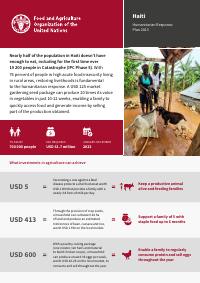
Nearly half of the population in Haiti doesn’t have
enough to eat, including for the first time ever
19 200 people in Catastrophe (IPC Phase 5). With
76 percent of people in high acute food insecurity living
in rural areas, restoring livelihoods is fundamental
to the humanitarian response. A USD 125 market
gardening seed package can produce 20 times its value
in vegetables in just 10-12 weeks, enabling a family to
quickly access food and generate income by selling
part of the production obtained.
700 000 people
FAO REQUIRES
USD 61.7 million
JANUARY–DECEMBER
2023
©FAO
TO ASSIST
What investments in agriculture can achieve
USD 5
Vaccinating a cow against a fatal
disease protects a vital food asset worth
USD 1 000 that provides a family with a
nearly 3.8 litres of milk per day.
Keep a productive animal
alive and feeding families
USD 413
Through the provision of crop seeds,
a household can cultivate 0.24 ha
of land and produce an estimated
0.66 tonnes of bean, cassava and rice,
worth USD 1 350 on the local market.
Support a family of 5 with
staple food up to 6 months
USD 600
With a poultry-raising package
(one rooster, ten hens and material
to build chicken coops), a household
can produce around 35 eggs per week,
worth USD 20‑25 on the local market, to
consume and sell throughout the year.
Enable a family to regularly
consume protein and sell eggs
throughout the year
Projected acute food insecurity situation (March–June 2023)
North Atlantic Ocea n
Nord-Ouest
Integrated Food Security
Phase Classification (IPC)
1 – Minimal
Nord
Nord-Est
2 – Stressed
3 – Crisis
Artibonite
4 – Emergency
5 – Famine
Centre
Grande-Anse
Ouest
Nippes
Sud
Not analysed
Ouest
Ca ribbea n S ea
T H E D O M IN ICAN
R EP U B L IC
Sud-Est
0
25 km
Source: IPC. 2022. Haiti: Integrated Food Security Phase Classification
Snapshot, September 2022–June 2023. Port-au-Prince, Haiti. https://
www.ipcinfo.org/fileadmin/user_upload/ipcinfo/docs/IPC_Haiti_
Acute_Food_Insecurity_22Sept_23Jun_Snapshot_French.pdf
Urgency of humanitarian agricultural assistance
Haiti has one of the highest levels of food insecurity in the world, with nearly
half of the population in high acute food insecurity, including for the first
time some 19 200 people in Catastrophe (IPC Phase 5). Over the past three
years, the percentage of people in Emergency (IPC Phase 4) has continuously
increased (from 7 percent in 2019 to 18 percent in 2022), while the percentage
of people in Minimal (IPC Phase 1) fell from 41 to 24 percent, indicating a
gradual worsening of the situation. Even the number of areas classified in
Emergency has increased in just one year, from five in September 2021 to 15 in
September 2022. The level of hunger is expected to worsen in Haiti as the war
in Ukraine continues to impact global food supply and rising gang violence
restricts the movement of goods into the country.
Haiti is facing unprecedented levels of violence perpetrated by armed groups.
Clashes between gangs for territorial control in the Port-au-Prince area are
displacing thousands of people and many are trapped in the conflict without
access to medical care. Compounding the situation are rising inflation, high
food and fuel costs and political instability. Previous marginal gains in poverty
reduction have been undone by successive crises, including the COVID-19
pandemic.
Haiti remains one of the most vulnerable countries to natural disasters –
mainly hurricanes, floods and earthquakes. The effects of climate change
are expected to increase their frequency and, while some progress has been
made, the country still lacks adequate preparedness and resilience building
mechanisms. In October 2022, heavy rains in the southern part of the country
triggered landslides that caused extensive material damage and loss of life.
Furthermore, functioning and access to essential services, health and
education have been disrupted across the country, disproportionately
affecting the most vulnerable populations. After three years without a single
case of cholera, the Ministry of Public Health and Population confirmed
the first two new cases in October 2022, and there are currently more than
32 140 suspected cases.
Drivers of food insecurity
Armed groups
Low production
Economic shocks
Natural disasters
Political instability
Key facts
Country population: 11.7 million
4.7 million projected to
be in high acute food insecurity, of
whom 3.6 million in rural areas
96% of the population
vulnerable to natural disasters
113 582 internally
displaced people
217 000 children
malnourished
USD 11.90 out of 100
in humanitarian assistance to food
sectors went to support agriculture
and livelihoods (2016–2021)
In 2022, FAO reached nearly 16 000 households (80 000 people)
through agricultural livelihoods support. For example,
1 500 households were provided with crop production assistance
through the provision of 15 tonnes of bean seed and 7.5 tonnes of
maize seed, enabling beneficiaries to produce around 255 tonnes
of food which can cover their food needs for for up to six months.
Under the overall lead of the Coordination nationale de la sécurité
alimentaire, the Food and Agriculture Organization of the United Nations
(FAO), as co-lead of the Food Security Sector in Haiti together with the World
Food Programme, works closely with 54 local and international partners,
including the IPC Global Support Unit, to ensure a needs-based, coordinated
and effective response.
©FAO
Coordination
FAO priorities
Priority
Improve staple
food and vegetable
production (spring and
winter 2023 seasons)
Protect livestock
assets and restore
production
Cost per
beneficiary
household
(USD)
Number of
beneficiary
households
Total cost
(USD)
10 kg of bean seed, 5 kg rice
seed and 300 cassava cuttings
412.50
100 g of certified vegetable
seed (aubergine, cabbage,
carrot, chili, leek, okra, onion,
pepper, spinach and tomato)
and 50 kg of fertilizers
125
40 000
5 000 000
Provision of poultry and
material for building
chicken coops
600
20 000
12 000 000
Provision of goats
400
20 000
8 000 000
Treatment (e.g. deworming)
and vaccination
300
40 000
12 000 000
60 000
REQUIRED CITATION
FAO. 2023. Haiti: Humanitarian Response Plan 2023. Rome. https://doi.org/10.4060/cc4664en
The boundaries and names shown and the designations used on the map(s) in this information product do not
imply the expression of any opinion whatsoever on the part of FAO concerning the legal status of any country,
territory, city or area or of its authorities, or concerning the delimitation of its frontiers and boundaries. Dashed
lines on maps represent approximate border lines for which there may not yet be full agreement.
Some rights reserved. This work is available
under a CC BY-NC-SA 3.0 IGO licence
24 750 000
Funds needed by
Planned
implementation
period
Main/spring season:
February
February–March
Summer season:
June
July–September
Year-round
Year-round
March
April–December
Contact
FAO Representation in Haiti
FAO-HT@fao.org | fao.org/haiti
Port-au-Prince, Haiti
FAO Office of Emergencies and Resilience
OER-Director@fao.org | fao.org/emergencies
Rome, Italy
Food and Agriculture Organization
of the United Nations
©FAO, 2023
CC4664EN/1/03.23
Type of assistance to
be provided/content of
assistance package
How to cite
Food and Agriculture Organization (FAO), Haiti: Humanitarian Response Plan 2023 (FAO Chapter), https://reliefweb.int/attachments/464e7b0d-b228-43bf-8f74-ba25021d212f/cc4664en.pdf