
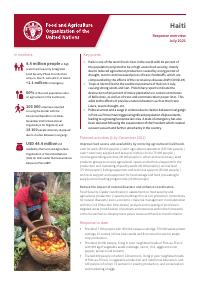
Haiti - Response Overview, July 2021
Summary — FAO response overview brief reporting 4.4 million people in high acute food insecurity as of the March-June 2021 IPC analysis, of whom over 1.1 million in Emergency phase. It describes Tropical Storm Elsa's destruction of maize plantations in Belle Anse in early July 2021, and rising political unrest and gang clashes in Port-au-Prince following the assassination of the President, and sets out FAO's July-December 2021 planned activities against a USD 44.4 million funding requirement.
Full Document Text
Extracted text from the original document for search indexing.
Haiti
Response overview
July 2021
In numbers
Key points
• Haiti is one of the worst food crises in the world with 46 percent of
4.4 million people in high
acute food insecurity (Integrated
Food Security Phase Classification
analysis, March–June 2021), of whom
+1.1 million in Emergency
•
60% of the rural population relies
on agriculture for the livelihoods
103 000 returnees reported
•
crossing the border with the
Dominican Republic in October–
November 2020 (International
Organization for Migration) and
18 100 people internally displaced
due to clashes between rival gangs
USD 44.4 million still
needed by the Food and Agriculture
Organization of the United Nations
(FAO) for 2021 under the Humanitarian
Response Plan (HRP)
the population projected to be in high acute food security, mainly
due to reduced agricultural production caused by a long period of
drought, storms and increased prices of basic foodstuffs, which are
compounded by the effects of the coronavirus disease 2019 (COVID-19).
Tropical Storm Elsa hit the southern peninsula of Haiti on 3 July,
causing strong winds and rain. Preliminary reports indicate the
destruction of 60 percent of maize plantations in certain communes
of Belle Anse, as well as of trees and communication power lines. This
adds to the effects of previous natural disasters such as Hurricane
Laura, severe drought, etc.
Political unrest and a surge in violence due to clashes between rival gangs
in Port-au-Prince have triggered significant population displacements,
leading to a growing humanitarian crisis. A state of emergency has also
been declared following the assassination of the President which created
a power vacuum and further uncertainty in the country.
Planned activities (July–December 2021)
Improve food access and availability by restoring agricultural livelihoods
cash for work (80 000 people) | cash+ agricultural assistance (325 000 people) |
cash+ veterinary supplies and set up of mobile clinics (75 000 people) |
income-generating activities (45 000 people in urban and rural areas) | seed
producer groups to receive agricultural inputs and technical support for the
production and marketing of quality seeds (30 000 people) | animal feed
(75 000 people) | fishing equipment and technical support (25 000 people) |
technical support and equipment for food storage and food processing to
supply school feeding programmes (20 000 people)
Reduce the impact of natural disasters and enhance coordination
Food Security Cluster coordination | assessment on food security and
agricultural production | capacity building of local civil protection committees
for natural disasters | socio-economic crises risk management in collaboration
with the Civil Protection Directorate | analysis and mapping of priorities in
targeted areas | mobilization of partners and resources within the framework
of the humanitarian-development-peace nexus and Hand-in-Hand Initiative.
Response to date
• Provided 7 500 people with 450 000 cassava cuttings, 750 000 sweet potato
•
© FAO
•
cuttings, 15 tonnes of lima bean seeds and 8 tonnes of maize for staple
crop production.
Provided 10 000 people, living in poor neighbourhoods of Port-au-Prince
with 439 kg of vegetable seeds (cabbage, carrot, chili, eggplant onion,
pepper, spinach and tomato).
Trained 200 people (of whom 120 women), living in poor neighbourhoods
of Port-au-Prince, in vegetable production and nutritional education; and
120 people (of whom 72 women) in poultry production, and conservation
and marketing of eggs.
Funding
Projected acute food insecurity situation (May–June 2021)
FUNDING GAP
Nor th Atla n tic O cean
USD 44.4 million
98.6%
Nord-Ouest
Nord
Nord-Est
L’Artibonite
Centre
Ouest
Caribbean Sea
Gran d’Anse
Ouest
Nippes
Sud
THE DOM INICAN
R EPUB LIC
1.4%
Sud-Est
FUNDING TO DATE*
0
USD 600 000
15 km
(FAO internal funds)
Cadre Harmonisé phase classification
Crisis
Minimal
Emergency
Stressed
Insufficient data
Not analysed
Source: IPC. 2020. Haiti: Acute food insecurity analysis, March–June 2021 [online]. Rome, Italy. [Cited 9 July 2021].
http://www.ipcinfo.org/ipc-country-analysis/details-map/en/c/1152816/?iso3=HTI
Challenges facing food security and agriculture
Food access and availability in Haiti is deteriorating. This is mainly due
to the economic decline, which has been aggravated by the effects of
the COVID-19 pandemic and related containment measures, as well as
by reduced production from previous agricultural seasons as a result
of rainfall deficits and climate shocks such as Hurricane Laura. Severe
flooding in April 2021 has negatively impacted crop growth in certain areas
in the Nord and Nord-Est.
Furthermore, the current surge in violence in Port-au-Prince linked to
clashes between armed gangs is triggering the displacement of thousands
of people, including many women and girls, elderly people and people
living with disabilities. The ongoing violence is hindering humanitarian
access to the most vulnerable households and is limiting the movement
of people and goods thus affecting households’ livelihoods activities. In
response, the Government has established a Task Force to coordinate
efforts to address the ongoing population displacement situation that is
expected to last for some time, likely resulting in greater humanitarian
needs. However, a state of emergency has just been declared following the
assassination of President Jovenel Moïse, which plunges Haiti further into
uncertainty.
In this context, the levels of acute food insecurity in the country may
further increase. It is critical to provide agricultural support to the most
vulnerable households, restore their productive assets and diversify their
sources of food and income to strengthen livelihoods resilience.
*The current emergency and resilience activities are
being implemented with the funds of two projects
(Central Emergency Response Fund: USD 1.5 million;
Spain: USD 581 045) that were approved at the end of
2020 in the framework of the 2020 HRP.
FAO requires
USD 45 million
by December 2021
to assist
675 000 people
The boundaries and names shown and the designations
used on this map do not imply the expression of any
opinion whatsoever on the part of FAO concerning the
legal status of any country, territory, city or area or of its
authorities, or concerning the delimitation of its frontiers
and boundaries. Dashed lines on maps represent
approximate border lines for which there may not yet
be full agreement.
Contact
FAO Representation in Haiti
FAO-HT@fao.org
Port-au-Prince, Haiti
FAO Office of Emergencies and Resilience
OER-Director@fao.org
fao.org/emergencies | @FAOemergencies
Rome, Italy
Some rights reserved. This work is available
under a CC BY-NC-SA 3.0 IGO licence
Food and Agriculture Organization
of the United Nations (FAO)
©FAO, 2021
CB5697EN/1/07.21
Famine
How to cite
Food and Agriculture Organization (FAO), Haiti - Response Overview, July 2021, https://reliefweb.int/attachments/a329e359-c15e-39df-a593-2faf50718122/cb5697en.pdf