Extracted text from the original document for search indexing.
Objectives
FAO is working with partners in the Food Security Cluster to:
• Protect and restore the livelihoods of the most vulnerable
populations.
• Enhance coordination among partners and support effective
information management mechanisms.
Activities
Improve agricultural production
climate-resilient seeds and planting material | agricultural
tools | nutrition education | creation of seed banks | support
for local seed production and seed security | promotion of
climate-resilient good agricultural practices | capacity building of
women’s associations for vegetable and fruit production | urban
and peri-urban farming | cash for work and technical support
for the rehabilitation of irrigation canals and for sustainable
micro‑watersheds management
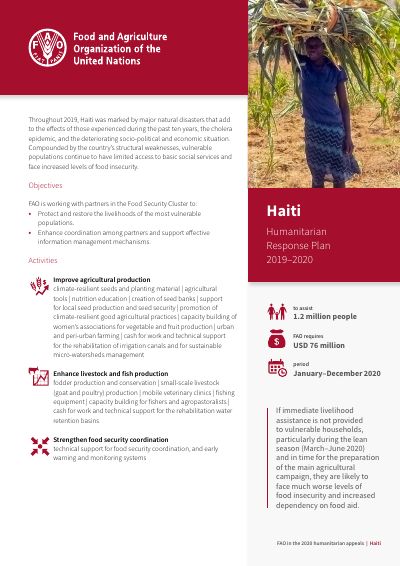
© FAO/Haiti
Throughout 2019, Haiti was marked by major natural disasters that add
to the effects of those experienced during the past ten years, the cholera
epidemic, and the deteriorating socio-political and economic situation.
Compounded by the country’s structural weaknesses, vulnerable
populations continue to have limited access to basic social services and
face increased levels of food insecurity.
Haiti
Humanitarian
Response Plan
2019–2020
to assist
1.2 million people
FAO requires
USD 76 million
period
Enhance livestock and fish production
fodder production and conservation | small-scale livestock
(goat and poultry) production | mobile veterinary clinics | fishing
equipment | capacity building for fishers and agropastoralists |
cash for work and technical support for the rehabilitation water
retention basins
Strengthen food security coordination
technical support for food security coordination, and early
warning and monitoring systems
January–December 2020
If immediate livelihood
assistance is not provided
to vulnerable households,
particularly during the lean
season (March–June 2020)
and in time for the preparation
of the main agricultural
campaign, they are likely to
face much worse levels of
food insecurity and increased
dependency on food aid.
FAO in the 2020 humanitarian appeals | Haiti
�Situation analysis
Acute food insecurity situation (October 2019–February 2020)
3.7 million people in
N orth Atlantic O cean
Nord-Ouest
severe acute food insecurity
Nord
Nord-Est
65 530 children under five suffer
from acute malnutrition
L’Artibonite
Centre
Gran d’Anse
60% of people in rural areas
Ouest
C a r ib b ea n S ea
depend solely on agriculture,
Ouest
Nippes
Sud
THE DOMIN ICAN
REPUBLIC
livestock and fisheries for their
livelihoods
Sud-Est
0
96% of Haitians are exposed to
15 km
climate shocks
Integrated Food Security Phase Classification
1 – Minimal
2 – Stressed
Inadequate evidence
3 – Crisis
4 – Emergency
5 – Famine
Not included in the analysis
Source: IPC, October 2019. Map conforms to UN Haiti map, February 2016.
Impact on food security
In 2019, Haiti experienced extreme political instability and a
considerable deterioration of its economic situation, which
was marked by an annual inflation rate of 19.5 percent, the
depreciation of the Haitian gourde, a rise in food prices
and a decrease in foreign investments. The multiple shocks
suffered by Haitians, including epidemics such as cholera,
combined with the country’s structural weaknesses, and
the fragile social, economic and political context, have
significantly affected vulnerable populations’ ability to meet
their basic needs.
In rural areas, recent floods as well as the drought related
to the El Niño phenomenon caused a significant drop
in agricultural production. The outcome of the spring
agricultural season, which usually accounts for more
The boundaries and names shown and the designations used on the map(s) in this
information product do not imply the expression of any opinion whatsoever on the part of
FAO concerning the legal status of any country, territory, city or area or of its authorities,
or concerning the delimitation of its frontiers and boundaries. Dashed lines on maps
represent approximate border lines for which there may not yet be full agreement.
than half of the country’s total production, was limited
due to poor harvests of the 2018/19 winter agricultural
season and the lack of available seeds. This is likely to
affect results of the next agricultural campaigns. Farmers’
purchasing power has continued to decline as well as local
food availability. Repeated episodes of rainfall deficits have
also strongly affected the herds of breeders in the Nord and
Nord-Est departments given the early depletion of available
pastures and dried-up water points.
According to the latest Integrated Food Security Phase
Classification (IPC) analysis (October 2019), if no actions
are taken to strengthen the livelihoods of vulnerable
populations, the food security situation is expected to
further deteriorate, particularly during next year’s lean
season (March–June 2020), with 4.1 million people in
IPC Phases 3-4 (42 percent of the rural population). It is
therefore crucial to enhance vulnerable people’s resilience
and protect their livelihoods.
Contact
FAO Representation in Haiti
Port-au-Prince, Haiti | FAO-HT@fao.org
FAO Emergency and Resilience Division
Rome, Italy | PSE-Director@fao.org
Food and Agriculture Organization of the United Nations
Some rights reserved. This work is available
under a CC BY-NC-SA 3.0 IGO licence
www.fao.org/emergencies
www.fao.org/resilience
©FAO, 2020
CA7618EN/01/02.20
During the past ten years, Haiti has been affected by two
major earthquakes (in 2010 and 2018), three hurricanes
(Sandy in 2012, Matthew in 2016 and Irma in 2017) and three
severe droughts (in 2014, 2015/16 and 2018), the effects of
which are still felt today.
�