
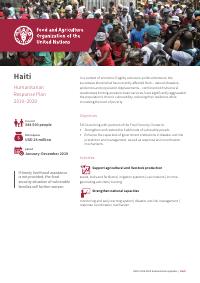
FAO in the 2019 Humanitarian Appeal: Haiti - Humanitarian Response Plan 2019
Summary — FAO's chapter of the 2019 Humanitarian Response Plan for Haiti, requesting USD 24 million to assist 384,500 people from January to December 2019. It situates the appeal in a context of economic fragility, socio-political tension and successive shocks that had aggravated chronic vulnerability, and sets out work with Food Security Cluster partners to restore livelihoods and strengthen government disaster-risk capacities.
Full Document Text
Extracted text from the original document for search indexing.
© FAO/Justine Texier
Haiti
Humanitarian
Response Plan
2019–2020
In a context of economic fragility and socio-political tensions, the
successive shocks that have recently affected Haiti – natural disasters,
epidemics and population displacements – combined with structural
weaknesses limiting access to basic services, have significantly aggravated
the population’s chronic vulnerability, reducing their resilience while
increasing the level of poverty.
Objectives
to assist
384 500 people
FAO requires
USD 24 million
FAO is working with partners of the Food Security Cluster to:
• Strengthen and restore the livelihoods of vulnerable people.
• Enhance the capacities of government institutions in disaster and risk
prevention and management, as well as response and coordination
mechanisms
period
January–December 2019
If timely livelihood assistance
is not provided, the food
security situation of vulnerable
families will further worsen.
Activities
Support agricultural and livestock production
seeds, tools and fertilizers | irrigation systems | vaccinations | incomegenerating activities | training
Strengthen national capacities
monitoring and early warning system | disaster and risk management |
response coordination mechanism
FAO in the 2019 humanitarian appeals | Haiti
Situation analysis
Projected food insecurity situation (March–June 2019)
Nor t h At l ant i c Ocean
Nord-Ouest
Nord
Nord-Est
L’Artibonite
Gran d’Anse
Ouest
Nippes
0
TH E D OMIN I C A N
R E P UBL I C
15 km
to be severely food insecure
25% of Haitians live
below the poverty line
Stressed
39 000 children under five
Minimal
at risk of acute malnutrition
Insufficient data
Sud-Est
2.6 million people projected
Crisis
Ouest
Sud
Famine
Emergency
Centre
C a ri b b ea n Sea
IPC phase
classification
Not analysed
333 000 people estimated
to be affected by cholera
568 000 people live in
Source: IPC, December 2018
areas at risk of being affected by
natural disasters
Impact on food security
In 2018, Haiti suffered a period of severe drought, floods and an earthquake,
while still facing cholera, diphtheria and malaria, a migration crisis and
recurrent protection issues. The successive shocks and frequency of natural
disasters, combined with structural weaknesses that limit access to basic
services, have significantly increased the vulnerability of populations in a
highly fragile socio-economic and political context. This has contributed to
the degradation of livelihoods and living conditions of the most vulnerable
populations in Haiti who are often affected by one or more crises at once.
The 2018 spring agricultural season was affected by drought linked to
the El Niño phenomenon in several areas of the country, including the
departments of Grand’Anse, Nord, Nord-Est, Ouest and Sud, and potentially
the departments of Artibonite, Centre, Nippes, Nord-Ouest and Sud-Est. This
has resulted in a reduced production of the main crops – haricot beans, maize
and sorghum – severely affecting the food security and income of Haitians
whose livelihoods depend on agriculture. Households’ purchasing power
has also been affected by the increase of staple food prices, the depreciation
of the Haitian gourde and the high inflation throughout 2018, undermining
vulnerable families’ ability to access food and leading to the adoption of
negative mechanisms.
The probability of an El Niño event during the first three months of 2019 along
with the factors described above will likely contribute to the deterioration
of the situation, particularly in Sud and Nord-Ouest, characterized by
the prevalence of acute food insecurity and high levels of global acute
malnutrition if adequate livelihood assistance is not provided.
The boundaries and names shown and the designations
used on this map do not imply the expression of any
opinion whatsoever on the part of FAO concerning the
legal status of any country, territory, city or area or of its
authorities, or concerning the delimitation of its frontiers
and boundaries. Dashed lines on maps represent
approximate border lines for which there may not yet be
full agreement.
Contact
Nathanael Hishamunda
FAO Representative
Port-au-Prince, Haiti | FAO-HT@fao.org
Dominique Burgeon
Rome, Italy | TCE-Director@fao.org
Food and Agriculture Organization
of the United Nations
Some rights reserved. This work is available
under a CC BY-NC-SA 3.0 IGO licence
www.fao.org/emergencies
www.fao.org/resilience
©FAO, 2019
CA3258EN/1/02.19
Director, Emergency and Resilience Division
and Strategic Programme Leader – Resilience
How to cite
Food and Agriculture Organization (FAO), FAO in the 2019 Humanitarian Appeal: Haiti - Humanitarian Response Plan 2019, https://reliefweb.int/attachments/737637ce-a05f-3a52-b4d7-34d77d60d479/ca3258en.pdf