
Haiti: Rapid Food Security Assessment Post-Hurricane Matthew, 7-10 October 2016
Summary — Rapid joint assessment by Haiti's CNSA, FAO and WFP conducted 7-10 October 2016 in the immediate aftermath of Hurricane Matthew, finding 2.1 million people affected, of whom 1.4 million needed food assistance (806,000 requiring immediate assistance). It reports local production and livelihoods severely damaged and nearly wiped out in Grand'Anse and Sud, significant market price increases expected within three months, and deteriorating access to safe drinking water alongside a resurgence of cholera cases.
Key Findings
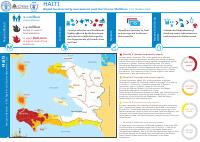
- The rapid assessment conducted from 7 to 10 October 2016 found 2.1 million people in need of food assistance after Hurricane Matthew, including 806,000 people in urgent need.
- Priority 1 areas had more than 75 percent of the population affected and livelihoods related to agriculture, livestock and fishing almost entirely destroyed.
- Priority 1 covered all Grande-Anse, most of the Sud coastline from Port-Salut to Tiburon, Ile-a-Vache, Cavaillon, Camp-Perrin, Chantal, Maniche and Petit-Trou-de-Nippes.
- Grande-Anse had almost 100 percent of its agriculture sector affected, seven of eleven communes inaccessible by road at assessment time, and local market availability limited mostly to tree fruits.
- Sud Department had irreversible damage to beans, yam, maize, cassava, millet and pigeon peas, with 90 percent of forest and fruit trees heavily hit.
- In Sud-Est, maize damage was 25 percent, other crop damage was 60 to 80 percent, livestock losses were 70 percent, fishing losses 60 percent and trade losses 40 percent.
Full Document Text
Extracted text from the original document for search indexing.
HAITI
2.1 million
People in need of
food assistance
of which 806,000
in urgent need of food
assistance
Local production and livelihoods
highly affected by the hurricane
and almost totally destroyed in
the Departments of Grande-Anse
and Sud
Markets
1.4 million
Livelihoods
People affected
People affected
Significant increase in food
prices expected in the next
three months
Access to drinking
water
Rapid food security assessment post-hurricane Matthew, 7-10 October 2016
Substantial degradation of
drinking water infrastructure
and increase in cholera cases
Hurricane Matthew - EFSA Rapid Food Security Assessment 2016
Haiti
Priority 1 (Extreme food security impact)
In these areas, more than 75% of the population is affected.
Livelihoods related to agriculture, breeding and fishing are almost
entirely destroyed, in terms of crops, agricultural equipment, stocks
of farmers or traders, livestock and fishing boats. The entire
Grande-Anse Department is classified in this priority, as well as
almost all the coastline of Sud Department from Port Salut to Tiburon,
Ile-à-Vache and the communes of Cavaillon, Camp-Perrin, Chantal
and Maniche. The commune of Petit-Trou-de-Nippes in the Nippes
Department is also part of this priority.
806,000
people
Priority 2 (Very high food security impact)
In these communes, about 30% of the population is affected.
However, the impact on livelihoods is 80% on average i.e. as high as
in priority 1. This priority includes six communes of the Sud
Department (Aquin, Arniquet, Cayes, St-Jean-du-Sud,
St-Louis-du-Sud and Torbeck), five communes of the Nippes
Department (Baradères, Grand-Boucan, L’Asile,
Petite-Rivière-de-Nippes and Plaisance du Sud), two communes of the
Artibonite Department (Anse-Rouge and Grande-Saline), and three
communes of the in Nord-Ouest Department (Baie-de-Henne,
Bombardopolis and Mole Saint-Nicolas).
577,000
people
Priority 3 (High food security impact)
In these communes, the proportion of affected population falls below
25%. However, the impact on livelihoods is estimated to be between
60 and 80%. The affected locations include three communes of the
Nippes Department (Arnaud, Anse-à-Veau and Fonds-des-Nègres), one
commune of the Nord-Ouest Department (Jean-Rabel) and all
municipalities of the Sud-Est Department, except for Anse-à-Pitre and
Cayes-Jacmel.
460,000
people
Priority 4 (Moderate food security impact)
In these areas, the proportion of affected population is less than 25%
and the impact on livelihoods ranges from 20 to 60%. A total of six
communes are in this category: two in the Nippes Department
(Miragoâne and Paillant), two in the Sud-Est Department (Anse-à-Pitre
and Cayes-Jacmel) as well as the two municipalities of the Gonâve
Island (Anse-à-Galets and Pointe-à-Raquette) in the Ouest
Department.
88,000
people
Overview of food security impact
Grande-Anse Department
In the Grande-Anse Department, almost 100
percent of the agriculture sector is affected and food
availability is very poor. The products available,
which are mostly imported, show a sharp decline
due to road inaccessibility. At the time of the
assessment, seven out of eleven communes in the
department were inaccessible by road. Existing
stocks in shops were damaged by water intrusions.
As a consequence, the current availability of local
products is essentially made up of tree fruits
(breadfruit, avocados, bananas, citrus, coconut,
etc.). Taking into account the current situation, local
products on the markets will be soon exhausted.
Food prices have not increased significantly.
However, households’ livelihoods were severely
affected, either through loss of agricultural crops,
commercial stocks or livestock, estimated at more
than 50 percent. Under these conditions, household
income to purchase food is considerably limited, or
totally insufficient.
In the department, several water sources were
affected by landslides and wells were polluted by
the flood water. Health facilities are partially or
completely non-functional, including the network of
drinking water in Jeremie. In these difficult hygienic
and sanitary conditions, cases of cholera have
already been registered.
Sud Department
All crops (beans, yam, maize, cassava, millet,
pigeon peas) are affected to an irreversible stage.
In all communes, 90 percent of forest trees and fruit
trees (breadfruit, avocado, banana, coconut and
mango trees) have been hardly hit and the
remaining 10 percent cannot cover the seasonal
production. In Torbeck and les Cayes, 80 percent of
the rice fields are damaged by mud flows and 50
percent in St Louis-du–Sud by the floods.
Considerable livestock losses have been observed, 95
percent for poultry, more than 80 percent for goats and
sheep, 40 to 60 percent for cattle and 20 to 40 percent
for pigs. All fishing activities have been paralyzed by
the lack of equipment. Nets, traps and other
equipment like boats and motors were swept away.
These losses have a major impact on the livelihoods of
households.
Access to drinking water is limited, especially on the
coastal
strip
and
particularly
in
Petite-Rivière-des-Nippes where all sources of water
were destroyed.
On the axis Port-Salut-Cayes-Aquin, the markets are
supplied by imported products. Sellers still have
stocks. Local products on sale are wild foods. Although
this is considered to be a temporary solution, there is a
good availability of wild foods also leading to price
reduction. In Roche-à-Bateau, a decrease in the
availability of imported products has been observed,
due to the lack of physical and economic access to the
supplies. The price of charcoal, used for cooking, has
increased between 40 and 80 percent, depending on
the areas. Drinking water sources are contaminated.
There is a very high risk of spread of waterborne
diseases. An unconfirmed number of cholera cases was
detected by the Ministry of Health.
In the Artibonite Department, Anse-Rouge was
reportedly the worst-hit commune, while in the
Nord-Ouest Department, the four communes of Mole
Saint-Nicolas District were the most affected.
Throughout this region, Hurricane Matthew ruined 60
to 90 percent of crops, destroying the available stocks
and ruining several irrigation canals. Concerning
breeding, a key activity in the Nord-Ouest Department,
60 to 80 percent of the cattle was killed by the
hurricane. Fishing equipment, the main source of
livelihood for the coastal population, was largely swept
away or destroyed. In Anse-Rouge, the salt ponds and
salt deposits were flooded, causing a total loss of
production and stocks.
Nippes Department
The hurricane destroyed 60 to 80 percent of crops in
the Department of Nippes. Worst-hit locations are
Petit-Trou-de-Nippes,
Baradères,
Grand-Boucan,
Plaisance-du-Sud, L’Asile, Petite-Rivière-de-Nippes,
where 80 percent of crops were destroyed and stocks,
gained during the spring months, were largely lost. The
production capacities of irrigated crops were also
strongly affected after the destruction of irrigation
canals and irrigated areas.
Key markets like Miragoâne and Fonds-des-Nègres are
currently
functional,
however,
the
potential
unavailability of supplies in the coming weeks can
hamper their activities. In the most affected areas of
the department, small markets are very poorly
supplied. Some products like vegetables, fruits and
meat are becoming increasingly scarce, and a slight
increase in prices was already observed.
Haut-Artibonite and Nord-Ouest
Departments
The main markets in the region are currently
well-stocked and supplied; however they remain
vulnerable to disruptions in the coming weeks, as a
result of potential lack of supplies. Some products such
as fruits, vegetables, tubers and meat are becoming
scarce, while a slight increase in prices is observed,
except in Mole Saint-Nicolas where the increase is
reportedly more substantial. Throughout the affected
region, the scarcity of sources of income will have an
impact on food accessibility.
In Anse-Rouge the access to drinking water was
drastically reduced by the contamination of the rivers
by animal wastes. The same situation is observed at
Baie-de-Henne. Except for the coastal area of
Bombardopolis, drinking water infrastructure are
damaged, in Mole Saint-Nicolas and Jean-Rabel as
well. Cases of cholera have been confirmed in
Bombardopolis and Baie-de-Henne following the
hurricane.
Overview of food security impact
Sud-Est Department
Agriculture is the sector that is hit-hardest by the
hurricane in this area with damages observed in the
entire Department. 25 percent of maize was
affected, while damage of all other crops accounts
for an estimated 60 to 80 percent. Livestock losses
are estimated to be 70 percent, fishing 60 percent
and trade 40 percent. Given the effects of the
hurricane on stocks, availability of seeds is
compromised for the next harvest. Availability of
some products like vegetables, fruits, and meat is
starting to decrease.
The main markets of Bainet, Jacmel, La Vallée and
Marigot are currently active, however, due to the
swollen rivers that have hampered road-access,
markets functioning might be compromised. As a
matter of fact, some sellers and buyers cannot
access them. Dysfunction and price increases are
expected in the next weeks, especially for local
products, if the roads do not reopen. In addition, a
slight increase in prices of imported products is
already observed with wholesalers while retail
prices remain stable. The de-capitalization and
deterioration of resources of farming families,
exacerbated by the limitation of their purchasing
power, has significantly reduced the demand.
Almost all water sources were damaged,
contaminated or destroyed in all the areas
assessed. Cases of cholera were identified in the
communes of Anse-à-Pitre, Bainet, Grand-Gosier
and La Vallée. Latrines in these areas urgently need
to be repaired.
Other coastal areas – Grande-Saline
(Artibonite) and Gonâve Island
(Ouest) – Partial assessment
The area of Grande-Saline was flooded, and the
road is currently blocked. The city is cut off from
the rest of the commune. The Civil Protection
reports a lack of food and therefore households are
feeding themselves with the small portion of food
remained after the disaster.
Nearby communes and village markets can supply the
rice, beans and oil, which are missing in the local
market. There is no water supply in the commune and
methods of purification of water are insufficient. Flood
drainage and water treatment are also needed.
The two municipalities of Gonâve Island have been
significantly damaged by the hurricane. It is estimated
that approximately 30 to 60 percent of the gardens
and agricultural plots were affected. Significant
livestock losses have been reported, especially near
Anse-à-Galets. Fishing gear has also been damaged.
Market supply by boat from the coast resumed after
the disaster; however the decrease in local production
could have an impact and lead to rising prices. Finally,
water systems and health facilities suffered important
damage.
Note:
The communes that were assessed are those
considered the most affected or that WFP was
requested to assess by the authorities or by its
partners. Other areas of the country may have
been affected as well. A household food security
assessment will be launched in November, followed
by acute IPC workshops that will be held in late
November or early December.
Aknowledgements:
This initial assessment was conducted with the
support of the technical secretaries of the
observatories of the CNSA, colleagues from FAO,
DDA (Agricultural Department) officials, mayors,
departmental officials of the DPC (Civil Protection
Direction) and WFP partner organizations: ACF,
ADEMAR, Alianza por la Solidaridad, AMURT, AVSI,
APPIP, CARE, Cooperation Switzerland, CROSE
CRS, FONDEPH, MAST, Médecins du Monde,
MINUSTAH, ODRG, OXFAM, RODANIP, Save the
Children, Solidarités International, UNEP, UNPOL,
World Vision. We express our gratitude to them.
This report was written by the WFP/VAM team in
Haiti and reviewed by the VAM team in Panama
(Byron Ponce Segura) and Rome (Anne-Claire
Mouilliez, Eleonora Ponti).
Contacts :
WFP Country Director: Carlos Veloso
Kokou Amouzou, kokou.amouzou@wfp.org, +509 3701 2368
Félix-Antoine Véronneau, felix.veronneau@wfp.org, +509 4896 0105
FAO Representative: Nathanael Hishamunda
nathanael.Hishamunda@fao.org
CNSA Director: Abnel Desamours
abneldes@gmail.com, +509 3464 4234
How to cite
National Food Security Coordination (CNSA); Food and Agriculture Organization (FAO); WFP, Haiti: Rapid Food Security Assessment Post-Hurricane Matthew, 7-10 October 2016, https://reliefweb.int/attachments/e4ac6642-b62f-338b-9151-b4dc3d20f9a7/wfp287955.pdf