
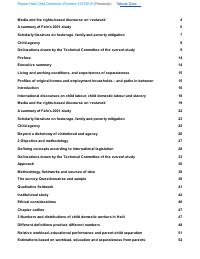
Haiti Child Domestic Workers: Tabular Data and Summary of the 2001 Study
Summary — A compilation accompanying Fafo's 2015 child domestic workers work, bringing together tabular data, a summary of the 2001 study, the media and rights-based discourse on restavèk, and the scholarly literature on fosterage.
Key Findings
- Reference apparatus rather than analysis: tabular data plus a summary of the 2001 study.
- Includes the media and rights-based discourse on restavèk alongside the scholarly literature on fosterage.
- Records the 2010 earthquake contracting GDP by an estimated 8 percent, the context for the 2011 population baseline used.
Full Description
A compilation accompanying Fafo's 2015 child domestic workers work, bringing together tabular data, a summary of the 2001 study, the media and rights-based discourse on restavèk, and the scholarly literature on fosterage. It is the reference apparatus behind the analytical report rather than the analysis itself, which is what makes it useful: it shows the evidence the estimates rest on.
Full Document Text
Extracted text from the original document for search indexing.
Report Haiti Child Domestic Workers 31072015 (Restavek) Tabular Data
Media and the rights-based discourse on ‘restavek’ 4
A summary of Fafo’s 2001-study 6
Scholarly literature on fosterage, family and poverty mitigation 7
Child agency 9
Delineations drawn by the Technical Committee of the current study 9
Preface 14
Executive summary 14
Living and working conditions, and experiences of separateness 15
Profiles of original homes and employment households – and paths in-between 15
Introduction 16
International discourses on child labour, child domestic labour and slavery 18
Media and the rights-based discourse on ‘restavek’ 19
A summary of Fafo’s 2001-study 22
Scholarly literature on fosterage, family and poverty mitigation 23
Child agency 25
Beyond a dichotomy of victimhood and agency 26
2 Objective and methodology 27
Defining concepts according to international legislation 28
Delineations drawn by the Technical Committee of the current study 33
Approach 36
Methodology, fieldworks and sources of data 38
The survey: Questionnaires and sample 38
Qualitative fieldwork 41
Institutional study 42
Ethical considerations 46
Chapter outline 47
3.Numbers and distributions of child domestic workers in Haiti 47
Different definitions produce different numbers 48
Relative workload, educational performance and parent-child separation 51
Estimations based on workload, education and separateness from parents 52
Report Haiti Child Domestic Workers 31072015 (Restavek) Tabular Data
Four hundred thousand: The maximum estimate based on workload and education 53
Stricter definitions of age result in lower numbers 55
Age, gender and geography 58
Conclusion 59
4.Contexts of children’s work and education in contemporary Haiti 60
Children and living arrangements 61
Regional differences in living arrangements 62
Living arrangement and household characteristics 62
Living arrangements from 2001 to 2014 63
Education 63
Enrolment 64
Completion of primary school 64
School delay 65
Workload 66
Work quintiles 66
Concluding remarks 67
Living and working conditions, and experiences of separateness 67
Gender and area: Recent changes among relocated children and child domestic workers 68
Left behind or travelled? Child domestic work and the nature of connections to new homes 70
Education 72
School enrolment, attendance and access to school material 72
Education and identity 74
Enterprising, education-seeking children 76
Working conditions 77
Health 80
Social conditions 82
Privileges and restrictions: Media access, clothing and freedom to leave the house 82
Experiences of care: Punishment, commensality and social inclusion 83
The bad end: Being set aside 84
A continuum of domestic work arrangements, and children’s movements along it 86
Report Haiti Child Domestic Workers 31072015 (Restavek) Tabular Data
Conclusions 88
6 Profiles of original homes and employment households – and paths in-between 88
Sending and receiving households: Some general characteristics 90
Child relocation and domestic work: A matter of attitudes? 92
Inequality, economic adaptations and the death of a parent 94
Marjorie placements of children and longer-term planning of household economy 95
Desperation: Parents acceptance, encouragements, and children’s own initiatives 96
Original parents’ expectations, motivations, acceptance 99
A note on differential treatment of children in receiving/employing households 100
Child movements 101
Processes of recruitment and placement, and the issue of middlemen 102
Conclusions 104
7 Responses: Institutions, organisations and methods 105
The national legal framework 106
Actors 110
State actors The policy of the Haitian government 110
The Ministry of Social Affairs and Labour (MAST) 111
The Institute of Social Welfare and Research (IBESR) 113
The Haiti National Police (HNP) 121
The judicial system 122
The Office for Protection of Citizens (OPC) 125
Local authorities 125
International actors 127
Bilateral and multilateral international cooperation 131
The International Organization for Migration (IOM) 132
International NGOs 133
The Approaches of Actors to Child Domestic Work 144
Awareness-Raising and Promotion of Children’s Rights 144
Implementing Community Structures for Child Protection 150
Bracket 2: The approach of Beyond Borders 151
Report Haiti Child Domestic Workers 31072015 (Restavek) Tabular Data
Mitigation: Education, Material Assistance and Social Integration. 152
Introduction PAG SOURCE
E
Media and the rights-based discourse on ‘restavek’
Estimates in 2011 put Haiti’s population at over 9.7 million. 3 9.7 million-CIA World
Haiti is the western hemisphere’s poorest and least-developed Factbook, Haiti,
country. It ranks 145th out of 169 countries on the 2010 United https://www.cia.gov/libr
Nations (UN) Human Development Index. ary/publications/the-wo
rld-factbook/geos/ha.ht
ml
145th rank -UN Human
Development Index,
http://hdr.undp.org/en/s
tatistics/
Haiti’s economy suffered severe setback when a 7.1 magnitude 3 Supra note 1.
earthquake damaged its capital city, Port-au-Prince, in January Ibid.
2010. The damage to Port-au-Prince caused the country’s GDP to
contract by an estimated 8 percent in 2010.
It further devastated the country’s already inadequate social 3 Luzincourt, K. and
services, exacerbated political and social-economic instability, and Gulbrandon, J., (2010).
weakened the already poor educational system. Education and Conflict
in Haiti: Rebuilding the
Education Sector after
2010 Earthquake.
United States Institute
of Peace, Washington.
http://www.usip.org/pub
lications/education-and
-conflict-in-haiti
Haiti’s economic conditions put children in a precarious situation. It 3 Smucker, Glenn R.,
is customary for a Haitian child, usually around age 6, to begin and Murry, Gerald F.
serving adults and contributing to the family’s livelihood (2004). The Uses of
Children: A Study of
Trafficking in Haitian
Children. Port-au-
Prince, USAID.
The U.S. Department of State’s 2012 Trafficking in Person Report 3 U.S. State Department.
states that Haitian children are frequently found crossing the (2012). Trafficking in
Haitian-Dominican border illegally, often in the company of an adult Person Report 2012.
who is paid to pretend to be the children’s parents. http://www.state.gov/do
cuments/organization/1
Report Haiti Child Domestic Workers 31072015 (Restavek) Tabular Data
92595.pdf
While some of these Haitian children are reunited with their real 3 Department. (2012).
parents who are working in Dominican Republic, others are forced Trafficking in Person
into organized begging rings, domestic servitude, or sex trafficking. Report 2012.
http://www.state.gov/do
cuments/organization/1
92595.pdf
Children in Haiti also work on farms, where they may be exposed to 3 Macro International Inc.
pesticides, sharp tools, harsh conditions, and long hours. In 2007, (2008). Child Labor in
ICF International (known as Macro International Inc. at the time of Haiti’s Agricultural
the research) conducted a household survey in one of Haiti’s Sector—A Study of
department about the agricultural sector. The survey found that Children in the Rural
children constituted one-fourth of the farm workers sampled. They Center Department.
contributed to the cultivation of pistachios, corns, peas, millet,
sugarcane, manioc, and rice.
Anecdotal evidences suggest that the 2010 earthquake, which 4 U.S. Embassy,
resulted in thousands of displaced individuals, likely increased the Port-au-Prince,
number of both restavèks and street children. reporting, March 1,
2010. Cited from
USDOL 2009 Findings
on Worst Forms of
Child Labor
www.dol.gov/ilab/progr
ams/ocft/pdf/2009OCF
Treport.pdf
Children on the streets perform activities such as washing car 4 Ibid
windows, vending, or begging. They are exposed to a variety of
hazards, such as severe weather conditions, car accidents, and
vulnerability to gangs and prostitution.
According to the International Labour Organization (ILO), child 4 International Labour
domestic labor refers to situations where children are engaged to Office. (2004). Helping
perform domestic tasks in the home of an exploitative third party or Hands of Shackled
employer. When such exploitation is extreme and includes Lives: Understanding
trafficking, slavery or practices similar to slavery, or work that—by its Child Domestic Labour
nature or the circumstances in which it is carried out—is hazardous and Responses to it.
and likely to harm the health, safety or morals of children, then it ILO: Geneva.
constitutes a worst form of child labor. http://www.unicef.org/vi
olencestudy/pdf/2004_
domestic_Helpinghand
s_en.pdf
Children in Haiti are exploited in the worst forms of child labor, most 4 Ibid.
commonly in domestic service
Often described simply as the ‘restavèk’ system, the phenomenon is 4 Smucker and Murray.
far more complex The Uses of
than this single term suggests. Smucker and Murray define Childhood, USAID,
Report Haiti Child Domestic Workers 31072015 (Restavek) Tabular Data
restavèks as unpaid child servants living and working away from Haiti, 2004, p. 21
home, but note that the restavèks’ fieldwork revealed significant
variation in the arrangements and treatment conditions of the
children who live or work away from their biological parents.
Restavèks are mostly found in middle-to-lower-middle class 4
households; they are also prevalent in the poorest slums of Restavèk
Port-au-Prince.
Freedom.
(2011).
Restavèk: The
Persistence of
Child Labor
and Slavery,
http://ijdh.org/w
ordpress/wp-
content/upload
s/2011/03/Haiti
-UPR-Restavek
-Report-FINAL.
pdf
Kinship plays a large factor in the recruitment of restavèks. 4 Francois, Smucker,
Tardieu. Lost
Childhoods In Haiti:
Quantifying Child
Trafficking, Restavèks
and Victims of
Violence, PADF/USAID,
Haiti, 2009
A summary of Fafo’s 2001-study
According to a 2009 study by Francois, Smucker, and Tardieu, only 5 UN HRC: Report of the
22 percent of restavèks had no kinship ties to the head of Special Rapporteur on
household where they resided. For the remaining 78 percent, family contemporary forms of
obligations and ties, to close and distant relatives, were evident as slavery, including its
children were transferred from lower-income to higher-income causes and
families. These obligations occurred even among households that consequences,
were just a little poorer than the sending households. For the poorer Addendum, Mission to
families, this represents an opportunity for their children to have a Haiti, 2009
proper education and health care in urban areas, which they cannot
receive in the rural areas where they currently live.
The UN Special Rapporteur on contemporary forms of slavery, 5 Ibid
Report Haiti Child Domestic Workers 31072015 (Restavek) Tabular Data
Gulnara Shahinian, argued in her 2009 report that the direct
placements of children from one family to another has been taken
over by the existence of recruiters. These recruiters, for their own
financial gain, recruit children from rural areas to work either with
urban families as restavèks or outside the home in markets. In many
cases, the recruiters are paid by the host family to find a restavèk.
Since the rural families are sending their children with a recruiter to
be placed with a family of strangers, many stakeholders label this
phenomenon as trafficking. While living with strangers, the
restavèks often lose complete contact with their biological families.
Another difference is that due to demographic changes, wealthy
families have paid workers to carry out the domestic chores. The
domestic workers themselves now have restavèks in their own
homes to take care of their home and children.
A third change noted in Francois, Smucker, and Tardieu’s 2009 5 Supranote 3
study is the intra- urban movement of children within the
metropolitan area of Port-au Prince for restavèk placement.
In their research, they found that communes within Port-au Prince 5 Ibid
were the second most important suppliers of restavèks for
Port-au-Prince. For example, for Cité Soleil, neighboring communes
supplied the same percentage of restavèks as the communes from
the Sud department. This is a change from the earlier practice of
rural families sending their children to be restavèks in urban
households.
Some children escape from their new home; they then either live in 5 IOM: Video News
the streets or are picked up by authorities who refer them to the Release on Child
Institut du bien-être social et de recherches—Haitian Social Welfare Trafficking and Abuse
Institute (IBESR). The children stay at centers, such as the Centre in Haiti, available at
d’action pour le développement—Center for Action and http://www.iom.int/jahia
Development (CAD) and Foyer L’Escale in Port-au-Prince, until they /Jahia/media/press-
are reunited with their biological families. briefing-notes/pbnAM/c
ache/offonce/lang/en?e
ntryId=16514, 2008
The U.S. Department of State 2012 Trafficking in Persons Report 5 Supra note 9.
also mentions the role of recruiters in arranging for restavèks to live
with families in other cities and towns with the hopes of going to
school. The report details the types of abuse these children suffer,
such as physical, sexual, and psychological. When they become too
difficult to control, they are dismissed and thrown out on the streets.
These dismissed children, the restavèks displaced by 2010
earthquake as well as those who run away, make up a significant
amount of the population of street children. The latter children might
be subjected to street crime or sex trafficking by criminal gangs.
Report Haiti Child Domestic Workers 31072015 (Restavek) Tabular Data
Scholarly literature on fosterage, family and pove
mitigation
Little reliable information is yet available about the effect of the 2010 6 Smucker, G. quoted in
earthquake on the restavèk situation. There are, however, sufficient Paul, K.: Labor
indications to suggest that there have been changes, some of them Shortage, available at
short-term, others possibly longer term. One example might be the http://www.newsweek.c
increased vulnerability of children separated from their families or om, February 01 2010
caregivers, often surviving alone in the crowded and often violent
tent cities. Another could be the patterns of post-earthquake
population displacement and its effect on the movements of
restavèks. For the families struggling in the wake of a natural
catastrophe, restavèks tend to be the first to go. They are the ones
most at risk to be turned out onto the streets or trafficked.
According to Haiti’s Labor Code, the minimum age for work in 6 Republic of Haiti, Code
industrial, agricultural, or commercial enterprises is 15. du travail, article 335
The minimum age for apprenticeships is 14. 6 U.S. Department of
State. (2012). Human
Rights Report. op. cit
Children ages 15 to 18 must obtain work authorization from the 6 Republic of Haiti, Code
Ministry of Labor to be employed. du travail, article 337
and 340.
Children are also prohibited from night work in industrial jobs, and 6 Republic of Haiti, Code
from work that is likely to harm their health, safety, or morals. du travail, article 333
and 334.
USDOL reported in its 2010 Findings on Worst Forms of Child Labor 6 USDOL. (2011). 2010
Report that no evidence indicated that the Government of Haiti has Findings on Worst
established a coordinating mechanism to combat the worst forms of Forms of Child Labor.
child labor. While the Ministry of Social Affairs is tasked with http://www.dol.gov/ilab/
enforcing child labor laws, it is hindered by understaffing and a lack programs/ocft/PDF/201
of equipment. The Brigade for the Protection of Minors within the 0TDA.pdf
Haitian National Police is tasked with investigating crimes against
children.
This agency has 35 officers and maintains a system to refer 6 U.S. Department of
exploited children State. (2012). Human
to protective services and has the authority to apprehend Rights Report. op. c
perpetrators, but its mandate is limited because of the lack of legal
penalties for child labor offenses
ILO Convention 29—Forced Labor Convention 6 http://webfusion.ilo.org/
public/applis/appl-byCtr
y.cfm?lang=EN&CTYC
HOICE=0280&hdroff=1
Report Haiti Child Domestic Workers 31072015 (Restavek) Tabular Data
ILO Convention 105—Abolition of Forced Labor Convention 6 Ibid.
ILO Convention 138—Minimum Age Convention 6 Ibid
ILO Convention 182—Worst Forms of Child Labor Convention 6 Ibid
UN 2000 Protocol to Prevent, Suppress and Punish Trafficking in 7 http://www.unodc.org/u
Persons, Especially Women and Children, Supplementing The nodc/en/treaties/CTOC
United Nations Convention Against Transnational Organized Crime /countrylist-traffickingpr
(Palermo Protocol) otocol.html
UN Convention on the Rights of the Child 7 http://treaties.un.org/Pa
ges/ViewDetails.aspx?s
rc=TREATY&mtdsg_no
=IV-11&chapter=4&lan
g=en
Optional Protocol on the Sale of Children, Child Prostitution and 7 39
Child Pornography. http://treaties.un.org/Pa
ges/ViewDetails.aspx?s
rc=TREATY&mtdsg_no
=IV-11-c&chapter=4&la
ng=en
Child agency
As a qualitative study, this research was intended to shed light on 8 Rowlands, B.H. (2005).
the situation of restavèks, particularly on the roles of the receiving Grounded in practice:
and sending families, through an inductive research process, in Using interpretive
which “the researcher tries not to be constrained by prior theory and research to build
instead sees the development of relevant theory, propositions, and theory. The Electronic
concepts as a purpose of the project.” Journal of Business
Research
Methodology, 3(1). p.
86
Delineations drawn by the Technical Committee of th
current study
Haiti’s educational system is considered one of the weakest in the 16 See
world. http://www.fafo.no/pub/
rapp/10070/10070.pdf
Even before the earthquake in January 2010, Haiti’s educational 16 See
system was characterized by significant exclusion and structural http://www.haitispeciale
deficiencies. Education costs were high in proportion to family nvoy.org/about-haiti/ed
revenues (approximately 40 percent of revenues for low-income ucation
Report Haiti Child Domestic Workers 31072015 (Restavek) Tabular Data
families) and access to school was difficult, especially in rural areas.
Public schools only covered 20 percent of the total demand for basic
education. In addition, parents had to pay school fees to enroll their
children in the public school system. Twenty-two percent of children
ages 6 to 11 (an estimated 400,000) were still out of the educational
system.
Approximately 30 percent of those initially enrolled in primary school 16 UNICEF. See:
would not continue on to the third grade, and 60 percent of all http://www.unicef.org/h
students would drop out of school before the sixth grade. ar08/files/har08_Haiti_
countrychapter.pdf
Much has happened since January 2010, both in terms of physical 17 See
reconstruction and in terms of access to schooling, particularly as a http://www.unicef.org/in
consequence of President Martelly’s new initiative for free fobycountry/files/2year
education, launched in October 2011, targeting some 260,000 sReport.pdf
out-of-school children
The formal and informal experts tended to suggest that participation 18 The Problem of
in education by these children was at a lower level than suggested Over-Age Students in
by the children themselves. In the experts’ view, which broadly the Haitian Education
aligns with available statistics, only a minority of children—probably System: An Overview,
no more than 20 percent—actually attended school, and most of Ministry of Education,
these children attended low-quality institutions. Some were late Youth and Sports,
starters and found themselves in classes with other children who Directorate of Planning
were significantly younger than they were. Hence, there might be a and External
discrepancy between the actual age of the working children and the Cooperation. Available
class in which they should have been enrolled. at:
http://unesdoc.unesco.
org/images/0013/00136
4/136433e.pdf
tap-tap 25 Tap-tap” is a Haitian
term to refer to public
transport, usually
buses or pick-up
trucks.
One particular type of intermediary is known as “Madam Sara,” 27 See “Subsidizing
predominantly rural women who purchase produce in rural areas Self-Destruction:
and then transport the goods directly to larger markets or Madam Sara vs.
Port-au-Prince. They operate either in their native rural area or in an Komèsan”, accessed at
area they are familiar with and where they have relatives. http://open.salon.com/c
They are, therefore, very well informed and connected. These over.php, on February
“Madam Sara” may connect sending and receiving families, and 19, 2012
help with the transport of the child. There are traffickers, “Madam
Sara” who are involved in the identification of children for placement
in domestic service … I know they receive earnings. (Formal Expert)
The “Dames Sara” and other brokers often serve as the channel
that brings children to the receiving families. (Formal Expert)
All of the receiving families analyzed had previous connections with 27
the sending families of the children working for them. In many cases,
Report Haiti Child Domestic Workers 31072015 (Restavek) Tabular Data
there was a direct family link, as one receiving family noted: “I know
her mother. She’s my sister.” In addition, in most of the remaining
receiving families, there were connections from places where both
had lived, as one receiving family remarked: “I knew their parents
from when we all lived in Saint-Louis-du-Sud.” Contact, especially
with members of the same family, appeared to quite common: We
always had good relations and her mother visits us. (Receiving
Family) We have close contact, since they are my brother’s
daughters. (Receiving Family)
Public transportation of one kind or another was the usual means of 28
transportation, as one sending family reported: “I went with her on
the bus when we left Delmas for Carrefour.” A receiving family also
acknowledges: “They came almost half the distance on foot, and
then took the bus.” In some cases, the arrangement was made
within one particular locality, where it was usual to walk; one
sending family reported: “The people she was going to also lived in
Anse-du-Claire, so I took her there on foot.”
As far as occasional visits to their family of origin, half of the children 28
who responded to the question reported having visited their parents
since they had been with their receiving family. Among those who
had never gone to visit their relatives, some of the reasons were the
lack of money to travel, the unwillingness of the adults in their
receiving family to take them, or the fact that they had no other
home.
When asked how long they thought their restavèks would stay with 29
them, some receiving families said simply that the children could
leave when they were ready and that it was their decision; one
receiving family said: “She can decide when she’s ready to set up
her own household.”
They don’t sleep; they don’t eat when they are hungry; they don’t 30
have time to study;[and] they are beaten, downcast, touched
inappropriately or physically abused by the young sons of the head
of household. (Informal Expert) They do everything that needs to be
done in the house—go to the market, fetch water, help with
preparing food, do the laundry and ironing, take the family’s children
to school and collect them later. Their living conditions are
inhumane. They are the first to get up and the last to go to bed.
They eat scraps of food that others have left. They work not only in
the houses where they live, but also do work for friends of the
family. (Informal Expert) They are malnourished [and] poorly clothed,
have no access to education, [and are] the victims of all kinds of
poor treatment. (Formal Expert)
The restavèks interviewed reported mostly doing typical household 30
chores, such as cleaning the home, cooking meals, fetching water,
and doing laundry. Parents imagined, sometimes without any
concrete evidence that their children would be involved in a wide
range of domestic chores, including fetching water, cleaning the
house, buying things at the market, washing dishes, laundry, and
Report Haiti Child Domestic Workers 31072015 (Restavek) Tabular Data
other domestic chores; as one sending family said: “I don’t know
because I’ve never asked him.” Receiving families repeatedly listed
a range of household chores when asked what kinds of work
domestic child workers did, and there was little variation between
families. One family said: “She cleans the house and goes to fetch
water when it’s needed.” Another receiving family stated 31 “She’s
learning to do a number of things—prepare food, wash clothes, get
rid of jumble and dirty water, clean the house.” Whereas there was
some suggestion that boys tended to do the physically more
demanding work, tasks seemed to be spread quite evenly between
boys and girls. The girl washes the dishes, and sweeps. I don’t want
her to fetch water—my own children are bigger and can help me
with the water. The boy sweeps sometimes. This morning I sent him
to Cité Militaire to do some shopping and made sure he came
straight back. (Receiving Family) Take out any urine, sweep, wash
dishes and the pans, clean the shower, take care of my children,
help me prepare food, do the laundry, and keep an eye on the
children. (Receiving Family) She helps my mother when she’s frying
food, does work around the house and washes plates. (Receiving
Family)
A restavèk’s day starts early. Most were up and about between 4 31
a.m. and 6 a.m. and very few were still in bed at 8 a.m. Although
they were not necessarily the first to rise—many said that they were
woken up by a member of the receiving family—they were certainly
among the first to be doing work.
Sleeping arrangements varied depending on the status of the 32
household. Some children had a room of their own, but sharing with
other children was most common. Most seemed to have had some
kind of bed, although some slept on the floor.
There was a recognition that the phenomenon was deeply rooted in 34
Haitian culture and, as such, acceptable—one formal expert noted:
“Most people think it’s a normal activity. Culturally, they do not
consider it to be an abuse.” Nevertheless, a repeated view reported
by the formal experts was that, with children working in domestic
service, there was an expectation of poor treatment. In its extreme
form, such children were not seen as humans and children
deserving of treatment appropriate to their age and situation. A
formal expert explained: “It’s modern slavery” commented one forma
expert; another formal expert said: “Most children are ill-treated and
verbally abused.” The word “restavèk” itself carried negative
connotations, even though historically it had been seen as a support
system within families to provide opportunities to less fortunate
members. Now they were sometimes reduced to a commodity to be
put to use; one formal expert said: “there are people who ask others
if they can borrow their restavèks.”
On balance, the sending families were not convinced that their 36
children’s lives had improved. As one sending family observed,
“There’s no difference. There she eats but gets ill-treated, or here
she’s well thought of but eats badly.” In some ways, things may
Report Haiti Child Domestic Workers 31072015 (Restavek) Tabular Data
have improved, as another sending family noted: “They go to
school, have a roof over their heads and something to eat.” But in
other ways the dangers and risks were all too apparent, as one
family remarked: “They’re beaten and not well thought of.” In fact,
when asked outright whether there any positive aspects to working
as a domestic, almost all sending and receiving families replied
firmly that there were not. With the possible exception of being able
to go to school, the responses were overwhelmingly negative; one
sending family observed: “There’s nothing good in any of it since
they are regarded negatively and badly treated. All the things that
the head of the house doesn’t want her own children to do are left to
ours.” Not surprisingly, all of this impacted the parents’ fears for their
children’s future. Several members of the sending families had done
similar work themselves when they were younger and had no
doubts about the possible consequences. As one sending family
observed: “I’m worried when I see my daughter going through all the
things I went through.” They would do their very best to prevent any
other of their children going down the same route, as noted by
another sending family: “No. I tell myself that, whatever the situation
here, I will not send my youngest child away because I know what
it’s all about.” Some sending families reported that they would
certainly do what they could to prevent their children’s children from
having the same experience: “I don’t want them to have that
experience. I want them to go to school and then learn a trade to
give them a future.”
Foyer d’amour, 37 Fondation Maurice
Sixto,
Foyer L’Escale,
Coordination des organisations Bolosse-Martissant,
Ligue des Frères Boursiquot pour les enfants, Fondasyon Limyè Lavi,
FOHDEDO,
, and Fondation Zanmi
TIMKATEC. Timoun
International Organization for Migration (IOM)
sensitization campaigns with parents/tutors, 37
campaigns to raise awareness of child rights in schools and
churches,
rescue and rehabilitation of restavèks,
monitoring orphanages,
vocational training for adolescents, and
lobbying for legal reform.
Table Sectorielle 38
IBESR (Haitian Ministry of Social Affairs)
On paper, yes, efforts are certainly being made, but there is nothing 38
happening concretely. In general, if problems are identified, no
action is taken to solve them.
engage children in schools and former restavèks in the fight against 38
Report Haiti Child Domestic Workers 31072015 (Restavek) Tabular Data
this phenomenon.
Some organizations are interested in the persistence of these 38
problems.… I wished good grassroots organizations who know the
children and work with them were taken into consideration. (Formal
Expert)
The sending families’ poverty or inability to look after their children 40
was identified as the main push factor. These difficulties were often
the result of household shocks, including the death of a parent,
unemployment due to injury or disability, relationship issues, the
consequences of the 2010 earthquake, or any combination thereof.
These shocks were particularly devastating because of pre-existing
poverty and the large number of children within many of these
families. The sending families’ expectation of a better life for their
children, including access to education, was the main pull factor for
sending their children to the receiving families.
There is a broad consensus among the different sources that 41
participated in this study that any solution to the restavèk problem
must go beyond law enforcement and the implementation of
programs aimed specifically at this sector. Since the root causes of
the problem are of broader demographic and economic nature, the
solution must tackle the pervasive poverty and demographic
problems that foster the practice. Further research should attempt to
identify best practices and evaluate the impact of interventions
aimed at eliminating the restavèk problem. Additionally, future
research attempting to quantify the population and distribution of
domestic child workers in worst forms conditions, as well as the
socio-demographic risk factors that may contribute to predict these
conditions, would be valuable in addressing the issue.
x
Preface
Report Haiti Child Domestic Workers 31072015 x by UNICEF, ILO, IOM,
●The research was commissioned in 2013. IRC and the Terre des
●It was carried out with the support of 28 Haitian organisations Hommes Lausanne
Foundation, in
that have served in a reference group for the research project,
cooperation with the
providing feedback, advice, and assistance throughout the Haitian state.
research period.
xi
Executive summary
This report is an analysis of the overall findings from the xi Following the
research project on Haitian child domestic workers. The announcement of
Report Haiti Child Domestic Workers 31072015 (Restavek) Tabular Data
research was initiated by UNICEF, the Haitian Ministère des research, the original
Affaires Sociales et du Travail (MAST), the Institut du Bien-Etre members of the
Social et de Recherches (IBESR), ILO, IOM, the IRC and the Technical committee –
the International
Terre des Hommes Lausanne Foundation. Additional
Labour Organization
organisations joined during the course of research, and (ILO), the United
eventually a group of 28 different organisations supported the Nations Children’s
research and made up a Technical Committee. Fund (UNICEF), the
International
The Technical Committee is composed of 28 organisations , w ith MAST and IBESR in leading Organization for
roles. Organisations that joined w ere Aba Sistem Restavek-Haiti, Ambassade de France, Migration (IOM), the
AVSI, Care International, Catholic Relief Services (CRS), Church World Services (CWS),
Enpak, Foyer Maurice Sixto (FMS), Free the Slaves, The French Government, Handicap International Rescue
International, Institut Haitien de l’Enfance (IHE), Kinder not Hilfe, Office of the High Committee (IRC ) and
Commissioner for Human Rights (OHCHR), Office of the United Nations High Commissioner Terre des Hommes,
for Refugees (UNHCR), Plan International, Réseau National de Défense des Driots Humain
(RNDDH), Restavek Freedom Foundation, Save the Children, UN Women, The United Nations IBESR and MAST –
Stabilisation Mission in Haiti (MINUSTAH) and World Vision. were joined by several
other organisations.
Findings in this report are based on statistical data from a xii
nation-wide household survey carried out in September 2014.
The report also draws on insights from a qualitative fieldwork
carried out in Haiti in September 2014, and an institutional study
that included fieldwork in Haiti from May to September 2014.
In addition, we have reviewed recent academic literature and
policy-related works on child domestic workers in Haiti.
Insights from this desk study appear in comparative
perspective throughout the chapters, as statistical data from the
survey and material from the qualitative fieldwork and the
institutional study are analysed in relation to existing literature
in the field. Needless to say, the institutional analysis also relies
on document reviews.
Living and working conditions, and experiences
separateness
According to the latter definition based on relative workload, xiii
education and parent-child separation (which was also used in
the analysis of the survey data from 2001, cf. Sommerfelt, ed.,
2002), both the absolute number and the percentage of child
domestic workers in Haiti have increased during the last fifteen
years. This is true regardless of age limits and whether we base
estimates on the upper two or upper three quintiles of work. The
highest estimate of 407 000 child domestic workers, obtained by
including those over 15 years of age, is probably too high,
because of the difficulty in applying standards for schooling and
Report Haiti Child Domestic Workers 31072015 (Restavek) Tabular Data
work for that group. Thus, a more reasonable figure is the 286
000 we find when we restrict the age to five to fourteen years.
Profiles of original homes and employment households
and paths in-between
Boys more often than girls move shorter distance to or within the xiv
rural areas. This reflects the difference in tasks undertaken by
boys and girls: girls move to urban areas to take up domestic
work in houses there whereas boys (also) take part in agricultural
labour in rural areas.
If children’s own reports of the use of middlemen better reflect xiv
the use of middlemen than the statements among the receiving
households (household heads) that pay for the services of
middlemen (kouyte), it means that the use of a third party that
receives payment for placing children in a work relationship is not
uncommon (10 percent). For the most part, however, parents,
children and receiving (employing) households arrange
children’s movements through informal networks and without
compensation. This should be kept in mind when discussing
child domestic work in terms of conscious processes of
“recruitment”. By the same token, distinctions drawn between
different categories of children (child domestic workers, child
labourers in domestic work, etc), for instance on the basis of
workload, age and education, are constructive for building up an
understanding of child domestic work, but must not be
understood categorically: These are not different children, but
different situations that many children slip in and out of during
their life course.
1
Introduction
This report is an analysis of the overall findings from the 1 Following the
research project on Haitian child domestic workers. The announcement of
research was initiated by UNICEF, the Haitian Ministère des research, the original
members of the
Affaires Sociales et du Travail (MAST), the Institut du Bien-Etre
Technical committee –
Social et de Recherches (IBESR), ILO, IOM, the IRC and the the International
Terre des Hommes Lausanne Foundation. Additional Labour Organization
organisations joined during the course of research, and (ILO), the United
eventually a group of 28 different organisations supported the Nations Children’s
Fund (UNICEF), the
Report Haiti Child Domestic Workers 31072015 (Restavek) Tabular Data
research and made up a Technical Committee. International
Organization for
The Technical Committee is composed of 28 organisations, w ith MAST and IBESR in leading Migration (IOM), the
roles. Organisations that joined w ere International Rescue
Aba Sistem Restavek-Haiti, Committee (IRC ) and
Ambassade de France,
Terre des Hommes,
AVSI,
Care International, IBESR and MAST –
Catholic Relief Services (CRS), were joined by several
Church World Services (CWS), other organisations.
Enpak,
Foyer Maurice Sixto (FMS),
Free the Slaves,
The French Government,
Handicap International,
Institut Haitien de l’Enfance (IHE),
Kinder not Hilfe,
Office of the High Commissioner for Human Rights (OHCHR),
Office of the United Nations High Commissioner for Refugees (UNHCR),
Plan International,
Réseau National de Défense des Driots Humain (RNDDH),
Restavek Freedom Foundation,
Save the Children,
UN Women,
The United Nations Stabilisation Mission in Haiti (MINUSTAH) and
World Vision.
The Technical Committee has acted as a reference group for the 1 chaired by MAST and
study. IBESR
The research follows up insights from a study that Fafo 1 In the web and in
conducted in Haiti in 2001. The 2001- study resulted in a report published literature,
entitled “Les fondements de la pratique de la domesticité des this report is variously
enfants en Haïti” (Sommerfelt, ed. 2002 referred to as «Fafo
2002», «Ministère
des Affaires Sociales
et du Travail 2002»
and «Sommerfelt
2002». We use the
latter version of the
reference. The report
can be found on
http://www.fafoarkiv.no
/ais/other/haiti/childlab
our/EEDH_Report_fin
al_french.pdf (in
French) and
http://www.fafoarkiv.no
/ais/other/haiti/childlab
our/EEDH_Report_dr
aft_english.pdf
(English).
Report Haiti Child Domestic Workers 31072015 (Restavek) Tabular Data
Among the funders’ stated interests at the time of announcement 1 cf. BIT et al 2013,and
of this research, were information that could enable a better Annex 5.
understanding of child domestic work in Haiti within a broader
framework of children’s mobility and vernacular practices of child
care.
The fact that most arrangements in Haiti are unpaid contributes 2
to blurring any distinction between socialisation and work.
the initial call for research and concentrated on children’s 2
domestic work as it takes place in settings of relocation, i.e. in
households different from children’s original homes. We shaped
research tools and data collection procedures accordingly, in
order to enable broader comparisons of children’s workloads
and schooling in Haiti, and in order to portray children’s
experiences in different household settings.
International discourses on child labour, child domes
labour and slavery
The 1990s saw a renewed interest in child labour. In reports and 2 Black 1997; UNICEF
rights-based work, the scope widened. Attention was no longer 1999
limited to children’s work in industry and manufacture, and was
increasingly directed towards children’s work in the household
sphere, in households different from their own, standardized
under the label “child domestic labour”
•child domestic work was often equated with “child servitude” 2 cf. Blagbrough &
and “child slavery” Glynn 1999
•
The ILO Convention on “the worst forms of child labour” from 2 ILO C182, article 3
1999 includes “all forms of slavery or practices similar to slavery,
such as the sale and trafficking of children, debt bondage and
serfdom and forced or compulsory labour”
Arbitrary references to this convention in many reports 2 The first legal tools
automatically classify child domestic work as slavery. In this regulating child labour
usage, the distinction between children’s work in the domestic were developed in
sphere and child slavery remains unclear, but tends to be related order to protect
to the degree of restraint that children experience, and the children from
degree of exploitation they are subjected to. For instance, exploitation in the
whereas children’s work in industrial settings is negatively industrial sector. The
evaluated because it makes part of a commercial wage labour commercial element
Report Haiti Child Domestic Workers 31072015 (Restavek) Tabular Data
relationship, children’s work in domestic settings is typically inferred by
considered similar to slavery precisely because it is not paid. remuneration is one of
the underlying
assumptions that
distinguish “child
labour” from “work”,
“socialisation” or
“duty” in much social
science literature. See
Nieuwenhuys (1994,
1996) and Zelizer
(1994) for
discussions of
moralities of
childhood.
Odd equations of children’s domestic work with servitude or 3
slavery are particularly striking in the case of Haiti. In this
introductory chapter we address overall tendencies in the
international discourses on child domestic work, as these play
out with respect to Haiti, as well as main issues in the scholarly
literature.
Media and the rights-based discourse on ‘restavek
Media and the rights-based discourse on ‘restavek’ 3
Only a few days after January 12th2010, news stories reported
that children orphaned by the earthquake were targeted by
human trafficking.
In one article published by the TIME magazine, the journalists 3 Padgett & Gosh 2010
quote American-Haitian emergency worker, Mia Pean, saying that
“I really fear … that most of the kids you see being picked up on
the streets in Haiti right now are going to become restaveks or
victims of sexual trafficking”
The early stories on trafficking were never verified 3 cf. Schwartz 2014
but they continued to circulate in the media and many NGO 3
webpages referred to an increase in “child trafficking” and
connected it with the earthquake, earthquake orphans and Haiti’s
history of child work and labour.
Report Haiti Child Domestic Workers 31072015 (Restavek) Tabular Data
The equation of child labour in domestic work with slavery was 3 see Schwartz 2011:
common before the 2010 earthquake too 230ff
In rights-based reports and in media-coverage on children’s life 3 cf. ILO 2002, ILO
situations in Haiti, there has been a broad tendency to link 2004; UNICEF, 1999
children’s domestic work in households other than their own, with
slavery, without qualifications. Haitian children have become a
symbol of exploitation of children in general, and no international
report of child domestic work can avoid mention of Haiti.
Haitian restavek created headlines in media around the world 3 see e.g. Anderson et
following a seminar organised in Port-au-Prince in 1984 and al., 1990: iv; UNICEF
especially following the publication of Cadet’s book entitled 1993: 34.
Restavec: From Haitian Slave Child to Middle-Class American The spelling of
(1998) “restavec” with a ‘c’ is
French, whereas
“restavek” is Haitian
Creole and is more
commonly used in
English texts. We use
Creole spelling of
Haitian terms in this
article.
In 2000, Cincinnati Post wrote that “Hundreds of thousands of 3 see also Schwartz
children are living in slavery in Haiti”. In the following years, 2011: 230-233
Haitian “child slaves” appeared in headlines and articles in TIME
Magazine, CNN, BBC, and elsewhere
A consequence of this surge of public attention to the issue both 3 Haitians reluctance to
nationally and internationally is that the restavek notion has using the term is
become increasingly negatively charged, also in Haitian usage. evident in the very low
Connotations to exploitation, abuse and slavery trickle down and self-reporting on
contribute to increased stigmatization.(Moncrieffe 2006). restaveks in
Consequently, many Haitians have become reluctant to using the households in the
term . HLCS and HYS. In the
HLCS from 2001, only
179 children in the
age group 5 to 18, or
1.4 percent, were
recorded as
“restaveks”. In the
HYS from 2009, only
10 “restaveks” were
reported in the same
Report Haiti Child Domestic Workers 31072015 (Restavek) Tabular Data
age group, i.e. 0.3
percent.
It also seems that inferring a restavek narrative occasionally is 4 cf. Schwartz
done opportunistically in order to attract money and attention to 2011
different aid projects
The equation of child labour in domestic work with slavery 4 United Nations 2009
intensified following a fact-finding visit in 2009 by the UN Special
Rapporteur on Contemporary Forms of Slavery that conducted
interviews with aid organisations and community leaders
The report concluded, “The Special Rapporteur considers the 4
restavèk system a contemporary form of slavery”
Notwithstanding the varied usages in Haiti over the term restavek 4
– and its multifaceted meanings in Creole – distorted images
arise when journal articles refer to “restavek” as slavery and
follow up by presenting estimates of how widespread “this
practice” is – reciting, however, estimates of the extent of child
domestic work or child labour in domestic work. The sub-text
thus conveys that all children who can be seen as child domestic
workers in a legal perspective live under conditions of slavery.
This is evident, for instance, in an article on CNN in 2010, where 4
the number 300,000 is supplied, in combination with a reference
to the UN labelling of restavek as slavery (Cohen 2010), thus
indicating that 10 percent of the child population lives in slavery.
A similar process – associating from child domestic work to 4 Cohen 2010 is an
slavery – appears in newspaper articles that report on individual example, another is
stories of children who live in horrible conditions BBC article by
Thomson 2009
Inflated numbers of “child slavery” tallies poorly with the 4
experiences of most children we have encountered that live as
“child domestic workers”, quite simply because a high workload
and delays in schooling is commonplace for children regardless
of whether they live with their parents or not. Many of the children
that “qualify” as child domestic workers attend school – which
they did not while living with parents. Moreover, inflated numbers
of “child slavery” seems like an exercise in misplaced blame to
the majority of Haitian that live in poverty and lack educational
opportunities.
When the international discourse on restavek obscures the 4 Smucker and Murray
differences in arrangements and rearrangements of child 2004; Pierre et al.
Report Haiti Child Domestic Workers 31072015 (Restavek) Tabular Data
rearing, caring, labour and exploitation, it is partly due to lacking 2009; Sommerfelt
contextualisation of children’s workloads in more general terms. ed., 2002
Also, with a few noteworthy examples.
publications on children’s domestic work and child domestic 4 see further discussion
workers based on field research in Haitian households are few, in Chapter 3 in this
and estimates on the number of child domestic workers are report
seldom grounded in empirical research.
The production of biased reports about Haiti and Haitians seems 5 Lawless, 1992;
to be a continuous process Farmer, 2006: 188ff.
extrapolations of “slavery” to all child relocation practices appear 5 Hoffman, 2012a,
as new contributions to this process. Several scholarly writers 2012b; Schwartz,
have criticized the international discourse on restavek on these 2011
grounds
A summary of Fafo’s 2001-study. 5
In 2001, the Fafo-study combined statistical data from the
extensive Haiti Living conditions Survey, and qualitative data
produced by a separate anthropological fieldwork
We found that child domestic workers made up 8.2 percent of 5
the child population aged five to 17 years. The population
estimates that were available at the time numbered the child
population in this age group to approximately 2.1 million. This
gave a figure of 173,000 child domestic workers in 2001.
According to counts since then, the 2004 census in particular,
the population estimate in 2001 was significantly
underestimated. With a child population of 2.9 million in 2001,
which is a more probable estimate, child domestic workers
would have counted 239,000 in 2001, rather than 173,000.
Not regarding urban-rural status, our data showed that overall, 59 5
percent of the child domestic workers were girls, whereas 41
percent were boys. In absolute numbers, most of the child
domestic workers were found in rural areas. When we
considered the proportion of child domestic workers of the total
child population in urban and rural areas, however, the
percentages of child domestic workers were about the same.
5
A summary of Fafo’s 2001-study
Report Haiti Child Domestic Workers 31072015 (Restavek) Tabular Data
The 2001-study also identified a tendency that more of the boy 5
child domestic workers originated from rural areas, whereas girls
to a larger extent than boys came from urban areas. We also
found that urban girls made up a large proportion of the child
domestic workers, and among these girls, fewer had kinship
relationships to their new guardians.
Based on both qualitative and quantitative findings in 2001, we 5 parents’ low incomes.
emphasised that Haitian children’s recruitment into child
domestic work in households different from their original homes
arise from needs related to poverty.
The devastating earthquake that struck Haiti in 2010, the flooding 6
and droughts following hurricanes Isaac and Sandy in 2012, and
late and poor rainfall in 2013 to 2014 has made life increasingly
difficult for many parents and children. These dramatic events,
and especially the earthquake, has reinvigorated international
media attention to child “servitude” in Haiti, as rumours about
urbanites taking orphaned children into domestic servitude has
abounded, and made international headlines.
Scholarly literature on fosterage, family and pove
mitigation
Report Haiti Child Domestic Workers 31072015 (Restavek) Tabular Data
Literally meaning “a person who lives with someone else”, the 6 We retain a general social
science vocabulary when
Creole term restavek conveys that a child’s co-residence is
using the concept of
transferred to new caretakers. In this sense, the term illustrates «household task». This may
that work arrangements and “fostering” may overlap. In Haiti, differ from usage in
however, the term restavek carries other connotations than to international legislative
fosterage. A restavek first and foremost denotes a “child frameworks, and from ILO
usage, the latter which
domestic servant” or “maid”. The “restavek” child performs seems to use «household
household tasks like carrying water, washing, cleaning, and also tasks” to describe domestic
services for other household members, petty trading, running activities performed by
errands, etc. children in their own homes
and by children in foster
situations, while “domestic
work” is used to describe
domestic activities
performed by children in an
employment situation.
Categorical distinctions
between fosterage situations
and employment are highly
problematic in the Haitian
cultural context. For
comparative reasons also,
and in to investigate which
children do what and in
which living arrangements,
we use the concept of
«domestic tasks » with
reference to all categories of
children.
Different Creole terms also blur arrangements of child relocation 6 domestik, restavek, tiomoun,
pitit kay
and child work and labour, and especially concepts denoting
“servant”-like positions.
arrangements of “paid board” (a pensyon) for the purpose of 6 see Sommerfelt, ed.
children’s education.Paid board” is sought when there is no 2002
school nearby, children thus being placed in homes in order to
attend school, their upkeep compensated for by cash and kind
transfers from parents. A range of intermediary arrangements –
between “paid board” and servant positions – exist, in which
parents or kin agree with new caretakers about the terms for a
child’s stay, parents paying for the child’s schooling, for instance,
but the child compensating for upkeep partly by contributing with
work.
Report Haiti Child Domestic Workers 31072015 (Restavek) Tabular Data
Early scholarly literature that addressed issues of children’s 7
domestic work input and phenomena referred to in Creole as
“restavek” has described them as forms of fosterage, and
emphasised that delegation of tasks of child raising (“parental
roles”) to other adults than a child’s parents is, or was,
widespread. For instance, Mackenzie (1971 [1830]: 273),
Herskovits (1964 [1937]: 103-104) and Simpson (1941: 648 ff.;
1942: 666-667) have described Haitian arrangements in this
regard.
A high level of child relocation is a longstanding feature of Haitian 7 as expressed in
sociality and should not come as a surprise Pierre et al. 2009: 9
In both 2001 and 2009, we found that around one in five Haitian 7 Pedersen & Hatløy
children are not living with any of their parents 2002: 38; Lunde
2009: 45)
frequencies of parent-child separations are higher in the 2014 7 Edmond et al. 2007)
data. As we outline in Chapter 4, the current data shows that one
in four children live in households without a parent present. In
Haiti, child mobility is an integral part of child rearing. Social
networks, including extended kin, are crucial channels for social
risk management, and mitigation of poverty and hardship for
Haitian parents. Raising children in rural areas of Haiti have
typically been a shared responsibility of the lakou, a cluster of
households that include a multi- generational family and relatives.
Mothers have received support in the care and supervision of
their children within the lakou, while children have benefitted from
multiple caregivers.
Fluidity in child raising practices is partly related to obligations of 7
kinship and ways that new ties of kinship can be forged. Haitian
kinship is constituted through consanguineal ties (blood kin), and
through marriage and various social contracts and guardianships.
The naming of godparents creates morally obligating kinship ties 7 Schwartz 2011
between families and is also a strategic decision that works as a
social safety net for vulnerable families
As early as in 1830, Mackenzie described godparenthood as a 7 1971 [1830]: 273
means used by Haitian landowners to “procure labourers” in
agricultural fields
Edmond et al. (2007) argue that the traditional lakou system has 8
changed. Land fragmentation and increased poverty has
intensified the pressure on Haitian mothers – transforming the
Report Haiti Child Domestic Workers 31072015 (Restavek) Tabular Data
model of “multiple” mothering in the lakou to a pattern of single
mothers becoming the sole caretakers (2007: 20ff)
The tendency among many wealthier urbanites in Haiti to argue 8 see Chapter 6
that the presence of restavek and child domestic workers in
urban areas can be blamed on failing family planning policies –
does not harmonize well with the view of children as a resource
among many poorer families. Many parents know that they
cannot care for their children for periods of time – but they seek
assistance from others and hope their children will be successful
elsewhere, and take in the children of others in later phases,
when the most resource demanding phase is past
Connected with the significance of extensive networks of kin and 8 see Chapter 4
the moral obligation of relatives, and opposed to the common
stereotype in sensationalist newspaper articles about children in
Haiti, most of the relocated children reside with kin and only few
with unrelated strangers.
In some reports, relocated children who are not (previously) 8 (Smucker and Murray
related to persons in their current home are described as more 2004: 23; Pierre et al.
vulnerable than other children. 2009: 10).
Child agency
Education has a strong position in Haitian society. Despite 8 (Kovats-Bernat 2006,
structural disincentives for enrolment and success within the see also Lunde 2008)
Haitian education system (Lunde 2008), parents go a long way to
ensure their children an education. In addition to providing
opportunities for employment, the socialising effect of education
on children is also regarded as important. It is striking that
children who regularly sleep in the streets define themselves as
timoun lari (children of the street) in contrast to timoun lekol
(children in school), rather than in contrast to timoun lakay
(children in homes).
Educational aspirations are a motive behind children’s voluntary 9
migration in many developing countries (cf. Boyden 2013), and in
Haiti, this is tied to notions of learning the ways of urban life (cf.
Sommerfelt et al., 2002a: 66ff.). Hoffman
(2011) points out that many children who are recognised in Haiti
as “restavek” see this as an opportunity to “become someone”
(2012a: 160). Schwartz’ recent accounts of how Haitian children
Report Haiti Child Domestic Workers 31072015 (Restavek) Tabular Data
“want out”, and often prefer an urban life to co-habitation with a
rural parent (2014). Moreover, Hoffman asserts that:
This theme of child agency has been echoed in an extensive 9
ethnographic literature on street children and child laborers
around the world that illustrates the large gaps between the
subjective realities of child laborers and representations of them
that emphasize their victimization at the hands of adults (2012a:
160
Attention to children’s own initiatives in migration and relocation is 9
important and remains a gap in the literature on Haiti. At the same
time, a danger of the attention to child “agency” in the current
context is that it may privilege the voices of the children whose
“manoeuvring” the streets and homes is the most striking, and
does not bring to the fore the “bad end” of the spectrum of child
relocation arrangements in which the nature of relationships
produce experiences of isolation. It also fails to address the
slow response by Haitian politicians to address children’s fates in
“the bad end” of the continuum of living conditions.
Beyond a dichotomy of victimhood and agency
As reflected in the discussion above, a cleavage has been 9 as outlined above,
produced in representations of Haitian child domestic work, see e.g. Pierre et al.
between a rights-based media discourse, on the one hand, and 2009)
an academic discourse on the other. In the first, where different
practices tend to be homogenized under a stigmatizing label of
slavery, descriptions centre on curtailments of children’s
freedoms
In the second, scholars draw attention to the logic of child 1
rearrangement solutions that grow out of rural poverty, high
fertility (Sommerfelt,ed.,2002; Schwartz 2011)parenting stress
and weakening of the caretaking structures in the larger lakou
residential units (Edmond et al. 2007).
the underlying notion of “agency” is understood in the same 1
manner across the divide, and it characterises discourses on
children’s domestic work, child labour and mobility beyond Haiti.
This notion of agency is perceived in terms of the opportunity to
make independent choices, i.e., degree of “free will”. As agency
is presumed as residing in the individual child’s range of choices,
it is defined as a matter of quantity: a person may or may not
Report Haiti Child Domestic Workers 31072015 (Restavek) Tabular Data
have agency (cf. Ahearn 2001: 114), or agency is described in
terms of its erosion from “thick” to “thin” (Klocker 2007: 85).
Aiming to move beyond a narrow conception of “agency”, and 1
the concomitant distinction between children’s agency and
victimisation (cf. Honwana 2005: 47ff.; Leifsen 2013), we
approach child domestic work by putting agency in relational
perspective.
Agency” in this Haitian setting, rather than constituted by the 1
degree of freedom to act independently, is the relational
dynamics of the multiple social attachments that define children’s
living conditions. By the same token, local perceptions of agency
and action are defined by the nature of social connectedness,
and caretaking, loyalty, collaboration and/or resistance to
domination in each of these relationships.
1
2 Objective and methodology
Tone Sommerfelt, Helen Spraos, Anne Hatløy and Henriette 1
Lunde
The main objective of the research component of the Haiti Child
Domestic Worker Project is to establish a better understanding
of phenomena involving children’s domestic work in Haiti, as well
mapping the existing institutional responses.
The terms of reference for the current research are attached in 1
Annex 5. The research seeks to answer the following
overarching questions:
a) How many child domestic workers are there currently in Haiti?
How can their demographic distribution be described?
b) What are their working and living conditions?
c) Which factors make children more or less vulnerable to
recruitment into domestic work and related arrangements?
Which factors make children and child domestic workers more or
less vulnerable to exploitation and abuse?
d) What are the characteristics of the children’s original
households and the households where they live and work? What
are Haitian household heads’ perceptions about child relocation
and children’s domestic work?
e) What is currently being done to prevent children from entering
into domestic work and to protect children already living as
domestic workers? What should be done at present?
Report Haiti Child Domestic Workers 31072015 (Restavek) Tabular Data
In addition to broadening the scope of research compared to the 1
2001-study, the current research thus also includes an
institutional study (cf. point e above). The aims of the latter
component include:
● identifying and mapping the organisations and institutions
working in the field of protection of child domestic workers in
Haiti. These include, for instance, services of the State, NGOs,
social partners and community organisations
●analysing the methods used by these organisations/institutions;
determine the types of services offered and reference
mechanisms proposed. Methods, services and mechanisms
used are for instance immediate care/removal of children from
their current location, family reunification, reinsertion, and
prevention
●assessing the financial and human resources available for the
protection of child domestic workers.
The aim of this comprehensive look is thus to identify and 1
address overarching patterns, diversity, strengths and
weaknesses of intervention strategies.
Defining concepts according to international legislation
Supplementary Convention on the Abolition of Slavery, the Slave 1 (United Nations 1956,
Trade, and Institutions and Practices Similar to Slavery (1956), Art. 1, paragraph d).
ratified in 1957, which covers
Any institution or practice whereby a child or young person under
the age of 18 years, is delivered by either or both of his natural
parents or by his guardian to another person, whether for reward
or not, with a view to the exploitation of the child or young person
or of his labour
The Convention on the Rights of the Child (United Nations 1989), 1
ratified by Haiti in 1994, which requires States to take
all appropriate legislative, administrative, social and educational
measures to protect the child from all forms of physical or mental
violence, injury or abuse, neglect or negligent treatment,
maltreatment or exploitation, including sexual abuse, while in the
care of parent(s), legal guardian(s) or any other person who has
the care of the child (Article 19).
Article 32 recognises "the right of the child to be protected from 1
economic exploitation and from performing any work that is likely
to be hazardous or to interfere with the child's education, or to be
Report Haiti Child Domestic Workers 31072015 (Restavek) Tabular Data
harmful to the child's health or physical, mental, spiritual, moral or
social development” (UN 1989).
ILO Convention 138 (International Labour Organization 1973): 1
●which sets the minimum age for work at 15 years, ratified by
Haiti in 2009.
●the Convention opens for a minimum age of 14 for developing
countries (cf. Article 2), and Haiti ratified the convention with this
specification, thus setting the minimum age to 14.
● ILO C138 permits children (as from the age of 12 or 13,
depending on the general minimum age declared) to perform
“light work” (Article 7) but requires national authorities to
determine the kinds of activities that should be permitted and
prescribe the number of hours and the conditions under which
such light work can be undertaken.
ILO Convention 182 (International Labour Organization 1999): 1
on the Worst Forms of Child Labour, ratified by Haiti in 2007,
which, among other, prohibits all forms of slavery or practices
similar to slavery, such as the sale and trafficking of children,
forced or compulsory labour, and work likely to harm the health,
safety or morals of children.
A list of hazardous work developed in accordance with this 1
agreement will be an integral part of the new Child Protection
Code which is waiting to be approved by the Haitian Parliament.
The Protocol to Prevent, Suppress and Punish Trafficking in 1 (Palermo Protocol,
Persons, Especially Women and Children, supplementing the United Nations 2000)
United Nations Convention against Transnational Organized
Crime ratified by Haiti in 2009.
The Palermo Protocol, article 3a, states that: 1 (UN 2000, Article 3a).
Trafficking in persons’ shall mean the recruitment, transportation,
transfer, harbouring or receipt of persons, by means of the threat
or use of force or other forms of coercion, of abduction, of fraud,
of deception, of the abuse of power or of a position of
vulnerability or of the giving or receiving of payments or benefits
to achieve the consent of a person having control over another
person, for the purpose of exploitation. Exploitation shall include,
at a minimum, the exploitation of the prostitution of others or
other forms of sexual exploitation, forced labour or services,
slavery or practices similar to slavery, servitude or the removal of
organs (
Report Haiti Child Domestic Workers 31072015 (Restavek) Tabular Data
In article 3c, it further states that: «The recruitment, 1
transportation, transfer, harbouring or receipt of a child for the
purpose of exploitation shall be considered ‘trafficking in
persons’ even if this does not involve any of the means set forth
in subparagraph (a) of this article».
in article 3d: «‘Child’ shall mean any person under eighteen years 1
of age» United Nations (2000).
The International Covenant on Social, Economic and Cultural 1 (United Nations
Rights ratified by Haiti by decree in 2012. 1966),
● Article 10 states that “The widest possible protection and
assistance should be accorded to the family.
● Article 10.1: while it is responsible for the care and education
of dependent children "
●Article 10.3 :Special measures of protection and assistance
should be taken on behalf of all children and young persons
without any discrimination for reasons of parentage or other
conditions. Children and young persons should be protected
from economic and social exploitation. Their employment in work
harmful to their morals or health or dangerous to life or likely to
hamper their normal development should be punishable by law.
This treaty from 1966 also states that “The States Parties to the 1
present Covenant recognize the right of everyone to an
adequate standard of living for himself and his family, including
adequate food, clothing and housing, and to the continuous
improvement of living conditions”Article 11.1
primary education shall be compulsory and available free to all; 1
secondary education … including technical and vocational
secondary education, shall be made generally available and
accessible to all” (Article 13.2).
Haiti has not yet ratified the ILO Convention 189 on Domestic 1 (ILO
Workers 2011).
As noted above, with reference to ILO C138, “light work” for 1 (Article 7)
children aged 12 to 14 is also allowed, as long as it does not
impact negatively on the child’s health, development and
education
The age normally allowed by Convention 138 for light work is 13 1 Article 2
to 15 years. However, given that Haiti took advantage of the
provision that allows 14 as a minimum age for work.
Report Haiti Child Domestic Workers 31072015 (Restavek) Tabular Data
upon ratification, the stipulated age for light work is affected 1 Article
accordingly 7.4
Thus, from the age of 14, children are allowed to work in a 1 Cf. article 3 of ILO
household or elsewhere unless conditions fall under those Convention 182 and
defined as worst forms of child labour (slavery alike situations Article 333 of the
and work that by its nature of the conditions in which it is carried Haitian Labour Code,
out is likely to harm the health, safety or morals of children). the latter which is
available at
http://www.crijhaiti.co
m/fr/?page=loi_interdi
ction.
The ILO's Statistical Information and Monitoring Program on 1 Edmonds 2008: 19
Child Labour (SIMPOC) has attempted to develop criteria for
measuring “light work”. Edmonds reviews the different criteria,
and refers to 14 hours of work per week in order to define child
labour globally for children below the age of 14.
Thus, more than 14 hours of work per week is considered “child 1
labour” for this age group and less than 14 hours per week
considered “light work.” For a child under the age of 12,
however, one hour or more of similar economic activity is
considered child labour.
However, “child labour” in this context is understood as “market 1 2008: 8, emphasis in
work” (and less preferably as “non-economic work”) that does original
not automatically include domestic work. With reference to
unpaid domestic work, Edmonds writes that “non-economic work
is sometimes used to denote participation in the provision of
goods and services to family members or other members of the
community that fall outside of the scope of the official definition
of economic goods and services”
Domestic work, he continues, “includes domestic chores such 1 2008: 8
as caring for family members, cooking, cleaning, or shopping”
and “is used in reference to non- economic work exclusive of
community service and volunteer work”.
Edmonds emphasises that the term “non-economic” with 1 Edmonds 2008: 9
respect to domestic work is unfortunate, considering the
importance of these activities. With respect to children
performing domestic work outside of their own households, he
concludes that “child domestic servants working outside of their
family will be grouped with market work and domestic work will
Report Haiti Child Domestic Workers 31072015 (Restavek) Tabular Data
be used to reference non-economic work exclusive of
community service and volunteer work”
In a report on children’s work in the agricultural sector in Haiti’s 1 Howell 2012: 9n54
Department du Sud, Howell points out the process underway to
include domestic work in child labour (2012). He refers in
particular to UNICEF’s use of 28 hours of domestic work as
defining child labour
In accordance with ILO C182 (and on an ILO mandate), and in 1
order to operationalize the ban of forms of labour to be
considered “worst forms” in Haiti, a list of work prohibited for
children was developed by a Tripartite Committee that brought
together representatives of the Government, unions and
employers. The list was approved by the Ministry of Social
Affairs and Labour (MAST) and incorporated into the text of the
new Child Protection Code.
We discuss the instruments for children’s protection in Haitian 1 The law is also
law in further detail in Chapter 7. At this point, we want to make a available at :
brief note on regulations that has implications for our delineations http://www.crijhaiti.co
of child domestic labour for purposes of estimating extent. The m/fr/?page=loi_interdi
Haitian Labour Code of 1961, amended in 1984, defines and ction
prohibits forced labour in general (art. 4) and sets the minimum
age for employment at 15 years for industrial, agricultural and
commercial work and 14 for entry into apprenticeships (see e.g.
ILO n.d.
Until it was repealed by a law of June 3rd 2003, Chapter 9 of the 1 cf. University of
Labour Code defined the legal conditions for the employment of Toronto 2008: 17,
children in domestic work. The minimum age at the time was 12 further discussed in
years. In 2003, however, this article on minimum age was Chapter 7
revoked, but was not replaced by a new minimum age
Today, facing this void concerning minimum age for domestic 1
work in national legislation, it is the ILO Convention 138 which
provides the legal standard.
The ambiguity of the minimum age-limits of 14 and 15 thus not 1
only derive from details of Haiti’s ratification of ILO C138, but
also from the fact that child domestic work is not currently
regulated by the National Labour Code
A factor which further contributes to this ambiguity is that ILO 1
C138 establishes that the minimum age for admission to
employment should not be inferior to the age at which
Report Haiti Child Domestic Workers 31072015 (Restavek) Tabular Data
compulsory education stops. In Haiti, primary schooling starts
when children are six years old, lasts for nine school years, and
thus ends after children’s 14th year of life.
Delineations drawn by the Technical Committee of th
current study
UNICEF and ILO, in collaboration with the other organisations in 1 Figure 1 Framework
the Technical Committee of the current study, have prepared the UNICEF/ILO 2014
following diagram in order to portray different legal distinctions.
They can be read as ways to further operationalize terms along 1 cf. Edmonds 2008,
the lines of ILO's Statistical Information and Monitoring Program see also ILO 2013:
on Child Labour (SIMPOC). 20
Definitions of concepts regarding child domestic work according 1 http://www.ilo.org/wcm
to ILO-framework. sp5/groups/public/---e
d_protect/---protrav/---
Domestic work- Work performed in or for a household or travail/documents/publ
households. It refers to work such as cook, waiter, chauffeur, ication/wcms_159558
housekeeper, child care home, gardener, washer person, .pdf
guardian, etc. The tasks and services vary from country to http://www.ilo.org/ipec/
country and may be different depending on age, gender, areas/Childdomesticla
ethnicity and immigration status of the workers concerned, and bour/lang--fr/index.htm
according to the cultural and economic context in which the work
is performed.
Domestic worker-Means any person engaged in domestic work 1 OIT C.189 et R.201
within an employment relationship. Domestic workers are concernant le travail
employed by private households for which they provide services décent pour les
travailleuses et
travailleurs
domestiques.
Child domestic work Refers to the situation where children, that 1 http://www.ilo.org/ipec/
is to say, people under 18 years of age, perform domestic work areas/Childdomesticla
performed in the home of a third party or employer, with or bour/lang--fr/index.htm
without pay. In some situations the term employer may include
the extended family, particularly when this family treats the child
as if he/she was an employee (domestic worker). This general
concept encapsulates both permissible as well as
non-permissible situations
Report Haiti Child Domestic Workers 31072015 (Restavek) Tabular Data
Child labour in domestic work :Means domestic work 1
performed by children:
- below the relevant minimum age applicable in Haiti for the
non-hazardous forms domestic work: 15 years; for the
hazardous forms of domestic work: more than 6 hours per day
between 15 and 16 years of age or more than 8 hours per day
between 16 and 18 years of age; or
- in a slavery-like situation (all persons below 18 years of age).
Child in a worst form of child labour : 1 OIT C.182, R 201
It is an aggravated form of child labour, in domestic work,
includes the following:
- all forms of slavery or practices similar to slavery, such as the
sale and trafficking of children, debt bondage and serfdom and
forced or compulsory labour, including forced or
- compulsory recruitment of children for use [as domestic
workers] in armed conflict;
- work which, by its nature or the circumstances in which it is
carried out, is likely to harm the health, safety or morals of
children
Hazardous child domestic work: 1
Domestic work that by its nature or the circumstances, in which it
is carried out, is likely to harm the health, safety or morals of
children.
In Haiti, according to the draft "Order Establishing dangerous
and prohibited forms of child labour" (MAST - 2013), it is
prohibited to employ children under 15 years in domestic work,
in addition, child domestic work is considered dangerous by the
conditions under which it is exercised if realized:
- For more than 6 hours a day for those in the age group 15 to16
years
- For more than 8 hours a day for those in the age group 16 to 18
years
- If the work is performed between 18:00 and 6:00 or
- If the work is excessively demanding, physically or
psychologically
Youth employment in domestic work Children carrying out 1
household services (in own home):
Means the professional activities, as part of domestic work,
carried out in Haiti by a young person of 15 years of age or
more, in decent work employment conditions.
Household chores performed by children in their own homes, on
reasonable terms and under close monitoring of adult members
Report Haiti Child Domestic Workers 31072015 (Restavek) Tabular Data
of the family, are an integral part of family life and personal
development, that is to say something positive. However, when
the workload interferes with children's education or is excessive,
in such cases, these situations should be considered equivalent
to a child labour situation, that is to say, these are situations to be
eliminated. Children performing household chores in their own
homes, and children involved in domestic work (in the home of a
third party) can perform similar tasks. However, in the first case,
the element of the employment relationship does not exist, and
so we should not refer to these situations as child domestic
work.
the definition of “Child labour in domestic work” is difficult to 1
operationalise, and becomes all-inclusive for children below 15
years (if we attempt to operationalise it in clear statistical terms):
No domestic work in the house of a third party (even if it is a
relative) is permissible. In this perspective, even half an hour of
domestic work per day qualifies a child below the age of 15
years as a child labourer.
As we show in Chapter 3, this is problematic in the Haitian 1
context, as it entails that almost all children living in the home of a
third party will be included in a label of “child labour in domestic
work”, regardless of whether they combine this work with
schooling. Children who live with a parent, on the other hand, do
not, even if they have heavier workloads (e.g. three hours per
day) and do not go to school.
for the above 15 year-olds, the hours of work specified are high 1
comparatively speaking: six hours a day permissible for 15 year
olds and eight hours per day for 16 and 17-year olds. This
workload is difficult to combine with schooling.
Moreover, this discussion illustrates a complicating factor in 1
delineating and estimating child labour, namely that universal
criteria of workload that do not take into account the general
workloads of children in a given context may easily lead to far too
all-inclusive estimates. Such all- inclusive estimates run the risk
of missing out on significant differences in processes pertaining
to the exploitation of children.
To underline the point: This is not incompatible with ILO’s
approach (2013b), in which it is acknowledged that children (also
children below 15 year) often engage in household work that
does not impact negatively on their education or health. Thus,
Report Haiti Child Domestic Workers 31072015 (Restavek) Tabular Data
our approach and emphasis is made with particular reference to
problems of operationalisation in research.
Two final points should be made with reference to method in this 1 (ILO 2013b: 20).
context. Firstly, with regard to ILO’s global estimate
classifications, child labour in domestic work statistically
includes:
(i) all children aged 5-11 years engaged in domestic work; (ii) all
children aged 12-14 years engaged in domestic work for more
than 14 hours per week; and (iii) all children aged 15-17 years
engaged in hazardous domestic work which includes “for long
hours” defined for purposes of these estimates as “43 and more
hours per week”.
with respect to hazardous child domestic work, as defined above 1
(Table 1) one of the criteria specifies that work is hazardous if
“excessively demanding, physically or psychologically”. It is
challenging to find good operationalisations of hazardous work in
Haiti, for statistical purposes.We return to this issue in Chapter 3
and consider working conditions in Chapter 5.
in research terms, we do not “presume” that relationships should 1 (as indicated in the
be defined as labour arrangements until the opposite is proven, lower right corner of
but set out, precisely, to document workloads Figure 1)
empirically.However, the criteria for a non-labour relationship
defined in Figure 1 – specifying that a child is in school and does
not work, but performs housework in the same way and under
similar, acceptable conditions as other children in the household
in which he/she lives – overlap with the criteria employed for the
current study.
1
Approach
In order to estimate the extent of child domestic work in Haiti, we 1
have defined a child domestic worker according to the following
four criteria:
● the child is living without parents;
● has a high domestic workload,defined as in the upper three
quintiles of weekly work hours for children’s age.(see Chapter 4)
● has insufficient education, i.e. never enrolled, not currently
enrolled or enrolled in a lower level than expected for his or her
age, and finally
● is aged 5 to 17 years (below 18).
Report Haiti Child Domestic Workers 31072015 (Restavek) Tabular Data
The lower age limit of five years does not imply that younger 1
children are regarded as not exposed to exploitation, but rather
reflects estimation purposes and possibilities, delays in
education not making sense for children below five years of age
we calculate living and working conditions based on data for all 1
children aged 5 through 17 years. With reference to the estimate
of child domestic workers – we provide figures for the number of
child domestic workers based on workload, inferior or no
education, and separation from both parents, for the age groups
5 throughout 14; 5 throughout 15, and finally 5 throughout 17
(see Chapter 3). We also make calculations based on the
distinction of domestic workload that exceeds 14 hours and 28
hours per week for the different age groups, and discuss what
kind of figures and estimates of the extent of child domestic
work and labour we produce when the criteria in are used. The
aim of all of these calculations is to enable a discussion of who
projects should reach: The many children that are aged 15 and
who have heavy workloads, or the children who are below 15
years and live with a third party but do not (we show) have heavy
burdens of work.
In theoretical terms, the aim of this approach is to depict patterns 2
of interaction. Hence, we approach child domestic work as a
social system, and seek to understand why original families,
children themselves, and the people who “employ” them, act and
react the ways they do, given the opportunities they are faced
with. This analysis enables an understanding of how practices
and relations are generated, and thus, an understanding of the
effects of intervening in these practices, and how such
interventions should be directed.
as discussed in Chapter 1, we aim to move beyond a narrow 2 (cf. Honwana 2005:
conception of children’s “agency”, and the concomitant 47ff.; Leifsen, 2013).
distinction between children’s agency and victimisation
Thus, we approach child domestic labour by putting agency in 2 (Carsten, 2000)
relational perspective. This approach rests on an analytical
framework that perceives of relation-making as a basis of
personhood
We explore the many social connections and movements that 2
define working childhood and the specificities of Haitian
children’s volatility.
Report Haiti Child Domestic Workers 31072015 (Restavek) Tabular Data
Methodology, fieldworks and sources of data
Findings in this report are based on statistical data from a 2 (see Lunde, Liu and
nation-wide household survey carried out in September 2014 Pedersen 2014)
The report also draws on insights from a qualitative fieldwork 2
carried out in Haiti in September 2014, and an institutional study
that included fieldwork in Haiti from May to September 2014.
In addition, we have reviewed recent academic literature and 2 see especially
policy-related works on child domestic work and labour in Haiti. Chapter 7).
Insights from this desk study appear in comparative perspective
throughout the chapters, as statistical data from the survey and
material from the qualitative fieldwork and the institutional study
are analysed in relation to existing literature in the field. Needless
to say, the institutional analysis also relies on document reviews
The survey: Questionnaires and sample
● The survey was developed to generate updated estimates on 2
the number of child domestic workers in Haiti.
● also wanted to identify characteristics of households that are
prone to send and receive children in domestic work
arrangements (e.g. in terms of household size and economy).
● to characterize the profile of child domestic workers in terms of
age, gender, labour tasks, workload, education, health,
punishment and abuse, sleep and sleeping arrangements,
clothing, and parental contact.
Extending the survey tool from 2001 in order to better capture 2 (in line with the Haiti
migration pattern of child domestic workers, we added questions Youth Survey from
on children’s number of moves, reasons for moving, and the 2009, see e.g. Lunde
social circumstances around children’s mobility 2010
As a result of this, and following input from the IHE, the Technical 2
Committee and Fafo’s desk review, the quantitative survey
questionnaire used for the current research has thus been
extended, and is far more detailed on issues relevant to children
compared to the 2001 questionnaire.
Two main questionnaires were used: 2
Report Haiti Child Domestic Workers 31072015 (Restavek) Tabular Data
●a household questionnaire: The household questionnaire
contained three rosters and a set of questions about the
household.
●three rosters: A household roster collected basic information
about all household members, while a child roster collected
more detailed information on children in the household aged
5-17. Main topics in the child roster were education, domestic
work, social conditions, health status and parental contact. In
addition, a roster for children who had left the household the last
five years prior to the survey was included. The household
questionnaire also contained questions on household level on
topics such as household economy, dwelling and infrastructure,
as well as a module on perceptions of child relocation.
In each surveyed household a child responded to the randomly 2
selected child questionnaire. Households without a member in
the age range 5-17 were not found eligible for interview
In households without children separated from their parents, the 2 (Angold et al. 1995)
respondent was randomly selected from all children within the
age range. The child questionnaire included questions on the
same topics as addressed in the household questionnaire, but
they were directed to the individual respondent. In addition the
child questionnaire included questions on relocation, treatment in
the household and a short psychological mood and feelings
self-assessment.The self-assessment questionnaire is
designed to screen for depression in general populations of
children and adolescents from the age of eight
The depression index is reported on in the current synthesis 2 (see tables 6.9 to
report. The tabulation report includes some of the individual 6.14 in Lunde, Liu and
questions that make up the index Pedersen 2014).
Both the household and the child questionnaires are to be found 2
at www.fafo.no.
The survey sample included 2,160 households, distributed in 80 2 see the Tabulation
randomly selected clusters, stratified according to an urban/rural report for details:
distinction Lunde, Liu and
Pedersen 2014).
The national sample was stratified into four regions: North, 2
South, Transversale and West (the latter including the
metropolitan region).
Sample : 2
Report Haiti Child Domestic Workers 31072015 (Restavek) Tabular Data
1.At the first stage of sampling, the 80 clusters were selected
based on a probability proportionate to the number of
households in each cluster.
2.Prior to the second stage of sampling, each cluster was
mapped and all households were listed and screened for the
presence of children not living together with their parents.
3. In total, 13,402 households were visited as part of the
screening exercise.
4.Two lists were made in each cluster: one for the households
hosting children separated from their parents and one for
households not hosting children separated from their parents.
5.For each cluster, a total of 27 households were selected.
● Out of these, 20 households were randomly chosen from the
list of households with children separated from their parents.
● 7 households were chosen from the list of households
without separated children.
● In clusters where there were less than 20 households
hosting separated children, all were selected for interview and
additional households were selected from the other list, giving a
total of 27 households in each cluster.(Lunde, Liu and Pedersen
2014: 12)
6.In each eligible household two respondents were interviewed:
1) the head of household. If the household head was not
available, another adult, informed household member was
interviewed.
2) A randomly selected child in the household. In the
households hosting separated children, the child was selected
from this group of children. If there were no children aged 5-17
living in the household, the household was not found eligible for
interview.
7. In total, 2,078 households and 1,617 randomly selected
children were interviewed. Out of the children, 959 were
separated children and 658 were children living with their
biological parents. The response rate was 98.7 percent on the
household level and 97 percent on the child level.
Qualitative fieldwork
Fieldwork was carried out by Tone Sommerfelt (PhD of 2
anthropology, who also conducted fieldwork for the 2001-study)
and Helen Spraos. Helen Spraos has carried out the institutional
analysis for the current research, and Fafo wanted to benefit
from her insights from that study as well as from her long-term
Report Haiti Child Domestic Workers 31072015 (Restavek) Tabular Data
engagement with work in Haiti, her Creole language skills and
wide, informal, network of people and families independently of
NGO and GO-networks.
Respondents, interviewees and participants were recruited partly 2
by the assistance of the Technical Committee, via UNICEF, and
partly through the independent and personal networks of Helen
Spraos and Tone Sommerfelt. In addition, we also recruited
respondents “sur site”: People who heard that we were in a
settlement volunteered to tell us about their own experiences,
views, and histories relating to sending or receiving children.
A main point of the qualitative fieldwork is to disconnect 2
information gathering from directly related project work, in order
to avoid that respondents adjust their explanations to the hope of
obtaining direct assistance or benefit as a result. This was also
one of the reasons why we tried to recruit as many respondents
possible independently of NGO-networks.
The overall aim of the supplementary qualitative fieldwork was to 2
provide independent findings that cannot be obtained by a
pre-defined questionnaire design, as well as to provide input on
the analysis of the quantitative material by identifying relevant
connections to explore statistically.
The topics covered in interviews, informal conversations and 2
group discussions with people included especially:
● the different mechanisms of recruitment of child domestic
workers, including initiatives among caretakers, employers and
children and the use middlemen or recruiters (a topic that arose
during the 2001-study but that could not be pursued in detail)
The topics covered in interviews, informal conversations and 2
group discussions with people included especially:
●motivations, life and work experiences of children in domestic
service and among former domestics in the areas of origin and
of destination.
● Reasoning over child placement among the original caretakers
of children in domestic service, including parents’ views on
children’s education.
● perceptions among employers with regard to the use of
children as domestics and the treatment of children taken in
The different categories of respondents included : 2
● current and former child domestic workers
Report Haiti Child Domestic Workers 31072015 (Restavek) Tabular Data
● children living away from original family (in different forms of
living arrangements).
● receivers/guardians/employers of child domestic workers;
● parents and/or family members of children sent into domestic
work or into a new home;
● middlemen, formal and informal, in the recruitment process of
child domestic workers (no formal recruiters, koutiye, were
identified);
● Resource personnel/other key informants (religious leaders,
school teachers and headmasters, local community leaders,
NGO-representatives, etc;
● other adults and children not directly or personally involved in
child placement.
Fieldwork and interviews were carried out in September 2014, 2
and took place in in different areas of :
● Carrefour Feuilles, also in also camp settings;
● in different neighbourhoods of Port-au- Prince (including Cité
Soleil) in camp and non-camp settings;
● in different areas of Petionville, Jacmel.
● Marigot (Plateau Desira, Seguin and Cassé Dent) and in Grand
Goave.
In addition to a series of informal conversations, this fieldwork 2 (see table in Annex 1
included individual interviews and group discussions with for details)
approximately 110 people.
Institutional study
Helen Spraos, an international consultant who is Creole-speaking 2
and has 15 years’ of experience in programming activities and
research in Haiti, conducted the institutional study.
The techniques used to collect the data in this report were 2
essentially:
●Document reviews, with a particular focus on the material
produced by organisations and institutions active in the field of
child protection in Haiti, and in particular, of children in domestic
service (publications, reports, leaflets, DVDs, etc.). Reviews
included internet sources and written information from
organisations that participated in the study.
Report Haiti Child Domestic Workers 31072015 (Restavek) Tabular Data
The techniques used to collect the data in this report were 2 (the guide is to be
essentially: found in Annex 3)
●Semi-structured interviews, lasting from 20 minutes to three
hours, conducted with resource persons belonging to the
organisations that are the subject of institutional analysis
A total of 123 people representing 58 institutions participated in 2 cf. list of participants
the interviews over a period of six weeks, from 6th of May to 20th in Annex 2
of June 2014, and during the period from September 12th to
21st
Much of the interviews were conducted in Port-au-Prince 2
because of the concentration of offices in the metropolitan area.
In addition to interviews carried out in the metropolitan area, field
visits were conducted in:
● Jacmel in the Southeast department.
● the city of Les Cayes in the South and in Grand Goave in the
west.
● in Mirebalais in the Central Plateau.
● Gonaives in the department of Artibonite.
Though insights from the institutional study appear throughout 2
the chapters, the main findings are gathered in Chapter 7. The
institutional study is the first attempt to map the stakeholders and
the methods they use in the sector in Haiti. Therefore, we sought
to identify and make contact with as many stakeholders as
possible instead of proceeding on the basis of a sampling
according to criteria of randomisation. We used a 'snowball'
approach, taking the members of the Technical Committee as a
starting point and following up with the organisations mentioned
in these interviews.
In view of the short time available and the many organisations of 2
civil society that seek to address the issue of child domestic
work in Haiti:
● we were unable to meet all stakeholders.
● we were able to make contact with the majority of the actors
playing a key role in the sector and, in addition, keep a balance
between the different types of institutions (public, private,
non-governmental, community) and include several geographical
regions.
● we were not able to visit all the departments of the country, and
chose to prioritise the relatively accessible major towns where it
has been reported that the mechanisms for the protection of
children has had some momentum.
Report Haiti Child Domestic Workers 31072015 (Restavek) Tabular Data
Our interview notes were analysed according to : 2
● our main themes of interest
●regarding mandate
●mission statements
● strategies adopted
●partnerships
● achievements and constraints
● resources and financing
Detailed data were registered in a separate database. The 2
database includes data on 31 organisations.
Aiming to highlight general tendencies, especially with respect to 2
the organisations’ methodologies, the institutional study in this
report cannot deal with all aspects of the work of institutions. As it
is also different from an evaluation – it does not set out to
measure the impact of various approaches and intuitions.
Furthermore, we could not force institutions to participate. This
has consequences for the current study.
Some particularities of the methodological challenges we faced 2 24
during the institutional study should be mentioned:
●Several organizations target vulnerable or abused children – or
child protection generally – without distinction and without explicit
definitions of child domestic work and labour.
●Children included in such programming activities are, for
example:
●street children
●orphans
●abused children
●children in domestic service
it is often difficult to quantify organisations’ input: 2
●much information provided by the organisations we contacted is
inaccurate and not suitable for further comparisons, either
because time periods for which data is reported do not match, or
the bases of data compilation differs (e.g. the budget figures
may include salaries in some cases, but not in others).
● Data on children reported by the organisations are often
disaggregated by children’s gender, but when they are, they
rarely report on age groups.
● there is a risk of double counting because donors provide
figures in order to cover activities implemented by partners that
have reported separately.
●With few exceptions, relatively little additional information was
made available by organisations that participated in the
Report Haiti Child Domestic Workers 31072015 (Restavek) Tabular Data
institutional study in written form. Most information was presented
in the form of verbal shared data during interviews of limited
duration. This may lead to inaccuracies.
●some people were unable to respond to our request for an
appointment during fieldwork due to illness, extended travel etc,
leaving gaps in information.
●In other cases, interviewees were unable to provide the
requested information.
● Some information was also received at a very late stage of the
research process, and was difficult to include in the main
analysis.
the absence of a definition of a “child domestic worker” in the 2
organisational sector and a clearly defined framework has made
discussions with partners difficult. Some ambiguities arise from
the legal framework itself (see discussion above).
the use of the term “trafficking” (as defined in Article 3a of the 2 The use of these terms
Palermo Protocol, as discussed above) and “slavery” tend to convey that all
complicates debates, as they exclude forms of child labour that children in domestic
service are subjected
cannot be captured by concepts included in the “worst forms”
to trafficking or live, or
(as entailed in trafficking and slavery) have lived, in
conditions similar to
slavery, which gives a
rather sensationalist
image of the subject.
See Smucker and
Murray (2004: 155ff)
for a discussion of
approaches in this
respect.
the notion of restavek does not encompass all forms of child 2
domestic work in the legal sense.
the objective is to make recommendation about priorities as well 2
as possible consequences – and unintended consequences –
of initiatives aimed to improve the lives of children in Haiti, and
children in domestic work.
2
Ethical considerations
During the development of the methodology for the current 2 cf. Childethics.com
study, the guidelines of the international “Ethical Research
Involving Children (ERIC)” project were consulted.
Report Haiti Child Domestic Workers 31072015 (Restavek) Tabular Data
We paid particular attention to the ethical challenges that arise in 2
relation to the roles and responsibilities researchers and
sponsoring institutions achieving meaningful informed consent,
maintaining confidentiality and privacy, assessing the
representativeness of “local authorities” in facilitating research
on behalf of vulnerable populations, and finally, ethical issues
that arise in the publication or dissemination of research findings.
It is important to emphasise that participants to this study (as well 2
as names of villages or local communities) will remain
anonymous. Participants were also made aware of the fact that
the research will not lead to immediate or direct intervention from
FAFO, though NGO’s or governmental organisations may use
the information to organise activities
●The research project set-up with a Technical Committee 2
improved the opportunities for doing ethically sound research
with follow-up from organizations after interviewing.
●Ahead of the fieldwork for the survey, interviewers received two
weeks of training. The supervisors participated during the
interviewer training and received an additional two weeks of
specialised training.
●All participants in the survey signed a code of conduct
developed by UNICEF.
●The training was conducted by IHE staff, supervised by Fafo
and following a field manual developed by Fafo. The technical
committee was represented by staff from World Vision, and the
International Rescue Committee (IRC), who held lectures in child
sensitive interviewing.
No suspected cases of child abuse were reported during the 2
quantitative fieldwork
During the qualitative fieldwork, we came across several 2
accounts of abuse from children during fieldwork.
●All of these accounts were retold in centres where the children
were already taken into care precisely because of this abuse.
●In addition, we forwarded several children who were not in
school to different educational facilities.
● Between 10 and 15 of these children were later assisted by
community workers into educational arrangements.
Chapter outline
Report Haiti Child Domestic Workers 31072015 (Restavek) Tabular Data
Chapter 3: makes estimates of the number child domestic 2
workers based on different criteria, and presents some general
demographic characteristics.
Chapter 4:describes some overall characteristics of children’s
living arrangements, workloads and educational levels, in order
to provide a broader perspective for comparisons of child
domestic work and labour with situations defined in different
terms.
Chapter 5:focuses on the children’s working and living
conditions, and on experiences of the conditions under which
child domestic workers live.
Chapter 6:we analyse the broader socio-economic relations of
which child domestic workers make part, by way of assessments
of the children’s backgrounds; the households that employ
children for domestic work; and the relationship between them in
term of social inequality.
Chapter 7: presents the institutional study
Chapter 8 : sums up research findings, discusses how
methodologies in the policy field match the empirical realities on
the ground, and present recommendations.
3.Numbers and distributions of child domestic worker
in Haiti
In this chapter, we start by estimating the percentages of child 2 (cf. Figure 1)
domestic workers in the child population based on delineations
provided by the Technical Committee to this study.
Different definitions produce different numbers
Child living in own home: In Haiti, three out of four children (74 2
percent), aged five to 18 years live with one or both parents. 44
percent of all children live with both parents, while 31 live with
only one parent.
Children living with the extended family: 2
●Seven percent of Haitian children live in the household that they
were born into, but where parents have moved out or have died.
These children most often live with grandparents or their parents’
siblings.
Report Haiti Child Domestic Workers 31072015 (Restavek) Tabular Data
● Another 11 percent of children in Haiti tell that they live with
what they refer to as “well-knowns” – which mainly are relatives.
● In total, then, 18 percent of children aged five to 18 in Haiti are
living with their extended family.
Children living with third party: The remaining seven percent of 2
Haitian children are living with what they characterize as people
they did not know prior to the move into their present home, or
who they only knew a little before they moved.
it is a clear tendency that it is the older children that move to 2 (Figure 2)
extended family, whereas movements to a third part is not
related to the age of the children.
Domestic work: 2
● Only two percent of all children in the age group five to 18
report that they never do any domestic tasks. It is only children
below eight years of age that say they never carry out any
domestic work.
●Among the latter, 11 percent say they never take part in any
domestic work.
●Another 24 percent of all children (regardless of age) did not
perform any work the day before the interview (“yesterday”, or if
the last day was a weekend, last weekday), but report to do such
work on a regularly basis.
●Six out of ten children (57 percent) carried out less than 4 hours
of work the last workday.
●More than 8 hours of work was carried out by two percent of the
children, and three percent worked between six and eight hours.
● around four out of five children eight years of age or older did
some form of work the previous weekday.
Child domestic work: 2
●According to the framework provided by ILO and the Technical
Committee to this study, how such work should be defined
depends on whether or not a child lives with a third party.
●child domestic work refers to a situation where children perform
domestic work in the home of a third party or employer with or
without pay.
●Out of the children in Haiti that live separated from their parents,
only one percent says that they never perform domestic work,
and another 21 percent had not performed any domestic work
the previous weekday.
Child labour in domestic work: 2
Report Haiti Child Domestic Workers 31072015 (Restavek) Tabular Data
●In Haiti, the minimum age for non-hazardous forms of domestic
work is 15 years.
●Thus, strictly speaking (and related to problems of
operationalisation, as pointed out in Chapter 2), all the work that
younger children perform is defined as non-permissible, in this
framework.
●80 percent of all children below 15 years who live away from
parents live in situations of child labour in domestic work.
●Children 15 years old may work up to six hours a day, and 3
children aged 16 and 17, up to eight hours a day.
●In Haiti, our figures show that in Haiti, among the 15-year olds
who live away from parents, a total of nine percent work hours or
more per day.
●In comparison, among the 15 year olds who live with parents,
the figure is six percent.
●Among the 16 and 17 year olds who live away from parents,
five percent work eight hours or more.
●In comparison, three percent among the 16 and 17 year-olds
who live with parents work eight hours or more per day.
●It should be noted, that many children aged 15 to 18 work from
one to six hours per day.
● A workload of 4 to six hours per day is difficult to combine with
education.
In Figure 4,all the non-permissible situations – ‘Child Labour in 3
Domestic Work’ – are put against a red background. As is
evident, it is only the children that live separately from their
parents that fall into the non-permissible situations, according to
this understanding.
●special attention should be made to the children younger than
14 years of age that work more than four hours a day.
●As many as 40 percent of the children who live away from
parents aged 11-13 years work more than four hours a day,
●15 percent work more than six hours/day.
●Another group of children that requires scrutiny is the children 3 as shown to the
living with their parents, and have a high workload. right in Figure 4
●Most children of this category do perform work. Even though
this is considered “permissible” in the given framework, a
workload of more than four hours a day is difficult to combine
with schooling.
As specified above, according to this framework, nearly 80 3 Figure 4 Child
percent of the children below 15 years of age living separately labour in
Report Haiti Child Domestic Workers 31072015 (Restavek) Tabular Data
from their parents will belong to the category “Child Labour in Domestic Work
Domestic Work”. (left) compared
●In contrast,only nine percent of the 15 years-olds and five to children
living with
percent of the 16-17 years old children living without parents will
parents with
be defined in this group. same workload
(right)
In the Haitian context, to single out child domestic workers in the 3 whether domestic
worst forms of child labour is particularly difficult. This applies workers or not,
equally to children below 15 years as well 15 to 17 year-olds.In see Table 10
and Table 11)
the Haitian context, to single out child domestic workers in the
worst forms of child labour is particularly difficult. This applies
equally to children below 15 years as well 15 to 17 year-olds.As
will become evident from the analysis that follows, this is related
to the fact that all Haitian children work.
●Usually, children perform domestic tasks without being paid, 3
which complicates the application of terms such as "exploitation"
and "slavery" to describe (some) child domestic workers
specifically.
criteria used to define hazardous child domestic work in the ILO 3 Table 1
framework.
● specifies that work is hazardous if “excessively demanding,
physically or psychologically.
●include children’s work with dangerous object and hazardous
substances
●most Haitian children engage in the same types of tasks that
also involve the use of sharp object or proximity to open fire. (see Figure 23)
Relative workload, educational performance an
parent-child separation
As shown in Figure 3,most children in all age groups do some 3 Figure 3 Hours of
kind of domestic tasks, whether they live with parents or not. This work spent on
definition is based on a fixed cut-off for hours of domestic work household
chores
for specific age-groups.
yesterday by
age. The length
of each bar
shows the
percentage f
children in each
Report Haiti Child Domestic Workers 31072015 (Restavek) Tabular Data
age-group that
worked
yesterday
In the study of child domestic workers from 2001.age-adjusted 3 see Pedersen and
cut off points for domestic work were used.However, these were Hatløy 2002).
relative and not fixed. In brief, this means that the children
working most compared to the other children in the age-group
were considered to be at risk.
In addition, education was taken into account in the 2001 study: 3
●In order to be characterized as a child domestic worker, the
child living away from parents should have a relatively high
workload and be delayed in his or her education.
●This definition captured a much higher proportion of the
children aged 15 and above, but left out a larger part of the
children under the age of 15 that have done some household
tasks. This difference will be considered in further detail later in
this chapter.
Figure 5 shows that if we apply the 2001 definition on the current 3 Figure 5 Proportion
data, a larger proportion of the children between 15 and 17 are of all children
defined as Child Domestic Workers. that are defined
as either in
All other studies have also found a relatively large proportion of
Child Labour in
child domestic workers in the older age-groups. According to the Domestic Work
framework of the Technical Committee, most children aged 15 or as Child
and above fall outside of the child domestic worker category. Domestic
Workers (based
on 2001
definition) by
age groups
Estimations based on workload, education an
separateness from parents
Based on the discussion in the previous section, we have 3
chosen to include three factors in the estimation of child
domestic workers in Haiti:
1.child is living away from its parents.
2.child is not following normal progression in education.
3.child is working more than other children.
In order to operationalize the workload criterion we have chosen 3 (see Table 11, Chapter
that the child is among those in the upper three quintiles in the 4).
Report Haiti Child Domestic Workers 31072015 (Restavek) Tabular Data
workload distribution. Since the acceptable workload varies with
age, the quintiles have been calculated separately for six
different age groups between five and seventeen
The second step, given this definition, is the actual proportion of 3
child domestic workers aged five to seventeen as recorded by
the survey. This proportion is 13.1 percent, with a 95 percent
confidence interval of 10.8 percent to 15.9 percent.
The third step is translating this proportion to a number. 3
●In principle this can be done using the so-called expansion
weights from the survey, i.e. adding together how many children
in the population each selected child represents.
●However, since the sample is relatively small, the estimate is
subject to large variability.
It is therefore prudent to adjust the estimate to the actual size of 3
the child population, as far as this is known.
●Unfortunately, the last census of Haiti was in 2004, and current
population figures are projections based on assumptions about
the development of fertility, mortality and migration.
Regrettably, the various recent surveys, and the population 3
projection of the United Nations Population Division (UNPD)
return relatively different age structures of children. The 2012
Demographic and Health Survey is relatively similar to the
present survey for the under eighteens, but different to the
population projection.
In contrast the ECVMAS of 2012 differs significantly from the 3 ECVMAS = Enquete
two other surveys, as well as the UNPD projection. sur les conditions de
vie des menages apres
le seisme, carried out
by the IHSI (The
Haitian Statistical
Bureau with support
from the World Bank
and the DIAL joint
research unit of
France.
we have elected to simply use the projected population count 3
from the projection as basis for the number estimate, without
correcting for the rather uncertain internal structure of the child
population. Or, put in another way, we accept the age and gender
structure of the current survey, while using the total number from
the projection. The projection arrives at a population count of
3,105,000 children aged from five to seventeen years in 2014. It
Report Haiti Child Domestic Workers 31072015 (Restavek) Tabular Data
is possible that this number is somewhat over stated because
the projection does not take migration sufficiently into account.
Four hundred thousand: The maximum estimate base
on workload and education
Based on the definition of child domestic workers in terms 3
parent-child separation, higher workload and lower educational
performance, as well as the assumptions and estimates above,
there were 407,000 child domestic workers in Haiti in 2014, with
a 95 percent confidence interval ranging from 335,000 to
494,000. The confidence interval is approximate because the
unknown uncertainty of the population numbers has not been
considered.
We estimated that there were 173,000 child domestic workers in 3
2001 with a similar definition to the one used here.
The huge increase in the estimated number of child domestic 3
workers is related to three factors:
●increase in the proportion of child domestic workers;
●change of population estimates;
●increase of the child population.
The first aspect is the fact that the proportion of child domestic 3
workers out of the total child population has increased.
●In 2001 we found the proportion to be 8.2 percent.Thus, the
increase is nearly five percentage points.
●In 2001 we considered that because of the fertility decline,
which indeed has continued since 2001, there would be a
smaller number of children available for fostering because
parents would be inclined to keep all their few children. That
assumption appears wrong, or other factors have increased the
supply and demand for children.
The second factor of the increase is a more technical issue of 3
estimation:
●the results of the census in 2004 implied that we probably had
underestimated the size of the child population in 2001.
●While we had used the figure of 2.1 million children between
ages five to seventeen, there were probably 2.9 million children.
Report Haiti Child Domestic Workers 31072015 (Restavek) Tabular Data
The 2.9 million-figure in turn implies that there in fact were
239,000 child domestic workers in Haiti in 2001, rather than
173,000.
Regarding the estimate of the child population one should note 3
that currently the situation is only slightly better than in 2001.
●In 2001 the population estimates were based on projection
from the 1982 census and therefore rather uncertain.
●The 2004 census on which the current projection is based is
now 11 years old.
one must be clear that the estimate of the size of the child 3
population is uncertain.
● Given the poor migration data;
● uncertainties about exact fertility levels and age patterns of
fertility;
●mortality patterns;
Third, and finally, regardless of the various demographic data 3
and assumptions, the child population has grown since 2011.
●Based on the projection the growth has been about 200,000
children between 2001 and 2014.
●The relatively small increase of 0.5 percent per year is partly
because of the fertility decline that Haiti has experienced.
●If the proportion of children living as domestics had been
constant at the 2001 level, with current population projections,
there would have been 257,000 child domestic workers today,
i.e. 152,000 less than what is found.
The proportion of child domestic workers is lowest for young 3
children.
●Of the children aged five to nine-7 percent (95% CI 5.3-9.2%)
are child domestic workers.
●in the age group ten to fourteen - 16.3 percent (95% CI
12.5-21.1) are child domestic workers.
● of those aged fifteen to seventeen - 17 percent (95% CI
12.4-22.9%) are child domestic workers.
Girls are more often child domestic workers than boys.
● Of the girls, 15.9 (95% CI 12.9-19.5%) are child domestic
workers.
● while 10.6 percent (95% CI 7.9-14%) of the boys are.
●The percentages correspond to 236,000 girls and 171,000
boys.
Report Haiti Child Domestic Workers 31072015 (Restavek) Tabular Data
Of the children aged between five and seventeen 25.7 percent, 3
or 797,000 (95% CI 719,000- 876,000) are living without both
parents.
Multivariate analysis of the propensity to be a relocated child, 3 The multivariate
depending on the age, gender, if residence is urban or rural and analysis in
the location in Haiti only yields age as a statistically significant question was a
design
explanatory variable, and the model fit in general is very poor.
corrected
logistic
regression,
Nagelkerke’s
pseudo
r-square was
0.032.
Thus, there is little evidence that being relocated is determined 3
by gender, location or residence.
● Relocation is necessarily related to age as the decisions to
relocate a child does all take place at the same age.
●there is a natural tendency that the relocation prevalence
increases with age, if we assume that once relocated a child
generally stays relocated.
Stricter definitions of age result in lower numbers
The child domestic workers are a relatively diverse group along 3
several dimensions.
●One such dimension is age, and reducing the top of the age
range reduces the number of child domestic workers
significantly using the same definition as above. This is because
the highest percentages of child domestic workers are found
among the older children and because the number of old
children is large.
Accordingly, the number of child domestic workers aged five to 3
fourteen years is 286,000 (95 % confidence interval 233,000 –
350,000).
One may argue that children aged fifteen and above should not 3
be considered child domestic workers, because their schooling
is not mandatory and few have an observed work load that
surpass legal limits.
Report Haiti Child Domestic Workers 31072015 (Restavek) Tabular Data
The present estimate is more than a doubling of the number 3
compared with our 2001 estimate for the five to fourteen age
group, which was 134,000.
As was the case for the whole five to seventeen age group. 3
● the increase stems from an increase in the percentage.
● an increase in the estimated population base;
● population growth.
The number of child domestic workers aged five to thirteen 3
years is 229,000 (95 % confidence interval 184,000 – 283,000).
Again, and for the same reasons as those stated above, the
estimate about twice as high as the similarly constructed
estimate from 2001 (115,000).
So far, we have considered estimates based on the three
factors.
●living away from parents.
●delay or absence of education.
● working in one of the three highest quintiles.
It may be argued that including the three highest quintiles result
in an over estimate, since the work load is not higher than two
hours a day for any age group in the third quintile except for the
15 to 17 one (where the limit on hours is not so relevant in any
case).
Two approaches to restricting the definition have been tested. 3 Restricting the
●The first is loosening the work criteria to the two highest definition to only the
quintiles. highest quintile
appears unreasonable,
●The second is to restrict the work criteria to an absolute number
since it would imply
of hours allowable for each age group. that it is acceptable for
all age group except for
the very youngest to
work more than 18
hours per week).
Restricting the estimate of the number of child domestic workers 3
through relaxing the to only the two highest quintiles results in a
total estimate of 9.1 percent or a total 284,000 (95% CI 233,000
–334,000) for the five to seventeen age group, that is, a
reduction of about 122,000 compared to the estimate that uses
the three highest quintiles.
In workload terms it means an unchanged workload for the 3 (see Table 11 in
youngest group, and an increase of the minimum to be Chapter 4 for precise
considered as child domestic of four to seven hours per day for changes).
the other age groups
Report Haiti Child Domestic Workers 31072015 (Restavek) Tabular Data
As was seen for the wider definition, restricting the age range to 3 Table 2: Numerical
five to fourteen years results in a smaller estimate, both as a consequences of
percentage (8.6 percent) and as absolute numbers: 207,000 different restrictions on
the definition of child
children (95% CI 166,000 – 248,000). Restricting the age range
domestic workers
even further has similar consequences (see Table 2).
The majority of children living away from their parents live 3 as noted in Chapter 4.
together with relatives
the percentage child domestic workers among those living 3
without relatives are strikingly different from that among those
living with relatives:
● 60 percent (95% CI 44- 75%) of children aged five to
seventeen years living without relatives can be classed as child
domestic workers.
● while 10.6 (95% CI 8.5-13.2%) of those living with relatives can
.
The huge difference in the width of the confidence intervals for 3
the two estimates stems from the fact that :
● only 180 children was observed as living without relatives.
● while 1409 lived with relatives.
●The estimates are practically the same for those aged five to
fifteen years.
Table 3: Number of domestic child workers in Haiti, various 3 Pierre, Y.-F., et al.
estimates: 2009
● PADF 2009 -225 -5-14 years- 1458 interviews in “troubled
urban PADF 2009 areas” in some Haitian cities/towns
HLCS 2001 High -173 -(5 – 17 years) National sample: 3 Pedersen & Hatløy
residence,HLCS 2001 High workload and education 2002
HLCS 2001 Low 124( 5 – 17 years) National sample: 3 Pedersen & Hatløy
residence,workload and education 2002
HLCS 2001 High 134(5 – 14 years )National sample: 3 Pedersen & Hatløy
residence,HLCS 2001 High workload and education 2002
HLCS 2001 High 115 (5 – 13 years)National sample: 3 Pedersen & Hatløy
residence,HLCS 2001 High workload and education 2002
Emmus III 2000 -87 -Asked household heads if unrelated 3 Cayemittes, M., et
children in their households were restaveks. al. 2001
IPSOFA/UNICEF 1998 -300 -Not specified 3 IPSOFA 1998
Report Haiti Child Domestic Workers 31072015 (Restavek) Tabular Data
UNICEF 1997- 250 - Not specified 3 UNICEF 1997
UNICEF 1993 -130- 0 – 15 years Sample of 1117 children in 3 3 UNICEF 1993
towns adjusted to whole population
IHSI/IBESR 1982 -109 -5 – 17 years Estimated from 3 Dorélien 1984
self-reporting of household composition in 1982 Census of Haiti
Clesca 1982---lI-240 -6 – 15 years Doubling of Clesca 1982 – I 3 Clesca 1984
based on inclusion of relatives and lodgers/tenants.
The present estimate is not the only one of the number of 3 Table 3, see
domestic child workers in Haiti. Several publications report reference list for
estimated numbers of domestic child workers bibliographical
details
Age, gender and geography
child domestic work is related to age and gender: 3
●the older children are nearly three times as likely to be child
domestic workers as the younger ones.
● girls are more likely to be than boys.
● This holds true regardless of whether we change criteria of
workload or age.
the fact that girls score more poorly than boys in being both 3
delayed at school, and working more at the same time.Thus, for
girls work and lack of education are a double whammy, while for
boys the two are independent disadvantages.
The percentage of child domestic workers (regardless of 3
workload or age in our definition) does not show much difference
according to the geographic region in Haiti.
While Transversale have higher percentages than others, the 3 see e.g. Pierre et
differences can easily be due to chance. In contrast to what is al. 2009)
often believed
A similar logistic regression model as the one carried out for 3
whether or not the child is relocated shows that age and gender
are significant variables as predictors of child domestic work, but
again overall model fit is poor.
3
Conclusion
Report Haiti Child Domestic Workers 31072015 (Restavek) Tabular Data
If we define “child domestic workers” as people under the age of 3 in accordance with
18 years, that perform domestic work in the home of a third party, the framework
either paid or unpaid in Figure 1
most of the persons below 18 years who live away from parents 3
fall into this category:
● This category includes both permissible and non-permissible
situations.
●Among the non- permissible, “child labour in domestic
work” defines 15 as an absolute boundary – all work performed
in the household of a third party qualifies as child domestic
labour as long as the child is under the age of 15.
●With the figures we have in Haiti, this would include 80 percent 3
of children below the age of 15 who live away from parents.
●with the high workloads specified as permissible for the
children 15 years and older, very few children fall in the category
of non- permissible situations.
Put differently, according to this understanding, the numbers on 3 (Figure 5).
child labour in domestic work drops drastically at 15 years
A definition based on relative workload, educational performance 3
and parent-child separation gives a different picture:
●According to these criteria, the age distribution of child
domestic workers is different, and numbers increase with age.
●This definition also leads to considerable numbers of child
domestic workers below 15 years of age, but it is not as all-
inclusive of the below 15-year-olds as is the previous definition.
According to the definition based on relative workload, education 3
and parents-child separation, both the absolute number and the
percentage of child domestic workers in Haiti have increased
during the last fifteen years.
The highest estimate of 407 000 child domestic workers, 3
obtained by including those over 15 years of age, is probably on
the high side, because of the difficulty in applying standards for
schooling and work for that group.
Thus, a more reasonable figure is perhaps the 286 000 found 3
restricting the age to five to fourteen years.
part of the increase in numbers stem from increases in child 3
population size :
Report Haiti Child Domestic Workers 31072015 (Restavek) Tabular Data
● due to population growth, albeit this increase is comparatively
small.
● Another reason for the increase in numbers compared to
previous estimates is that the earlier assumptions about the
population size in 2001 were too low.
● That, of course, is a technicality rather than a substantive issue.
● Finally, and most importantly, the prevalence of child domestic
labour has increased.
4.Contexts of children’s work and education
contemporary Haiti
In this chapter we describe overall patterns of children’s living 3 The quantitative
arrangements in Haiti, i.e. who children live with, as well as their analyses in this
educational level and workload. chapter are,
when nothing
else is
mentioned,
based on the
information from
the household
roster files in
‘Child Domestic
Survey 201
The purpose of this contextualisation : 3
● is to provide a broader perspective for comparisons of child
domestic work with situations defined in different terms.
● Another purpose is to identify three vulnerabilities that can be
employed as criteria for the delineation and definition of child
domestic workers for the purpose of statistical study.
●These vulnerabilities include :
●parent-child separation i.e. whether children live away from
their parents
● delayed education
●high domestic work load.
Children and living arrangements
In 2001, one out of five Haitian children (19 percent) aged 5 to 3 HLCS 2001, see
17 lived separately from their biological parents. Sommerfelt,
●This number has increased to one out of four (26 percent) in ed., 2002
the present 2014-survey.
Report Haiti Child Domestic Workers 31072015 (Restavek) Tabular Data
● Among all the children in this age group, 8 percent no longer
have a living mother, and 12 percent do not have their father
alive.
As shown in Table 4, 3 Table 4 Percentage of
●only half of the children live together with their biological father all children with
(51 percent), mothers and fathers
alive, and percentage
●69 percent live together with their mother.
who live in the same
● Less than half of Haitian children, 44 percent, live together with household as their
both their biological parents (Table 4). mother and father (all
children UnWn=3525)
Among the 26 percent of the children that live away from their 4 The term “Restavek”
biological parents, most live with other relatives . was used as a code in
●Living with grandparents is the most frequent living arrangement the questionnaire with
respect to the relation
for these children.
between household
●17 percent of children who live away from parents do not have members and the
any prior relation to their current household head. household head. This
●13 percent of these children are characterized as ‘Other alternative was not
non-relatives’. probed, and was only
●4 percent are characterized as “Restavèk” by respondents. noted if the respondent
used the term
him/her-self. The term
CDW – child domestic
worker – will be defined
for statistical purposes
in chapter 3, and is not
based on the
respondents’ own uses
of the term.
In the figure below, we distinguish between children who live 4 Figure 6 Relation to
away from their parents, according to the following criterion: Household head for
1) Children living with “other relatives” (as grandchild, sister’s or children living without
their biological parents
brother’s child, cousin, other relative of spouse, sibling, other
in the household (blue
relative, adopted or fostered child, sibling of spouse, Godchild lives together with
or son/daughter-in-law); relatives, green with
2) Children living with non- relatives – registered by respondents none-relatives) (UnW
as “other non-relative” or “restavèk”. n=1467)
●In sum, three out of four Haitian children (74 percent) live with 4 Figure 7 Living
one or two parents. arrangements for
●one of five live with extended family (22 percent). Haitian children under
age 18
● one of twenty-five live with a third party (4 percent).
Report Haiti Child Domestic Workers 31072015 (Restavek) Tabular Data
Regional differences in living arrangements
As shown in Table 5, 74 percent of children live together with 4
either one or both parents.
●However, there is a tendency that fewer children in the North
live together with non-relatives than in the West (2 versus 6
percent).
However, there are differences in living arrangements between 4
children living in urban and rural areas.
● In urban areas, fewer children live with both parents (31
percent versus 51 in rural), and more live with relatives or
non-relatives.
● In rural areas, half of both the boys and the girls live in the
same households as both of their parents, while this is only the
case for one out of three children in urban areas (Table 5).
● The rural boys are those who most rarely live with non-relatives 4
(3 percent).
● while the urban girls are those who most frequently live with
non-relatives (6 percent.
Living arrangement and household characteristics
●The highest proportion of children living with biological parents 4
live in a household where the household head is in the age-span
35-49, which correspond to the age of their parents.
There is no difference in the age of the household head for the 4 Figure 8 Age of
children living with other relatives and the children living with household head
non-relatives. by living
arrangement
As shown in Table 6: 4 Table 6 Mean
●mean number of household members is between 6 and 7 for all number of
groups, with the exception of urban children living with only household-mem
bers in
fathers that are somewhat lower.
households
●children living with both parents in rural area that is somewhat where children
higher. aged 5 to 17
lives by living
arrangement
and area
Report Haiti Child Domestic Workers 31072015 (Restavek) Tabular Data
Living arrangements from 2001 to 2014
●The rural children tend to live more frequently together with one 4 Figure 9 Percent of
or both of their parents than the urban children. This is the same children 5-17
tendency that surveys conducted in 2001 and 2009 have found years of age
living biological
(see Figure 9).
parents (one or
●However, it seems to be a trend that children not living with their both), other
parents increasingly live together with other relatives, and fewer relatives and
live with non-relatives. non-relatives by
gender and
area.
Comparison
between the
surveys in Haiti
Living Condition
Survey 2001,
Haiti Youth
Survey 2009
and Haiti Child
Domestic
Workers in Haiti
2014
4
Education
Below, we look at the educational levels of Haitian children, and
make a preliminary analysis of these in relation to the living
arrangements described above.
4
Enrolment
Nearly all children above 12 years of age have been enrolled, 4
either previously or currently (Table7) :
●Only 1-2 percent of the children in this age-group that live with
their biological parents or other relatives have never attended
school.
●while this is the case for 4-6 percent of those living with
non-relatives.
For the children younger than 12 years of age. 4
Report Haiti Child Domestic Workers 31072015 (Restavek) Tabular Data
● less than 90 percent have ever attended school no matter their
living arrangements.
Regarding the children that are currently enrolled to school : 4 Table 7 Percentage
● the children living with non- relatives have a lower enrolment of children ever
rate than the others – in all age-groups. enrolled and
children
● For children aged 15-17, however, the ones living with other
currently
relatives have a higher enrolment rate than their peers (Table enrolled by age
7). group and who
●This can indicate that some children move from their parents to they are living
relatives in order to attend school. together with
(percent =’yes’)
we investigate enrolment among children according to whether 4 Table 8 Percentage
they have a birth certificate or not .In Haiti nearly all children (95 of children with
percent) have birth certificates (Table 8) birth certificate
by whom they
are living with
children living without parents and relatives more often do not 4
have a birth certificate than other children (14 percent).
Among the children who have a birth certificate, 90 percent have 4 The sample size is too
been enrolled (i.e. “ever enrolled”), while for those who do not small to make any
have such a certificate 70 percent have been enrolled. analyses on the school
attendance among
children with no birth
certificate living with
non-relatives.
4
Completion of primary school
One of the Millennium Development Goals (MDG) is completion 4
of primary school.
● If children follow the educational schedule, they should finish
their primary education when they are 12 years old.
●Among children aged 12-17, only 40 percent had obtained that 4
goal countrywide.
●Only 27 percent of Haitian children in the age group 12-14 have
completed primary education.
●children aged 15-17 years, no matter who they live with, have a
higher likelihood for having completed primary school
than their younger peers.This indicates that a large amount of
Haitian children either have started school late, or have failed
repeatedly.
Report Haiti Child Domestic Workers 31072015 (Restavek) Tabular Data
Only 54 percent of all Haitian children aged 15 to 17 have 4 Figure 10
completed primary education. As shown in Figure 10, somewhat Percentage of
fewer children living with non-parents also in this age-group have children age 12
to 17 who have
completed primary education.
completed
primary
education by
their living
arrangement
4
School delay
As indicated above, many Haitian children seem to be delayed in 4 Table 9 Delayed
their schooling. When we take into account which level they schooling by
should have obtained according to their age, as many as 77 age and living
arrangements.
percent of the children is delayed in their education (Table 9).
Percentage that
are delayed or
have never
attended school
according to the
school norm
Even though it is high for all : 4
●it is highest for the children above 10 years of age
●highest for children living with non-relatives.
For the children 15-17 years of age : 4
●there is no significant difference in delays between the children
living with their parents, and those living with their relatives.
●another indication that children might move to relatives in order
to attend school.
4
W orkload
With reference to the legal frameworks discussed in Chapter 1 4
and enabling analysis according to different criteria for defining
child domestic work and labour :
● we analyse children’s workloads with particular reference to the
distinction of 14 hour per week for children aged less than 14
years (given that the work is carried out under acceptable
conditions).
Report Haiti Child Domestic Workers 31072015 (Restavek) Tabular Data
●We include domestic work in work hours in this case, and also
include assessments of domestic workloads with respect to the
28-hour-per-week criterion.
Nearly all Haitian children take part in domestic tasks in the 4
household, no matter whether they live with parents, relatives or
non-relatives.
The one exception is children below 11 years of age: 4 ●Table 10 Hours of
● one third of these young children are not reported as domestic
performing domestic work if they live with their parents or with work/week for
children living
relatives.
with parents,
●It is a relatively small share of the children in this age-group that other relatives
live with non-relatives and
● however more than half of them do domestic work for more non-relatives by
than 14 hours per week. age.
● as many as 24 percent of them do domestic work for more ●Figure 11 Hours
of domestic
than 28 hours per week (Table 10 and Figure 11).
work/week for
children living
with parents,
other relatives
and
non-relatives by
age- groups
For the children aged 12 years and above : 4
● there are no remarkable differences between children living
with parents, other relatives and non-relatives in the number of
hours they do domestic work.
●However, approximately half of the children aged 12-17 work
more than 14 hours a week with domestic tasks .
● one out five have more than 28 weekly hours of domestic work.
4
W ork quintiles
We have ranked their weekly workload into five approximately 4 Table 11 Children's
equally sized groups (quintiles) within age groups. weekly
Table 11 gives an overview of the number of working hours in domestic
workload, in
each quintile in each age-group.
approximate
quintiles of
hours worked
by age
For children aged 15 and above : 4
Report Haiti Child Domestic Workers 31072015 (Restavek) Tabular Data
●there are no differences in their workload according to who they
live with.
For the children aged 5 to 14 : 4 Figure 12 Workload
●the highest share of the children that work in the upper 5 in quintiles by
quintile, are from the children living with non-relatives (Figure 12). living
arrangement
and age
4
Concluding remarks
●Twenty five percent of Haitian children 5-17 years of age live 4
separated from their parents.Most of these children live together
with relatives, 21 percent, while the remaining four percent live
with “strangers” (non-relatives). Fewer of the children living with
strangers are currently attending school, and they have in general
more domestic work than children living with parents or relatives.
In Chapter 3, this information was used to define which children
can be considered as child domestic workers ( CDW)
a more thorough analysis of the living conditions of CDWs, 4
non-CDWs and children living with parents will be presented in
Chapter 5.
Living and working conditions, and experiences
separateness
●In this chapter, we explore working and living conditions and 4
education in greater detail, and base our analyses on information
that the children themselves provide.
● If nothing else is stated, all the statistical information in this
chapter is thus based on interviews with children in the child
questionnaire-part of the survey.
We use the definition, or delineation, of child domestic workers 4
that is described in the last section of chapter 3 :
● compare child domestic workers with other children who live
away from their parents (non-child domestic workers).
● and with children who live with one or both parents.
Report Haiti Child Domestic Workers 31072015 (Restavek) Tabular Data
The aim of these analyses is to : 4
● draw portraits of child domestic workers
● describe common features as well as variations among them.
● Another aim is to show what children themselves describe as
particular difficulties.
Gender and area: Recent changes among relocate
children and child domestic workers
As pointed out in chapter 3, child domestic work is related to age 4
and gender:
● the older children are nearly three times more likely to be child
domestic workers than the younger ones.
● girls are more likely to be child domestic workers than boys.
Consistent with the 2001 findings, there are no differences in the 4
proportions of child domestic workers of the child population
between urban and rural areas.
In the survey in 2001, we found that overall : 4 Table 12
● 59 percent of the children classified as domestic child workers Distribution of
were girls and 41 percent boys. child domestic
workers
● The data from the current survey shows that the share of male
according to
and female domestic workers has remained unchanged (Table gender, place of
12). residence and
year
Another continuity is the gender distribution in rural areas, which 4
should be noted especially:
● Just as in 2001, the proportion of boys in rural areas is higher
than in urban areas.
This is most likely related to the differences in labour tasks in 4 (cf. Sommerfelt,
urban and rural areas: ed., 2002:
●Tending animals is almost entirely a male task, and taking part in Chapter 4).
agricultural work is far more common for boys than girls.
●A household need for the labour force of boys in agriculture
may thus partly account for the higher proportion of boys in rural
areas.
In urban areas, there are changes in the gender distributions of 5
child domestic workers as compared to results of 2001:
Report Haiti Child Domestic Workers 31072015 (Restavek) Tabular Data
● While in 2001 we found 72 percent girls among the urban
CDWs, this share is reduced to 65 percent in 2014.
●The proportion of boy CDWs in the urban areas has increased
accordingly, and the gender distribution of CDWs are thus
becoming more equal in urban areas too.
Concentrating on the 2014-figures, we have stated earlier that 25 5
percent of children in the age- group 5-17 live separately from
their parents :
●These 25 percent include all children who live separately from
their parents, also children who cannot be considered as child
domestic workers.
●Among these “separated” children, there are differences
between CDWs and non-CDWs in urban and rural areas and with
respect to gender and age.
As shown in Figure 13, more children live separately from their 5
parents in urban than in rural areas (30 vs 23 percent):
●In rural areas there is not a big difference between the genders
in this respect.
● However, 12 percent of the rural boys are not CDWs even
though they live separated from their parents, which is higher
than for girls.
Put differently, in the rural areas, girls who live away from their 5
parents more often are CDWs than boys. The highest share of
child domestic workers is found among urban girls: Nearly one in
five urban girls can be classified as a CDW.
Looking into distributions according to gender and age : 5 see the second part
● the highest share of child domestic workers is found among of Figure 13
girls in the age-group 10-14.
●In this group too, nearly one out of five girls can be
classified as a CDW.
●In the youngest age-group, 5-9 years of age, 20 percent of
children live separately from their parents – but the proportion of
CDWs among them is different for girls and boys.
It is important to pay attention to the girls in this group, as half of 5 Figure 13
them are characterised as CDW. Percentage of
The figure also brings out that the majority of CDWs are found in children living
separated from
the highest age group, 15-17 years of age, where the gender
their parents by
distribution is pretty similar. whether they
work as child
Report Haiti Child Domestic Workers 31072015 (Restavek) Tabular Data
domestic
worker or not
One of the reasons to include all children separated from their 5
parents in the assessment above is to :
● illuminate gender differences among children living away from
parents more generally.
● Overall, girls who live away from their parents are more often
than boys CDWs.
This may mean that boys either live away from parents in order to 5
attend school, in arrangements of “paid board” (cf Sommerfelt,
ed. 2002), or they do not pursue an education but do not have
heavy domestic workloads either.
Left behind or travelled? Child domestic work and th
nature of connections to new homes
As we have pointed out, 75 percent of children live with either 5 (cf. Chapter 4)
one (31 percent) or both (44 percent) of their parents
we describe in further detail the distribution of the remaining 25 5 (often with
percent of children who live in households without a parent grandparents,
present : cf. Figure 6).
●As many as seven percent are born in their current household,
and they are thus left behind as parents migrate or they stay on in
their parental household they when orphaned.
●Of the remaining 18 percent of the children who do not live with
a parent.
● 11 percent say that they live with relatives or someone they
know well.
● while seven percent say that they live with strangers or
people they only knew “a little” before their move.
Interestingly, among the children who remain living in their 5
original household without parents present, there is a gender
bias:
●Girls are underrepresented in the rural areas, whereas boys are
not.
● This indicates that boys are left behind when parents move
away from their children’s households in the rural areas, whereas
girls to a greater extent are brought along.
Report Haiti Child Domestic Workers 31072015 (Restavek) Tabular Data
boys’ labour input in agricultural work is highly valued and that 5 cf. Sommerfelt, ed,
boys more often than girls participate in farm work 2002: Chapter
4
In the urban areas, more girls than boys live in households they 5
were not born into.
In Chapter 3, we outline that the focus of the current study is : 5
●child domestic labour in children’s non-parental households.
● delineated child domestic labour in accordance with this –
defining CDWs for the purpose of the current study as children
living in non-parental households and with higher workloads and
delays in schooling.
Here, it becomes evident that the lowest proportion of child 5 Table 14
domestic workers is found among the children who are living in Distribution of
their original household without parents present (and who have child domestic
workers by
thus been left behind).
living
arrangements
for Haitian
children aged
5-17
Furthermore – and opposed to the common stereotype that child 5 Table 14
domestic workers live with unrelated strangers – the table below Distribution of
shows that the highest proportion is found in the households of child domestic
workers by
relatives or with people the children knew well prior to their move
living
(58 percent). arrangements
for Haitian
children aged
5-17
among the children who move, about half can be defined as child 5
domestic workers in their new homes – regardless of whether
they live with people they know well or not.
Among the children who live away from their parents : 5
● two thirds have both parents alive
● whereas 11 percent have lost both parents.
This pattern is similar for the child domestic workers and the 5 Figure 15 Contact
non-CDWs : with parents
●Most of the children, 85 percent, with at least one parent still among the 85
percent of the
alive, stay in touch with their parent(s) (Figure 15).
children with at
●Child domestic workers and non-CDWs thus report to have least one
relatively similar frequency of contact with parents. parent alive
Report Haiti Child Domestic Workers 31072015 (Restavek) Tabular Data
5
Education
As we employ educational level as one of the criteria for 5
delineating child domestic labour, child domestic workers by
definition have lower enrolment rates than non-child domestic
workers.
However, a further elaboration of the figures brings out how 5
educational performance varies with age, and in different living
arrangements.
School enrolment, attendance and access to scho
material
As noted, CDWs by definition have delayed schooling compared 5 Figure 16
to the norm: Percentage of
● Compared to both children living with parents and non-CDWs children
currently
living away from parents, the CDWs have a lower enrolment-rate
enrolled in
(Figure 16). school by age
and child-status
However, whereas the enrolment-rate for the children living with 5
their parents drops from age 10-14 to 15-17, the same is not the
case for the two groups living away from their parents.
This figure shows that non-CDWs who live away from their 5
parents have better school attendance than children who live with
their parents in age group 15 to 17 years.
As noted earlier too, this category of children include those who 5
live in arrangements of “paid board” (a pensyon in Creole):
●where they pursue an education and thus get better schooling
than many kids who live with parents.
●In this sense, child placement for the purpose of education
works for the older children.
However, as compared with 2001, the difference in this regard 5 Table 15 School
between children living with parents and non-CDWs who live enrolment by
away from parents is not as pronounced: child status,
comparing
●In 2001 it was found that more non-CDWs were currently
survey data
enrolled than those living together with their parents - in 2014 this from 2001 and
difference only applies to older children (Table 15). 2014
Report Haiti Child Domestic Workers 31072015 (Restavek) Tabular Data
A moderate improvement in school enrolment applies to child 5 Table 15 School
domestic workers too : enrolment by
●whose current enrolment increase with age. child status,
comparing
●However, child domestic workers have low enrolment rates in
survey data
their early age. from 2001 and
●On a positive note, their enrolment rates have improved in 2014
2014, as compared to 2001,the percentage of child domestic
who have never attended school falling from 29 percent to 7
percent, for instance.
●These and other details are provided in Table 15.
The table above shows that overall; 5 Table 15 School
● three out of four Haitian children are currently attending school. enrolment by
This is similar to the level found in the 2001 survey. child status,
comparing
● However, while in 2001 it was found that 16 percent of the
survey data
children never had attended school; from 2001 and
●in 2014 this was reduced to 6 percent that never had attended 2014
school (Table 15).
Most remarkable is the reduction among the child domestic 5
workers that we mentioned above:
● While in 2001 29 percent of them had never attended school.
● in 2014, it was only 7 percent of the CDW that never had
attended school.
What school attendance is concerned: 5 Table 16 Percentage of
● the absolute majority of children go to morning school. the enrolled children
● The percentage of children attending day school is higher attending morning or
day-school
among the child domestic workers, but the difference is not
remarkable (Table 16).
● It is assumed that Child domestic Workers attend evening
schools – however, none of the children in our survey attended
evening schools.
most children struggle with access to textbooks, and some of 5 ●Table 17 Access to
the other material that they need for school. text books for enrolled
children
●Figure 17 Access to
school material for
enrolled children
5
Education and identity
Report Haiti Child Domestic Workers 31072015 (Restavek) Tabular Data
the largest proportion of children who are not currently enrolled 5
(or have never been enrolled) are found among child domestic
workers.
●As shown in Table 16, these figures are 32 percent (seven plus
25 percent) for child domestic workers (as against 40 in 2001.
● 24 percent for non-child domestic workers living away from
their parents (as against 14 percent in 2001).
● 23 percent for children living with their parents (as against 21
percent in 2001).
Moreover, educational aspirations are a motive behind children’s 5 cf. Boyden 2013
voluntary migration in many developing countries
Despite structural disincentives for enrolment and success within 5
the Haitian education system (Lunde 2008), parents go a long
way to ensure their children an education.
In addition to providing opportunities for employment, the 5
socialising effect of education on children is also regarded as
important.
●“Children out of school are lost in a jungle”, one of Lunde’s 5
respondents told her in 2008, and continued to say that: “They
are a menace to society”.
●Thus, schooling provides children with knowledge, and also
integrates children among a group of “school children”, rather
than among the “drifting” children, or the “vagabonds”, who are
not in school.
Putting such a strong stigma on not being in school is likely to 5
provide parents with a strong incentive towards enrolling their
children when the possibility is there (Lunde 2008).
●At the same time, many adults and children alike regard 5 cf. Sommerfelt et al.
migration, even without prospects of schooling, as a better 2002a: 66ff.
option than “drifting” and “vagabondisme” in rural communities.
● This applies to boys especially, for whom working in
households away from home, it is hoped, may provide informal
training (formasyon) in a craft, and experience with the ways of
the urban world.
Younger children too are remarkably concerned with education; 5
● they portray it as an aspect of personal fortune and sense of
self and they go to much trouble in order to cover educational
expenses.
During fieldwork in 2001 : 5 cf. Sommerfelt, ed,
Report Haiti Child Domestic Workers 31072015 (Restavek) Tabular Data
●many children as well as adults portrayed informal learning of 2002: 60ff
life skills (formasyon) as important.
During fieldwork in 2014, the emphasis had shifted: 5
●though informal training is still described as a resource, adults
as well as children underlined that formal education is a
prerequisite for success (albeit an insufficient one), and this
emphasis was more striking than in 2001.
In Carrefour Feuilles near Port-au-Prince, we met Maria in 5
September 2014, whose story is recounted below:
●Maria is a girl of 15 who has lived with an aunt since the
earthquake in 2010. She was ten years old when the earthquake
hit.
●she was living in Cap Haitien with an older cousin, whom she
had lived with since her mother died.
●Maria has done two years of schooling earlier.
●Her aunt wants to go back to live in a rural area (an provens) but
Maria does not want to go with her because she would not be
able to go to school there. Maria hopes a local NGO will help her
go to school.
●she repeats that she does not want to go outside of
Port-au-Prince, even if it has a school,as the water there will give
her “spots” on my skin”, is a commonly held view.
●Maria finds money to pay the bus fare, five Gourdes each way.
She manages to find the money to go, gets it from her aunt of
from others she knows.
Near Jacmel, we met a 17-year-old boy: 5
● Joseph comes from Belle Anse, a town in a very arid part of
the South East which often suffers from food insecurity. His
father died when he was young and his mother went to the
Dominican Republic in 2010. He is one of five children. One of
his sisters (of the same mother) lives in Cayes Jacmel with her
father. Another sibling lives in Port-au-Prince with an aunt, and
two are with his mother in the Dominican Republic.
●Joseph has not gone back to school yet this year. He was in the
third year of primary school last year, a class supposed to be for
eight to nine-year-olds. He has been paying his own school fees,
helped by his mother who sends some money from time to time.
When he left Belle Anse, he had only completed his first school
year, and was thus seriously delayed. In the four years that had
passed since then, he has completed two years of schooling.
●He needs to buy trousers for 400 Gourdes, 1 000 Gourdes for
the material for two shirts plus 300 Gourdes to get them made,
Report Haiti Child Domestic Workers 31072015 (Restavek) Tabular Data
as well as the cost of shoes. His school costs 3 000 Gourdes, of
which he only has to pay half at the beginning.
Enterprising, education-seeking children
In many of the conversations we had with children who live in 5
servant-like positions, both children going to school and not, a
recurrent theme was the ways in which children search for tiny
incomes in order to improve their opportunities. They also do so
in order to cover small needs in daily life.
We met with another young man of 20 years in Jacmel who had 5
been more successful in staying in school than Joseph, thanks
to his own work input and personal connections.
● Gregory has not lived with his mother since he was two months
old. Since his father died in 1999 he has lived in five different
households, until now, when he rents his own room.
●he has managed to build up a small pot of money from the help 6
from relatives abroad, and has bought a motor cycle.
●All along, he has used his incomes and personal networks in
order to pay school fees and expenses.
●Throughout the years, he says has missed out on two years of
schooling only:
● in 2007 to 2008 when he did not manage to pass his
exams, and when one of the relatives who used to help him went
abroad, in 2012 to 2013.
● In 2013, he could not pass his ninth and final year of basic
education (the “Brevet”), as the Ministry of education ended up
not recognising (accepting) the school that Gregory had paid so
much to go to. Now, at the age of 20, he will sit for the Brevet and
thus complete his basic cycle (the ninth year).
Gregory’s relative success is a result of assistance – his social 6
network materialising in the form of economic support. Volatility
is a fact of life for all of these children, opportunities changing
rapidly when caretakers fall ill or another crisis hits. In these
situations, children work hard to change their opportunities for the
better.
Given the cultural importance of formal education, not being able 6
to go to school in a home where other children do, is
Report Haiti Child Domestic Workers 31072015 (Restavek) Tabular Data
experienced by children as a form of exclusion in broader terms
– emotionally and socially.
This aspect of the educational complex is significant regardless 6 Lunde et al 2014:
of whether child domestic workers’ access to education is 178
improving or not – in statistical terms. Interestingly, however, and
as is shown in Chapter Six of the tabulation report :
● the factor that has the highest [reported] impact on the
children’s [emotional] well-being in the … [survey] is whether the
child is enrolled in school or not .
●Children who are not enrolled in school generally feel more
lonely, unhappy and unloved than enrolled children, regardless of
domesticity status
6
W orking conditions
●As shown in Figure 18, more child domestic workers than 6 Figure 18
non-CDWs do household tasks. Household
●It is important to remark, however, that overall, there are no tasks done
daily, child
activities that are performed exclusively by child domestic
domestic
workers. workers
compared to
other children,
age 5 to 17
Even though no activities are performed exclusively by child 6
domestic workers, the distribution of tasks individual households
may give a different perspective.Many children explain that they
take over some tasks when they move to a new household, and
become the only ones to perform them. They associate this with
their servant position, especially the task of throwing out the
contents of the night buckets when the morning comes.Many
children explain that they take over some tasks when they move
to a new household, and become the only ones to perform them.
They associate this with their servant position, especially the task
of throwing out the contents of the night buckets when the
morning comes.
As can be seen in Chapter 3 of the Tabulation Report (Lunde et 6
al 2014), more than half of child domestic workers are daily
involved in:
● collecting and transporting water, washing dishes, sweeping
the compound, running errands and making fire in the morning.
Report Haiti Child Domestic Workers 31072015 (Restavek) Tabular Data
If we control for children’s age, as is done in Figure 19: 6 Figure 19 Domestic
● we see that even in the same age group, it is a higher tasks performed
proportion of child domestic workers that perform domestic daily by
domestic-and
tasks.
non-CDW not
● It is worth pointing out that the two groups of children that live living with
separately from their parents have a very different workload, and parents and
child domestic workers do considerably more of all tasks than children living
other children. with parents by
age
Male child domestic workers do more of the outdoor activities, 6
such as carrying firewood, tending animals and agricultural
activities. The tasks of female child domestic workers are to a
higher degree tied to the house, typically involves preparing food
products and meals, washing dishes and sweeping the
compound
Most children do some kind of domestic tasks, no matter with 6
whom they live. As Figure 20 shows:
●around 80 percent of children aged 5 to 17 do domestic tasks
both on weekdays and in weekends.
● There is a tendency that children do some more work on
Saturdays than on the other weekdays.
On Saturdays there is also a higher share that works many hours:
● 14 percent of all the children worked more than 6 hours the last
Saturday.
● while only 5 percent had such a large workload last weekday,
and 3 percent last Sunday.
● It is not possible to point out clear differences in the workload
by the living-arrangement for children. However, a somewhat
higher share of the children living away from the household they
were born into, work more hours during weekdays than the other
children: 25 percent versus 18 percent.
It is not only the total number of hours that are important in 6 Table 18
assessing the working conditions for children. Percentage of
● Another aspect is working hours. Fifteen percent of all children that
always,
Haitian children work after 8 pm in the evening and before 6 pm
sometimes or
in the morning (14 percent “sometimes” and 1 percent “always”). never work
●There is a small tendency that children living together after 8 pm and
with one or both parents work somewhat less during the before 6 am by
night-time than children living together in a non-parental living status
household (Table 18). Note that twenty-seven percent of the and CDW
status
Report Haiti Child Domestic Workers 31072015 (Restavek) Tabular Data
child domestic workers work during night-time. This is more than
twice as many as the non-CDWs.
●Very few children (4 percent) are given compensation in form of 6
money for their work.
● As shown in Figure 22, an equal amount of the child domestic
workers (3.3 percent) and the non-CDWs (2.5 percent) get
compensation, as the children living with their parents (3.9
percent).
● Thus, the living arrangement does not seem to influence
whether or not children receive payment.
As regards hazardous work, our statistical material does not 6 Figure 23 Percentage
show systematic differences between different categories of of the children that use
children dangerous objects and
hazardous substances
during their work in the
house
With respect to work-related injuries: 6
●half of all children report that they have experienced injuries
while doing domestic work.
●The two main injuries reported are cut-injuries and having been
burnt.
As indicated in Figure 24, the child domestic workers and the 6 Figure 24 Percent of
non-CDWs follow the same pattern in this respect, but with a children that have
tendency that there are some more child domestic workers who experienced injuries
during domestic works
have experienced any injury (57 versus 50 percent) and have
received cuts during work (50 versus 41 percent).
In addition, some rare cases of broken limbs, eye injuries, 6
infected wounds, head injuries and other injuries are reported.
However, our sample is too small to give any indication of how
frequent these injuries are, as only 1 to 5 individuals out of all
child respondents have reported any of these kinds of injuries.
Domestic tasks do not seem to influence on school work to the 6 Figure 25 Percentage
extent that it shows in statistical terms. The only exception is of enrolled children that
late-coming to class, where child domestic workers are slightly have dropped
homework, been
over- represented.
absent from school or
been late for class due
to work to do at home
In terms of being too tired to follow instructions in class, no 6 Table 19 Being too
significant differences can be registered (note however that this tired to follow classes
only regards children who are enrolled to school). due to work at home for
enrolled children
Report Haiti Child Domestic Workers 31072015 (Restavek) Tabular Data
6
Health
The survey material does not reflect differences between child 6 Figure 26 Percent of
domestic workers and other children in terms of exposure to children suffering from
illness and injuries (Figure 26). different health
problems
Differences in medical treatment are so marginal that it is difficult 6 Table 20 Been to
to draw definitive conclusions hospital or seen a
health worker past 12
months
In the child questionnaire for the survey, we also included a 6
psychological mood and feelings self- assessment :
● The self-assessment screened for depression among children
and adolescents from the age of eight (along the lines of Angold
et al. 1995)
●The tabulation report includes some selected tables on mental
health (see tables 6.9 to 6.14 in Lunde et al 2014).
The tables are a part of a larger set of questions that together 6 Figure 27 Depression
make up a depression index. index: Percentage of
children 8-17 years of
age that said it was
true or sometimes true
that they had these
feelings last two weeks
Differences in medical treatment are so marginal that it is difficult 6 Table 20 Been to
to draw definitive conclusions hospital or seen a
health worker past 12
months
In the child questionnaire for the survey, we also included a 6
psychological mood and feelings self- assessment.The
self-assessment screened for depression among children and
adolescents from the age of eight (along the lines of Angold et
al. 1995).
●The tabulation report includes some selected tables on mental 6 see tables 6.9 to 6.14
health. in Lunde et al 2014)
●The tables are a part of a larger set of questions that together ●Figure 27 Depression
index: Percentage of
make up a depression index.
children 8-17 years of
age that said it was
true or sometimes true
that they had these
feelings last two weeks
Report Haiti Child Domestic Workers 31072015 (Restavek) Tabular Data
What is evident from the individual tables in the tabulation report 6
is that :
● there are no large differences in the reported moods and
feelings the last two weeks before the survey between child
domestic workers and other children.
● As noted, the factor that has the highest impact on the
children’s well-being in the selected tables is whether the child is
enrolled in school or not.
● There is also a tendency that girls are more troubled with
difficult moods and feelings than boys, and older children more
than younger children.
As Figure 28 shows, distributions of children on the different 6 Figure 28
levels of the depression index, from high to low, is not Percentage on
significantly different between children who live with parents, each level of
the depression
child domestic workers and non-CDWs who live away from
index
parents.
If we disregard the distinction between child domestic workers 6 20 All the handicaps
and non-CDWs, and focus on children’s living arrangements, we are as reported by the
find that one out of twenty children (five percent) in the age- household head – no
medical examinations
group five to 18 has a handicap20 (see Table 21)
have been carried out
during this survey. As it
appears from this, the
data on this variable
are based on the roster
data and not on direct
response from children.
●The most frequent handicap is intellectual. 6 Table 21 Prevalence of
● There is a tendency that parents to a very little extent will send handicap among
their handicapped children to other relatives. children under 18 years
of age by living status
●Relatively few children with an intellectual handicap are found
among the children living with other relatives.
● As we will come back to later, many of the children living with
other relatives do that for educational purposes.
6
Social conditions
In the child questionnaire of the survey : 6
● a range of questions intended to uncover children’s different
limitations, privileges, resources and treatment in households
were included.
Report Haiti Child Domestic Workers 31072015 (Restavek) Tabular Data
●For the most part, no marked differences between the different
categories of children can be drawn based on this data.
Therefore, the discussion is complemented by qualitative data.
Privileges and restrictions: Media access, clothing an
freedom to leave the house
●Nearly none of the children that were included in the survey 6 Figure 29 Access to
sample reported to have access to internet. media by living
●Roughly one third have regular access to radio, TV and status
telephone.
●Compared to what we witnessed during ethnographic fieldwork
in Haiti in 2001, many children living in new homes stayed in
regular contact with their parents via mobile phones.
Child domestic workers are slightly less likely to go to church 6 Table 22
with other family members. Percentage of
children going
to church
When they go, they are slightly less likely to wear special 6
clothes, but the differences are so minimal that it is not possible
to draw dramatic conclusions based on the survey data.
As Lunde et al point out in the tabulation report (2014: Chapter 7 Figure 31 Children
5), data show that overall : allowed leaving
●child domestic workers are more frequently allowed to leave the house alone
by living status
the house alone, both for duties and for own purposes, than
and age
other children. Much of the explanation for this is, however, is that
the child domestic workers on average are older than other
children.
●girl child domestic workers are less likely to be allowed to leave
the house for own purposes than child domestic workers who
are boys.
Experiences of care: Punishment, commensality an
social inclusion
In the survey data, there are no marked differences in the 7
frequency of punishment:
Report Haiti Child Domestic Workers 31072015 (Restavek) Tabular Data
● The difference that is there, though small, indicates that child
domestic workers receive less punishment than do other
children.
Approximately 10 percent of all children, child domestic workers 7 see tabulation
included, report to have received verbal reprimand. Interestingly, report, Lunde et
verbal reprimand is the type of punishment that parents who want al 2014:
Chapter 7
to send their children to live in another household find least
acceptable. According to these parents, verbal reprimand and/or
insulting is unacceptable, while 81 percent accept that members
of the new household whip their children
●In spite of small or no significant differences between child 7 Figure 32
domestic workers and non-child domestic workers with respect Percentage of
to punishment, also reflected in the findings from 2001 all children that
have been
(Sommerfelt et al. 2002).
punished in
●children’s statements during our informal conversations with different ways
them indicate that punishment reproduces child domestic last 30 days
workers’ feeling of being outsiders.
●In informal interviews, children who talked about difficult
circumstances during stays as domestic workers often focused
on the issue of being beaten and punished.
● By punishment in this context, they also referred to scolding,
being put to tasks they did not want to perform or that they found
disgusting.
This feeling of separateness is a vague notion in the sense that it 7
is practically impossible to capture by way of asking questions in
a standardised interview. However, notions of separateness
come out clearly in conversations with child domestic workers,
and especially clearly in the context of meals, and how and by
whom they are served meals. Some child domestic workers are
not allowed to eat at the same table as other people of the house
they live in, or they have to eat after the other residents have
finished their meal.
Nathalie 7
●We meet Nathalie in Port-au-Prince, where she attends a day
centre for children who live under difficult circumstances.
●There are three other children (aged nine, five and two years) in
the house.
●Nathalie tells she is suffering (map pase mizè) in the house of
her Godsister. She says that her Godsister “doesn’t give me
anything”. Nathalie sweeps the floors and does the washing up.
The God Sister gives clothes to her children but not to her, in
spite of her selling second hand clothing, Nathalie remarks.
Report Haiti Child Domestic Workers 31072015 (Restavek) Tabular Data
Moreover, a feeling expressed by many child domestic workers 7
is that their employers, or caretakers, do not worry about their
well-being and do not care about their material survival.
Nearly four out of five Haitian children (78 percent) do eat 7
together with other members of the households they live in.
However, there is a remarkable difference between the children
living with their parents, and the other children.
As shown in Figure 33 : 7 Figure 33 Percent
● children living with their parents eat more frequently together of the children
with the rest of the household than the other children do. that usually eat
together with
● Only half of the female child domestic workers in urban areas
other members
(53 percent) eat with the rest of the households. of the
● The mean number of meals does however not vary between household by
the groups, the mean number of meals for all the groups were 2. living status,
area and
gender
Another aspect of treatment on households is children’s sleep 7 ●Figure 34 When
and sleeping facilities: children rise in
●However, the survey results show only small differences, too the morning
and where they
small to be significant (Figure 34 and Figure
sleep
35), between child domestic workers and other children. ●Figure 35 Kind of
bed children
sleep on
7
The bad end: Being set aside
Among the children that do not live together with their original 7
parents:
● 10 percent think they are worse treated than the other children
in the household (12 percent of the child domestic workers and 8
percent among the others). This question is only answered by
the children that live separated from their parents.
● For the children not defined as child domestic workers, 17
percent feel they are better treated than other children in the
household, while this is the case for six percent of the child
domestic workers (Table 24).
●Though there are a difference among child domestic workers 7
and non-child domestic workers who live away from parents with
respect to the feeling of being treated better, then, we cannot
say that a majority of child domestic workers feel that they are
treated worse.
Report Haiti Child Domestic Workers 31072015 (Restavek) Tabular Data
● This is, moreover, an aspect the constitution of the “bad end”
of the continuum of cases of child domestic labour, and these
cases differ from those situations in which children experience
the stay or employment in a new home as an acceptable way to
improve their opportunities.
●Thus, this is not an issue of describing the majority situation, but
rather, how worst cases are experienced. In this context, the
account given by one of the urban girls we talked with is
illustrative.
Joane 7
●Joane is 14 years old. Her mother lives in a rural area.
● She went to school from the age of six to eight and she
reached the third year of primary school. She thus started school
on time but dropped out before coming to Port-au-Prince. “I’d
like to go to school”, she says, ‘but [if I don’t] when I’m bigger I’ll
sell things in the market”.
● In her current home, Joane says, “I do a lot of work: I wash up,
and wash clothes, I cook”. Sometimes she is allowed to play with
other children, but not when she has got work to do. “I cry when I
see them go to school because I can’t go”, she says.
● She tells that sometimes, she is beaten for a long time (san
rete). “She treats me badly” (mizè l fe m pase). When we ask
why she is beaten, Joane answers, “because I’m not herchild”.
And to illustrate, she adds: “I’m hungry and they don’t give me
food”. The family eats, she says, but they do not give her proper
meals. In the morning they have coffee and bread, and later they
buy fritay (street food) to eat. “If I ask for five Gourdes, she [the
old woman] says she hasn’t got it. It’s when I do the washing up
that I will find something to eat from what they leave behind. She
mentions that she sleeps on a sheet on the floor and that the
others have beds.
A continuum of domestic work arrangements, an
children’s movements along it
●Children’s experiences of being treated differently are also 7
shaped by their own comparisons with their opportunities back in
their original homes.
●Some children express that a difference of privilege in degree
between children in a house.
●One of the cases that leads us to this description of the
diversity of child domestic worker arrangements includes a boy
Report Haiti Child Domestic Workers 31072015 (Restavek) Tabular Data
we call Joel (below). We met him in his home in one of the
refugee camps that still existed in Port-au-Prince in September
2014. We also met the couple who was his caretaker. They all
lived in a small house (so-called “T-shelter”). Joel is a nephew of
the wife of the family.
●Joel is 10 years old, and attends school. He is currently in the
5th year of primary school, and is on track with his education. He
lives in the house of his aunt and her husband, a couple in their
forties. They have two children of their own, the youngest a boy
of 10 years who is also in his fifth year.
●Joel has been with the couple for three years. Before joining
the family he had reached the third year of primary school.
According to the aunt, the boy’s father never took responsibility
for him and his mother is not working.
●It was difficult for us to check Joel’s workload, but his situation
came across as a regular case of informal fostering.
Many children we met had experienced the kind of delay that 7
was threatening Joel, due to parents’ inability to pay school fees.
In some of these cases, their taking up domestic duties in a new
home did not entail denigration as in the bad cases accounted
for above, but enabled them to take up schooling again, although
they were now delayed in their education.
In the steep hills above Port-au-Prince, in an area called 7
Phillipeau, we visit the house of Marjorie.
Marjorie, Lisa and Immacula
● Marjorie has four adult children who all live with her – three
boys and a girl (26-year old Immacula). Additionally, Marjorie’s
Goddaughter, Lisa, moved to Marjorie three years ago, from
Jeremie, and is now 18 years old. She is the niece of Marjorie’s
late husband.
● Lisa’s own father died three months ago. Her mother is alive,
but has had 10 children, out of whom two have died.
● When Lisa first arrived to Philippeau she attended a local
private school, for two years. Marjorie then found a place for her
in a state secondary school (lycee), where she has done three
years now. She is in the 10th grade, and as an 18-year-old, this
implies that she is two years behind in her education. This is less
of a delay in schooling than Immacula, her 26-year-old daughter,
who is nine years behind at present. Immacula has recently taken
her exam for “Rheto” again (the second of three years of the
Baccaleureat), for the second time. When Immacula was 18
years old, she was in the ninth grade, thus delayed in schooling
with three years.
Report Haiti Child Domestic Workers 31072015 (Restavek) Tabular Data
● Marjorie works as a maid. Consequently, she is away at work
most days, and many nights too. In effect, there is a heavy
workload falling on Lisa, Immacula and the three sons. All
children in the house participate in the housework, says Marjorie,
with no distinctions. Wilbert fetches water, a heavy job
considering the distance from the pump and up the hillside. If
Immacula doesn’t do the cooking, then Lisa does it, then the
youngest of the sons.
●
The workloads of both Lisa and Immacula when they return from
school are rather high – as no other adult is present in the
daytime. They have to do housework for several hours a day, and
turn to homework when the housework is done.
●When Immacula was younger, she and her three brothers all
lived in Jeremie. In fact, Marjorie placed them in the house of
Lisa’s mother and father. They stayed there for four years, while
Marjorie was working to pay for the plot of land she now owns,
and to build the house she currently lives in. The fact that
Marjorie does not have to pay rent, but owns her own house, is
the reason why she can afford to pay for the kids schooling, she
explains. This was when Immacula was 10 to 13 years old.
●When Immacula was in Jeremie, she went to poorer schools,
she says. Also, at one point, a relative of Lisa’s father
(Immacula’s caretaker at the time), claimed that Immacula was
too young to go into the class she was supposed to enter. He
made her repeat a class: he “held her back”.Marjorie says, in her
presence, that while she was living away from her in Jeremie,
Immacula used to complain that she was the only one in the
house who used to to the laundry. They laugh about this when we
talk – and Immacula says that there was work to do, but they had
a water pump in the yard so the load was not too heavy.
The example of Lisa and Immacula exposes some of the 7
experiences behind cases that would most likely be considered
child domestic service, especially in Lisa’s case during the last
three years:
●Moreover, the case shows the way in which domestic labour is
a process of transitions for many children, a matter of slipping in
and slipping out of work and education.
●the case of Immacula and Lisa resembles the stories of
Gregory and Joseph presented earlier in this chapter, who
slipped in and out of education in a similar manner, the
difference being that they had to pay for their own schooling and
Report Haiti Child Domestic Workers 31072015 (Restavek) Tabular Data
that their interruptions were caused by their own
income-generating activities.
7
Conclusions
●Child domestic workers are vulnerable to exploitation. At the 7
same time, they actively try to improve their opportunities, some
successfully, others not.
●The different patterns in the living and working conditions of
child domestic workers depicted in this chapter, and their
different experiences, convey a point we have emphasised
earlier: rather than a lack of personal independence, the nature
of children’s social relationships, inclusion and exclusion better
portrays the specific nature of individual child domestic labour
arrangements.
●Agency” in this setting is defined by the relational dynamics of
children’s multiple social attachments, rather than the degree of
freedom to act independently.
●The extent and limitations of children’s social networks affect
their opportunity situations and shape feelings of self-worth. In
the next chapter, we turn to explorations of the households that
send and receive child domestic workers, and the processes by
which arrangements of domestic service come about.
6 Profiles of original homes and employment household
– and paths in-between
Tone Sommerfelt and Anne Hatløy 8
In this chapter we direct attention to households that children
come from and go to.
●We compare households that have sent children away to live
elsewhere, households that are the homes of non-biological
children and homes that only include children born into the
household.
● In addition to exploring the demographic characteristics of
these households, we assess attitudes towards child relocation
and child domestic work.
● In the last part of the chapter, we explore the paths between
households that send and receive children in relocation and work
arrangements, by focusing on the circumstances around
Report Haiti Child Domestic Workers 31072015 (Restavek) Tabular Data
children’s movements and the processes by which children
change homes.
In order to analyse the living conditions of children who have 8 (cf. section on
moved into new households, the survey methodology for this research
study was designed to obtain as many “receiving” households as methodology
possible
There are also households in the sample that has sent their 8 21.Among the
children away to live elsewhere. However, the research design responding
does not allow us to quantify how many receiving and how many households, 40 were
both senders and
sending households there are, as the number of sending
receivers of children as
households is too low. Even so, the sample enables us to look they had both received
into some different characteristics of these households. children and some of
their own children have
left the household.
These 40 households
have been excluded
from the analyses of
the quantitative
material that follow
because they are too
few to generalise from.
We do discuss this
situation based on
qualitative material,
however.
In addition, we complement the quantitative survey material with 8
information from parents as well as former and present
caretakers, and thus employers, of children who can be
considered child domestic workers.
Sending and receiving households: Some gener
characteristics
●According to our figures, the average household size in Haiti is 8
4.9 persons.
● In households that have received children in different
relocation arrangements, the mean household size is nearly one
member more, 5.8.
As shown in Figure 36, these households have a much higher 8 Figure 36 Household
proportion of eight or more household members than any of the size by children under
18 that have moved
Report Haiti Child Domestic Workers 31072015 (Restavek) Tabular Data
other households. These households are larger, obviously, as a into the HH (receiving)
result of children having moved to them, but they are larger than or left the HH (sending)
the increase of children to them can account for. This may
indicate a higher demand for household work in receiving
households
●Households that do not contain children are by far the smallest. 8
The households where children have left to live elsewhere have
a mean size of 4.7 persons.
● It seems to be a commonly held view in Haiti (also among
NGO representatives) that households that send children away to
live elsewhere are generally larger than other households. In our
material, however, there is nothing that indicates that it is the
larger households that send some of their children away.
Based on information from children in the child questionnaire: 8
● the households of child domestic workers and non-child
domestic workers (who live separately from parents) have some
different characteristics.
● The child domestic workers come from households with more
children than the non-CDWs (living away from parents).
●Once again, this shows that children who are sent away for the
primary purpose of pursuing their education, but also may
conduct household work within the limits of the “permissible”,
come from smaller households than the children that live as child
domestic workers.
Also, the non-CDWs (living away from parents) come from 8
households with higher education among the household heads
that the child domestic workers.
Figure 36 Household size by children under 18 that have moved 8
into the HH (receiving) or left the HH (sending).
●Household Members: receiving (n=976),sending (n=86),only
on chd (n = 713 ),no children (n=263)
Figure 37 Situation in household where children were born. 8
Left: percentage of household heads that were literate and
percent hindered in their work due to handicap.
Right: number of adults and children in the household of origin
●Literacy of HH head in HH of origin : CDW (n = 460 ), Non
CDW not with parents ( n= 400).
Figure 38 Age and gender of household head in the households 8
that have received children or sent children away:
Report Haiti Child Domestic Workers 31072015 (Restavek) Tabular Data
Gender household head :Receiving ( n= 976 ),sending ( n
=86),only on chd ( n =713),no children (n= 263).
Age household head : Receiving ( n= 976 ),sending ( n
=86),only on chd ( n =713),no children (n= 263).
● Households that have sent children away are equally female 8
and male headed.
●This is in contrast to the households that have received children
– this group has the highest share of female headed
households. Almost none of these sending households have old
household heads (Figure 38).
Figure 39 Literacy of household head in the households that 8
have received children or sent children away.
Literacy of household head:Receiving (n= 968),sending (
n=82)only own chd ( n =708),no children (n= 261).
There are no particular differences in the level of literacy in 8
French and/or Creole among the different groups of households
(Figure 46).
●Most of the households that have sent their children away are 8 Figure 40 Area and
located in rural areas, while the receiving households are found region where
both in urban and rural areas. the households
are located by
●In all regions there are households receiving children and other
households that
households sending their children away. It is a small tendency have received
that in the “Transversal” (The North-East, ) area there is a higher children or sent
level of child mobility; households here have a higher likelihood children away
both of receiving children and sending children away than in the
other regions (Figure 40).
Figure 40 Area and region where the households are located by 8
households that have received children or sent children away :
Area : Receiving ( n= 976 ),sending only own chd (n = 713 ),no
children (n=263).
Region :Receiving ( n= 976 ),sending only own chd (n = 713 )
no children (n=263).
Child relocation and domestic work: A matter
attitudes?
●Most of the adult respondents find it not desirable for children 8
to be placed in other households for doing unpaid or paid
Report Haiti Child Domestic Workers 31072015 (Restavek) Tabular Data
agricultural work and domestic work. This is found desirable for
neither children under the age of 18 nor children under 14
(Figure 41).
●The placement in homes of relatives or godmothers/godfathers
is found “not desirable” for 50 to 60 percent of therespondents
The least problematic is to place children for apprenticeships. 8
However, attitudes in the latter respect vary considerably with 8
children’s age:
● 49 percent of respondents report that they find it inacceptable
to place children under 14 years for apprenticeship.
● while 27 percent state that children under 18 should not been
placed for apprenticeship.
Figure 41 Percentage of adults that find different forms of 84
placement of children as NOT desirable for children under the
age of 14 and 18.
●Whether a household contains only biological children, whether
it contains children unaccompanied by parents (receiving
household.
●whether one or more of their own children has left before the
age of 18 during the last five years (sending household).
●the overall picture of what is considered acceptable and
inacceptable is relatively similar (Figure 42).
However, the sending households are somewhat less sceptical 84
to sending children under the age of 14 away for unpaid
domestic and unpaid agricultural work than other households.
Figure 42 Percentage of adults that find different forms of 85
placement of children as NOT desirable for children under the
age of 14 by status of children in the household:
● Parents do not distinguish between their sons and daughters
with respect to the purpose of sending children to live and/or
work in new homes.
As shown in Figure 43: 8 Figure 43 Percent
●nearly none of the parents want to send their children to other of parents that
households to do unpaid domestic or agricultural work. would NOT
encourage own
●They are also very sceptical to sending them for these activities
sons and
even if the children receive payment or an education (in addition daughters to
to working). live under
certain
conditions
(UnWn=711
Report Haiti Child Domestic Workers 31072015 (Restavek) Tabular Data
adults with own
children in the
household)
However, most parents accept sending their children to 8
households “in pension” (a pensyon in Creole) arrangements,
i.e. where parents pay for children’s schooling and expenses
while they live in a home closer to their school, or in a household
for apprenticeship
Among all the parents that were asked: 8
● five percent said they would encourage their own children to
live in another household, regardless of purpose.
●Another 24 percent said that they would do so under certain
conditions.
As shown in Figure 44, the poorest households - and 8 Figure 44
households the lowest education of household heads – are Percentage of
much more willing to send their children to other households than adults with own
children that
the more wealthy households and the households whose
encourage their
household heads have higher education. children to live
●parents from rural areas are more willing to send their children in another
to other households than the urban ones: household by
●While 40 percent of the parents from the Transversal region are household
willing to relocate their children, this is the case for 18 percent of wealth,
education of
the parents in Northern region.
HH head, area
and region
(UnWn=1043)
Figure 44 Percentage of adults with own children that encourage 8
their children to live in another household by household wealth,
education of HH head, area and region (UnWn=1043)
● wealth
●Education of HH head
●area
●region
The finding shown in Figure 44, as well as the minor variations 8
between sending and receiving households that were shown
Figure 42, indicate that to send children away is not necessarily a
matter of attitudes, but of economic adaptations to economic
circumstances, that vary according to household wealth, or that
varies in different life phases. Other survey data strengthens this
impression, as does the qualitative material.
Report Haiti Child Domestic Workers 31072015 (Restavek) Tabular Data
Inequality, economic adaptations and the death of
parent
Looking at the wealth of the households, 8
● nearly none of the households that have sent children away to
live elsewhere are defined in the rich third on the wealth index.
●In the households that have received children, on the other
hand, only 26 percent are in the poor third.
●Thus, there is a tendency that the better-off receive children,
whereas the poorer households have a higher likelihood of
sending their children away.
Figure 46 Wealth in the household that have received children or 8
sent children away
These findings support the interpretation that parents adjust to 8
difficult economic circumstances by circulating children for
periods of time :
●This also entails that parents cannot necessarily be
distinguished categorically on the basis of whether they defend,
or do not defend, the placement of children in arrangements of
child domestic work:
●Many parents send of children during some phases of difficulty
and following crises, and when times become easier, they
“assist” other parents by providing upkeep for their children.
They may benefit from the children’s labour in return.
● Or, people struggle in some phases, and actively look for
children as extra hands when times turn and they are in need of
extra labour input in the household. Moreover, many parents are
thus both receivers and senders of child domestic workers
during their life course.
●only 40 households in the survey material were registered as 8
both senders and receivers of children.
●the question asked in the survey was whether parents had sent
children away during the last five years.
●During the qualitative interviews, we met many parents who had
sent away children during difficult phases, only to collect them
some years later.
●Eventually, they “returned the favour” to the same family by
caring for their children in a position to receive children later.
Marjorie, whose case we introduced in Chapter 5, is one
example.
Report Haiti Child Domestic Workers 31072015 (Restavek) Tabular Data
Marjorie placements of children and longer-ter
planning of household economy
Marjoire’s Goddaughter Lisa was living with Marjorie in 8
Phillipeau, along with Marjorie’s four children. Lisa took part in
housework in Marjorie’s house, and went to school in
Port-au-Prince.
Years earlier, however, Marjorie had sent her own four children to 8
live with Lisa’s parents in Jeremie. Lisa’s parents were not
well-off, but they did not have the same burden of support for
children at the time as Marjoire. When their children left for
Jeremie, Marjorie’s husband lived in The Dominican Republic,
and worked in a factory where he made bricks for construction.
Marjorie herself did not have a regular job, and she was renting
the house that they lived in. As many others, she was paying rent
every six months. When one of the six- month payments was
approaching, she understood that she needed relief of
expenses for the upkeep of her children.
●The children moved to him and his wife in Jeremie, and stayed 8
there for four years. Marjorie says that she used to send money
to contribute to the children’s upkeep when she could, but often
she could not.
●Soon after the children’s departure, Marjorie managed to find a
regular job, and she has had regular jobs as a maid ever since.
●As a maid, Marjorie slept in the house of her employers, and
thus, could not care for her children. At the same time, Marjorie
decided to keep the children in Jeremie in order to build up
capital to buy a plot of land.
●As soon as she had enough money and an appropriate piece
of land was available, she did. When the first room was ready
and roofed, four years after the children.
had moved to Jeremie, she brought the children back to her, and 9
put them in school in Port- au-Prince.Marjorie’s husband
sustained a serious injury in the factory in The Dominican
Republic. Her returned to his wife in Haiti, but did not survive.
Marjorie still insisted on bringing her children back home from
Jeremie. Even with the loss of her husband’s income, her
economic situation was now much easier, as she could live
without the burden of paying rent. The fact that Marjorie does not
Report Haiti Child Domestic Workers 31072015 (Restavek) Tabular Data
have to pay rent, but owns her own house, she explains, is the
reason why she can afford to pay for her children’s schooling,
and for the schooling of her Goddaughter. She has now
extended the house with additional rooms.
Payment of rent yearly or every six months appears as a 9
particularly critical time for people, and it is a recurrent topic in
parents’ stories about decisions to place their children
temporarily in the homes of others.
It should be noted that households both receiving children in 9 as indicated in a study
work arrangements, and sending children away in other phases, by Pierre et al 2009: 9
is not unique, and it is not a new finding
An economic shock that affects parents in the rural area is failing 9
crops following drought or flooding. In the mountains in the
South-East department, we spoke with farmers who saw no
alternative than to send their children away, eyes open to the fact
that children were placed in difficult situations.
Desperation: Parents acceptance, encouragements, a
children’s own initiatives
●In September 2014, we talked with Claude, a farmer of about 9
60 years. He lived in a community at an altitude of more than
1800 meter above sea level in the commune of Marigot. The
area is moist and rocky, and agricultural fields stretch out in all
directions. Due to the altitude and constant mist, people in this
area usually expect rains or dew from January to late autumn.
However, the area had experienced drought from January 2014
and therefore increased sun-exposure, further aggravating the
drought.
●Claude has been active in establishing initiatives for youth in the
area, and started community school nearby. He is a respected
elder in the community, and is described by others we meet as a
person people turn to for help.
●Claude says that this year has been particularly hard for
parents, due to the drought the past six months: “Normally, we
can send kids to school from the [money from the sale of]
harvest, but now, with the drought and too much sun, it is not
possible”.
Report Haiti Child Domestic Workers 31072015 (Restavek) Tabular Data
Farmers are on their second round of carrots and spring onions 9
when we speak with Claude – as their entire first round was
destroyed. But even the second round does not grow properly.
Claude points to small plants of (second round) spring onions
that should have been large, harvestable, plants now. He is afraid
that all of their investments from two rounds of planting will be
lost. And worse, people will not have food to eat, says Claude.
As we walk into the small yard of his house, we meet several 9
women residents. They fill in, and emphasise that the drought,
added to it the loss of a parent, is a usual reason for sending
kids away: “For some kids, their fathers die or leave, and then
their mothers cannot take care of them”. Many do become
restavek”, they say, and explain that: “People here suffer! When
the sun is hot they eat snails and lizards raw, to stop the feeling
of hunger. This is bad! It’s worse here than in town. Here, they
don’t get even a single [hot] meal. The children who stay [behind]
here, who don’t go as restavek, they suffer more!”.
●Some kids go to Port-au-Prince, they say, and sleep in the 9
public market places. They spend the night under the empty
market tables. One of the women we speak with says that she to
sleeps in the market place when she goes to Petionville.
●She adds: “The sadness of the kids who sleep in the market
places is that they watch other children who have a better time.
So they are not happy. Even if the street kids see others who are
better off, they don’t return here, because life here is too bad.
They hope for a better life [in town]. They sell water. They are
often 10 to 12 years old when they go to town”.
●We speak with a middle-aged woman, the sister of Claude’s 9
wife. As a comment to the discussion of the difficult agricultural
year, she emphasizes, “we have nothing”, and the house is built
directly on the ground. She tells that she has eight children all in
all, by two different fathers. The two oldest children, two sons of
23 and 21 year, live with their father in Port-au- Prince. “They
have their father”, she says.
●With respect to the six youngest, she says that “I should have
sent them to school but I can’t”. Their father died. They are two
boys and four girls. Four of them are in Port-au-Prince and
Petionville.
●The oldest among the girls is about 18 years old. She went to
Petionville to do trade, but after the government outlawed the
marketplace trade in Petionville, it was no longer allowed to sell
there and she could not continue.
Report Haiti Child Domestic Workers 31072015 (Restavek) Tabular Data
●This commerce was supposed to pay for the schooling of the
youngest girl of 15 years, who came to stay with her. But now
that’s impossible: “She started schooling in Port-au-Prince last
year but couldn’t finish, so she couldn’t start this year. She did
her third year last year in primary school. She feels the ‘bleach’
(klorox)”.
By “the bleach”, she refers to the pain in the stomach that is felt 9
when hungry, as if you have eaten bleach.Now, the 15-year old
helps her sister, washes dishes and does the dusting. They both
live near Canapé Vert.
One of the two sons (of the deceased father) has also left for 9
Port-au-Prince. He lives in the marketplace of Petionville. The
other son is doing day labour, cutting horse fodder. He wants to
earn money to put himself in school.
This situation is more desperate than Marjorie’s, given that 9 refer chapter 5
parents respond to crisis without the opportunity of building up Living and working
longer-term resilience. This situation seems extreme, but it was conditions, and
experiences of
not unique in the area. Parents also emphasised that children put
separateness
pressure on their parents to accept them leaving for town. Many
children had also simply left Marigot, parents told, by taking the
path across the mountains to Fermathe, and then continuing
down to Petionville. Children’s active initiatives in these
circumstances reflect the enterprising attitudes described in
Chapter 5, in the context of children’s active pursuit of work
opportunities in order to pay for their education.
The accounts from adults in Marigot illustrate, also, that the death 9
of a breadwinner often leads to children’s placements in new
homes. Widowhood was a recurrent topic in conversations we
had with people in the Port-au-Prince area, and the 2010
earthquake had affected many, as the burden of support of
children was too heavy following widowhood.
The situation in Marigot may seem exceptional, but it does reflect 9
a general shift that was also remarked upon in Chapter 5:
Whereas in 2001, parents often emphasised the “positive”
factors of children’s placements in a new home, such as informal
training in city habits or learning the ways of the world, avoiding
idleness in children (“vagabondisme”), in 2014 many parents
underlined that the placement of children is a response to a
difficult situation, and which is especially unfortunate if it deprives
them of the opportunity to attend schooling.
Report Haiti Child Domestic Workers 31072015 (Restavek) Tabular Data
●At the same time, child placements are an elementary aspect 9
of social risk management in Haitian households, to the extent
that discussing “motivations” for child placements seems
biased: When a crisis arises, an equally relevant question to
parents is why parents would insist on keeping kids close when
they may receive better care elsewhere.
Original parents’ expectations, motivations, acceptanc
Based on the survey material, we see that parents that are 9 Figure 47
positive to letting their children live in other households have high Expectation
expectations to the new household. They expect new caretakers, from the
parents to the
or employers, to help out with education and upbringing of the
receiving
child, and with feeding and protection (see Figure 47). households
(UnWn
Urban=76 and
Rural=217
parents that
would
encourage
children to
leave to live
elsewhere)
Parents who have sent children to live in new households also 9 Figure 48
expect that the adults in the new household take action if their Acceptable
child misbehaves: punishment by
members of the
● there are some forms of punishment that are seen as relatively
new household
acceptable, such telling the child to stand on its knees, hitting the if child
child with an object and sending the child back to the household misbehave
of origin. (UnWn= 294
parents that
would
encourage
children to
leave to live
elsewhere)
As Figure 32 in Chapter 5 showed, the children that have been 9
punished the last 30 days have mainly been hit with an object or
asked to stand on knees.
Report Haiti Child Domestic Workers 31072015 (Restavek) Tabular Data
A note on differential treatment of children
receiving/employing households
In receiving households, there are complexities in the way that 9
people understand the role of children who perform domestic
work. This comes across clearly in children’s experiences that
we described in Chapter 5.
In many of the earthquake stricken areas we visited in 9
Port-Au-Prince, for instance, neighbours had taken in children
when parents died. Already burdened by their own children’s
schooling, new caretakers could not afford additional costs of
schooling for new children. The differential treatment of children
in house with respect to schooling did not reflect a deep-seated
intent to exploit, but rather, showed economic limitations and
parents’ commitments to provide their own children with an
education. Asked if she would not send an orphaned child to
school, one woman exclaimed: “Of course. But I couldn’t simply
leave the boy in the streets alone”.
Many children who did help out in houses in these areas did not 9
blame their caretakers for differential treatment, but were sadden
by their destiny and by their inability to attend school. Many of the
older children in this category tried to work in order to put
themselves to school, and as such, saw it as their own
responsibly.
This entails those motives in “receiving” households, also among 9
“employers” whose use of children’s work in the house would be
regarded as child domestic work according to some international
standards, should not be taken for granted.
9
Child movements
A high number of Haitian children have been moving from the 9
place where they were born. Among all the children under 18
years of age:
● one third (36 percent) has moved at least once.
● 14 percent has moved more than once.
Report Haiti Child Domestic Workers 31072015 (Restavek) Tabular Data
As shown in Table 25, more children currently living in urban 9 Table 25 Number of
areas have moved than those living in rural areas. There might times children
be at least two explanations for this; under 18 has
moved by
1) Children tend to move from rural to urban households, or
current area of
2) Rural households move less. Most likely the situation in Haiti residence and
is a combination of the two. age
Movements are related to age, but not as linear as one could 9
expect.
While 25 percent of the youngest children have moved at least
once, this is the case for about 40 percent of children both in the
age-group 10-14 and 15-17. In all age groups the children
currently living in rural households have moved less than the
children living in urban households (Figure 49).
In the survey interviews, children were asked about each move 9
they had ever done. We do not know the status of the children on
each given point in time, but we do know if they were moving
together with other members of the household or not.
In the interviews with the children: 9
● 42 percent of the moves were reported to have taken place in
the company of parents.
●another 15 percent with other household members.
● and the remaining 43 percent of the moves were done
unaccompanied by household members.
Two third of the moves (69 percent) had taken place within the 9 22.With the
same department, and 43 percent within the same commune methodology used, we
have not intended to
capture the children
moving abroad
When the boys move without other household-members, they 9 Figure 50 Destination
move mainly within the same commune, or they move out of the for the moves by girls
commune to a rural area either in the same department or in and boys have done
without any other
another department (Figure 50)
household members
(UnWn=608 moves)
A large part of the girls moving without other 9
household-members also move mainly within the same
commune. However, the remaining of these girls mainly travel out
of their department, and move into an urban area.
Thus, while boys move relatively shorter distances within rural 9
areas, girls move further away to urban settings. This brings
attention, again, to the rural boys, an overlooked group in
Report Haiti Child Domestic Workers 31072015 (Restavek) Tabular Data
discourses on child domestic labour in Haiti, whose labour is in
demand in rural areas (cf. Chapter 5*).
Looking at the reasons for moves that the children had done 9 Figure 51 Main reason
unaccompanied by other family-members, results show that the for moving among
main reason for moves were related to problems in the moves made when
children are moving
household of origin, either health problems, economic problems
without other
or social problems; or the main reason for the move was that the household members
child was needed in another household (Figure 51). (UnWn=593 moves)
Note that respondents were to provide the “main reason”, but 9
that these alternatives are not necessarily mutually exclusive.
None of the children said that they moved in order to search for
work. Very few children say that they have left their original
homes to fulfil their own wishes, like obtaining work, schooling,
for reasons of adventure or “to escape”.
These results support the image of child domestic work in Haiti 9 Figure 51 Main reason
as made up of informal relationships: for moving among
● children are not always “recruited” into arrangements that are moves made when
children are moving
recognised as “work” or “work for upkeep” by the people who
without other
benefit from children’s work, but many children still enter into household members
working life this way. (UnWn=593 moves)
●Also, the results strengthen the impression of poverty and
family crisis as a main driver in child placements
Processes of recruitment and placement, and the issu
of middlemen
They most often move because of problems in their household 9
of residence, or their work input is in need in the household they
move to. They do not leave their parents for good in order never
to return: Children leave for a period of time, return, and leave
again.
In some of children’s moves a middleman is involved. A 9
middleman is defined in this context as a person that is neither a
member of the old household nor of the new one, and who
assists in the moving process for a payment or for free.
The term “middleman” can be translated into different terms in 9
Creole. A koutye is a broker who procures services on someone
else’s behalf. One may go to a market place asking for a koutye
Report Haiti Child Domestic Workers 31072015 (Restavek) Tabular Data
to find a painter, a maid, and the same term is occasionally used
in real estate. In the context of child domestic work, the term is
used about the person who finds a child who can provide
domestic work, and helps out in the transfer of the child from one
household to another, for payment. In principle it is the receiving
households that pay the koutye.
In the receiving households, two percent said a Kouyte was used 9
when the child arrived (Table 26). Among these two percent,
most employers had paid between 100 and 500 Gourdes
(US$2-
10), with one exception of 2500 Gourdes (US$50).
●However, other persons than kouyte may be involved when 9
children move, most often referred to as Madam Sara or Vyewoi.
These terms where used when household heads were asked
about children that had left the household.
●Thirty-eight percent of the household heads said that a person
unrelated to the household had helped out with the move in a
way or another. This indicates that the use of a third party is
relatively frequent, but there are rarely money- transfers involved.
The children themselves reported that around ten percent of 9 Table 26 Use of
their moves were assisted by a Kouyte. middlemen
●Usually, it is the receiving household that makes the contact with when children
move between
the Kouyte. Sometimes the children know about this contact,
households
other times not. Discrepancy in numbers is therefore difficult to
interpret.
In 2001, we registered similar accounts of middlemen, kouyte 9
included. As we did not obtain quantitative data on the use, we
cannot state determine whether the use of middlemen is on the
rise.
During our qualitative interviews, it appeared that middlemen was 9
an informal family affair:
● A relative with a social network searched for possibilities of
placement on parents’ behalf or put parents in touch with town
dwellers in need of a child’s domestic work – the latter often a
relative too, only more distant.
●Moreover, the discussion of “trafficking” in Haiti, also in
connection with the new law against trafficking (cf. Chapter 7),
does not reflect the fact that the majority of child domestic work
cases are informal and directly organised, facilitated either by
parents, by relatives who look for assistance, and in the case of
Report Haiti Child Domestic Workers 31072015 (Restavek) Tabular Data
older children in rural areas, often initiated by children
themselves.
It should be recalled in this context, that only 17 percent of the 9
children who live away from their parents in Haiti (26 percent) do
not have any prior relation to their current household head, or put
differently, the absolute majority of children who live away from
parents – child domestic workers or not – live with kin.
9
Conclusions
●In assessments in previous chapters of the distribution of child 9
domestic workers in urban and rural areas, we have seen that the
proportion of children is relatively similar.
●However, it has also been shown that the proportion of boys in
rural areas is higher than the proportion of boys in urban areas.
Data presented on boys’ and girls’ patterns of movement in this 1
chapter echo these findings, boys more often than girls moving
shorter distance to or within the rural areas.
●Again, this reflects the difference in tasks undertaken by boys
and girls: girls move to urban areas to take up domestic chores
in houses there whereas boys (also) take part in agricultural
labour in rural areas.
For the most part, however, parents, children and receiving 1
(emplopying) households arrange children’s movements through
informal networks and without compensation. This should be
kept in mind when discussing child domestic work in terms of
conscious processes of “recruitment”
By the same token, distinctions drawn between different 1
categories of children in earlier chapter, for instance on the basis
of workload, age and education, are constructive for building up
an understanding of child domestic work, but must not be
understood categorically:
●These are not different children, but different situations that
many children slip in and out of during their life course.
As pointed out in this chapter: 1
●households that contain child domestic workers score higher on
the wealth index than households that have sent children away
during the past five years.
Report Haiti Child Domestic Workers 31072015 (Restavek) Tabular Data
●child domestic work is a “solutions” for household that are in
need of helping hands, but also appears as a way to help out
relatives who are in trouble and cannot provide proper care for
their children at a certain point in time
With the unpredictability of rainfall and income, many people rely 1
on these kinds of informal help networks:
●They know that in ten years’ time, the ones in need of relief
from upkeep of children may be themselves. This does feed
children into the “market” of child domestic labour.
In addition to informal risk management strategies in a context of 1
poverty, children themselves in the slightly higher age categories
(10 upward) often seek employment in order to pay for their own
schooling. In this sense, the quest for education is contributing to
the supply side of child domestic labour.
Moreover, child domestic work in Haiti covers multiple needs and 1
reflects many motivations:
● The need for relief of upkeep of children among parents, for
labour in receiving households, for investment in future security
for receiving households (given that they too may need relief of
child care at a later stage), and children’s need and wish for an
education and better lives.
●This stands as a contrast to economies in which child labour
covers primarily one need, for instance in a strictly plantation
based setting where children work the fields but not much else.
In consequence, several methods must be employed to counter
their negative effects.
7 Responses: Institutions, organisations and methods
Helen Spraos 1
● This chapter presents the analysis of institutions and actors in
the sector that relates to, and is of relevance to, child domestic
work.
● It also discusses methodologies used by different
organisations and actors.
As discussed in the section on methodology in Chapter 2, a 1
particular challenge in the interviews with organisational and
institutional representatives was that there is no general
agreement about the delineations and definitions of “child
Report Haiti Child Domestic Workers 31072015 (Restavek) Tabular Data
domestic work”, “child labour in domestic work”, or the often
used “child domesticity”.
Consequently, in Appendix 4, we list some of the definitions of 1 Although the NGOs agree on
including practices of the w orst
child domesticity that non- governmental organisations in this forms of child labour in a
definition of “child domesticity”,
study provide when asked (other have not provided a precise different organisations
definition sometimes include additional
criteria in “domesticity”, such as
discrimination and abuse or the
involvement of an intermediary.
Definitions provided by NGOs do
not discriminate according to
children’s age, nor specify the
w orkload, the time invested in
w ork or the consequences of the
child’s w ork for its living
conditions implied in their
understanding of child
domesticity. Given that virtually
all Haitian children perform
household tasks, this is bound
to cause confusion, a point that
w as made clear during our
conversations.
1
The national legal framework
The legal framework in Haiti for the protection of children, and 1
laws on child labour in domestic work, is considered as
insufficient by many stakeholders who participated in the
interviews. The basis for child protection in Haitian law has been
limited, but some progress is reported, particularly with regard to
the harmonization of national legislation with the commitments
made by the Haitian government internationally.
Among the laws that relate to the issue of child domestic work, 1 The law is also
the following should be mentioned: available at :
● The Labour Code of 1961, amended in 1984, defines and http://www.crijhaiti.com/
fr/?page=loi_interdictio
prohibits forced labour in general (art. 4) and sets the minimum
n.
age for employment at 15 years for industrial, agricultural and
commercial work and 14 for entry into apprenticeships (see e.g.
ILO n.d.).
● Until it was repealed by a law of June 3rd 2003 (see below),
Chapter 9 established the conditions for the employment of
children in domestic work. The minimum age at the time was 12
years and IBESR was to oversee and control that standards
were respected. Today, facing a void concerning minimum age
for domestic work in national legislation, it is the ILO Convention
138 which provides the legal standard (see below, and
discussions in Chapter 2).
Report Haiti Child Domestic Workers 31072015 (Restavek) Tabular Data
contd….. 1
● The Law of September 2001 prohibiting corporal punishment
against children see e.g. (University of Toronto 2008: 12)
●The Law of June 5th 2003 (La Loi relative à l’interdiction et à 1 (see Le Moniteur
l’élimination de toutes formes d’abus, de violences, de mauvais 2003).
traitements ou traitements inhumains contre les enfant) on the
prohibition and elimination of all forms of abuse, violence, ill-
treatment or inhuman treatment against children
This text cancels chapter 9 of the Labour Code (see above). 1 University of Toronto
With respect to this, the University of Toronto points to the legal 2008: 17, emphasis in
gap left by the new law: original).
●Chapter 9 [of the older Labour Code] pertained to children’s
work (’des enfants en service’) and included an Article allowing
children to work as domestic employees as of age 12, which
was highlighted as a concern by the UN Committee on the Rights
of the Child (CRC Committee) in its 2003 Concluding
Observations regarding Haiti.However, this new law does not
stipulate a new minimum for child domestic workers, resulting in
a legislative gap
The law of 2003 provides that a child may be “given to a foster 1
family in the context of a helping relationship and solidarity. It
should enjoy the same privileges and the same rights as other
children of the family. It must be treated as a member of the
family” (Article 3). The text does not provide for penalties for
those who do not comply with its provisions. However, it is under
revision to correct this deficiency.
The Law on Trafficking in Persons, enacted June 2, 2014 (Le 1 Law on the fight
Moniteur 2014a)25. against human
●which penalizes all parties involved in “the recruitment, trafficking, published in
Le Moniteur 2 June
transportation, transfer, harbouring or receipt of a child for the
2014. Despite the fact
purpose of exploitation” by imprisonment to life imprisonment. that this law
● The law does not refer directly to child domestic work but has been in
employs the term “servitude” to mean the submission of a preparation for several
person to a state or condition of dependency to provide a years and that the
service; unlawfully forced or coerced (“l’état de soumission ou la debates have included
the active participation
condition de dépendance d’une personne illicitement forcée ou
of many actors,
contrainte par une personne de fournir un service”). participants were not
well familiarised with its
content and we were
not been able to
Report Haiti Child Domestic Workers 31072015 (Restavek) Tabular Data
discuss in depth its
relevance to the
phenomenon of child
domestic work.
●The Law of 4 June 2014 on paternity, maternity and filiation, 1
which specifies that filiation creates moral and financial rights and
obligations of the parents (Le Moniteur 2014b).
A Child Protection Code has been developed, adopted by the 1
Government in August 2014, and is waiting for a vote in
Parliament. This text includes provisions on protection against
labour exploitation and abusive conditions in child placements.
The same law prohibits child abandonment. A framework law that
reforms the functions of the IBESR and strengthens the
functions of the IBESR was also adopted by the Government in
August 2014. Moreover, the Labour Code is currently being
revised and the process of a revision of the Penal Code has
been initiated.
However, the organisations we interviewed emphasised 1 See also United
persisting weaknesses in the legal framework. The 2003 Act on Nations (2009: 5) and
the Prohibition of violence and abuse of children mentioned ILO (2013a).
above is perceived as a particular problem. Despite the
condemnation of discrimination, the text fails to specify the
content of the relation of “solidarity” and, in the opinion of many
of the interviewees, thus justifies the practice of entrusting a child
to another, leaving the door open abuse.26
They also emphasised that lack of punishment prevents 1 see also the discussion
prosecution in cases where the provisions are not met. In of the the judicial
addition, despite the laws that already exist, and the frequent system below).
cases of abuse that are identified by most of the organisational
actors in the field, the laws are rarely applied in practice
It remains to be seen how the new law on trafficking will be 1 We had to present the
employed. When the Law was issued on June 2 2014, it had updated legal text to
been in preparation for several years. Despite the fact that one interviewee, who
has a representative of
several institutions that participated in the interviews have led a
the Ministry that had
plea for the introduction of the law, the text has undergone been directly involved
changes and the people we spoke with during the study did not in the implementation
know well the contents of the final law.27 of the law.
Nevertheless, the importance accredited to this initiative in some 1
sectors, as a tool to fight against the exploitation of children in
domestic work, may trigger lawsuits.
Report Haiti Child Domestic Workers 31072015 (Restavek) Tabular Data
For the US Embassy, for example, the adoption of this law 1
provides a tool for the prosecution of cases that it has not been
possible to bring before court so far. In the annual evaluation
published by the US State Department (2014), Haiti, for the third
consecutive year is on the watch list of countries deemed not to
be in compliance with the minimum standards in the fight against
trafficking in persons.Strong political pressure is likely to be put
on the Haitian Government in the coming years for the
implementation of this law, from the United States in particular.
Non-compliance may result in consequences for cooperation 1 Haiti is at risk of being
between the two countries. downgraded to
Category (Tier) 3. In
such cases,
“Governments of
countries on Tier 3 may
be
subject to
certain restrictions on
bilateral assistance,
whereby the U.S.
government may
withhold or withdraw
non- humanitarian,
nontrade-related
foreign assistance. In
addition, certain
countries on Tier 3 may
not receive funding for
government
employees’
participation in
educational and
cultural exchange
programs” (US State
Department 2014: 44).
it should be noted that during our interviews: 1
● several members of civil society organisations, although
satisfied with the adoption of an anti-trafficking law, expressed
concerns about the very broad definitions of the provisions of the
law.
●They were of the opinion that penalizing all perceived “actors”
in the same way, parents especially, neglects the socio-
economic roots of phenomena of trafficking.
●They say it as unfair to penalize people who act as a result of
extreme poverty, all the while the state has failed in its duty to
ensure access to basic services.
Report Haiti Child Domestic Workers 31072015 (Restavek) Tabular Data
● This, they held, can lead to problems in the implementation of
the law.
1
Actors
This section describes the mandates of the different actors 1
committed to fighting child labour in domestic work and/or
improving the lives of child domestic workers. Three categories
of actors will be analysed: the State, international stakeholders
and the Haitian civil society.
●This analysis will be followed by a conclusion on the 1
coordination between these different authorities.
●Comments on the most widely-used strategies will be found in
the section of this chapter entitled “Actors’ approaches to
children’s domestic work”.
State actors The policy of the Haitian government
●The priorities of the Haitian government are presented in the 1
Haiti Strategic Development Plan (Government of the Republic
of Haiti, 2013), operationalized in the Triennial Investment
Framework 2014-2016.
●Among the five main defined priorities are access to education
and basic social services (including universal education as a
fundamental right, the generalization of school canteens and
social welfare), creating jobs (with a strong impetus on the
development of the agricultural sector) and the promoting of the
rule of law (with a strong emphasis on the decentralisation of
services and local development).
● Overall, these actions are aimed at the whole population and
may address the causes of child domestic work, thus
contributing to curbing the sending of children into domestic
work. Although it is a matter of promoting social inclusiveness,
measures specifically targeted at child domestic workers are not
identified. A series of social programs for poor families have
nevertheless been introduced and are presented in the section
“The government's social programs (Ede Pep)”, included below.
● Because of this, in spite of the scale of the phenomenon, there 1
is no joint ministerial policy destined to fight child labour in
Report Haiti Child Domestic Workers 31072015 (Restavek) Tabular Data
domestic work or improve the living conditions of child domestic
workers.
● This lack and absence of a national plan for its implementation
is deplored by many actors and reflects, according to some, a
lack of vision on the issue.
●The first steps towards a national strategy have been taken by
the “Sectoral Table” (“Table Sectorielle”) on child domestic
labour. see “Coordination Platforms” below) and although the
desire to involve a wide range of partners to help define it is
laudable, these intentions will not be sufficient to perform such a
task in the absence of involvement from the State’s highest
administrative levels.
The Ministry of Social Affairs and Labour (MAST)
The Ministry of Social Affairs and Labour (MAST) holds the 1 Article 1 of the Organic
responsibility of defining and executing the government’s social Law Decree of MAST,
policy while ensuring the safety of workers in both formal and issued November 24,
1983.
informal sectors and by granting specific protection to the family,
women and children
It plays a crucial role in fighting child domestic labour and should 1 Public finance bill
take leadership in this matter within the Executive branch of the 2014-2015 consulted
government. The Ministry has set itself the goal of providing help on
http://www.mefhaiti.gou
to disadvantaged families, notably through the program against
v.ht/Documents/PDF/P
hunger and social exclusion. For the current fiscal year LF_2014-
(2014-2015), it has a budget of HTG 3.6 billion (USD 80 million) 106
equivalent to 2.9% of the state budget, of which 75 % are 2015_29062014_bl.pdf
investment fees in social programs.
The representative of MAST stresses the government's 1
commitment to upholding the rights of all people and the fact that
slavery-like practices can no longer be tolerated. A certain
willingness to advance the issue of domestic child workers and
child protection in general is indeed indicated by the progress
made for some time in terms of the legal framework, particularly
with the development of the Child Protection Code, the
preparation of a list of hazardous labour for children, the revision
of the employment legislation as well as responsible parenthood
and filiation act.
Furthermore, the Ministry emphasizes the need to address the 1
causes of the phenomenon of child domestic work upstream and
focuses on the establishment of a social welfare system and
Report Haiti Child Domestic Workers 31072015 (Restavek) Tabular Data
other government policies. These include the fight against
extreme poverty and free access to primary school, programs
designed to reduce social injustice and mitigate the vulnerability
of the poorest among the population. The Ministry therefore
plays an active role in the promotion of government social
programs (see "Data Collection" below) in collaboration with the
Minister of State for Human Rights and the Fight Against
Extreme Poverty who shares this preventive approach to child
domestic work.
●The MAST Labour Directorate has inspectors who are 1
supposed to implement employment legislation by making
inspection visits to workplaces in order to ensure the workers’
safety.
●However, their responsibilities are limited to employees only
(ILO 2014), which would mean they are not empowered to
control the labour of child domestic workers.
●The Directorate has however a Woman and Child Labour
Department which, under Article 32 of the Organic Law of MAST,
will ensure the application of legal provisions relating to living and
working conditions of women and children.
The Department coordinates the “Sectoral Table against 1 MAST could not
domesticity” (see "Coordination platforms" below) and is provide figures on this
responsible for raising awareness and training officials on child matter.
trafficking and labour. This Department is, however, not very
active on other levels and few complaints have been received.
A grey area persists in terms of coordination on the issue of 1
domestic child labour between this office and IBESR (World
Vision 2013)
The Institute of Social W elfare and Research (IBESR)
The main State actor responsible for the implementation of child 1
protection policies and the daily management of cases of
children in need is the Institute of Social Welfare and Research
(IBESR).
The IBESR is a technical and administrative body attached to 1 Some of its functions
MAST but which enjoys in practice a broad autonomy; a have become obsolete,
framework law is in preparation in order to provide it with a such as ‘civilising the
sublime act of
structure better suited to its needs
procreation through the
Report Haiti Child Domestic Workers 31072015 (Restavek) Tabular Data
implementation of
eugenic policies (art.
119 of the MAST
Organic Law of 1983).
Indeed, IBESR is the institution that receives and organizes the 1
placement of vulnerable children who are identified by its staff or
through its call centre known as “SOS Timoun”, referred by its
partners or who come to its offices.
●IBESR protection officers have multiple responsibilities in
relation to all categories of vulnerable children. In addition to
exercising control over home child organisations and taking over
the management of cases of children requiring intervention
reported in their area (including children in the worst forms of
child labour, i.e. situations to be eliminated), they accompany the
rehabilitation process of children returned to their parents or
families, sometimes in association with partners or who come to
its offices.
●IBESR protection officers have multiple responsibilities in
relation to all categories of vulnerable children.
●In addition to exercising control over home child organisations
and taking over the management of cases of children requiring
intervention reported in their area (including children in the worst
forms of child labour, i.e. situations to be eliminated), they
accompany the rehabilitation process of children returned to their
parents or families, sometimes in association with partners.
●This requires an assessment of the family situation as well as
the child’s best interests while ensuring monitoring, taking into
account the necessity to refer the child to the services he or she
needs.
●Moreover, agents take part in coordination meetings and
sometimes engage in outreach activities in their areas, for
instance radio shows or the organisation of meetings with
community leaders.
In 2013, IBESR received 50,832 calls through its two phone An electronic address
lines (511 and 133) open to the public and which receive, on an is also available
anonymous basis, information relating to cases of children in (enfantsvulnerables@g
mail.com) which helps
need (IBESR, 2013)
activate the emergency
cell.
Also in 2013, the Institute received 243 cases of child domestic 1 Figures provided by the
workers,including 175 girls and 68 boys. Child Protection
Service on the basis of
quarterly reports. The
data is processed
Report Haiti Child Domestic Workers 31072015 (Restavek) Tabular Data
according to the age of
the child, preventing us
from seeing the profile
of these children.
Pending the
establishment of an
improved data
management system,
the children are
registered according to
a single vulnerability.
Therefore, some child
domestic workers that
were received for other
reasons have probably
not been registered
and the true figure is
likely higher.
Each child receives the necessary immediate attention (food, 1
medical care, etc.) and is directed after his assessment to a
specialized centre. IBESR also works conjointly with these
organizations in order to facilitate, when possible, the child's
return to his parents or, when appropriate, the extended family,
with the help of a hygiene kit, school kit and income-generating
activity for the family.
As an organisation attached to MAST, the financing of IBESR 1 Interview with the
from the Public Treasury is received through its parent ministry. Manager of IBESR,
HTG 53 million (USD 1,175 million) were allocated for the fiscal 05.29.14.
year 2014-2015 (the equivalent of less than 1.5% of the total
Ministry budget), out of which 80% is spent on salaries. No
investment funds are granted. In addition, the Institute receives a
sporadic income from other sources ranging from 15 to 18
million Gourdes
Crucially, IBESR receives a large grant from UNICEF (HTG 1 IBESR Budget
43,354,068 for the period from August 2013 to December Institutional Capacity
2014) covering a number of salaries (call centre manager, social Consolidation (UNICEF
financing August
workers, protection agents and a psychologist) as well as
2013-December 2014),
specific activities (income-generating activities for foster revised
families, the publication of statistical reports, WGTP department 07.07.2014.
meetings) and administrative costs
Thanks to this funding, IBESR has managed to open 1 By comparison, the
decentralized offices in nine departments (the Department of the IBESR had only 4
“Ouest” is managed from the head office), enabling it to have a offices outside
Port-au-Prince before
much stronger presence in all areas of the country.
the earthquake with
Report Haiti Child Domestic Workers 31072015 (Restavek) Tabular Data
only a limited range
of activities (Premarital
service, for instance).
Today, there are 7
people working in
these offices, including
4 officers and 1
coordinator.
● Despite these limitations, many of the interviewed interlocutors 1
hailed the progress of IBESR in recent years. Its manager is
particularly esteemed for her commitment and effectiveness.
● Nevertheless, according to one of the observers belonging to
an international agency, now is the time to consolidate the
achievements in the wake of the expansion of IBESR since
2010.
● Some practices need to be better assimilated by the officers
so that they can conduct assessments without preconceptions,
for instance, or handle cases according to the various
encountered degrees of vulnerability.
They offer training on topics such as the minimum standards of 1
care, psychosocial issues, and on the sale and trafficking of
children.
●They provide daily support in certain instances, allowing social
workers to apply the concepts learned during the training in their
work environment.
● The relationship between the team of Terre des Hommes 1
Lausanne and the office employees of IBESR in the South is
such an example of a highly appreciated relationship.
●In addition to consulting on certain specific cases:
●the two organizations undertake joint planning.
●allowing them to share the logistics, and they are currently
working together on the implementation of the pilot project
regarding the new structure of foster families.
This initiative, described in more detail in the "Foster Family 1
Placement System" section below, seeks to develop a
sustainable alternative for the placement of children separated
from their biological parents by ensuring they are housed in
selected families, accredited and monitored according to clearly
defined standards.
The Ministry of Women’s Conditions and Rights (Le 1
Ministère de la Condition Féminine et des Droits des
Femmes, MCFDF)
Report Haiti Child Domestic Workers 31072015 (Restavek) Tabular Data
Although it should be concerned with young girls’ issues, the 1 The MCFDF selected 6
Ministry of Women’s Conditions and Rights (MCFDF) has yet to of the 12 points of the
make them a priority Beijing Conference
action program to work
with, before addressing
at a later date the other
six, including the issue
of young girls.
Interestingly enough, the Ministry developed a draft legislation on 1
domestic labour and although it does not deal with child labour, it
would be possible to imagine that the issue of child labour and
domestic child workers, the majority of which are girls (see
Chapter 3) could be monitored in collaboration with MAST. As
was clearly underlined by the representative of UN Women,
domestic work practices help maintain a cycle of poverty for
women.
Furthermore, the network of offices set up by the MCFDF for the 1
management of cases of violence against women (usually
accessible through the decentralised offices of the Ministry in
each department) would be able to welcome girl domestic
workers (as well as boys, to a lesser extent) who have been
subjected to violence in order to refer them.
●The Ministry however intends to share its experiences with the 1
actors that advocate the rights of children in domestic labour, the
development of services as well as the Concertation Table on
violence against women, a coordination procedure bringing
together various State representatives (MCFDF MJSP, MSPP,
MAST), cooperation agencies and civil society members in order
to harmonize the actions of all stakeholders.
● Its members proceeded in developing a strategy and a work
plan where everyone's roles are defined in order to achieve the
best coverage.
●They have also produced a directory of support services as
well as documents to raise the awareness on the steps that need
to be taken by women seeking help. In this context, a protocol
between MCFDF, the MSPP and MJSP for granting medical
certificates for victims of violence was developed - a model that
could befit children as well.
The Ministry for Youth, Sports and Civic Action (MJSAC) 1
Report Haiti Child Domestic Workers 31072015 (Restavek) Tabular Data
●Overall, the target group of the Ministry are youth between the 1
ages of 18 and 35 and the Ministry deals with children between
11 to 18 years only at the request of other Ministries.
●Apart from the National School for Sports Talent, its main focus
is on the professional training of young mothers.
The National Office of Migration (ONM) 1
●The National Office of Migration belongs to the State agencies
under the supervision of MAST. It was created to ensure the
reception and reintegration of returnees and deportees and also
to deal with internal migration – even though this second aspect
of its mission has not been developed in the past due to a lack
of funds.
●For this reason, the ONM have not produced figures on the
scope of the phenomenon of child domestic workers or of the
migration of children seeking a better life in the big cities. A new
director is in charge and he could be interested in modernising
the legal framework on migration (the current law dates back to
1953)
●At the present time, a restructuring of the services is underway
and will be formalised by a new law. In this context, the creation
of a unit dedicated to the sale and trafficking of persons (women
and children being the main victims of both) is planned, which will
allow the ONM to take the necessary steps to act upon this
issue. The ONM has opened a shelter for returnees in Croix des
Bouquets. The people who are received there do not stay long
and are usually not child domestic workers.
The Brigade for the Protection of Minors (BPM) 1
●The BPM is a specialised body of the National Police of Haiti
(HNP), which is set up under the “Direction Centrale de la Police
Judiciare” (DCPJ). In addition to working with children in conflict
with the law, BPM is responsible for the protection of minors and
the police investigations of child victims. It conducts
investigations of offenses whose victims are under-aged and
sends the information to the relevant authorities to allow for
prosecution.
●The Brigade also conducts social inquiries regarding the
situation of under-aged children, assists children in danger and
participates in outreach activities, often in cooperation with
IBESR.
●Civilian agents act as reinforcements when funding is available.
They provide control over the four border points with the
Dominican Republic in order to fight child trafficking and can get
access to social circles where police officers are not welcome.
Report Haiti Child Domestic Workers 31072015 (Restavek) Tabular Data
The Brigade is directly alerted by the public: 1 40. The telephone line
● through calls to the 188 line (permanently open to received 5,423 calls in
receive information provided by victims and the public 2013 without anyone
knowing how many of
regarding abuses of children's rights40).
many of these involved
● through police stations where cases are referred by their cases
state and civil society partners. of child domestic
workers. The line was
closed down for some
time in 2014 due to
payment problems.
Once a case is reported 1
● the BPM has a response time of two to three hours in
the capital, if there are no other simultaneous cases.
in certain instances (the example of a child working beyond his 1 BPM agents:The
capacity was brought up) and according to the child’s best Brigade for the
interests, BPM agents, always in relation with IBESR, may to Protection of Minors
pursue the case but to talk with the concerned adults. (BPM).
Pending the establishment of a new data management system 1 (see
currently being developed "Data collection")
Page:146
the classification of cases used by the BPM is based on the: 1
● offense suffered by the victims according to its
classification in the Criminal Code (rape, assault and
abuse being the most common)
● does not reflect the nature of the child's vulnerability (for
instance, child domestic workers have yet to be officially
recognized as a category
Therefore, for any given year, the system is not able to identify 1 41. Interview with BPM
Commissioner, 5.12.14.
how many child domestic workers were received by the Brigade.
42. This is an increase since
● Nevertheless, according to verbally shared data41. 2011 when 713 cases were
● 1808 cases of all kinds were received in 2013 .42. reported and 364 sent to
○ of which 555 were referred to the IBESR. IBESR (World Vision 2013).
○ 76 placed at the centre of Delmas
○ 3 dealt with by MAST
○ 46 children were returned to their parents
Report Haiti Child Domestic Workers 31072015 (Restavek) Tabular Data
○ 84 concerned ill treatment
○ 43 were assaults
○ 73 were cases of runaway children
The Brigade conducted 100 investigations of child labour (US 1
Department of Labor, 2014) but we do not know the number of
cases that involved child domestic workers.
● According to a senior member of the BPM, a significant
percentage of the rape cases involved child domestic
workers.
Some agents of IBESR emphasised the good relationship they 1
have with BPM and held that its officers are available at any time
and participate in outreach activities alongside IBESR.
Despite these strengths, the achievements of the BPM are
fragile.
● The number of received cases is small given the size of
children's rights violations in the country. Moreover, its
status within the police is relatively low, as it is not a
specialised body with a specific budget but simply a unit
of the DCPJ.
● The number of received cases is small given the size of 1
children's rights violations in the country. Moreover, its
status within the police is relatively low, as it is not a
specialised body with a specific budget but simply a unit
of the DCPJ.
Although the salaries of members of the BPM are paid by the 1
HNP, the organisation remains largely dependent on funding
by UNICEF for its :
● operating expenses
● civilian staff salaries as well as an important part of its
administrative costs (a very limited support to cover some
of these costs was scheduled for the end of 2014 and a
disengagement plan was to be developed at the time of
our fieldwork).
● The lack of an operating budget, apart for certain
projects, makes the BPM highly vulnerable.
Report Haiti Child Domestic Workers 31072015 (Restavek) Tabular Data
BPM staff do not always have an office nor the adequate 1 43 In Jacmel, our
equipment and do not always have access to transportation meeting took place in a
despite the donation by UNICEF of a vehicle to each corridor due to the lack
department43. of space and in Les
Cayes, the vehicle of
BPM was broken
down, awaiting repairs.
According to a participant of an international organisation : 1
● the Brigade is not sufficiently valued by HNP
Command.
● a pleading with the Police hierarchy would be required in
order to receive the proper recognition and a resource
allocation that would match its mission.
● the Brigade suffers from a lack of recognition and the
public is probably not able to distinguish its actions from
those of the HNP
While some participants agree that cases of abuse are more 1 44.During the
easily reported today, reluctance persists among some qualitative data
sectors of the population,due to the lack of confidence in the gathering in Cité
response that will be provided as well as fear of reprisals.44 Soleil, for instance,
we witnessed as a
rule of thumb the
absence of such
a thing as a “reporting
culture”.
1
The Haiti National Police (HNP)
The mission of the Haitian National Police (HNP) is to protect 1 45
the lives and property of citizens. http://www.alterpresse
● Its workforce is about 11,200 people,45. .org/spip.php?article1
○ including a small percentage of women 6597#.VFqdzvmG9fY
.
The 2012-2016 five-year development plan of the HNP aims 1
Report Haiti Child Domestic Workers 31072015 (Restavek) Tabular Data
for, amongst other things, the strengthening of operational
capacity and the professionalization of human resources.
Gradually, all of the HNP’s police officers are currently 1
receiving training on child protection.
● This approach began through the Child Protection Unit
of MINUSTAH in 2006 with the introduction of a short
module for new promotions and for some of the officers
performing their duties.
Since 2013, UNICEF has started a training course for some 1
inspectors attached to the School of Police who, with the
help of an instructional guide, will be in charge of a
preliminary
training for all police recruits as well as the on-going training
of existing policemen.
In the Southeast, these focal points maintain tight contact with 1
the BPM in Jacmel but there is no formal obligation for the
other police officers to contact the Brigade when dealing with
a victim less than 18 years of age.
According to interviewees: 1 46 A civil society
● the experience of working with other members of the member illustrated the
HNP is less positive than with the BPM. Police officers tendency of
who are not associated with this specialized body do not disagreeing with the
necessarily understand the sensitivity of these cases. victim by quoting an
● According to members of the Haitian civil society, these instance when a
officers tend to share the contemptuous attitudes of the police
population towards child domestic workers and do not officer would have
take these cases seriously 46. said that children in
domestic labour are
“all petty thieves”.
According to these same interviewees: 1
● when its intervention is sought, the police does not always
respond to calls and sometimes demands money for
fuel.
● On the other hand, according to one of the interlocutors,
● when local authorities are involved in a case, police
officers react more swiftly.
Report Haiti Child Domestic Workers 31072015 (Restavek) Tabular Data
1
The judicial system
Despite the advances in new laws described above (see 1 Refer:The National
"The National Legal Framework"),progress is less evident in Legal Framework-
the application of these texts. page 102.
A detailed study of the practice of the judicial system in Haiti 1
concerning the rights to legal recourse by child domestic
workers victims of crime is:
● We shall limit ourselves to a description of the procedure
● some findings and an analysis of some barriers that
prevent victims from turning to the justice system.
In the case of offenses against an under-aged child the BPM, 1
having conducted an investigation,sends the files to the local
State prosecutor’s office
From January to May 2014, for instance: 1 47.
● The BPM forwarded 40 files to the Prosecutor of http://www.hHNPaiti.co
Port-au-Prince 47.and in Jacmel, in 2013, 80 cases m/site/index.php?opti
involving under-aged victims were forwarded. on=com_content&vie
● The Government Commissioner then decides whether it w=article&id=12993:h
is appropriate to begin legal proceedings, and if aiti-societe-environ-21
necessary, refers the case to an investigating judge, 2-
before presenting it to the Dean of the Court of First mineurs-ont-recu-laide
Instance for judgment. -de-la-bpm-au-cours-d
e-ces-5-premiers-moi
s&catid=8:societe&Ite
mid=14.
However, according to our interlocutors: 1 48 US Department of
● few prosecutions against individuals responsible of State (2014).
illtreatment and other abuses against children are
initiated, much less brought to completion.
● No convictions for cases of trafficking have been
reported48.
Report Haiti Child Domestic Workers 31072015 (Restavek) Tabular Data
Those who participated in our interviews about the reasons why 1
prosecutions are unsuccessful mentioned the following:
● A settlement agreement is sometimes found between the
family of the victim and the aggressor.A community
association provided an example of their involvement in a
case of a girl domestic worker who had been raped.After
having found the medical certificate and sent her case to
the Prosecution Office, the perpetrator, who was
arrested, paid HTG 7,500 ($ 165) to the child's parents in
order for them to drop the case.
● An occasionally difficult relationship between the police
and the judicial system. In one of the departments visited,
recurring problems seem to arise between BPM and the
Prosecution Office (for example, an administrative refusal to
comply with a request for a medical certificate because it is
perceived as additional workload).
As with the HNP, there is a tendency to disagree with the victim 1 49 A police officer
or to trivialize the case.49 explained that “the
judge had not seen
the child the day he
was beaten up”.
● The cost, not only for lawyers but also for transport, is too 1 50. The project is
high. valued at $ 800,000.
● It is interesting to note in this context the existence within Its sustainability
the Prosecution Office of Port-au-Prince, of a legal depends on the
assistance unit for women and children working with the success of a
support of the Community Violence Reduction section of committee in charge
MINUSTAH. of devising
● by aiming to reduce the number of cases of prolonged development
preventive detention, the unit gives priority to inmates in strategies.
other cases, resulting in a situation that could limit the
access of child victims wishing to file a legal complaint50.
Given these facts, it is not surprising that most interlocutors 1
do not trust the judicial system,which was also criticized for
its corruption and influence peddling.
● We did not meet one civil society organization with a
systematic support policy for child victims throughout the
legal process.
Report Haiti Child Domestic Workers 31072015 (Restavek) Tabular Data
● Most merely refer cases to the BPM or the Prosecution
Office.
The negative experiences of the participants point to the 1 51.There is at least
importance of training the actors in the legal system of child one Peace Court in
protection. each municipality and
● The School of Magistrates has developed a training they probably deal
program on juvenile justice. with a lot of cases
● 95 members of the legal system were given training in involving children
2013 and a follow-up was planned for 2014. that are not
● In addition, J/TIP of the Department of State of the United documented centrally.
States has a training program on the sale and trafficking They sometimes play
of persons for employees in the penal system. a conciliatory role and
● However, a member of the BPM particularly insisted on are the delegated
the need for the Justices in the Peace Courts to take part authority of the
in these training courses as they represent the branch of Government
justice the most accessible to the population51. Commissioner.
● The same person regretted the fact that the judges
assigned to cases involving minors are not systematically
the ones who receive training on juvenile justice. It is
hoped that this problem will diminish the more these
training programs are conducted.
It is important to note that in cases of disputes over working 1
conditions:
● the procedure seems ambiguous because of grey areas
in Haitian law (see the Section on Legal Framework).
● MAST inspectors have not issued intervention reports
(ILO 2014).
The Office for Protection of Citizens (OPC)
The Office for Protection of Citizens (OPC) is an 1
independent body:
● funded through the budget of the Republic
● mandated by the Haitian Constitution to protect people
against all forms of abuse from the public administration
● contribute to the definition of the general policy for
the protection of human rights
Report Haiti Child Domestic Workers 31072015 (Restavek) Tabular Data
● It contains a Child Protection Department with five 1
employees, including a representative office in Les
Cayes and Cap Haïtien,intended to strengthen the
protection mechanisms for children's rights.
● the OPC can potentially forward an appeal at no cost for
children who have encountered difficulties (or their
representatives) to actors in the protection system.
● The organization has decentralized offices to make
access easier.
● The OPC is open to address issues of child domestic
workers and has
● supposedly resolved some cases, the details of which
are not known to us.
1
Local authorities
According to the decree of December 3rd, 1973: 1 52.The Mayor of
● the mayor of each municipality is considered the legal Delmas has granted
representative of all minors whose parents are unknown approximately 500
● The mayors have the power to issue birth certificates to birth certificates to
these children, a document required for asserting their street children but the
citizenship and rights. procedure has not
● Yet, so far, there are few examples of the involvement of been extended to
municipalities in the issue of child domestic workers child domestic
52.probably in part because,outside of big cities, they are workers.
institutions with very limited resources 53 53 The Mayor of
● In some cases, mayors have received basic training on Delmas has a Social
children’s rights (such is the case, for instance, of the Affairs office which
current mayor of Grand Goave who attended a workshop focuses on street
on child abuse organized by Terre des Hommes and the children and which
BPM) does not have the
● but we know only of an isolated case and USAID will wait resources to carry out
till after the elections to undertake training sessions on its activities. The
human rights for all mayors in the country 54.. Mayor of Grand
Goave has a budget
of 400,000 HTG,
three quarters of
which
come from a State
allowance
Report Haiti Child Domestic Workers 31072015 (Restavek) Tabular Data
supplemented by
local taxes. This
amount covers the
operating costs and
the salaries of
37 employees, with
no social worker or a
social affairs
commissioner.
54. Interview with US
Embassy staff,
6.11.14. The mayors
currently in office (i.e.
2014) are appointed
by the Executive
since the mandates of
elected mayors have
come to term with no
subsequent elections
to ensure their
succession.
Several participants underlined the importance of CASEC 1
and ASEC (members of the Administrative Councils or
Communal Section Assemblies, the smallest units of the
country’s
administrative structure) and other local officials.
Many people are of the opinion that the proximity of 1 55.Limyè Lavi starts
elected officials to their community members entails that they its interventions in an
are able to identify families with child domestic workers and area with a
families particularly vulnerable and likely to send children into participatory mapping
domestic worker arrangements55 of vulnerable families.
Under the new Child Protection Code, an important role is
planned to be given to local officials. A parent who entrusts 1
his child to a family member for a period of one to three
Report Haiti Child Domestic Workers 31072015 (Restavek) Tabular Data
months must notify either the council or a member of the 56 Article 394 of the
closest local authority56. draft bill of the Child
Protection Code.
Given the lack of resources and administrative capacity at 1
this level (for CASEC/ASEC in particular), it is questionable
whether the concerned authorities are genuinely able to
exercise this function on a systematic basis.
● Even with proper training, it is not clear whether elected 1
officials can play the proper role of the social services.
● Nevertheless, a closer cooperation between the IBESR
(or other relevant actors) and representatives of local
authorities seems important.
● One of the mayors we met complained about the fact that
he was not made aware of the family reunifications (of
children with their original families) taking place in his
commune, the municipal administration thus unable to
contribute to the monitoring of the family.
1
International actors
The system of the United Nations: 1
The United Nations Integrated Strategic Framework for Haiti
2013-2016 identifies two important priorities:
● the strengthening of the rule of law (and in particular the
need to make the administration of justice more efficient)
and child protection.
● It specifies in particular the establishment of a policy of
protection against violence, abuse and exploitation of
vulnerable groups (including children) and the availability
of a national plan for the prevention and elimination of
child labour.
● This commitment provides a framework for the
involvement of United Nations agencies in efforts to end
child labour, and in particular the worst forms of child
labour in domestic work.
Report Haiti Child Domestic Workers 31072015 (Restavek) Tabular Data
● The issue of child domestic workers has been a 1
long-term preoccupation for UNICEF, which has child
protection as its specific mandate.
● Resources mobilized following the earthquake,combined
with a greater level of coordination through the Child
Protection Sub-Cluster and a certain willingness from
state partners, has enabled the initiation of a more
systematic work on protection.
● Advances in the legal framework for the protection of
children against abuse and exploitation can largely be
attributed to the collaboration between UNICEF and ILO
on the one hand, and the government on the other.
● Through its financing, UNICEF has also enabled, for the 1
first time, national coverage of social services dedicated
to child protection.
● The agency has also contributed significantly to the
strengthening of capacities and structures of the main
actors in matters of protection by promoting care
solutions as a function of the specific vulnerabilities of
each child (IBESR and BPM in the first place, but also the
bodies of the judicial system).
This collaboration has made possible the establishment of 1
mechanisms for monitoring children's homes and
international adoptions, and in turn, has provided the
foundation for the mobilization of organisations on the
issue of child domestic workers.
ILO - Program(s)/actions 1 Table 27. United
IPEC (International Programme on the Elimination of Child Nations priority
Labour) actions relating to
● Strengthening MAST’s activities and accompanying the child protection and
State in its definition of the list of hazardous child labour child domestic
and the implementation of policies for the elimination of workers
child labour.
● Awareness-raising on the international standards
regarding child labour.
● Advocacy for the adoption of Convention no. 189
(domestic work).
● Pilot project for the prevention of child labour
Report Haiti Child Domestic Workers 31072015 (Restavek) Tabular Data
Protection Unit, MINUSTAH: 1 Table 27. United
● Support of the State in the promotion and protection of Nations priority
children’s rights actions relating to
● Strengthening BPM’s capacities child protection and
● Advocating the framework on juvenile justice child domestic
● Accompanying the Sectoral Table against domestic workers
labour
OHCHR/Human Rights Section of the MINUSTAH: 1 Table 27. United
● Monitoring from 8 decentralized offices the human rights Nations priority
situation and monthly meetings with the protection actors. actions relating to
● Accompanying the victims in their rights to complain (3 child protection and
cases of child domestic workers were received between child domestic
January and March 2013.57) workers.
57
OHCHR/MINUSTAH
Human Rights
Section, quarterly
report Jan. – March
2013.
UNDP: 1 Table 27. United
● Promoting the state of law Nations priority
● Reinforcement Plan of MJSP’s capacities actions relating to
● Training of 8 judicial inspectors child protection and
child domestic
workers.
UNHCR 1 Table 27. United
● Prevention of statelessness through the granting of birth Nations priority
certificates. actions relating to
● Institutional framework for the support of vulnerable child protection and
groups (Cluster Protection) child domestic
workers.
UNICEF 1 Table 27. United
● Partnership with MAST; financial and technical Nations priority
strengthening of IBESR and BPM. actions relating to
● Strengthening the legal framework (Child Protection child protection and
Code, etc.) child domestic
● Elaboration and implementation of foster family systems workers.
● Setting minimum care standards for vulnerable children
Report Haiti Child Domestic Workers 31072015 (Restavek) Tabular Data
● Reinforcement of the data gathering system by child
protection actors
UN Women: 1 Table 27. United
● Promoting women's and girls’ rights Nations priority
● Reintegration and socio-economic support for victims of actions relating to
violence child protection and
child domestic
workers.
● It should also be noted in this context that the UN Special 1
Rapporteur on Contemporary Forms of Slavery led a
fact-finding visit in 2009 to investigate the human rights
situation of restavèk children (United Nations 2009).
● The report stated that “The Special Rapporteur
considers the restavèk system a contemporary form of
slavery” (2009: 2).
The rapporteur is concerned that: 1
● restavek children are forced to work long hours under
heavy workloads
● that they are exploited economically in a way which also
interferes with their education and is harmful for their
development and health, and that abuses against
restavek are widespread (2009: 2).
Bilateral and multilateral international cooperation
The US government’s foreign policy attaches great 1
importance to the fight against child trafficking.
● in addition to strong diplomatic pressure, considerable 1
funds have been made available through the US
Department of State's Office to Monitor and Combat
Trafficking in Persons (known as the J/TIP).
● Through this mechanism, the US government has 1
invested more than $ 4.4 million since 2009 through
Report Haiti Child Domestic Workers 31072015 (Restavek) Tabular Data
funding for the activities of, amongst others, the IOM, IRC
and Free the Slaves.
● The amount available was increased after the earthquake
in an effort to try to prevent an increase in trafficking, but
funding has decreased steadily since 2013.
● Today, USAID, the US cooperation agency, is the only 1 58
international donor with a program that prioritizes child http://www.haitiinfoplu
protection. s.com/index.php/actu
● It aims at strengthening the legal framework, public alites-d-ici-et-d-ailleur
policies and national strategies for protection, as well as s/2360-hpp-akse-ouvr
expanding access to services and care for vulnerable e-des-nouveaux-bure
groups – including child domestic workers – in 42 of the auxa-
country’s municipalities juvenat-petion-ville
● According to its manager, AKSE provides a bridge
allowing USAID to implement a long-term strategy aiming
to strengthen the protection system of the Haitian
State58.
So far, the European Union has provided none-recurring 1
funding for work promoting respect of fundamental rights,
provided through several funding lines, including the
European Instrument for Democracy and Human Rights,
and open to the civil society
The International Organization for Migration (IOM)
IOM is one of the most active actors of recent years 1
regarding child labour in domestic work. It addresses:
● the issue of child domestic workers, primarily through the
lens of trafficking and the organization has played a key
role in the definition of the new law on this issue.
● It actively participated in the law’s drafting process and
pleaded for its adoption.
The organization is particularly active in terms of family 1
reunification:
● 1944 such reunions were carried out between 2005 and
2013, 1170 (60%) of involved girls (see also the section
on
Family Reunification below).
Report Haiti Child Domestic Workers 31072015 (Restavek) Tabular Data
● Following the earthquake, most of these children were 1
identified in the IDP camps in the metropolitan area or
were referred by IBESR.
● In order to provide emergency shelter, the IOM works
with
the Foyer l'Escale and the Centre d’Action pour le
Développement (CAD).
The IOM also participated in the work to strengthen the 1
capacities of IBESR and the BPM. In collaboration with
UNICEF, it has developed a training manual on child
trafficking in Haiti (OIM 2011) and has conducted
numerous training sessions for state employees on
issues such as the identification of trafficking victims, their
listing, return and reintegration.
The organization has conducted awareness-raising 1
campaigns in the communities of origin of children who
have been reunited with their families,and among the
populations of the displacement camps, on the risks of
placing children as domestic workers.
1
International NGOs
We Identified fifteen international NGOs with a particular 1 59 The following
interest in the problems put forth by children’s domestic categories are not
work, most of which are part of the Technical Committee watertight. There is a
of this study.Overall, international NGOs play different degree of overlap
roles in the efforts to raise the issue of child domestic between them,
work59: particularly between b)
and
c), where several
organizations promote
individual
empowerment and the
establishment of
structures, but with an
emphasis on one
strategy or the other.
Report Haiti Child Domestic Workers 31072015 (Restavek) Tabular Data
Funding and coaching programs carried out by partners 1
from the Haitian civil society to assist child domestic
workers.
● Kindernothilfe,for example,funds educational activities
undertaken by MVM, ONEF and MOCOSAD for child
domestic workers in Port-au-Prince,and also helps them
develop codes of conduct;
● Terre des Hommes Switzerland is one of the backers of
FMS, and Free the Slaves and Church World Service
fund several partners,including ASR (see "Coordination
Platform" below).
Individual case management through protection programs 1 60 AVSI sometimes
for different categories of vulnerable children and children pays for the education
in need, including child domestic workers (see “Individual of a child if the
care” below). recipient family
● This approach is used by Terre des Hommes (Lausanne) agrees to let the child
and IRC who, once the child has been identified through domestic worker
community structures, performs an assessment and attend
develops an action plan based on the child’s best school.
interests.
● AVSI, on the other hand, has a psychosocial approach in
work with child victims,as shown in their work in Cité Soleil
and Martissant (metropolitan area).
● AVSI does not necessarily seek reunification but ensures
schooling and performs a negotiation with the recipient
family in order to ensure a better integration of the child
domestic worker60.
Community capacity development through the See below on
establishment of protection committees (Plan “Setting Up
International, Beyond Borders, Free the Slaves, World Community
Vision). Structures for
Child Protection”.
Report Haiti Child Domestic Workers 31072015 (Restavek) Tabular Data
1
Mass awareness and direct
help.Restavek Freedom Foundation
(see Bracket 1) provides various
supports (school, medical, etc.) to
7-800 child domestic workers in the
metropolitan area and specifically
targets churches in order to raise
awareness nationally on child domestic
work.
However, it is interesting to note that, today, only two of 1 61 Not to be
these organizations address the issue of child mistaken with
domestic workers directly, namely Beyond Borders and Restavek
Restavek Freedom Foundation61 (see Brackets 1 and 2 Freedom Alliance,
below). an organization for
which we lack
information but
which offers
shelter for former
child domestic
workers in
Southern Haiti
(see
https://www.rfahaiti
.org/about/).
● Others act either as supporters of local organizations or 1
accommodate children who have experienced violations,
also child domestic workers (TdH-L, AVSI).
● Save the children has prepared a project on “positive
deviance” (dissemination of strategies of individuals in
local communities whose constructive solutions are used
as example), but to date, these remain without funding.
● This situation highlights the fact that a significant portion 1 62 IOM performed
of the activities of international organizations depends on 267 reunifications
Report Haiti Child Domestic Workers 31072015 (Restavek) Tabular Data
donor funding,and that activities tend to be developed in 2007 but only
according to the available budgets. 47 in 2008, and
● This became clear after the earthquake, when the number 656 in 2011 and
of international NGOs involved in protection and other half (330) in 2012.
issues increased sharply only to decrease following the According to
termination of the humanitarian aid programs in 2011/12. one of its
● With respect to family reunifications, it has been the employees, the
available funding that has been the determining factor in variation is due to
the number of reunifications, rather than the number of the availability of
cases in the population.62 funds. FZT has
children awaiting
reintegration but
the
funding to do so is
unavailable
1 63 The influence
On the other hand, Beyond Borders and of a former
self-declared child
Restavek Freedom are able to mobilize
domestic worker,
funds from the public and from Jean Robert
foundations in the United States where Cadet, must be
noted in this
their head offices are located. Due to context.
fundraising campaigns, the concepts of Cadet eventually
“restavek” and Haitian “child slaves” are migrated to the
United States and
relatively familiar to a US audience63 published a book
about his
experiences. He is
the head of the
Jean Robert
Cadet Restavek
Organization,
which has given
itself the mission
of
awareness-raising
and acts as an
advocate
internationally (see
http://www.jeanrca
det.org/mission.as
px). The
Report Haiti Child Domestic Workers 31072015 (Restavek) Tabular Data
organization did
not respond to our
request for
additional
information.
● Furthermore, it is important to note that there is a 1 64 IBESR agents
willingness on the part of most international NGOs to were reluctant to
strengthen the State’s ability to ensure child protection, visit Cité Soleil,
and many of them are partners of IBESR. but with the
● In addition to Terre des Hommes, which works in teams support of AVSI
with the staff of the office of IBESR in the department of the recruitment
the Sud, World Vision, for example, organizes joint and training of an
missions to address specific cases in their sectors and agent
fund some outreach activities. from the area is
● AVSI on their part assists IBESR agents ensure the planned, in order
coverage of Cité Soleil64. to address this
problem.
Haitian civil society 1
● For the past twenty years, a considerable amount of 1
Haitian NGOs and community associations have been
engaged in efforts relating to child domestic workers.
● We have identified more than forty but the list is not
comprehensive.
● Occasionally, organizations work in the same areas
without knowing about each other’s existence or activities
(this is the case of some organizations involved in
Carrefour Feuilles, for example)
● there is some overlap in this regard (one NGO confessed
that its beneficiaries are sometimes involved in several
programs dealing with the same target groups).
These organizations address the issue of child domestic 1
workers in various ways, ranging from:
● awareness-raising (Fondation Maurice Sixto)
● transitional housing (SOFALAM),Foyer l'Escale and
CAD), prevention (Limyè Lavi )
Report Haiti Child Domestic Workers 31072015 (Restavek) Tabular Data
● education (see Table 29)
● family reintegration (Foundation Zanmi Timoun Combite
for Peace and Development)
Other organizations that do not target child domestic workers 1
specifically (such as Fanm Deside, an NGO fighting
violence against women in Southeast Haiti) may, however,
engage in activities relating to this group of children
through their community awareness-raising sessions and
family reintegration programs.
Among the human rights organizations, some have related 1
interests but do not specifically address the issue of child
domestic workers:
● GARR (Support Group for Refugees and Returnees), for
example, focuses on cross-border migration and the
issue
of cross-border trafficking,
● and the National Human Rights Network (RNDDH) leads
no specific actions on child domestic workers at the
moment but receives reports on abuse of all kinds.
A major discrepancy can be identified between those, for 1
instance,
● who believe that it is possible to ensure equal treatment
between the children of the house and child domestic
workers (while reporting abuses),
● and others who think that the children should be returned
to their families to avoid exploitation and abuse
Unsurprisingly, these organizations are largely dependent on 1
external funding and the reduction of contributions from
international funders makes them vulnerable.
● Most of these organizations have generally had little
training and sustained support from international
organizations;
● the latter that have rather created new structures through
the establishment of
● Child Protection Committees (see the section below on
“Implementation of Community Structures for Child
Protection”).
● In addition, although they generally refer to IBESR or the
BPM in cases of abuse, many Haitian civil society
Report Haiti Child Domestic Workers 31072015 (Restavek) Tabular Data
organizations lack clearly defined partnerships with state
institutions (with some exceptions: the DAC has a
partnership agreement with IBESR).
These observations led the Sistem Restavek Aba Network – a 1
platform made up of Haitian organizations working on the topic of
child domestic workers – to initiate an effort of coordination of
interventions and systematization of current practices (see
section immediately below).
Coordination platforms 1
● For the issue of child domestic labour to be addressed 1
adequately and the protection of rights of the children
involved, actors from different sectors need to work
together.
● Some attempts at consolidation have been made, and
sometimes succeed on a local level in promoting
coordination on specific activities (such as
awareness-raising and the management of individual
cases, for instance).
● It is particularly striking that several of the groups 1
interviewed were not aware of each other, even when they
are present in the same areas (some organizations active
in Carrefour Feuilles are unknown to each other, for
example)
● In some cases,there is even a tacit competition for the
limited resources.
The major networks and coordination workspaces that have 1
been created are:
The Child Protection Working Group:
● (GTPE) is a platform for the exchange of national
information created after the closure of the Child
Report Haiti Child Domestic Workers 31072015 (Restavek) Tabular Data
Protection Sub-Cluster, set up in the aftermath of the
earthquake on January 12th, 2010.
● It is a technical coordination group responsible for setting
strategic orientations, child prevention and protection
policies, as well as data management, monitoring and
evaluation, capacity devolopment and resource
mobilisation. Coordinated by IBESR with the help of a
partner (in rotation), it is composed of the main
concerned ministries, relevant international organizations,
as well as national and international NGOs active in child
protection; it meets on a monthly basis.
● Decentralised offices can be found in 9 of the 10 1
departments (the exception being the West department,
which remains a sizeable gap).
● A certain momentum can be observed in several
departments (Southeast,Artibonite and Centre are worthy
of mention) where regional actors are brought together,
such as local authorities representatives, juvenile
magistrates and Civil Protection.
● At this level, the Group provides a space for dealing with
certain cases encountered and establishing joint work
plans. Although the GTPE has shown its value and has
worked on a number of issues such as adoption, child
domestic work still remains to become one of its
priorities.
● In the South Department, for example,the GTPE has
several subcommittees (juveniles in conflict with the law,
street children, inclusive education), but the one that
should be dealing with child domestic labour is not
operational.
The Sectoral Table on Child Domestic Workers , 1
● chaired by MAST, was launched again in 2011 as a space
for dialogue, reflection and the sharing of information
between the different actors interested in the issue. It is
expected that the space also serves as a support for the
government in the preparation and implementation of
action plans, joint projects and a law concerning domestic
child workers.
● IOM, BPM, MINUSTAH, several NGOs and associations
were actively involved in these meetings.
Report Haiti Child Domestic Workers 31072015 (Restavek) Tabular Data
● Regular meetings were held for a few years but have not 1
been held since February 2014 (the data collection
period for this chapter ended in September 2014).
● The Sectoral Table was able to prepare a first draft for a
national strategy that has not yet been approved by the
Minister of Social Affairs.Some participants say they
appreciate the platform since it allows actors to network
and thus act better when dealing with cases while others
expressed the view that the meetings did not yield
sufficient concrete results.
● The absence of a steering committee has been identified
as one of its weaknesses. A deconcentration of its
activities was put forward but has yet to become effective
in the departments we visited. It is too early to witness the
obsolescence of that instance, but next to the momentum
shown by the GTPE, which in theory also deals with this
issue, its modus operandi should be reassessed.
● The Sectoral Table has the advantage of having assured
that child domestic labour is at the forefront of its
concerns and its achievements should be maintained.
● With the involvement of some Ministers, it could become
an ad hoc Committee for the implementation of an action
plan on this issue. Failing this high-level commitment, it
will probably be amalgamated with the GTPE and
become one of its subcommittees.
Under the new law on the subject, a National Committee to 1
Combat Human Trafficking, will be soon constituted
and will provide a potential space for acting on issues
relating to the exploitation of child domestic workers.
● The Committee is responsible for defining the relevant
public policies and ensuring the application of the law, for
establishing procedures for the identification of victims,
for ensuring that the services necessary to trafficking
victims are available (such as health, housing, legal
assistance and reintegration) and for launching
awareness-raising programs for the public. It is chaired
by MAST, and also includes the MJSP, MCFDF, MICT, the
MAEC, the MSPP, MENFP, IBESR, ONJ, 2
representatives of human rights organizations and, as an
observer, the OPC.
● It is supposed to be funded through the State treasury but
may receive grants. At the time of writing this institutional
analysis,the Presidential Order for the appointment of the
committee members had not yet been issued.
Report Haiti Child Domestic Workers 31072015 (Restavek) Tabular Data
● A first conference of the Directors-General of the 1
child protection sector is planned before the end of
2014.
● If the meetings come to be held regularly and if child
domestic labour is part of its priorities, this forum could
provide an important tool for establishing a more
coordinated and multi-sectoral approach, by opening
communication channels and ensuring a more direct
involvement of other Ministries in the definition of joint
strategies to combat child domestic work in Haiti.
● The Sistem Restavek Aba Network (ASR) was 1 65 These are
established in 2000 and currently has 19 members65, OJFA, ACNVH,
CEMEAH,
Madegan,
MSIPACS, LATI,
SODIH,
CECODE, AED,
ICEDNO, Zanmi
Timoun
Foundation, CAD,
LACEED,
Solidarité pour la
Bienfaisance,
Limye Lavi
Foundation,
Salvation Army,
Foyer Maurice
Sixto,
FEDDEH and
FOPJ.
● all from organizations of the Haitian civil society, but with 1
very different capacity levels.
● Together, they organize awareness-raising activities
during
the National Day Against Child Domestic Labour (each year on
November 17th),an initiative launched by the Network.
● ASR receives occasional funding from some donors in 1
the
● US. Based on agreements, its members receive building
Report Haiti Child Domestic Workers 31072015 (Restavek) Tabular Data
development training (victim identification, the establishment
of codes of conduct,project management, etc.).
● External funding is sometimes distributed through the
network.
● In addition, ASR is actively engaged in promoting the 1 66.Protocol
Protocol developed by its members. Agreement for the
● This document 66 (reproduced in Appendix H), launched prevention of child
in 2013, provides a framework of coordinated actions and domestic labour
its members believe it will eliminate the exploitation of and the
child domestic workers in Haiti. reintegration of
● The initiative was developed by the Network in order to affected children.
ensure a real concerted effort instead of the dispersion
witnessed so far.
While it recognises the regulating role of IBESR, the 1
Protocol calls for the:
● development and implementation by the various
stakeholders of a joint strategy throughout the protection
chain.
● from the legal framework to the implementation of social
safety nets and employment programs, including the
identification of children, their care and social
reintegration and access to quality education.
● The text of the Protocol was the subject of a large 1
promotional campaign in all areas of the country so that
the greatest number of institutions could validate its
contents.
● In the West department alone, 50 organizations of all
kinds signed the document,thus agreeing with its ideas.
● Towards the end of 2014, a second stage will be opened
to encourage organizations to adhere to the Protocol and
commit to its principles and implementing it.
● Once 15 signatures will have been collected, the Protocol
will come into force.
1
Bracket 1: Restavek Freedom Foundation
Mission: put an end to child slavery in Haiti
Strategies:
Report Haiti Child Domestic Workers 31072015 (Restavek) Tabular Data
i. Supervision of children through:
● 7-800 child domestic workers and children at risk in the
metropolitan area that are identified and monitored at
home by 10 “councillors”.
● Through agreements with certain schools, their education
is paid for, as well as transportation, books and uniforms.
● As needed, these children also receive additional
contributions (shoes, glasses, medical exams, etc.) and
the recipient families are encouraged to treat them
properly.
● A transitional home in Delmas accommodating around
fifteen girls aged 11 to 19 subjected to serious abuse
and who cannot return to their parents, some of which are
sent by IBESR (another centre is being built in South
Haiti).
● The girls receive psycho-social support,attend school
and learn craft making.
ii. Awareness-raising and mobilisation:
● The aim is to change the cultural norms and reach a
mobilisation that will lead to a refusal of the “restavèk
system” (child slavery).
● For this, the Foundation specifically targets Protestant
Churches as these structures can reach a significant part
of the population.Amongst other activities, it organizes:
➔ Songs for Freedom. A singing contest on the theme of
child domestic workers, with rounds in each department
before a grand national finale.
➔ A radio drama, Zoukoutap, which has reached its 78th
episode, broadcast on 3 stations and rebroadcast several
times a week.
➔ Justice for the restavèk! A training of trainers for
church leaders and community leaders (with the help of
biblical messages textbooks).
➔ All the country’s municipalities have been covered and
100,000 people are expected to attend before the end of
2014.
1
The Approaches of Actors to Child
Domestic W ork
● Before analysing the most common strategies adopted 1 67 Of the 31
by the various organisations engaged in activites relating members of the
Report Haiti Child Domestic Workers 31072015 (Restavek) Tabular Data
to child domestic work, certain observations need to be Haitian civil society
made concerning the interventions undertaken. First of all, that we registrered
a certain imbalance in the geographical coverage of information on
interventions should be noted. As is often the case in durting the
Haiti, activites are concentrated in the metropolitan institutional study,
area67. 21
are located in
West Haiti and the
metropolitan area.
The lack of visibility of the organisations that do work in cities 1
other than Port-au-Prince and its surroundings, and in
rural areas, probably results in less funding, a tendency
which in turn increases this imbalance.
● Most interventions have not been formally evaluated (or 1
the evaluation reports have not been made public).
● This trend prevents actors from capitalising on their
experience, which leads to a certain lack of efficiency.
● Rigorous assessments (whether internal or external)
should be conducted, and results shared in order to
reach a better understanding of what works and under
what circumstances. ASR has proposed experiences be
systematized.
● The activities are closely linked to funding. The end of a
project or grant leads to the almost total cessation of
interventions.
● This indicates that funding has a directly strategic role, but
also raises questions regarding the sustainability of many
of the actions undertaken.
Awareness-Raising and Promotion of Children
Rights
● Awareness-raising in many different forms is practiced by 1
most of the organizations pursuing the issue of child
domestic labour and takes up a significant portion of the
resources allocated for this purpose.
● With no access to the documents concerning the projects
for which the material was developed, we are unable to
analyse the goals and achievements of the
Report Haiti Child Domestic Workers 31072015 (Restavek) Tabular Data
awareness-raising activities. We will nevertheless try to
show here the range of communication means and offer
an overall analysis of the impact of these efforts (see
Table 26 below, which is far from comprehensive).
● These awareness-raising activities are sometimes 1
designed to sustain initiatives in support of interventions,
although in other instances these prime means may
almost be seen as an end in themselves, assuming that
information is the key to a behavioural change.
It should be noted that there are a number of approaches 1
and communication strategies grouped under this title.
Not only are the communication means used very
diverse, but the targets and messages broadcast are also
very large.
These are, amongst others:
● Prevent the sending of children into domestic labour by
warning the families in the areas of origin of the risks
associated with the practice (including through the
testimonies of parents reunited with their children).
● by promoting parental responsibility and good practice in
the education of children.
● by promoting family planning (an important element in
some of the organizations’ strategies ) in order to
decrease the burden of children.seen as a cause of child
domestic work in families of low economic means.
● Discourage people likely to take on a child domestic
worker
● Prepare for the return of a child in a family and a
community
● Encourage a better treatment of children in recipient
families
● Promote the reporting of cases of abuse
● Inform children on behaviours they should not tolerate
and on seeking help.
● According to some interlocutors, the awareness-raising 1
has shown its effectiveness, since the population is now
more willing to report or intervene in cases of abuse.
● Others have questioned the resources invested in mass
awareness-raising, especially given the lack of funds for
the support activities of child victims.
● Indeed, the cost of these activities varies greatly, ranging
from community radio shows and door-to-door visits by
Report Haiti Child Domestic Workers 31072015 (Restavek) Tabular Data
volunteers (done at little cost) to large events that are very
expensive to organise. Yet, many people would like to
intensify outreach activities because they think it is one of
the best ways to end domestic child labour.
● Moreover, it should be noted that during many public 1
interventions in Creole, the word “restavek” is still used,
although it is a derogatory term for child domestic
workers.
● Unfortunately, despite the significant efforts invested in
these activities, few evaluations have been conducted on
the effectiveness of the strategies adopted (the radio
drama Zoukoutap is an exception, with an on-going
evaluation at the time of writing this study).
● Public health experience shows that is not enough to
inform or otherwise identify the barriers that prevent target
groups from changing their behaviour (on a community
level or on the level of the socio-economic and political
structures).
Organization-IBESR 1 Ref:Table 28
● Means:Involvement in Carnival (parade, banners, handing Awareness-raising
out tee-shirts; media activities) undertaken by
● Target Groups :Carnival audience certain
● Message:Promotion of children’s rights Use of organizations on
emergency numbers: 511/133 the issue of child
domestic work
BPM/IBESR in the regions 1
● Interventions in local media -Area population
● Awareness-raising sessions-Schools, various groups
Fondation Maurice Sixto 1 10.12.14.
● Viewing of Ti Sentaniz -Schools -Haiti with no ‘restavek’;
website (207,053 visitors69.
● Talks-Women’s groups -A child is a person, protect-me,
do not exploit me; -Students from over 60
schools-Distribution of 1,000 flyers.
Beyond Borders 1
Means :Door-to-door visits Handing out leaflets Short movie
Target Groups :Population of the targeted neighbourhoods
Message 6:Contact number to report cases of abuse
Report Haiti Child Domestic Workers 31072015 (Restavek) Tabular Data
1 70
Restavek Freedom https://restavekfre
edom.org/estore/a
Means:
ll?=&nccsm=21&_
● Zoukoutap (radio series)
_nccscid=20&__n
● Songs for Freedom (contest)
ccsct=Justice+Cur
● “Compassion and Courage” Conferences
riculum+Training&
● “Justice for the Restavek” training
__nccspID=947
Target Groups
● Contest audience in the 10 departments (youths)
● Churches and community leaders
● Churches and community leaders
Message 68
12 biblical messages to fight the restavek system
Audience reached
17,000 participants (target: 100,000 by the end of 2014)70
IOM 1
Means :
Comic books (Chimen Lakay)
Target Groups
Population in camps and other groups
Message :
Stop the “restavek” system; a child’s best protection is his family;
if you think a child is in danger, call 188
IRC
1
Means :
Stickers
Message :
Living with my family is my right as a child. Respect it!
BIT 1
Means:
June 12th celebration (World Day Against Child Labour) Leaflets
Message :
Prevention and elimination of child labour
Report Haiti Child Domestic Workers 31072015 (Restavek) Tabular Data
ASR 1
Means:
National Day Against Domestic Labour (media interventions,
rallies, etc.)
Preventing Child Work in Domestic Labour and 1
Exploitation
After several years of experience trying to fight the issue of
child domestic workers through awareness-raising in urban
environments, Limyè Lavi made a strategic choice to refocus
its work in order to address the key factors it feels are the
source of the problem:
● namely the lack of access to schools and the economic
problems of families in rural areas.
● Their model is the strengthening of rural communities
from which originate the majority of child domestic
workers.
The organization uses a popular education method on 1
children's rights, developed with the help of an anthropologist
in order to ensure its relevance in the Haitian context
(Edikasyon se yon konvesasyon is also used by World
Vision, Beyond Borders and SCF in the training of their
protection committees).
● Its approach aims to empower the population to help 1
itself and to create action plans to deal with its major
needs.
● In parallel, schools using accelerated curriculum for
over-aged children are being set up for vulnerable
children and community activities are launched (a savings
and credit program to fund trade activities, for example,
or a shop for agricultural inputs or goat keeping)
● The profits are partly used to pay for the education of the
children in need within the community.
According to an external evaluation conducted early in 2014, 1 Free the Slaves
after 3 years, 27% of child domestic workers initially (2014).
identified (55 out of 205) are returned and the influx of
children becoming child domestic workers has decreased.71
However, these initiatives are costly and do not yet cover all the 1
families whose children have returned;
Report Haiti Child Domestic Workers 31072015 (Restavek) Tabular Data
● because of the precariousness of the life of farmers,
there exists a risk of the children becoming once again
child domestic workers.
It is also interesting to note that AED (one of the members of 1 This initiative is
ASR), besides offering non formal education and recreational funded by CRS.
activities for child domestic workers in Solino (a popular district
of Port-au-Prince) organises a credit savings group of about
thirty families in order to improve their situation.72
The justification for this is that, according to the association, the 1
abuses suffered by child domestic workers are not done
consciously but are the consequences of the very difficult living
conditions of existence.
This approach seeks to offer economic help in order to prevent
the exploitation of children.
The organization formalizes this relationship by having the
participants sign an agreement detailing the importance of using
the benefits derived from the activity, for all the children under
their care.Should this not be the case, the families are expelled
from the group. This happened at least once.
The Government Action Plan for the Reduction of Extreme 1
Poverty should provide, in the medium term, a major step in
preventing the phenomenon of child domestic workers to the
extent that its objectives will be achieved.
However, as we have already observed, the duration and scope
of these programs are often limited, and certain aspects of their
implementation have been criticized. Furthermore, care should
be taken to ensure that the most at-risk families do not fall
through the cracks of the social safety net (by living too far from
a PSUGO school, for example).
1
Implementing Communit
Structures for Child Protection
Report Haiti Child Domestic Workers 31072015 (Restavek) Tabular Data
Several non-government stakeholders make a great effort in 1
developing community structures for child protection that are
able to play a role in both prevention, promoting the children’s
rights, and also monitoring and reporting cases of abuse.
This strategy is implemented by
● SCF, and others,
● in the south-eastern and western areas (Port-au-Prince
and Leogane)
● Plan Haiti in north-eastern areas
● World Vision in Plateau Central and La Gonave
● Beyond Borders in the metropolitan area
● and Limyè Lavi in South East Haiti, through the training
and mentoring of local child protection committees,
composed of a dozen volunteers.
● In these cases, the members receive training on the 1
rights of children and on how to provide a listening ear.
● SCF alone has created 68 committees and Beyond
Borders around fifty. World Vision and SCF also support
the implementation of children's clubs with nearly 14,000
and 2,400 children respectively.
To the extent that these networks are able to operate
independently without sustained support from an NGO,
they offer an interesting and sustainable option for
identifying and managing cases of child abuse, be it
domestic work or other circumstances.
● In the opinion of some individuals highly involved in
monitoring, at least some of these groups have stopped
working or have difficulty in continuing their work.
● In the southeast areas, for example, they have lost
contact with IBESR and do not use the listing tools made
available to them.
● They continue to refer certain cases to the BPM without
the proper documentation provided for this purpose. The
departmental office of IBESR has considering
reinvigorating these committees.
● It is interesting to note an initiative of Beyond Borders, 1 see Bracket 2
aimed at creating a network of adult domestic work
survivors.
● About 160 people are grouped into 11 groups in the
metropolitan area.
Report Haiti Child Domestic Workers 31072015 (Restavek) Tabular Data
● They take part in community education sessions and 1
stimulate dialogue in the hope of organizing themselves
and overcoming the stigma that exists towards child
domestic workers and integrate themselves in the
struggle against the exploitation of child domestic
workers.
Bracket 2: The approach of Beyond Borders
Acknowledging that the phenomenon of child slavery in Haiti 1
is the result of both the socioeconomic realities and attitudes
towards children, Beyond Borders has two complementary
programs, one rural and the other adapted to urban areas.
i. Child protection :
● Objective: Contribute to the emergence of a movement
for the rights of the children in Haiti, with particular
emphasis on the eradication of child slavery .
● Intervention areas: metropolitan area (Delmas,
Pétion-Ville, Martissant, Carrefour, La Saline, etc.) Target
groups: associations and community leaders, civil
servants, adults who worked as child “slaves” Strategies:
● Awareness-raising of the inhabitants of popular
neighborhoods and community leaders using the popular
education methods ESK (Edikasyon if yon Konvèsasyo )
● Participants are then encouraged to form child protection
committees in their areas (43 were created between
2010 and 2013). These groups, which are autonomous,
raise the awareness of the population of the
neighbourhood with door-to-door visits, handing out a
contact number, and refer the reported cases of abuse.
3,000 children’s rights activists were thusly trained.
● Creation of survivor groups composed of former child
domestic workers (about 160 people).
● Collaborate with the Sectoral Table, GTPE and other
instances 2014 Budget: $321,750 .
ii. Model Communities (in partnership with Limyè Lavi).
Objective: Promote sustainable means of living as well as 1
access to education so that parents in rural areas are able
to provide the basic needs for their children.
Report Haiti Child Domestic Workers 31072015 (Restavek) Tabular Data
Intervention areas: South-East (municipalities of Jacmel,
Marigot, Bainet).
Target groups: community leaders, parents with children
living as child domestic workers, over-aged children .
Strategies:
● Community Dialogues around ESK, leading to the
creation of KOMANTIM (Children Supervision
Committees), 1.600 individuals trained .
● The implementation of an accelerated curriculum for
over-aged children, more at risk of being sent into child
domestic labour. (146 children in 2012, distributed in 10
classes) .
● Payment of a portion of the school fees for the poorest
students, and a rental service for textbooks, otherwise too
costly for parents .
● Creation of seed banks and tools to improve the farmers’
yield .
● Literacy and entrepreneurship Programs for adults 2014
Budget: $369,522.
Mitigation: Education, Material Assistance and Soc
Integration.
● Given the situation of deprivation usually experienced by 1
child domestic workers, and the lack of access to schools
in particular, a number of organizations have decided to
supervise the children and provide them with other
services to meet their needs.
Report Haiti Child Domestic Workers 31072015 (Restavek) Tabular Data
● Restavek Freedom, for example,
covers the cost of education for over
700 children. There are also many
community schools in the poor
neighbourhoods of large cities – only a
portion of which we have been able to
identify (see Table 27 below) - whose
purpose is primary education (the first
six years of compulsory basic schooling
according to the amended version of
the Constitution).
They allow underprivileged students, and child domestic 1 The afternoons have
workers more specifically, to benefit from basic been chosen because
education. Local organizations such as Koz Pam in the the children having
metropolitan area and MBESH in the southern region of accomplished their
the country help identify child domestic workers and morning chores are
organize lessons in the afternoon, mainly attended by this more available.
category of children73. Moreover it is
sometimes possible
to use the rooms of
other schools that are
open in the morning
only.
● Certain organizations (such as CAD, FOPJ, MBESH, 1
OJPA and Limyè Lavi, for instance) use an accelerated
curriculum, recognized by the MENFP and developed for
older children, which allows students to reach the
Certificate level (6th fundamental year) after 3 years of
study.
● This method seems well-suited to child domestic
workers, who are often educationally retarded. Its
application should however be the subject of a special
assessment. Several of these institutions have received
coaching from GHRAP, a Haitian NGO, for the
implementation of the system.
● In addition to the formal education provided, these 1
schools have certain features suited to the needs of the
targeted children. A relaxation of the rules is applied:
Report Haiti Child Domestic Workers 31072015 (Restavek) Tabular Data
unlike most other schools, the students are accepted
even without a birth certificate, for example, and they are
not turned down if they are not properly dressed, dirty or
show up late for class because of personal
circumstances.
● The Zanmi Timoun and Pam Koz Foundations use a
timetable, developed with the families in order to limit the
child’s working hours and ensure that he / she can study,
sleep and enjoy recreational activities.
● For its part, FOPJ organizes monthly meetings with the
recipient families where trainings on topics such as
children’s rights are organized. According to one of the
interlocutors, this allows them to feel more like other
children. In this spirit, the Foyer Maurice Sixto seeks to
integrate the other children of, the household in
extra-curricular activities (summer camps, for example),
while MVM provides a ration of dry food to the recipient
family so that the child domestic worker can bring
something home, which could lead to an improvement in
his treatment.
● Despite efforts to ensure children receive a basic 1
education, participants acknowledged that the first two
cycles of primary education (from the first to the 6th
fundamental years) are not enough for them to find a
decent job as a grown-up and thus become independent.
● Once the students have passed their Certificate of
Primary Studies, the relevant organizations, thanks to their
influence, try to refer students to other schools so that
they can be admitted into State high schools, or negotiate
half-grants through the directors of some high schools.
● Some organizations offer for the children under their care
a professional training promoting their integration into the
employment market (Foyer Maurice Sixto, FZT or OJPA,
for example), either directly or in partnership with another
institution.
● n. According to the institution, several courses are
available, (plumbing, bodywork, handicraft, computers,
sewing, etc.). Sometimes, these same organizations try
to help the child find a job or an internship (Terre des
Hommes Switzerland has recently launched a support
service for the professional integration of young people
from underprivileged backgrounds, helping them in their
first steps towards getting a job).
Report Haiti Child Domestic Workers 31072015 (Restavek) Tabular Data
● For the sake of avoiding perverse effects and having 1
children become child domestic workers because of
easier access to city schools, MBESH has decided
several years ago to reduce its support to schools in
urban areas and focus on rural areas where most of the
child domestic workers originate from.
● Moreover, the more PSUGO comes into effect, the lower
of children lost to the system, and the schooling offer
running parallel to the state system will no longer be
pertinent.
Bracket 3: Foyer Maurice Sixto (FMS) 1
Aim: Offer to child domestic workers access to schooling and a 1
psychological and emotional support, educate the boss-families
.
Target Groups: around 350 child domestic workers, aged
between 7 and 8, 80-85% of which are girls; neighbourhood
children, boss families and biological families.
Intervention Area: Carrefour (metropolitan area) 1
Programmatic Orientations: 1
i. Education of fundamental years 1 through 6 (for children aged
7 to 15) and literacy programs for children over 15. The children
receive a warm meal and a glass of milk .
ii. Activities (sports activities, recreational outings, collective
birthday and Christmas celebrations, etc.)
iii. Professional training (bodywork, hotel skills, electricity), to
give children a better perspective on their future. Since the
earthquake children were sent elsewhere for their training but
starting in 2015 a new center will open, with 3 workshops . Since
September 2014, the Support Services for Integration into work
helps young graduates integrate into the work market through
training (job seeking), guidance in the establishment of
microenterprise, finding internships, partnerships with business
that can provide jobs or contracts, etc.
iv . Awareness-raising of the receiving families during monthly
meetings on children’s rights, etc. and of the population in rural
areas to deter them from sending their children as domestic
workers.
Report Haiti Child Domestic Workers 31072015 (Restavek) Tabular Data
In cases of emergency, FMS has at its disposal a short-term
foster home (up to one month).
Funding: Terre des Hommes Suisse, Chaine de Bonheur,
SOS Enfants Sans Frontières
1. Name of the Institution :Foyer Maurice Sixto 1 Table 29 Some of the
2. Location of the school(s) :Carrefour organizations offering
3. School Curriculum :1-6 Fundamental years (AF) schooling to child
4. Age Group :7 - 18+ domestic workers
5. Number of students who are child domestic workers
:350 (280-300 girls); 80-90% child domestic workers
6. Extra activities with the students:Warm meal, glass of
milk
7. Secondary/ professional :Professional training
8. Comments :Meetings with the family Summer camps
Dental clinic
1. Name of the Institution :CAD 1
2. Location of the school(s) :Carrefour Feuilles
3. School Curriculum :Accelerated
4. Age Group :11-17+
5. Comments :GHRAP supervision
Name of the Institution :Limyè Lavi 1
Location of the school(s) :Jacmel, Bainet
School Curriculum :Accelerated
Number of students who are child domestic workers :148
per year (444)
1. Name of the Institution :Foyer L’escale 1
2. Location of the school(s) :Pleine du Cul-deSac
3. School Curriculum :1-5 AF
4. Number of students who are child domestic
workers:43
5. Extra activities with the students :Accommodation,
medical care
1. Name of the Institution:LATI 1
2. Location of the school(s) :La Saline
1. Name of the Institution :MSIPACS 1
2. Location of the school(s) :Carrefour Feuilles
3. School Curriculum :Preschool – 6 AF
Report Haiti Child Domestic Workers 31072015 (Restavek) Tabular Data
4. Number of students who are child domestic workers
:20
1. Name of the Institution :FZT 1
2. Location of the school(s) :Ti Place Cazeau Gressier
Savanette
3. School Curriculum:1-6 AF Accelerated
4. Age Group :10-18
5. Number of students who are child domestic workers
:360 (120 per school), the majority of which are child
domestic workers
6. Secondary/ professional :Professional training
7. Comments:GHRAP supervision
5. Name of the Institution:MBESH 1
6. School Curriculum:21 centres from 1-4 AF; 10 centres,
accelerated programs 1-6 AF
7. Age Group:10-14 at the onset
8. Number of students who are child domestic
workers:2,500 (including circa 1.000 child domestic
workers)
9. Extra activities with the students :Books; school kit
10. Comments :The uniform must be provided by the family
1. Name of the Institution:OJFA 1
2.Location of the school(s) :Carrefour Feuilles
3.School Curriculum :1-9 AF Accelerated Programs in the
afternoon
4.Age Group :7-17
5.Number of students who are child domestic workers
:547 (including 387 girls) vulnerable children
6.Extra activities with the students:Donation of uniform,
books and equipment; warm meal .
7.Secondary/ professional :Professional training
1. Name of the Institution:FOPJ (Foyer Esperance) 1
2. .Location of the school(s) :Carrefour Feuilles La Saline
3. School Curriculum :Accelerated
4. Number of students who are child domestic workers
:250 (210 of which are child domestic workers), a majority
of girls
5. Extra activities with the students:Dance lessons,
music, cooking, computing, etc. on Saturdays; infirmary,
hot meal.
Report Haiti Child Domestic Workers 31072015 (Restavek) Tabular Data
6. Comments :Yearly contribution of 350 Gourdes, children
are not sent back in cases of non-payment. Free tee shirt
and books. CWS and MCC funding
1.Name of the Institution :CECODE 1
2.Location of the school(s):Cite Plus
3.School Curriculum:Maternelle-6 AF (Accelerated
program)
4.Number of students who are child domestic
workers:84
5.Comments :GHRAP Supervision
1.Name of the Institution :Koz Pam 1
2.Location of the school(s):13 municipalities including 3 in
Pétion-Ville, Delmas, Port-auPrince et Carrefour, and one
in Gressier
3.School Curriculum :1-6 AF Accelerated Program for
older children
4.Age Group :7-15+ in groups according to the age group
5.Number of students who are child domestic workers
:Nearly 2,000 children with 60% girls, all child domestic
workers or children in need
6.Extra activities with the students :Recreational
activities after studies and on Saturdays (dance, soccer,
discussion sessions, etc.)
7.Secondary/ professional :Children referred to
high-schools; tile- laying lessons in Philipeau
8.Comments :Action Aid funding cut off since the
introduction of PSUGO
1.Name of the Institution :New Academy Adam César 1
Monplaisir
2.Location of the school(s):Grand Goave
3.School Curriculum :Preschool until 4 AF (until 5 AF last
year)
4.Number of students who are child domestic
workers:Capacity of 150, decreasing
5.Comments :0 to 500 Gourdes
Individual Care: 1 (see “Setting Up
● Several international NGOs (IRC, Terre des Hommes) Community Structures
work with IBESR to ensure the management of individual For Child Protection”
child victims cases. above)
● Once a case for protection is identified by the community
structures with which the organizations work or is reported
Report Haiti Child Domestic Workers 31072015 (Restavek) Tabular Data
by another actor, the child’s needs (medical or
psychological care, etc.) are evaluated.
● SOFALAM offers macramé or cosmetology
activities for girls who take part in their programs, for
example, and at times an aid for school
Reintegration.
● In the case of children, this process often results in a
family-based rehabilitation (developed in more detail
below “Emergency Accommodation and Alternative
Placement”).
Family Reunification 1
● For a number of years, great efforts have been made to
support the reintegration process, particularly after the
2010 earthquake, when many resources were made
available for family reunification.
● IOM alone carried out a total of 894 reinsertions of
child victims from trafficking, between January 2011 and
December 2013, in collaboration with its partners.
The strategies used to conduct reinsertions vary. In most 1 74 At least one
cases, the initiative is taken by the organization that took institution offers
charge of the child, often with the backing of IBESR, and education to two of
incorporates a range of benefits such as food kits, the family’s children in
payment of school fees74, economic programs order to avoid others
(stockbreeding, trading or other agricultural activities, for being sent into child
example) domestic work after
their reinsertion.
The amount of income-generating activities varies, but can 1
range from 5,000 to 20,000 Gourdes ($ 110-450).
● The child is first placed in a centre (usually the Foyer 1
l'Escale and the “Centre d’Action pour le
Développement”, CAD) where or he/she receives
medical attention, can attend school and sometimes
receives psychosocial support while waiting to be
reinserted.
● Moreover, the family enjoys training and
income-generating activity (often trade or agricultural
activity) worth 20,000 HTG ($ 450) to improve the family’s
economic situation and prevent the child becoming once
again a child domestic worker.
● Particular importance is given to a one-year monitoring,
based on a classification system (green, orange and red)
Report Haiti Child Domestic Workers 31072015 (Restavek) Tabular Data
and providing a more regular attention on higher-risk
cases.
For others however, success is not guaranteed to the extent 1
that the living conditions of the family remain as fragile as
when the child left.
● . Several interlocutors admit failure in cases where the
child returns to child domestic labour in another recipient
family.
● . Even when the biological families wish to keep the child
at home, their inability to meet its needs makes them
reluctant to receive him. According to one participant,
parents even tend to blame the child, arguing that he is
the one responsible for his mistreatment.
● . In other cases, the child himself has difficulty adjusting
to his native home after getting used to the urban lifestyle.
Families sometimes find it difficult to manage resources 1 (an available report
provided by an economic activity and this activity does not states 5 cases of
necessarily become permanent failures out of 18, with
9 others barely
functioning).
● An evaluation for Limyè Lavi quotes a parent saying “the 1
school is paid for, true enough, but the children get up in
the morning and you have nothing to offer them, you don’t
even have shoes for them to wear.
● They learn, but sometimes the teachers tell you that the
child sleeps in school, and it’s understandable.
● If the child goes to school on an empty stomach, it's
normal”. Once the school year is over, parents may not
necessarily have the funds to pay another year, meaning
they would be back to square one.
● On several occasions, parents have even asked for 1
money before accepting to have their child returned at
home. It is feared that these incentives may encourage
sending children to become child domestic workers in the
hope of receiving a donation.
● For this reason, many institutions prefer not to propose
income-generating activities, despite the fact that
economic support is considered necessary for the
success of the approach by other institutions.
● To avoid any ambiguity, Limyè Lavi and World Vision
prefer not initiate reinsertions but prefer that parents
Report Haiti Child Domestic Workers 31072015 (Restavek) Tabular Data
choose to reintegrate their child themselves after a period
of reflection.
● Monitoring is deemed essential to the success of family 1
reunification.
● Despite its importance, this monitoring occurs rarely
beyond a year after the reinsertion has taken place,
because of the lack of funds, and there is generally no
data to show what happens after this period.
● One year is too short to complete the process correctly.
● Although IBESR is often associated with the rehabilitation
activities performed by its partners, field agents lack the
means of transport for them to ensure a correct follow-up.
● For this reason, many participants suggested the
involvement of CASEC and the ASEC (representatives of
the smaller units of the local authorities) because their
close relationship would allow them to monitor the
situation of the children involved.
● Although it is considered the optimal solution, the costs of 1
reintegration are therefore high because of the
complexity involved and the process is not always
successful.
● In the absence of systematized data, we are not able to
identify the factors that lead to the success or failure of
income-generating activities, but the examples quoted
remind us that these must be addressed with caution.
● Again, a better documentation and evaluation of
experiences is essential in order to understand under
which conditions reintegration works.
● Given the importance of education and child nutrition, the
creation of explicit links with governmental social
programs seems essential and could avoid some of the
pitfalls outlined above which compromise the success of
family reunification.
Emergency Accommodation and Alternative Placement 1
● Child victims of serious abuse must be removed
immediately from the environment where they are and a
more suitable environment for them must be found in the
short to medium term until a more permanent solution is
found.
● Currently, IBESR first calls upon CAD and Foyer
l'Escale, as well as other authorized centres, for the
metropolitan area.
Report Haiti Child Domestic Workers 31072015 (Restavek) Tabular Data
● The CAD, in Ganthier (with a capacity of 75 children) and
the Foyer L'Escale at La Plaine du Cul-de-Sac (a centre
specializing in the care of child domestic workers, with a
capacity of 40 children) are working at full capacity and
IBESR sometimes has difficulty in finding
accommodation.
● Although designed as transitional centres, the children 1 75 Another transitional
sometimes remain for a relatively long period of time (one centre in Fonds
year, or more), in part because the children want to finish Parisien set up by
their school year. World Vision has
● They would like IBESR, with which they have an already had to close
agreement and which refers children to them, to help due to lack of funds.
them cover their costs75. 76. The CAD does
● Several organizations have premises used for short stays not accept children
(such is the case for SOFALAM, with 10 beds, and FMS over 14. For l’Escale
with six available rooms); the age limit is set at
● According to more than one participant, it is often 16 for boys, and 17
particularly difficult to find places for older children and for for girls.
those needing extra care, such as pregnant girls76 .
In the long run, most institutions aim for the reintegration of 1 see “Family
the child in his family of origin, preferably with his own Reunification” above
parents, or with members of the extended family
● One of MAST's priorities is to increase the State’s 1
capacity to provide full support for girls and boys
separated from their families and which cannot be
returned to their families;
● MAST currently has two centres in Delmas 3 and in
Carrefour with a capacity of 160 and 350 children,
respectively. Work is under way to more than double the
capacity of these centres and the Ministry is seeking
funding to build new transitional houses in Jacmel, Les
Cayes and Cap Haïtien.
Report Haiti Child Domestic Workers 31072015 (Restavek) Tabular Data
● Moreover, Restavek Freedom has a 1 .
home in Delmas for 15 girls who
suffered extreme violence and had to
flee.
● The organization is currently building another home in
South Haiti for 16 or more children.
● Other options of accommodation have been considered,
such as independent homes for youth aged 14 or over - a
solution that is provided for in the Child Protection Code
that awaits approval from the appropriate authorities.
Foster Family Measures 1
● Faced with the need to develop an alternative to the
institutionalization of vulnerable children, IBESR and
UNICEF, together with several other partners, have
collaborated to develop measures for foster families,
which have been formally approved by MAST.
● A one-year pilot program (April 2014-March 2015) is
being carried out with a hundred families in the South
region and the Goâve region by IBESR and Terre des
Hommes.
● This solution is intended for short-term stays and also
long-term stays.
● This new approach responds to a need and has several
advantages including its low cost and durability. It has
been implemented in Europe and elsewhere.
● The process requires a large investment in terms of time
needed for the child’s identification and the monitoring of
families;
● given that no payment is offered for accommodating
children (although this involves a real cost to be borne by
the foster family), families must have their own means in
order to qualify.
● several of our interlocutors expressed concern over the 1
fact that despite no payments being made by IBESR to
the families, their main motivation may still be
nevertheless of an economic nature.
● According to the regulations already in place, foster
families can apply for economic aid if they suffer a
personal crisis, such as an unpredictable setback
Report Haiti Child Domestic Workers 31072015 (Restavek) Tabular Data
● several interviewees raised the issue of the weakness of 1
the evaluations conducted by the staff of IBESR despite
their training.
● Without proper monitoring, there is a danger that foster
families measures become a new route for the placement
of child domestic workers with the approval of
government and a domestic labour recruitment structure
with the State’s approval.
● . Consequently, it would be important to have certain
preconceptions assessed by an independent institution.
This should be done initially after a period of one year,
and three years after.
Referral Mechanisms 1
● No institution is able to handle all the needs of these
children (direct care, medical care, psychosocial and
legal help, etc.) and that is why referrals to specialized
services are essential.
● In the absence of common standardised operational
procedures, each institution tends to try to find the
necessary support where it can, based on the services
available in its area of intervention.
● World Vision, for instance, has established partnership
agreements with both public and private institutions; Terre
des Hommes Lausanne has nurses that accompany the
children to the health centres, sometimes providing
financial assistance for the purchase of medication. IOM
refers directly to two institutions funded by the
organisation: CAD and Foyer l'Escale (the second
specializes in the care of former child domestic workers).
● These two bodies, in addition to offering temporary
accommodation for children, provide schooling and
medical assistance, and refer – when appropriate the
children to specialized medical centres such as
GHESKIO.
● Regarding health care, the actors usually find solutions to 1
problems that arise, at least in Port-auPrince. IBESR, for
example, refers cases of children requiring treatment to
the General Hospital (HUEH) and SOFALAM sends the
children to APROSIFA (a clinic close to its premises),
The MSF Hospital and HUEH.
● For referrals in cases of sexual abuse, the situation also
varies from one region to the next. Terre des Hommes
Report Haiti Child Domestic Workers 31072015 (Restavek) Tabular Data
Lausanne refers to MSF in the West and to l’Hôpital
Immaculée of Cayes in the south.
● In Jacmel, on the other hand, despite the presence of 1
Fanm Decide, a Haitian NGO that provides support in
cases of rape, one of the participants thinks that the
referral of cases is done with difficulty.
● In one of the visited areas, the hospital does not examine
rape victims without a requisition from the Prosecutor’s
office, and an officer of the court refused to give the
document, thus stalling the case.
● The lack of housing for emergency accommodation, 1 (see “Emergency
particularly in the provinces and for cases perceived as Accommodation and
more complex (such as pregnant girls or older boys) has Alternative
been reviewed above) Placement”).
● The Foyerl'Escale mentioned the lack of access to the
services of a psychologist as a hindrance preventing
them
from offering psychosocial activities for children.
● To ensure more systematic referrals, it is necessary to
develop formal referrals networks, made official
preferably through agreements on a ministerial level (as is
the case for medical certificates for violence against
women, delivered according to a protocol binding the
Ministry of Public Health, MCFDF and MJSP).
Government Social Programs (Ede Pep) 1 77. According to
The social programs implemented by the government are not EMMUS -V (Republic
explicitly aimed at eliminating child domestic work but are of Haiti, 2013), 11.5 %
intended for several categories of vulnerable people. of the population is
Known under the title of Ede Pep, these are a set of aged between 5 to 9
social protection programs. years-old, while 12.3
● Universal, Free and Compulsory Education Program % is between 10-14
(PSUGO) : aims at enabling 1.2 million children aged years-old (23.8 % in
6-12 to attend school without the basic costs (about half total), nearly 2.5
of the children in this age range in the country77). million children aged
● Qualitative interviews conducted as part of another phase between 5 to 14
of the study also revealed that families with very limited years, with a total
resources (such as those living in the IDP camps in population of about
Port-au-Prince)are unable to find a subsidised place 10.25 million in 2011.
through PSUGO or are reluctant to come forward 78. A farmer
because they cannot afford to buy shoes and school interviewed in Seguin
supplies. as part of the
qualitative research
Report Haiti Child Domestic Workers 31072015 (Restavek) Tabular Data
● Even with the school canteens, the required daily associated with this
participation seems a deterrent for some families with study raised this
several children, thus assimilating them as disguised constraint. He must
school fees78. pay 10 HTG (US $
0.22) per day for each
of his three children,
which amounts to a
considerable amount
to be paid in cash
each week and which
exceeds his
resources, especially
since farmers'
incomes are very
erratic.
● Ti Manman Cheri: a cash transfer program, targeting 79 Contacted by
100,000 mothers in order to enable them to keep their phone, 5.20.14
children in school. Women receive HTG 400, 600 or 800 80 Although only the
per month ($ 9, $ 13.50, $ 18) depending on whether most underprivileged
they have one, two or three children in a school belonging households are taken
to the Universal Free and Compulsory Education into account, this
Program (PSUGO), for one year. figure still remains low
● According to the Minister of State for Human Rights and given the total number
the fight against poverty, women use these transfers not of households in Haiti,
for consumption but to start commercial activities that which would be about
allow them to rise from poverty79. 2.3 million in 2011
● However, the aid received does not reach all the families according EMMUS V
in need of support (400,000 according to the Minister80). (the average size of a
It remains to be seen to what extent the beneficiaries household is 4.4
manage to sustain these gains beyond the 12 months of persons and with a
the grant. population estimated
at 10,250,000 ) .
● Kore Peyizan : seeks to increase the production 1
capacity of the agricultural sector (through the distribution
of seeds, goats, fishing kits, fertilizer subsidies, etc.)
valued at 1,850 HTG ($ 41) per beneficiary. 100,000
people per year are expected to benefit from this
program with a total budget of 508 million HTG ($ 11,29
million).
● Kore Fanmi: is an initiative led by the World Bank and 1 81
implemented by the Economic and Social Assistance http://www.worldbank.
Fund (FAES), a government agency for local org/en/news/feature/2
Report Haiti Child Domestic Workers 31072015 (Restavek) Tabular Data
development, with the aim of promoting access to basic 013/06/20/kore-fanmi-
services. improving-social-cove
● 15,000 vulnerable families were identified through a rage-for-15000-vulner
survey in three towns of Plateau Central (Boucan Carré, ablefamilies-haiti
Saut d'Eau and Thomassique) and three other towns in
Southeast Haiti should follow (Grand Gosier, Thiotte,
Anse-a-Pitre). General-purpose community workers help
vulnerable families in identifying their needs and refer
them to the services they need81.
● The 48 municipalities thus identified as the most 1 82 Government of the
disadvantaged (red) and 70 of those at the orange Republic of Haiti
level82 must be prioritized. (2014b).
● The Minister of State for Human Rights and the fight
against poverty is convinced this will happen in the
medium term.
Data Collection 1
● Little data is available regarding the profile of child
domestic workers supported by the various programs of
the interveners who participated in the interviews.
However, the available figures are presented in Table 30.
● These figures show that the programs reach a majority of
girls (with the exception of Terre des Hommes, where
girls account for slightly less than half), a trend confirmed
by other interview participants. Moreover, children aged
between 10 to 14 years-old appear to represent the bulk
of children in care.
● Monitoring and state data collection mechanisms are
weak and do not allow to distinguish between the different
vulnerabilities faced by children, who are sometimes
manifold. It must nevertheless be pointed out that an
initiative, supported and funded by UNICEF, is underway
that will vastly improve this situation.
● An analysis of the tools used for the collection and
management of data from IBESR and BPM has already
occurred and the two institutions are currently finalizing
the definitions used, taking into account those used in the
Criminal Code.
Table 30 Profile of children in domestic labour 1
supported by some interveners
● IBESR, number of child domestic workers received
(2013)
Total :243
Report Haiti Child Domestic Workers 31072015 (Restavek) Tabular Data
Gender
○ Male:68 (28%)
○ Female:175 (72%)
IOM, family reintegration (2005-2013)
Male <14 ,614 (32%)
Male 14-17 ,132 (7%)
Male 18-24 ,13 (1%)
Male Unknown ,15 (1%)
Male All ages ,774 (40%)
Female <14 ,885 (45%)
Female 14-17 ,228 (12%)
Female 18-24 ,17 (1%)
Female Unknown ,40 (2%)
Female All ages ,1170 (60%)
Total <14 ,1499 (77%)
Total 14-17 ,360 (18%)
Total 18-24,30 (1%)
Total Unknown ,55 (3%)
Total All ages ,1944 (100%)
147
● Restavek Freedom, direct aid
beneficiaries (year not specified)
Total :670 (100%)
Gender
● M:262 (39%)
● F :408 (61%)
Age when entering the program
● 2-5 years old:3.3%
● 6-9 years old :22%
● 10-12 years-old :37.3%
● 13-14 years old:21.8%
● 15-17 years old :12.7%
● 18 and over:2.9%
Terre des Hommes, child domestic workers received by
the protection programme (April 2010 – Dec. 2012)
Total :50
Gender
● M:26 (52%)
Report Haiti Child Domestic Workers 31072015 (Restavek) Tabular Data
● F :24 (48%)
● <10 years-old:16 (32%)
Age
● 10-13 :14 (28%)
● 14+ :20 (40%)
Area
● Cayes :43 (86%)
● Grand Goave:7 (14%)
Schooled
● Yes :18 (36%)
● No :32 (64%)
Identification criteria
● Ill-treatment/ abuse :33 (66%)
● Social:2 (4%)
● Psychological :1 (2%)
● Family :14 (28%)
Resources 83 This is only
however a partial
Funding: picture. During our
● The big steps forward made by the protection system in interviews, information
recent years have been made possible thanks to the on budgets and
external funding mobilized after the earthquake on funding sources were
January 2010. not always made
● However, the demand only deepens based on efforts available to our
made by the reinforced structures (presence of IBESR consultant.
and BPM in the 10 departments), while financial
resources become increasingly scarce.
● Table 29 and Table 30 below summarize the funding
identified in recent years for activities related to child
domestic workers 83 .
Report Haiti Child Domestic Workers 31072015 (Restavek) Tabular Data
● Today it should be noted that almost all of the funding for 1 84 For this analysis
the sector comes from outside the country (the US in we have considered
particular). With the exception of UNICEF, the main donor internal trafficking as
is the J / TIP US State Department, which has invested akin to child domestic
more than $ 4,4 million in the fight against internal labour. As we have
trafficking since 200984. noted elsewhere, the
● The IOM is the principal recipient, having received a total relationship between
of $ 2,042,000 since January 2009 but now these funds these two concepts
have been reduced to $ 250,000. remains to be
clarified.
● The recent outreach work by IBESR, and by BPM to a 1
lesser extent, was made possible largely thanks to
UNICEF funds.
● Despite receiving subsidies from UNICEF, IBESR and
BPM both show a fund deficiency for their operation and
for the achievement of their activities.
● Faced with this situation, several non-governmental
actors, active in child protection, have ceased or reduced
their interventions. Some international NGOs such as
CRS, IRC and SCF, have been forced to cease their
activities in this area.
● Therefore, many organizations with relevant experience, 1 85.As such, the ASR
are seeking funds to continue their activities. They are system may face a
thus engaged in a tacit competition for funds that are conflict between its
becoming increasingly rare85. mission of dialogue
and advocacy as well
as the role it has taken
of funnelling individual
funding (for example
only 4 of its members
have benefited from
funds made available
by CWS for school
reconstructions).
. We do not exclude
the fact that these two
Report Haiti Child Domestic Workers 31072015 (Restavek) Tabular Data
● The situation is not the same for logics may come
together but this is not
organizations that are able to mobilize automatically the
funds directly (such as Restavek case. For this reason,
the adopted
Freedom or Beyond Borders, for
fundraising strategies,
example), but they face a potential although not a major
tension between a choice of strategies concern in the context
of this report, are
that appeal to donors, on the one hand, nevertheless of
and those that, on the other hand, meet interest.
the needs of the target populations86
● Most non- state actors operate on a fixed-term projects 1 87. After our interview
(usually 12 to 36 months) that are not easily renewable. we learned that IOM
● They also often depend on external aid. Right now, Foyer will be providing new
l'Escale, one of the two main centres that provide shelter limited funding for the
to children referred by IBESR for emergency Foyer l'Escale
accommodation (and the only centre specializing in boys allowing it to remain
and girls in domestic labour) is threatened with closure87 open for a few
months.
Material Resources 1
● By putting a vehicle at their disposal, UNICEF has helped 1
each IBESR and BPM departmental team become
operational.
● According to the information we have collected during
visits outside of Port-au-Prince, the employees of both
agencies are facing a lack of working equipment.
Human Resources 1
● In 2009, IBESR was present in only 4 departments while
today there are offices in every department - with the
exception of the West - with 7 employees, including one
coordinator and 4 protection agents.
● Currently, their reduced number and their concentration in
the capital of each department systematically prevent
them from reaching the population located in the most
remote areas.
● Several international organizations (UNICEF, IOM, IRC, 1 88. The PNH
Terre des Hommes, AVSI) have helped in the training of contributes to a small
percentage of certain
Report Haiti Child Domestic Workers 31072015 (Restavek) Tabular Data
IBESR employees on topics such as a psychosocial costs (4 to 6 % for
approach, juvenile law, minimum standards of care, etc. certain administrative
● On the other hand, the salaries of the fifty or so agents costs , and 3 to 50 %
assigned to BPM are covered by the PNH but virtually all for certain salaries).
operating costs are supported by UNICEF88
● However, among the reasons given by various
interlocutors, what prevents them from being more
effective is primarily the lack of staff and resources.
● Several representatives of the Haitian civil society 1
expressed difficulties in finding a psychologist (Foyer
l'Escale, among others) because of the cost of the fees.
● SOFALAM was able to hire one as part of its program
funded by Terre des Hommes Lausanne through a
project of the European Union.
Table 31 Donors for current programs / projects aiming at 1
the protection of children and child domestic workers
Line/Project :UNICEF
Project/Funded Institution :IBESR
Project/Funded Institution :BPM
Funded Partners :Nil
Number of beneficiaries :Nil
Duration :17 months: Aug. 13 – Dec. 14
Total project amount (USD) :$963,424 (HTG 43,354,068)
Total project amount (USD) :$202,797 (HTG 5,492,700)
Line/Project: USAID
Project/Funded Institution:The Futures Group/AKSE
Funded Partners :Maurice Sixto Foundation
Awareness-raising on the issue of child and juvenile
domestic work in schools and communities of Carrefour
Feuilles et PétionVille
Number of beneficiaries:Nil
Duration:4 months: June – Sep. 2014
Total project amount (USD): $25,000
Line/Project:European Union
Project/Funded Institution :
European Instrument for Democracy and Human Rights:
● Combite pour la Paix et le développement Alternative for
a community without child domestic workers
● Terre des Hommes Lausanne
Protection and promotion of
Report Haiti Child Domestic Workers 31072015 (Restavek) Tabular Data
children’s rights in the South
department
Funded Partners : LATI
Number of beneficiaries :250 children 15 teachers 10 parents
Number of beneficiaries :215 children 7060 adults
Duration:12 months: 2014-15
Duration: 24 months 1.1.14- 12.31.15
Total project amount (USD) :$95,000 (€75,000)
Total project amount (USD) :$424.300 (€333,172)
Social and human development Investing in People
● AVSI
● Valè timoun yo – Public/Private partnership for the
protection of armed gangs of children and other cases of
violence in Haiti
Funded Partners : IBESR JILAP
Number of beneficiaries :700+ victims of child abuse;
Number of beneficiaries :400 families of victims of child
abuse; 2.400 students
Duration:36 months 11.1.13- 10.31.16
Line/Project :US Department of State, J/TIP 1 89 haitingoaidmap.org
Project/Funded Institution :IOM
Funded Partners:CAD Foyer L’Escale Sources: project
Number of beneficiaries :150 child trafficking victims /restavek documentation
Duration :9 months Sep. 13 – May 14 provided as part of
Total project amount (USD):$250,000 this study,
http://www.state.gov/j/t
ip/rls/other/2011/1751
Line/Project :Chaine de Bonheur 02.htm
Project/Funded Institution :Terre des Homme Lausanne
Project/Funded Institution :Terre des Hommes Suisse
Funded Partners :SOFALAM
Funded Partners :Foyer Maurice Sixto
Number of beneficiaries :Direct: 255 Indirect: 4410
Report Haiti Child Domestic Workers 31072015 (Restavek) Tabular Data
Duration :24 months 1.1.14- 12.31.15
Total project amount (USD) :$448,025
Line/Project:Foundations/dons
Project/Funded Institution :Beyond Borders
Project/Funded Institution :CWS
Funded Partners :Foyer Maurice Sixto
Funded Partners :Lime Lavi
Funded Partners :FOPJ
Duration :2014
Duration :2014
Total project amount (USD) :$321,750
Total project amount (USD) :$369,522
Line/Project:Equitas Group
Project/Funded Institution :CWS
Project/Funded Institution :Limye Lavi
Restavek Freedom Beyond Borders
Project/Funded Institution :Bethany Christian Services Global
Capacity building for organizations working against restavek89
Funded Partners :ASR
Funded Partners :ASR
Duration :14 months 10.1.13- 12.31.14
Total project amount (USD) :$100,000
Total project amount (USD) :Unavailable
Partial TOTAL
(Current protection projects/programmes targeted at child
domestic workers and other vulnerable groups)
Total project amount (USD) :$3,279818
Partial TOTAL
(Current projects/programs directly targeted at child domestic
workers)
Total project amount (USD) :$1,241272
Report Haiti Child Domestic Workers 31072015 (Restavek) Tabular Data
Table 32 Donors for recent programs / projects aiming at 1 Sources: project
the protection of children and child domestic workers documentation
Donor:UNICEF provided as part of
Project/ Funded institution:IOM Combating child trafficking in this study,
Haiti: reinforcement of the capacity of IBESR and BPM and http://www.state.gov/j/t
providing return and reintegration assistance to 500 restavek ip/rls/other/2011/1751
children 02.htm
Funded partners :CECODE CAD CASODI OPEE Horizon Vert
ATM GRAHDEL Zanmi Timoun
Number of beneficiaries:500 children
Duration :15 months: Dec. 10 – Feb. 12
Total project amount (USD) :$788,341
Donor:US Department of State, J/TIP
Project/ Funded institution:IOM
Funded partners :CAD Foyer L’Escale
Duration :Jan. 09 – Jan. 10 ,Dec. 11 – Nov. 12,Dec. 11 – Dec.
12 ,Jan. 13 – Sep.13
Total project amount (USD) :$315,000 ,$250,000 ,$750,000
,$477,000 .
Project/ Funded institution:IRC Fighting Child Trafficking
Channelled through Haitian Orphanages
Number of beneficiaries:50 victims of trafficking (restavek)
Duration :19 months 9.30.12-4.30.14
Total project amount (USD) :$750,000
Project/ Funded institution:Heartland Alliance
Funded partners :FMAS
Duration :Jan. 11 – Jul. 12
Total project amount (USD) :$250,000
Report Haiti Child Domestic Workers 31072015 (Restavek) Tabular Data
Project/ Funded institution:International Association for
Women Judges
Duration :Jan. 11 – Jan. 14
Total project amount (USD) :$650,000
Project/ Funded institution:Anti-Slavery International/Free the
Slaves Freedom for Haiti’s Children: community action to end
slavery locally and nationally
Funded partners :Limye Lavi
Duration :Jan. 11 – Jan. 14
Total project amount (USD) :$700,000
Project/ Funded institution:Warmath Group, LLC
Duration :6 months
Total project amount (USD) :$50,000
Project/ Funded institution:Terre des Hommes Suisse
Funded partners :Foyer Maurice Sixto
Total project amount (USD) :$108,000
Conclusions : 1
● This chapter describes the range of actors that have
been mobilised on the issue of child domestic workers in
Haiti.
● This commitment reflects a substantial willingness on the
part of the State, the international community and the
Haitian civil society to take action to resolve what is a
major social problem.
● The issue of child domestic workers requires a
multidisciplinary response (protection, education, justice,
health care, etc.)
● Based on this, the government should develop a clear
policy on the subject that can be implemented through a
multi-sectoral plan, developed in consultation with a wide
range of stakeholders.
● A solid legal framework on the issue of child domestic
labour, which has been lacking for a long time, is being
gradually established. The new law on trafficking and the
anticipated approval of the new Child Protection Code are
milestones in this direction. However, a number of
weaknesses and ambiguities still persist.
Report Haiti Child Domestic Workers 31072015 (Restavek) Tabular Data
● A greater challenge is to ensure the proper application of
the law and the strengthening of the institutional
framework in order to make sure that the rights contained
in the legal instruments are being respected. The judicial
system suffers from chronic procedural and
administrative failures.
● The training of judges (including Justices of the Peace)
and the State prosecutor in children’s rights and issues of
child labour is absolutely necessary and should be
accelerated.
UNICEF is currently supporting the salaries of IBESR’s 1 Fafo 2015
decentralized social workers as well as operational costs. The
situation is similar for BPM, as the United Nations agency pays
the civil workers and covers basic expenses.
Family reunification should not necessarily be the preferred 1
answer, for reasons discussed in previous sections. Family
reunification is expensive, requires close monitoring and is not
always successful, especially in the case of older children.
Another solution would be autonomous homes for children of 14 1
years and older.
● Several Haitian organizations have chosen to offer 1
teaching adapted to the needs of child domestic workers.
● On the other hand, more emphasis should be put on a
quality professional training, which would offer prized
marketable skills to children who would otherwise have a
very little chance of escaping the cycle of poverty.
● Access to school, sorely lacking in rural areas for a very 1
long time, for reasons of cost and distance, is gradually
becoming easier thanks to PSUGO, thus eliminating one
of the main factors that encourages parents to send their
children into child domestic labour.
● The other government social programs could also
contribute to improving socioeconomic conditions of rural
households, from which originate most child domestic
workers.
● If all the key players come together and mobilize the
resources at their disposal, the reality of tens of
thousands of children could be transformed.
Based on these conclusions, the institutional study suggests 1
the following recommendations:
Report Haiti Child Domestic Workers 31072015 (Restavek) Tabular Data
1. The government, under the leadership of MAST should
develop a multisectoral national policy to address the
issue of child domestic labour based on a thorough
understanding of its causes, manifestations and
consequences.
2. Reactivate the Sectoral Table on child domestic workers
with a high-level government participation alongside civil
society and international organizations to develop a
national action plan on child domestic labour.
3. The government should commit to funding the bulk of the
action plan through the Treasury, then invite donors to
complement these investments.
4. The 2003 Act on the prohibition and elimination of all 1
forms of abuse, violence, ill-treatment and inhuman
treatment against children should be amended to include
sanctions in cases of noncompliance.
5. Include in the revision process of the Labour Code
provisions guaranteeing the rights of domestic workers
and children in particular. The minimum age for child
domestic labour should be clarified and the list of
hazardous work should include domestic labour.
6. MAST and other actors should undertake a media plan in
order to clearly inform a wide range of actors (including
the media) on the definitions of the different categories of
child domestic work according to legal standards
(minimum age for youth employment, the number of legal
work hours at different ages, other working conditions,
hazardous work situations and situations similar to slavery
(i.e. the worst forms of child labour) in which no child
should find himself in.
7. Haiti should ratify ILO Convention No. 189 on workers and
domestic workers
8. The State should bear the costs associated with the
departmental offices of the social workers of IBESR by
integrating them into the Republic’s budget.
9. The HNP should gradually take over the costs associated
with BPM’s activities (including the salaries of civil
servants) to ensure the sustainability of its services and
ensure that their staffs have the necessary resources
(work environment, transportation, equipment) to carry out
its task
10. Clarify the different responsibilities of MAST, IBESR and
BPM for the inspection of domestic work in general, and
particularly that of child domestic workers and ensure
Report Haiti Child Domestic Workers 31072015 (Restavek) Tabular Data
these agencies have a warrant granting them the power to
control all public and private areas, including private
homes.
11. Accelerate the training of members of the judiciary on
children’s rights and child labour, including members of
the Prosecutor’s office and judges of all levels, including
Justices of the peace.
12. Facilitate the prosecution of cases of abuse and
exploitation of child domestic workers by making legal
assistance available to the complainant as well as
providing support throughout the entire process.
13. Extend PSUGO until it is available to all children in the
country who could benefit from free basic education and
evaluate its implementation to ensure there are no hidden
barriers during enrolment and retention of the poorest
students.
14. Orient government social programs towards vulnerable
households with dependent children, by developing
identification criteria as well as referral and appropriate
monitoring tools.
15.Promoting access to free and relevant professional 1
training to child domestic workers of a legal working age,
along with post-training assistance in order to help find
employment in decent working conditions or to start a
small business.
16. Conduct as planned the evaluation of the foster care
system after one year of implementation in pilot
departments, in order to ensure that the principles on
which it is based are respected. This assessment should
be repeated on a regular basis.
17.IBESR should experiment the model of autonomous
homes for teenagers in order to assess its relevance in
the context of Haiti.
18.Develop protocols to ease referrals between MAST /
IBESR on the one hand, and MSPP and MJSP on the
other, as well as provide training for the staff of these
institutions so that they understand its usefulness for
children having suffered from violence or exploitation.
No Data 1
Report Haiti Child Domestic Workers 31072015 (Restavek) Tabular Data
8 Conclusions and recommendations 1
Michel Cayemittes 1
● This report on child domestic workers in 2014 in Haiti is
an analysis of the overall findings from the research
project on the Haitian child domestic worker.
● The overall aim of this study is to enable policymakers to
develop a common program, in line with socioeconomic
realities, the institutional environment, and national and
international legal frameworks.
● Findings in this report are based on :
● statistical data from a nation-wide household survey
carried out in September 2014, reflection from a
qualitative fieldwork carried out in Haiti in September
2014, an institutional study that included fieldwork in Haiti,
and a recent review of academic literature and
policy-related works on child domestic work and labour in
Haiti.
● The research defines “child domestic workers” based on
relative workload, educational performance and
parent-child separation
● Consequently and based on the criteria of age and
separation with the biological family, 80 percent of
children below the age of 15 who live away from their
parents, can be consider as child domestic workers.
● In Haiti twenty five percent (25%) children 5-17 years of
age live separated from their parents. Most of these
children (21%) live together with relatives, while the
remaining four percent live with non-relatives.
● Differential treatment and exclusion from educational 1
opportunities affect children’s situation and their feelings
of self-worth. Verbal reprimand from their employers is a
source of denigration for child domestic workers, and
they experience this as more denigrating than many
forms of corporal punishment.
● The proportion of boys in rural areas is higher than the
proportion of boys in urban areas because of their
participation in agricultural work.
● The study points out that in general, boys tend to move
to shorter distances than girls since girls are more likely
to move to urban areas to take up domestic chores in
houses.
Report Haiti Child Domestic Workers 31072015 (Restavek) Tabular Data
● Concerning wealth issues, households that have child
domestic workers score higher on the wealth index than
households that have sent children away during the past
five year.
● With regard to poverty, children 10 years old and over
often look for work in order to pay for their own schooling.
● Representations of child domestic workers used to fall 1
into two categories:
● a stigmatizing label of slavery, and curtailments of
children’s freedoms homogenizing different practices VS
child rearrangement solutions that grow out of rural
poverty, high fertility, and parenting stress and weakening
of the caretaking structures in the larger lakou residential
units
● The reasons for child domestic work in Haiti covers
multiple needs and reflects many motivation:
● the need for relief of upkeep of children among parents,
for labour in receiving households, for investment in
future security for receiving households , and children’s
need and wish for an education and better lives.
● In conclusion, when we compare the situation of children
living with their biological parents to the one of so called
CDWs, the study depicts a general picture of all children
in Haiti living in difficult conditions.
● . The actors in charge of child protection (state, national
and international NGOs) need to give full attention to all
categories of children.
● The policy needs to be understood by everyone, so they 1
know the consequences of mistreatment of the child.
● The study shows that behind the term "child domestics",
there are a number of different realities or definitions:
● There is a group that can be considered as
“non-admissible cases” which are children under 15
years old or above 15 years old working children in a
worst form of labor or near slavery. The data from this
study suggests that only a small minority of children
among the CDW could be classified in the “slavery
“category.For those cases there needs policies to be
implemented to eliminate this form of child labor.
● There is another group considered as “eligible situations”
requiring regulation and control of the work authorized for
children over 15 years.
Report Haiti Child Domestic Workers 31072015 (Restavek) Tabular Data
● And finally there is the group considered as "normal" in
the cases of placement situations based on family
solidarity (Haitian tradition). In those cases the treatment
of the children "placed" and the biological children, would
need control visit by social agents of these traditional and
non-formal foster care.
● Based on the results of this study, the technical
committee has developed a series of recommendations
in addition to those developed by FAFO.
● The main objective was to develop recommendations
that are feasible and in line with the realities faced by child
protection actors in Haiti.
● Moreover, these recommendations are the basis for the
development and the implementation of a common road
map between the different actors working on the issue of
child domestic workers.
Appendices 1
Annex 1: Participants and sites/persons met during
qualitative fieldwork
Annex 1: Participants and sites/persons met during 1
qualitative fieldwork
Annex 2: Participants interviewed for the institutional study 1
● Interviews conducted in Port-au-Prince
Annex 2: Participants interviewed for the institutional study 1
Annex 2: Participants interviewed for the institutional study 1
● Interviews conducted in Jacmel
● Interviews conducted in Cayes / Grand Goave
Annex 2: Participants interviewed for the institutional study 1
● Interviews conducted in Gonaives
● People contacted by telephone
Annex 3: Interview guide used during institutional study 1
● Guide d’entretien avec les Responsables/Points Focaux
Protection de l’Enfant
● Introduction et consentement éclairé
Report Haiti Child Domestic Workers 31072015 (Restavek) Tabular Data
Annex 3: Interview guide used during institutional study 1
Conclusion 1
No Data 1
Annex 4: Some definitions used by NGOs in Haiti 1
Annex 5: Terms of reference 1
Annex 5: Terms of reference 1
Annex 5: Terms of reference 1
● Objectif général
● Objectifs spécifiques
Annex 5: Terms of reference 1
Annex 5: Terms of reference 1
● Tâches du consultant / prestataire
● Résultats escomptés
● Qualifications
Annexe : définitions 1
Annexe : définitions 1
Annex 6 Recommendations of Technical Committee after 1
presentation of results in Port-au-Prince June 24-25,
2015
Annex 6 Recommendations of Technical Committee after 1
presentation of results in Port-au-Prince June 24-25,
2015
Report Haiti Child Domestic Workers 31072015 (Restavek) Tabular Data
Annex 6 Recommendations of Technical Committee after 1
presentation of results in Port-au-Prince June 24-25,
2015
● Ratifiée par Haïti le 19 juillet 2007
● Recommandations
Annex 6 Recommendations of Technical Committee after 1
presentation of results in Port-au-Prince June 24-25,
2015
Annex 6 Recommendations of Technical Committee after 1
presentation of results in Port-au-Prince June 24-25,
2015
● Cadre règlementaire
Annex 6 Recommendations of Technical Committee after 1
presentation of results in Port-au-Prince June 24-25,
2015
● Recommandations
RECOMMANDATIONS ACCES AUX SERVICES 1
● Recommandations MSPP
● Recommandations IBESR
● Recommandations MAST 1
● Recommandations Ministères de la Justice
● Recommandations Syndicats
● Recommandations ONG 1
● Recommandations Bailleurs
RECOMMANDATIONS IDENTIFICATION – PRISE EN
CHARGE
● Recommandation pour la prise en charge: 1
● RECOMMANDATIONS SENSIBILISATION - MESSAGE
RECOMMANDATIONS QUESTIONS TRANSVERSALES 1
● Recommandations sur l’approche/ stratégie 1
● Recommandations sur la communication
● Recommandations sur le renforcement des capacités
● Recommandations sur la participation
● Recommandations sur la coordination
Report Haiti Child Domestic Workers 31072015 (Restavek) Tabular Data
● Recommandations sur la ressources 1
humaines/budgétaires
● Recommandations sur les Données, Suivi et Contrôle
References 1
References 1
References 1
References 1
References 1
References 2
How to cite
Fafo Institute for Applied International Studies, 2015, Haiti Child Domestic Workers: Tabular Data and Summary of the 2001 Study, accessed via HaitiDocs, https://www.haitidocs.org/doc/fafo-2015-child-domestic-workers-tabular-summary