
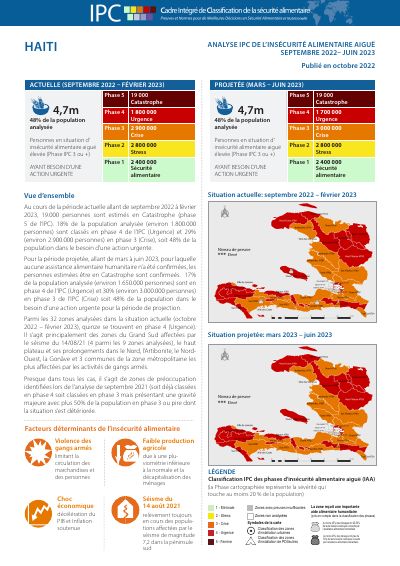
Haiti: IPC Acute Food Insecurity Analysis, September 2022 to June 2023
- From September 2022 to February 2023, 4.7 million people, 48% of the population analyzed, were in IPC Phase 3 or above.
- About 19,000 people were estimated in Catastrophe (Phase 5) in the current period.
- Fifteen of the 32 areas analyzed were in Phase 4 (Emergency).
- The number of areas in Phase 4 rose from five in September 2021 to fifteen in September 2022.
- The share of people in Phase 4 rose from 7% in 2019 to 18% in 2022, while the share in Phase 1 fell from 41% to 24%.
- The main drivers named are gang violence, low agricultural production, an economic shock and the August 14, 2021 earthquake.
The analysis comes from an IPC classification workshop held from September 26 to 30, 2022 under the leadership of the CNSA. For September 2022 to February 2023 it estimates 4.7 million people, 48% of the population analyzed, in IPC Phase 3 or above, including about 19,000 in Phase 5 (Catastrophe). Fifteen of the 32 areas analyzed are in Phase 4 (Emergency), mainly in the Grand Sud affected by the August 14, 2021 earthquake, the central plateau, the Artibonite, the Northwest, La Gonâve and three communes of the metropolitan area most affected by gang activity. The text names gang violence, low agricultural production, an economic shock and the 2021 earthquake as the main drivers. It compares the result with earlier analyses, notes that the share of people in Phase 4 rose from 7% in 2019 to 18% in 2022, and ends with recommendations and focus sections on Cité Soleil and the coastal Grand'Anse.
How to cite
Food Security Sector (FSS) Haiti, Haiti: IPC Acute Food Insecurity Analysis, September 2022 to June 2023, https://fscluster.org/sites/default/files/documents/fiche_communication_ipc_aigue_septembre_2022_version_finale_251022.pdf
- Rights holder
- Food Security Sector (FSS) Haiti