Full Document Text
Extracted text from the original document for search indexing.
1 Any comments or questions? Please contact us at info@acaps.orgAnticipatory note
21 February 2025
BACKGROUND: SUSPENSION OF US-FUNDED FOREIGN AID
On 20 January 2025, US President Donald Trump issued an executive order (EO) calling
for a 90-day suspension of US-funded foreign aid, including humanitarian operations
(WH
20/01/2025)
. On 24 January, the administration started sending out stop-work orders (SWOs)
and suspending new aid projects. By 7 February, most USAID employees had been placed
on administrative leave, with the exception of critical personnel
(CNN 05/02/2025). Despite the
issuance of a waiver for “life-saving humanitarian assistance” on 28 January, and several court
challenges to the freeze, humanitarian organisations worldwide were experiencing significant
disruption to their operations by 20 February
(BBC 07/02/2025; Devex 13/02/2025; Devex 17/02/2025).
OVERVIEW: ANTICIPATED IMPACT ON FUNDING AND HUMANITARIAN
NEEDS IN HAITI
The suspension of US assistance will have severe implications for Haiti, where six million
people (50% of the 11.9 million population) are in need of humanitarian assistance
(OCHA
09/02/2025; UNFPA accessed 14/12/2025)
. Escalating gang violence, chronic political instability and
governance challenges, and recurrent climate hazards contribute to high humanitarian needs
across all sectors
(OCHA 09/02/2025). The rapidly increasing scale of needs is demonstrated
by a 230% increase in IDPs throughout 2024, reaching 1.04 million people (around 8.5% of the
population), almost all of whom fled violence
(IOM 14/01/2025 a).
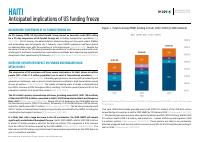
The US is Haiti’s primary humanitarian aid donor, providing around 65% (USD 190.6 million)
of the total USD 295.5 million committed to Haiti’s 2024 Humanitarian Needs and Response
Plan (HNRP)
(OCHA accessed 12/02/2025 a). Nearly 50% of US funding for the 2024 HNRP went to
the food security sector (USD 107.6 million), followed by 12.5% for WASH (over USD 24 million)
and 6% for health (over USD 11 million)
(OCHA accessed 13/02/2025). The US also provided around
USD 17 million in humanitarian funding not specifically earmarked for the HNRP, including for
coordination and support services
(OCHA accessed 18/02/2025).
It is likely that, with a large decrease in the US contribution, the 2025 HNRP will remain
significantly underfunded throughout the year. Haiti’s 2025 HNRP calls for USD 908.2 million
to assist 3.9 million people in need (of the total six million). This represents a 34% increase
from the USD 673.8 million required by the 2024 HNRP
(OCHA 09/02/2025 and 28/02/2024). The
total amount of US funding committed to Haiti’s humanitarian operations for the 2025 financial
year is not publicly available.
Figure 1. Total incoming HNRP funding in Haiti, 2022–2024 (in USD millions)
Source: ACAPS using OCHA (accessed 12/02/2025 a); OCHA (accessed 12/02/2025 c); and OCHA (accessed
12/02/2025 d)
That said, USAID had already provided nearly half (USD 23.1 million) of the USD 48.5 million
committed by all countries to Haiti’s 2025 HNRP by 12 February 2025
(OCHA accessed 12/02/2025
b)
. This funding has been primarily allocated to the shelter and NFI (USD 9 million), WASH (USD
2.9 million), health (USD 2.8 million), and protection – human trafficking and migration (USD
2.6 million) sectors
(OCHA accessed 12/02/2025 b). These sectors are likely to be particularly
affected, alongside food security, which received nearly 50% of all US humanitarian funding to
Haiti in 2024
(OCHA accessed 13/02/2025).
HAITI
Anticipated implications of US funding freeze
Anticipatory note | 21 February 2025 2
The funding freeze may also contribute to a deterioration in Haiti’s security situation. The
freeze will affect some US contributions to the Multinational Security Support (MSS) mission,
deployed in 2024 to combat gang violence in Haiti, which is already facing significant under-
resourcing
(OHCHR 20/09/2024). By the beginning of February, USD 13.3 million (of USD 15
million) of pending US contributions to the UN’s MSS fund were suspended, although direct
US assistance to the mission, which amounted to USD 300 million in funds and equipment by
January 2025, will continue under a waiver
(US Embassy in Haiti X 06/02/2025; US DOS 06/02/2025;
AP 05/02/2025; France 24 04/02/2025)
. The freeze has also affected the employment of expert
security and policing advisors – furloughed in late January – for the Haitian National Police
(HNP) and MSS
(Miami Herald 05/02/2025 and 28/01/2025). Decreased humanitarian and security
presence may create space for increased gang activity.
ABOUT THIS REPORT
Aim
This report analyses the actual and potential implications of the US funding freeze and SWOs
on humanitarian operations and needs in Haiti. It aims to provide key stakeholders with an
accessible overview of emerging challenges.
Methodology
This analysis is based on a secondary data review of publicly available information.
For recent information on humanitarian needs, this analysis cites the 2024 REACH Multi-
Sectoral Needs Assessment (MSNA) completed in June–July. The MSNA surveyed nearly
2,700 households in Haiti’s ten departments, along with around 700 households in the Port-
Au-Prince Metropolitan Zone (ZMPAP) and around 800 IDP and host community households
in Sud department
(REACH 07/2024).
Limitations
By 20 February, there remained a lack of information on how many UN organisations, INGOs,
and national and local NGOs had been affected by the funding freeze and SWOs in Haiti. This
report draws on information about 2024 US humanitarian funding to provide insight into the
potential implications of the freeze for different sectors and organisations.
By 20 February, guidance on implementation of both the funding freeze and waiver remained
vague or unavailable because of ongoing disruption to USAID staffing and payment systems
(HRW 10/02/2025; Devex 17/02/2025). Given this lack of clarity, this report covers the funding
freeze’s potential implications for sectors and specific activities that would likely fall under
the waiver, those that are unlikely to be covered, and those with uncertain status.
To ensure a humanitarian focus, this analysis primarily highlights the US assistance provided
towards Haiti’s Humanitarian Needs and Response Plans, along with a small amount
of additional funding recorded in the Office for the Coordination of Humanitarian Affairs’
Financial Tracking System. While it acknowledges the impact of the suspension of non-
humanitarian US funding to development, health, early warning and preparedness, and other
areas, it does not provide detailed analysis of these funding sources.
Figure 2. People in need and targeted by Haiti’s 2025 HNRP, by sector
SECTOR PEOPLE IN NEED PEOPLE TARGETED
WASH 3.8 million 1.8 million
Health 4.2 million 2.0 million
Food security 5.5 million 3.4 million
Nutrition 1.2 million 906,000
Protection (general) 214,000 467,000
Child protection 1.6 million 1.2 million
Protection (gender-based
violence)
1.5 million 833,000
Protection (migrants) 350,000 281,000
Shelter and NFIs 3.6 million 525,000
Anticipatory note | 21 February 2025 3
POTENTIAL IMPACT ON NEEDS
WASH and health
Figure 3. US contribution to WASH and health funding under the 2024 HNRP
Source: OCHA (accessed 13/02/2025)
The White House’s waiver for life-saving humanitarian assistance does not specify WASH
services, and it is unclear whether such services would fall under the health or subsistence
assistance categories
(US DOS 28/01/2025). In 2024, the US committed over USD 24 million
to WASH in Haiti, covering nearly 30% of the USD 84.3 million required by the HNRP
(OCHA
accessed 13/02/2025)
. These funds supported 13 organisations conducting WASH activities,
including the provision of hygiene kits and hygiene awareness sessions, clean drinking water,
and WASH infrastructure
(USAID 30/09/2024 a).
The suspension of any of these WASH activities will increase the risk of cholera and other
vector and waterborne disease transmission, particularly for at least 3.8 million Haitians in
need of WASH assistance in 2025
(OCHA 09/02/2025). Haiti has been experiencing a cholera
outbreak since October 2022, with 9,500 suspected cases, 8,870 hospitalisations, and 130
deaths across the country between January and mid-December 2024. Most of these cases
occurred in Artibonite, Centre, and Ouest departments
(OCHA 09/02/2025). These departments
also have some of the worst WASH access in Haiti, with the highest rate of non-improved
water usage in Centre (50%) and third-highest rate in Artibonite (31%)
(REACH 09/2024).
WASH access is also limited at some IDP sites, where overcrowding may facilitate disease
transmission
(IOM 14/01/2025 a).
As a result of the funding freeze, patients who contract cholera and other diseases will
likely face increased barriers to accessing healthcare. In 2025, 4.2 million Haitians (over
35% of the population) are in need of health assistance
(OCHA 09/02/2025). In 2024, the US
committed over USD 11 million to health, covering around 30% of the USD 37.3 million
required and supporting six implementing organisations, including mobile clinics
(OCHA
accessed 13/02/2025; USAID 30/09/2024 a)
. Mobile healthcare is particularly vital in many rural
parts of Haiti, where distance and a lack of safe, affordable transport options limit access
to health facilities. The 2024 MSNA found that 34% of respondents were unable to access
healthcare when in need in the three months prior to data collection, with the highest rates
in Sud-Est (53%), Grand’Anse (44%), and Nord (39%) departments. Distance constituted the
second-most common reason for inaccessibility, at 33%, after cost (41%)
(REACH 09/2024).
While the waiver applies to life-saving medical services, there is a lack of clear public guidance
on what specific services are included. An internal directive to the Bureau of Global Health
specified that the waiver covers activities related to the prevention, diagnosis, and treatment
of tuberculosis and malaria; acute ante and post-natal care; treatment for acute childhood
illness, including immunisations to prevent ‘imminent mortality’; and management of severe
acute malnutrition
(Devex 07/02/2025).
It is unclear whether this includes additional services essential to preventing and treating
serious illness, such as care for chronic non-communicable diseases, early detection of
malnutrition, regular immunisations, and mobile primary care clinics. Lack of funding for
regular immunisations may increase rates of childhood disease. A suspension of non-acute
primary care services, including treatment for non-communicable diseases, is likely to have
a disproportionate impact on older people and people with disabilities.
The waiver’s explicit exclusion of “activities that involve abortions, family planning… gender
or DEI ideology programs” may also have a significant impact on comprehensive sexual and
reproductive healthcare. This will disproportionately affect women and girls, including at
least 1.5 million women of reproductive age. It may contribute to an increase in unplanned
pregnancies, unsafe abortions, and associated rise in maternal mortality
(Devex 17/02/2025).
Haiti’s maternal mortality rate of 5.3 is already the highest in the western hemisphere
(UNFPA
22/01/2025; MSF 23/01/2025)
.
Prior to the EO, WASH and healthcare access barriers were already contributing to rising
overall mortality in Haiti. In the first eight months of 2024, violence, displacement, limited
access to basic services, and high food insecurity aggravated chronic and acute illness,
leading to a 180% increase in overall mortality estimates compared to the same period in
2023, from a crude death rate of 0.26 to nearly 0.73
(REACH 06/02/2025). Even a temporary loss
of access to healthcare as a result of the funding freeze may increase these rates further.
Anticipatory note | 21 February 2025 4
Food security, nutrition, and livelihoods
Figure 4. US contribution to food security and nutrition under the 2024 HNRP
Source: OCHA (accessed 13/02/2025)
In 2024, US funding accounted for around 30% (USD 107 million) of the USD 340 million
required for food assistance and 33.5% (USD 10.9 million) of the USD 32.5 million required
for nutrition assistance under the HNRP
(OCHA accessed 13/02/2025). In total, USAID reported
contributing over USD 118 million to food and in-kind food assistance, nutrition services, and
agricultural support to 14 humanitarian responders throughout 2024
(USAID 30/10/2024).
The 2025 HNRP calls for USD 425 million in food assistance and USD 39.9 million in nutrition
assistance
(OCHA 09/02/2025; WHO accessed 14/02/2025). By the time the EO was issued
in January 2025, the US had not yet made its contribution to food, nutrition, or livelihood
assistance under the HNRP
(OCHA accessed 12/02/2025 b). That said, organisations may have
continued implementing US-funded projects from previous years or may have been awaiting
the provision of new funding for 2025.
While the White House waiver for life-saving assistance includes food and subsistence
assistance, it is unlikely that many food assistance programmes have resumed, given the
waiver’s significant implementation barriers
(US DOS 28/01/2025; HRW 10/02/2025). It is also
unclear whether the waiver covers some nutrition activities, such as early detection of
malnutrition, or livelihood support activities. For example, by 7 February, World Relief had
3.9MT of seed at risk of rotting in a warehouse in Haiti after receiving a SWO preventing
delivery
(Time 07/02/2025).
Even a temporary or partial decrease in US funding for food, nutrition, and livelihood
assistance will have a significant impact on food security in Haiti. In February 2025, an
estimated 5.41 million people, nearly 50% of Haiti’s population, faced Crisis (IPC Phase 3) or
above levels of food insecurity, including two million people facing Emergency (IPC Phase
4) levels. In September 2024, the number of those experiencing IPC 3 or above levels of
food insecurity was projected to increase to 5.54 million between March–June 2025
(IPC
30/09/2024)
. This projection did not account for the US funding freeze, however, and it is likely
that food insecurity will increase even more than projected. This may contribute to rising
malnutrition, which had already reached emergency levels by December 2024, with over
125,000 children at risk of severe acute malnutrition
(OCHA 09/02/2025; UNICEF 05/12/2024).
Lower levels of food and livelihood assistance in Haiti will have a particularly severe impact
given the increased shift from personal food production to buying from markets. Increasing
insecurity has displaced farmers, disrupted supply chains, blocked access to markets, and
decreased household purchasing power, contributing to a decline in agricultural output.
Between 2021–2024, an estimated USD 1.1 billion, or 4.5% of Haiti’s GDP, was lost in the
agriculture sector
(OCHA 09/02/2025). This translated into an increasing number of farmers
relying on cash and credit to buy food in 2024, rather than growing their own
(REACH 09/2024).
By September 2024, food spending accounted for up to 70% of household expenditure
(IPC
30/09/2024)
. The suspension of livelihood assistance, including agricultural inputs, will likely
affect the main March–April maize sowing period and May start to the rice sowing period,
forcing households to rely even more on markets
(FAO 14/10/2024; FEWS NET 31/12/2024).
In 2024, 13 of the 18 USAID-funded implementing organisations received funding to provide
cash transfers for food, work, and multi-purpose cash assistance
(USAID 30/10/2024). Without
cash assistance to buy food or the livelihood support required for people to grow their own
food, hunger is likely to increase.
Decreased food, nutrition, and livelihood assistance will also increase the use of potentially
harmful coping strategies, including the recruitment of children into armed gangs. By the
beginning of 2025, children comprised an estimated 50% of armed group members in Haiti.
Hunger was identified as the main factor driving children to join gangs, which provide them
with food, shelter, and income
(OCHA 09/02/2025; ACAPS 30/09/2024).
Anticipatory note | 21 February 2025 5
Protection
In 2024, the US committed nearly USD 9.5 million to the protection sector, covering around
14% of the over USD 67.6 million required
(OCHA accessed 13/02/2025). This funding supported
12 protection organisations
(USAID 30/09/2024 a). The funding waiver does not explicitly
cover protection-related activities, although many are life-saving, including the provision of
emergency shelter. Further, the waiver explicitly excludes “family planning” and “gender or
DEI ideology programs”
(US DOS 28/01/2025). The precise implications of these exclusions for
protection programming in Haiti were unclear by 20 February.
That said, it is likely that the funding freeze will impact assistance for many of the 2.2 million
Haitians in need of protection assistance in 2025. This includes 1.6 million in need of child
protection assistance, 1.2 million in need of GBV assistance, and 350,000 in need of migrant
and refugee-related assistance (categories not mutually exclusive)
(OCHA 09/02/2025).
The funding freeze may affect case management, referrals, psychosocial support, and
other protection support for GBV survivors, leading to negative long-term impacts on their
wellbeing. Humanitarian responders working in various services recorded around 5,860
reported incidents of GBV in 2024. As this figure only reflects the experiences of people with
access to humanitarian assistance and willing or able to report, the true number of cases
is likely much higher. Among the 5,860 documented cases, around 70% involved sexual
violence
(OCHA 31/01/2025; GBV AoR et al. 30/01/2025).
The US funding freeze may also disrupt protection activities for children and youth recruited
into armed gangs. Boys are particularly vulnerable to recruitment, while girls recruited into
armed gangs are at a high risk of GBV, including rape
(OCHA 09/02/2025).
Haitian deportees from the Dominican Republic, of whom there were around 200,000 in
2024, have high protection needs after experiencing violence, including sexual violence, and
inhumane and degrading treatment during the arrest, detention, and deportation process
(GBV AoR et al. 30/01/2025; IOM accessed 17/02/2025). The waiver excludes any migration and
refugee assistance activities except those related to life-saving assistance or repatriating
‘third country nationals’ to their countries of origin
(US DOS 28/01/2025). This may leave
deportees without case management, referrals, and other important protection services
upon their arrival and reintegration into Haiti.
Emergency shelter and NFIs
In 2024, the US committed over USD 10.2 million to Haiti’s shelter and NFI sectors, covering
around 18.5% of the USD 55.7 million required
(OCHA accessed 13/02/2025). By February 2025,
emergency shelter and NFIs had received the most US funding of all sectors, at USD 9 million
(OCHA accessed 13/02/2025). While emergency shelter is covered by the waiver, the situation is
unclear for NFIs, which are likely needed by a growing number of IDPs fleeing attacks with
little time to gather their belongings.
In total, according to the 2025 HNRP, 3.6 million Haitians are in need of shelter and NFI
assistance, with USD 78 million required to meet the needs of only 525,000 of these people.
Frequent climate hazards, displacement, and high poverty contribute to high shelter
needs
(OCHA 09/02/2025). The 2024 MSNA found that 29% of respondents nationwide
lived in incomplete buildings and 19% lived in makeshift shelters. Shelter conditions were
particularly poor in Artibonite department, where 36% lived in incomplete buildings; Centre
and Sud, where around 40% of respondents lived in makeshift shelters; and Sud-Est, where
42% reported damage to or the total collapse of their roof
(REACH 09/2024).
IDPs and Haitians deported from the Dominican Republic have especially high shelter and
NFI needs because of overcrowding in host communities and a lack of assistance. 83% of the
1.04 million IDPs in Haiti (around 830,000) live in host communities. The remaining 170,000
live in 142 displacement sites, 108 of which are in the ZMPAP
(IOM 14/01/2025 a). According to
the most recent IOM data, IDPs living outside the sites were more likely to have shelter needs
(at 40%) than IDPs living in sites
(IOM 14/01/2025 a).
Emergency shelter for Haitians deported from the Dominican Republic is already limited at
border crossings, forcing some deportees to sleep on the streets. Most of these deportees
lack longer-term shelter options, as they lost connection with their communities of origin
while living in the Dominican Republic, were already internally displaced prior to leaving Haiti,
and/or have no resources or livelihoods to find long-term shelter
(ACAPS 26/11/2024). The
funding freeze may limit longer-term shelter support for deportees.
Anticipatory note | 21 February 2025 6
AGGRAVATING FACTORS
Gang violence
Haiti has experienced a surge in its long-standing gang violence crisis since March 2024,
primarily concentrated in the ZMPAP, although gang control has also increased in Artibonite,
Centre, and the rest of Ouest department
(GI-TOC 05/11/2024). By November 2024, an estimated
2.7 million people (nearly 25% of Haiti’s population) lived under gang control, primarily in
these departments
(OSRSG Children and Armed Conflict 11/11/2024; OCHA 08/11/2024). Throughout
2024, gang violence killed 5,600 people (a 20% increase from 2023) and injured 2,215, with
an additional 1,500 people kidnapped
(OCHA 09/02/2025).
In June 2024, the MSS was deployed to Haiti to assist the HNP in combatting gang violence.
By the end of 2024, however, the mission had not succeeded in decreasing violence or re-
establishing state control over the capital, partly because of significant under-resourcing
(GI-TOC 05/11/2024; OHCHR 20/09/2024).
Political and economic instability
The escalation of gang violence in March 2024 led to the resignation of Haiti’s former
Prime Minister Ariel Henry, who had ruled by decree since July 2021, as he never received
parliamentary approval
(BBC 12/03/2024). In April 2024, a nine-member Transitional
Presidential Council (TPC) was appointed to regain state security control and prepare for
democratic elections by the end of 2025. After months of infighting and corruption-related
scandals, the TPC fired Haiti’s interim prime minister, Gary Conille, on 12 November 2024,
replacing him with Alix Didier Fils-Aimé
(AJ 10/11/2024; OCHA 09/02/2025; The Guardian 11/11/2024;
ICG 19/02/2025).
Continuing instability within the TPC will likely hamper government efforts to fill any gaps
left by the US funding freeze, as will a lack of economic resources. In 2024, Haiti’s GDP
contracted for the sixth consecutive year, by 4.2%, largely as a result of insecurity-related
economic disruptions. Haiti remains one of the poorest countries in Latin America and the
Caribbean
(OCHA 09/02/2025; WB accessed 18/02/2025). While inflation decreased from a peak of
nearly 50% in January 2023, it remained high in mid-2024, at around 30%, according to the
most recent figures
(WB accessed 18/02/2025). The suspension of US development assistance,
along with humanitarian assistance, may aggravate this economic decline.
Climate and natural hazards
Haiti’s INFORM Climate Change Risk Score is 5.5/10 (high), with a score of 7.3/10 for lack of
coping capacity, reflecting limited state capacity to respond to natural hazards
(EC accessed
14/02/2025)
. Haiti is particularly vulnerable to tropical storms and cyclones, which cause
flooding and landslides, especially in low-lying coastal regions
(OCHA 19/01/2024). Floods
in November–December 2024 caused significant agricultural losses, destroying 80% of
bean, potato, and plantain crops in Nord and Nord-Ouest departments
(OCHA 09/02/2025).
Such natural hazards increase the need for agricultural and other assistance, which will be
limited by the funding freeze. Decreased US assistance for early warning, early action, and
preparedness will also aggravate the impact of hazards.
Deportations to Haiti
An increasing number of Haitians deported back to Haiti, particularly from the Dominican
Republic and US, will increase the number of people in need of assistance in 2025,
aggravating gaps caused by the US funding freeze. The Dominican Republic has increased
its deportation of Haitians since 2022, with a further rise from October 2024. Many deported
Haitians have been in the Dominican Republic for extended periods and have minimal
connections with their communities of origin. Most arrive with no resources. While a small
amount of emergency assistance is available to deportees at some of the formal border
crossings, there is limited monitoring or targeted support once they leave the border area
(ACAPS 26/11/2024; IOM 14/01/2025 b). The US, which increased its deportation of Haitians under
the Biden administration, is likely to further increase returns following several immigration-
related EOs calling for mass deportations issued by the Trump administration at the end of
January 2025
(Euronews 05/02/2025; AP 19/04/2024; Vera Institute 29/01/2025).
Additional US policies and funding suspension
The US provides separate health funding specifically for HIV/AIDS prevention, care, and
treatment under the President’s Emergency Plan for AIDS Relief
(US DOS accessed 19/02/2025).
By February 2025, an estimated 125,000 patients in Haiti were receiving antiretroviral
treatment under this plan and the Global Fund to Fight HIV, Tuberculosis, and Malaria, which
only had a three-month supply of medication between them. While the US issued a separate
waiver for ‘urgent, life-saving HIV treatment’, many organisations have been unable to take
advantage of this waiver. For example, the medical supply organisation in Haiti that controls
access to the building where HIV medication is stored has received a SWO, preventing
disbursement of the medication
(Miami Herald 06/02/2025; The Global Fund accessed 19/02/2025;
Devex 01/02/2025)
.
Anticipatory note | 21 February 2025 7
The US withdrew from the WHO on 20 January 2025, which will likely cause significant
public health consequences, including in Haiti. The US was the largest contributor to the
WHO, providing an estimated 12–15% of WHO funding (USD 1.28 billion) in 2022–2023
(Johns
Hopkins 30/01/2025; WHO accessed 21/02/2024)
.
HUMANITARIAN ACCESS AND OPERATIONAL CONSTRAINTS
Access constraints in Haiti are severe, largely because of gang-related insecurity, including
gang-imposed movement restrictions. Around 770 access incidents were reported in
2024, nearly 50% (360) of which were in Ouest department, followed by around 25% (185)
in Artibonite and 10% (72) in Grand’Anse. 43% (around 332) of these incidents related to
movement restrictions and 41% (around 315) related to security operations and hostilities
(OCHA 09/02/2025).
Insecurity also led to the effective suspension of commercial flights into the ZMPAP in
November 2024, leaving the UN Humanitarian Air Service (UNHAS) as the key transport link
for the ZMPAP and the rest of Haiti’s departments
(WFP 10/02/2025; Haitian Times 03/12/2024).
USAID facilitated 150 UNHAS flights in Haiti in 2024 and committed nearly USD 7.9 million
to the logistics sector, covering about 46% of the USD 17.2 million required
(USAID 30/09/2024
a; OCHA accessed 13/02/2025)
. On 10 February 2025, the WFP issued an emergency appeal for
USD 3.9 million to enable the continuation of UNHAS flights in Haiti
(WFP 10/02/2025).
Aside from sectoral impacts, the funding freeze has implications for humanitarian
information and coordination, which may hamper humanitarian operations in coming
months. For example, the humanitarian information service FEWS NET, which provides
information vital for preparing for food insecurity crises and famine, was suspended at the
end of January
(The Guardian 31/01/2025). In 2024, USAID supported several humanitarian
information services and coordination operations in Haiti, providing 3.8 million out of 5.5
million in coordination and support funding
(OCHA accessed 19/02/2025).
Figure 5. US contribution to logistics funding under the 2024 HNRP
Source: OCHA (accessed 13/02/2025)
Anticipatory note | 21 February 2025 8
Figure 6. Active USAID-supported programmes and funding recipients, October
2024
Source: USAID (30/09/2024 b)
Figure 7. Number of IDPs by department, January 2025
Source: IOM (14/01/2025 a)