Full Document Text
Extracted text from the original document for search indexing.
KEY FIGURES
Briefing note
02 June 2023
1 Any comments or questions? Please contact us at info@acaps.org CRISIS OVERVIEW
Gangs have existed in Haiti for decades, but related violence has been rapidly
increasing in several areas of the country since 2021. In December 2022, the
UN estimated that 60% of Port-au-Prince, the country’s capital, was under
gang territorial control
(AP 09/12/2022). By April 2023, this figure had increased
to about 80%
(UN 14/04/2023; NYT 22/03/2023). Gangs have also established
their presence in other regions of the country, including Cap Haïtien (Nord),
Gonaïves (Artibonite), Jacmel (Sud-Est), Jérémie (Grand’Anse), and Les Cayes
(Sud)
(ICG 27/07/2022).
In 2022, around 2,180 homicides were recorded in Haiti, an increase of more
than 35% compared to 2021
(UNSC 17/01/2023). Other violent crimes, such as
rape and kidnapping, also increased in 2022
(TNH 14/11/2022; The Telegrapgh
15/07/2022)
. During the first quarter of 2023, 815 homicides and over 630
kidnappings were reported across the country, representing respective
increases of 21% and 63% compared to the last quarter of 2022
(SCR 25/04/2023).
On 24 April 2023, new gang clashes in Port-au-Prince resulted in the burning of
houses and several stabbings and shootings
(MSF 27/04/2023).
There are 200–300 gangs across Haiti, around half of which are in Port-au-
Prince
(OCHA 13/04/2023 and 17/03/2023). These gangs are sometimes organised
in federations of more than a dozen gangs. The two main gang federations
are the Fòs Revolisyonè G9 an Fanmi e Alye, usually abbreviated as G9 or
FRG9, and the GPèp, which translates to G-People in English
(Haïti Liberté
13/07/2022)
. Jimmy ‘Barbecue’ Chérizier, a former policeman, leads G9, and
Gabriel Jean Pierre, known as Ti Gabriel, leads the GPèp
(Brookings 03/02/2023).
Chérizier created G9 in May 2020, and the GPèp appeared several months
later to compete for the control of Cité Soleil, one of the neighbourhoods most
affected by violence in Port-au-Prince
(InSight Crime 29/12/2021).
Both gang federations have alliances with politicians and police officials.
There are accusations that the G9 is close to the Haitian Government and is
receiving money from high-level officials
(InSight Crime 24/11/2022). On the other
hand, the GPèp has alliances with opposition members that aim to weaken
the Government
(Haïti Liberté 13/07/2022; InSight Crime 21/07/2022). These alliances
are important, as gangs use the impunity they generate to carry out violent
acts without consequence and increase their power
(UNSC 26/04/2023; News24
09/03/2023)
. These alliances also give them access to arms, financing, and
ammunition from government sources
(IHRC/OHCCH 22/04/2021; DW 08/10/2022).
The gangs have also assumed some governance functions, such as providing
financial assistance in areas under their control. In return, politicians receive
electoral assistance, with gangs using violence to mobilise voters
(GI-TOC
17/10/2022; Niño 08/02/2023)
.
As at 15 March 2023, gangs had forcibly displaced at least 160,000 people
since 2021. IDPs live in host communities or informal collective sites with
limited shelter, health services, education, and food access. The violence has
increased food prices, and half of Haiti’s population has reported struggling
to eat
(OHCHR 21/03/2023). There are records of snipers committing random
violence against people in the streets and kidnapping people, resulting in self-
imposed lockdowns for civilians
(OHCHR 10/02/2023). Schools and hospitals
have had to close as a result of their staff falling victim to the violence
(OCHA
23/04/2023; UNICEF 09/02/2023)
. Although violence has been mainly concentrated
in Ouest department, especially in Port-au-Prince, gangs exist in many parts of
Haiti. People report the most movement restrictions in Artibonite, Centre, and
Ouest departments
(OCHA 17/03/2023).
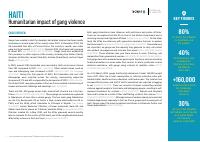
HAITI
Humanitarian impact of gang violence
80%
OF PORT-AU-PRINCE
IS CONTROLLED
BY GANGS
40%
DECREASE IN THE
NUMBER OF
POLICE OFFICERS
BETWEEN
2020-2023
+160,000
PEOPLE DISPLACED
BY CRIMINAL
VIOLENCE
IN HAITI
30%
OF HAITIAN WOMEN
BETWEEN 15-30 YEARS
OLD HAVE BEEN
VICTIMS OF
SEXUAL VIOLENCE
Briefing note | 02 June 2023 2
KEY MESSAGES
• Gang presence increased in Port-au-Prince between November 2022 and May 2023. As
at April, gangs controlled an estimated 80% of Port-au-Prince. They have also spread
beyond Port-au-Prince, mainly to the other areas of Ouest department and to Artibonite
department.
• Gangs have also become more violent. Homicides and kidnappings have steadily
increased since 2018. Although figures are unreliable, cases of sexual violence have
increased, mainly used to punish rival gang members or pressure them for ransom.
• Violence is unlikely to decrease in the short term. Firstly, the Haitian National Police
(PNH) is outnumbered and outgunned in many areas, with a 40% reduction in their
personnel over three years. Secondly, the number of gangs are increasing in the country,
and alliances are weak even within gang federations, which could lead to more violence
over territory control.
• Gang violence has led to the closure of multiple markets and the abandonment of land in
Artibonite, one of Haiti’s main agricultural regions. Livelihood disruption is worsening the
food insecurity crisis, which already affects almost half of Haiti’s population.
• Gang violence has also increased internal and international forced displacement,
displacing at least 160,000 people who find themselves in makeshift shelters or host
communities with limited access to basic services and food.
• Some humanitarian aid targets crises other than criminal violence, such as cholera
outbreaks and food insecurity. While those crises may overlap, humanitarians are limited
in their ability to act, as the Haitian State has very limited control over some cities. Gangs
have also attacked aid workers and looted their supplies, limiting responders’ ability to
address the issues fueled by gang violence
(TNH 14/12/2022).
• The funding required for humanitarian response has almost doubled since 2022 in
a context where it is almost impossible to operate in the areas where funding is most
needed, such as Port-au-Prince, and humanitarian constraints prevent the smooth running
of operations across the country
(FTS accessed 11/05/2023). Most of the Humanitarian
Response Plan’s funding is meant to curb the food insecurity crisis, and the geographical
focus is on Ouest department
(OCHA 13/04/2023).
About this report
Aim: this report highlights the humanitarian impact of the recent increase in gang
violence in Haiti. In November 2022, ACAPS published another report on the deteriorating
humanitarian situation in the country, with a focus on Port-au-Prince, where gang
violence was already described as a driver of multiple crises
(ACAPS 01/11/2022). Since
then, while several other drivers have deteriorated, such as the cholera outbreak or
the high cost of living, gang violence has further increased, worsening the severity of
the insecurity and displacement crises. Gang violence is aggravating the humanitarian
situation, and humanitarian space is increasingly decreasing. This report is a follow-up
on the November report, including on the risks identified and their materialisation. The
focus is on gang violence, and the geographical scope has been extended to cover the
entire country.
Method: this report was built on a review of secondary sources from humanitarian
organisations, think tanks, and local and international media.
Limitations: the very nature of the crisis limits what information is available on gang
violence in Haiti. In the most affected areas, leaving their homes puts people at risk of
attacks, and people may choose not to report instances of crime to avoid retaliation
from gangs. Consequently, figures on sexual violence, kidnappings, and displacement
are likely higher than what ACAPS can access
(ICG 14/12/2022). The intertwining of
the gang violence crisis with other crises, such as health, displacement for different
reasons, and food insecurity, makes it difficult to understand the real magnitude of the
impact of violence. Although we have attempted to isolate the effect of gang violence
where possible, there will be times when the crises are difficult to separate.
TABLE OF CONTENTS
Anticipated scope and scale....................................................................................................................3
Humanitarian access constraints...........................................................................................................3
Impact of gang violence............................................................................................................................4
Compounding factors................................................................................................................................9
Briefing note | 02 June 2023 3
ANTICIPATED SCOPE AND SCALE
Given the constraints, the Haitian security forces cannot curtail gang violence in the short
term. Gangs outnumber the PNH in some areas of the capital, and they have burnt and looted
some police stations in search of weapons
(TNH 14/11/2022). PNH officers are also underpaid,
and their troops are not sufficiently armed. In 2020, the country had about 15,000 police
officers
(CRS 03/03/2020). As at 2023, this figure had decreased to around 9,000, as many
officers had resigned or left the country
(NYT 22/03/2023). Although the number of gang
members is unknown and constantly changing, 2022 estimates suggested that 20,000–
30,000 people belonged to gangs
(TRT World 21/10/2021). In January 2022, gangs carried out
a series of targeted killings of police officers, leading to protests and several resignations
among members of the police force
(CBS News 27/01/2023). The police union have said that
the salary of police officers is insufficient considering the risk of lethality
(NYT 22/03/2023).
These aspects make it unlikely for the gangs to stop the escalation of violence or for Haiti’s
security forces to be able to stop them.
Gang violence in Haiti is also likely to continue because of several risks of dispute. The first
is at the intragang level. Alliances between the gangs that make up the G9 and the GPèp are
weak
(Le Nouvelliste 03/07/2020). Some gangs were enemies before becoming allies, and there
have been violent disputes between them in some neighbourhoods
(InSight Crime 29/12/2021;
GI-TOC 17/10/2022)
. The second is between gang federations and other criminal groups seeking
to contest their control over some neighbourhoods. An example is the 400 Mawozo, which
exercises control over Croix-des-Bouquets, a Port-au-Prince neighbourhood. This gang is
considered one of the largest in the country and has used kidnappings as one of its main
tactics
(InSight Crime accessed 20/05/2022). The third risk of dispute, possibly producing the
most violence, is the war between the G9 and GPèp federations. These federations have been
fighting for more than three years. Given their alliances with politicians, the political crisis will
likely encourage the latter to use the former for protection or to attack their opponents
(InSight
Crime 21/07/2022; PBS 21/10/2022).
Illegal gun markets have also armed gangs with machine
guns
(UNODC 28/02/2023; CFR 25/04/2023). The high number of armed gangs, their alliances
with sectors of the police and politicians, and the weak alliances within and between them
are likely to sustain the violence resulting from the turf wars over time.
Haiti’s Prime Minister, Ariel Henry, has at various times called for international military
intervention in the country
(TWP 07/10/2022). Civil society groups favour a Haitian-led solution,
rejecting calls for foreign intervention
(TNH 14/11/2022). The opposition has also criticised the
request, believing it would expand Henry’s power during the political crisis. Previous foreign
military interventions have failed and undermined public confidence in the authorities and
the international community
(Foreign Affairs 10/03/2023; NYT 19/12/2021).
The Haitian Government has not established formal IDP camps, leading to the expansion of
multiple makeshift shelters with limited access to humanitarian assistance in Port-au-Prince.
As at April 2023, over 38% of the IDPs lived in 50 makeshift shelters, the vast majority without
access to basic services. The remaining IDPs live with host communities in an environment
where they share very limited resources
(UNSC 14/04/2023). Despite the absence of formal
camps, the Government has taken a stand against makeshift shelters. In November 2022,
the PNH evicted more than 3,000 IDPs from Hugo Chavez Square near the Port-au-Prince
airport
(Le National 18/11/2022; TNH 14/12/2022). As gang violence continues, the conditions in
which migrants live will likely worsen in the absence of available camps and the increasingly
limited resources of host families.
HUMANITARIAN ACCESS CONSTRAINTS
Access of humanitarians to people
Between 2019–2022, there were 11 instances of gangs attacking health aid providers. Over
60% of these incidents occurred in 2022
(Insecurity Insight 08/03/2023). Between 2020–2022,
there were at least 37 deaths, injuries, kidnappings, or arrests of aid workers in the country
(Insecurity Insight 23/05/2023). Gangs have kidnapped some aid workers to ask for ransom (Le
Journal de Montréal 31/01/2023)
. They appear to have carried out some of these attacks without
precise intent to target humanitarians, but the high level of randomness of the violence in
Haiti puts anyone living in the affected areas at risk
(TNH 14/12/2022).
Security constraints
Widespread insecurity puts the functioning of humanitarian programmes at risk. Even when
armed groups do not directly attack humanitarian workers, fighting usually occurs near
facilities, so some organisations cannot guarantee the safety of either their staff or the
population they support. Médecins Sans Frontières (MSF) cited this reason for temporarily
closing its Cité Soleil hospital
(MSF 08/03/2023). The violence also prevents aid workers
from moving around neighbourhoods. Several humanitarian organisations have reported
negotiating with gangs to move around safely, as the Haitian Government has lost control
over much of the capital
(Newsweek 16/08/2021; TNH 07/02/2022). For humanitarian responders,
moving through national roads is costly and dangerous in many areas
(ACAPS 14/07/2021;
OCHA 05/07/2021)
. The arrival of most goods in the country through the capital also challenges
how humanitarian responders transport goods to other affected areas of the country, which
can prevent the delivery of critical aid to people in need. Gangs have closed roads, leading at
various times to fuel and other goods crises in Haiti
(Reuters 27/09/2022).
Briefing note | 02 June 2023 4
Access of people to aid
The spread of violence across different areas of the capital has trapped many of the
population in need in gang-controlled neighbourhoods, restricting them from seeking
assistance
(Newsweek 16/08/2021; TNH 07/02/2022). Gangs have closed roads several times to
demand money from road users travelling by car or motorbike, and they have hijacked some
buses at illegal roadblocks. In some areas, there are lists of cars allowed to pass. Gangs
have also killed people for refusing to pay the amount they impose
(St Kitts & Nevis Observer
27/02/2023)
.
IMPACT OF GANG VIOLENCE
In April 2023, projections suggested that around 5.2 million out of a population of 11 million
needed humanitarian assistance in Haiti. This figure is a 6% increase compared to 2022,
with around 300,000 more people needing assistance. 4.2 million were projected to need
shelter, while two million needed protection. The areas with the most people projected to
need humanitarian assistance and protection were the departments of Ouest (1.8 million)
and Artibonite (824,000)
(OCHA 13/04/2023).
Among the people in need, OCHA estimates that 1.5 million suffer as a direct result of
gang violence in terms of insecurity, movement restriction, forced displacement, hunger,
the closure of basic health and education services, and protection concerns, including
widespread sexual violence and kidnapping
(OHCHR 21/03/2023). Haitians living outside Port-
au-Prince are also in need and suffer from the sociopolitical crisis and indirect impacts
of gang violence, including street blockades, fuel shortages, and rising food prices
(OCHA
17/03/2023)
.
Killings, kidnappings, and forced recruitments
• Homicide rates tripled in Haiti between 2018 (6.87 per 100,000 inhabitants) and 2022
(18.84 per 100,000 inhabitants).
• Kidnappings increased by 2,673% between 2018–2022. During the first quarter of 2023,
the number of kidnappings was already equivalent to 63% of those in 2022.
• Different disorganised and grassroots vigilante groups are killing suspected gang
members, increasing some types of violence. Incidents have included burning people
alive in the streets and lynching.
• Children and adolescents are at risk of gang recruitment, with gangs offering them
money to join armed groups and threatening them with violence should they refuse.
Given the extent of gang violence in Ouest and Artibonite departments, particularly in Port-
au-Prince, homicides have risen steadily since 2018. The homicide rate in Ouest department
in 2022 was more than 44 per 100,000 inhabitants, above the countrywide rate of 18.84 per
100,000
(UNSC 17/01/2023). In Artibonite, gangs have killed 138 people since July 2022, more
than the total number of homicides since 2019
(WFP 27/04/2023).
Numbers and rates of homicides in Haiti (2018–2022)
Source: ACAPS using data from SCR (accessed 08/05/2023)
Gang warfare means that civilians perceived as allies (family members, friends, or people
living in rival-controlled neighbourhoods) risk being killed by other gangs to send a message
to their enemies
(BBC 05/12/2022). Snipers shooting randomly in certain neighbourhoods have
killed some people
(AP News 10/02/2023). Gangs also target the relatives of police officers (AP
22/01/2023)
. This situation implies that people living in neighbourhoods under gang territorial
control are particularly exposed to the risk of death or injury.
Other forms of violence, such as vigilantism, have recently emerged. Some neighbours have
organised themselves to punish suspected gang members. This retaliation poses the risk
of homicides at the discretion of those involved in vigilante groups. Vigilante mobs have
killed at least 75 people accused of gang membership between January–April 2023
(BINUH/
OHCHR 09/05/2023; AP 02/05/2023)
. The killings are often public, with groups beating up people
with stones or burning them alive near politicians’ homes or police stations
(The Guardian
30/04/2023)
.
Briefing note | 02 June 2023 5
The number of people killed in this manner is likely higher than the reported number (CBC
08/05/2023)
.
Besides committing homicides, gangs have increasingly used kidnapping to extort money
from individuals in exchange for release. Between 2021–2022, there was a 107% increase
in kidnappings. Between 2018–2022, the figure grew by 2,673%
(SCR accessed 08/05/2023).
During the first quarter of 2023 alone, there were 637 kidnappings in Haiti, a 63% increase
compared to the same period in 2022 and almost 47% of the total number of kidnappings for
the entirety of 2022
(UNSC 14/04/2023; The Nation 17/04/2023). There is a risk of the kidnappers
killing abductees if the ransom is unpaid. Kidnapping targets have ranged from diplomats,
NGO staff, and businessmen to ordinary people, for whom lower ransoms have been
demanded
(Bloomberg 31/03/2022; The Nation 17/04/2023).
Table 1. Number of reported kidnappings in Haiti (2018–2022)
YEAR NUMBER OF REPORTED KIDNAPPINGS
2018 49
2019 78
2020 234
2021 655
2022 1,359
Source: ACAPS using data from SCR (accessed 08/05/2023)
Another risk of gang expansion is the forced recruitment of children and adolescents. Schools
function as protective environments that help children avoid contact with gang members,
and the closure of several schools has left children more vulnerable to gang recruitment.
According to the testimony of recruited children and youth, gangs offer to pay between HTG
1,500–2,500 (approximately USD 15–25) and threaten to kill those who refuse the offer
(NYT
22/03/2023; UN 03/07/2022)
. Gangs use children in multiple ways, including as spies to warn
of the presence of police or rival gangs or as hired assassins for the armed group. This use
of children in criminal violence puts them at risk of rival gangs retaliating or the community
stigmatising them
(InSight Crime 03/06/2022; OHCHR 17/05/2022). Gangs also use social media to
attract recruits. Gang leaders display high-value items to motivate children and young people
and invite them to join their armed groups. These high-value items are taken as proof that
those who join the gangs will achieve good living standards
(TWP 11/06/2022).
Sexual violence
• An estimated 30% of Haitian women between 15–30 years old have been victims of
sexual violence.
• Medical and mental health services available to victims are insufficient and inadequate.
• Armed gangs have tried to force officials and humanitarian workers to share personal
data about victims receiving medical and psychological care.
• Gangs use sexual violence to punish members of rival gangs or to pressure families to
pay ransoms.
Gangs have used sexual violence against women and girls
(NYT 22/03/2023). An estimated
30% of Haitian women between 15–30 years old have been victims of sexual violence
(UN
27/11/2022)
. Actual figures are likely higher, as stigma, shame, and fear of reprisal from gangs
lead to the underreporting of sexual violence. Many traditional reporting sites, such as
hospitals, women’s centres, and police stations, have also closed because of the violence
(TNH 14/11/2022).
In 2017, at least half of the victims of sexual violence treated by MSF were under 18 years old,
and almost 97% were women. The actual number of male victims is likely higher, as social
stigma makes them less likely to report. The medical and mental health services available
to victims are insufficient and inadequate
(MSF 12/07/2017). In 2022, MSF reported treating
more than 100 victims of sexual violence
(MSF 20/12/2022). Even though gang violence has
increased incidents of sexual violence, related reports have decreased because victims fear
retaliation from the perpetrators. Armed gangs have tried to force officials and humanitarian
workers to share personal data about victims receiving medical and psychological care
(TNH
14/11/2022; The Guardian 14/11/2022)
.
Gangs have used sexual violence to terrorise and punish members or relatives of other
gangs. They have also used rape to establish territorial control in rival communities. Gangs
target women living in communities accused of collaborating with the police or another gang,
punishing them with rape or killing them
(UN 27/11/2022; HRW accessed 17/05/2023). They have
also used rape to terrorise and pressure families to pay the ransom for abductees
(OHCHR
14/10/2022; TNH 14/11/2022)
. At other times, gang members appear to use sexual violence
only to exercise their power, as they have raped (in some cases, with multiple perpetrators)
women in informal camps and those displaced from their homes
(The Guardian 14/11/2022).
Briefing note | 02 June 2023 6
Education
• By February 2023, at least one million children in Port-au-Prince had no access to
education because of gang violence.
• Gang violence has closed 1,700 schools in the Haitian capital. Gangs have attacked
31% of schools in Port-au-Prince.
• School enrolment in Haiti decreased by 22% between 2021–2022.
• Gangs have looted some schools, and many teachers have reported being victims of
extortion, leading some to resign.
By mid-2022, gang violence had closed at least 1,700 schools in Port-au-Prince; this
represents more than 10% of the total number of schools in the country
(UN 03/07/2022;
Scholaro accessed 23/05/2023)
. These closures resulted in at least 500,000 children losing
access to education in the country’s capital
(UN 03/07/2022). Estimates suggest that this
number had increased to more than one million by February 2023
(AA 10/02/2023). Around
four million children or almost all the children in Haiti had their right to education disrupted
in 2022
(OCHA 17/03/2023). As at October 2022, 2.4 million children could not return to school
because of gang violence or the resurgence of cholera
(UNICEF 10/10/2022). As at April 2023,
gang violence had destroyed more than 1,250 schools and caused logistical constraints to
efforts to rebuild the schools
(STC 11/04/2023).
Gangs have attacked 31% of Port-au-Prince’s schools and occupied several others. Some
schools are also serving as temporary shelter for families displaced by the violence. During
the first two months of 2023, there were attacks on 72 schools compared to eight during the
same period in 2022
(AA 10/02/2023). These numbers are low-confidence estimates given the
high levels of displacement and access restrictions resulting from violence.
Gangs have started attacking schools to obtain additional income. They have looted some
schools and kidnapped teachers for ransom. Some students have died during these attacks
(AA 10/02/2023). Increased violence against schools, students, and their educational and
administrative staff has increased fears around attending school during the violence and
forced several institutions to close or students to leave school
(The Haitian Times 08/03/2023).
The forced displacement of many families also affects the ability of children to continue
attending school
(UNICEF 22/11/2022).
The gang violence crisis continues a trend of education disruption in Haiti. Towards the
end of 2019, the political crisis and multiple protests across the country also led to school
closures
(France 24 23/10/2019). In 2020, the COVID-19 pandemic completely closed all schools
between March–June. Schools reopened in August, but teachers had to give the content of
the entire school year in the remaining time between August–October
(Outreach International
accessed 08/05/2023)
. Several students were also unable to return to school, as their parents
had lost their sources of income
(CERF 27/10/2020). The national school closures between
2019–2023 have led to Haitian students losing 190 school days, equivalent to an entire
school year. Some students have lost more than these days
(GPE 03/04/2023).
Internal displacement
• Gang violence has forcibly displaced at least 160,000 people in Haiti.
• As at May 2023, violence has displaced more people than natural disasters in Haiti.
• At least one-third of IDPs live in makeshift shelters with limited access to basic
services. Those living in host communities must share increasingly scarce resources
in the face of rising prices and the widespread disruption of livelihoods.
Between the beginning of the current gang violence crisis in 2021 and March 2023, at least
160,000 people were forcibly displaced in Port-au-Prince
(OHCHR 21/03/2023). From these,
more than 127,000 are still living in a situation of displacement
(BINUH/OHCHR 09/05/2023).
Some displaced people have moved to the south of the country, mainly to the departments of
Grand’Anse and Sud. As at August 2022, between 75–80% of IDPs lived in host communities
or in the homes of relatives or friends
(OCHA 17/03/2023; IOM 10/10/2022). The rest lived in
makeshift shelters, which ranged from tents in informal sites in parks or on the streets to
schools and churches used as collective shelters
(The Grio 23/07/2022; Al Jazeera 28/04/2022).
Violence has displaced more people than natural disasters in Haiti
(OCHA 17/03/2023).
The Haitian Government has confirmed that there would be no formal camps for those
displaced by gang violence. In November 2022, the Government shut down the main informal
camp in Hugo Chavez Square, which was sheltering more than 3,000 people displaced from
Tabarre and Cité Soleil
(TNH 14/12/2022).
The makeshift shelters used by displaced people are in bad condition and made with plastic
sheets that cannot withstand extreme weather conditions. The informal sites do not have
WASH facilities or access to safe drinking water
(OHCHR 21/03/2023; Medium 03/11/2021).
People lack water storage containers and NFIs, such as kitchen kits, beds, and blankets
(OCHA 17/03/2023). The lack of adequate shelter exposes these people to protection risks, and
several women have experienced rape or sexual assault in the sites
(RTL 25/08/2021; St Kitts &
Nevis Observer 25/10/2022)
.
Briefing note | 02 June 2023 7
The pressure on host communities is increasing with the continual displacement and rise
of food prices and the cost of living. The increase in violence will likely generate further
displacements, including multiple displacement for some, worsening their situation
(OCHA
17/03/2023)
.
International migration flows
• The number of Haitians who crossed the Darien Gap during the first quarter of 2023 is
already higher than the total number who crossed it during 2022.
• Mexican authorities project more than 50,000 asylum applications from Haitian people
by the end of 2023. In 2022, around 17,100 Haitians applied for asylum in Mexico.
• In 2022, Dominican Republic deported more than 154,300 Haitians, 500% more than
in 2021.
Besides resulting in forced internal displacement, gang violence in Haiti has led to an influx
of migrants and refugees to Latin America and the US. There is no comprehensive record of
the number of Haitian people migrating, fleeing, or living in those countries. Some available
figures indicate that the number has significantly increased since 2021. In 2022, more than
22,000 Haitians crossed through the Darien Gap, a jungle area between Colombia and
Panama through which migrants and refugees travel to Central American countries to reach
the US
(IOM 17/01/2023). Between January and early April 2023, more than 23,000 people from
Haiti crossed the Darien Gap
(IOM/UNHCR 14/04/2023).
In Mexico, asylum seekers have increased significantly in recent years. Mexican authorities
expect more than 50,000 asylum applications in 2023. Between January–March 2023 alone,
more than 13,600 Haitians applied for asylum, nearly matching the 17,100 who applied in
the whole of 2022. The year with the highest number of Haitian asylum applications in
Mexico was 2021, with around 52,000 applications
(Reuters 17/04/2023). Between 2021–2022,
the US deported more than 25,000 Haitian asylum seekers
(Al Jazeera 23/11/2022). Migrants
and refugees travelling to the US suffer various abuses and hardships, including violence
from armed groups, a lack of food or water, and extreme environmental conditions
(ACAPS
19/04/2023 and 21/10/2022)
. People say they are fleeing either because they or their relatives
suffered attacks in Haiti or because they fear some form of violence
(La Prensa Latina 31/01/2023;
St Kitts & Nevis Observer 01/02/2023)
.
The Dominican Republic is another common destination for Haitians, as the two countries
share a border. In 2022, the country deported more than 154,300 Haitians, including
pregnant women and unaccompanied children (The Miami Herald 20/03/2023). This number is
an increase of more than 500% compared to the 24,800 Haitian people repatriated from
the Dominican Republic in 2021
(OCHA 17/03/2023). The Dominican Republic Government
claims that the number of deportees was more than 170,000 in 2022
(TWP 16/03/2023). The
Dominican Republic is building a fence on the border to limit the crossing of people, drugs,
and contraband
(The Guardian 25/02/2022). Haitian people have reported being imprisoned and
beaten up by Dominican authorities
(The Miami Herald 21/11/2022).
Health and WASH
• Approximately 48% of hospitals in the Port-au-Prince metropolitan area are in areas
under the control or influence of gangs.
• A hospital in charge of attending to around 700,000 people in Artibonite closed because
of gang violence.
• One in four Haitians travel for more than one hour to reach a health centre.
Around 48% of hospitals in the Port-au-Prince metropolitan area are in areas under the
influence or control of gangs. Several have had to close because of attacks on their facilities,
patients, or medical staff. Between January 2022 and April 2023, there were more than 30
kidnappings of doctors; over 50% happened during the first three months of 2023
(OCHA
23/04/2023)
. MSF closed one of its hospitals in Carrefour after gang members entered the
hospital, pulled out a patient, and shot him. MSF says the number of people with gunshot
wounds has increased recently
(MSF 27/01/2023). Another MSF hospital in Cité Soleil has
closed twice because of the violence surrounding it
(NYT 22/03/2023). The Hôpital Albert
Schweitzer, located in Deschapelles (Artibonite), also closed because of the violence. The
hospital served nearly 700,000 people
(UNSC 14/04/2023; Project HOPE 16/02/2023).
In Haiti, 44% of households consider healthcare assistance a priority. The presence of health
facilities in the country is limited, as about 21% of communes have no health centre. One in
four Haitians travels more than one hour to reach a health centre
(Le Nouvelliste 14/04/2023;
OCHA 23/04/2023)
. Gang violence prevents patient access to health centres. Child deliveries
in health facilities decreased by about 14% in Haiti between 2020–2022
(OCHA 23/04/2023).
People displaced by gangs have limited access to healthcare. IOM’s Displacement Tracking
Matrix collected data between February–March 2023 showing that at least 63% of IDPs in
the Port-au-Prince metropolitan area did not have a medical centre nearby, and around 89%
had to walk for at least one hour to reach the nearest health facility. In informal settlements,
Briefing note | 02 June 2023 8
people report needing healthcare for fever (73%), cough (57%), and skin diseases (51%).
Displaced people lack WASH facilities and live in unsanitary conditions, making them more
prone to infections and disease outbreaks
(OCHA 23/04/2023).
The loss of medical personnel in Haiti also limits healthcare. Even before the crisis, Haiti
was short of medical personnel. In 2017, the country had 0.65 doctors, nurses, and midwives
per 1,000 people, far below the WHO recommendation of 4.45 per 1,000
(USAID/HFG 04/2017).
Some hospitals report that staff have resigned as a result of gang attacks or because they are
afraid of being victims of violence
(OCHA 23/04/2023). These departures worsen the existing
shortage of staff in hospitals.
Gang violence, along with the fuel and electricity crisis, increases operating costs, which
also affects health services. Between November 2021 and September 2022, some hospitals
reported that fuel costs increased by up to four times
(OCHA 23/04/2023). Gangs have also
occupied gasoline stations and blockaded the main oil terminal, forcing hospitals to close
temporarily or to reduce their operations because of a lack of fuel
(VOA 20/10/2022; Al Jazeera
27/09/2022)
. As at September 2022, the fuel crisis affected at least three-quarters of the
22 largest hospitals in the country, and 73% lacked supplies or medical personnel
(UNICEF
26/09/2022; OCHA 13/04/2023)
. The crisis has also caused a scarcity of other medical supplies
in Haiti, including oxygen
(OCHA 23/04/2023).
Livelihoods
• At least 87% of the Haitian population lives in poverty and 30% in extreme poverty.
• Criminal violence severely affects people who make a living from agriculture, as some
markets are not functioning and transportation is more expensive and dangerous,
hampering the commercialisation of the food.
• At least 5,800 hectares of land have been abandoned in Artibonite because of gang
violence.
• Self-imposed confinements limit the population’s ability to access jobs and make a
living.
Although there is no recent official data available, the World Bank estimates that 87%
of people in Haiti were living in poverty and 30% in extreme poverty in 2021
(WB accessed
10/05/2023 a)
. Since 2019, the Haitian economy has consecutively contracted yearly (Focus
Economics 16/05/2023)
. 89% of those engaged in the agrarian sector do subsistence farming,
but around 65% of them affirm that they do not have the financial or human resources to keep
cultivating
(PI 11/01/2023). Criminal violence causes supply routes to operate intermittently,
making movement between some regions dangerous and preventing several markets
from functioning, meaning that people who depend on agriculture struggle to market their
products
(InSight Crime 27/02/2023).
In Artibonite, people have abandoned large proportions of lands because of the violence,
particularly in the communes of Dessalines and Petite Rivière-de-l’Artibonite. Estimates
suggest that around 2,400 hectares of arable land were lost between 2022–2023; between
2018–2023, 5,800 hectares were lost
(WFP 27/04/2023). Artibonite is Haiti’s main agricultural
region, where 90% of domestic rice production occurs (InSight Crime 27/02/2023).
Besides affecting agriculture, gang clashes also lead many Port-au-Prince neighbourhoods
to live in intermittent self-imposed confinements for protection
(NYT 22/03/2023; UN
12/07/2022)
. Coupled with limited transportation because of a lack of gasoline or gang-
enforced illegal roadblocks, these confinements severely constrain those who commute
between neighbourhoods to get to work, putting their livelihoods at risk
(TRT World 07/07/2022).
Living costs have also risen rapidly in the country. As at October 2022, the prices of staple
foods (rice, wheat, flour, corn, bean, sugar, and vegetable oil) had increased by 88%
(PI
11/01/2023)
. As at March 2023, these prices had continued to increase (WB 27/04/2023). Gang
violence is one of the main reasons behind the price increases
(VOA 12/07/2022). The closure
of small businesses and a reduction in tourism also disrupt the livelihoods of parts of the
population
(IPC 10/2022).
Food insecurity and malnutrition
• About half of the Haitian population is experiencing high levels of acute food insecurity.
• Households spend between 60–75% of their income on food.
• At least one in five children in Haiti suffers from acute malnutrition.
Note:
ACAPS is preparing a thematic note on food insecurity in Haiti that will be published
soon.
Briefing note | 02 June 2023 9
Gang violence has worsened the food insecurity crisis that Haiti has been experiencing for
more than ten years. 4.9 million people are experiencing high levels of acute food insecurity
in the country. This figure represents nearly half of the country’s total population. IPC
analysed nearly 1.8 million people, estimating that 18% are experiencing Emergency (IPC
Phase 4) food insecurity. Food insecurity affects Cité Soleil and Ville de Jérémie the most;
in September 2022, 5% of Cité Soleil’s population faced Catastrophe (IPC Phase 5) food
insecurity. Humanitarian food assistance reduced this number in 2023, ensuring that the
most vulnerable people moved from IPC 5 to improved phases. The main drivers of food
insecurity in Haiti are criminal violence, low agricultural production, the rising cost of
transportation, and high inflation. In Haiti, the number of food-insecure people rose from 2.3
million in 2018 to 4.9 million in 2023. Food insecurity affects Artibonite, Cité Soleil, the rural
area of Grand’Anse, Haut Nord-Ouest, Haut Plateau, La Gonave, Nippes, Nord-Est, and Sud
the most
(IPC 14/10/2022 and 23/03/2023).
Households report spending 60–75% of their income on food
(TRF 18/07/2022; IPC 10/2022).
Consequently, the disruption of livelihoods directly affects food insecurity
(UN 12/07/2022).
Some coping mechanisms for the high cost of food include skipping meals, early and forced
marriages, dropping out of school, and child labour
(PI 11/01/2023; IRC 07/04/2023).
At least one in five children in Haiti suffers from acute malnutrition
(WFP 31/03/2023; STC
11/04/2023)
. Around 47% of the population was undernourished in 2020 (WB accessed 10/05/2023
b)
. Current numbers are likely much higher, as UNICEF predicted that gang violence would lead
to a 30% increase in cases of malnourished children compared to 2022
(UNICEF 11/05/2023).
Among the reasons for this increase are a lack of clean water, rising food prices, and gang
violence restricting food supplies from reaching certain communities
(UNICEF 05/08/2022; UN
01/11/2022)
.
1 The end of Moïse’s term was the subject of discussions in Haiti and in the international community. Some considered that his term should have ended on 7 February 2021, but others affirmed that it should have ended on 7 February 2022, given that he assumed the presidency
late because allegations of irregularity delayed the elections for more than a year
(NPR 04/01/2017; CFR 14/07/2021).
COMPOUNDING FACTORS
Political crisis
Haiti has not had a functional election since 2019. In 2016, the country elected Jovenel Moïse
as President, and he took office in February 2017. Presidents in Haiti have a five-year term
(USDS 2019). In 2021, Moïse was assassinated, and the former Prime Minister, Ariel Henry,
took over his office
(NPR 19/07/2021).
The country’s last legislative elections were held in 2015 and 2016. The next general elections
were scheduled for October 2019 but postponed multiple times. First, budgetary problems in
congress delayed the elections
(EIU 05/11/2019). The elections were rescheduled to September
2021, but Ariel Henry postponed them after dismissing the electoral administration members
(Al Jazeera 28/09/2021). In February 2022, Henry pledged to hold elections in 2023. In December,
he changed plans again, announcing a transition plan to hold elections in February 2024,
months after breaking the Montana Accord, a negotiation between the de facto president
and a coalition of Haitian NGOs, politicians, and civil society members
(Brookings 03/02/2023).
After the first five months of 2023, there are doubts as to whether this will be possible
(PL
23/03/2023)
.
In practice, Haiti currently does not have a democratically elected candidate in office: Ariel
Henry acts as the leader of the executive, but he is not an elected president, and his alleged
term ended when Moïse’s term was supposed to end.1 The term of the last senators in office
ended in January 2023, so there is no longer a functioning legislative branch
(NPR 18/01/2023).
Besides the crisis over the lack of democratically elected officials in the executive and
legislative branches, a rift between Ariel Henry and the judicial system has deepened since
Moïse’s assassination. In August 2022, a group of judicial investigators, after claiming that
Ariel Henry had obstructed investigations to find the person responsible for the Moïse’s
death, linked him to the assassination
(The Hill 02/08/2022; BBC 14/09/2021). Just hours after
the investigation became known, Henry fired the chief public prosecutor who had accused
him and appointed someone else to the post, despite the constitution stating that this could
only be done by the president
(Al Jazeera 15/09/2021). Days later, Henry replaced the justice
minister
(Al Jazeera 16/09/2021).
In March 2023, Henry appointed all eight judges who sit on the Supreme Court, which was
not functioning. This decision, while helping to make the paralysed judicial system functional,
led to even less of a balance of power in Haiti, with fewer constraints on the president than
before
(The Haitian Times 07/03/2023).
Briefing note | 02 June 2023 10
The independence of the judiciary in Haiti has been undermined since 2021 when then-
president Jovenel Moïse arbitrarily removed three Supreme Court justices
(HRW 22/02/2021).
This confrontation between Henry and the judicial system has contributed to the paralysis of
the judiciary, as the decrease in personnel is slowing down decisions. Gangs have unleashed
a wave of violence against judges and lawyers, resulting in many courts stopping the holding
of hearings or trials. The courthouse is located near a gang-dominated slum, and gangs
target lawyers who go there with kidnapping or murder. Some gangs use hearing or trial days
to enter the courthouse and free their allies
(France 24 09/04/2022). Clerks, judges, and other
judicial branch officials have held multiple protests against the poor state of the system
(The
Haitian Times 13/04/2022; PL 29/03/2023)
.
Political instability worsens criminal violence, since it prevents decisions from being taken
to combat organised crime on a large scale. With no parliament and an unpopular president
without constitutional authority, the measures are harder to put into practice
(NPR 04/11/2022).
The paralysis of the judicial system also aggravates the crisis in prisons. The country’s 20
prisons have the capacity for around 3,000 inmates but currently hold more than 11,000
people, 83% of whom had not been convicted as at 31 December 2022
(UNSC 17/01/2023).
Several prisoners have died in prison from malnutrition or cholera, and there is a shortage of
food, water, and sanitation facilities. Estimates indicate there is only 1 doctor for every 1,000
detainees
(OHCHR 30/06/2021; The Guardian 23/06/2022). Without the real capacity to prosecute
and imprison those responsible for the violence, the prospects for reducing the power of the
gangs are reduced in the medium term.
Sociopolitical unrest
Since 2018, Haiti has been in the midst of multiple protests. Initially, the strikes were a response
to the drastic gasoline price increase. They quickly evolved, and members of the opposition
used them to call for the resignation of Jovenel Moïse and for a transitional government to
be put in place after it became known that there was a corruption scheme financed with
loans from Petrocaribe, a Venezuelan-funded programme related to the oil industry
(France
24 18/08/2020; NUSO 12/2018)
. In February 2021, a new wave of protests demanded that Moïse
step aside from office as his term had ended that month. Moïse argued that since he had
assumed office late, he was entitled to one more year in power
(Africanews 09/02/2021; BBC
15/02/2021)
. Later in the year, Moïse proposed a referendum to remove the veto on indefinite
re-election, causing further protests
(The Miami Herald 28/03/2021). Between 2018–2021, there
were multiple protests across the country, with demands ranging from improved living
conditions to the President’s resignation
(Americas Quarterly 20/05/2021).
With Ariel Henry in office, things were not much different. In 2022, citizens protested over
rising energy prices and the drastic increase in the cost of living
(Le Monde 17/09/2022). One
year after the gang violence crisis escalated, armed groups blockaded some petrol terminals,
creating shortages and leading to further protests
(The Guardian 16/07/2022; PBS 04/10/2022).
In 2023, protests have increased, in part because of gang violence. The police staged a
protest that led to an attack on Ariel Henry’s house after gangs murdered several officers
(VOA 26/01/2023; BBC 26/01/2023). Doctors and medical personnel have also protested against
gang violence directed towards medical staff
(Al Jazeera 15/03/2022; Haiti Libre 26/02/2023).
During April and May, civilians staged riots, including killing and burning gang members in
the streets
(The Guardian 30/04/2023). Besides the already precarious law and order situation
caused by gang violence, the Haitian state is also facing multiple issues that, given the
looming humanitarian crisis, are unlikely to abate in the coming months.
Cholera outbreak
In February 2022, Haiti was declared cholera-free after three years without confirmed cases
following the first outbreak in October 2010. In October 2022, two cases were confirmed in
Port-au-Prince, and by January 2023, more than 20,000 suspected cases of cholera were
identified nationwide
(Vega Ocasio et al. 13/01/2023). As at 28 February 2023, more than 33,000
suspected and 2,400 confirmed cases had been identified across Haiti’s ten departments.
Of these, 29,700 people required hospitalisation, and nearly 600 died
(PAHO 03/03/2023). When
cholera is properly treated, the case fatality rate (CFR) is usually less than 1%. In Haiti, the
CFR is 1.77%
(PAHO 03/03/2023; PAHO accessed 11/05/2023).
Actual cholera figures are likely higher, as sociopolitical unrest, gang violence, and the fuel
crisis make it impossible to have an adequate surveillance system
(PAHO 03/03/2023). Gang
violence and the fuel crisis prevent many hospitals from functioning and restrict medical
personnel’s access to their workplaces, limiting care for the sick
(MSF 10/05/2023). IDPs in
makeshift sites are particularly at risk of contracting cholera, as they usually have few WASH
facilities and consume contaminated water. One-third of IDP settlements have reported at
least one case of cholera. In 25% of all IDP settlements, at least one person has died from
the disease
(OCHA 23/04/2023).
Briefing note | 02 June 2023 11
Embargo
In October 2022, the UNSC established a sanctions regime against some responsible for the
violence in Haiti, including Jimmy ‘Barbecue’ Chérizier, leader of G9, one of Haiti’s largest
gang federations. The sanctions included asset freezes, travel bans, and an arms embargo
in the country
(UN 21/10/2022). Following these, other governments, such as the Canadian,
British, and US Governments, announced their participation in the sanctions
(Gov’t of Canada
accessed 11/05/2023; Gov’t of the UK accessed 11/05/2023; US Department of the Treasury 05/04/2023)
.
Besides gang members, politicians accused of financing or receiving money from the gangs
also face sanctions
(InSight Crime 24/11/2022).
While these sanctions are targeted at dismantling the collaboration scheme between
politicians and gangs that has contributed to the expansion and strengthening of gangs, they
can also have unintended effects. For instance, in the immediate aftermath of the sanctions,
there were protests in Haiti with demonstrators holding up signs saying “down with the UN”
or “down with foreign occupation”
(DW 22/10/2022). While this disdain for the involvement
of international responders also considers past experiences, sanctions could make it even
more difficult for the international system to contribute to solving the humanitarian crisis in
Haiti
(CEPR 01/11/2022; The Guardian 19/10/2022).
Natural disasters
Haiti is prone to natural disasters, with little capacity to respond to them (Germanwatch
21/01/2021)
. Haiti is one of the world’s most vulnerable countries to climate hazards, with
about 96% of its population exposed to hurricanes, floods, and earthquakes
(WB accessed
30/05/2023)
. Its geographical position in a hurricane belt means that between June–November
every year, during the Caribbean hurricane season, Haiti’s population is particularly exposed
to flooding, mudslides, and other forms of hurricane damage
(USAID 24/05/2022).
Haiti has struggled to recover from damage to infrastructure from the multiple natural
disasters it has faced over the past three years, including tropical storms, hurricanes, and
earthquakes
(ACAPS 01/11/2022). Some hospitals and schools have not received adequate
repairs, further limiting the capacity to respond to the criminal violence crisis in several
regions
(UN 12/02/2022; Salesians 07/09/2022).
The rainy season in Haiti normally starts in April and ends in October or November
(WMO
08/2014)
. As at May 2023, the rains had already started, accumulating waste in some
communes. Garbage has blocked some areas, such as Brooklyn, restricting vehicle access.
This accumulation poses risks of a resurgence of cholera and other diarrhoeal diseases,
particularly in makeshift shelters, where some of these diseases are already present
(OCHA
23/04/2023, 11/05/2023, and 11/05/2023)
.
Fuel and electricity crisis
Haiti has experienced several periods of fuel crisis. In 2018, there were several mass protests
in the country over rising fuel prices
(Al Jazeera 08/07/2018). During the following years, the crisis
deepened at times, either because of price increases or fuel shortages
(OCHA 29/09/2022).
Several factors are driving this fuel crisis, including subsidies that keep prices low but that
the Government has been unable to pay
(The Haitian Times 08/06/2022). At various times, gangs,
which control the movement of goods through much of the capital, block trucks from leaving
for other cities
(Global Press Journal 08/12/2022). Violence and looting have also caused gas
stations to close. In 2022, the G9 gang coalition blocked the country’s main terminal, Varreux,
for two months, causing shortages and increasing fuel prices
(DW 04/11/2022).
The lack of fuel affects the humanitarian response in multiple ways. It increases the cost
of mobilising humanitarian assistance within and between cities in the country
(OCHA
29/09/2022)
. The lack of fuel has also led to power and water cuts and telecommunication
limitations
(France 24 21/07/2022). Less than half of the Haitian population has permanent
access to electricity
(WB accessed 25/05/2023). Transport constraints have also restricted
assessments, reducing the possibility of prioritising those with the most urgent needs
(Devex
18/11/2021)
.
Briefing note | 02 June 2023 12
PRESENCE OF GANGS IN THE PORT-AU-PRINCE METROPOLITAN AREA, DECEMBER 2022
Source: OCHA (17/03/2023)