Full Document Text
Extracted text from the original document for search indexing.
KEY FIGURES
&riefing note
16 August 2021
1 Any comments or questions? Please contact us at info@acaps.org CRISIS IMPACT OVERVIEW
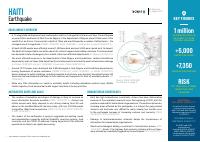
• A 7.2 magnitude earthquake struck southwestern Haiti on 14 August at 8:30 am local time. The earthquake
occurred 13km southeast of Petit-Trou-de-Nippes, in the department of Nippes, about 125km west of the
capital Port-au-Prince. It occurred at a depth of 10km and was followed by a number of aftershocks – the
strongest was 5.2 magnitude
(CDEMA 14/08/2021; USGS 14/08/2021 c; Independent accessed 14/08/2021).
• At least 60,000 people were affected, around 1,300 have died, and over 5,000 were injured as at 16 August.
The death toll is expected to rise as the search for victims trapped under rubble continues. The Government
has declared a state of emergency for a month in the most affected departments
(ACTalliance 16/08/2021).
• The most affected areas are in the departments of Sud, Nippes, and Grandv’Anse. Jérémie (Grand’Anse
department)
and Les Cayes (Sud department) arrondissements recorded the most infrastructure damage
(Le Temps 15/08/2021; Europe 1 15/08/2021; Government of Haiti 14/08/2021 a).
• Around 7,370 houses were destroyed and 4,850 damaged in Sud, Nippes, and Grand’Anse departments,
leaving thousands of people homeless
(CDEMA 15/08/2021; OCHA 15/08/2021; Le Monde 15/08/2021).
Severe damage to public buildings, including hospitals and schools, was reported. Hospitals that are still
functional are overwhelmed and likely to lack medicine and equipment to treat all wounded patients
(AP
15/08/2021)
.
• While very little information on needs is available, health (including immediate medical care), WASH,
shelter, logistics, food, and mental health support are likely to be key priorities.
1 million
ESTIMATED PEOPLE
EXPOSED TO VERY
STRONG SHAKING
+5,000
PEOPLE INJURED
+7,350
HOUSES DESTROYED
RISK
OF TROPICAL STORM
IMPACT WITHIN
48 HOURS
NATIONAL
REPONSE CAPACITY
46 national actors present
on the ground, including
Red Cross and Red Crescent
Movement agencies (OCHA
31/07/2021)
INTERNATIONAL
REPONSE CAPACITY
54 INGO and 8 UN
organisations
(including OCHA, UNHCR,
UNDP, UNFPA, UNOPS)
are present on the ground
in Haiti (OCHA 30/07/2021)
HAITI
Earthquake
ANTICIPATED SCOPE AND SCALE
• The number of casualties and degree of damage is likely to increase as
more information becomes available
(USGS 14/08/2021 a). Around one
million people were likely exposed to very strong shaking (level VII and
above on the modified Mercalli intensity scale), with over 230,000 people
living within 15km from the epicentre
(GDACS 14/08/2021; USGS 14/08/2021
b; WFP 14/08/2021).
• The impact of the earthquake is going to aggravate pre-existing needs
and vulnerabilities caused by political instability, recurring violence, food
insecurity, and the COVID-19 outbreak. Coping capacities of the affected
population are likely to be rapidly decreasing.
HUMANITARIAN CONSTRAINTS
• Haiti has high humanitarian constraints. Access has been deteriorating
because of the escalating insecurity since the beginning of 2021, both for
people in need and for humanitarian organisations. The southern peninsula,
including areas affected by the earthquake, is a hotspot for gang-related
violence and had been very difficult to reach already two months prior
to the earthquake because of increasing violence and insecurity
(CARE
15/08/2021; OCHA 15/08/2021)
.
• Damage to telecommunication networks delays the transmission of
information for humanitarian organisations.
• Roads were damaged, adding a constraint to humanitarian access.
(IFRC
14/08/2021)
. Route 7, the highway that connects Jérémie with Les Cayes,
were blocked by a landslide triggered by the earthquake
(AP 15/08/2021).
Source: OCHA 15/08/2021
See full map on page 8
&riefing note ` 16 August 2021 2
IMPACT OF THE CRISIS
A 7.2 magnitude earthquake struck southwestern Haiti on 14 August at 8:30 am local
time. The earthquake occurred 13km to the south-southeast of Petit-Trou-de-Nippes, in the
department of Nippes, at a depth of 10km
(CDEMA 14/08/2021).
Most affected departments include Sud, Grand’Anse, and Nippes, with Les Cayes, Aquin,
Cavaillon, Petite-Rivière-de-Nippes, and Anse-a-Veau arrondissements
1
known to be
particularly affected and exposed to severe shaking (level VIII on the modified Mercalli
intensity scale). The impact of the earthquake was felt in all departments of the country,
including the capital Port-au-Prince, around 125km to the east
(USGS 14/08/2021 d; ADRA
15/08/2021; USGS 14/08/2021 c)
.
CITIES AND POPULATIONS EXPOSED TO VERY STRONG AND SEVERE SHAKING
CITY DEPARTMENTLEVEL OF
EXPOSURE
(MMI)
POPULATION
EXPOSED
TOTAL POPULATION
OF ARRONDISSEMENT
(2019)
Les Cayes Sud VIII 126,000 154,850
Aquin Sud VIII 5,000 106,382
Anse-a-Veau Nippes VIII 2,000 35,556
Petite-Rivière-de-Nippes Nippes VIII 2,000 29,331
Cavaillon Sud VIII 1,000 49,699
Miragoane Nippes VII 89,000
2
64,232
Fond des Blancs Sud VII 3,000 part of Aquin
arrondissement
Corail Grand’Anse VII 3,000 20,098
Torbeck Sud VII 2,000 7 7, 6 6 4
Saint-Louis du Sud Sud VII 2,000 66,274
Petit-Trou-de-Nippes Nippes VII 2,000 30,807
Chantal Sud VII 2,000 34,830
Baraderes Nippes VII 2,000 42,103
Sources: USGS 14/08/2021; OCHA accessed 15/08/2021
1 Arrondissements are subdepartment administrative divisions in Haiti. There are a total of 42 arrondissements nationally, in 10 departments.
2 ACAPS was not able to verify the number of people exposed in Miragoane city against the current population numbers. Current data suggests that the number of people exposed exceeds 100% of the total population. Possible explanations include outdated population numbers
and administrative divisions used by different sources.
More than 14,000 families are known to have been affected across Sud, Grand’Anse, and
Nippes departments as at 16 August. Numbers are expected to increase, as around one
million people were exposed to very strong shaking (level VII and above on the modified
Mercalli intensity scale) and over 230,000 people are living within 15km from the epicentre
(ACTalliance 16/08/2021, GDACS 14/08/2021; USGS 14/08/2021 b; WFP 14/08/2021) .
Around 1,300 people were reported dead and over 5,000 injured as at 16 August, but
the numbers are expected to increase. Most of the fatalities were reported in the Sud
department, where at least 1054 people died, followed by the Nippes department (at least
122 fatalities) and the Grand’Anse department (at least 119 fatalities). At least two deaths
were reported in the Nord-Ouest department
(ACTalliance 16/08/2021, CDEMA 15/08/2021;
Government of Haiti 14/08/2021 a)
. Many people are still missing or trapped under the rubble.
The earthquake caused severe damage to infrastructure, particularly in Les Cayes and
Jérémie arrondissements. Buildings (including hotels, hospitals, and churches), roads,
bridges, and health and education infrastructure were affected
(Government of Haiti
14/08/2021 b; IFRC 14/08/2021; AlterPresse 14/08/2021)
. Damage to infrastructure and
casualties were further aggravated by secondary hazards such as aftershocks, landslides,
and localised flooding. Aftershocks and landslides remain a significant concern for the
affected population and responders. Localised flooding was reported in Les Cayes
(HOPE
14/08/2021; VOA News 14/08/2021)
.
SECTORAL NEEDS
Key priorities reported on 15 August focus on health, WASH, shelter, and logistics. The
Government has declared a month-long state of emergency and underlined the need for
food and psychological support
(VOA News 14/08/2021). The immediate priority for first
responders is to locate and recover survivors and missing people from the rubble, but the
conditions are making this challenging
(BBC 15/08/2021).
There is very little information available on the extent or specific type of sectoral needs,
particularly in relation to WASH and food. The available information is preliminary and should
be complemented by upcoming needs assessments as well as revision of lessons learnt and
knowledge of past disasters in the region. For more information on lessons learnt, please
see page 6.
&riefing note ` 16 August 2021 3
Health
• 140 hospitals are in the areas exposed to the earthquake. According to PAHO, out of
the health institution contacted, 1 of 5 in the Sud department, 1 of 7 in the Nippes
department, and 5 of 8 in the Grand’Anse department have reported damages
(PAHO
15/08/2021; Haiti Libre 15/08/2021)
.
• It is expected that multiple health facilities were damaged and that available facilities
will not be able to respond to all the medical needs of the affected population
(HOPE
14/08/2021)
. Prior to the earthquake, health facilities were known to be short of essential
supplies, while emergency units were overwhelmed by a combination of COVID-19 and
casualties caused by violence
(The New Humanitarian 05/07/2021).
• Local hospitals, particularly in Les Cayes in the Sud department and Pestel, Corail, and
Roseaux arrondissements in the Grand’Anse department, are known to be overwhelmed
with people injured because of the earthquake. They are likely to lack medicine and
medical equipment. Some hospitals necessitate support for the transfer of severely
wounded patients, as operation rooms are not functional. Some transfers have been
made by helicopter and ambulance
(AP 15/08/2021; PAHO 15/08/2021).
• Survivors of the 2010 earthquake are likely to be in need of psychological and trauma
support
(IFRC 14/08/2021; 20 Minutes 15/08/2021).
Shelter
• At least 7,370 houses were destroyed and 4,850 damaged in Sud, Nippes, and
Grand’Anse departments, leaving thousands of people homeless
(CDEMA 15/08/2021;
OCHA 15/08/2021)
. Based on the available information, over 720 houses were damaged
and around 900 were destroyed in the Nippes department. In the Grand’Anse department,
at least 50 houses are known to have been destroyed. Those numbers are expected
to increase as more data becomes available
(PAHO 15/08/2021; Government of Haiti
14/08/2021 c)
.
• With around 7,370 houses destroyed, it is likely that over 30,000 people are in need
of temporary shelter. 1,000 people have been reported in need of tents for temporary
shelter in Jérémie arrondissement (Grand’Anse department)
(PRB accessed 16/08/2021;
CARE 15/08/2021)
.
• Many people in the affected region live in structures that are vulnerable to earthquakes.
The majority of both rural and urban homes in Haiti consists of two-room houses made
of mud walls and floors. Roofs are often thatched with grass or palm leaves but may
also be made of plastic or corrugated metal. Windows are panel-less and covered with
wooden shutters
(EB 09/2016). For flooring, 5% of Haitian homes use sand, 55% use
cement, and 3.5% use mud
(MSPP 05/10/2013). The majority of shelter materials used in
the Sud department are distributed out of Les Cayes
(PI 10/2016), which was one of the
most affected cities; this is likely to disrupt the supply chain and make accessing shelter
materials more difficult.
• Structures with mud walls and of informal construction are likely to suffer considerable
or great damage in an earthquake of such intensity. The damage is likely to be increased
as a result of continuing tremors and aftershocks
(USGS accessed 15/08/2021; USGS
14/08/2021 d; USGS 14/08/2021 b).
• In Les Cayes and Jérémie, thousands of people fled their homes in fear that they may
collapse
(OCHA 15/08/2021).
Protection
• Prevalence of physical and gender-based violence are major protection concerns.
Reports of gender-based violence had already increased because of gang violence-
related displacement in the two months prior to the earthquake. The significant number
of newly displaced people reinforces concerns about gender-based violence, particularly
in IDP sites and temporary shelters
(OCHA 14/07/2021; ACAPS 14/07/2021).
• Children are especially at risk of dying from earthquake-related injuries. During the
2010 Haiti earthquake, it was reported that children were considerably more likely to have
been killed during the earthquake than adults and were 11 times more likely to have died
of injuries after the earthquake
(Kolbe 2010; ACAPS 01/2012).
WASH
• In Les Cayes, water storage tanks were destroyed, flooding the streets and creating an
urgent need for safe drinking water
(Americares 15/08/2021).
• Water and basic hygiene supplies like soap will be vital for containing the spread of
COVID-19 and preventing the emergence of waterborne diseases such as cholera
(CRS
15/08/2021)
.
Briefing note ` 1� August 2021 4
ACCESS
Access constraints in Haiti were high even before the earthquake. Escalating insecurity
since the beginning of 2021 has increasingly hindered humanitarian access both for people
in need and for humanitarian organisations. Since early June, there has been a surge in
intergang clashes in the metropolitan area of Port-au-Prince over territorial control, with the
communes of Bas Delmas, Bel Air, Martissant, and Saint Martin being the most affected. See
more in the July 2021
Humanitarian Access Overview.
The southern peninsula, including areas affected by the earthquake, is a hotspot for
gang-related violence and had been very difficult to reach already two months prior to
the earthquake because of increasing violence and insecurity. This is likely to affect the
response, hindering the capacity of humanitarian actors to operate normally and reach
affected populations. Prior to the earthquake, responders reported being forced to deliver
assistance by boat or plane because of road blockages and insecurity. Targeted attacks on
emergency health facilities have been reported as well
(CARE 15/08/2021; OCHA 15/08/2021).
The only road connecting the capital Port-au-Prince to the southern half of the country
crosses the Martissant and Carrefour neighbourhoods and has been under the control of
armed gangs since early June, preventing free movement. This is a major challenge for
humanitarian response
(Le Temps 15/08/2021). After the earthquake, humanitarians trying to
access the affected areas are reported having to take an alternative route or travel by air
(AP
15/08/2021)
.
Earthquake impact on access
Initial information indicates that roads have been damaged, particularly in Les Cayes and
Jérémie, adding a constraint to humanitarian access
(IFRC 14/08/2021).
A landslide caused by the earthquake has blocked a major road (Route 7) connecting Jérémie
and Les Cayes, hampering rescue operations
(AP 15/08/2021; GardaWorld 14/08/2021).
Poor phone network and internet connection makes communications challenging. The city
of Petit-Trou-de-Nippes remains cut off as a result of damaged telephone lines
(Mercy Corps
14/08/2021; OCHA 15/08/2021)
.
A humanitarian corridor through the Dominican Republic has been activated by IFRC
(IFRC
15/08/2021)
.
AGGRAVATING FACTORS
Tropical storm risk and rainy season
There is a risk that strong winds and rainfall associated with Tropical Storm Grace could
affect Haiti within 48 hours of the earthquake – as early as 16 August – and result in flash,
urban, and small stream flooding and potential mudslides. Tropical Storm Grace formed
in the eastern Caribbean Sea on 14 August and continued to move west towards Leeward
Islands and Puerto Rico
(CDEMA 14/08/2021; The New York Times 14/08/2021; DW 15/08/2021) .
The storm could result in 10–18cm of rain, which would cause flooding and mudslides,
further restricting access and aggravating the situation of people affected by the
earthquake, rescue efforts, and road/rubble clearance. More deaths and increased shelter,
WASH, and food needs are highly likely. People without shelter as a consequence of the
earthquake would be most vulnerable to the impact of the tropical storm
(CDP 14/08/2021).
Weather forecast for a week following the earthquake anticipates rainy conditions every
day, meaning the likelihood of rain complicating access and conditions of the affected
population is very high, even if Tropical Storm Grace does not directly affect Haiti. The
second rainy season in Haiti started in August and usually lasts until the end of December,
implying weather-related challenges will continue impacting the response efforts
(FEWS NET
accessed 15/08/2021; WFP 14/08/2021)
.
Gang violence and political turmoil
The unstable political situation in Haiti is likely to affect the local response capacity.
Following the assassination of the Haitian President Jovenel Moïse on the night between
6–7 July, there was a period of a power struggle between the current prime minister Ariel
Henry and the interim prime minister Claude Joseph. The power struggle resulted in a
highly unstable security situation with increasing gang violence and criminal activity
(DW
15/08/2021; NPR 20/07/2021)
.
Gang violence is likely to disrupt humanitarian access, needs assessments, and the
delivery of services to affected people. The southern peninsula, including areas affected
by the earthquake, is a hotspot for gang-related violence. Those areas were already almost
unreachable two months prior to the earthquake as a result of security concerns and road
blockages
(OCHA 15/08/2021).
&riefing note ` 16 August 2021 5
An increase in gang violence and criminal activity in Haiti since 1 June 2021 has been affecting
around one-third of the territory of Port-au-Prince. Southern neighbourhoods are the most
affected (Bas Delmas, Bel Air, Cité Soleil, Fontamara, Laboule 12, Martissant, and Toussaint
Brave townships)
(GardaWorld 18/06/2021). 1.5 million people are affected by violence across
the country. As at 30 June, 18,100 people were displaced –14,700 of them from Bas Delmas,
Cité Soleil, and Martissant. 11,500 people are missing; they are either trapped in the conflict
zone or have fled the town
(OCHA 05/07/2021).
Gang influence and control is likely to increase, worsening political instability and triggering
more humanitarian needs in the country. Read more information on gang violence and the
impact on the humanitarian situation in the
ACAPS Briefing Note on Gang Violence.
COVID-19
The number of confirmed COVID-19 cases has declined in recent weeks after a spike during
May–June. The reported deaths quadrupled in May and currently remain at similar levels. As
at 13 August, there have been at least 20,500 confirmed cases of COVID-19, with 576 deaths
reported
(WHO accessed 15/08/2021).
Until July, Haiti was the only country in the Americas not to have received a single dose of
the COVID-19 vaccine. Following the arrival of 500,000 doses donated by the United States
Government through COVAX, a total of 14,074 vaccine doses have been administered as at 9
August 2021
(UNICEF 27/07/2021; WHO accessed 15/08/2021).
Vaccine acceptance in Haiti is extremely low, fuelled by rumours and misinformation.
According to a perception study carried out by the University of Haiti with the support of
UNICEF in July, only 22% of Haitians would agree to be vaccinated
(UNICEF 27/07/2021) . Gang
violence and earthquake impacts are likely to further slow down the vaccination campaign
(The New Humanitarian 05/07/2021).
Emergency units of hospitals were already reported to be strained in July, being overcrowded
with a combination of people with gunshot wounds (as a result of gang violence) and COVID-19.
Shortages of oxygen and supplies were reported
(The New Humanitarian 05/07/2021).
The pandemic has had a negative impact on the economy, resulting in increased deterioration
of the economic situation and increased vulnerability among the population
(OCHA
04/03/2021)
.
Food insecurity
The earthquake has struck the country during the bean, maize, and yam harvest in the
southern peninsula. This is likely to increase food prices and reduce availability
(FEWS NET
accessed 15/08/2021).
Black beans and maize are among the most important food items
for poor and middle-income households in Haiti, which is likely to increase reliance of
the affected population on negative coping mechanisms such as reduction in quality and
quantity of meals, begging, sale of wood, and consumption of early harvest or seeds
(FEWS
NET 31/07/2021).
The fragile sociopolitical environment, general insecurity, presence of armed gangs, and
scarcity of fuel reported in Haiti are all factors likely to increase the prices of food. Areas
further affected by below-average harvest are likely to experience Crisis levels (IPC 3)
of food insecurity because of the earthquake, with parts of Nippes, Grand’Anse, and Sud
department particularly at risk
(FEWS NET 31/07/2021).
Around four million people were already food-insecure and at risk of hunger in Haiti prior
to the earthquake, as a result of an increase in food prices and poor harvest caused by
frequent natural disasters, including drought and storms
. The earthquake will compound
this situation, potentially increasing the number of household experiencing food insecurity
and deepening the conditions for those already food insecure
(CARE 14/08/2021; Action
Against Hunger 18/12/2020)
.
&riefing note ` 16 August 2021 6
CONTEXTUAL INFORMATION
Haiti has an estimated population of 11.9 million (IHSI accessed 16/08/2021). 4.4 million
people (around 37% of the population) are in need of humanitarian aid in Haiti.
Table: Population and humanitarian needs in the departments most affected by the earthquake
DEPARTMENT POPULATION (2019) PIN 2021 (PRIOR TO THE EARTHQUAKE)
Ouest 5,010,200 1,608,000
Sud-Est 893,900 253,000
Sud 791,085 309,000
Grande'Anse 481,065 187,000
Nippes 351,590 136,000
Source: OCHA accessed 15/08/2021; OCHA 04/03/2021
Sud, Grande'Anse, and Nippes departments are located in the southwest of Haiti and constitute
three of the four departments on the Tiburon Peninsula. Up to 60% of the population living in
the areas exposed to the earthquake is considered vulnerable, and 77% of the population of
the region lives below the poverty line
(OCHA 14/08/2021; WFP 14/08/2021).
70% of households in Grand'Anse, 50% in Nippes, and 50% in Sud are in the two lowest
quintiles of economic wellbeing
(USAID 10/2020; Ministère de la Santé Publique et de la
Population 07/2018)
. 58% of the inhabitants of Nippes and 57% in Grand’Anse are food-
insecure. 17% of children under 5 in Nippes, 19% in Sud, and 26% in Grand'Anse are stunted
as a result of insufficient nutrition
(WFP 21/02/2017; USAID 2012).
64% of households in Sud, Grand'Anse, and Nippes do not have access to clean water, soap,
and hygiene products. During previous humanitarian emergencies, WASH has been one of
the priorities because of the lack of water connection networks in the regions
(Ministère de la
Santé Publique et de la Population 07/2018; UNICEF 29/10/2016)
.
Les Cayes, one of the communes most affected by the earthquake, is home to about 155,000
people
(UNFPA 2019). Its population has grown considerably over the last decade thanks
to post-earthquake migration since 2010. Its main economic activities are tourism and
activities around the maritime port, both of which were likely affected by the earthquake
(OCHA 04/03/2021). Les Cayes is susceptible to natural disasters such as floods and tsunamis
(USAID 30/09/2020).
Although the entire territory of Haiti is susceptible to earthquakes, some of the communes
in Nippes and Sud are more vulnerable. In Nippes, the communes of Anse-à-Veau, Petite-
Rivière-de-Nippes, and some sectors of Miragoâne are situated in critical vulnerability (5 on
a scale of 1 to 5), while in Sud, the communes of Cavaillon, Saint Louis du Sud, Aquin, Les
Anglais, and Tiburon have territories in this category
(HRP 01/2019).
LESSONS LEARNT
There are several lessons learnt from past responses to natural disasters in Haiti (not only
from the 2010 earthquake response but also the 2016 Hurricane Matthew) that may be
relevant in improving humanitarian response.
A list of useful lessons learnt reports from previous responses include:
•
Lessons learned for Hurricane Matthew Response, ACAPS, 10/10/2016
• Health response to the earthquake in Haiti, PAHO, 01/2010
• Haiti Earthquake Response: Context analysis, ALNAP, 07/2010
• Lessons learned from the Haiti Earthquake Response, HPN, 08/2010
Coordination
Key points from the 2010 earthquake:
During the response to the 2010 earthquake in Haiti, lack of coordination was identified on at
least five different levels:
• between UN Agencies and NGOs
• between UN/NGOs and state institutions
• between state institutions
• between state institutions and local authorities
• between UN/NGOs and local authorities.
This lack of coordination was found to result in an uneven response, which was observed in
a variety of ways:
• limited sharing of data, including registration records or lists of relocated households
• duplication of projects
• selection of beneficiaries.
&riefing note ` 16 August 2021 7
The international response did not reinforce local response capacity (IMPACT 01/03/2016).
Communication and coordination between actors can prevent secondary impacts
(ACAPS
10/10/2016)
.
In order to strengthen the local response capacity, coordinate more efficiently with local
organisations, and communicate more effectively with the affected populations, the
response and coordination should be conducted in French (and Creole wherever possible)
(ACAPS 10/10/2016).
Assessment techniques
As assessments are currently starting, the following lessons learnt from past responses
should be considered by those planning and leading assessments:
• Phones are an efficient data collection technique in Haiti.
• Consultations on the questions are vital to the assessment quality.
• Including both areas people are displaced from as well as where they are displaced to
improves the understanding of needs
(ACAPS 10/10/2016).
INFORMATION GAPS
There is very little information available on the extent or kind of sectoral needs, particularly
WASH and food. The available information is preliminary and should be completed by
upcoming needs assessments.
Population numbers, including numbers of people exposed to the earthquake, vary between
different sources, and ACAPS has not been able to verify them.
&VMI�