Full Description
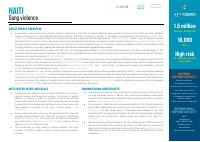
This ACAPS briefing note, published 14 July 2021, analyzes the escalation of gang violence in Port-au-Prince from 1 June 2021, when some 95 gangs began clashing over territory following a reconfiguration of alliances, concentrated in southern neighborhoods including Bas Delmas, Bel Air, Cité Soleil, Fontamara, Laboule 12, Martissant, and Toussaint Brave. An estimated 1.5 million people were affected; 18,100 were displaced as of 30 June (14,700 from Bas Delmas, Cité Soleil, and Martissant) and 11,500 people were missing, either trapped in conflict zones or fled. The note was finalised days after the 7 July assassination of President Jovenel Moïse, which it assesses as likely to further destabilise the political situation, with interim Prime Minister Claude Joseph's authority contested by designated Prime Minister Ariel Henry and a two-week state of emergency declared.
Sectorally, the note documents makeshift IDP sites with acute gaps: 3,000 IDPs in seven sites and 9,000 with host families; reported rape and sexual violence at sites in Carrefour and Delmas; 565 IDPs with disabilities hosted in a school after the La Piste camp was burned; and Delmas 103 with four overflowing latrines for 500 IDPs and no running water. Access constraints were severe: 35 percent of health workers in Carrefour/Martissant could not reach work, MSF suspended activities in Martissant after its center was attacked on 26 June, at least eight police officers were killed and eight stations attacked, and road closures cut assistance to 14,000 households in the south. Aggravating factors include COVID-19 deaths quadrupling since May (19,220 cases and 467 deaths by 12 July, with no vaccination rollout), Tropical Storm Elsa's 3 July damage at the start of hurricane season, and 4.4 million food-insecure people, with school closures cutting take-home rations for 55,000 students.
Full Document Text
Extracted text from the original document for search indexing.
Briefing note
14 July 2021
HAITI
Gang violence
CRISIS IMPACT OVERVIEW
• An increase in gang violence and criminal activity in Haiti since 1 June 2021 has been affecting around one -third of the territory of Port-au-Prince. Southern
neighbourhoods are the most affected: Bas Delmas, Bel Air, Cité Soleil, Fontamara, Laboule 12, Martissant, and Toussaint Brave townships ( Garda World
18/06/2021) . Violence erupted because of territorial disputes and a reconfiguration of gang alliances ( OCHA 23/06/2021) . Since 1 June, 95 gangs have been
clashing in Port-au-Prince in a bid to gain power, looting local businesses and leading to the desertion of the commercial district ( News in America 05/07/2021).
Sporadic clashes between gangs are common in Port-au-Prince, but recent incidents are on a much greater scale and systematic. On 24 June, the leader of the
G9 gang called for a ‘ revolution’ against the country’s political and business elite, triggering more violence.
• 1.5 million people are affected by violence. As at 30 June, 18,100 people were displaced –14,700 of them from Bas Delmas, Cité Soleil, and Martissant. 11, 500
people are missing; they are either trapped in the conflict zone or have fled the town. The G overnment has set up a task force to coordinate the response between
national and humanitarian actors ( OCHA 05/07/2021) .
• The killing of a police officer in Bas Delmas on 17 June led to a counterattack by police forces with teargas and firefights with the gangs, which forced the
population to flee in order to escape the shootings ( OCHA 23/06/2021) . At least eight police officers have been killed and eight police stations attacked since the
beginning of June, with theft of ammunition and supplies ( Garda World 18/06/2021) . On 17 June, La P iste – a camp hosting people with disabilities – was set
on fire, killing one person and wounding three (La Prensa Latina 27/06/2021) .
• On the night between 6–7 July, Haitian P resident Jovenel Moïse was shot and killed, and his wife wounded by gunmen. A least 17 suspects have been detained
(The New York Times 10/07/2021) . Interim Prime Minister Claude Joseph was scheduled to leave office that week, as Moïse had appointed Ariel Henry on 5 July
to take up the role of Prime Minister. However, as Henry did not officially take office before the assassination, Joseph has now taken command of the G overnment
and security services. The legality of Joseph’s current role is contested by Henry (Le Devoir 09/07/2021) . Joseph has declared a two-week state of emergency
(Reuters 08/07/2021) . This is likely to result in more violence and instability in the country.
ANTICIPATED SCOPE AND SCALE
• President Moïse’s death is likely to further destabilise the country’s
political situation and cause more violence. The number of people
affected by violence is likely to increase, as the Prime Minister
launched a manhunt for the killers. Police operations are preventing
the population from accessing essential services in many places and
have caused an increase in the price of basic goods
(OCHA
23/06/2021) .
• Gangs continue to gain control over the industrial district of the city,
including along the road to the Toussaint Louverture International
Airport
(OCHA 23/06/2021). The border with the Dominican Republic
was closed as at 7 July
(Reuters 08 /07/2021) . This is likely to have a
negative impact on Haiti’s economy.
• The combination of gang violence, political instability, and rapid
increase in COVID-19 cases is likely to worsen the humanitarian
situation.
HUMANITARIAN CONSTRAINTS
• Humanitarian access is a major challenge as a result of violence and insecurity.
Locating displaced people is difficult. Gang violence has delayed humanitarian
assistance and hindered the movement of basic supplies such as food, medicine ,
and fuel
(News in America 05/07/2021) .
• The provision of health services is increasingly difficult: 35% of health workers in
the Carrefour/Martissant area could not go to work because of violence
(OCHA
23/06/2021)
. The MSF health centre in Martissant was attacked on 26 June,
prompting MSF to suspend its activities in the area. Two humanitarian staff were
robbed, and one humanitarian health worker was killed on 25 May
(MSF
29/06/2021)
.
• Repeated shootings affect access to IDP sites in Bas Delmas. Difficult access to
the airport limits the ability to deliver assistance. UNHAS flights are currently the
safest options to deliver assistance to the south of the country
(OCHA 05/07/2021).
Road closures in the southern area prevent the delivery of assistance to 14,000
households.
NATIONAL
REPONSE CAPACITY
Fonds d’Assistance
Économique et Sociale
Direction de la Protection Civile
Haiti Red Cross Society
Organisation des Coeurs pour
le Changement des Enfants
Démunis d'Haïti
Office National de la Migration
INTERNATIONAL
REPONSE CAPACITY
MSF
UN agencies
(WFP, UNICEF, IOM)
Salvation Army
World Renew
Solidarités International
1.5 million
PEOPLE AFFECTED
18,000
IDPS
High risk
OF GENDER-BASED
VIOLENCE
2
Briefing Note
14 July 2021
humanitarian partners are exploring the relocation of IDPs from the Delmas 103
site. The Eglise Saint Yves site is also overcrowded and lacks basic facilities such
as toilets, sleeping spaces, and water (OCHA 05/07/2021).
SECTORAL NEEDS
Shelter
The majority of the IDPs displaced by the current crisis are sheltered in makeshift
sites, with limited access to humanitarian assistance. 3,000 IDPs are located in
seven sites, while 9,000 are with host families
(OCHA 05/07/2021) . Some of the
shelters in the seven sites are damaged and need to be repaired, especially as the
months of June–November are prone to hurricanes in Haiti.
Protection
Cases of rape and sexual violence were reported at IDP sites in Carrefour, Delmas,
and Eglise Saint Yves. There is a high risk of gender -based violence (GBV) in IDP
camps as they are not segregated by household, age, or gender. There are
allegations of sexual abuse and exploitation by humanitarian workers in Carrefour
(OCHA 05/07/2021) . IOM is conducting training on protection against sexual
exploitation and a buse for all the volunteers and humanitarian workers at the
Carrefour site. Assessments and data collection on GBV and reproductive health
are in progress.
565 IDPs with disabilities are temporarily hosted at a school in Port-au-Prince with
limited access to basic items and services
(La Prensa Latina 27/06/2021) . They are in
urgent need of adequate equipment, as well as access to food, water , and
healthcare. The population trapped in the zones affected by gang violence cannot
access external assistance and faces increased protection risks.
IDPs in Delmas have been threatened by unidentified individuals at night, raising
safety concerns
(OCHA 05/07/2021).
WASH
Delmas 103 is the site with the most acute WASH needs. There are currently no
running water or handwashing stations, and the site only has four latrines for 500
IDPs. The latrines are full and cannot be emptied. There are cases of diarrh oea in
at least one IDP site. Humanitarian partners are working together to install water
tanks and rehabilitate the latrines, but access to the site is difficult becaus e of
security restrictions. Lack of adequate facilities continues to be an issue, and
Health
There is currently limited access to health services for both IDPs and host
communities because of insecurity. MSF has suspended activities in Martissant
after its emergency health centre was attacked on 26 June
(MSF 29/06/2021) .
Health personnel are also unable to go to work because of violence. A mobile
clinic has been deployed in Carrefour to provide healthcare services to pregnant
women and GBV victims
(OCHA 05/07/2021) . There is an urgent need for healthcare
for pregnant and lactating women, older people, children, and people with
disabilities. The lack of clean water is likely to cause outbreaks of waterborne
diseases
(OCHA 05/07/2021) .
AGGRAVATING FACTORS
COVID-19
The number of COVID- 19 death has quadrupled since May. As at 12 July, there
were 19,220 confirmed cases and 467 deaths
(WHO accessed 12/07/2021
).
Emergency units of hospitals are overcrowded with people treated for gunshot
wounds and COVID-19. There is a shortage of oxygen supply in at least two
hospitals
(The New Humanitarian 05/07/2021) . In Cité Soleil, gang violence is
preventing people with COVID-19 from leaving their homes and receiving
adequate treatment at the hospital. Haiti has not started its vaccin ation
programme rollout because of a lack of proper storage infrastructure. Gang
violence is likely to slow down the vaccination campaign further, preventing
access to several parts of the city and the southern Tiburon P eninsula
(The New
Humanitarian 05/07/2021)
. Overcrowded IDP camps with poor hygiene facilities are
likely to experience a spread of the disease.
3
Briefing Note
14 July 2021
MAP: IDP SITES LOCATION AS AT 5 JULY 2021
Source: OCHA (05/07/2021)
POLITICAL INSTABILITY
The death of President Jovenel Moïse risks to cause civil unrest and further
violence in the country. He ha d been ruling by decree for over a year; his decision
to postpone the elections had led to the dissolution of the Parliament. Opposition
leaders had been calling for his resignation since February 2021. Local human
rights organisations alleged that President Moïse had reached agreements with
the G9 – an alliance of Haiti's major gangs
(Insight Crime 23/07/2020) . On the week
of 24 June, the leader of G9 announced a ‘ revolution’ against the country’s
political and business elite, triggering more violence in the country
(Reuters
24/06/2021)
. Gang influence and control is likely to increase, worsening political
instability and triggering more humanitarian needs in the country.
TROPICAL STORM ELSA
Tropical Storm Elsa hit Haiti on 3 July, causing the destruction of agricultural land,
houses, communication powerlines, and public buildings. T his event highlights
the beginning of the hurricane season, which typically goes from June–
November. Heavy rains, floods, and landslides are expected in the next six
months in Haiti
(Logistics Cluster 12/06/2021) . This will likely cause an increase in
humanitarian needs. In 2020, Storm Laura caused 31 deaths and destroyed 8,835
houses
(OCHA 28/08/2021) . Humanitarian partners have used emergency NFIs
planned for the hurricane season to respond to the immediate needs of the
population. There is an urgent need to replace them for the next emergency.
FOOD INSECURITY
4.4 million people are currently food-insecure and at risk of hunger in Haiti as a
result of an increase in food prices and poor harvest caused by frequent natural
disasters, including drought and storms
(Action Against Hunger 18/12/2020) . Violence
has resulted in school closures and prevented 55,000 students from accessing
take-home rations as part of the school feeding programme
(OCHA 23/06/2021) .
The crisis is likely to increase the number of food-insecure people.