Texte Intégral du Document
Texte extrait du document original pour l'indexation.
HAITI
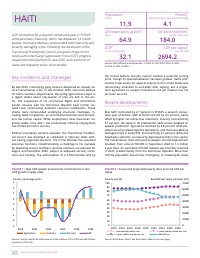
GDP contracted for a seventh consecutive year in FY2025
amid persistent insecurity, which has displaced 1.4 million
people. Hurricane Melissa compounded food insecurity and
poverty, damaging crops. Following the dissolution of the
Transitional Presidential Council, prospects hinge on the
newly authorized Gang Suppression Force (GSF), progress
toward elections planned for late 2026, and resolution of
trade and migration policy uncertainties.
Key conditions and challenges
By late 2025, intensifying gang violence deepened an already se-
vere humanitarian crisis. In late October 2025, Hurricane Melissa
hit Haiti’s southern departments, disrupting agricultural output in
a region where about one-quarter of jobs are tied to the sec-
tor. The suspension of US commercial flights and intermittent
border closures with the Dominican Republic have further iso-
lated Haiti, constraining domestic resource mobilization. These
shocks have compounded underlying structural challenges, in-
cluding weak competition, an unconducive business environment,
and low human capital. While employment rates have been rel-
atively stable since 2021, low productivity informal employment
haslimitedeconomicsecurity.
Political uncertainty remains elevated. The Transitional Presiden-
tial Council was dissolved as scheduled in February 2026, with-
out having organized elections. The Prime Minister has assumed
executive functions, notwithstanding a challenge to his mandate
by departing council members. General elections are planned for
August and December 2026, subject to adequate security condi-
tions and funding. The authorization of a 5,500-member GSF by
Population
1
Poverty
2
million millions living on less than $3.00/day
11.9 4.1
Life expectancy at birth
3
School enrollment
4
years primary (% gross)
64.9 184.0
GDP
5
GDP per capita
6
current US$, billion current US$
32.1 2694.2
Sources: WDI, MFMod, and official data. 1/2025. 2/2012 (2021 PPPs). 3/2023.
4/2016. 5/2025. 6/2025.
the United Nations Security Council marked a potential turning
point, though its operationalization has been gradual. Haiti's pref-
erential trade access for apparel exports to the United States was
retroactively extended to end-2026 after lapsing, but a longer-
term agreement to support investment and job creation has not
yetbeensecured.
Recent developments
Real GDP contracted by 2.7 percent in FY2025, a seventh consec-
utive year of decline. GDP at factor cost fell by 3.6 percent, partly
offset by higher net indirect tax collections. Industry contracted by
5.1 percent, the lapse in US preferential trade access weighed on
apparel production. Agriculture declined by 4.8 percent amid per-
sistent security-related logistics disruptions, and Hurricane Melissa
damaged crops in early FY26. Services fell by 2.7 percent, led by the
hospitality subsector, as insecurity depressed activity in the capital.
The humanitarian crisis continued to deepen. Forced displacement
doubled, from around 700,000 in September 2024 to 1.4 million
a year later. An estimated 270,000 Haitians were forcibly returned
in 2025, predominantly from the Dominican Republic. More than
half the population faced Crisis, Emergency, or Catastrophic levels
FIGURE 1 /Real GDP growth and sectoral contributions to real
GDP growth (supply side)
-5
-4
-3
-2
-1
0
1
2
3
2018 2020 2022 2024 2026 2028
Agriculture Industry ServicesGDP
Percent, percentage points
Sources: Institut Haïtien de Statistique et d'Informatique (FY18–FY25) and World Bank
projections (FY26–28).
FIGURE 2 /Actual and projected poverty rates and real GDP per
capita
0
10000
20000
30000
40000
50000
60000
70000
0
10
20
30
40
50
60
70
80
90
100
201220142016201820202022202420262028
International poverty rate Lower middle-income pov. rate
Upper middle-income pov. rateReal GDP pc
Real GDP per capita (constant LCU)Poverty rate (%)
Source: World Bank. Notes: See footnotes in table on the next page.
Macro Poverty Outlook / April 20261
of food insecurity according to the latest Integrated Food Security
Phase Classification analysis. Social assistance programs reached
less than 1 in 10 Haitians in 2025.
The bleak business environment contributed to weak tax revenues.
Total government revenue declined from 5.4 to 4.8 percent of GDP,
including grants. Recurrent expenditure, primarily wages, per-
formed broadly in line with the budget, but capital spending was
constrained by weak procurement, inadequate project execution,
and insecurity. Interest expenditure declined following the resolu-
tion of PetroCaribe obligations with Venezuela in early 2024, con-
tributing to a small fiscal surplus in FY2025. Monetary financing of
the fiscal deficit was maintained at zero in FY2025. The gourde ap-
preciated slightly, supported by remittances equivalent to around
16 percent of GDP. The strength of the currency combined with
high domestic inflation has eroded trade competitiveness. Net in-
ternational reserves have trended upward since late 2024, though
levels differ significantly depending on the definition applied.
Inflation averaged 28.3 percent in FY2025, up from 25.8 percent
in FY2024, driven primarily by food and housing amid persistent
supply disruptions linked to insecurity and displacement. The
impact fell disproportionately on poorer households, which de-
vote a larger share of income to these essentials. The estimated
FY2025 current account deficit narrowed to 0.3 percent of GDP,
as weak exports and resilient imports were offset by sustained
remittances. The estimated share of Haitians living on less than
US$3.00/day 2021 PPP increased from 42.2 percent in 2021 to
49.0percentin2025.
Outlook
Modest GDP growth is projected in FY2026 (0.6 percent) as the
expanded GSF supports gradual improvements in security, accel-
erating to 1.9 percent in FY2027 and 2.2 percent in FY2028 fol-
lowing completion of elections. Average inflation is expected to
moderate to 22.0 percent in FY2026, anchored by an Internation-
al Monetary Fund Staff-Monitored Program. Exports are project-
ed to recover gradually, contingent on sustained market access.
Current expenditure is expected to rise in the context of elec-
tions, while capital spending remains constrained by security con-
ditions in the near term. The share of Haitians living on less than
US$3.00/day 2021 PPP is projected to decline from 49.0 percent
in2025to47.4percentby2028.
The outlook is subject to significant downside risks, most notably
the feasibility of general elections in late 2026 and potential esca-
lation in violence. External pressures are also intensifying. Uncer-
tainty over the migration status of Haitian nationals in the United
States poses additional risks to remittance flows, a critical source of
household income and foreign exchange. Preferential trade access
for apparel exports through the end of 2026 provides too short a
horizon to anchor investment decisions. Higher oil and commodi-
ty prices associated with the conflict in the Middle East may con-
tribute to inflationary pressure. Over the medium term, security
is required to return to inclusive growth, which will also require
strengthening the business environment, expanding social protec-
tion, and improving domestic revenue mobilization.
Recent history and projections 2022/23 2023/24 2024/25e2025/26f2026/27f2027/28f
Real GDP growth, at constant market prices -1.9 -4.2 -2.7 0.6 1.9 2.2
Private consumption 0.1 -5.2 -2.3 -0.5 1.1 1.4
Government consumption 3.3 1.6 9.4 8.7 6.4 6.9
Gross fixed capital investment -17.6 -36.8 -15.3 -5.6 6.3 7.7
Exports, goods and services -9.6 -31.0 -2.0 0.5 3.5 4.9
Imports, goods and services -0.4 -16.2 1.5 0.1 2.4 3.2
Real GDP growth, at constant factor prices -3.6 -4.4 -3.6 0.6 1.9 2.2
Agriculture -5.6 -5.6 -4.8 0.1 0.4 0.4
Industry -4.2 -4.4 -5.1 0.3 1.3 1.5
Services -2.8 -4.1 -2.7 0.8 2.5 2.9
Employment rate (% of working-age population, 15 years+) 55.8 55.4 55.4 55.4 55.4 55.4
Inflation (consumer price index) 44.1 25.8 28.3 22.0 15.5 13.1
Current account balance (% of GDP) -3.5 -0.6 -0.3 -0.3 -0.1 0.0
Net foreign direct investment inflow (% of GDP) -0.1 -0.1 -0.1 0.0 -0.1 -0.1
Fiscal balance (% of GDP) -2.1 -0.1 0.6 -0.1 -0.2 -0.6
Revenues (% of GDP) 7.5 6.3 5.5 5.5 6.0 6.3
Debt (% of GDP) 25.1 15.6 10.4 8.8 7.7 7.3
Primary balance (% of GDP) -1.8 0.2 0.9 0.1 0.0 -0.5
International poverty rate ($3.00 in 2021 PPP)
1,2
44.6 47.1 49.0 49.5 48.8 48.5
Lower middle-income poverty rate ($4.20 in 2021 PPP)
1,2
64.2 66.4 67.9 68.1 67.8 67.3
Upper middle-income poverty rate ($8.30 in 2021 PPP)
1,2
90.0 91.5 92.2 92.3 92.1 91.9
GHG emissions growth (mtCO2e) -1.5 -0.7 1.3 1.3 1.4 4.0
Source: World Bank, Fiscal Policy & Growth Department. Emissions data sourced from CAIT and OECD.
Notes: e = estimate, f = forecast. Data in annual percent change unless indicated otherwise.
1/ Calculations based on CONLAC harmonization, using 2012-ECVMAS. Actual data: 2012. Nowcast: 2013-2025. Forecasts are from 2026 to 2028.
2/ Projection using neutral distribution (2012) with pass-through = 0.87 (Med (0.87)) based on GDP per capita in constant LCU.
Macro Poverty Outlook / April 20262