Texte Intégral du Document
Texte extrait du document original pour l'indexation.
Prosperity
Data360 Economy Snapshot
Justice
HAITI
LATIN AMERICA & CARIBBEAN (LCN) ; LOWER MIDDLE INCOME ; GNI PER CAPITA (USD, THOUSANDS) - 1.76 (2024) ; POPULATION (MILLIONS) - 11.77 (2024)
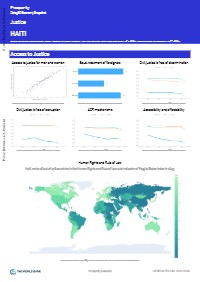
Access to Justice
Access to justice for men and women Equal treatment of foreigners Civil justice is free of discrimination
SOURCE: Varieties of Democracy Project (V-Dem) (Higher is better) SOURCE: Institutional Profiles Database (Higher is better) SOURCE: WJP Rule of Law Index 2024 (Higher is better)
Civil justice is free of corruption ADR mechanisms Accessibility and affordability
SOURCE: WJP Rule of Law Index 2024 (Higher is better) SOURCE: WJP Rule of Law Index 2024 (Higher is better) SOURCE: WJP Rule of Law Index 2024 (Higher is better)
Human Rights and Rule of Law
Haiti ranks 16 out of 176 countries in the Human Rights and Rule of Law sub-indicator of Fragile States Index in 2023.
SOURCE: Fragile States Index 2023 (Rank 1 is the lowest, with higher numbers indicating better ranks.)
Prosperity Data360 GENERATED ON: 2025-10-06
Public Disclosure Authorized
Public Disclosure Authorized
Public Disclosure Authorized
Public Disclosure Authorized
Do laws, policies, and practices guarantee equal treatment of various segments of the population? (Best score=4)
HTI scored 1 in 2024, compared to the regional average of 2.15 and global average of 1.82.
SOURCE: Freedom House - Freedom in the World (Higher is better)
Efficiency
Civil justice is not subject to
unreasonable delay
Firms identifying courts as a major
constraint
Firms choosing courts as their biggest
obstacle
WJP Rule of Law Index 2024 (Higher is better) SOURCE: Enterprise Surveys (Lower is better) SOURCE: Enterprise Surveys (Lower is better)
Democracy Index: Rule of Law Timeliness and Means Civil justice is effectively enforced
SOURCE: EIU Democracy Index 2023 (Higher is better) SOURCE: Institutional Profiles Database (Higher is better) SOURCE: WJP Rule of Law Index 2024 (Higher is better)
Transparent laws with predictable enforcement (Worst score: -4, Best Score: 4)
HTI scored -1.45 in 2024, compared to the regional average of 0.36 and global average of 0.46.
SOURCE: Varieties of Democracy Project (V-Dem) (Higher is better)
Efficiency of legal framework in settling disputes (WEF Global Competitiveness Index)
Haiti ranks 133 out of 141 countries in the Efficiency of Legal Framework sub-indicator of Global Competitiveness Index in 2019.
SOURCE: World Economic Forum Global Competitiveness Index 2019 (Rank 1 is the highest, with lower numbers indicating better ranks.)
Prosperity Data360 GENERATED ON: 2025-10-06
Quality
Compliance with judiciary High court independence Lower court independence
SOURCE: Varieties of Democracy Project (V-Dem) 2024 (Higher is better)SOURCE: Varieties of Democracy Project (V-Dem) 2024 (Higher is better) SOURCE: Varieties of Democracy Project (V-Dem) 2024 (Higher is better)
Civil rights and Independent judiciaryFreedom from improper government
influence
Judicial independence & observance
of contractual terms
SOURCE: Bertelsmann Transformation Index 2024 (Higher is better) SOURCE: WJP Rule of Law Index 2024 (Higher is better) SOURCE: Institutional Profiles Database (Higher is better)
Is there an independent judiciary? (Best score=4)
HTI scored 1 in 2024, compared to the regional average of 2.55 and global average of 2.09.
Does due process prevail in civil and criminal matters? (Best score=4)
HTI scored 1 in 2024, compared to the regional average of 2.09 and global average of 1.92.
SOURCE: Freedom House - Freedom in the World (Higher is better)
Judicial independence (WEF Global Competitiveness Index)
Haiti ranks 137 out of 141 countries in the Judicial Independence sub-indicator of Global Competitiveness Index in 2019.
SOURCE: World Economic Forum Global Competitiveness Index 2019 (Rank 1 is the highest, with lower numbers indicating better ranks.)
Prosperity Data360 GENERATED ON: 2025-10-06
Methodological Notes
1. Bertelsmann Stiftung’s Transformation Index [BTI]
• Bertelsmann Stiftung’s Transformation Index is a comprehensive tool that evaluates the status of political and
economic transformation in countries worldwide, assessing factors such as democracy, governance, civil society,
and market economy. The index is produced by the Bertelsmann Stiftung, a private, non-profit foundation based in
Germany.
• Covers 137 countries currently across the World and has been active since 2006, with its latest report being in
2024.
• Scoring Format: Scores are based on a scale of 0-10, with higher scores indicating greater levels of political
transformation, democratic governance, and rule of law.
2. Democracy Index (Economist Intelligence Unit)
• Democracy Index is an index that ranks countries based on their level of democracy, considering factors such as
electoral processes, civil liberties, and the functioning of government. The index is produced by the Economist
Intelligence Unit (EIU), a research and analysis division of The Economist Group.
• Covers 148 countries currently across the World and has been active since 2006, with its latest report being in
2023.
• Scoring Format: Scores are based on a scale of 0-10, with higher scores indicating stronger democratic
institutions, processes, and outcomes.
3. Enterprise Surveys (World Bank)
• Enterprise Surveys by World Bank is a survey-based research project that provides information on the business
environment in various countries, including factors such as access to finance, regulation, and corruption. The
surveys are produced by the World Bank, an international financial institution that provides loans and other
assistance to developing countries.
• Covers 5 countries currently across the World and has been active since 2005, with its latest report being in 2020.
• Scoring Format: Scores are based on a scale of 0-100, with higher scores indicating greater levels of business
environment quality and effectiveness.
4. Fragile States Index (The Fund for Peace)
• Fragile States Index is an index that measures the level of fragility and vulnerability of countries based on factors
such as political stability, security, and economic development. The index is produced by The Fund for Peace, a
non-profit research and educational organization that seeks to prevent conflict and promote sustainable security.
• Covers 179 countries currently across the World and has been active since 2005, with its latest report being in
2023.
• Scoring Format: Scores are based on a scale of 0-120, with higher scores indicating greater levels of state fragility.
5. Freedom in the World (Freedom House)
• ‘Freedom in the World’ is a comprehensive annual report that measures political rights and civil liberties in
countries around the world, assessing factors such as freedom of speech and the rule of law. The report is
produced by Freedom House, a non-governmental organization based in the United States that promotes freedom
and democracy worldwide.
• Covers 196 countries currently across the World and has been active since 1978, with its latest report being in 196.
Prosperity Data360 GENERATED ON: 2025-10-06
• Scoring Format: Prior to the 2020 edition, Freedom in the World assigned a country or territory two ratings—one
for political rights and one for civil liberties—based on its total scores for the political rights and civil liberties
questions. Each rating of 1 to 7, with 1 representing the greatest degree of freedom and 7 the smallest degree of
freedom, corresponded to a specific range of total scores. The average of the ratings determined the status of
Free, Partly Free, or Not Free.
• From the 2020 edition onwards, a country or territory is awarded 0 to 4 points for each of 10 political rights
indicators and 15 civil liberties indicators, which take the form of questions; a score of 0 represents the smallest
degree of freedom and 4 the greatest degree of freedom. The political rights section also contains an additional
discretionary question for which a score of 1 to 4 may be subtracted, as applicable (the worse the situation, the
more points may be subtracted). The highest overall score that can be awarded for political rights is 40 (or a score
of 4 for each of the 10 questions). The highest overall score that can be awarded for civil liberties is 60 (or a score of
4 for each of the 15 questions).
6. Global Corruption Barometer (Transparency International)
• Global Corruption Barometer Survey is a survey that measures public perceptions of corruption in various
countries around the world. The survey is produced by Transparency International, a non-governmental
organization that promotes transparency and fights corruption worldwide.
• Covers 78 countries currently across the World and has been active since 2005, with its latest report being in 2021.
• Scoring Format: Scores are based on a scale of 0-100, with higher scores indicating greater levels of perceived
corruption in various sectors and institutions.
7. Institutional Profiles Database (French Government)
• Institutional Profiles Database is a database that provides information on the structure and functioning of key
institutions, such as the judiciary and civil service, in various countries. The Institutional Profiles Database is
produced by the French Development Agency (AFD) and the French Ministry for the Economy and Finance,
collaborative entities that aim to understand and promote institutional, political, and economic changes in different
countries.
• Covers 144 countries currently across the World and has been active periodically since 2006, with its latest report
being in 2016.
• Scoring Format: Scores are based on a scale of 0-4, with higher scores indicating greater levels of institutional
quality, effectiveness, and responsiveness.
8. Nations in Transit (Freedom House)
• ‘Nations in Transit’ is an annual report that assesses the state of democracy and governance in post-communist
countries in Europe and Eurasia. The report is produced by Freedom House, a non-governmental organization
based in the United States that promotes freedom and democracy worldwide.
• Covers 29 countries currently across the World and has been active since 2005, with its latest report being in 2022.
• Scoring Format: Scores are based on a scale of 1-7, with higher scores indicating greater levels of democratic
consolidation, rule of law, and respect for human rights.
9. Rule of Law Index (World Justice Project)
• ‘Rule of Law Index’ is an index that measures the strength of the rule of law in various countries, assessing factors
such as the effectiveness of the judiciary and the level of corruption. The index is produced by the World Justice
Prosperity Data360 GENERATED ON: 2025-10-06
Project, a non-profit organization based in the United States that works to advance the rule of law worldwide.
• Covers 142 countries currently across the World and has been active since 2015, with its latest report being in
2024.
• Scoring Format: Scores are based on a scale of 0-1, with higher scores indicating greater levels of adherence to
the rule of law, absence of corruption, and open government.
10. The Global Competitiveness Report (World Economic Forum)
• ‘The Global Competitiveness Report’ is an annual report by World Economic Forum that assesses the
competitiveness of countries based on factors such as economic development, innovation, and business
environment.
• Covers 0 countries currently across the World and has been active since 2004, with its latest report being in 2019.
• Scoring Format: Indicators are scored from 1-7, whereas the final scores are based on a scale of 0-100, with higher
scores indicating greater levels of economic competitiveness and productivity.
11. The Liberal Democracy Index – Varieties of Democracy Project [V-Dem]
• The Liberal Democracy Index is a tool developed by the Varieties of Democracy (V-Dem) project, which aims to
measure the level of liberal democracy in countries around the world. The index measures the extent to which
countries respect these liberal democratic principles, using a range of indicators such as freedom of association,
freedom of expression, and judicial independence. It is based on extensive expert surveys.
• Covers 175 countries currently across the World and has data available from 1900, with its latest report being in
2024.
• Scoring Format: The scoring format of The Liberal Democracy Index is based on a scale of 0 to 1, where higher
values indicate a higher level of liberal democracy in an economy.
Disclaimer
The Prosperity Data360 platform only aggregates publicly available data and does not produce or own any
mentioned data.
For information on the World Bank’s work on justice, please refer to https://www.worldbank.org/justice
Region and income group mapping followed in the data sheets are as per the official World Bank classification.
Aggregates calculated do not include economies absent in the World Bank list.
Economy borders or names do not necessarily reflect the World Bank Group's official position. Maps available
through the Prosperity Data360 are for illustrative purposes and do not imply the expression of any opinion on the
part of the World Bank, concerning the legal status of any economy or territory or concerning the delimitation of
frontiers or boundaries.
Prosperity Data360 GENERATED ON: 2025-10-06