Texte extrait du document original pour l'indexation.
Home ▶ Research & Analysis
KEY TAKEAWAYS
Security support mission must partner in unprecedented ways with Haiti’s civil society.
The new government needs a comprehensive counter-gang strategy.
This strategy must aim to rebuild trust within communities and protect human rights if it is
to establish long-term peace and stability.
Thursday, June 20, 2024/ READ TIME: 12 minutes
BY: Keith Mines; Kirk Randolph
Search
Share This Print the Page
Haiti’sHaiti’s
GovernmentGovernment
Seeks to RestoreSeeks to Restore
Security withSecurity with
InternationalInternational
SupportSupport
Lire en français
Many Haitians expressed genuine sympathy and shared loss when an American
missionary couple, Davy and Natalie Lloyd, were killed by gangs alongside Jude
Montis, the local director of the Missions in Haiti organization where they were
working. Following a confusing few hours of attacks and counter-attacks by rival
gangs on May 23, the tragic shootings and subsequent burning of the male bodies
quickly made national news in the United States, in part because of the prominence
of the couple — Natalie Lloyd is the daughter of Missouri State Representative Ben
Baker and Davy Lloyd’s family is prominent in Oklahoma.
But for Haitians, as much as they lamented the deaths of the Americans, such
violence is part of daily life for them. Gangs have taken control of 80 percent of Port-
au-Prince and are increasingly pushing into areas outside the capital. The fact that
there was no security force to call on to respond to the attack and no one readily
available to even recover the bodies was no surprise to Haitians. It’s not an
expectation they would have in a country where gangs killed or injured more than
4,700 people in 2023 and more than 600,000 have been displaced from their homes.
The momentum over the past three years has shifted strongly away from any
legitimate security forces and in favor of the gangs, as they have grown more
emboldened even as the capacity of the Haitian police has diminished, their
recent retaking of control of the airport a rare exception and only then with the help of
the army. A tepid international response is underway, as the United States and the
Caribbean Community of regional countries together sought a diplomatic solution,
alongside a U.S. push for Kenya to lead a very small international security mission,
and which now aims to support the new government. Haitians are understandably
skeptical, yet hopeful it will make a difference. But for the response to be adequate to
the challenge, the effort will have to mobilize Haitian society on a level never before
seen.
To date, Haiti’s business and political class have focused on their own security, often
to the detriment of society at large, while average citizens were never allowed an
opening for involvement of any kind. Going forward, that will have to change as the
country designs a counter-gang strategy that will allow the country to restore security.
Such a strategy will require a surge of new security forces that can push back the
gangs, a massive program for gang diversion and disarmament, a temporary judicial
and penal arrangement allowing for secure incarceration, and well-financed and
supported programs for citizen engagement.
While there are pieces of each of these in the works, none are serious efforts in their
current iterations, and all lack the funding to succeed. Without an adequate response
from both the international community and Haitian elites, there is every indication that
Haiti will not only continue to slip further into violent chaos, but the very real
possibility that any hint of governance could disappear, leaving not only a fragile state
affecting all Haitians but a failed state on America’s doorstep.
One of the first tasks of the newly formed Transitional Council and newly appointed
Prime Minister Garry Conille and his cabinet will be to develop a comprehensive
counter-gang strategy that addresses the immediate requirements for restoring
security, while directing resources and attention to the root causes of gang
Haiti’s business and political class have
focused on their own security, often to the
detriment of society at large.”
“
A Comprehensive Counter-Gang Strategy
proliferation and violence. The development of a strategy will naturally fall to a
National Security Council of Haitian officials and experts who are supported and
advised by international experts, academics and practitioners who can bring in other
successful cases of countering violent non-state actors. The advice of local
communities should be a part of any planning, as they bear the brunt of gang
depredations, and no solution can be effective without their advice and buy in.
The first element in such a plan will be to immediately begin shifting the balance of
force away from the gangs and toward the legitimate security forces. The arrival of
the Kenyan-led Multinational Security Support Mission (MSS) will be the first step in
this shift, as they will have greater capacity and mobility than the Haitian National
Police (HNP) that they ultimately will be supporting. But they also will arrive with real
deficits — not speaking the language or knowing the local communities, to start. And
the size of the force, when compared with the task at hand, is small. The MSS will
need to partner from the start with the current HNP, as the international community
supports a surge of new Haitian security forces who can not only confront gangs but
begin to hold and control territory. And the international force will need to use a host
The advice of local communities should be
a part of any planning, as they bear the
brunt of gang depredations, and no
solution can be effective without their
advice and buy in.”
“
of enablers — drones, air support and superior intelligence to guide the actions of
rapid reaction forces supporting fixed security units.
How the gangs will react to a fresh infusion of force is not clear. They could melt away
or decamp from Port-au-Prince and wait the new force out. Some gangs could at the
same time begin a kind of guerrilla war, sniping from the sidelines while still
controlling neighborhoods and terrorizing the population. Some Haitian security
experts believe the arrest of a handful of gang leaders will be key. All of this will hinge
on a well-established but dynamic strategy that can be quickly adapted to changing
circumstances and opportunities. But the early message needs to be clear to gangs
— that their days of running the capital are over.
The current HNP, especially U.S.-trained and equipped SWAT units, has held up in
many engagements with gangs much better than anyone expected and there is much
to build upon there. But they are far too small for the task at hand, as shown in a
recent horrific attack on an HNP contingent that resulted in the burning deaths of
three officers. They can engage gangs and sporadically protect, but they are simply
not designed to “hold” territory as will be required. Meanwhile, the Haitian Army has
been left largely on the sidelines, the airport operation being an exception.
One of the problems Haiti has faced over the past three decades of democratic rule,
alongside many other countries in the hemisphere, is that its security forces were not
designed for the threats that emerged. Part of this was overcompensation for the
oppressive security forces that were a part of the dictatorial years, part of it was
underinvestment, and part simply a lack of good planning and organization.
Going forward, as part of the above national security planning, Haiti will need to
redesign its security forces to include the army. The revised approach should ensure
that communities are secured by lightly armed community police officers who are
A Properly Tiered, Adequate Security Force
backed up by heavier units, who are themselves backed up, in extremis, by forces
that can respond to gang surges. The revamped force will need special units for
crowd control and a full array of investigators backed up by forensics labs and other
technical means. It will need mobility on the ground and in the air, and the capacity to
conduct surveillance by air using drones and by other means.
All of this will require time and will be expensive, but to a certain extent it can be done
incrementally if it can be matched in the meantime — and hopefully over the long
term as well — by “force multipliers.” Those could include strong civic action
programs that build support for the government, including by ensuring accountability,
while reducing the strength of the gangs. The balance of force then could shift
quickly in Haiti — for the better this time.
The question of whether to negotiate with gangs has been brewing for months, with
some Haitians and international experts arguing there is simply no alternative given
their relative strength, while others contend any political validation of the gangs
would forever taint the provisional government. A middle ground would be to
differentiate the patronage networks and gang leadership from the foot soldiers.
Talks would be conducted fairly, respectfully, and aimed at finding a way forward for
many of the foot soldiers, while gang leaders and their patrons would, at the very
least, be prevented from violently forcing their way into government.
The way forward for former gang members will presumably be in line with what has
been done with violent non-state actors in dozens of similar cases in other countries:
they will be given the option to demobilize and some vocational training for a new life
contributing to society rather than terrorizing it. In Haiti’s case this will need to include
some way they can give back to their communities — a jobs corps in which they are
Comprehensive Gang Diversion and Disarmament
active in environmental or urban restoration is often met with a positive response by
Haitian civil society, a kind of restorative justice.
As with all cases of transitional or restorative justice — the peace process in Colombia
is one recent example — it will be tricky to manage this without giving too much away
and leaving many Haitians wondering why those who brutalize society are rewarded
more than those who have helped their communities consistently. And any program
will also need to be coupled with a disarmament program to remove as many
weapons as possible from anyone not authorized to use them. Communications
surrounding these programs will be critical, including making clear to gang members
that they must make a clear choice: demobilization or prison.
To create the preconditions necessary for communities to consider reintegrating
demobilized gang members, gang patronage networks in addition to leaders must be
held to account for directing and enabling the brutalization of the Haitian population.
If security forces fixate on taking down the most prominent public faces of the gangs
— leaders like the infamous Barbecue, Vitel’Homme and Izo — and fail to target the
patrons who sustain the gangs through direction, intelligence, weapons and
equipment, then the gang strategy and any efforts at disarmament, demobilization
and reintegration (DDR) will fail. Haiti has long been plagued by elite actors terrorizing
the population through private security forces to maintain power — from the Tonton
Macoute to the Chimères to today’s gangs. A gang strategy must strike at the root of
this dynamic, investigating and prosecuting the patronage network. Failure to do so
will lead the Haitian people to largely reject DDR programs and pose the threat of a
continuing cycle of violence.
Haiti also will need a temporary justice and prison system that can work alongside a
newly empowered Haitian security force to ensure a two-fold outcome: that the
alternative of prosecution and incarceration for those who refuse to accept
A Temporary Justice System
demobilization can be carried out, and that patronage networks are dismantled.
Haiti’s justice system has never been adequate to the task of trying and convicting
criminals.
Haiti’s justice system has made tremendous strides over the past two decades and
the country has the legal framework to try, sentence and incarcerate offenders, but it
falls down in the tasks of administration of justice and the routine things such as case
management. While the court system has received continuous assistance from
international donors, the penal system has received very little. Both will need large-
scale emergency assistance now, especially given the number of prisons that gangs
have destroyed over the past months.
The real tragedy of Haiti since the restoration of democracy has been the untapped
potential of its citizens. That has been particularly acute on security issues, and going
forward, especially given the paltry size of both the international force and the Haitian
security forces, citizens will need to be empowered to do more, and all indications are
that they are more than prepared to play such a role.
Real Citizen Involvement
The real tragedy of Haiti since the
restoration of democracy has been the
untapped potential of its citizens.”
“
The Transitional Council has provisions for engagement with communities and with
regions in the form of roundtables, and there is even a nod to a national dialogue.
Whatever form the council and the Cabinet’s engagement with communities takes, it
should begin with the most important issue of security and glean from citizens their
views on how to best restore security in their communities. Women, displaced people,
and youth should be prominent in these discussions, as the main victims of the
violence and undoubtedly holding valuable ideas for solutions. Their views should
reflect prominently and consistently in the plans made at the national level, and the
results of the dialogues should be clearly communicated to the country.
But beyond the national-level dialogues, community-level justice and security
dialogues could be valuable. Such mechanisms, piloted by our organization, the U.S.
Institute of Peace, in Africa, bring a broad range of local leaders and residents
together to chart strategy and develop solutions to security issues. Participants
include officials, civil society representatives, the business community, educators,
women, youth, and religious leaders.
These dialogues can be helpful in guiding the services of all government ministries in
communities, not just on security, a key issue in Haiti where government
responsiveness to communities has been historically weak. If the government is able
to better provide services in education, health and development, popular support for
the government will grow and security will be enhanced.
The fundamental purpose of a strategy to curb the gangs should be to guarantee
Haitians the ability to exercise their fundamental rights to free movement, medical
care, education, employment and civic participation. Achieving this from such a deep
deficit will require a holistic approach, integrating security measures with social and
economic interventions that address root causes of gang proliferation and violence.
Conclusion
Ultimately, the strategy must aim to rebuild trust within communities, ensure the
protection of human rights, and lay the groundwork for long-term peace and stability
in Haiti. In so doing, it will tackle the immediate challenges posed by gang violence
while rebuilding a foundation for a resilient and thriving society where all Haitians can
pursue opportunities for growth and prosperity without fear.
This article was originally published by Just Security.
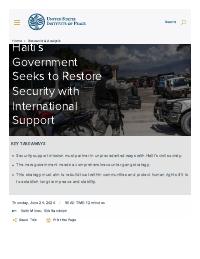
PHOTO: A police checkpoint in Port-au-Prince, Haiti on Oct. 20, 2021. (Adriana Zehbrauskas/The New
York Times)
The views expressed in this publication are those of the author(s).
PUBLICATION TYPE: Analysis
Keith Mines
Former Vice President, Latin America
Kirk Randolph
Program Officer, Latin America Program
ABOUT THE AUTHORS
How to Break Gangs’ Grip on Haiti
RELATED RESEARCH & ANALYSIS
Ki Sa Siksè Politik Etazini ta Dwe Sanble an Ayiti?
À quoi ressemble le succès de la politique américaine en Haïti?
What Does U.S. Policy Success Look Like in Haiti?
View All Research & Analysis
COUNTRIES
Haiti
USIP has a variety of newsletters and announcements with the latest analysis, publications
and events.
STAY INFORMED
2301 Constitution Avenue NW, Washington, DC 20037
Tel: +1.202.457.1700
About USIP
Countries & Regions
Research & Analysis
Gandhi-King Global Academy
Legal and Privacy Information | FOIA InquiriesThe United States Institute of Peace
Sign up!
Connect Press Projects
The Olive Branch Blog