Texte Intégral du Document
Texte extrait du document original pour l'indexation.
This publication was produced for review by the United States Agency for International Development. It
was prepared by Chemonics International Inc.
INTEGRATED FINANCIAL
MANAGEMENT SYSTEM
FINAL REPORT
SEPTEMBER 26, 2014 – JULY 25, 2019
DISCLAIMER
The authors’ views expressed in this publication do not necessarily reflect the views of the United States
Agency for International Development or the United States government.
,
INTEGRATED FINANCIAL
MANAGEMENT SYSTEM
FINAL REPORT
SEPTEMBER 26, 2014 – JULY 25, 2019
Contract No. AID-OAA-I-12-00035, Task Order No. AID-521-TO-14-00001
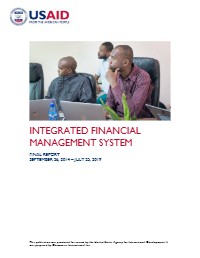
Cover photo: Haitian Ministry of Finance help desk technician, system administrator, and IT
managers participate in an IT security (“vmware”) training delivered by IFMS through its partner
Dell at the Ministry of Finance training room in Port-au-Prince, Haiti. (Credit: Ch emonics/IFMS).
INTEGRATED FINANCIAL MANAGEMENT SYSTEM FINAL REPORT | i
CONTENTS
Acronyms ............................................................................................................... iii
Executive Summary ............................................................................................... 4
Task Order Key Outcomes ................................................................................... 9
Section 1. Project Context and Review of the Country Situation .................. 10
Section 2. Major Program Activities: IFMS Highlights and Achievements ... 12
Project Purpose and Evolving Scope ........................................................................................12
Updated data platform and computer equipment improve customs services
................................................................................................................................ 13
Key Outcome 1: IFMS Network Infrastructure Updated and Improved ........................14
Replacement of Network Hardware .................................................................................14
Upgrade of the NOC .............................................................................................................15
Expansion and Upgrade of Tax System Automation ......................................................16
Renovation: Network operations center gets a much-needed makeover ..... 17
Key Outcome 2: Capacity to Utilize the IFMS for Financial Reporting and Auditing
Processes Expanded ....................................................................................................................18
Business Intelligence Tools ...................................................................................................18
Replacing typewriters: Haiti’s tax authority receives critical upgrades......... 20
Key Outcome 3: Capacity of the Network to Support both Operational Support and
Financial Auditing Built ................................................................................................................21
Financial Audit Software ........................................................................................................21
Human Resource System ......................................................................................................22
Revamped IT systems lead to greater transparency in data management... 25
Key Outcome 4: Expenditure and Revenue Systems Integrated, and Financial
Management Improved................................................................................................................26
Establishment of an Electronic Data-Exchange Capability .............................................26
New online platform improves government efficiency, data security ........... 29
Exchange of Local Government Tax Data ........................................................................30
Key Outcome 5: Capabilities to Properly Document and Implement Governance
Policies and Procedures Enhanced ...........................................................................................30
IFMS Capacity Building ...........................................................................................................30
Development of Policies and Procedures for Governance and Management ..........31
INTEGRATED FINANCIAL MANAGEMENT SYSTEM FINAL REPORT | ii
Development of IT Maintenance Plan ................................................................................32
Section 3. Problems Encountered: Solutions and Lessons Learned............... 34
Challenges and How to Address Them ..................................................................................34
Lessons Learned for Future Programs ....................................................................................35
Annex A. Summary of Performance Indicators ............................................... 37
Annex B. Summary of Training Sessions Through Quarter 4 of Fiscal Year
2017 ........................................................................................................................ 43
EXHIBITS
Exhibit 1 Dashboard Expenditure on Operating Budget .........................................................19
Exhibit 2. Dashboard Expenditure on Investment Budget .......................................................19
Exhibit 3. Dashboard on Public Revenue .....................................................................................21
Exhibit 4. SIGRH Interface I ............................................................................................................24
Exhibit 5. SIGRH Interface II ..........................................................................................................26
Exhibit 6. Sample of Tax importation from Customs ...............................................................27
IFMS FINAL REPORT | iii
ACRONYMS
AGD Administration Générale des Douanes
CSC/CA Cour Supérieure des Comptes et du Contentieux
Administratif
DGI Direction Générale des Impôts
IFMS Integrated Financial Management System
IT Information Technology
KO Key Outcome
KONEKTE KONesans E Konpetans TEknik project
LAN/WAN Local Area Network/W ide Area Network
LOKAL+ Limyè ak Oganizasyon pou Kolektivite yo Ale Lwen project
MOU Memorandum of Understanding
NOC Network Operations Center
OMRH Office de Management et des Ressources Humaines
SDI Schéma Directeur Informatique
SIGRH Système Interministériel de Gestion des Ressources Humaines
ULCC Unité de Lutte Contre la Corruption
UXP Unified Exchange Platform
INTEGRATED FINANCIAL MANAGEMENT SYSTEM FINAL REPORT | 4
EXECUTIVE SUMMARY
The Integrated Financial Management
System (IFMS) project began in September
of 2014, in the wake of increased public
discontent in Haiti over delayed elections
and perceived government corruption. The
state of information technology (IT)
infrastructure supporting financial
transparency in the country had been
deprioritized given more urgent needs
following the devastating 2010 earthquake.
Much of the government of Haiti’s IFMS
network equipment had been damaged in
the earthquake. A dearth of real-time data
for decision-making contributed to
governance challenges for the government
of Haiti. Haiti’s 2014-2019 Schéma
Directeur Informatique (SDI or IT Master
Plan) laid out the key challenges hampering
its IT systems, such as a lack of planning
and leadership; a desperate need for
physical upgrades; undertrained staff; outdated, overlapping, and unconnected software;
expensive and complicated communication systems; and poor physical and virtual
security. The IFMS project was designed to tackle these challenges and support the
government of Haiti in achieving greater financial transparency and decision- making
capacity.
Emerging from nearly a decade of planning between USAID and the government of
Haiti, the IFMS project engaged the government of Haiti to improve financial planning
and public financial managemen t by restoring, improving, and expanding its IFMS-related
network infrastructure and financial management systems. The project was successful in
upgrading this infrastructure, strengthening public financial management systems and
governance, and p roviding the government of Haiti with an innovative interface (the
Unified Exchange Platform or UXP), which allows the government of Haiti the ability,
for the first time ever, to seamlessly share data between institutions.
The project experienced significant hurdles during its five -year lifespan, including
hurricanes, a period of more than a year without a legitimate government after delays in
presidential elections, key counterpart leadership transitions, and mass protests that
shut down the country for weeks at a time. Additionally, the government of Haiti was
unable to fulfill some of its commitments , such as contributing resources to repair
IFMS BY THE NUMBERS
• Number of training days provided to
executive branch personnel: 71 days for
men and 57 days for women
• Number of servers installed: 52
• Number of data- exchange transactions
using the Unified Exchange Platform in the
project’s last quarter: 33,132
• Number of government staff receiving
project-supported training: 184 (24 of
whom were women)
• Number of municipalities using CIVITAX that receive data from the Direction Générale des Impôts to monitor daily tax
collection at the commune level: 10
• Average days to onboard employees before
the project: 60 days
• Average days to onboard employees after
the project: 1 day
• Average time to license a business before
the project: 7 days
• Average time to license a business after the
project: 45 minutes
INTEGRATED FINANCIAL MANAGEMENT SYSTEM FINAL REPORT | 5
existing IFMS network site microwave
towers and providing the leadership required
to ensure that the IFMS-provided human
resources software — Système
Interministériel de Gestion des Ressources
Humaines or SIGRH 2.0 – be rolled out
across the government. Despite these real
impediments, the IFMS project adapted and
identified creative ways to move activities
forward throughout the life of the project,
such as using cost savings from other
activities to repair all 42 IFMS network sites
when the government of Haiti was unable to
do so.
Today, because of IFMS support, Haitian
government agencies have real- time access
to expenditure data through the improved IFMS network. Entities can send and receive
key data faster, and make more informed planning decisions. IFMS installed the UXP, a
technology developed in Estonia that enables peer-to-peer data exchange over
encrypted and mutually authenticated channels. Through the UXP, the decision-making
processes have improved for agencies because they now have access to data from
different agencies that they didn’t previously have. For example, the Ministère de
l'Economie et des Finances can now directly access data on revenue from the Tax
Agency (Direction Generale des Impots, or DGI) and the Customs Agency
(Administration Generale des Douanes or AGD) to inform budgeting and key planning
decisions. This improvement allows budgeting and planning to be grounded in actual
data, reducing the opportunity for political influence over resource allocation and
helping to ensure that plans are more responsive to citizen needs.
The IFMS project also revamped the “nucleus” of the Ministère de l'Economie et des
Finances’s network, the Network Operations Center (NOC). Before IFMS, the NOC
was in disarray with outdated hardware and software, exposed wiring, few security
protocols, and no backup systems, which put critical government data at great risk
should Haiti experience another emergency — such as an earthquake. Now, thanks to
IFMS, the NOC includes greatly improved and robust security protocols and software
protection, including redundancies for data storage and backup. Today, the system could
continue to operate and the government could still function even if one server fails. If
there should be another earthquake, Haiti now has strong data backup and c ould
recover faster.
IFMS contributed to increasing transparency on tax revenue data by connecting the
three municipalities with the highest populations in the country with the DGI to share
information on taxes. Prior to IFMS, data-sharing (if done at all) was conducted through
the exchange of hard copy (paper) documents and the process often took months .
“IMAGINE IF A MAIL ADDRESS
SHOULD BE HACKED, IM AGINE
HOW EASILY A PIECE O F
PAPER COULD BE FALSI FIED,
IMAGINE AN OFFICIAL NEED
FOR QUICK INFORMATION TO
MAKE A STRATEGIC
DECISION… THE OLD ME THOD
WAS NEITHER SECURE N OR
EFFECTIVE...”— DONALD
MARCELIN, MINISTÈRE DE
L'ECONOMIE ET DES
FINANCES, INFORMATION
SYSTEMS DIRECTOR
INTEGRATED FINANCIAL MANAGEMENT SYSTEM FINAL REPORT | 6
Municipalities are now actively sharing information in real time with the DGI on
property assessments and property ownership, and the DGI is sharing data on property
taxes collected. Thanks to IFMS support, both the DGI and municipalities can obtain
more accurate information more quickly. This has in turn increased the overall
transparency of the government of Haiti, reducing the opportunity for corruption and
leakage in revenue collection activities. The Ministère de l’Intérieur et des Collectivités
Territoriales has announced plans to invest in providing remaining municipalities the
required private network capabilities to enable them to communicate with DGI.
Overall, IFMS contributions included hardware and software procurement, installation,
implementation, and training across a broad spectrum of government IT management
and information- sharing functions. These activities contributed to improving current
IFMS functionality, access, security, and system accountability; developing business
continuity and contingency plans; and better aligning government business processes
with technology. As a result, the project helped to pioneer electronic submissions of
budget requests, improve monitoring capabilities, increase management control of
budget expenditures, instill greater transparency and accountability in revenue
collection, and improve public services.
At its start, the IFMS project focused on acutely needed infrastructure upgrades and
equipment procurement. Later, the project turned to application development, process
improvement, and capacity building of government institutions to put new systems and
tools to effective use. By project end, the Ministère de l'Economie et des Finances
demonstrated ownership of the UXP platform — for example, presenting on the
transformational potential of UXP at an international finance summit held in Port-au-
Prince in April 2019 and independently organizing and financing training sessions on the
UXP for end- users.
The IFMS project provided the Haitian government with tools to boost efficiency,
transparency, and accountability in public financial management, thereby str engthening
the government’s ability to identify and combat corruption. Now the government of
Haiti must step up and make the best use of the tools provided. Below are some steps
the government of Haiti should take to ensure sustainability of IFMS investments:
• Internet connectivity and electricity challenges. Internet connectivity and electricity
challenges remain persistent problems. The extent to which the government of
Haiti commits resources (financial and human) to ensure reliable Internet
connections and continuous power supplies to maintain USAID's IT investments
will be a measure of its commitment to improved public financial management
using IFMS. The primary institutions of the government of Haiti involved with
IFMS (Ministère de l'Economie et des Finances, Office de Management et des
Ressources Humaines or OMRH, DGI) should commit to renewing high-speed
Internet access with appropriate providers and to maintaining redundant systems
to ensure a continuous electricity supply (e.g., generators, inverters).
INTEGRATED FINANCIAL MANAGEMENT SYSTEM FINAL REPORT | 7
• Commitment to maintenance of the NOC. There has been a vast improvement in
the infrastructure, hardware, and software at the NOC that will allow the
Ministère de l'Economie et des Finances to store and access data related to
public financial management safely and efficiently. The new systems allow for
IFMS data to be exchanged much faster than before — and in a secure way.
However, maintenance of the renovated NOC by the Ministère de l'Economie et
des Finances is essential to its sustainability. The government of Haiti should
adhere to the IFMS-provided maintenance plan, and include the costs for this
maintenance in its annual budget.
• General budget for IFMS network maintenance. IFMS prepared a budget for the
maintenance of the IT hardware and software. The government of Haiti needs to
include budgetary line items for the maintenance of existing equipment, the
purchase of spare parts, the renewal of high-speed Internet contracts, the
renewal of software licenses , and the provision of continuous and reliable power.
• Sharing data through tools provided. The tools provided by IFMS present a
remarkable opportunity for the government of Haiti to digitize information-
sharing and achieve real gains in financial transparency. However, a public
financial management system is only as useful as the data it has access to . Certain
agencies (i.e., DGI and AGD) have already begun sharing critical data on revenue
and expenditures related to taxes and customs. Municipalities and the DGI are
exchanging information on property and tax revenue. However, the government
of Haiti has not yet populated certain tools provided by the IFMS project — for
example, business intelligence tools — with real data, limiting the tool s’ utility.
Additionally, intragovernmental government of Haiti memoranda of
understanding (MOUs) prepared by the project to allow formal data exchanges
between government of Haiti institutions were never signed by Ministère de
l'Economie et des Finances, OMRH, and others, although the draft MOUs were
provided three years ago. The government of Haiti must commit to populating
IFMS tools with useful data in order to harness their full potential.
INTEGRATED FINANCIAL MANAGEMENT SYSTEM FINAL REPORT | 8
HIGHLIGHTS OF THE PR OJECT’S MOST SIGNIFICANT ACHIEVEMENTS:
• Completely renovating and upgrading the NOC at the Ministère de l'Economie et des Finances, giving the
ministry state-of-the-art servers with secured access and big-data analysis capability.
• Engaging an Estonian firm to develop a UXP that allows government institutions to securely and rapidly
exchange information related to government financial flows. The project installed and made the UXP
operational at 13 Haitian government institutions.
• Streamlining human resource management operations by developing the SIGRH software for the OMRH.
This software automates financial transactions for government staff and makes the process of onboarding
and paying staff faster and more accurate.
• Upgrading IT equipment and training staff in 25 DGI offices to automatically register local tax payments
and share tax records in real time. Additionally, the IFMS project partnered with USAID’s Limyè ak
Oganizasyon pou Kolektivite yo Ale Lwen project (LOKAL+) project to install IT equipment in nine
municipalities using CIVITAX software to improve efficiency and transparency in municipal tax collection.
INTEGRATED FINANCIAL MANAGEMENT SYSTEM FINAL REPORT | 9
TASK ORDER KEY OUTCOM ES
This report serves as the Integrated Financial Management System (IFMS) project’s final
report, which covers activities from September 2014 to July 2019.
The purpose of this task order was to provide continued assistance to the Haitian
government’s Ministère de l'Economie et des F inances in developing a full and complete
IFMS. The IFMS project’s overall strategy was to provide technical, logistical, and
managerial strengthening support to the ministry to restore, operate, and expand IFMS-
related infrastructure and its financial management system. The project worked to
address the following key outcomes (KOs) under this task order:
1. KO1: The IFMS network infrastructure is updated and improved
2. KO2: The Haitian government’s capacity to utilize the IFMS for financial
reporting and auditing processes is expanded
3. KO3: The capacity of the IFMS network to support both operational support
and financial auditing is built
4. KO4: The expenditure and revenue systems are integrated, and financial
management is improved
5. KO5: The Ministère de l'Economie et des Finances ’ [information technology] IT
governance and management capabilities to document and implement
governance policies and procedures for each stakeholder ministry and
municipality are enhanced
INTEGRATED FINANCIAL MANAGEMENT SYSTEM FINAL REPORT | 10
SECTION 1. PROJECT
CONTEXT AND REVIEW OF
THE COUNTRY SITUATION
The IFMS project has been a result of fruitful collaboration between USAID and the
Haitian government for more than a decade. It served its primary goal of providing the
Haitian government, the Ministère de l'Economie et des Finances , and other entities
with the tools and infrastructure needed to support efficient, transparent, and
accountable financial management activities. The IFMS project emphasized providing
appropriate access and tools to prevent and fight corruption and empowering civil
society organizations and government oversight institutions to monitor the Haitian
government’s financial transactions.
The Haitian Government’s IT infrastructure, anchored by its IFMS for decades, evolved
through several phases of implementation and upgrades, and experienced significant
setbacks after the 2010 earthquake in Haiti. It served as the backbone of the Ministère
de l'Economie et des F inances’ network infrastructure and was the major
communication and data-exchange channel for other government ministry applications
(e.g., DGI and AGD). It needed to be completely reliable, accessible, scalable, and
dependable for end-users.
Post-earthquake, USAID’s assessments and the Ministère de l'Economie et des Finances’
2014-2019 SDI (IT Master Plan) outlined the IFMS’ continued need for modernization,
which led to this iteration of the IFMS project, implemented by Chemonics from 2014
to 2019. Building on the successes of past USAID projects and previous collaboration
among implementers and Haitian government institutions, the project’s scope of work
identified a number of priority interventions , including greater integration of systems
among the ministry’s autonomous bodies; upgrades and updates to existing systems,
software, hardware, and infrastructure; expanded functionality; training of IT staff; and
improvement and consolidation of governance processes.
Despite turbulent national elections in 2016, and the lack of a functional government for
several months, the IFMS project made progress toward supporting the government of
Haiti’s goals of improving financial efficiency, transparency, and accountability through
strengthened infrastructure, software integration, and capacity building. In 2018 and into
2019, Haitian citizens’ discontent with the way funds were managed by the government
reached a boiling point, with protests calling for the resignation of government officials
shutting down the country for weeks at a time. Now that the IFMS is online and
functional, the new tools provided by IFMS, such as the UXP, have the capacity to bring
additional transparency to funds management by the government of Haiti. Today’s IFMS
INTEGRATED FINANCIAL MANAGEMENT SYSTEM FINAL REPORT | 11
has evolved to support the growing demands and needs of Haiti’s public financial
management functions and IFMS tools have been successfully transferred to the Haitian
government. It is now up to the Haitian government to make the best use of tools that
have been provided.
INTEGRATED FINANCIAL MANAGEMENT SYSTEM FINAL REPORT | 12
SECTION 2. MAJOR PROGRAM
ACTIVITIES: IFMS HIGHLIGHTS
AND ACHIEVEMENTS
PROJECT PURPOSE AND EVOLVING SCOPE
The IFMS project ’s Year 1 and 2 work plans focused on strengthening the existing IFMS
network, including upgrading the Ministère de l'Economie et des Finances ’ NOC server
room security; replacing servers, storage hardware, and network communications
hardware and software; and establishing links for data exchange between key Ministère
de l'Economie et des F inances institutions that manage budget, treasury, revenue, and
expenditure functions.
Beginning in Year 1, the project also undertook a major initiative to automate DGI
headquarters and regional offices, resulting in the provision of hardware to DGI
headquarters and 13 regional tax offices.
In Year 2, the project configured data exchange software on servers that were delivered
to eight government of Haiti institutions that were participating in UXP between
ministries. The project also continued renovations of the NOC, and identified needs and
conducted a competitive procurement process for the development of software to
upgrade the OMRH’s automated human resource system. Th e project also procured
business intelligence solutions for the Ministère de l'Economie et des Finances. Lastly,
the project conducted a procurement to repair infrastructure at 14 IFMS network sites,
including repairs or complete replacement of microwave towers.
In Year 3, the project automated 12 additional DGI tax offices, installing equipment after
ensuring they were ready to receive IT hardware, and trained staff at these locations to
use tax-processing software. The project also focused on installation of procured IFMS
network equipment. After the government of Haiti communicated its inability to repair
the 42 remote IFMS network sites, the project changed direction and repaired the sites
to ensure they were secure and that equipment could be safely installed and stored. In
total, IFMS repaired 43 sites, including the NOC . IFMS then installed equipment at each
of these sites, and trained Ministère de l’Economie et des Finances IT staff responsible
for maintenance of these sites.
In Years 4 and 5, the project transitioned towards operationalizing the equipment
installed in key sites, troubleshooting system maintenance and oversight software (e.g.,
network monitoring tools), and providing training/capacity building for IT staff and end-
users on tools provided.
INTEGRATED FINANCIAL MANAGEMENT SYSTEM FINAL REPORT | 13
SNAPSHOT
UPDATED DATA PLATFORM
AND COMPUTER EQUIPMENT
IMPROVE CUSTOMS SERVICES
Thanks to new
computer equipment
and enhanced
connectivity, the
AGD can function
more smoothly.
The General Administration of Customs (AGD) is responsible
for collecting customs revenue in Haiti. Traditionally, paying
taxes at the AGD level has involved long days of dealing with
heavy bureaucracy. The country’s complicated administrative
system is not conducive to efficiency nor to the well- being of
the citizens. As a result, the state is unable to replenish its
coffers proportionally to ensure the flow of goods.
As part of its extensive public finance reform campaign, the Haitian government has leveraged US government expertise through the USAID- funded Integrated Financial Management
System (IFMS) project to optimize the AGD’s operations. As
part of this, IFMS isntalled a Unified Exchange Platform (UXP)
data exchange platform at the national and the AGD level,
facilitating the exchange of information between various
entities of the Haitian public administration.
Today, with this data exchange platform in place, a customs
officer has the ability to connect from his workstation to the
database of the Direction Générale des Impôts (DGI) to check in re
al time the validity of an importer’s patent number.
This approach will eliminate the need for time -wasting back-
and-forth within the AGD and significantly improve the
clearance process for goods entering the country.
The DGI, for its part, has the ability to check in real time the
customs taxes paid by importers, and can also verify the
information provided by importers in their final tax return documents.
Strong political will from the AGD and DGI, as well as strong
collaboration with the IFMS project was all that was needed
to: improve the work of customs agents, i ncrease the state’s
tax revenue, strengthen the capacity of the DGI to control
tax duties, and reduce wait time for taxpayers at the AGD.
INTEGRATED FINANCIAL MANAGEMENT SYSTEM FINAL REPORT | 14
KEY OUTCOME 1: IFMS NETWORK INFRASTRUCTU RE UPDATED AND
IMPROVED
The government’s interministerial communication system for financial reporting uses a
microwave- based technology established with USAID funding. The system, generally
referred to as the IFMS network, is managed by the Ministère de l'Economie et des
Finances’ IT department. Although a microwave communication network of this type is
generally capable of two-way transmission of any data type, the ministry has used the
system primarily for one-way daily transmission of expenditure data, typically from
remote network installations at line ministries’ headquarter offices and other
government budget institutions to the data center. The network sites are all located in
the Port-au-Prince metropolitan area.
The Ministère de l'Economie et des Finances owns the IFMS communication equipment
at these remote sites; the equipment is kept physically and electronically separated from
line ministries’ and other budget institutions’ IT units, and is operated and maintained by
ministry IT specialists. To report expenditure data through the IFMS network, IT
specialists working for each budget institution had to re -enter data from their own
internal IT systems into the IFMS system servers, which was inefficient, vulnerable to
transcription errors, and created opportunities for corruption.
The massive earthquake that devastated the Port-au-Prince area in 2010 destroyed or
damaged most of the physical infrastructure supporting the network’s operation. In the
three years that followed, USAID funded infrastruc ture repair and equipment
replacement on a piece-by- piece basis. Large parts of the system, however, were not
functional at the start of the IFMS project in 2014 and as many as one-third of the
network sites were down on any given day.
REPLACEMENT OF NETWORK HARDWARE
The IFMS project was tasked with replacing and upgrading all end-of-life hardware and
network support software, including communication equipment at the NOC and the 41
remote network sites — for a total of 42 sites , which comprise all of the Ministère de
l’Economie et des Finances’s priority spending sites. The project’s scope of work also
included renovating and upgrading the NOC and its physical support systems, including
fire suppression, access security, and air conditioning. However, when the project
assessed the IFMS infrastructure and functionality during project startup, it was clear
that a more holistic approach was required for restoring and upgrading the network.
Following the network assessment, the project prepared a comprehensive plan for
replacing all communication equipment in the NOC and existing remote sites, plus
expanding the network to additional sites. New communication equipment provided at
each site included a wireless bridge (transmitter/receiver), router, and switch. In
addition, the plan included replacing physical servers with a newer technology that
featured virtual servers. The project conducted an international competitive
procurement for the communication equipment, servers, and virtualization software.
INTEGRATED FINANCIAL MANAGEMENT SYSTEM FINAL REPORT | 15
The Ministère de l'Economie et des Finances committed to repairing the microwave
towers and electrical connections, ensuring proper grounding of each site.
During the project’s second year, after the purchased equipment arrived, the project
team learned that the Ministère de l'Economie et des Finances did not have the funds to
repair the microwave towers and electrical connections. Accordingly, the project shifted
resources to provide these needed repairs, working beyond its original scope. The
project waited to install new communication equipment at each remote site until the
repair work was complete to avoid exposing the new equipment to damage from
lightning strikes. Using reprogrammed resources, the project also repaired transmission
towers and cabling at the 42 sites; some sites required completely replacing the
transmission towers, while others required replacing or repairing damaged sections of
the towers. In addition, the project regrounded most of the towers, and rewired the
electrical connections from the towers to the control rooms.
Concurrently, the project hired an engineer to test the new transmission equipment
purchased for various combinations of distance and terrain. Based on the test results,
the project team and the Ministère de l'Economie et des Finances ’ IT department agreed
on a final configuration of the network sites, using a hub-and- spoke design with five
backbone sites and the remaining remote sites clustered around them. After installing
the new communication equipment at the remote sites, the project trained Ministère de
l’Economie et des Finances IT directors responsible for maintaining each piece of
equipment and network connection, ensuring that capacity existed within the MEF to
maintain and fix equipment. Procedure manuals were developed by IFMS and shared
with Ministère de l’Economie et des Finances IT staff, serving an important need for
proper documentation that will improve the sustainability of activities.
UPGRADE OF THE NOC
In 2015, the project engaged a Haitian engineering firm to assess the NOC’s physical
infrastructure and design a full facility renovation and upgrade. Before these upgrades,
the NOC was in disrepair. Security and access to the NOC room was limited — data
could be easily stolen, equipment could be easily removed, and cords were a tangled
mess, requiring hours to sort out which cords connected which pieces of equipment.
Because of the repairs made by IFMS, the NOC now has increased physical security to
restrict physical access to sensitive equipment as well as security cameras and an “ID
card swipe” requirement allowing only authorized personnel to monitor access. The
NOC is now fully protected against fire, and the NOC features redundancy in electrical
power sources to ensure servers continue to operate even if the main electrical grid
turns off. Cabling is now properly labeled and configured and connections between
different pieces of equipment can be more easily adjusted, limiting the need for outside
maintenance assistance. A Haitian construction consortium provided these renovation
services, which included replacing the floor and interior walls of the server room,
replacing and upgrading the electrical switching equipment for the entire building ,
installing systems for fire suppression and access security, carrying out electrical
INTEGRATED FINANCIAL MANAGEMENT SYSTEM FINAL REPORT | 16
rewiring and replacement/relocation of backup batteries, rewiring all electronic
connections, and installing control room furniture and system monitors.
Following these renovations, the project installed the new network management
equipment and high- level servers. To prepare for future growth and system additions,
the project included two VXRails, which are computers on which servers can be
virtualized. VXRail technology is easy to manage, provides more security to a system,
and simplifies deployment of big-data analytics and business intelligence tools. The
project trained ministry staff on Data Domain (a Dell system that focuses on computer
storage, networking, and backup systems), VXRail, and troubleshooting using Dell
helpdesk software. In total, five IT staff from the Ministère de l'Economie et des Finances
and three from the DGI received full VXRail training.
The last phase of the NOC upgrade, conducted during the project’s final months,
included installing Cisco network monitoring software and network converters. These
tools monitor how the network is functioning at all 42 sites. IT network administrators
were trained on these tools by a Haitian-American IFMS senior network architect with
advanced Cisco certifications. The new network monitoring software provides
immediate alerts to NOC system operators about incidents affecting system s operation,
including power outages at sites and other types of system failures or interruption at the
NOC or remote sites. The administrators do not have to wait for an issue to be
reported by the remote site administrator before taking action. It also provides
performance statistics and usage data. A tape backup system and Avamar backup
software were also configured to ensure that data can be restored in the event of a
disaster that destroys all the equipment in the NOC.
EXPANSION AND UPG RADE OF TAX SYSTEM A UTOMATION
The Haitian tax authority, known as the DGI, underwent a major automation effort,
including upgrading infrastructure, hardware, software, and training. The IFMS project
was tasked with providing hardware to the DGI, while other donors funded new
software (through the company “Tax Solutions”) and the Haitian government upgraded
software and trained DGI staff. DGI operates its own network using the government-
owned communication company NATCOM’s optical fiber system, which allows data
transmission over mountainous terrain to regional Centre des Impôts locations.
INTEGRATED FINANCIAL MANAGEMENT SYSTEM FINAL REPORT | 17
SNAPSHOT
RENOVATION: NETWORK
OPERATIONS CENTER GETS A
MUCH-NEEDED MAKEOVER
The NOC at the
Ministère de
l'Economie et des
Finances serves as a
central storage room
for critical electronic
financial data.
Previously, the Network Operations Center (NOC) was a
confusion of server boxes and cords, making it difficult for the
IT department to identify and troubleshoot challenges. This
meant that issues often went unaddressed, since internal
capacity was limited and the MEF lacked resources to hire
external assistance. The room was not properly air
conditioned, increasing the likelihood of equipment
overheating and malfunctioning. Additionally, the room was
not properly secured, increasing the risk of equipment theft.
To improve this situation, the Ministère de l'Economie et des
Finances partnered with the IFMS project to organize and
update this important electronic data storage room. Through
a few key renovations — detailed below — the ministry has
now significantly improved the NOC’s organization and its
networks’ data security.
Brightly colored cords held in place by zip ties now clearly
twist and turn around servers housed in metal shelving units neatly placed around the room. Each storage unit is easy to access, bringing clarity and organization to a once-chaotic
space.
Metal trays that run across the room just below the ceiling hold bright blue network cables, which were previously
hidden away in a false ceiling, making them difficult to access.
This improvement keeps the cables safely out of the way,
while providing clearer organization. Now IT staff can quickly
access them to make adjustments as needed.
In addition, the IFMS project installed new drywall, creating a
separate room for the air conditioning unit, which now safely
keeps the room at a consistent cool temperature.
The IFMS project also installed additional security measures,
such as security cameras, fire suppression equipment, and an
upgraded door with a high- security lock system, which allows
direct access only to IT technicians servicing the room.
Before its renovation, the NOC’s
server boxes and cords lacked
organization.
After the NOC’s renovation,
servers and cords are clearly
organized and easier to access.
PHOTOS: IFMS project
INTEGRATED FINANCIAL MANAGEMENT SYSTEM FINAL REPORT | 18
At the beginning of their partnership, DGI and project staff agreed that the physical
security of each site that required equipment had to be prepared to protect the new
equipment from theft or damage. For many of the remote facilities, this involved building
a new facility or conducting major upgrades. The timing for purchasing and delivering
new hardware was thus dependent on DGI’s construction schedule.
In total, the project procured new servers and storage hardware for DGI’s headquarters
and equipped 25 regional tax offices once upgrades were completed. While the project
installed new equipment in each remote office, staff received training on the system and
equipment. For some, the idea of such a major change was daunting, but DGI ’s IT
director assured them that no one would lose their job or be left behind. Employees
completed the training and are now proud to provide the public with better, more
efficient, and more transparent services.
AGD has utilized these tools and made information available to other institutions. The
Ministère de l’Economie et des Finances and DGI are now actively exchanging
information on business registration, and what goods are being imported, providing the
government of Haiti with better information on revenues versus expenditures so it can
make more informed decisons.
KEY OUTCOME 2: CAPAC ITY TO UTILIZE THE IFMS FOR FINANCIAL
REPORTING AND AUDITI NG PROCESSES EXPANDE D
One of the IFMS project’s key objectives was to build the Ministère de l'Economie et
des Finances' IFMS technical support team’s capacity to become a best practices-based
IT organization, with the skills and tools to ensure IFMS transparency and accountability.
Previously, the ministry had been unable to produce and publish accurate, timely
monthly revenue and expenditure reports, which prevented evidence -based budgeting
and planning decisions and limited international donors’ ability and willingness to provide
financial support.
BUSINESS INTELLIGENC E TOOLS
The IFMS project helped the government generate real- time dashboards and scorecards
displaying GOH financial flows, which gave authorities accurate data to form sound
policies and manage day-to-day public finance tasks with a higher level of quality and
reliability. These business intelligence tools allowed end-users to generate reports and
dashboards without extensive assistance from the ministry’s IT units.
The project consulted ministry representatives to better understand the needs of
government stakeholders, and investigated alternative software applications, including
data warehousing and business intelligence software products. After extended
discussions, staff agreed to purchase a business intelligence software from Sisense, which
offered the best combination of functionality, user-friendliness, and acquisition and
maintenance cost. The project installed this software on the NOC’s VXRails for better
security and easier maintenance and reconfiguration. The project then developed three
INTEGRATED FINANCIAL MANAGEMENT SYSTEM FINAL REPORT | 19
sample dashboards (see Exhibits 1 to 3) for operating budgets, investment budgets, and
public revenue. At project end, these dashboards were awaiting ministry population of
real data. At this stage, dashboards are complete, have been validated through tests with
sample data, and are ready to be populated with information so they can be used to
assist GOH stakeholders in making key budgeting and planning decisions. The
government of Haiti should now provide access to key databases to link real information
into the business intelligence tools provided by IFMS.
EXHIBIT 1 DASHBOARD EXPENDITURE ON OPERATING BUDGET
EXHIBIT 2. DASHBOARD EXPENDIT URE ON INVESTMENT BU DGET
INTEGRATED FINANCIAL MANAGEMENT SYSTEM FINAL REPORT | 20
SNAPSHOT
REPLACING TYPEWRITERS:
HAITI’S TAX AUTHORITY
RECEIVES CRITICAL UPGRADES
The IFMS project has
installed IT
equipment at 25
regional DGI sites,
which are now fully
equipped and
programmed to use
the tax processing
software, Tax
Solution.
The recent installation of new equipment and tax-processing
software at 25 regional DGI sites has resulted in a significant
increase in taxpayer and DGI staff satisfaction. Filing processing
times have gone down from five to seven business days to only
45 minutes. With drastically reduced wait times of only five to
10 minutes, employees are thrilled with the significant
improvement in productivity they experience. They now look
forward to the busy tax period in March and April, knowing
they have the equipment to meet demand effectively.
One DGI employee said, “Before the computers arrived, we
had to keep all the calculations and institutional knowledge in
our heads. Now I can calculate more efficiently and accurately
and look [up] past records more easily." A nother echoed this
sentiment, saying, “Before, it was not possible to report on
revenue each day. There was a two-month delay due to manual
processing. Now I can do it immediately with just a few clicks.”
Regional tax authorities reported how much easier it is for
headquarters to access their data online, whereas previously,
the regional offices had to hand-deliver boxes of hard-copy files
and reports. Electronic data greatly reduces the opportunity for
corruption and allows for timely inputs into the budgeting
process.
This upgrade has not only improved efficiency, but also gave
DGI employees an opportunity for professional development, as
staff members were trained on how to use the new hardware
and software. One team member with 15 years of experience
working with tax-processing software said she was excited to
use her expertise to train colleagues.
Tax offices can potentially increase revenue due to their ability
to provide additional services, such as issuing passports, driver’s
licenses, and identification cards, which previously were only
provided at DGI headquarters in the capital. Additionally, DGI’s
headquarters have added a call center to address citizens’
questions, and launch RMS, a tax refund program.
New computers make it easier
for DGI employees in Cayes to
provide high-quality, efficient
services to customers.
PHOTO: IFMS project
INTEGRATED FINANCIAL MANAGEMENT SYSTEM FINAL REPORT | 21
EXHIBIT 3. DASHBOARD ON PUBLIC REVENUE
KEY OUTCOME 3: CAPAC ITY OF THE NETWORK T O SUPPORT BOTH
OPERATIONAL SUPPORT AND FINANCIAL AUDITING BUILT
FINANCIAL AUDIT SOFT WARE
The IFMS project was tasked with expanding the Haitian government’s capacity to use
the IFMS network for financial reporting and auditing processes. This involved identifying
the training, tools, and processes necessary to support financial audit ing capability, and
then procuring new auditing software and tools for the government ’s oversight agencies,
Unité de Lutte Contre la Corruption ( ULCC) and Cour Supérieure des Comptes et du
Contentieux Administratif ( CSC/CA).
In the project’s third year, staff engaged a Haitian auditing firm, Analytics, to assess, in
collaboration with their leadership, government institutions’ auditing capabilities. The
assessment identified gaps and recommendations for implementing auditing processes,
performed a requirements analysis for procuring and rolling out audit software, and
identified the types of training appropriate for ULCC’s and CSC/CA’s needs. The
assessment resulted in a thorough market analysis of available audit software with
suitable features for both agencies. Upon examination, the project determined that the
audit software required would be too complex for the ULCC to implement at this time
given basic capacity gaps.
Instead, the project focused on strengthening the ULCC’s capacity in UXP network and
Windows Server administration. Other donors (notably the United Nations
Development Programme) are considering supporting the ULCC with additional
auditing capacity building and monitoring their readiness to absorb new tools at a later
date once their basic capacity has been strengthened.
INTEGRATED FINANCIAL MANAGEMENT SYSTEM FINAL REPORT | 22
HUMAN RESOURCE SYSTE M
The project’s scope of work called for implementing a government-wide human
resource management application within the OMRH , utilizing the IFMS network. OMRH
works closely with line ministries to provide the Ministère de l'Economie et des
Finances with key employee information needed for payroll processing. Previously, this
information was transmitted via hard copy and submitted to the payroll team on a case-
by-case basis as new employees were onboarded or as employees experienced a change
in status. These paper-based processes involved many staff, and it was not uncommon
for a payroll action to spend months in review before it was ultimately entered into
payroll.
Initial meetings with OMRH staff indicated that they were already working on an
upgrade of the existing human resource management software and did not need project
support. However, in the project’s second year, OMRH determined that the upgraded
system did not function as expected. The project team determined that the software
needed another upgrade. This upgrade would require a link to the Ministère de
l'Economie et des Finances’ payroll software, which is responsible for preparing the
payroll and serves as a repository for budget and payroll expenditure data. The system
also lacked a time-reporting function, which was needed to control the issue of
payments to non-existent employees, a large source of leakages from the government’s
payroll budget. In addition, the project discovered that the e lectronic linkages between
OMRH and line ministries did not function well, giving line ministries little incentive to
use the system.
Based on a request from the Minist ère de
la Santé Publique et de la Population, the
project prepared an upgraded design of
SIGRH 2.0 and presented it to OMRH,
the Ministère de l'Economie et des
Finances, and several line ministries. This
redesign was based on working sessions
with the OMRH on what new business
processes related to hiring and tracking
of employees could look like with
improved technological tools; these
processes weremapped out by the IFMS curriculum developer. The new design included
linkages to the Ministère de l'Economie et des F inances’ functioning government payroll
system (SYSPAY) and expenditure management system (SYSDEP) through UXP , as well
as linkages to line ministries through the IFMS network. It also included a monthly time-
reporting function, whereby supervisors are required to log into the system every
month and verify each employee’s attendance before that employee can be paid a
monthly salary. Once the design was approved , the project conducted a competitive
international procurement for developing the new software. The successful vendor
SIGRH AS AN ANTI-CORRUPTION TOOL
The new SIGRH system enab les efficient
management and centralization of data at each ministry and offers transparency to combat
corruption. The system ensures that data management complies with the Ministère de l'Economie et des Finances’ payroll system by
preventing generation of multiple checks for the
same government agent and centralizing the payroll
approval process. In addition, centralizing this information supports decision-making for managing
the Haitian public service’s human resources.
INTEGRATED FINANCIAL MANAGEMENT SYSTEM FINAL REPORT | 23
collaborated with OMRH to program and test the software in Year 3 and initiated a
pilot with OMRH and the Ministère de la Planification .
This upgrade to SIGRH 2.0 (see Exhibits 4 and 5, below and next page) would enhance
the government’s financial oversight of personnel costs. OMRH now has access to a
new SIGRH system which is able to:
• Transmit employee information electronically to the Ministère de l'Economie et des
Finances for payroll processing
• Build smart controls before initiating a new hire in SIGRH to calculate budget
availability and prevent budget excesses
• Provide monthly verification processes as well as processes to monitor candidate
and movement activity
• Streamline the onboarding process
The project finalized and deployed this system on OMRH’s servers, although the system
was not rolled out across the government for reasons beyond Chemonics’ manageable
control. In March 2019, OMRH leadership announced, in spite of best efforts by
Chemonics to convince them otherwise, that it would not roll out the SIGRH 2.0
version developed by IFMS. OMRH said that the International Development Bank had
committed to providing a new human resources software to the government of Haiti,
and OMRH noted that they would prefer to wait for this new system rather than rolling
out the SIGRH 2.0.
As of the writing of this report in July 2019, IFMS had yet to see funding for the new
human resources system materialize, despite repeated advocacy efforts from both IFMS
and USAID. IFMS encourages the OMRH to rollout the IFMS-developed SIGRH 2.0 as
an interim solution before the new system is in place. IFMS believes this would allow
additional financial monitoring, oversight, and transparency while the government of
Haiti awaits the new management tool to be developed by the International
Development Bank. To administer the payroll, the Ministère de l'Economie et des
Finances will need to develop and deploy its own part of the financial interface between
SIGRH and SYSPAY and SYSDEP, the two software programs managing all public
servants’ payroll. The International Development Bank project will be able to use the re -
engineered business processes designed by IFMS so they do not need to start from
scratch in aligning the hiring process with technological automation.
INTEGRATED FINANCIAL MANAGEMENT SYSTEM FINAL REPORT | 24
EXHIBIT 4. SIGRH INTERFACE I
INTEGRATED FINANCIAL MANAGEMENT SYSTEM FINAL REPORT | 25
SNAPSHOT
REVAMPED IT SYSTEMS LEAD
TO GREATER TRANSPARENCY
IN DATA MANAGEMENT
The Haitian
Ministère de
l'Economie et des
Finances champions
IFMS contributions
and the UXP at the
2019 Finance Summit
From 2014 to 2019, the Integrated Financial Management
System (IFMS) project engaged the government of Haiti to
not only overhaul the IFMS-related infrastructure, but to take
ownership of improved IT governance and management
capabilities. Most importantly, IFMS worked to help the GoH
understand and adopt an IFMS-provided tool with
extraordinary potential- the Unified Exchange Platform ( UXP)
facilitating real-time financial data exchange.
Near the end of the project in April 2019, the 8th annual
Finance Summit brought together a cadre of Haiti’s influential
economists and government representatives to discuss opportunities for economic development in tourism and agribusiness. The Minister of Finance proposed to event
organizers that his staff would conduct a presentation at the
event about the UXP and its potential to revolutionize public
financial management. The MEF’s IT director conducted the
presentation, which was picked up by several news outlets
including Haiti’s largest newspaper the Nouvelliste, whose.
editor-in-chief Frantz Duval independently penned an editorial
titled “mini-revolution at the AGD”. This was an example of
the remarkable ownership the GoH has taken of the UXP and
the kind of buy-in that can be achieved through careful and
patient collaboration, as well as strong political will.
To date, more than 30,000 data exchanges have taken place
on UXP, and the MEF can now directly access data on
revenue from the DGI and the AGD to inform budgeting and
key planning decisions, improving the GoH’s responsiveness
to citizen needs. UXP is now operational at 13 government of
Haiti institutions, and there is significant potential for
expansion to other agencies.
“Imagine if a mail address should be hacked, imagine how easily a
piece of paper could be falsified, imagine an official need for quick
information to make a strategic decision… the old method was
neither secure nor effective.”— Donald Marcelin, Ministère de
l’Economie et des Finances Information Systems Director
At the Finance Summit held in
April 2019 in Port-au-Prince,
Donald Marcelin, Information
Systems Director of the Ministère
de l'Economie et des Finances,
praised the benefits of secure,
real-time exchanges between
ministries through the UXP.
PHOTO: Karine Roy, IFMS Project.
INTEGRATED FINANCIAL MANAGEMENT SYSTEM FINAL REPORT | 26
EXHIBIT 5. SIGRH INTERFACE II
KEY OUTCOME 4: EXPEN DITURE AND REVENUE S YSTEMS INTEGRATED,
AND FINANCIAL MANAGE MENT IMPROVED
ESTABLISHMENT OF AN ELECTRONIC DATA -EXCHANGE CAPABILITY
Public administration and service delivery in Haiti, as in many other countries, suffers
from stove-piped institutions that do not share data efficiently. In particular, public
financial management is negatively affected by data compartmentalization. Before the
project, government institutions exchanged financial data by email, on CDs, or on paper,
none of which were secure or delivered in real time. These outdated systems prevented
financial decisions from being made on a timely basis and grounded in evident, not to
mention they also allowed for significantly higher levels of fraud and graft. The IFMS
project thus set out to assist the Ministère de l'Economie et des Finances with
electronic data-sharing to better link the government’s revenue and expenditure
systems.
The project determined that the most efficient approach with distinct sustainability
advantages was to acquire a general electronic data-exchange capability that could
facilitate any type of government-to-government data-sharing activity. In August 2015,
the IFMS project awarded a subcontract to Cybernetica , an Estonian systems developer,
to install a government data-exchange platform — UXP — which had been implemented
successfully in Estonia and in several other developing countries. Data transmission
through the UXP software is highly encrypted, secure, and efficient. Once the system is
installed, designing and installing a new exchange application involves creating a web
service, typically requiring no more than a few hours of web programming.
INTEGRATED FINANCIAL MANAGEMENT SYSTEM FINAL REPORT | 27
A project-supported study tour to Estonia solidified the Haitian government’s support
for the new platform. Ten ministry IT directors and former OMRH coordonnateur
général Uder Antoine saw the UXP in action, enabling them to better understand the
system’s benefits and how decision- makers can access financial data in real time through
the platform.
EXHIBIT 6. SAMPLE OF TAX IMPORTATION FROM CUSTOMS
Thirteen government institutions were designated as the initial participating institutions
for using UXP, including six ministries, DGI, AGD, two anti -corruption institutions, the
motor vehicle insurance agency, and OMRH. The IFMS project delivered servers and
supporting IT hardware to these 13 institutions, installed the data-exchange software,
and initiated a process of configuration and testing at each institution. The project also
developed a web portal to facilitate UXP use by displaying data in user -friendly formats.
For example, the project developed new web services between institutions like AGD
and DGI, increasing the amount of exchanged data (see Exhibit 6 above). OMRH, the
platform administrator, agreed to extend its use to the Police National d’Haiti with the
help of the Bureau of International Narcotics and Law Enforcement, lending a new
dimension to the platform.
Along with installing UXP at each site, the
project trained IT directors and staff to
administer and use it . Each training coincided
with UXP configuration at each institution. In
total, more than 40 IT staff received training ;
of these, 10 were women. As the software
improved, the government progressively
gained greater ownership of the platform. Ministère de l'Economie et des Finances staff
participated in training sessions on web s ervice development, security, and connector
Thanks to this new data- exchange technology, DGI can access import data from customs (Administration
Générale des Douanes, or AGD) in real time via the UXP. This information contains a list of each shipment and
taxes to be levied by DGI on each import and is key in fighting corruption in custom tax payments.
UXP APPLICATION DEVE LOPMENT
The project team, in collaboration with IT staff at DGI, AGD, and OMRH, have developed web services for exchanging data. For example, DGI shares information on NIF
(fiscal ID) with AGD, ULCC, and OMRH.
INTEGRATED FINANCIAL MANAGEMENT SYSTEM FINAL REPORT | 28
servers. Counterpart institutions DGI and AGD developed their own web services to
share information with other agencies, such as the Ministère de l’Economie et des
Finances. For example, DGI is now receiving data on importation coming from AGD,
and can ensure that taxpayers are accurately reporting import revenue on tax returns.
As the number of exchanges increased, the
project team discovered that most institutions
did not have enough bandwidth to use the UXP
properly. To manage this issue, the team
adapted the service to match each institution’s
quality and capacity of internet connection.
Thanks to an upgrade of the UXP software, the
UXP platform is now functioning well, with staff
in connected institutions taking greater
ownership of and circulating more data.
The project presented UXP’s infrastructure
and system to the primature (IT advisor to the
prime minister) and to the coordonnateur
général at OMRH. The latter presentation took
place at an OMRH retreat as part of a larger
seminar on e-governance. The project also presented the system to USAID and other
implementing partners during a broader thematic meeting on e-governance at which
several government agencies, businesses, donors, and other development actors were
present.
The project also presented the UXP to the minister and his cabinet at a Ministère de
l'Economie et des Finances conference to show the advantages that the Haitian
government will be able to enjoy by encouraging the exchange financial information
between AGD, DGI, and the ministry itself. The exchange of information between these
institutions will focus on revenues and expenditures.
In order to facilitate the institutions in administering and maintaining the UXP, a series
of training sessions was conducted on “ UXP Administration,” which provided the
necessary skills and competences to the UXP IT administrator of each institution to
manage and troubleshoot the UXP servers. The project also provided training on “Web
Services Development” to IT software engineers of 11 UXP institutions to teach them
how to develop web services, which are extremely important to allow each institution
to obtain or query information. To date, five institutions have used this training to
create their own customized w eb services. These institutions include the DGI, AGD,
MEF, ULCC and MENFP.
GETTING UP TO SPEED ON UXP
Cybernetica, the Estonian system developer
of UXP, conducted a one-week training
seminar on UXP for government IT
directors in Port-au Prince. More than 40
IT staff from all 13 participating government
institutions attended the training.
The project also conducted classroom and computer lab training for IT staff in administering and using the UXP software, with project IT staff serving as instructors. Project staff timed the training to coincide
with UXP configuration at each institution. Staff developed a web portal to create a user-friendly display of exchange data and
exchanged test data between DGI and AGD using the actual system configuration
and the new web portal.
INTEGRATED FINANCIAL MANAGEMENT SYSTEM FINAL REPORT | 29
SNAPSHOT
NEW ONLINE PLATFORM
IMPROVES GOVERNMENT
EFFICIENCY, DATA SECURITY
In the rapidly
advancing field of
online information-
sharing, governments
worldwide are
seeking tools to
ensure data security
while maximizing
efficiency.
As part of a long-term strategy to build government capacity,
USAID’s IFMS project partnered with Cybernetica, a world-
renowned Estonian information and communications
technology agency, to introduce Haiti’s government agencies
to UXP, a government data-exchange platform developed in
Estonia. Governments around the world are using UXP to
efficiently and securely exchange high volumes of data
between ministries and government institutions.
This budding partnership began with an IFMS-led study tour
to Estonia, where Haitian government officials were
introduced to the software for the first time. Tax Authority
IT Director Serge Rosental noted this trip was the catalyst for
partnership: “The actual trip pushed this forward. People
could see first-hand what Estonians were doing and how
everything was interconnected.”
Following this successful introduction, IFMS installed UXP
equipment at 13 government agencies. Cybernetica’s top
experts then conducted a one-week training in Haiti for IT
officials from each of the agencies on the program’s
architecture and the functionality of its various components.
Employing a participatory approach, instructors used these
sessions to teach software skills and run test scenarios so
trainees could explore ways to use the software in their
everyday work. By the end of the week, participants were able to focus on their assigned test cases and required minimal assistance from trainers. The introductory program
clearly demonstrated that information-
sharing that previously
took weeks of back- and-forth communication could now be
done in minutes through an online network.
As a result of the IFMS pilot program, online information-
sharing is progressively becoming the norm for Haiti’s
government agencies, increasing efficiency, data security, and
overall government productivity nationwide.
Government officials eagerly
watch as an instructor
demonstrates the data-sharing
program’s features.
PHOTO: IFMS project
INTEGRATED FINANCIAL MANAGEMENT SYSTEM FINAL REPORT | 30
EXCHANGE OF LOCAL GOVERNMENT TAX DATA
UXP’s second major data-exchange application involved exchanging municipal tax data
between DGI and the Ministère de l' Intérieur et des Collectivités Territoriales. While
municipalities assess municipal taxes, regional tax offices receive the tax payments.
Accordingly, the Ministère de l' Intérieur et des Collectivités Territoriales , which
supervises municipalities, needs current tax
payment data to verify whether assessed taxes
are being collected from each taxpayer.
Previously, an inneficient tax collection system
was rone to inaccuracies and leakage. CIVITAX
is a software designed to improve
municipalities’ financial management capabilities
and to allow CSC/CA ’s regional branches to
improve their oversight mission. This software
was developed and rolled out by USAID ’s
LOKAL+ project. The IFMS project provided
equipment (computers and network
capabilities) to nine municipal town halls and
four CSC/CA offices supporting them to use
CIVITAX (see box). In parallel, the project
installed a server at the Ministère de l'Intérieur et des Collectivités Territoriales (MICT)
and developed a web service to facilitate data exchanges between nine municipalities
and DGI. The project also developed a second web service to share data among
municipalities, DGI, and the Ministère de l'Intérieur et des Collectivités Territoriales.
Currently, the largest municipalities in the country, the municipal town halls of Delmas,
Carrefour, and Kenscoff are exchanging CIVITAX data. The MICT is working on
connection incompatibility issues to enable access for the other six municipalities.
KEY OUTCOME 5: CAPABILITIES TO PROPERLY DOCUMENT AND
IMPLEMENT GOVERNANCE POLICIES AND PROCED URES ENHANCED
IFMS CAPACITY BUILDI NG
As part of its commitment to sustainability and protecting USG investments in Haiti,
during its last two years, the IFMS project focused on building counterparts’ capacity to
take full ownership of newly introduced technologies and processes. The project
implemented a series of classroom and on-the-job training sessions across a broad
spectrum of Haitian government institutions. Through targeted program design and
training materials, such as manuals, presentations, videos, policies, and procedures, the
team trained government employees in the specific skills necessary to operate and
maintain the procured tools. Without these skills and documentation, IFMS initiatives
would not be able to survive past the project’s close.
The project hired a curriculum developer, who worked closely with the IFMS IT team
to develop specialized training materials (e.g., syllabus and course content, participant
manuals, trainer manuals, visual presentations, exercises, tests, and case studies) on
EQUIPMENT UPGRADES T O
MODERNIZE TAX SERVICES
The project procured, delivered, and installed computers and network equipment
in nine municipalities (below) and one
provincial court (CSC/CA in Fort Liberte):
• Mairie de Delmas
• Mairie de Carrefour
• Mairie de Kenscoff
• Mairie de Saint Marc
• Mairie de Cap Haitien
• Mairie de l’Acul du Nord
• Mairie de Ouanaminthe
• Mairie de Caracol
• Mairie de Limonade
INTEGRATED FINANCIAL MANAGEMENT SYSTEM FINAL REPORT | 31
database administration, IT project management, network administration, and IT
security. See the text box below for a list of project -developed manuals.
Training-of-trainers manuals used a
scenario-based learning
methodology, which is a
compelling way to present skills-
based training. Instead of reading
books or attending lectures,
learners take part in situations —
or scenarios — in which they can
clearly see how the new skills and
knowledge will benefit them in the
long run. The training-of-trainers
manuals also incorporated adult
learning and instructional systems
design, which involve determining
the learner’s needs, defining the
end goal of instruction, and
creating tailored materials to assist
the learning experience. This process makes acquiring knowledge and skills more
efficient, effective, and appealing. Both methodologies helped to keep participants
engaged throughout training.
The training-of-trainers manuals will serve as the project’s legacy to Haitian training
institutions, such as the École National d’Administration Financière, the Ministère de
l'Economie et des Finances ’ training and management development center , and the École
Nationale d’Administration et de Politiques Publiques, which will include the materials in
their new courses for civil servants.
DEVELOPMENT OF POLICIES AND PROCED URES FOR GOVERNANCE AND
MANAGEMENT
The IFMS team developed and
disseminated 12 policies and
procedures to support the
Ministère de l'Economie et
des Finances’ IT governance
and management capabilities,
including operating and
maintaining the NOC. The
project trained six ministry
staff members on procedures
and provided technical
support on their use. Policies
and procedures included:
EDUCATING FUTURE IT S TAFF
IFMS PROVIDED THE FO LLOWING DOCUMENTS TO
THE MEF TO SUPPORT TRAINING FUTURE IT ST AFF:
• Syllabus for the IT security course
• Syllabus for the network administration course
• Syllabus for the database administration course
• Syllabus for the IT project management course
• Training manual for the IT security course
• Training manual for the network administration course
• Training manual for the database administration course
• Training manual for the IT project management course
• Training-of-trainers manuals for the IT security course
• Training-of-trainers manuals for the network
administration course
• Training-of-trainers manuals for the database
administration course
• Training-of-trainers manuals for the IT project
management course
UPGRADES FOR IMPROVE D INTERNET ACCESS
At project start, the team received a request to investigate why
Internet access at the minister of finance’’s office was not
continuously available. Project staff quickly discovered that the Ministère de l'Economie et des Finances’ IT department did not
have control of its operating environment and lacked adequate
means of controlling or monitoring internal network and Internet
use. Working with ministry IT staff, the project initiated an
upgrade of the ministry’s local area network/wide area network
(LAN/WAN). They installed an active directory that listed the 350
users of the ministry’s LAN/WAN so that IT staff could identify,
authorize, and control users’ access. This resolved the issue and
allowed the minister regular access to the internet.
INTEGRATED FINANCIAL MANAGEMENT SYSTEM FINAL REPORT | 32
• Active directory infrastructure and design
• Backup, update, and maintenance procedures
• Security against malware, acceptable use, intrusion detection, password security, and
standard nomenclature of computer network equipment policies
• Procedures to access the NOC
• Data migration
• Secondary domain implementation
• Technical specifications of ministry servers
DEVELOPMENT OF IT MAINTENANCE PLAN
The IFMS project developed an IT maintenance plan to ensure IT equipment
sustainability. The IFMS plan will serve as a roadmap to empower the Haitian
government to properly budget and allocate funds for equipment upkeep. In addition,
the plan encouraged the government to be proactive in maintaining IT equipment,
thereby ensuring longer equipment life and minimizing failures and repairs.
The budget for maintaining IT equipment included allowances for purchasing spare parts,
provisions for a preventive maintenance contract with regular equipment and software
checks, and provisions for Internet connection and renewing software licenses. Now,
the Government of Haiti should include these items in its budget.
INTEGRATED FINANCIAL MANAGEMENT SYSTEM FINAL REPORT | 33
SNAPSHOT
INTRODUCING NETWORK
STRUCTURE IMPROVES
FINANCE DATA SECURITY
Access controls
provide data security
by restricting who
can view information
within a network and
monitoring their
usage. For
governments, this is
critical because their
networks house both
national and personal
confidential data.
A 2015 audit of Haiti’s Ministère de l'Economie et des
Finances found that there was no structure to its network
server. This meant that any of its 350 employees could access
the entire system without entering a unique username and
password, making it impossible to track individual use . The
ministry decided to address this security concern by
partnering with the IFMS project to introduce new IT polic ies.
IFMS began by creating an active directory and teaching ministry IT staff how to generate unique usernames for each
employee. Next, they instituted strong password policies,
requiring complexity and regular updating. Users were then grouped into categories based on their role in the process to
provide additional control and opportunity for management oversight through a permanent log.
With an active directory and categories for users in place,
IFMS further improved data security by creating policies that allowed groups to access only the information relevant to
their job function. IFMS tailored policies to each group,
allowing the ministry to restrict online usage by blocking
websites that were an unnecessary strain on the system due
to streaming or downloading. Installing a secondary server
provided an additional level of data security in case the
primary one was destroyed during an unexpected event,
such
as an earthquake or hurricane.
As a result of these network improvements, the ministry saw
significant increases in its network speed. Through thoughtful
policy creation in collaboration with counterparts, the IFMS
project established strong controls to ensure that Haiti’s
financial data remains secure — yet accessible — to the
pertinent government agencies.
After successful implementation
of IT policies, the IFMS project
installed equipment to strengthen
the networks of the 51
institutions and agencies working
with the Ministère de l'Economie
et des Finances.
PHOTO: IFMS project
INTEGRATED FINANCIAL MANAGEMENT SYSTEM FINAL REPORT | 34
SECTION 3. PROBLEMS
ENCOUNTERED: SOLUTIONS
AND LESSONS LEARNED
A project like IFMS requires strong political will as well as close coordination with
partner government institutions and their active participation, in addition to appropriate
resources. These requirements underpinned most of the IFMS project’s implementation
challenges, and addressing them required flexibility . The major challenges the project
faced are described below, along with lessons learned for future programs with similar
objectives.
CHALLENGES AND HOW TO ADDRESS THEM
Progress toward IFMS objectives depended heavily on the ability of Haitian government
institutions to fulfill their responsibilities as counterparts. The evolving political
environment created an ongoing challenge in keeping activities moving forward on the
project’s timeline. Additionally , a lack of staff at the Ministère de l'Economie et des
Finances resulted in delayed decision-making on things like IFMS network
communication equipment.
During project implementation, Chemonics adapted and remained flexible as much as
possible, but activities were often hampered by delays in government decision-making at
critical periods. Significantly, the main project counterpart at the Ministère de
l'Economie et des Finances went on extended medical leave in 2015 and did not name a
replacement who would be empowered to make decisions on his behalf. Another lenthy
period of delay was prompted by the prolonged interim government in Haiti and 12
months the country waited to hold delayed presidential elections. This absence of a
senior government meant that senior decision-makers were not able or willing to make
commitments that affected project issues. Similarly, although IFMS initially had a very
supportive OMRH coordonnateur general, the project experienced significant difficulty
securing buy-in from his successor after the new government was formed, despite
repeated efforts both by the IFMS team and USAID.
Although the public reform commission held coordination meetings, that body did not
demonstrate a pragmatic approach. For example, IFMS requested its approval to move
forward with key features to pilot -test the SIGRH, but the commission insisted that the
entire system be validated first (rather than rolling it out “piece by piece”) and
continued to request new features that were not part of IFMS’ scope of work.
Eventually, despite advocacy by the project and by senior USAID staff, OMRH (part of
INTEGRATED FINANCIAL MANAGEMENT SYSTEM FINAL REPORT | 35
the prime minister’s office) decided not to roll out the SIGRH 2.0 platform , which it had
worked for years with the project to develop. This demonstrates the critical nature of
strong political will at the most senior levels to ensure the most sensitive reforms such
as human resource system streamlining are pushed forward. In Haiti, this political will to
push SIGRH roll out was unfortunately was not present in part due to constant changes
at the most senior (prime ministerial) level and the reality that there were significant
disincentives for change, given that substantive human resources management reforms
would limit opportunities for corruption. IFMS worked around these challenges which
were outside its manageable control by focusing on improvements required regardless
of whether advanced software was in use or not, such as documenting OMRH’s human
resources business processes to serve as a roadmap for the World Bank or another
international donor to develop the next iteration of SIGRH.
As the project approached closeout, the IFMS team responded by focusing on activities
it could advance (e.g., capacity building for Ministère de l’Economie et des Finances IT
staff) and seeking support from ministry staff when available. Political instability
throughout the life of the project made it difficult for the IFMS team to actively engage
the prime minister’s office and discuss government policies that affect IFMS processes.
However, near the project’s end, the IFMS team made inroads by establishing a
relationship with the prime minister’s IT advisor and had the opportunity to present and
exchange on project activities and progress.
In addition, activities that began as simple technology procurement tasks turned into
greater efforts in cases where the government lacked the necessary infrastructure, such
as a secure environment or network access, to support the new technology. In many
cases, the project carried out infrastructure upgrades and built staff capacity to operate
and maintain the new equipment. Future initiatives operating in this space should ensure
that proper infrastructure needs analyses are conducted prior to developing project
scopes of work and budgets.
Government counterparts often did not have staff with the necessary technical
backgrounds to fully benefit from IFMS training or to manage the implemented
technologies. The project team recognizes that counterpart staff participated as best
they could but they would benefit from more basic IT training and/ or hiring additional
staff with complementary profiles.
LESSONS LEARNED FOR FUTURE PROGRAMS
Effective collaboration, buy-in, and accountability. In the long term, it is the counterparts’
responsibility to maintain the physical equipment, the space in which it is housed, and
the conditions that allow it to function optimally. Developing counterpart engagement,
commitment, and accountability to ensure effective collaboration and sustainability is
necessary for projects like IFMS to succeed. To this end, Chemonics developed MOUs
with government counterparts (however, they were not signed); trained Ministère de
l'Economie et des Finances staff on NOC policies and procedures; developed an IT
INTEGRATED FINANCIAL MANAGEMENT SYSTEM FINAL REPORT | 36
maintenance plan with checklists to help the ministry plan and budget for needed
upkeep; and included language that committed counterparts to these responsibilities in
the Acts of Acceptance when formally disposing equipment. Chemonics emphasized the
need for counterparts to commit budgets for Internet connectivity, reliable electrical
supply, and climate control to guarantee the sustainability of installed IFMS IT systems.
The project team recommend s these actions to ensure the IFMS system’s continued
optimal function:
• A multi-counterpart government project would benefit from forming a high- level
steering committee with representatives from each major stakeholder. The s teering
committee should facilitate presentation of the project plan and regular updates to
the highest authorities of the government.
• The primary government institutions involved with the IFMS (Ministère de
l'Economie et des Finances , OMRH, and DGI) should commit to renewing high-
speed Internet licenses with appropriate providers and maintaining redundant
systems (e.g., generators and inverters) to ensure a continuous electricity supply.
• The Haitian government should commit to implementing recommendations in the
IFMS maintenance plan and reserving the necessary resources to do so.
• Any future project working with the IFMS system should carefully review its policies,
procedures, and maintenance plan and include measures to ensure they are
followed.
Partnerships with other programs. The IFMS project actively coordinated with two other
USAID projects to implement and synchronize activities. The LOKAL+ project worked
with the Ministère de l'Intérieur et des Collectivités Territoriales and DGI to develop
application tools for municipalities to improve service delivery at the local level. The
IFMS project provided IT equipment to six municipalities, enabling them to use a tax
management software (CIVITAX) to exchange data securely with DGI and automate tax
collection. The KONesans E Konpetans TEknik (KONEKTE) project worked with
OMRH to foster interministry collaboration and support OMRH’s mandate to reform
the Haitian civil service. IFMS and KONEKTE enjoyed a fruitful collaboration during the
requirements assessment and software development stages of SIGRH 2.0. KONEKTE
provided input during testing of the software functionalities developed by IFMS.
INTEGRATED FINANCIAL MANAGEMENT SYSTEM FINAL REPORT | 37
ANNEX A. SUMMARY OF PERFORMANCE INDICATO RS
# INDICATOR NAME
FY2015 FY2016 FY2017 FY2018 FY2019 LIFE OF PROJECT
COMMENTS
ACTUAL ACTUAL ACTUAL ACTUAL
ACTUAL,
(Q1-Q3)
ACTUAL TARGET
1
Level of comprehensiveness of
information included in budget
documentation; PEFA indicator
PI-6
N/A N/A N/A N/A N/A B B
PEFA Indicator PI-6
is reported at the
end of the project.
This is a qualitative
indicator reviewed
once all
corresponding
activities have been
completed.
2
Degree of integration & reconciliation between
personnel records & payroll
data; PEFA indicator PI-18(i)
N/A N/A N/A N/A N/A C C
PEFA Indicator PI-
18(i) is also
reported at the end
of the project. This
is a qualitative
indicator reviewed
once all
corresponding
activities have been
completed.
INTEGRATED FINANCIAL MANAGEMENT SYSTEM FINAL REPORT | 38
# INDICATOR NAME
FY2015 FY2016 FY2017 FY2018 FY2019 LIFE OF PROJECT
COMMENTS
ACTUAL ACTUAL ACTUAL ACTUAL
ACTUAL,
(Q1-Q3)
ACTUAL TARGET
3
Timeliness of financial reporting
by Treasury and Budget office
(KO1)
0 0 0 N/A N/A 2 days 15 Days
IFMS exceeded its
target for this
indicator as it
reduced the time
required to produce
financial reports
from 30 days to 2
days. The unit of
measure is based on
the average number
of days it takes to
generate financial
reports.
4
Number of GOH institutions
using IFMS for financial reporting and auditing (KO2)
0 0 0 0 0 0 2
GOH institutions use the IFMS for
financial reporting, but not auditing.
5
Number of training days
provided to executive branch
personnel with USG assistance
0
15 days for men;
11 days for
women;
56 days for men; 46
days for women
30 days for
Men, 14 days
for women
53 days for
Men, 25 days
for Women
154 Days for
Men,
96 Days for
women
160 days for
Men,
110 days for
Women
IFMS achieved 93%
of its target for men
and 83% for women.
6
Number of GOH IT staff trained (disaggregated by gender and
GOH entities) (KO2)
0
67 men; 4
women
93 men; 20 women
38 Men, 5
Women
111 Men, 31
Women
309 Men,
60 Women
75 men,
9 Women
LOP result
exceeded LOP
target by end of
project.
INTEGRATED FINANCIAL MANAGEMENT SYSTEM FINAL REPORT | 39
# INDICATOR NAME
FY2015 FY2016 FY2017 FY2018 FY2019 LIFE OF PROJECT
COMMENTS
ACTUAL ACTUAL ACTUAL ACTUAL
ACTUAL,
(Q1-Q3)
ACTUAL TARGET
7
Number of audit reports
produced by ULCC, MICT, and
CSCCA using IFMS (KO3)
0 0 0 0 0 0 10
IFMS has enabled
counterparts to use financial reporting
tools through the
UXP. However,
partners have not
begun formal audit
reporting through
the system.
8
Number of ministries using
GOH human resource management system on IFMS
network (KO3)
0 0 0 0 0 0 5
GoH made decision
not to roll out
SIGRH 2.0 despite
advocacy efforts
from IFMS and
USAID.
9
Number of GOH ins1titutions
connected and able to exchange
data through the unified
exchange platform (UXP)
(KO04)
0 9 4 13 13 13 13
IFMS achieved its
target for this
indicator through
connecting all
participating
institutions to the
UXP.
INTEGRATED FINANCIAL MANAGEMENT SYSTEM FINAL REPORT | 40
# INDICATOR NAME
FY2015 FY2016 FY2017 FY2018 FY2019 LIFE OF PROJECT
COMMENTS
ACTUAL ACTUAL ACTUAL ACTUAL
ACTUAL,
(Q1-Q3)
ACTUAL TARGET
10
Number of data exchange
transactions monthly using the
UXP (KO4) including test data
0 0 33132 0 12656 45,788 1000
Traffic on data
exchange between
DGI AGD, MEF and
ULCC from January
to May 2019.
Protocols for
exchange have been
defined and
developed and UXP
portal is operational.
11
Number of procedure manuals and internal processes developed
(KO4)
0 6 6 0 6 18 18
IFMS developed and shared procedure
manuals on
technologies such as
VxRail, UXP, and
network monitoring
tools etc.
12
Number of DGI offices connected to the network and able to use Tax Solutions (KO4)
0 10 12 0 2 24 10
IFMS exceeded its
LOP targets for this
indicator; GoH to
fund internet to
maintain onnectivity
of all 26 sites where
IFMS delivered
equipment.
INTEGRATED FINANCIAL MANAGEMENT SYSTEM FINAL REPORT | 41
# INDICATOR NAME
FY2015 FY2016 FY2017 FY2018 FY2019 LIFE OF PROJECT
COMMENTS
ACTUAL ACTUAL ACTUAL ACTUAL
ACTUAL,
(Q1-Q3)
ACTUAL TARGET
13
Number of municipalities using
CIVITAX and able to receive
data from DGI in order to
monitor daily tax collection for
the Commune level
0
0 3 3 3 3 5
IFMS encountered
issues related to
internet
compatibility at
some sites, which
prevented
exchanges.
14
Number of municipalities using the new version of CIVITAX with improved functionality
(KO4)
0 0 3 3 3 3 10
IFMS encountered
issues related to
internet
compatibility at
some sites, which
prevented
exchanges.
15
Number of CSCCA offices
connected to IFMS and able to
use CIVITAX (KO4)
0 0 0 0 0 0 5
CSCCA opted not
to receive support
from IFMS.
16
Number of GOH offices using
Decision Support Systems
0 0 0 0 0 0 5
This indicator is linked with the
SIGRH software
which was not
rolled out based on
a decision by the
OMRH, for reasons
outside IFMS’
manageable control.
INTEGRATED FINANCIAL MANAGEMENT SYSTEM FINAL REPORT | 42
# INDICATOR NAME
FY2015 FY2016 FY2017 FY2018 FY2019 LIFE OF PROJECT
COMMENTS
ACTUAL ACTUAL ACTUAL ACTUAL
ACTUAL,
(Q1-Q3)
ACTUAL TARGET
17
Number of USG-Supported
Anti- Corruption Measures
Implemented (F-indicator: 2.2.4-
7) (KO5)
0 0 2 0 3 5 10
IFMS implemented 5
anti-corruption
measures through
UXP deployement
and installation of
network monitoring
tools and web
services for IFMS.
18
Number of MEF offices using BI software
0 0 0 0 0 0 3
BI software is operational but data must be input by
GOH in order to be
useful.
INTEGRATED FINANCIAL MANAGEMENT SYSTEM FINAL REPORT | 43
ANNEX B. SUMMARY OF TRAINING SESSIONS THROUGH
QUARTER 4 OF FISCAL Year 2017
TRAINING
# TRAINING
PERIOD
THEMES INSTITUTION
# OF
PARTICIPANTS
# OF TRAINING
DAYS TRAINING
LOCATION
TYPE OF TRAINING
MEN WOMEN MEN WOMEN
1
October 5, 2015
to October 8,
2015
Linux
Administration
UXP
OMRH, DGI, MEF,
AGD, MICT,
CSCCA, ULCC,
MENFP, MPCE,
MSPP, OAVCT
11 0 4 0 Estonia Class
2
March 14, 2016, to Marc 18 2016
UXP Administration
OMRH, DGI, MEF, AGD, MICT, CSCCA, ULCC, MENFP, MPCE, MSPP, OAVCT, ONI, MTPTC
41 1 5 5
Informatique
d'Haiti
Class
3
May 30, 2016 to June 1, 2016
UXP Administration
OMRH, DGI 6 1 3 3 IFMS Office Class
4
May to September 2016
UXP Administration
MTPTC, OAVCT, OMRH, MSPP, DGI, AGD, MPCE
9 2 3 3
At different
sites
On Site
5
December 7, 2016 to Decmber 9 2016
UXP Administration
MTPTC, OAVCT 5 1 3 3 IFMS Office Class
6
December 23, 2016
NOC Maintenance procedures
MEF, Telematica 10 0 1 0 IFMS Office Class
INTEGRATED FINANCIAL MANAGEMENT SYSTEM FINAL REPORT | 44
TRAINING
# TRAINING
PERIOD
THEMES INSTITUTION
# OF
PARTICIPANTS
# OF TRAINING
DAYS TRAINING
LOCATION
TYPE OF TRAINING
MEN WOMEN MEN WOMEN
7
March 21, 2107 to
March 23 2017
UXP
Administration
MEF, ULCC 2 1 3 3 IFMS Office Class
8
April 25, 2017 to May 4, 2017
Windows Server 2012R
DGI, ULCC, OAVC, MEF
4 4 7 7 IFMS Office Class
9 May 15, 2017 Portail UXP MENFP 6 1 1 1 IFMS Office Class
10
May 23, 2017 to May 26, 2017
UXP & Portail UXP
DGI, MPCE, CSCA
6 1 4 4 IFMS Office Class
11
June 21, 2017 to June 27, 2017
VXRAIL MEF, DGI 8 2 4 4 MEF Office On Site
12
June 26, 2017 to
June 30 2017
UXP & Portail
UXP
MSPP, ONI 5 1 5 5 IFMS Office Class
13 April to June 2017
UXP Administration
ONI, CSCCA, ULCC, MENFP
4 0 2 0
Different GOH sites
14
July 12, 2017 to July 14, 2017
Windows Server 2012R
DGI, ULCC, OAVCT, MSPPP, MEF
8 4 3 3 IFMS Office Class
15
July 25, 2017 to July 28, 2017
GLPI OMRH, DGI, MPCE, MEF/DSI,
OAVCT
5 1 4 4 IFMS Office Class
16
August 16, 2017 to August 22, 2017
Business Intelligence for ADM
MEF, DGI, AGD, IHSI
7 2 3 3 MEF office On site
17
August 24, 2017 to
August 30, 2017
Business
Intelligence for
MEF, DGI, AGD,
IHSI
16 1 5 5 MEF office On site
INTEGRATED FINANCIAL MANAGEMENT SYSTEM FINAL REPORT | 45
TRAINING
# TRAINING
PERIOD
THEMES INSTITUTION
# OF
PARTICIPANTS
# OF TRAINING
DAYS TRAINING
LOCATION
TYPE OF TRAINING
MEN WOMEN MEN WOMEN
18
September 24,
2017
CIVITAX
DGI, CSCCA,
MICT,
3 1 1 1 IFMS Office Class
19
November 5, 2017
to Nvember 8
SIGRH by
Softline
OMRH, MEF,
MPCE, MHAVE,
17 15 5 5
Informatique
d'Haiti
Class
20
July to Nvember
2017
UXP
Administration
MSSP, MEFONI,
CSCCA, ULCC,
4 0 6 0
Different
GOH sites
On site
IFMS EXTENSION PERIO D (MAY 25, 2018 TO JULY 25, 2019)
21
October 22, 2018
to October 26,
Linux
Administration
MTPTC, OAVCT,
MSPP
7 1 5 5 Banj Delmas Class
22
October 22, 2018
to October 26,
Webservices
on UXP
MPCE, ULCC,
CSCCA
6 0 5 0 Banj Delmas Class
23
November 12,
2018 to November
Webservices
on UXP
MTPTC, OAVCT,
MSPP
6 3 5 0 Banj Delmas Class
24
November 12,
2018 to November
Linux
Administration
MPCE, ULCC,
CSCCA
6 0 5 5 Banj Delmas Class
25
December 17,
2018 to December
Webservices
on UXP
MENFP, MEF, DGI 6 1 5 4 Banj Delmas Class
26
December 17,
2018 to December
Linux
Administration
MENFP, MEF, DGI
AGD, MICT
7 0 5 0 Banj Delmas Class
27
January 28, 2019 to
February 1, 2019
VMWARE/Dell MEF, DGI 12 0 5 0 MEF office On Site
28
February 25, 2019
to March 1, 2019
UXP, Training
of trainers
DGI, AGD, MEF 6 2 5 5 DGI Office On Site
29
March 18, 2019 to
March 20 2019
UXP, Training
of users
DGI, AGD, MEF 16 6 3 3 MEF Office On Site
30 March 29, 2019 Procedures MEF 2 0 1 0 MEF Office On Site
31 April 2, 2019 Procedures MEF 2 0 1 0 MEF office On Site
32
April 1, 2019 to
April 5, 2019
UXP Birt
DGI, ADG,
MENFP, MEF
11 1 5 5 DGI Office On Site
33
April 8, 2019 to
April 11, 2019
Data
Domain/Dell
MEF, DGI 6 0 4 0 MEF Office Online class
34 April 12, 2019 Procedures MEF 2 0 1 0 MEF Office On Site
INTEGRATED FINANCIAL MANAGEMENT SYSTEM FINAL REPORT | 46
TRAINING
# TRAINING
PERIOD
THEMES INSTITUTION
# OF
PARTICIPANTS
# OF TRAINING
DAYS TRAINING
LOCATION
TYPE OF TRAINING
MEN WOMEN MEN WOMEN
35
April 22, 2019 to
April 30, 2019
CISCO
MSPP, MTPTC,
DGI, AGD, MEF
14 3 7 7
Telematica
Office
Class
36
May 6, 2019 to
May 8, 2019
VSAN/Dell MEF, DGI 6 0 3 0 MEF Office Online class
37
May 15, 2019 to
May 17, 2019
AVAMAR MEF, DGI 6 0 3 0 MEF Office Online class
38
April 16, 2019 to
May 29, 2019
UXP Hands on AGD, MEF 3 0 5 0
MEF and
AGD Office
On Site
39
June 5, 2019 to
June 7, 2019
UXP
Workshop
MEF 4 4 3 3 MEF Office On Site
40
June 12, 2019 to
June 27, 2019
VXRAIL
Hands on
MEF 4 6 MEF Office On Site
TOTAL 309 60 154 96
U.S. Agency for International Development
1300 Pennsylvania Avenue, NW
Washington, D.C. 20523
Tel.: (202) 712-0000
Fax: (202) 216-3524
www.usaid.gov