
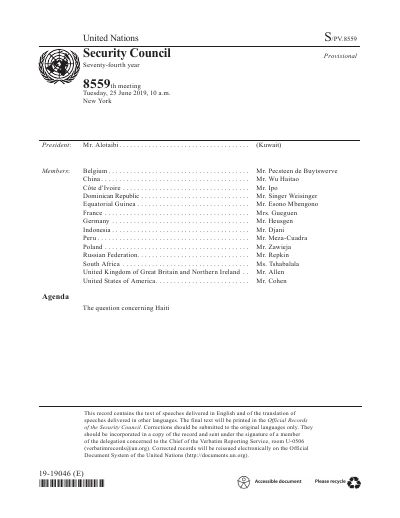
S/PV.8559 : séance du Conseil de sécurité sur Haïti, 2019-06-25
Résumé — Le compte rendu de la séance ayant adopté la résolution 2476 (2019), qui a créé le Bureau intégré des Nations Unies en Haïti, par 13 voix pour et 2 abstentions.
Constats Clés
- La résolution 2476 (2019) a été adoptée à cette séance par 13 voix pour et deux abstentions, créant le BINUH.
- Tenue le 25 juin 2019 sous la présidence koweïtienne, avec M. Alotaibi au fauteuil.
- Le représentant d'Haïti a été invité à participer et a pris la parole.
- Le BINUH a commencé le 16 octobre 2019, à la fermeture de la MINUJUSTH, et ses rapports du Secrétaire général sont détenus sous binuh-sg-reports.
- C'est le vote fondateur du bureau qui rend encore compte au Conseil sur Haïti.
Description Complète
La séance ayant adopté la résolution 2476 (2019), qui a créé le Bureau intégré des Nations Unies en Haïti, par 13 voix pour et deux abstentions. Le Koweït présidait, avec M. Alotaibi au fauteuil, et le représentant d'Haïti a été invité à participer et a pris la parole.
C'est le vote fondateur du bureau qui rend encore compte au Conseil sur Haïti. Le BINUH a commencé le 16 octobre 2019, au lendemain de la fermeture de la MINUJUSTH, et le corpus détient ses rapports du Secrétaire général sous la série binuh-sg-reports, de 2020 à aujourd'hui.
Texte Intégral du Document
Texte extrait du document original pour l'indexation.
S/PV.8559
United Nations
Security Council
Provisional
Seventy-fourth year
8559th meeting
Tuesday, 25 June 2019, 10 a.m.
New York
President:
Mr. Alotaibi. . . . . . . . . . . . . . . . . . . . . . . . . . . . . . . . . . . . .
(Kuwait)
Members:
Belgium. . . . . . . . . . . . . . . . . . . . . . . . . . . . . . . . . . . . . . .
China. . . . . . . . . . . . . . . . . . . . . . . . . . . . . . . . . . . . . . . . .
Côte d’Ivoire . . . . . . . . . . . . . . . . . . . . . . . . . . . . . . . . . . .
Dominican Republic. . . . . . . . . . . . . . . . . . . . . . . . . . . . . .
Equatorial Guinea. . . . . . . . . . . . . . . . . . . . . . . . . . . . . . .
France . . . . . . . . . . . . . . . . . . . . . . . . . . . . . . . . . . . . . . . .
Germany . . . . . . . . . . . . . . . . . . . . . . . . . . . . . . . . . . . . . .
Indonesia. . . . . . . . . . . . . . . . . . . . . . . . . . . . . . . . . . . . . .
Peru. . . . . . . . . . . . . . . . . . . . . . . . . . . . . . . . . . . . . . . . . .
Poland . . . . . . . . . . . . . . . . . . . . . . . . . . . . . . . . . . . . . . . .
Russian Federation. . . . . . . . . . . . . . . . . . . . . . . . . . . . . . .
South Africa . . . . . . . . . . . . . . . . . . . . . . . . . . . . . . . . . . .
United Kingdom of Great Britain and Northern Ireland . .
United States of America. . . . . . . . . . . . . . . . . . . . . . . . . .
Mr. Pecsteen de Buytswerve
Mr. Wu Haitao
Mr. Ipo
Mr. Singer Weisinger
Mr. Esono Mbengono
Mrs. Gueguen
Mr. Heusgen
Mr. Djani
Mr. Meza-Cuadra
Mr. Zawieja
Mr. Repkin
Ms. Tshabalala
Mr. Allen
Mr. Cohen
Agenda
The question concerning Haiti
This record contains the text of speeches delivered in English and of the translation of
speeches delivered in other languages. The final text will be printed in the Official Records
of the Security Council. Corrections should be submitted to the original languages only. They
should be incorporated in a copy of the record and sent under the signature of a member
of the delegation concerned to the Chief of the Verbatim Reporting Service, room U-0506
(verbatimrecords@un.org). Corrected records will be reissued electronically on the Official
Document System of the United Nations (http://documents.un.org).
19-19046 (E)
*1919046*
S/PV.8559
The question concerning Haiti
The meeting was called to order at 10.05 a.m.
Adoption of the agenda
The agenda was adopted.
The question concerning Haiti
The President (spoke in Arabic): In accordance
with rule 37 of the Council’s provisional rules of
procedure, I invite the representative of Haiti to
participate in this meeting.
The Security Council will now begin its consideration
of the item on its agenda.
Members of the Council have before them document
S/2019/519, which contains the text of a draft resolution
submitted by the United States of America.
The Council is ready to proceed to the vote on the
draft resolution before it. I shall put the draft resolution
to the vote now.
A vote was taken by show of hands.
In favour:
Belgium, Côte d’Ivoire, Equatorial Guinea, France,
Germany, Indonesia, Kuwait, Peru, Poland, Russian
Federation, South Africa, United Kingdom of
Great Britain and Northern Ireland, United States
of America
Abstaining:
China, Dominican Republic
The President (spoke in Arabic): The draft
resolution received 13 votes in favour and two
abstentions. The draft resolution has been adopted as
resolution 2476 (2019).
I shall now give the floor to those members of the
Council who wish to make statements.
Mr. Cohen (United States of America): We were
pleased to vote in favour of resolution 2476 (2019),
which authorizes the United Nations Integrated Office
in Haiti (BINUH). This is a historic moment. Today
we establish a new United Nations special political
mission that replaces the 15-year-long peacekeeping
mission in Haiti. The United Nations Mission for
Justice Support in Haiti and its predecessor, the United
Nations Stabilization Mission in Haiti, made important
strides in the areas of stability and security, democratic
governance and institutional development and the
promotion and protection of human rights in Haiti. We
2/6
25/06/2019
recognize the United Nations peacekeepers’ efforts
to support a free, prosperous and peaceful Haiti, and
we thank the troop- and police-contributing countries
whose nations served in those missions.
This transition also demonstrates that, as conditions
on the ground evolve, the United Nations presence
can and should change to reflect the new realities. It
is our hope that this transition in Haiti will serve as
a valuable model that the Security Council can apply
elsewhere. As a long-time friend and partner to Haiti,
the United States is clear-eyed about the challenges that
lie ahead. It is essential for the Government of Haiti,
in partnership with the United Nations and the United
States, to recognize the great opportunity this moment
presents and to seize it on behalf of the people of Haiti.
A successful transition will depend in large part on
the Haitian Government’s assumption of responsibility
for the range of issues the Security Council is
mandating BINUH to support. That includes free and
fair elections, the continued professionalization of the
Haitian National Police, the reduction of community
and gang violence, the protection of human rights,
improvements to prison facilities and detainee treatment,
and justice-sector reform. A successful transition will
also depend on close coordination among the many
stakeholders invested in Haiti’s success, including,
but not limited to, United Nations entities, Security
Council members, local and international partners,
the Haiti-based diplomatic corps and the humanitarian
assistance community. In the coming months the
United States will continue to call for constructive and
inclusive dialogue among all Haitian actors. We are
confident that compromise leading to a transparent and
accountable Government will lay the foundation for a
sustainable future for all Haitians.
Mr. Meza-Cuadra (Peru) (spoke in Spanish): We
welcome the Council’s adoption today of resolution 2476
(2019), requesting the Secretary-General to establish
the United Nations Integrated Office in Haiti (BINUH)
for an initial period of 12 months starting on 16 October,
in line with the Secretary-General’s recommendations
and the priorities and expectations of the Government
of Haiti. Peru is firmly committed to stability and
development in Haiti, and we have confidence in the
important role that BINUH will play in supporting
the efforts of the Haitian Government during this
transitional period, particularly in strengthening and
promoting political dialogue, the rule of law, human
rights and the fight against gangs and corruption.
19-19046
25/06/2019
The question concerning Haiti
While we thank the delegation of the United
States for its efforts to achieve a robust text, we would
nevertheless like to day that we would have liked
the resolution to include references to Haiti’s high
vulnerability to the effects of climate change, as well as
to the role of the Peacebuilding Fund and the Economic
and Social Council Ad Hoc Advisory Group on Haiti,
which we believe are in a position to make a coordinated
contribution to BINUH’s work. Peru will continue to be
committed to the people and the Government of Haiti
and to contributing, together with the United Nations
and the international community, to their efforts to
achieve sustainable peace in our brother country.
Mr. Heusgen (Germany): Germany welcomes
today’s adoption of resolution 2476 (2019), although
we are disappointed that it did not receive the Security
Council’s full support.
We welcome the mandate for a strategic political
United Nations presence that will support the Haitian
Government in tackling the many challenges presented
by the extremely fragile political situation, including
ensuring the necessary structural reforms, starting a
constructive and inclusive national dialogue, protecting
human rights, meeting the people’s humanitarian needs
and strengthening the police and justice institutions. Of
course, ownership belongs to the Haitians themselves
when it comes to shaping the future of their country.
Together with the international community, Germany
stands ready to support Haiti in that endeavour. We
want to make this transition work, and we want the
new special political mission to be able to work jointly
with the country team, effectively and efficiently, from
the outset.
One point I particularly want to highlight is that
while we were pleased to see the reference in the
resolution to the adverse effects of natural disasters on
Haiti’s stability, we were surprised and disappointed
that there was no reference to the security implications
of the effects of climate change. At least since 2011 the
Security Council has repeatedly expressed its concern
about the possibility that the effects of climate change
may aggravate existing threats to international peace
and security, and has underlined the importance of
conflict analysis and contextual information, including
on the security implications of climate change in relevant
situations. In that regard, I would point to the 2011
presidential statement on the subject (S/PRST/2011/15).
S/PV. 8559
Haiti is one of the countries of the world that is most
vulnerable to the adverse effects of climate change.
The effects of climate change there constitute a threat
multiplier, bringing the risk of further destabilizing
the country, creating new conflict over increasingly
diminishing resources and derailing efforts aimed at
peacebuilding and stabilization. The Security Council
should therefore examine the situation more closely
with a view to including the effects of climate change
in its overall assessments and decision-making, and to
do that we need a proper information basis, including
a substantial risk assessment. Turning a blind eye
to the problem will not make a threat multiplier
like climate change disappear. Disregarding it and
assessing the country situation selectively jeopardizes
the effectiveness of the Council’s work. In that
regard, I would like to note that the hearing last week
in Washington of the proposed new United States
Permanent Representative to the United Nations sent
some encouraging signals, in that she specifically
recognized the importance of climate change.
Mr. Wu Haitao (China) (spoke in Chinese):
Haiti is encountering a multiplicity of challenges on
the political, security and humanitarian fronts. The
United Nations Mission for Justice Support in Haiti
(MINUJUSTH) and the peacekeeping mission that
preceded it have played an important role in assisting
Haiti in achieving stability and enhancing capacitybuilding in the area of security.
China supports the establishment of the United
Nations Integrated Office in Haiti (BINUH), after the
expiry of the mandate of MINUJUSTH, with a view
to achieving an orderly transition and continuing to
assist the Haitian Government in maintaining political
stability, conducting a nationwide dialogue, training
the Haitian National Police and responding to security
challenges. We believe that the Security Council has
the primary responsibility for maintaining international
peace and security, and that BINUH’s mandate must be
clear and concise if it is to assist Haiti in responding to
peace and security issues. China participated actively
in the consultations on the text of resolution 2476
(2019) and proposed amendments to it. Regrettably, the
final text failed to fully reflect our legitimate concerns,
which is why China abstained in the voting today.
China is ready to engage with the rest of the members
of the Council in joint efforts to ensure that BINUH can
fully carry out its mandate and play an active role in
promoting stability and development in Haiti.
19-190463/6
S/PV.8559
The question concerning Haiti
Mrs. Gueguen (France) (spoke in French): We
welcome the adoption of resolution 2476 (2019),
which launches the United Nations Integrated Office
in Haiti as of 16 October and establishes its mandate
for the following 12 months. The work of the Office
will focus on providing strategic advice to the Haitian
authorities and the Haitian National Police and
should support the country’s priorities with regard to
security, development, respect for human rights and the
entrenchment of the rule of law. Since the country is
still facing many challenges, the situation requires not
only the continuing commitment of every branch of the
Haitian authorities but also strong support from Haiti’s
international partners, starting with the United Nations.
Political instability, deteriorating economic
conditions, the very worrying state of the country’s
public finances, food insecurity, problems with access
to basic services and high levels of violence continue
to be a source of concern. There is still a great deal
to be done in order to build strong institutions and the
legislative framework that is essential to entrenching
the rule of law and fighting corruption and impunity.
The United Nations Integrated Office in Haiti will
therefore begin its mission in a difficult context, and
sadly we fear that the extremely volatile situation is
likely to deteriorate in the coming weeks and months,
which the work of the new Office will have to fully take
into account.
It is a pity that the resolution adopted today does
not consider the impact of climate change on Haiti’s
situation and security. In this difficult context, France
encourages Haiti’s political leaders to do everything
possible to create the conditions for sustainable
development in stability and to promote the national
dialogue that the great majority of Haitians aspire to.
France remains more than ever committed to supporting
the United Nations Integrated Office in Haiti in its
future work.
Mr. Repkin (Russian Federation) (spoke in
Russian): Russia supported the adoption of resolution
2476 (2019), establishing the United Nations Integrated
Office in Haiti in accordance with the recommendations
contained in the Secretary-General’s letter of 13 May
(S/2019/387). We believe the resolution is an important
step towards stabilizing the situation in the country.
The United Nations has been supporting Port-auPrince on the basis of Chapter VII of the Charter of
the United Nations for many years. The United Nations
Mission for Justice Support in Haiti will continue
4/6
25/06/2019
that work for another four months. At the same time,
the Government and the Haitian National Police will
gradually gain greater independence. During the
Council’s previous discussions on the situation in Haiti
on 12 April (see S/PV.8510), and despite concerns about
increased tensions on the eve of the elections, Council
members agreed with the Secretary-General’s view that
by October Haiti’s Government and police would be
ready to take national ownership of the responsibility
for ensuring the people’s security. We also hope that
the accumulated experience and expertise passed on by
international advisers will enable Haitians to overcome
all the obstacles on their path to stability, although the
initial stage after the withdrawal of the United Nations
presence under Chapter VII will be absolutely crucial.
That is why it is the task of the new special political
mission to help to ensure the smoothest possible
transition from a peacekeeping mission to a political
one by supporting the efforts of the Government and the
Haitian National Police to promote the rule of law and
establish a national dialogue. We hope that the attention
of the United Nations and the Security Council will
enable Haitians to retain confidence in the support of
the international community.
In conclusion, I want to express our support to the
people and the Government of Haiti. In October they
will have the opportunity to take full and independent
national ownership of their country’s destiny, stability
and development. Russia will continue to work to
ensure that the Security Council’s work results in a
genuine normalization of the situation in Haiti and in
the strengthening of its sovereignty and self-sufficiency.
Mr. Singer Weisinger (Dominican Republic)
(spoke in Spanish): As we have stated on previous
occasions, the political, economic and social situation
in Haiti remains fragile and requires multidimensional
support on the part of the international community
based on national priorities. The objective, as we
understand it, must be political and institutional
strengthening so as to ensure a stable, economically
prosperous and inclusive Haiti, one that is resilient in
the face of the continuing ravages of climate change
and natural disasters.
For months now, we have been taking part in the
process of the discussion and subsequent negotiation of
the terms of the mandate of the special political mission
that is slated to replace the United Nations Mission for
Justice Support in Haiti (MINUJUSTH) in Haiti. We
19-19046
25/06/2019
The question concerning Haiti
had wished for more thoroughgoing and horizontal
talks so as to ensure a robust, multidimensional
mandate, especially now given the clear deterioration
of conditions in Haiti and the frustration of the
international community.
The security situation in Haiti is fragile, not
only because the institutional capacity to support the
security apparatus is itself fragile, but also because
social conditions do not allow for the momentum
needed to set in motion a virtuous circle leading to
development. We must also point out that the economic
situation is daily becoming more complicated, which
means that there is a deepening of the crisis and greater
social instability and violence.
At the regional level, the Organization of
American States just concluded a visit to Haiti, as
did the Economic and Social Council last month.
The preliminary conclusions from both visits are
dramatic and disheartening. A significant part of
the international community has been calling for a
comprehensive response to the situation in Haiti, and
we join in that call.
We believe that the political mission that is to
replace MINUJUSTH must be strong, broad-based and
adequately funded. The Secretary-General’s proposal
was not specific enough in terms of the objectives, nor
was it sufficiently broad to preserve stability over time
and place Haiti back on the track to development. It
is our view that if we are to respond to the challenges
facing Haiti, an approach that is based exclusively
on public security will not suffice. The Dominican
Republic believes that the Haiti mission must focus also
on other key aspects to ensure peace and stability.
To be clear, it is our view that support for the
Government is required in order to strengthen the
political and electoral systems and the rule of law
and help to create the conditions necessary for the
Government to put in place policies aimed at tackling
social inequality, governance and the adverse effects of
climate change and natural disasters.
As to the electoral system, we agree with the
Secretary-General on the need to set up a permanent
electoral council to organize and manage electoral
processes. It must be independent and credible and be
provided with an appropriate legal framework that will
ensure, at the very least, reliable voter registration,
international election observation and timely results.
The proposed text of the draft resolution (S/2019/519)
S/PV. 8559
does not capture this idea or give any specific mandate
concerning the institutional structure that should be
created in support thereof.
Turning to inequality and its link with public
security, the Dominican Republic suggested that the
special political mission should be directly involved
in helping to build the necessary capacities within the
Government so that it can coordinate economic and
social development initiatives. We also deem this key
to improving living standards in the most vulnerable
areas as well as to enhancing peaceful coexistence in
public spaces.
This is without a doubt the way to address the
root causes of the social problems that are leading
to violence and social instability. The strengthening
of national institutions, especially political ones,
remains one of the major challenges to the stability and
sustainable development of the Republic of Haiti. It
is our understanding that the special political mission
must play a key role in this area so as to promote
continuity in public policies.
Another key aspect for our delegation is Haiti’s
vulnerability to climate change and natural disasters.
As all are aware, our country and the Republic of Haiti
share the same ecosystem, Hispaniola. This puts us in
a unique position to deal with this issue. Our island,
a fragile ecosystem with limited resources, is highly
vulnerable to climate change. There is no debating
the fact that Haitian ecological conditions are truly
precarious and represent a cause of displacement
and suffering and a threat to stability and peace in
the country.
We understand that based on the principle of
complementarity, this new mission, along with the
United Nations country team in Haiti, could have begun
its work by dealing with all of the aspects requiring
urgent action. Our position in this debate has always
been the same: promote a strong mission with broad
scope and capacities and with sufficient financing. The
mission should be able to truly bring peace and lasting
stability to Haiti and genuinely reflect the solidarity of
the international community with the people of Haiti.
Experience and the complexity of the current
situation leads us to conclude that this mandate will
not be enough to achieve these objectives. We cannot
but be disheartened at seeing that this opportunity to
contribute actively to improving the future of Haiti
and to show our genuine commitment to one of the
19-190465/6
S/PV.8559
The question concerning Haiti
communities that is suffering the most on our continent
has been reduced to a mission with limited resources
and functions.
The President (spoke in Arabic): I now give the
floor to the representative of Haiti.
Mr. Saint-Hilaire (Haiti) (spoke in French):
I welcome the adoption of resolution 2476 (2019),
creating a United Nations special political mission,
which will take over from the United Nations Mission
for the Support of Justice in Haiti as of 16 October.
This second transition within the space of two years
is taking place in a national context that continues to
be fragile. However, the creation of a United Nations
mission other than a peacekeeping operation in Haiti is
without a doubt a step in the right direction. It is also
the option favoured by the President of the Republic,
His Excellency Mr. Jovenel Moïse, during the strategic
assessment conducted in January.
The Republic of Haiti has been facing major
difficulties for some time now, but the situation is not a
threat to regional peace and security.
The second preambular paragraph of the
resolution — which is reprised in all Council resolutions
on the situation in Haiti — will finally find its true
meaning in the context of the special political mission.
Like the people of Haiti themselves, the Security
Council has always declared itself firmly committed to
the sovereignty, independence, territorial integrity and
unity of the Republic of Haiti.
In spite of everything, the Haitian people remain
deeply attached to the glorious moments of their
history and to the noble ideals of the founding fathers
of national independence. Having said that, I will limit
myself to a few brief observations.
First, the special political mission is in keeping with
the parameters defined in the letter dated 13 May 2019
from the Secretary-General addressed to the President
of the Security Council (S/2019/387).
Secondly, I have taken note of the main
responsibilities assigned to the special political mission.
The mission’s work will focus more on strategic
advice to the Haitian authorities in the areas set out in
paragraph 1 of resolution 2476 (2019).
Thirdly, the United Nations must strive, as part of
this mission, to work concretely in the interests of all
6/6
25/06/2019
Haitians by promoting stability, justice, human rights,
the rule of law, democracy and sustainable development.
I remind Council members that a safe and stable
environment cannot be built in a context of poverty,
hunger, social inequality and, worst of all, difficulties
in accessing financing for the implementation of
essential reforms. In that regard, the United Nations
should pursue its efforts to help the Haitian authorities
take swift and decisive action to improve the living
conditions of the entire Haitian population, including
the most vulnerable groups.
We would have liked to see a special political
mission commensurate with the challenges facing our
country, which include political difficulties requiring
constructive, authentic and inclusive dialogue among
all strata of Haitian society; social, economic and
financial difficulties requiring the mobilization of
adequate financial resources; threats to security in
light of the increasing number of acts of violence,
the spread of firearms and the proliferation of armed
gangs; difficulties in reviving national production
and food security, as there are still fears of food
riots; humanitarian difficulties, including the fight
against cholera; and environmental challenges, given
the country’s vulnerability to natural disasters and
climate change.
I remain hopeful that the special political mission
will have adequate financial means to be able to
provide concrete assistance to the Haitian authorities
in overcoming this multidimensional crisis. Only then
will we be able to speak of the real impact of the United
Nations presence on stability, security, strengthening
institutions and sustainable development in Haiti.
I strongly encourage all members of the Security
Council and the Economic and Social Council,
specifically members of the latter’s Ad Hoc Advisory
Group on Haiti, to engage in strategic discussions with
a view to ensuring the United Nations presence in Haiti
is integrated, balanced, respectful of national priorities
and working in synergy with the three inextricably
linked pillars of the Organization.
I conclude by saying that the due implementation
of the 2030 Agenda for Sustainable Development will
undoubtedly spearhead our efforts to achieve national
security and stability.
The meeting rose at 10.35 a.m.
19-19046
Comment citer
United Nations Security Council, S/PV.8559 : séance du Conseil de sécurité sur Haïti, 2019-06-25, https://docs.un.org/en/S/PV.8559
- Titulaire des droits
- United Nations Security Council