Texte Intégral du Document
Texte extrait du document original pour l'indexation.
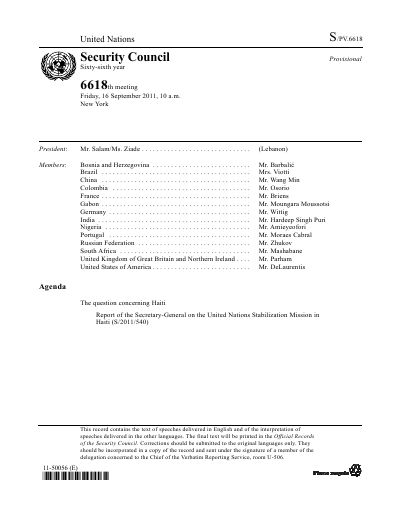
United Nations
S/PV.6618
Security Council
Provisional
Sixty-sixth year
6618
th meeting
Friday, 16 September 2011, 10 a.m.
New York
President:
Mr. Salam/Ms. Ziade . . . . . . . . . . . . . . . . . . . . . . . . . . . . . .
(Lebanon)
Members:
Bosnia and Herzegovina . . . . . . . . . . . . . . . . . . . . . . . . . . .
Brazil . . . . . . . . . . . . . . . . . . . . . . . . . . . . . . . . . . . . . . . . .
China . . . . . . . . . . . . . . . . . . . . . . . . . . . . . . . . . . . . . . . . .
Colombia . . . . . . . . . . . . . . . . . . . . . . . . . . . . . . . . . . . . . .
France . . . . . . . . . . . . . . . . . . . . . . . . . . . . . . . . . . . . . . . . .
Gabon . . . . . . . . . . . . . . . . . . . . . . . . . . . . . . . . . . . . . . . . .
Germany . . . . . . . . . . . . . . . . . . . . . . . . . . . . . . . . . . . . . . .
India . . . . . . . . . . . . . . . . . . . . . . . . . . . . . . . . . . . . . . . . . .
Nigeria . . . . . . . . . . . . . . . . . . . . . . . . . . . . . . . . . . . . . . . .
Portugal . . . . . . . . . . . . . . . . . . . . . . . . . . . . . . . . . . . . . . .
Russian Federation . . . . . . . . . . . . . . . . . . . . . . . . . . . . . . .
South Africa . . . . . . . . . . . . . . . . . . . . . . . . . . . . . . . . . . . .
United Kingdom of Great Britain and Northern Ireland . . . .
United States of America . . . . . . . . . . . . . . . . . . . . . . . . . . .
Mr. Barbalić
Mrs. Viotti
Mr. Wang Min
Mr. Osorio
Mr. Briens
Mr. Moungara Moussotsi
Mr. Wittig
Mr. Hardeep Singh Puri
Mr. Amieyeofori
Mr. Moraes Cabral
Mr. Zhukov
Mr. Mashabane
Mr. Parham
Mr. DeLaurentis
Agenda
The question concerning Haiti
Report of the Secretary-General on the United Nations Stabilization Mission in
Haiti (S/2011/540)
This record contains the text of speeches delivered in English and of the interpretation of
speeches delivered in the other languages. The final text will be printed in the Official Records
of the Security Council. Corrections should be submitted to the original languages only. They
should be incorporated in a copy of the record and sent under the signature of a member of the
delegation concerned to the Chief of the Verbatim Reporting Service, room U-506.
11-50056 (E)
*1150056*
�S/PV.6618
activities of MINUSTAH in support of stability, the
development of the rule of law and recovery efforts in
the wake of the January 2010 earthquake.
The meeting was called to order at 10.10 a.m.
Adoption of the agenda
The agenda was adopted.
The question concerning Haiti
Report of the Secretary-General on the
United Nations Stabilization Mission in
Haiti (S/2011/540)
The President (spoke in Arabic): Under rule 37
of the Council’s provisional rules of procedure, I invite
the representatives of Argentina, Canada, Chile,
Guatemala, Haiti, Spain and Uruguay to participate in
this meeting.
In accordance with rule 39 of the Council’s
provisional rules of procedure, I invite Mr. Mariano
Fernandez Amunategui, Special Representative of the
Secretary-General and Head of the United Nations
Stabilization Mission in Haiti, to participate in this
meeting.
Under rule 39 of the Council’s provisional rules
of procedure, I invite Mr. Pedro Serrano, Acting Head
of the Delegation of the European Union to the United
Nations, to participate in this meeting.
The Security Council will now
consideration of the item on its agenda.
begin
its
I wish to draw the attention of Council members
to document S/2011/540, which contains the report of
the Secretary-General on the United Nations
Stabilization Mission in Haiti.
I now give the floor to Mr. Mariano Fernandez
Amunátegui.
Mr. Fernandez Amunategui (spoke in Spanish):
I would like to begin by expressing my sincere thanks
to you, Mr. President, and to the members of the
Security Council for having organized this debate on
the mandate of the United Nations Stabilization
Mission in Haiti (MINUSTAH). This is the first time I
have had the honour of addressing the Council in my
capacity as Special Representative of the SecretaryGeneral in Haiti since I began fulfilling my duties on
26 June.
I am honoured to share with the Council an
assessment of the most recent developments in the
political and security situation in Haiti and of the
2
Today, I have the privilege of presenting to the
Council the report of the Secretary-General on the
United Nations Stabilization Mission in Haiti
(S/2011/540), issued on 25 August. The report includes
a summary of the most relevant findings and
recommendations of the security assessment mission to
Haiti that was conducted by the Secretariat in response
to the Council’s request in its resolution 1944 (2010) of
14 October 2010.
The post-earthquake surge, authorized by the
Security Council to meet the needs arising from the
large-scale humanitarian operations that had been
launched and to the complex nature of the subsequent
elections, was very necessary at the time. The current
situation, however, affords us an opportunity to think
about reducing force levels. Such a reduction would
need to be accompanied by a reconfiguration of
MINUSTAH in order to ensure an adequate response to
current needs, including support for the political
process, the consolidation of State authority and State
capacity-building, as well as the strengthening and
possible creation of institutions responsible for
upholding the rule of law.
Since the previous report of the SecretaryGeneral to the Security Council (S/2011/183), issued
on 24 March, Haiti has witnessed a historic event with
a change in presidential leadership in which one
democratically elected Head of State transferred power
to a new leader from the opposition. I believe that we
should congratulate the people of Haiti for having
achieved this important milestone and President Michel
Joseph Martelly on his election as the new leader of
Haiti.
I also wish to thank the Organization of American
States (OAS) and the joint electoral observation
mission of the OAS and the Caribbean Community for
their support to a successful and significant election. I
am particularly pleased to see Haiti being represented
by its diplomatic officials in the Council today.
Despite all this, Haiti’s political transition has not
been without its difficulties. Even before the new
President took office and the forty-ninth legislature
began, the electoral process was tarnished by a
decision of the Provisional Electoral Council whereby
it decided to change the results for the winners of
11-50056
�S/PV.6618
17 seats in the Chamber of Deputies and two in the
Senate. Furthermore, discrepancies remain between the
text of the constitutional amendments approved by
Parliament during the last term of President René
Préval and the text that was subsequently published.
This is delaying the constitutional reform process and
has brought it to a standstill, owing to the decision by
President Martelly to reverse the promulgation of the
proposed amendments. As a result, the 1987
Constitution remains in full effect.
The greatest challenges to the political process in
Haiti, however, are that it has been impossible for the
new President to obtain parliamentary approval for a
new Prime Minister and, in turn, to form a new
Government and draft a viable policy agenda with the
assent of Parliament.
Four months after President Martelly took office,
and after two failed attempts to have Parliament ratify
a Prime Minister-designate, Haiti is still without a
Head of Government. Other ministerial appointments
are pending, and there is a continuing lack of a very
necessary political agreement between the executive
and the legislative branches on the main rule of law
institutions and key public policies, as previously
mentioned.
In recent days, there has been a positive sign with
the nomination of Mr. Garry Conille, a long-time
United Nations official. It is hoped that Parliament will
approve him as President Martelly’s first Prime
Minister. Information emerging from Parliament
indicates that he will most likely be approved as Head
of Government. I stress that such approval alone would
change the political landscape of Haiti and open up a
far more promising future.
In the midst of political paralysis and before the
possible approval of a Prime Minister, the
humanitarian situation remains of concern. Despite the
successes achieved before the earthquake, the
relocation of those living in camps for displaced
persons has slowed in recent months. At the moment,
approximately 634,000 people are still living in camps,
and the Government plan to relocate them has enjoyed
limited success. While the basic humanitarian needs of
displaced persons have been met by the distribution of
humanitarian assistance, the sparse socio-economic
opportunities and the rising costs of food and oil have
exacerbated the Haitians’ living conditions. Similarly,
the prevalence of such diseases as malaria and cholera
11-50056
remains a serious problem. Although the cholera
mortality rate fell in all departments, from 5.6 per cent
at the beginning of the epidemic last year to 1.4 per
cent in August, it is clear that the epidemic has not
disappeared.
In general, recovery and reconstruction activities
are progressing, supervised by the Interim Haiti
Recovery Commission. We are seeing, however, that
much remains lacking. Of the funds pledged by
international donors for 2010-2011, only 37.8 per cent
have been disbursed. I take this opportunity to appeal
to donor countries to honour their donation pledges to
ensure that Haiti will have the resources necessary to
advance its reconstruction.
There security situation is somewhat calm, but
very fragile. Political tension, alongside a precarious
socio-economic situation, is generating new tensions in
the security situation. The second round of voting in
2011 was carried out without major incident, largely
thanks to the assistance of MINUSTAH police and
troops to the Haitian National Police. As the SecretaryGeneral’s security assessment confirmed, law and
order did not totally break down following the
earthquake, although there has been a recent rise in
crime rates. Undoubtedly, the calm but fragile security
situation of recent months, due to the overall political
instability generated by the lack of a Government, has
led to greater fragility in civic security.
I am particularly concerned over the instability
that could arise should the political and socioeconomic situations continued to deteriorate.
MINUSTAH will have to continue to play an
invaluable role in supporting the fight against
criminality. In August, the United Nations fell victim to
the rising violence. I pay tribute here to Sergeant Serge
Kamali of Rwanda, a United Nations police officer
who was shot in Port-au-Prince last month and whom I
visited in the Santo Domingo hospital before his death
on 26 August. The Sergeant’s death was the first in two
years to be caused by a malicious act, and it represents
a loss to MINUSTAH and the United Nations.
Against that backdrop, I should like to highlight
the work that MINUSTAH has been doing in key
aspects of its mandate and in response to contingent
needs since the issuance of the Secretary-General’s last
report (S/2011/183).
First, the Mission continues to provide support to
the Haitian electoral authorities and the political
3
�S/PV.6618
process. In addition to its substantial technical and
logistical support and coordination efforts for the
presidential and legislative elections during the second
half of 2010 and early 2011, in recent months the
Mission has focused its efforts on launching a dialogue
with the authorities, civil society and the private sector
in support of agreements on governability that will
promote the creation or strengthening of institutions
necessary to the proper functioning of the rule of law,
which is critical to Haiti politics.
The political stalemate between the new President
and Parliament, in addition to the absence of a
Government, has complicated prospects for progress in
this area. Haitian political and civil society leaders
continue to clamour for national consensus in key
areas, such as the national budget, education, recovery
and development priorities, elections and constitutional
reform. I add my voice to the appeals of the Haitian
political class that we heed the calls for greater
understanding and demonstrate greater political will to
reach agreement that will undoubtedly help to improve
the lives of the Haitian people and reflect clear
progress in the consolidation of the rule of law, and
hence towards Haiti’s complete self-reliance in its
development efforts, which is our common aspiration
as we work in that dear country.
The tireless efforts of MINUSTAH to facilitate
national and local dialogue in order to motivate an
exchange of ideas among the Government, civil
society, the private sector and other key actors will
remain critical in the future. It will also be important to
support the electoral process in Haiti, which is
preparing for partial legislative and local Government
elections in November. In that respect, I stress that
electoral reform, including the establishment of a
credible permanent electoral council, is indispensable
if Haiti hopes gradually to reduce its dependence on
international electoral assistance.
Secondly, with regard to the consolidation of
State authority, progress has been made, but the
Administration’s current capacities, the provision of
basic services and the administration of justice remain
far below the levels necessary if the Haitian authorities
are to fully assume their responsibilities for ensuring
stability. During the period covered by the report,
MINUSTAH continued to provide technical support to
increase the capacities of State institutions at both the
national level, including Parliament, and at the local
level, and to assist in the development of the
4
infrastructure of ministries and local administrative
bodies.
In that context, one important priority remains the
strengthening of rule of law institutions and the
protection of human rights. Progress in this area has
been hindered by the absence of a new Government
and the lack of agreement on the nomination of four
judges, including the President of the Court of
Cassation and the Superior Council of the Judiciary —
a priority that has long remained unmet. President
Martelly has announced that these nominations will be
made by early October, and we hope they will.
However, the nominations to those vital institutions
and other key judicial posts have been marred by
controversy and require dialogue and, in particular,
political will on the part of leaders. I would say quite
frankly that such political will is hard to come by in
Haiti.
Parliament recently endorsed 18 candidates, from
whom the President must nominate the President of the
Court of Cassation and other pending judicial
appointments. We hope that these necessary decisions
will be taken soon. That would represent a very
important step forward in the area of the rule of law,
which is fundamental, as I have repeatedly stressed, to
international cooperation and MINUSTAH’s work in
Haiti.
With regard to the strengthening of human rights,
MINUSTAH and the Office of the United Nations High
Commissioner for Human Rights have investigated
violations, including extrajudicial executions, arbitrary
detention and detainee abuse. Thus 26 local courts
have been set up in various parts of the country, which
have coordinated their efforts with those of the United
Nations country team in order to train judicial actors in
the area of gender violence so that they have the
necessary legal framework in place to deal with
violations of human rights.
With regard to corrections and the penal system,
MINUSTAH is providing support to the Haitian
authorities in the conclusion of judicial cases, which
has led to the release of 260 detainees since March
2011. Continued support and bilateral cooperation with
donor countries has made it possible to develop prison
infrastructure, thereby helping to increase by 28 per
cent the space that detainees have in their cells.
Nonetheless, prison overpopulation is a problem, and
violations of prisoners’ human rights remain a serious
11-50056
�S/PV.6618
concern. To date there has been no improvement in
administrative reform at the national level. Given these
challenges, I am convinced that the strategic focus of
MINUSTAH will continue to be to support the
strengthening of institutions and the rule of law for the
protection of human rights and, above all, to contribute
to providing greater stability to the country.
This leads me to a third priority of MINUSTAH,
mentioned in the report, namely, our support in the area
of security and stabilization. I wish to share with the
Council the successful joint operations of our military
and police personnel in support of the Haitian police to
prevent and minimize the activities of gangs and
maintain public order, particularly in important areas
of Port-au-Prince such as Cité Soleil, Bel Air and
Martissant. I should like to recall here Operation
Phoenix, carried out in July 2011, which made it
possible to detain various gang members as well as
fugitives from justice responsible for criminal
activities throughout the city.
MINUSTAH has continued its efforts to protect
vulnerable groups, carrying out 24-hour patrols in
camps for internally displaced persons and providing
assistance to victims of sexual abuse and gender-based
violence. The Mission is training the Haitian Police to
respond to and prevent this kind of violence,
particularly against women and children. That support
has been reflected in the establishment of a gender and
women’s affairs coordination office, in cooperation
with the Haitian National Police.
There has been significant, concrete progress in
the training of the Haitian National Police. Let us
recall that its capacity to create and maintain security
conditions is one of the fundamental aspects with
respect to a reduction of MINUSTAH and the
development of a strategy for its eventual exit. May
witnessed the graduation of the twenty-second
promotion of Haitian National Police officers, whose
strength currently stands at 10,000, of whom 783 are
women. MINUSTAH continues to provide support in
the enrolment and certification process for future
promotions as well as in the elaboration of a
development plan for the next five years that will
replace the current one, whose deadline is December
2011.
The Haitian National Police has continued to
support the MINUSTAH structure and to work with
other international groups in order to improve the
11-50056
process of recruitment, training and the development of
infrastructure. This, however, must change in future if
Haiti wishes to gradually assume responsibility for its
own security.
As I indicated at the beginning of this briefing, it
is the Secretariat’s vision, with which we fully agree,
that we gradually reduce the MINUSTAH force
levels — levels that had been approved as a result of
the 2010 earthquake but that now can and should be
reduced. The Secretary-General, in a report that
Council members have probably already seen, has
recommended reducing the Mission’s authorized
military strength by 1,600 personnel and 1,150 United
Nations police officers. That would leave 7,150 troops
and 2,300 police.
Such a quantitative reduction should be
complemented by a greater emphasis on the
qualifications and specialization of police officials.
This is particularly important with regard to the
creation of a police academy, which will require
international cooperation so that it can become an
institution of excellence and be an important
instrument in the rule of law as well as in enabling
Haiti to fight the most sophisticated types of modern
crime.
In the coming days, we will be hosting 50 special
police officers who are experts in fighting narcotrafficking and organized crime. This is a very
important contribution that will qualitatively
complement the proposed quantitative reduction, and I
believe it is particularly important for Haiti and for
MINUSTAH in carrying out its activities.
Finally, I should like to refer to the efforts of
MINUSTAH for recovery and development in the long
term. The United Nations peacekeeping missions,
including
MINUSTAH,
are
not
development
operations, but they are essential to creating the
conditions for long-term development. As such,
MINUSTAH is continuing — and must continue — to
contribute to sustainable recovery in Haiti.
This year the Mission has worked with the United
Nations country team, together with the Haitian
authorities and with other international donors, to
respond simultaneously to the needs of displaced
persons, as specified in the mandate of MINUSTAH,
and to make progress in the area of peace. Since July
2010, the United Nations country team has identified
and submitted 18 project proposals to the Interim Haiti
5
�S/PV.6618
Recovery Commission; eight have received funding
through the Haiti Recovery Fund, while another three
have received funding from bilateral donors. This is
promising, but not sufficient to meet people’s urgent
needs and change their lives for the better.
Likewise, a resumption of the activities of the
private sector will be fundamental to the long-term
stability of the country. This sector has been weakened
by the lack of security and the absence of the legal
framework necessary for investment in the private
sector.
On a smaller scale, but equally important,
MINUSTAH has contributed to recovery in Haiti
through its quick-impact projects, through its
programme to reduce violence in communities and
through its military engineering reconstruction
projects. In 2010-2011, the majority of the 229 quickimpact projects were focused on the rehabilitation of
public infrastructure and the provision of basic public
services in areas where assistance from the
Government is non-existent. Various projects have
created income for women and other civil society
groups, enabling them to develop the capacities of the
members of the various communities of the country.
Since the earthquake, a total of 99 programmes
for the reduction of violence in communities have been
implemented in response to environmental and
socio-economic needs. Those programmes include the
construction of canals, the installation of public
lighting, professional training, and initiatives to
provide employment. About 30,000 women and young
people at risk have been given temporary employment
through those programmes. More than 1,100 young
people have been provided access to training
programmes and employment in the private sector. In
addition to these small-scale initiatives, MINUSTAH
and its military engineering units have been able to
contribute to the reconstruction and rehabilitation of
the country. The military force increased the number of
engineers following the earthquake, and that number
should be maintained as part of the reconfiguration of
the activities of our Mission.
Since April 2011, military engineers have
finalized 80 projects, including the removal of rubble
from former Government buildings and public
institutions damaged by the earthquake, the repair and
construction of roads, groundwork for the construction
of facilities for dealing with outbreaks of cholera, the
6
construction of storage space and the draining of
canals.
I should like to stress that a reduction of the
efforts of MINUSTAH in the area of reconstruction and
development would represent a setback in this respect,
particularly given Haiti’s politically fragile situation,
and we could see a further deterioration of the security
situation. Furthermore, all of the projects carried out
by MINUSTAH are primarily aimed at ensuring peace
and security, such as providing public lighting in areas
where there was none after dark. This is being
welcomed and supported because it is a great
contribution to the security of the population. Many of
them also have a positive impact on development,
infrastructure and employment, among other areas. But
they are not solutions in the long term.
I must therefore also call on the members of the
Security Council and of the international community to
help stimulate investment and development efforts in
Haiti and to make available to the United Nations
country team the resources necessary to contribute to
that end. This will be increasingly necessary in order
for MINUSTAH to begin to drawdown its military and
police presence.
In conclusion, I would like to point out that Haiti
and MINUSTAH are today at an important crossroads.
The Haitian people have demonstrated great strength
and admirable determination in the face of many and
varied challenges and catastrophes. The international
community can feel proud of its show of solidarity
vis-à-vis the Haitian people. I trust that this solidarity
will continue. In that regard, I would like to express
my gratitude for the commitment and efforts of the
men and women serving in MINUSTAH, as well as to
the wider United Nations family serving in Haiti.
The situation in Haiti continues to be fragile, and
certain reversals could generate a new crisis. The
future stability of Haiti, and ultimately its prosperity,
will continue to depend upon the political will of its
leaders and citizens, as well as the support of the
Security Council and the international community as a
whole.
I should like to conclude by launching an appeal
to all stakeholders involved to continue our
commitment to cooperate with Haiti so that the country
may achieve the best of futures, which it deserves.
11-50056
�S/PV.6618
The President (spoke in Arabic): I thank
Mr. Fernandez Amunategui for his statement.
I shall now give the floor to members of the
Council.
Mrs. Viotti (Brazil): I would like to thank
Ambassador Mariano Fernandez Amunategui for his
very comprehensive briefing. Brazil commends his
much appreciated work to assist Haiti in its efforts
towards enhanced stability and concrete progress in
key political, economic, social and institutional
objectives.
As the
(S/2011/540),
Secretary-General
notes
his
report
“Haiti has experienced, for the first time in
its history, a peaceful transfer of power from one
democratically elected president to another from
the opposition.” (S/2011/540, para. 2)
This is in itself a major achievement. It also brings new
challenges. We call on all political actors in Haiti to
contribute to the forging of a broad political compact
based on a common set of national priorities. That will
greatly facilitate continued international cooperation
and support to the country.
The humanitarian situation in Haiti has shown
considerable improvement, as the number of people
living under tents has declined significantly. But the
thousands of Haitians still in camps are precisely the
most vulnerable. We must redouble our efforts so that
housing projects increase in pace and scale. Strong
international engagement is still essential to ensure that
all pressing humanitarian needs are met. Mitigating
natural disasters and preventing cholera outbreaks are
still crucial tasks we must all help to complete.
Brazil reiterates its full support to the Haiti
Interim Recovery Commission and would welcome the
extension of its mandate. In that regard, we hope that
its renewal will entail enhanced national ownership of
the reconstruction process. In turn, that would improve
the dialogue between the Commission and Haitian
society. Reconstruction must help to tackle the
economic challenges that have long thwarted Haiti’s
path towards prosperity. That is one of the many ways
by which we can assist Haitians not only to rebuild but
to rebuild better.
Job creation remains the most urgent challenge.
We therefore favour a more strategic vision of the
11-50056
reconstruction
efforts,
with
the
expeditious
implementation of approved projects and special
attention to those that are labour-intensive.
Brazil also welcomes the appointment by
President Martelly of his presidential consultative
council for economic development and investment. We
hope that this initiative will contribute to enhancing the
coordination of international cooperation, fully
developing Haiti’s economic potential and attracting
investment, in an environment of stronger democratic
governance and the rule of law.
Infrastructure and energy remain key aspects in
that respect. Brazil continues to believe that the
construction of the hydroelectric plant of Artibonite 4C
is a critical project that will boost economic growth
and job generation, while providing a clean source of
energy for millions of people. We urge all interested
partners to rally behind this project so that it can be
implemented as a matter of urgency. Brazil will
continue to support the development of Haiti, through
technical cooperation and economic assistance. Such
initiatives pave the way for the sustainable peace and
stability in Haiti.
Throughout the years, the experience of the
United Nations Stabilization Mission in Haiti
(MINUSTAH) has provided us with many examples of
the benefits of addressing security and development as
interlinked challenges. Recent events have confirmed
that perception. In July, as mentioned by Ambassador
Fernandez Amunategui, MINUSTAH conducted
Operation Phoenix in poor areas of Port-au-Prince,
with the aim of dismantling resurgent gang and
criminal activity. The Operation resulted in lower
crime rates and an increase in the level of social
assistance, better public services and enhanced
economic opportunities for the local population.
Last month, MINUSTAH completed the
installation of 208 lampposts in Cité Soleil, in a
partnership with the Brazilian military contingent and
local contractors. Apart from its economic benefits,
that initiative is expected to have a major impact on
crime rates in the area and provide enhanced security,
especially for women.
Brazil supports the renewal of MINUSTAH’s
mandate as recommended in the Secretary-General’s
report. We concur with the proposed drawdown of
military and police contingents to pre-earthquake
levels, with the understanding that such a measure will
7
�S/PV.6618
be implemented in a way that does not impact the
Mission’s assets and capacity to preserve stability in
the country.
Brazil also sees a need to initiate a serious debate
on the future of the Mission. Our collective reflection
should in particular take into account the security
situation on the ground as it evolves, as well as the
interlinkages between security and development as key
components of sustainable peace. It is essential that
efforts on the security front be accompanied by even
stronger support by the international community to
socio-economic development and the strengthening of
the institutional capabilities of the Haitian State.
Brazil’s commitment to Haiti, bilaterally,
regionally and through the United Nations, remains
unwavering. It stems from the deep-rooted and longstanding solidarity of the Brazilian people towards our
Haitian brothers and sisters. We will continue to assist
Haiti, including through MINUSTAH, in its quest for
independence, justice and prosperity.
Mr. Osorio (Colombia) (spoke in Spanish):
Allow me, first of all, to welcome Special
Representative of the Secretary-General Mariano
Fernandez Amunategui, as well as to thank him for his
introduction of a very sober and concise report
(S/2011/540), which extensively covered such
important topics as political developments and the
humanitarian situation, including the full range of
reconstruction and security issues, as well as some very
important considerations concerning the role and future
of the United Nations Stabilization Mission in Haiti
(MINUSTAH).
I should also like to express my gratitude to
Mr. Edmond Mulet, who led MINUSTAH during a
critical time for both Haiti and the Mission. His
dedication, experience and efforts were crucial to
addressing the complex challenges facing the Mission
as a consequence of the earthquake that struck the
country.
We are meeting in the Security Council once
again today to evaluate the progress made in Haiti and
to recommend the measures that should be expanded to
achieve stability, well-being and development. First of
all, we welcome the democratic process that began
seven months ago, which brought His Excellency
Mr. Michel Joseph Martelly to the presidency. This was
a historic step in Haiti’s democracy that will without a
doubt make it possible for this sisterly country to
8
strengthen its institutions, consolidate national unity,
make progress on the implementation of economic and
social programmes in line with the plans and
programmes to be decided upon, and bolster
reconstruction in response to the 2010 earthquake.
The election of President Martelly and his
assumption of power underscored the contribution
MINUSTAH has made to maintaining a secure and
stable environment, acting as a crucial support helping
the Haitian people to better face the numerous
political, economic and social challenges before them.
However, significant challenges remain in several
areas, including in terms of security, as stated by the
Special Representative of the Secretary-General,
following recent events.
We believe that consolidating peace in Haiti still
requires continued assistance from MINUSTAH, in
particular under the central pillar of its mandate to
promote and build conditions of security, well-being
and stability necessary for development in a way that
gradually reduces dependence on aid. In this context,
while the Secretary-General correctly states in his
report that conditions are now in place to start reducing
the number of troops deployed to pre-earthquake
levels, he also spurs us to consider the opportunity to
consolidate security and take action to strengthen the
central elements of socio-economic development in
Haiti.
In our view, if troop levels are drawn down,
continuity must be ensured for the ongoing
reconstruction efforts. In particular, the achievements
made by cooperating countries in the field of military
engineering support for recovery and reconstruction
activities must be safeguarded. This position is based
on our view that security is strengthened when the
physical environment allows for greater protection of
citizens, starting with services such as electric light,
access routes, hospitals and anti-flooding waterways.
As stated in the Secretary-General’s report, a total of
125 project proposals have been received in this area.
The reconstruction support we continue providing to
Haiti is therefore crucial for the State to continue
carrying out its functions and for the implementation of
these projects to be adequately organized.
We are convinced that there is a need to
undertake a fresh evaluation of the sort carried out by
MINUSTAH prior to the earthquake with regard to the
military and police presence in order to plan — instead
11-50056
�S/PV.6618
of simply returning to pre-2010 troop levels — any
adjustment to the force configuration on the basis of
needs on the ground. It is of great importance that
action be carried out gradually, in keeping with the
criteria set out by the United Nations and in
consultation with the Haitian authorities so as to avoid
any shortfall in this area.
The future configuration of the Mission, as well
as the required level of troops, should be determined
by the type of operations required. In this context, we
note said the statement of the Secretary-General in the
report with regard to the incidence of crime and
violence in Haiti, and in particular the growing
demands on the police force. From an institutional
standpoint, this reinforces the need to strengthen the
capacities of the Haitian National Police. We could
reduce troop numbers if officers became more
specialized in specific areas of criminality and in their
assigned duties. In that respect, the Special
Representative’s briefing was very important with
regard to the progress that has been made in police
training.
With that same spirit and commitment, Colombia
has been part of the evolving situation on the ground in
Haiti, including through police cooperation and, more
recently, cooperation in the fight against drug
trafficking. We must also underscore our participation
in the mission of Ministers of Foreign Affairs and
Defence of the South American countries involved in
MINUSTAH, which visited Haiti from 26 June to
1 July 2011, and in the assessment mission to
coordinate cooperation projects in which Colombia is
participating.
Shortly, a decision will be made on the future of
MINUSTAH, a Mission that we believe has
accomplished important tasks. We reaffirm the
conclusions reached by the Security Council in its open
debate in April (S/PV.6510) led by President of
Colombia Juan Manuel Santos, which are contained in
the presidential statement adopted that day
(S/PRST/2011/7). In it, the Council emphasized that in
the case of Haiti security must be accompanied by
socio-economic development, and reaffirmed the
responsibility of MINUSTAH to support the Haitian
State in the areas of the rule of law, good governance,
the consolidation of State authority, and the promotion
and protection of human rights.
11-50056
A fundamentally important topic addressed in that
statement was the importance of continuous
coordination and joint work among the Government of
Haiti, the United Nations, the Interim Haiti
Reconstruction Commission and other stakeholders in
order to achieve sustainable results. To that end,
coordination among donors, the Government of Haiti
and the United Nations must be guided by a coherent
framework aimed at long-term sustainable results.
Today, the Council’s long-standing call for
political consensus in Haiti, issued when it established
MINUSTAH, is more urgent than ever. It is up to the
political forces in Haiti to build their own destiny on
the foundations of the gains achieved, in order to get
on track to a better future. No contribution can be
effective without such political will, and no one other
than the Haitians themselves can help in this task.
In conclusion, I express the gratitude of my
Government for the work carried out by a great number
of countries, organizations, institutions and individuals
in Haiti, among which I must single out the Haitian
people themselves, whose difficult experiences have
taught them to overcome adversity and the trials of
nature. Keeping alive the world’s message of solidarity
with Haiti is an obligation, as is the spirit and desire of
the Latin American and Caribbean countries to
embrace as a brother a nation with which we have
historical and geographic links, as well as a moral
obligation.
This commitment is in harmony us with the
philosophy and spirit of the Charter of the United
Nations, which reaffirms the dignity of the human
person based on the equal rights of men and women
and of States large and small. Haiti, a nation of great
values, expects the international community not to
falter in this endeavour.
Mr. Mashabane (South Africa): At the outset, we
wish to take this opportunity to congratulate
Mr. Fernandez Amunategui on his appointment as the
new Special Representative of the Secretary-General
for Haiti, and to thank him for his statement. We assure
him of our support for the United Nations efforts in
Haiti.
South Africa would like to take this opportunity
to congratulate the people and Government of Haiti on
the successful conclusion of the presidential and
parliamentary election process in May this year. Even
though there were some difficulties initially, Haiti
9
�S/PV.6618
successfully managed the peaceful transition from one
democratically elected President to another. However,
this positive momentum, created by the transition, may
be lost due to the political differences that have
delayed the appointment of a Prime Minster and
Cabinet. My delegation agrees with the observation of
the Secretary-General in his report that
“antagonisms between opposing political forces
are casting a shadow on the country’s recent
democratic success and threatening its progress
towards lasting stability” (S/2011/540, para. 55).
We are concerned that the success of the
presidential elections runs the risk of being eroded by
the lack of progress in establishing Government. It is
therefore imperative that all stakeholders within the
legislative and executive branches of Government
make the necessary concessions to ensure that
agreement is reached to establish a Government. The
formation of a Government is essential if Haitians are
to lead the efforts to rebuild their country.
In April, the Council adopted a presidential
statement (S/PRST/2011/7) in which we recognized the
interconnected nature of the challenges facing Haiti.
We reaffirmed that security, good governance, the rule
of law, the consolidation of national Government
structures and development are mutually reinforcing.
While the security situation is relatively calm,
South African shares the concerns that the situation
could deteriorate if the political disagreement persists.
We further remain concerned at the continued high rate
of crimes such as murder, rape and kidnapping. This
can also erode the stability of Haiti. In this regard, the
efforts of the Haitian National Police, the United
Nations Stabilization Mission in Haiti (MINUSTAH)
and the United Nations country team should be
expanded to all areas experiencing high rates of
criminal activity.
Cooperation between the Haitian National Police
and MINUSTAH is vital to bringing about overall
security and stability in the country. We welcome the
fact that, in the areas where MINUSTAH and the
Haitian National Police have jointly carried out
anti-crime operations, criminality has decreased.
We remain deeply concerned at the tremendous
humanitarian challenges still facing Haitians, with
large numbers of the population — in particular
internally displaced persons — continuing to lack
10
access to housing and basic services. It is therefore
troubling that a number of non-governmental
organizations have had to leave Haiti due to reduced
donor funding. This is likely to have a negative effect
on the cholera prevention efforts and other daunting
challenges facing Haiti, such as the soaring prices of
food and fuel. It is therefore incumbent on the
international community to continue to support Haiti in
its recovery from the various humanitarian disasters
that affected it last year. Without such support, the
country will not be able to achieve stability and
development.
For its part, South Africa remains committed to
assisting the people of Haiti bilaterally, through United
Nations structures and projects, and through our
cooperation with India and Brazil in the IBSA Facility
for Poverty and Hunger Alleviation.
South Africa supports the proposed drawdown of
the military and police capabilities of MINUSTAH as
long as it is gradual and conducted with the
cooperation of the Haitian authorities, taking into
account their needs and institutional capacity. We also
support the recommendation by the Secretary-General
that the mandate of MINUSTAH be extended for an
additional year so that the Mission can continue with
its efforts in support of the political process and the
consolidation of State authority.
We are appalled by the allegation of sexual
assault by MINUSTAH military personnel. Allegations
such as these harm the credibility of MINUSTAH. The
United Nations zero-tolerance policy for such actions
must be emphasized, and there should be no impunity
for those found guilty of such offences. We note that
the Government concerned has acted immediately to
investigate these allegations.
In conclusion, Haiti has made significant strides
towards peace and stability. Challenges remain, and it
is imperative that the Haitians, with the sustained
support of the international community, work to
overcome these obstacles.
Mr. Briens (France) (spoke in French): I would
like to thank Mr. Mariano Fernandez Amunategui, the
Special Representative of the Secretary-General for
Haiti, for his presentation, and I congratulate him on
his appointment at the head of the United Nations
Stabilization Mission in Haiti (MINUSTAH). I shall
limit my statement to three points.
11-50056
�S/PV.6618
Our most recent meeting on this issue in April
2011 (S/PV.6510) took place following the second
round of presidential and legislative elections in Haiti.
A peaceful and historic transition, as noted by the
Secretary-General in his report (S/2011/540), indeed
took place between two democratically elected
Presidents. We should congratulate the Haitian people
on this, as well as MINUSTAH for its efforts, which
made these elections possible.
Today we call upon the authorities of the country
to act with a sense of responsibility and allow the
establishment of a Government. Cooperation between
executive and legislative powers is never easy, as we
all know, but it is the mark of statesmen to put national
interests before partisan or individual interests.
Secondly, the international community needs
political stability and an established Government in
Haiti so as to continue its efforts for stabilization and
rebuilding. We know what the challenges are: a calm
but fragile security situation; a reconstruction effort
that is taking too long; more than 600,000 internally
displaced persons; an economy that must be rebuilt; a
police force that is still unable to guarantee security
throughout the country; a fragile rule of law; an
upswing in criminality, particularly in Port-au-Prince;
and a cholera epidemic that, after a second spike last
June, could become endemic.
The endeavours of the international community
for Haiti for so many years — and not just since the
earthquake of 2010 — are commensurate with these
challenges. In addition to its participation in
MINUSTAH, France’s aid totals more than
€326 million for 2010-2011. More than half of this sum
has already been disbursed. The European Union is
also providing significant support, and France aligns
itself with the statement to be made by its
representative.
earthquake. Circumstances have changed, and we must
take this into account. The humanitarian context has
changed and the elections are behind us. Therefore,
today we can reduce the number of military and civil
personnel deployed without endangering either the
ability of the Mission to fulfil its mandate or the
stability of the country. These are, moreover, the
conclusions of the Secretary-General’s report.
We cannot ignore the people’s feelings with
respect to the presence of foreign troops in their
country and the wishes of elected authorities. In this
context, it is important that the behaviour of soldiers
deployed in the country be exemplary. As the presence
of the United Nations in Haiti is part of a long-term
endeavour, and as we want MINUSTAH to be the last
peacekeeping operation deployed in Haiti, we hope that
it evolves in a gradual and responsible way.
Mr. Amieyeofori (Nigeria): Allow me to convey
our gratitude to Mr. Mariano Fernandez Amunategui
for his effective work as Head of the United Nations
Stabilization Mission in Haiti (MINUSTAH) during a
very difficult and challenging period for Haiti. We wish
him tremendous success in his new assignment and
thank him for his insightful presentation of the report
of the Secretary-General (S/2011/540).
The end of the presidential elections in Haiti and
the transition to another elected Government, despite
the acrimony that attended the process, represent a
major milestone in Haiti’s political development. The
need to avoid the pitfalls of the past while striving to
heal the wounds emanating from the political process
requires the new Government to rapidly consolidate its
efforts.
We will pursue our efforts not in order to keep the
country on indefinite life support, but to strengthen
State capacities and those of the Haitian people. The
determination of the elected authorities to shoulder
their responsibilities and undertake the measures
necessary will be the best gauge of the staying power
of our collective efforts for development in Haiti.
But as President Martelly rises to the enormous
challenges of his office, the support of the Haitian
people will remain exceedingly vital. The challenges
facing the country require Haitian leaders to forge a
common bond. More than ever, they must demonstrate
willingness to own the process of national recovery.
They must commit to peace, democracy and national
stability by ending the current political stalemate in the
appointment of a new Prime Minister. Indeed, the task
of rebuilding the country cannot be successfully
accomplished in the current fractious atmosphere.
This also applies to the United Nations and
MINUSTAH. We will renew the Mission’s mandate in
the near future. Its means were enhanced so as to rise
to the exceptional circumstances created by the
The implementation of the Haitian national
recovery and development plan will require strong and
resilient security institutions that will effectively
address the increasing menace of armed banditry and
11-50056
11
�S/PV.6618
organized crime. The Haitian National Police will need
to be adequately resourced to discharge its
constitutional law enforcement duties. It will require
basic equipment, logistical support and other essential
assistance to strengthen its operational efforts and
overcome the dire security challenges facing the
country. We believe that the implementation of the
recommendations contained in paragraphs 49 and 50 of
the Secretary-General’s report will go a long way
towards comprehensively addressing Haiti’s security
concerns.
The international community must also support
Haiti in developing the capacity and resources needed
for proper border management. The partial withdrawal
of MINUSTAH’s military and police personnel should
neither compromise the current security conditions nor
prejudice the Mission’s ability to address adjustments
to its mandate.
Although much remains to be done to restore
Haiti to its pre-earthquake state, it is encouraging that
the humanitarian conditions in the country have
improved considerably since the recovery efforts
began. Undoubtedly, the significant inflow of funds
from donors and the international community and
pledges received through international aid initiatives
played a critical role. The launching of the World
Bank-supported housing project and the Government
housing initiative to build 2,000 homes in Port-auPrince will, we hope, ameliorate the current conditions
of over 1 million internally displaced persons still
living in emergency shelters in and around the capital
of Port-au-Prince. We expect that these initiatives will
further decongest the over 1,000 internally displaced
person sites and provide durable accommodation that
will survive the harsh weather.
We would like to take this opportunity to
commend humanitarian partners for their efforts in
distributing relief materials and coordinating with the
Haitian authorities in implementation of the country’s
priority programmes. Indeed, the United Nations
country team and MINUSTAH have facilitated the
delivery of a humanitarian response capable of
consolidating Haiti’s recovery and the implementation
of its programmes.
Aware of the persistent challenges, the
international community must not remove its focus
from Haiti. We must continue in our bilateral and
multilateral efforts to assist Haiti to grow faster and
12
better following the devastating effects of the
earthquake and cholera epidemic. It would help if
donors were to continue to fulfil their outstanding
pledges and also respond favourably to the 2011
consolidated appeal of the Office for the Coordination
of Humanitarian Affairs (OCHA).
While the international community remains
vigilant, the Government must assume responsibility
and full ownership of Haiti’s stability process by
advancing the provision of basic amenities and
reducing the country’s dependence on international
support. The role of the United Nations — in particular
MINUSTAH, the Department of Peacekeeping
Operations and OCHA — in leading and coordinating
the international efforts in Haiti is most commendable.
Nigeria is pleased that its police contingent is
part of MINUSTAH, which has continued to carry out
it mandate with distinction under very trying
circumstances. I therefore salute the courage,
dedication and sacrifice of the gallant men and women
of MINUSTAH, as well as humanitarian workers in
Haiti. On this score, we welcome the SecretaryGeneral’s recommendation that the mandate of
MINUSTAH be extended.
Mr. Barbalić (Bosnia and Herzegovina): At the
outset, I would like to express our gratitude to
Mr. Fernandez Amunátegui for his extensive briefing
today and to congratulate him on assuming the position
of Special Representative of the Secretary-General. I
also wish to extend our appreciation to former Special
Representative Edmond Mulet for his important
contribution and engagement through a rather
challenging period for Haiti.
We commend the first historic peaceful transition
of power in Haiti and wish newly elected President
Michel Joseph Martelly every success in performing
his duties and facing the great challenges that lie
ahead.
Bosnia and Herzegovina expresses its concern
about the current political stalemate in establishing a
new Government and defining a clear constitutional
reform process. This political stand-off threatens recent
democratic success and any progress towards lasting
stability in the country. We call upon Haitian political
leaders to strengthen their efforts in bridging the
political gap and finding a compromise in order to
make progress towards a political agreement. We also
extend our full support for the efforts and activities of
11-50056
�S/PV.6618
the Special Representative aimed at reaching a political
consensus.
Although the security situation in Haiti is
relatively calm, we remain concerned regarding
criminal trends in the aftermath of the earthquake,
especially the increase in murders, sexual and genderbased violence, and kidnapping. There have also been
cases where children were used as soldiers. We urge
the Government of Haiti to take strong measures to
prevent such violence and ensure that the perpetrators
of those acts are brought to justice.
Bosnia and Herzegovina recognizes the
importance of the presence of the United Nations
Stabilization Mission in Haiti (MINUSTAH) in the
country and its activities in maintaining stability and
security there, with emphasis on election run-offs and
the post-electoral phase at a time when the situation is
especially precarious due to possible clashes between
political opponents and their supporters.
We commend MINUSTAH for pursuing its
strategic security goal of reforming and strengthening
the Haitian National Police. The progress in institutionand capacity-building is evident. However, the Haitian
National Police still has not acquired enough capacity
and strength to guarantee the security of the country’s
citizens.
More than a year and a half has passed since the
devastating earthquake in Haiti, but the Haitians are
still suffering the consequences. There are still more
than 630,000 internally displaced persons, living
mainly in camps. The already harsh living conditions
are further aggravated by economic instability and
reduced donor funding. We take this opportunity to call
upon donors to continue their support to Haiti so that
the country can establish stability and security.
We are also concerned by the resurgence of
cholera cases, although the mortality rate seems to be
slowly diminishing. More efforts by the Government of
Haiti and international humanitarian organizations
must be put into preventive activities, such as
providing sanitation and clean water.
Haitian executive and legislative authorities need
to proceed with institution-building, particularly in the
domains of security, rule of law and justice. They must
also do their utmost to improve the living conditions of
Haiti’s citizens by providing basic services, housing
and education. In this challenging process, the
11-50056
assistance and support of the international community
to Haitian authorities will be of crucial importance. We
therefore support the recommendation of the SecretaryGeneral to extend the MINUSTAH mandate for another
year, with a recalibration of the Mission’s role through
downsizing the surge capacities and increasing the
institutional capacities of the Haitian authorities.
Mr. Moraes Cabral (Portugal) (spoke in
French): I thank the new Special Representative of the
Secretary-General,
Mr.
Mariano
Fernandez
Amunategui, and wish him every success in the
performance of his duties. I thank him for his excellent
briefing. I also offer a special word of thanks to
Mr. Edmond Mulet for everything that he has
accomplished. I also would like to welcome among us
of our colleague from Haiti.
Our debate today concerns the activity of the
United Nations Stabilization Mission in Haiti
(MINUSTAH) over the past five months and also with
the situation in Haiti and the challenges that it faces:
security, reconstruction, economic and social
development, the strengthening of its institutions and
the rule of law, and the promotion of human rights —
basically the building of a modern democratic State. I
shall be brief because the essential points have already
been covered in previous statements.
We welcome the democratic transition that has
taken place in Haiti. Democracy is being consolidated
in the country despite the difficulties. We hope that the
stalemate in the appointment of a Prime Minister will
soon be overcome so that Haitian politicians will be
able to concentrate on the process of reconstruction
and development in conditions that will strengthen
Haitians’ trust in their democratic institutions.
Security has been a central issue in Haiti for a
long time. We take note that the Haitian National
Police has been strengthened, but its action is “severely
constrained by insufficient numbers and a lack of basic
equipment and logistics” (S/2011/540, para. 11). We
feel that cooperation between MINUSTAH and Haitian
National Police should be based increasingly on
training and institution-building. Peace and security in
Haiti are above all the responsibility of the people and
authorities of Haiti, an independent and sovereign
State. The international community cannot replace
these national authorities and can only support the
stabilization efforts carried out by the Haitians
themselves.
13
�S/PV.6618
The protection of human rights and the
humanitarian situation continue to be of special
concern to us. MINUSTAH is continuing to cooperate
with the High Commissioner for Human Rights in
order to help Haitian institutions to better integrate the
protection of human rights in their daily activities. The
activities carried out by the Haitian authorities are
praiseworthy, given the considerable difficulties, but it
appears that additional efforts will be required in the
fundamental area of consolidation of the rule of law.
The marginalization of particularly vulnerable groups,
the significant number of internally displaced persons
and gender-based and sexual violence also continue to
be a source of major concern.
Much has already been said about the work of
MINUSTAH in supporting public institutions,
economic recovery, the fight against community
violence and the response to the cholera epidemic. I
will therefore not address those issues. Nevertheless, it
is important that the international community continue
its efforts in solidarity with the people of Haiti. Such
continued solidarity is necessary to ensure the
coordination and coherence of those efforts.
It is certain that in adapting to new challenges
and measures, MINUSTAH will continue to play a
central role in that context, in close cooperation with
the Haitian authorities, who have been called upon to
increasingly take charge of their competencies and
responsibilities.
In
conclusion,
Portugal
supports
the
recommendations of the Secretary-General and an
extension of MINUSTAH’s mandate for an additional
year. I would like to assure the Permanent
Representative of Haiti of Portugal’s support for his
goals and for the stability and growing development of
his country.
Mr. Moungara Moussotsi (Gabon) (spoke in
French): At the outset, as previous speakers have done,
I would like to express my appreciation for the
initiative taken to convene this debate, and to thank
Mr. Fernandez Amunategui, Special Representative of
the Secretary-General, for his detailed briefing on the
work of the United Nations Stabilization Mission in
Haiti (MINUSTAH). My statement will address the
political and security situations, the humanitarian
sphere and the rebuilding of Haiti.
On the political front, my country is pleased with
the successful conduct of the democratic elections in
14
Haiti, which led to the election of President Michel
Joseph Martelly on 20 March. In that regard, we salute
the maturity of the Haitian people as well as the
support of MINUSTAH and other international partners
to them.
My delegation also pays tribute to the recent
constitutional amendments and the nomination of the
President of the Supreme Court. Nevertheless, we
encourage all political actors in the country to continue
to work together in order to accelerate the
establishment of the Government and the putting in
place of the institutional reforms necessary to restore
the rule of law and a calm political and social climate.
The establishment of the Government will also lead to
the resolution of security issues.
Turning now to the security situation, we
welcome the essential role played by MINUSTAH’s
military and police personnel in stabilizing Haiti.
Those individuals have also contributed significantly to
establishing an efficient handover process to tackle the
numerous security challenges, including organized
crime, rape, attacks and kidnappings. Along those
lines, my delegation continues to be deeply concerned
by the number of kidnappings and attacks on
MINUSTAH staff. We therefore stand ready to support
MINUSTAH at its current levels of military and police
personnel in guaranteeing support to the Haitian
National Police, in order to ensure their ability to
protect internally displaced persons and vulnerable
groups.
My country believes that it is also necessary, in
the transfer of security responsibilities, to strengthen
the training and capacities of police personnel in the
various areas of border management and electoral
security. We support the implementation of a zerotolerance policy in all cases of sexual violence. We also
support the adoption of the three-year strategic action
plan aimed at fighting that scourge.
Turning now to the humanitarian situation, we
remain concerned by the persistence of the cholera
epidemic in spite of the laudable efforts made to reduce
the epidemic’s scale. Moreover, the situation of
internally displaced persons (IDPs) in the camps
remains a great concern for my delegation. In that
context, Gabon welcomes President Martelly’s
launching of a project to relocate internally displace
persons from the six main IDP camps in Port-auPrince.
11-50056
�S/PV.6618
With respect to rebuilding, many projects have
been undertaken since the earthquake. My delegation
welcomes the infrastructure and equipment projects
under way, as well as programmes being implemented
jointly by MINUSTAH and the United Nations country
team, in cooperation with the Haiti Reconstruction
Fund. Economic recovery — for which we call on the
participation of all of Haiti’s development partners —
will help to generate employment opportunities, which
will not only improve the lives and living conditions of
Haitians but will also result in a reduced crime rate.
In conclusion, Gabon fully supports the
authorized reduction in military and police personnel
as a step in the progressive transfer of responsibilities
to Haitian authorities. We also support the renewal of
the MINUSTAH mandate as recommended by the
Secretary-General. For its part, Gabon will continue to
support the efforts of the international community in
Haiti in order to help the country restore peace,
prosperity and stability.
Mr. Zhukov (Russian Federation) (spoke in
Russian): We are grateful to Special Representative of
the Secretary-General Fernandez Amunategui for his
briefing on the situation in Haiti.
In spite of the difficult challenges faced by the
country, it is encouraging that its leadership and
people, with the active support of the international
community, have been able to progressively stabilize
the situation. We hope that President Martelly will
continue to adopt genuine steps aimed at the swift
launching of a national dialogue process and the
sustainability of the current positive trends in the
country’s development. My country calls upon all
political actors in Haiti to demonstrate maximum calm
and restraint and to resolve their disputes solely
through legal mechanisms.
The international aid provided to Haiti under the
United Nations is unprecedented in scale. We welcome
the efforts of the United Nations and regional
organizations, including the Caribbean Community, to
overcome the multifaceted crisis in Haiti.
My delegation shares the conclusion of the
Secretary-General contained in his report on the United
Nations Stabilization Mission in Haiti (S/2011/540)
that the security situation in Haiti is gradually
improving, due in large part to the work of
peacekeepers and law enforcement personnel.
However, the political, social, economic and
11-50056
humanitarian spheres of the situation in Haiti remain
difficult.
National law enforcement bodies are not yet
ready to bear full responsibility for the protection of
civilians.
International
efforts
to
provide
comprehensive aid to Haiti, in particular relating to
strengthening State institutions, should be continued in
order to ensure that, in the future, Haitians can
independently resolve all issues related to security and
restoring and guaranteeing sustainable development in
their country.
Leadership roles on defining priorities in those
areas should of course be played by national
institutions. All aid to Haiti should be provided based
upon unconditional respect for State sovereignty.
Mr. DeLaurentis (United States of America): I
would like to begin by thanking Special Representative
of the Secretary-General Mariano Fernandez
Amunategui for his informative remarks on the
situation in Haiti.
The United States supports the renewal of the
mandate of the United Nations Stabilization Mission in
Haiti (MINUSTAH) for another year under broadly the
same terms as the 2010 mandate. MINUSTAH has been
working tirelessly in Haiti to restore a secure and
stable environment, to promote the political process
and to strengthen Haiti’s Government institutions and
rule of law structures, as well as to promote and protect
human rights. MINUSTAH has provided vital security
and logistical support during presidential and
legislative elections, supported programmes designed
to strengthen the rule of law and conducted capacitybuilding work with the Haitian National Police (HNP)
through the HNP reform plan.
The United States commends the role of the
United Nations in previous elections and underscores
the importance of United Nations assistance with the
next round of partial national and local elections in
Haiti. The United States supports the SecretaryGeneral’s recommended reduction of two infantry
battalions and the reduction in authorized strength of
1,150 formed police unit personnel, but notes that
strong rules of engagement for the remaining
MINUSTAH forces will be important to deal with a
stable but fragile security situation in Haiti. The United
States believes that any determination of the future size
of MINUSTAH forces must be based on security
conditions on the ground. We commend the work of the
15
�S/PV.6618
United Nations security assessment team, which led to
those recommendations, and we express our hope for
continued progress in Haiti.
The United States agrees with the SecretaryGeneral’s finding that the Haitian National Police has
improved in some respects, but it is not yet in a
position to assume full responsibility for the provision
of internal security. The United Nations and the HNP
jointly need to develop a new iteration of the HNP
reform plan of 2006 and encourage Haitian ownership
and leadership of the reform effort. We urge the
authorities in Haiti to reach agreement to appoint
women and men of demonstrated integrity and
competence to Cabinet positions. The United States
urges the authorities in Haiti to fulfil their pledge to fill
all the six vacancies at the Cour de Cassation Supreme
Court by 3 October 2011. That pledge by the Haitian
President must be fulfilled in order to enable the
judiciary in Haiti to function.
We urge the authorities in Haiti to commit
sufficient and lasting budgetary resources from their
domestic budget to the HNP institutions, especially to
build up the systems that will allow it to function on its
own. The United States urges the HNP to fully support
its Office of the Inspector General and give it the
resources to help investigate allegations of wrongdoing
at all levels of the Police. The United States urges the
Government of Haiti to eliminate impunity and
prosecute abuses of power. We believe that Haitian
officials who are brave enough to investigate and
marshal evidence against those acting with impunity
must be allowed to do their jobs under the law without
political interference in the due process of law.
We are disappointed with the halt in the vetting
process for cadets at the HNP noted in the SecretaryGeneral’s report (S/2011/540). The United States urges
the United Nations and the HNP to redouble the vetting
efforts. We believe that vetting cannot simply occur
when a cadet begins his or her career, but needs to
occur throughout their careers, at least at every
promotion in rank, to be a truly effective prevention
tool with respect to impunity.
The United States continues to play a leading role
in international efforts to ensure that United Nations
peacekeepers, military police and civilian, neither
exploit nor abuse the vulnerable people they have been
sent to protect. The United Nations has taken several
critical steps in recent years to establish and implement
16
a zero-tolerance policy for sexual exploitation and
abuse by United Nations peacekeeping personnel,
including establishing a well publicized code of
conduct and creating conduct and discipline units in
the field to perform training, carry out initial
investigations and support victims. In that light, we are
deeply concerned regarding the recent allegations of
severe misconduct by some MINUSTAH personnel. We
welcome the public commitment of Uruguay to
conduct a full investigation in cooperation with the
United Nations into the incident.
The Secretary-General recommended retaining
the MINUSTAH engineering units that the Council
authorized after the earthquake. The United States
supports those recommendations. We applaud the
military engineering battalions for working within the
plans of the Government of Haiti and the civilian
development agencies. We note with appreciation the
creative collaborations between the civilian experts at
the Interim Haiti Recovery Commission and the
MINUSTAH military component’s tasking team. We
note with appreciation the contribution that makes to
stability.
Lasting stability of course will come not only
through the political and security arrangements but also
through the work that major donors are doing to
support Haiti’s long-term plans for economic
development. To that end the United States applauds
the recent vote by the Interim Haiti Recovery
Commission to approve the Government of Haiti’s
16 neighbourhood/six camps project to help internally
displaced persons find housing. The use of the
neighbourhood returns approach, instead of mere camp
evictions, is the type of humane approach we fully
support. The United States has adjusted its housing
assistance programmes to be fully in line with that
Government of Haiti initiative, and we have backed the
same neighbourhoods-return approach in our
$65 million housing programme disbursement to the
Haiti Reconstruction Fund managed by the World
Bank. We applaud the work of the United Nations
Human Settlements Programme and the United Nations
country team in Haiti to provide experts that helped the
Government of Haiti design the programme in a
manner that respects human rights.
Mr. Wittig (Germany): I would like to thank
Special Representative of the Secretary-General
Mariano Fernandez Amunategui for his briefing and we
are grateful to him and all the personnel of the United
11-50056
�S/PV.6618
Nations Stabilization Mission in Haiti (MINUSTAH)
for their dedicated work.
encourage all participating Member States to ensure
participation from capitals in the field mission.
One and a half years after the devastating
earthquake, the people of Haiti are still facing daunting
challenges. There has been progress, but we remain
concerned about the continued plight of the Haitian
population. Despite the successful and peaceful
conclusion of the presidential elections, Haiti is still
paralyzed by political uncertainty. Political leaders in
Haiti urgently need to live up to their responsibilities to
end the stalemate and start working together. Restoring
the credibility and leadership of the Government as
well as the confidence of the Haitian people in their
political system is a prerequisite for any real progress.
Ultimately, both political and economic success will
depend upon strengthening the rule of law in all areas
of society. A lack of legal certainty is the biggest
impediment to increased foreign investment.
In concluding, we concur with previous speakers
that MINUSTAH’s continued presence, with gradual
adjustments, still remains a prerequisite for the
stability and development of the country and for peace
and security in the region.
MINUSTAH is playing a vital role in maintaining
peace, security and stability in Haiti and must continue
to do so. We are grateful to all the troop contributors
for their efforts. At the same time we should look into
possible adjustments in the size and structure of
MINUSTAH personnel in line with the security
assessment presented to us.
We are reassured to hear of the serious efforts
undertaken by both the troop contributors and the
Secretariat to enforce the United Nations zerotolerance policy on misconduct by its personnel. This
is indeed of paramount importance for the acceptance
of peacekeeping forces anywhere in the world.
With regard to the humanitarian situation, we
welcome the results of the real-time evaluation on the
impact of humanitarian action in Haiti commissioned
by the Inter-Agency Standing Committee. The results
clearly indicate the need to improve the link between
relief, reconstruction and development activities. It
also revealed a critical lack of longer term
development perspectives, especially for those 600,000
persons still living in camps and shelters. The
International Humanitarian Partnership’s field mission
to Haiti planned for November will provide
participating Member States with an opportunity to
consider first-hand the value of United Nations-led
multilateral humanitarian action and coordination. As
incoming Chair of the Office for the Coordination of
Humanitarian Affairs Donor Support Group, we
11-50056
Mr. Wang Min (China) (spoke in Chinese): I
wish to thank Special Representative of the SecretaryGeneral Mr. Fernandez Amunategui for his briefing.
Since the powerful earthquake of January 2010, with
the support and assistance of the international
community, Haiti has resolutely undertaken postdisaster reconstruction and strengthened national
security and institution-building with positive progress.
Last May, the swearing-in of President Martelly
marked a turning point. China wishes to register its
appreciation and to welcome him. We also wish to
thank the Organization of American States for the
positive role that it has played in that regard. At
present, Haiti is still faced with daunting challenges in
areas such as sustained stability and post-disaster
reconstruction. I wish to underscore the following.
First, continuing to advance the political process
to form a new Government as soon as possible is one
of Haiti’s priorities. We hope that the parties will seize
the opportunity, strengthen unity, enhance mutual trust,
resolve disputes through consultations and consolidate
the hard-won gains.
The second point is supporting its post-disaster
reconstruction in response to the cholera epidemic. To
date, the pace of recovery and rebuilding in Haiti
remains slow. The international community needs to
keep its attention on Haiti, fulfil its contribution
commitments and seek to provide constructive support
and to create a favourable environment. International
assistance and training projects need to be tailored to
local conditions and real needs, taking the views of the
Haitian side into full account. We welcome the
Secretary-General’s initiative to set up a senior-level
integrated task force to study the findings and
recommendations of the independent panel of experts
on the cholera outbreak in Haiti. We hope that
appropriate recommendations can be implemented as
soon as possible.
The third element is supporting the work of the
United Nations Stabilization Mission in Haiti
17
�S/PV.6618
(MINUSTAH). China welcomes the contribution of
MINUSTAH in helping Haiti to maintain security and
stability. China hopes that, under the leadership of
Special Representative of the Secretary-General
Fernandez Amunategui, MUNUSTAH will actively
implement its Security Council mandate and stay
focused on helping Haiti to maintain security and
stability, advance its political process and play a dual
role in strengthening the security sector and capacitybuilding.
Mr. Parham (United Kingdom): I would like to
join others in welcoming Mr. Fernandez Amunategui to
the Council and in thanking him for his briefing. The
United Kingdom welcomes today’s debate to discuss
the current situation in Haiti. I would like to touch on
three main topics in my intervention today: the current
political situation, the role and configuration of the
United Nations Stabilization Mission in Haiti
(MINUSTAH), and the vital capacity-building work
required to improve the standard of the Haitian
National Police.
We note, with some disappointment, that it has
not yet been possible to appoint a new Prime Minister
and to renew ministerial portfolios. The impasse risks
raising political tensions and undermines the mood of
increased confidence that prevailed following the
elections and the inauguration of President Martelly.
We urge the President and Parliament to show the
necessary flexibility and spirit of compromise so that a
Prime Minister can be appointed in the near future and
Haitians can properly take the lead in the development
process.
We note that there appears to be increasing
support for a reconfiguration of the Mission’s presence
in order to respond more effectively to the challenge
that Haiti faces. As United Nations Special Envoy Bill
Clinton noted in his address to the Council in April
(see S/PV.6510), troops may not be the most
appropriate means of delivering development
objectives on the ground. The United Kingdom has
long held that view. We believe that there is growing
consensus around the principle that peacekeepers
should not be tasked to undertake reconstruction or
development roles, which others are better able to
perform.
In our view, the continued presence of
MINUSTAH’s military engineers in Haiti slows the
momentum for other actors to step in, stifling, in turn,
18
the development of the civilian private sector. We
believe that MINUSTAH’s role is to maintain peace
and security and to provide an enabling environment in
which United Nations civilian agencies, with donor
support, are best qualified to lead on reconstruction
and development.
There are worrying reports that many ordinary
Haitians increasingly see MINUSTAH as an occupying
force. There is a risk that its presence could become a
barrier to the investment that Haiti so desperately
needs. We were therefore disappointed that the
Secretary-General’s report (S/2011/540) recommended
only a partial drawdown of surge forces.
We believe that the continued presence of large
numbers of troops is counterproductive and that police
officers, whether from the United Nations police or,
ideally, the Haitian National Police, would be seen as a
more sensitive and low-key presence on Haiti’s streets.
It is our firm belief that the key to progress is the
ability of the Haitian authorities to maintain domestic
law and order. As the Secretary-General’s report
recognizes, a Haitian National Police force that is fit
for
purpose
represents
the
cornerstone
of
MINUSTAH’s eventual exit strategy.
With that in mind, we welcome the most recent
graduation of new police cadets in May this year. The
Security Council must now maintain that momentum
by empowering MINUSTAH to make the reform of the
Haitian National Police its number one priority. In that
regard, we look forward to the next iteration of the
police reform plan and call on the Government of Haiti
to engage fully in what needs to be a joint capacitybuilding effort.
While that is under way, we agree with the
Secretary-General that Haiti will require the continued
support of MINUSTAH and international donors to
bolster the capacity of its rule of law and security
institutions. That means increased investment in
development, including through the augmentation of
the resources made available to the United Nations
country team, which the Secretary-General has made
clear is crucial to ensuring that an eventual downsizing
of MINUSTAH does not create a vacuum. It is
therefore imperative that we all respond and explore
how non-military actors, from within the United
Nations system and from elsewhere, can best assist
Haiti.
11-50056
�S/PV.6618
The United Kingdom shares the determination of
all here today to ensure that the mandate of
MINUSTAH will conclude successfully — and
success, of course, means that United Nations
peacekeepers will not need to return to Haiti. As Haiti
enters a new era, it is important that the international
community respond accordingly to ensure that it can
stand on its own feet. We will continue to work with
the United Nations and others to support that.
Mr. Hardeep Singh Puri (India): At the outset, I
would like to join others in thanking Special
Representative of the Secretary-General Mariano
Fernandez Amunategui for his comprehensive briefing
on the recent developments in Haiti and for the
Secretary-General’s report (S/2011/540). Haiti has
been making steady, but slow progress towards
recovery since the devastating earthquake that struck
the country on 12 January last year.
Despite the death of an estimated 300,000 people,
including civil servants, and the destruction of the
capital, Port-au-Prince, the Haitians have shown
tremendous resolve and determination to rebuild their
country. The Haitians need the sustained support of the
international community in this critical phase of
recovery and reconstruction to improve governance,
create employment and undertake comprehensive
reforms, including in the police and judicial sectors.
The relatively peaceful conduct of the electoral
process and the transfer of power following the second
round of presidential elections demonstrate the
vibrancy of Haitian society. The role played by
regional organizations, particularly the Organization of
American States, in the later stages of the elections
also gave credibility to the entire process. We join
others in congratulating the new President, Michel
Joseph Martelly, on taking over from the outgoing
President, René Garcia Préval, and wish him success in
his endeavours to restore political stability and to
undertake economic and social reconstruction.
The delay in the formation of the new
Government has, however, slowed down the recovery
efforts, and could affect the fragile security situation as
well. Nearly 634,000 internally displaced persons are
living in temporary shelters and depend on assistance
for survival. The fact that only 47,000 have left those
camps since March underscores the importance of
effective administration and the need to accelerate
11-50056
efforts so as to create an environment conducive to
facilitating their return.
Reduced donor funding is also affecting
reconstruction efforts. Clearly, the confidence of the
donor community has been eroded by the political
instability at the beginning of the year and the current
stalemate in Government formation. Together with
increasing food prices and unemployment, those
developments make the affected population vulnerable
to violence and exploitation.
If Haiti is to recover quickly from the effects of
last year’s disasters, the political leadership must show
resilience in order to achieve much-needed reforms
required to improve the living conditions of the Haitian
population. It is therefore important that, as a first step,
political leaders set aside their differences to reach a
compromise on the formation of the Government.
The United Nations Stabilization Mission in Haiti
(MINUSTAH) has played a commendable role since
the beginning of its mandate in maintaining overall
security and stability. The earthquake and the resultant
large-scale humanitarian efforts, as well as the
presidential and legislative elections, created new
challenges. MINUSTAH made sterling efforts, along
with other United Nations agencies, in the immediate
aftermath of the disastrous earthquake and also ensured
peaceful elections this year.
I also recall the contribution made by the Indian
police officers deployed with MINUSTAH, presently
numbering 470 in three contingents, two of which were
deployed by India after the earthquake at the request of
the United Nations. While the role of MINUSTAH will
continue to be critical in the near future, it is a matter
of satisfaction that Haitian national institutions have
been gradually assuming larger roles, with the
objective of ultimately taking over MINUSTAH’s
responsibilities.
Against this backdrop, MINUSTAH should focus
its efforts on supporting the political process, capacitybuilding and the consolidation of Haitian national
institutions. We therefore agree with the SecretaryGeneral’s recommendation for a partial withdrawal or
drawdown of the Mission’s post-earthquake surge
capabilities. We also support the extension of
MINUSTAH’s mandate for one more year, as
recommended by the Secretary-General.
19
�S/PV.6618
The outbreak of the cholera epidemic affecting
the Haitian population also resulted in wild allegations
about its origin. We are happy to note that the
independent panel of experts appointed by the
Secretary-General to investigate the matter has not
found any substance to those allegations. While efforts
to fight cholera continue, there is a need to focus on
providing clean drinking water and better sanitation
conditions to the population so as to avoid regular
recurrences of the epidemic.
India made a modest contribution to the efforts of
the Haitian authorities to deal with the situation there.
In the immediate aftermath of the earthquake, India
made a cash contribution of $5 million to the
Government of Haiti towards relief measures as a
token of its solidarity with the people of Haiti. India
also contributed $500,000 to the Central Emergency
Response Fund, which was put to good use in the
earliest stages of recovery work in Haiti.
We have also undertaken a waste management
project as part of a joint India-Brazil-South Africa
initiative. In addition, at the request of the President of
Haiti, the Government of India will support the
construction of 500 low-cost housing units.
In conclusion, the continuing support of the
international community, coupled with stable and
effective governance in Haiti, would help the Haitian
people to overcome the problems they are currently
facing. It is our hope that Haiti will soon do so and
move towards stability and development.
The President (spoke in Arabic): I shall now
make a statement in my national capacity.
At the outset, I would like to thank Mr. Edmond
Mulet for his services and sacrifices during his tenure
as Special Representative of the Secretary-General and
Head of the United Nations Stabilization Mission in
Haiti (MINUSTAH), in an era that was characterized
by challenges and difficulties. I would also like to
welcome
the
new
Special
Representative,
Mr. Fernandez Amunategui, and wish him success in
his tasks during this very critical transition period in
Haiti.
Painful tragedies have long dwelled in the
collective memory of the Haitian people and will
continue to do so. This is particularly true of those
witnessed in 2010, which included natural disasters
and political and economic crises, starting with the
20
earthquake, which has claimed the lives of 230,000
people and displaced more than 2.3 million to date, and
ending with the cholera epidemic, which has taken
many lives.
The major steps taken by Haiti to rebuild its
democratic system are heartening and give cause for
hope. The most recent achievement was the stable and
calm conduct of the presidential elections, which led to
the peaceful transfer of power to President Martelly. In
order to build upon those gains and avoid undermining
them, Haiti must appoint a new Prime Minister. We
therefore appeal to all parties to do so and to establish
a new Government that can face the challenges and
difficulties confronting Haiti in the tasks of
reconstruction, social and economic development and
building State institutions.
We also express our appreciation for the efforts
made by MINUSTAH and support the extension of its
mandate. We support all efforts to restore human
security and rebuild civilian capacity in Haiti. We hope
that such undertakings will not be affected by the
downsizing of military and police capabilities next
year.
In conclusion, I stress the fact that Lebanon
stands side by side with the international community in
its efforts to rebuild Haiti and establish a permanent
and strategic partnership that would lead to a better
future for the country. We appeal to donor countries
that have provided support to the people and
Government of Haiti to continue to do so and to
provide relief in all areas.
I now resume my functions as President of the
Security Council.
I now give the floor to the representative of Haiti.
Mr. Cazeau (Haiti) (spoke in French): On behalf
of my Government and the people of Haiti, whom I
have the distinct honour of representing, allow me to
begin by reiterating our warmest congratulations to
you, Mr. President, on your leadership of the Security
Council this month, which is full of various events and
expectations. We also wish to express our confidence
in the Council, which remains dedicated to making the
contributions to international peace and security that
are so essential for ensuring harmony between people
and development.
I would like to personally thank Mr. Mariano
Fernandez Amunategui, Special Representative of the
11-50056
�S/PV.6618
Secretary-General and Head of the United Nations
Stabilization Mission in Haiti (MINUSTAH) and
congratulate him on his masterly briefing. I reiterate
the full support of the Government and people of Haiti
for his most difficult and noble task.
On 20 January (see S/PV.6471), on behalf of the
Republic of Haiti, I expressed appreciation for the
cooperation of the United Nations and emphasized the
importance of the United Nations Stabilization Mission
in Haiti (MINUSTAH). The Mission’s presence on the
ground has significantly helped to supplement the low
numbers of Haitian National Police and contributed to
its professionalization. As we consider the report of the
Secretary-General on the United Nations Stabilization
Mission in Haiti (S/2011/540) of 25 August, those
feelings continue and will stay with us as we move
forward.
At the same time, we are aware that various
unspeakable acts have aroused suspicions regarding
some Mission staff, and that many Haitians have
voiced their criticism. Happily, those issues have been
rapidly addressed by the Secretary-General, who
swiftly deployed a fact-finding mission on the ground
to work with the Haitian authorities and MINUSTAH
so as to determine the truth. In that regard, we can only
commend Secretary-General Ban Ki-moon for taking
swift action. Here, I should like to underscore the
words of Mr. Gérard Gourgues, a great Haitian jurist
and statesman who represented a defendant in a
historic and highly publicized trial: “If the truth is to be
found at the bottom of a well, then we must go to the
bottom of that well to find the truth”.
The report before us today shows that the
situation has progressed somewhat. I need not recall
that since 14 May Haiti has had a new President, His
Excellency Mr. Michel Joseph Martelly, elected on
20 March. Unfortunately, the country has yet to
establish a new Government, in spite of the efforts
being made across the board. This is understandable, as
the President does not enjoy a comfortable majority in
Parliament, and it demonstrates how democracy is
taking root in my country and that each of the three
branches of power is playing its role under the
Constitution and laws of the country. A third candidate
for Prime Minister has been nominated, and formalities
in the houses are proceeding apace, which augurs well
for the future.
11-50056
The security problem is not entirely resolved in
my country, as we must not forget that many prisons
were destroyed in the earthquake of 12 January 2010
and that many detainees escaped to resume their
criminal activities. Fortunately, the Haitian National
Police, helped by MINUSTAH and community police,
have made praiseworthy efforts to apprehend the
escapees. We also stress the importance of cooperation
with various regional police agencies, which has
allowed for the apprehension and repatriation of many
of those individuals, who had fled abroad in the hope
of evading the long arm of the law.
We note with satisfaction the work of
MINUSTAH in areas other than that of support to the
police. The Mission participates actively in the creation
of jobs for young people, making them less vulnerable
to the aggressive temptations of organized crime.
Furthermore, its support for various ministries and
State institutions, including through its commitment to
the rule of law, has been invaluable and we are grateful
for it. Certainly, we should like to see the Mission
more committed to development, but that is not in the
mandate assigned to it under Chapter VII of the
Charter. Perhaps Chapter VI would be another option.
With respect to the social realm, significant
efforts are under way. Some 20 million people lived in
tents following the earthquake; that number has now
slightly more than 600,000. This decrease can be
attributed to various local representatives who have
made temporary and permanent housing available
thanks to the support of the Government and the
international community. Life is returning to normal,
and people are returning to work. It is true, however,
that unemployment persists, and that is why the
establishment of a Government, with the approval and
support of Parliament, is more critical than ever.
The return to school usually happens every year
in September, but this year it has been delayed to the
first week of October in order to implement a project
allowing classroom access for more than 500,000
children who have never attended school. This project
is ambitious, of course, but achievable, and will be
financed in part by a minimal tax on telephone calls
and money transfers. Launched in June, this innovative
source of financing has been welcomed by members of
the diaspora and the local population, and has already
added $4 million to the State coffers. The President’s
goal of ensuring that all school-age children return to
school is important because, if young people are to be
21
�S/PV.6618
the future of the country, they must first be educated
and trained so as to compete and produce.
Caribbean nation and to help its authorities in their
efforts towards long-term development.
Haiti is at a crossroads that is most interesting
and crucial to its existence. At this crossroads, young
people are vigorously claiming their right to participate
in the country’s public life and reconstruction, and
where the needs that have arisen since 12 January 2010
oblige us to support them and to work for them and
with them to ensure that their future is better equipped
for the transition. However, we cannot do so without
peace, security, the protection of lives and property,
political and social stability, the rule of law and good
governance.
I further reiterate the commitment we made in
February 2004 to the stabilization and peacebuilding
processes in Haiti, and to MINUSTAH’s work in
promoting security, stability and the strengthening of
institutions. Seven years after MINUSTAH began its
work, and despite last year’s earthquake, we can see
some success and progress. At the same time, alarming
uncertainties and serious challenges have arisen in
various areas, including the establishment of the rule of
law and an effective and productive political and
judicial system.
In that regard, MINUSTAH’s assistance is
indispensable, given its commitments on the ground.
We understand that the Mission must one day come to
an end and that Haiti must begin preparing itself to
shoulder
its
republican
prerogatives
and
responsibilities. We also understand that a progressive
drawdown of MINUSTAH is already desired and
envisaged. We believe, however, than an abrupt
withdrawal would be counterproductive and create an
unprecedented vacuum, particularly given the fact that
conditions conducive to the hoped-for large-scale
investment and sustainable development are not yet
entirely established.
We congratulate the people of Haiti on their
recent peaceful democratic elections and on the
progress that has been made in the area of security. We
call on the political authorities to reach the national
agreement necessary to ensuring that the international
force can adequately perform its tasks. We also
consider it essential to redouble efforts in the socioeconomic sphere in order to promote comprehensive
development in Haiti.
In conclusion, I reiterate my thanks to SecretaryGeneral Ban Ki-moon for his unwavering commitment
to countries in difficulty, including my own. The
people and Government of Haiti wish him every
happiness and success during his second term in office.
I thank all members of the Security Council for their
concern for my country, Haiti.
The President (spoke in Arabic): I now give the
floor to the representative of Chile.
Mr. Errázuriz (Chile) (spoke in Spanish): Chile
thanks you, Madame, for having convened this
meeting, offering us a further opportunity to consider
the situation in Haiti, and the most recent report of the
Secretary-General (S/2011/540) on the United Nations
Stabilization Mission in Haiti (MINUSTAH).
I should also like to thank the Special
Representative of the Secretary-General in Haiti,
Mr. Mariano
Fernandez Amunategui,
for
his
informative briefing, and to reiterate my country’s
support for his work leading cooperation in that
22
Political stability and security are crucial to
achieving that objective, and we therefore consider it
essential that programmes be implemented that can
help alleviate current levels of unemployment in Haiti.
Any progress made will be sterile if we are not able to
mitigate the country’s unemployment problem. Chile’s
contributions to Haiti’s socio-economic development
are focused on police training, education, child care,
rural development, the environment, health and
housing. Chile attaches great importance to the training
of police in Haiti and reaffirms its commitment to
continuing to work with the Haitian authorities in that
area. In that respect, we consider it important to define
the police model that we wish to implement, as well as
the most urgent needs to be addressed. Similarly, as
noted by Ambassador Fernandez Amunategui, we
believe it important to favour quality over quantity in
police training.
We take this opportunity to highlight in particular
the ongoing commitment of Latin America to the future
of Haiti. Our countries have sought to work together on
sustainable and coherent strategies to optimize our
contribution to the peacekeeping Mission and to
training and cooperation programmes with the Haitian
National Police. Our experience has taught us the
importance of maintaining a fluid dialogue with the
11-50056
�S/PV.6618
Haitian authorities and to give priority to projects that
can be implemented by local administrations, despite
the difficulties encountered. Local participation in the
design, implementation and assessment of projects
allows the beneficiaries to assume ownership and helps
gradually to generate local capacity, consecrating the
concept of national ownership and, hence, sustainable
results.
Chile agrees with the Secretary-General’s
recommendation concerning the reduction of troops
and police personnel to the levels authorized prior to
the earthquake, and concerning the renewal of
MINUSTAH’s mandate. We also agree that there is a
need to begin to develop Haiti’s institutional capacities
so that it can gradually take over more national
reconstruction responsibilities.
In conclusion, I would like to reiterate Chile’s
readiness to continue to cooperate with the
international community and Haitian authorities in the
search for lasting peace, including full respect for
human rights and strengthening the rule of law and
democracy, and genuine progress in the level of
development for its population.
The President (spoke in Arabic): I now give the
floor to the representative of Guatemala.
Mr. Rosenthal (Guatemala) (spoke in Spanish):
Allow me to thank you, Madame President, for having
organized this debate. I would also like to thank the
Secretary-General for his report (S/2011/540)
concerning recent events on the ground, as well as
proposals to address the situation during the coming
months. In addition, we would like to welcome the
Secretary-General’s new Special Representative,
Mr. Mariano Fernández Amunategui, and to express
our admiration and respect to Mr. Edmond Mulet for
his work in Haiti over the past year.
We pay tribute to the resilience of the Haitian
population in overcoming a series of external shocks
on the heels of the devastating earthquake of January
2010. These shocks have two serious consequences.
First, they have created an ongoing humanitarian
emergency that threatens the peace and stability of
Haiti. Secondly, they have set back the development
agenda, which was already seriously compromised
even before the earthquake. These setbacks have
reinforced the general impression that Haiti is trapped
in a spiral of failures. However, there is nothing
inevitable about that trend. We believe that Haitians
11-50056
can and must overcome them. They also deserve the
support of the international community; for Haiti’s
failure would also be our failure.
Part of the external support gravitates around the
United Nations Stabilization Mission in Haiti
(MINUSTAH). It is understood that peacekeepers
cannot remain in Haiti in perpetuity. However, in this
renewed phase of MINUSTAH, it is important not to
abandon Haiti prematurely. The question is how to
fulfil our mandate while ensuring that the United
Nations does not have to return in the next decade. As
we all know, an exit strategy for the Mission had begun
to be considered prior to January 2010. The new
demands Haiti faces today certainly warrant a
continued presence. Nevertheless, we think that the
Mission should focus on priority areas tailored to the
current state of affairs, with measurable targets and
benchmarks and an eye to a future exit strategy.
Among the priority areas that should be
considered, political stability is an absolutely critical
element. We applaud the historical peaceful transfer of
power from a democratically elected President to an
opposition successor. However, we are concerned that
the taking of key decisions has to date been
undermined by a lack of political consensus.
A second obvious priority has to do with recovery
and reconstruction. While we cannot return to the
pre-earthquake situation, it is still indispensable to go
beyond recovery towards economic and political
development. Throughout the years, the rule of law,
democracy, security and development have been the
main areas of focus. Regrettably, they have not all been
addressed in an integrated manner or dealt with the
same level of commitment and resources. We have
learned various lessons, and now understand the
importance of building on and complementing existing
strategies and programmes. A point of special concern
in the report is the slow disbursement of the resources
pledged to the earthquake recovery efforts for the
period 2010-2011.
In our view, a third priority for MINUSTAH is
for the Government of Haiti, along with civil society,
to begin to gradually take up some of the activities now
undertaken by MINUSTAH. Under genuinely
extraordinary circumstances, MINUSTAH undertook
new responsibilities at the cost of advancing in key
sectors such as those of security and the rule of law.
We believe that there is enough support and resources
23
�S/PV.6618
in both these areas to be able to refocus our efforts.
MINUSTAH cannot and should not take on the role
and primary responsibilities of the State. We fully
support the development of the proposed rule of law
compact. We look forward with interest to the next
five-year Haitian National Police development plan.
We are proud to have been part of MINUSTAH
since its establishment. We will remain committed to
both Haiti and United Nations peacekeeping operations
for as long as necessary. In that regard, we support the
Secretary-General’s recommendation to renew the
mandate of MINUSTAH for another year. We would
like to express our solidarity with MINUSTAH, its
personnel and Special Representative of the SecretaryGeneral Mariano Fernández Amunategui. We believe
that the Mission’s presence is having a profound and
positive impact on the future well-being of Haiti.
The President (spoke in Arabic): I now give the
floor to the representative of Canada.
Mr. Rishchynski (Canada) (spoke in French): I
would like to start by addressing my most sincere
thanks to you, Madame President, as well as the
delegation of Lebanon, for organizing this open debate
on Haiti. I would also like to congratulate President
Martelly on his electoral victory, and to wish him every
success in his term of office. I would also like to
welcome the new Special Representative of the
Secretary
General,
Mr.
Mariano
Fernández
Amunategui, whom I thank for his presentation and
wish success in carrying out his important functions.
(spoke in English)
Today’s debate is taking place at a very opportune
time. The transition of power from one democratically
elected President to the opposition is no small
achievement, and carries the potential for many more
democratic advances. Canada commends the efforts of
the United Nations Stabilization Mission in Haiti
(MINUSTAH) for its vital contribution to the
maintenance of overall security and stability and to the
ongoing consolidation of State authority in Haiti. As
highlighted in the latest report (S/2011/540) of the
Secretary-General on Haiti, there has been some
progress on the ground, but daunting challenges persist
and recent security gains remain fragile.
Any changes to MINUSTAH’s composition or
mandate should therefore be carefully considered to
ensure that Haiti’s stability is preserved and that
24
political challenges are addressed. Canada therefore
strongly supports the renewal of MINUSTAH’s
mandate for another year as recommended in the
report. The United Nations peacekeeping presence
needs to remain adapted to the needs on the ground.
Canada therefore shares the Secretary-General’s
assessment that the Mission is in a position to begin the
process of returning to its pre-earthquake deployment
levels.
There is a continued need to support the Haitian
State in its most fundamental functions, including
maintaining public security, building democratic and
good governance and establishing the rule of law. The
Secretary-General recommends that the eventual
downsizing of the Mission be accompanied by
refocused efforts in support of the political process and
the consolidation of State authority, as well as by
assistance in building the capacity and accountability
of State institutions. This is a responsible approach that
should guide MINUSTAH’s future.
(spoke in French)
Canada contributes to MINUSTAH through the
deployment of up to 150 police officers, 25 correctional
officers and 10 military officers. Canada’s contribution
to security sector reform and the rule of law also
includes significant bilateral initiatives aimed at
strengthening Haiti’s justice and security institutions.
Canada is actively supporting the Haitian National
Police through the construction of a new headquarters.
In that regard, we must underscore that the support
provided by Canada, MINUSTAH and other partners to
the Haitian National Police will only bear fruit if the
Haitian Government demonstrates its will to strengthen
its own police force. I therefore encourage the Haitian
Government to allocate adequate resources to the
Haitian National Police and to take the necessary
courageous decisions with respect to police force
staffing and the vetting of candidates to ensure their
integrity.
Canada is also funding a series of initiatives
aimed at reinforcing border security, addressing sexual
violence against women and girls, reforming the prison
system, improving detention conditions for prisoners,
increasing access to justice for vulnerable populations
and restoring the foundations of a functional justice
system in Haiti.
Furthermore, our country also takes pride in
supporting Haiti in other critical fields to address both
11-50056
�S/PV.6618
immediate needs
development.
and
long-term
recovery
and
The link between security and development in
Haiti is well known. However, our commitment to
continue our efforts in Haiti must now include a much
stronger emphasis on political will, good governance
and the rule of law. These aspects are crucial for the
success of all efforts, whether on the part of Haitians or
of the international community.
Canada recognizes that the new President is
driven by the political will and energy to achieve the
change that is needed so urgently given the insecurity
and impoverished economic and social conditions in
which most Haitians live. Despite eight United Nations
interventions and billions of dollars of international
assistance over two decades, Haiti is still one of the
poorest countries in the world.
Change does not occur overnight. All political
actors must commit to achieve sustainable progress.
While political challenges remain, we hope that the
new Government will soon be up and running. It is
crucial for the State to continue efforts to strengthen
democratic practices and institutions and to bring an
end to impunity and corruption. In that context, we
encourage political actors to enact constitutional
reform; work towards the creation of a permanent
electoral council; strengthen political parties; appoint
judges and a head to the Cassation Court; and establish
a Conseil supérieur du pouvoir judiciaire. We also
recall that elected officials have a responsibility to the
population that chose them as their leaders with the
hope of seeing tangible results.
This assessment explains why Canada strongly
supports the Secretary-General’s proposal for the
development of a rule of law compact. This could be a
major step towards improving governance and the rule
of law in Haiti. Canada intends to plan an active role in
the implementation of this initiative. Canada also
welcomed the fact that President Martelly included the
rule of law as a priority for his presidency. We stand
ready to support and assist him in this endeavour,
which sends a crucial and encouraging political signal.
(spoke in English)
As international partners, we need to hold each
other to account and make good on our promises to the
Haitian people. We also need to be clear about the
11-50056
international community’s expectations,
Haitian leaders will do the same.
and
that
The President (spoke in Arabic): I now give the
floor to the representative of Spain.
Mr. De Laiglesia (Spain) (spoke in Spanish): At
the outset, I wish to thank the Lebanese presidency for
having organized this debate and allowed us to
participate in it.
I wish to take this opportunity to welcome the
presence of the new Special Representative of the
Secretary-General, Ambassador Mariano Fernández
Amunategui. I thank him for his detailed briefing and
wish him the greatest success. He can rest assured of
Spain’s full support.
I would also like to fully associate myself with
the statement that will be delivered on behalf of the
European Union. I should now like to make some
remarks in my national capacity.
This is a extremely important moment in Haiti’s
recent history. For the first time in its history, there has
been a peaceful transition of power from one
democratically elected President to another, formerly
of the opposition. President Martelly won significant
popular support. The country is hopeful for a change
for the better. It will not be easy. The challenges lying
ahead are enormous and leave no room for delay.
More than four months have passed since
President Martelly took office; yet a prime minister has
still not been appointed and no Government has been
formed. This is hard to understand. We share the hope
expressed by the Special Representative and other
speakers that this situation can be rapidly resolved as
soon as possible, for the country is in need of a
Government that can take decisions and the
international community needs an interlocutor to work
with in implementing those decisions. We urge there to
be constructive institutional dialogue between the
executive and legislative branches. We appeal to the
sense of responsibility of all of those in whom the
Haitian people have placed their trust. The public
interest must prevail.
While the security situation has, fortunately,
remained calm, we all know that this is only a relative
calm given that the signs are not entirely positive. On
the on hand, criminality has continued to grow. On the
other, there is a heightened risk of social unrest
25
�S/PV.6618
political
view of these recommendations by the SecretaryGeneral.
As noted in the Secretary-General’s most recent
report (S/2011/540), the Haitian National Police is still
not ready to take over full responsibility for internal
security. It is therefore crucial that the pace of the
process of reforming and strengthening the Haitian
National Police be stepped up, both in terms of
personnel and resources.
The continuation of the presence of MINUSTAH
in the medium term is necessary, we feel. We know that
some Haitians are asking for its withdrawal so as to
fully recover the sovereignty of their country, and it is
true that some mistakes have been made, both in action
and omission, but they have been isolated and
infrequent. What is important is to correct those
mistakes and to eliminate the factors that allowed them
to take place. We know that the majority of the Haitian
people appreciate the work of MINUSTAH and
value — as do we — the generosity of contributing
countries, the majority of which are Latin American, as
they are best-placed to know the country and its
particularities. I would like to pay them a welldeserved tribute in the Council.
resulting from the socio-economic
situation in the country.
and
The humanitarian situation remains fragile. There
are still 634,000 internally displaced persons in the
camps. That is a lot — indeed, too many.
Unfortunately, the pace at which this number was
being reduced has slowed significantly, with only
47,000 returns since March.
Cholera continues to pose a serious threat. In
May and June, there was a spike in the epidemic. The
death rate has gone down, but the incidence could rise.
The total number of cases continues to be very high.
With regard to reconstruction and development, it
is clear what has to be done. Putting it into practice is,
obviously, more complicated. We have a strong basis
for doing so, following the international donors’
conference held in New York last March. First of all,
we must all honour our own pledges. According to the
report of the Secretary-General, as has been previously
mentioned, only 37.8 per cent of the funds promised
for the 2010-2011 biennium have been delivered.
We also have appropriate tools at our disposal,
including the Haiti Interim Reconstruction Commission
and the Haiti Reconstruction Fund. We recently
supported the extension of the Commission’s mandate
for another year, until October 2012. We are acutely
aware that interim means temporary. We have
committed to improving its internal functioning and to
creating conditions to allow it to be fully transferred to
Haitian hands as soon as possible.
With regard to the United Nations Stabilization
Mission in Haiti (MINUSTAH), we share the
assessment of the Secretary-General and support his
recommendation that the Mission’s mandate again be
extended for another year, up to 15 October 2012,
while its size is gradually reduced. The reduction
proposed by the Secretary-General seems to us
realistic, as does the proposal that it be partial and
gradual. We would therefore urge the members of the
Council and the Group of Friends to have a favourable
26
We
applaud
the
excellent
stabilization,
humanitarian, reconstruction and development work
carried out by MINUSTAH in difficult conditions. We
should intensify our efforts to strengthen the rule of
law. Without legal security or judicial and prison
systems that are effective, and without an adequate
revenue collection system, the development of Haiti
will not be sustainable. We have expressed and
reiterate our support for a rule of law compact, as
proposed by the Secretary-General.
Spain’s commitment to the Haitian people is solid
and consistent with the values that we hold. We are the
third largest bilateral donor. At the conference held in
New York, Spain committed to contribute to the
reconstruction of the country with $346 million, and
we have already disbursed 68 per cent of this. We
participate in the Interim Haiti Recovery Commission
and we are part of the consultative group of the
Economic and Social Council. We will also be joining
the Advisory Council for Economic Development and
Investment recently created by President Martelly. We
also maintain a police contingent within MINUSTAH.
As I said, our commitment is firm, and we have
repeated this on many occasions, including in the
biannual debates held by this Council. This is what we
told President Martelly during his visit to Spain on
7 and 8 July 2011, his first visit to a foreign country
after his election. Monday will be another opportunity
to tell him this again, during the Haiti partners’
meeting.
11-50056
�S/PV.6618
The President (spoke in Arabic): I now give the
floor to the representative of Argentina.
Mr. Argüello (Argentina) (spoke in Spanish):
First, allow me to congratulate you, Madam President,
on presiding over the Security Council for September.
As we always do, we would like to say that we are
grateful to be able to participate in meetings of the
Security Council, in this case to analyse the current
situation of and challenges facing the United Nations
Stabilization Mission in Haiti (MINUSTAH) in light of
the most recent report of the Secretary-General
(S/2011/540). Allow me, first of all, to welcome among
us today Mr. Mariano Fernández Amunategui. When
that distinguished Chilean official was appointed as the
Special Representative of the Secretary-General in
Haiti, Argentina felt that he was representing us. He
fully represents us all, we are sure. Despite the obvious
difficulties that he will have to face in the future, we
are sure that he will be able to fulfil his task
successfully, namely, by achieving the objectives of the
international community in Haiti.
My delegation would like to associate itself with
the statement be read shortly by Ambassador José Luis
Cancela, the Permanent Representative of the Eastern
Republic of Uruguay, on behalf of the Group of
Friends, so I am just going to share a few brief
additional thoughts with the Council.
Allow me to reaffirm, therefore, Argentina’s firm
commitment to Haiti’s institutional stability. This has
been evident over the past 17 years and can be seen
today in our continued participation in MINUSTAH
and in technical and bilateral cooperation with the
Haitian Government.
As the Secretary-General pointed out in his
report, my delegation believes that MINUSTAH
continues to be a decisive factor for finally establishing
a secure and stable environment in Haiti. Likewise, we
believe that the Mission contributes in a special way to
maintaining peace and bringing about recovery and
reconstruction of the country following the 2010
earthquake, while also providing essential support to
the electoral process.
For this reason, Argentina supports the extension
by one year of the mandate of the Mission. Its presence
continues to be required by the Haitian Government.
While we support this renewal, my delegation also
feels that it would be possible, as suggested by the
Secretary-General in his report, to reduce the number
11-50056
of troops and to redirect the efforts of the Mission
towards the development of institutional capacity and
the strengthening of the Haitian State without
undermining security and stability in Haiti.
Argentina realizes that the political and social
situation in Haiti continues to be a complex one, but
we would like to stress the achievements since the
earthquake, particularly in the area of strengthening
democracy with the holding of peaceful elections and
the peaceful passing of power from one democratically
elected leader to another one who belongs to the
opposition party. This further underlines the important
contribution that the military component of
MINUSTAH makes to reconstruction, a task that
should be given adequate funding through the
Mission’s budget. In that respect, my delegation feels
that it is necessary to analyze future aims in greater
depth in order to develop an orderly strategy for
gradual withdrawal that will meet the needs of the
authorities and people of Haiti and will address the
situation of the country in terms of security and its
interrelationship with sustainable development. In that
respect, Argentina feels that the strengthening of the
institutional capacity of the Haitian Government in
accordance with national priorities and in the
framework of appropriate coordination of international
systems by the United Nations should be an essential
component of that strategy. Furthermore, Argentina
believes that institutional strengthening, among other
aspects, in the area of the administration of justice, the
promotion and protection of human rights and
economic and social development is the key for
fulfilling the mandate of the Mission.
I conclude by stating, as my delegation has said
on many occasions in the Council, that the objective of
our work in Haiti is for the presence of the United
Nations and of the international community not to be
needed anymore owing to the ability of the Haitian
authorities themselves take care of their economic and
social development in that they have strengthened their
own political institutions.
The President (spoke in Arabic): I now give the
floor to the representative of Uruguay.
Mr. Cancela (Uruguay) (spoke in Spanish): I
have the honour to speak on behalf of the Group of
Friends of Haiti, namely, Argentina, Brazil, Canada,
Chile, Colombia, France, Peru, United States and my
country, Uruguay. I would like to congratulate you, Sir,
27
�S/PV.6618
and the delegation of Lebanon, for organizing this
debate to enable us to discuss the most recent report of
the Secretary-General (S/2011/540) on the United
Nations Stabilization Mission in Haiti (MINUSTAH).
The Group of Friends welcomes the presence
amongst us today of the Special Representative of the
Secretary-General for Haiti, Ambassador Mariano
Fernández Amunategui, and we thank him for his broad
ranging briefing. We would also like to underscore his
appointment and thank him for having assumed the
difficult task of leading the efforts of the United
Nations in Haiti in a critical moment in the history of
this country. As is indicated in the report of the
Secretary-General, for the first time in its history, Haiti
has seen a peaceful transfer of power between a
democratically elected president and another from the
opposition. On behalf of the Group of Friends, I would
also like to thank Mr. Edmond Mulet for his tireless
work as Special Representative of the SecretaryGeneral and thank the entire staff of MINUSTAH for
their dedication and selfless sacrifice. I would also like
to express our firm support for MINUSTAH and the
Special Representative of the Secretary-General in his
attempts to improve stability, security and governance
in Haiti.
At this crucial moment, the Group of Friends of
Haiti once again expresses its continued support to the
Government and the people of Haiti as they rebuild
their country, consolidate peace, democracy and
stability, and promote recovery and sustainable
development. The Group expresses its satisfaction at
the improvements achieved in the overall security
situation. However, we recognize that political stability
is essential in order to stay the course towards
stabilization and reconstruction. The Group of Friends
of Haiti therefore encourages representatives of the
executive and legislative branches of the Government
to work in concert in order to meet the aspirations of
the Haitian people in accomplishing the reforms.
The Group is prepared to support Haitians in their
recovery and in the implementation of the Haitian
Government’s strategy, which will transform projects
into realities, in close cooperation with the country’s
authorities and MINUSTAH. The Group of Friends of
Haiti would also like to stress the importance of
cooperation between the international community and
the Government of Haiti in meeting the needs of the
Haitian people, particularly to help the more than
600,000 internally displaced persons living in more
28
than 1,000 locations, as mentioned by the SecretaryGeneral in his report.
In that regard, the Group of Friends recognizes
the efforts of the international community of donors
and calls upon them to meet their commitments
without delay. The Group also shares the concern
expressed by the Secretary-General in his report with
regard to the existence of sexual and gender-based
violence in the districts of Port-au-Prince, particularly
in internally displaced person camps, which is a
problem that requires concerted and continuous action.
The Group of Friends of Haiti would like to stress
that security and development are very closely
interrelated and are mutually reinforcing. Taking this
factor into account, there is a need for security that
goes hand in hand with economic and social
development. At the same time, the Group would like
to stress that there can be no genuine stability or
sustainable development in Haiti without the
strengthening of its democratic institutions.
In that context, the Group of Friends of Haiti
would like to stress the importance of promoting the
rule of law by strengthening Haitian institutions. We
would also like to reiterate the responsibility of
MINUSTAH to support the Haitian State in the areas of
the rule of law, good governance, the extension of State
authority and the promotion and protection of human
rights, in conformity with its mandate.
The Group of Friends of Haiti reiterates the need
for Member States and other interested parties to
continue to support Haitian authorities in strengthening
the basic structures of Government and in the
implementation of the Haitian Government’s plan of
action for recovery and national development as an
efficient and coherent working framework.
Finally, given the enormous challenges that Haiti
still faces and the fundamental support provided by
MINUSTAH, the Group of Friends of Haiti reaffirms
the need to extend the mandate of MINUSTAH for one
more year in order to allow the Mission to continue to
meet its responsibilities in the current situation. The
Group of Friends of Haiti also shares the assessment of
the Secretary-General that a reduction in the military
and police capacities would not undermine the progress
that has been achieved to date in the area of security
and would not affect the capacity of MINUSTAH to
carry out its assigned functions. In the next few days,
the Group will present a new draft resolution on the
11-50056
�S/PV.6618
mandate and capacities of MINUSTAH for the
consideration of the Security Council.
European Union statement, the full version of which is
being distributed in the Council Chamber.
Having come to the end of my statement on
behalf of the Group of Friends of Haiti, allow me to
make a few brief comments in my national capacity
with regard to the Uruguayan contribution to
MINUSTAH.
The candidate countries of Croatia and
Montenegro, the countries of the Stabilization and
Association Process and potential candidates of
Albania, Bosnia and Herzegovina and Serbia, as well
as the Republic of Moldova and Georgia, align
themselves with this statement.
Currently, Uruguay maintains a deployment of
1,124 men and women, military and police, in
MINUSTAH. Since the beginning of the Mission, in
2004, 10,000 Uruguayan men and women, working
through the United Nations, have contributed their
efforts to help to forge stability and a prosperous future
for Haiti. Eight of them lost their lives in the service of
the Mission.
The Government and the people of Uruguay feel
extremely ashamed at the complaints of presumed
misconduct and abuse and sexual exploitation on the
part of five members of the Uruguayan contingent in
MINUSTAH deployed in Port Salut. We have
emphatically expressed our rejection and indignation in
the light of these facts.
In view of this lamentable situation, the
Uruguayan Government has reacted rapidly, drastically
and unambiguously. We have designated one of our
most high-ranking military officials to conduct
investigations. He is currently on the ground and has
expressed his willingness to carry out the investigation
in close cooperation with the Office of Internal
Oversight Services. He has also taken the step of
referring the case to the ordinary criminal justice
system of my country.
This serious episode affects the image not just of
Uruguay but also of the United Nations. Nevertheless,
the Government of Uruguay is determined to carry out
a full investigation and to take any appropriate
measures in the framework of the impartial application
of justice and guarantees of due process. That is our
commitment to the people and the Government of
Haiti, to the United Nations system and to our own
people.
The President (spoke in Arabic): I now give the
floor to Mr. Pedro Serrano, Acting Head of the
Delegation of the European Union.
Mr. Serrano (spoke in French): In the spirit of
brevity, I shall read out an abridged version of the
11-50056
I should first like to welcome the presence of the
new Special Representative of the Secretary-General,
Mr. Mariano Fernández Amunategui. I wish him every
success in carrying out his duties. I also pay tribute to
his predecessor, Mr. Edmond Mulet, for the services he
provided during an extraordinarily busy time.
We are pleased that, since our last debate in this
Chamber on this issue (S/PV.6510), the country has,
for the first time in its history, seen a peaceful transfer
of power from a democratically elected President to
another from the opposition. Nevertheless, it is
regrettable that, several months after the election of
President Martelly, political negotiations have not led
to the effective appointment of a new Prime Minister
and the establishment of a new Government. Political
stability and the resolute action of a competent Cabinet
are crucial to providing new momentum to the
country’s reconstruction efforts. We encourage all
parties to accelerate consultations and to work to
establish a ministerial Cabinet that will be ready to rise
to the challenges at hand.
Turning to the security situation, while on the
whole the situation has remained calm during the past
few months, it could deteriorate given political
tensions and frustration among the people. Indeed,
while the Haitian National Police has gradually
improved in effectiveness, it does not yet seem ready
to fully guarantee internal security in the country.
Appropriate transfer of expertise and the strengthening
of institutions tasked with applying and enforcing the
rule of law and to ensure better protection of
vulnerable groups are, in our view, the priorities that
must be addressed immediately, with the essential
support of the United Nations Stabilization Mission in
Haiti (MINUSTAH).
MINUSTAH continues to play a primary role,
and the European Union warmly welcomes the
recommendations of the Secretary-General on
extending its mandate. The European Union also notes
29
�S/PV.6618
the recommendations of the Secretary-General for a
partial withdrawal of personnel.
Finally, the European Union deplores the
allegations of sexual abuse recently made against
certain members of MINUSTAH and calls upon the
United Nations to investigate those matters as quickly
as possible. Along those lines, I take note of the
declaration just made by the Permanent Representative
of Uruguay.
The European Union remains firmly committed to
standing side by side Haiti in its reconstruction and
development process over the long term. The financial
commitment made by the European Union at last year’s
international conference is a perfect witness to that.
In order to better satisfy the various identified
priorities, we have re-evaluated our programme for
2011-2013 in cooperation with member States and in
close cooperation with the Haitian authorities.
Infrastructure, governance, decentralization, health and
education, food security and rural development remain
our main areas of action. We also continue to provide
budgetary support to ensure priority expenditures. The
European Union will continue to provide substantial
humanitarian aid in 2012. It is also essential for
30
reconstruction and development projects to strengthen
the resilience of both the Haitian population and public
infrastructure in confronting natural disasters.
Finally, we highlight our support for the principle
of the gradual transfer of the coordination role of the
Interim Haiti Recovery Commission to the Government
of Haiti, which should go hand in hand with the
strengthening of national capacities. In that context, we
support the extension of the Commission’s mandate
and all initiatives aimed at strengthening its
effectiveness.
In conclusion, our role as the international
community is to help the country to rebuild itself
better. The European Union has demonstrated that it is
able to turn its promises into tangible reality by
working closing with the national authorities and the
United Nations family in Haiti.
The President (spoke in Arabic): There are no
further speakers inscribed on my list.
The Security Council has thus concluded the
present stage of its consideration of the item on its
agenda.
The meeting rose at 12.55 p.m.
11-50056
�