Texte Intégral du Document
Texte extrait du document original pour l'indexation.
2024
www.unicef.org/appeals/haiti
© UNICEF/UNI465839/
Humanitarian
Action for
Children
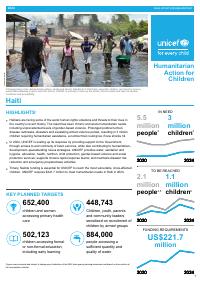
Following heavy rains, debris blocks gutters, canals and streets. Residents of Cité Soleil, especially children, are forced to cross a
waste-filled waterway to get to and from school. UNICEF is working to clean up the canals, remove waste and improve sanitary
conditions and accessibility.
Haiti
HIGHLIGHTS1
IN NEED
Haitians are facing some of the worst human rights violations and threats to their lives in
the country’s recent history. The result has been chronic and acute humanitarian needs,
including unprecedented levels of gender-based violence. Prolonged political turmoil,
disease outbreaks, disasters and escalating armed violence persist, resulting in 3 million
children requiring humanitarian assistance, a number that could grow if new shocks hit.
In 2024, UNICEF is scaling up its response by providing support to the Government,
through access to and continuity of basic services, while also contributing to humanitarian–
development–peacebuilding nexus strategies. UNICEF provides water, sanitation and
hygiene, education, health, nutrition, child protection, gender-based violence and social
protection services; supports cholera rapid-response teams; and maintains disaster risk
reduction and emergency preparedness activities.
Timely, flexible funding is essential for UNICEF to reach the most vulnerable, crisis-affected
children. UNICEF requires $221.7 million to meet humanitarian needs in Haiti in 2024.
5.5
million
people2
3
million
children3
2020
2024
TO BE REACHED
2.1
1.1
million million
people4,5 children6
KEY PLANNED TARGETS
652,400
448,743
children and women
accessing primary health
care
Children, youth, parents
and community leaders
sensitized on recruitment of
children by armed groups
502,123
884,000
children accessing formal
or non-formal education,
including early learning
people accessing a
sufficient quantity and
quality of water
2020
2024
FUNDING REQUIREMENTS
US$221.7
million
Figures are provisional and subject to change upon finalization of the 2024 inter-agency planning documents and based on the evolution of
the humanitarian situation.
2020
2024
1
�HUMANITARIAN SITUATION AND NEEDS
After two years of continuous crisis in Haiti and repeated calls for the intervention of an
international force, the Security Council approved the deployment of a security mission to Haiti
through Resolution 2699 in October 2023. The Multinational Security Support mission is
mandated to support the restoration of security and pave the way for democratic elections.
While the force is expected in the first quarter of 2024, protection concerns about such a force
are already being considered. And urban populations are still trapped by armed violence,
families are displaced due to conflicts, marginalized communities outside the capital suffer
from food insecurity and repatriated migrants face numerous challenges. By 2024,
approximately 5.5 million Haitians will be dependent on humanitarian protection and
assistance.7
In Haiti, at least 200,000 people are internally displaced, with 25 per cent living in
spontaneous sites and 75 per cent in host communities.8 This includes many unaccompanied
children who are exposed to abuse, exploitation and violence. An ongoing cholera epidemic is
aggravating existing disparities and further heightening the vulnerability of already
marginalized populations: As of September 2023, more than 64,400 suspected cases had
been reported, almost half of them among children under the age of 14 years.9 The healthcare system remains challenged by limited human resources that strain the running of public
health facilities. And precarious sanitation conditions and limited access to drinking water
open the way for waterborne diseases.
SECTOR NEEDS
1.1 million
people in need of
nutrition assistance11
1.3 million
children in need of
protection services12
1.2 million
children in need of
education support13
3.4 million
people lack access to
safe water14
Armed group activity in and around schools has further reduced access to education,
exposing children to an increasing risk of being recruited by armed groups or being the victim
of social exclusion and gender-based violence, particularly sexual and physical abuse.
Approximately 3.4 million people require water and sanitation, more than 1.6 million people
need emergency protection services, more than 100,000 children under age 5 require
treatment for severe wasting and 1.2 million children will require support to access education
in 2024.10
The southern part of the country, which is particularly vulnerable to natural hazards, is
experiencing a new crisis as increasing numbers of internally displaced persons arrive in the
area after fleeing violence in the capital. Meanwhile, northern Haiti is facing growing spillover
effects of conflict and cholera, with reported expansions of armed groups, an increasing
number of internally displaced persons and a rise in suspected cholera cases.
Haiti must also begin investing in recovery readiness, because responding to the complex
needs of the affected populations will require a comprehensive, multisectoral approach,
beyond immediate life-saving aid, to support recovery and resilience.
STORY FROM THE FIELD
On the violent streets of Port-au-Prince, a
glimmer of hope emerges. In the midst of
the chaos, a young mother, Valet
Widemiange, 23, is the symbol of
extraordinary resilience. After losing her
husband and her home during a night of
terror that swept through her
neighbourhood in September 2023, Valet
brought her child, Wideleysa, into the
world, giving birth to her on the streets,
the baby a powerful symbol of
unshakeable courage in the face of
uncertainty.
UNICEF and its local non-governmental
partner, Organisation des Coeurs pour le
Changement des Enfants Démunis d'Haiti
(OCCED'H), were quick to provide
support, offering Valet medical care,
essential supplies and temporary shelter.
UNOCHA
Read more about this story here
Shortly after her birth, Wideleysa lies in a cradle.
2
�HUMANITARIAN STRATEGY15,16,17
2024 PROGRAMME TARGETS19
In 2024, UNICEF will maintain its focus on immediate
humanitarian life-saving responses and contribute to nexus
strategies where possible. Interventions will be tailored to the
needs of specific population groups: those living in areas
directly affected by armed violence, those who are internally
displaced, repatriated migrants and border communities and
other populations with acute emergency needs.
Health (including public health emergencies)
In areas affected by armed violence,18 UNICEF has invested
in humanitarian access capacity to provide emergency basic
services while promoting community engagement and social
cohesion. UNICEF is strengthening service provision in
reachable safe spaces while assisting people who are
internally displaced with supplies, through mobile teams, and
with protection and education activities and referrals to
health services for complicated medical cases. UNICEF is
also responding to needs in communes where social service
systems are limited and likely to collapse, including through
increased support to teachers, doctors, social workers and
health workers. Along the border, unaccompanied children
and families are supported.
Nutrition
UNICEF is expanding access to safe drinking water,
sanitation and hygiene services through trucking, household
water treatment, rehabilitation of infrastructure, waste
disposal, hygiene promotion and supplies. The cholera
response uses the case area targeted intervention approach,
community awareness-raising, a WASH shield response and
support to treatment centres. UNICEF supports access to
maternal and child health care services and immunization
and reinforces health supply chain management. UNICEF
has scaled up screening and treatment for severe wasting,
promotion of infant and young child feeding practices and
vitamin A supplementation. Education is a gateway to
strengthen social cohesion and child protection and promote
peacebuilding. UNICEF promotes safe access to learning by
providing school supplies, disaster-risk management and
psychosocial support; while also supporting the national
social protection system through humanitarian cash transfers
meant to improve access to basic services.
Protecting children exposed to violence, exploitation and
family separation is a priority. Specialized services, genderbased violence risk mitigation and response, psychosocial
support and community-based structures provide care and
referrals to victims of violence and to children associated
with armed groups. Other priorities include contingency
planning, and mainstreaming gender equality and protection
from sexual exploitation and abuse through awarenessraising materials, reporting channels and reinforced
accountability mechanisms. Gender analysis and engaging
with women-led organizations inform the response.
The UNICEF Executive Director, as the Principal Advocate
for Haiti for the Inter-Agency Standing Committee, is
engaging with the Haitian Government, Haitian civil society,
international partners and other actors to enhance access for
safe, dignified and predictable humanitarian assistance and
protection for children and their families.
223,052 children vaccinated against measles,
supplemental dose
652,400 children and women accessing primary health
care in UNICEF-supported facilities
250 new health professionals recruited and deployed in
health institutions
600,000 children 6-59 months screened for wasting
104,827 children 6-59 months with severe wasting
admitted for treatment20
430,884 primary caregivers of children 0-23 months
receiving infant and young child feeding counselling21
600,000 children 6-59 months receiving vitamin A
supplementation
Child protection, GBViE and PSEA
336,557 children, adolescents and caregivers accessing
community-based mental health and psychosocial
support
181,200 women, girls and boys accessing gender-based
violence risk mitigation, prevention and/or response
interventions
1,623,584 people with safe and accessible channels to
report sexual exploitation and abuse by personnel who
provide assistance to affected populations22
5,979 unaccompanied and separated children provided
with alternative care and/or reunified23
448,743 Children, youth, parents and community
leaders sensitized on recruitment of children by armed
groups24
Education
502,123 children accessing formal or non-formal
education, including early learning25
120,000 children receiving individual learning materials
500 teachers and facilitators trained in basic pedagogy
and/or mental health and psychosocial support
25,000 children accessing mental health and
psychosocial support in their schools/learning
programmes
Water, sanitation and hygiene
884,000 people accessing a sufficient quantity and
quality of water for drinking and domestic needs26
176,400 people accessing appropriate sanitation
services
884,000 people reached with critical WASH supplies27
Cross-sectoral (HCT, SBC, RCCE and AAP)28
39,696 households reached with UNICEF-funded
humanitarian cash transfers (including for social
protection and other sectors)
4,500,000 people reached through messaging on
prevention and access to services29
150,000 people with access to established
accountability mechanisms
Supporting government coordination, UNICEF co-leads the
Education and Nutrition Clusters, the Child Protection SubCluster and the WASH sector. UNICEF co-leads the cholera
response with the Government, the World Health
Organization and the Pan American Health Organization.
This appeal is aligned with the revised Core Commitments for Children in Humanitarian
Action, which are based on global standards and norms for humanitarian action.
Programme targets are provisional and subject to change upon finalization of the 2024 inter-agency planning
documents and according to the evolution of the humanitarian situation.
3
�FUNDING REQUIREMENTS IN 2024
UNICEF is requesting $221.7 million to meet the needs of 2.1 million people in Haiti, including 1.1 million children. The humanitarian
situation is not likely to improve in 2024. On the contrary, scenarios project a potential increase in risks that may elevate humanitarian
needs nationwide. While UNICEF's 2024 funding requirement and targets have decreased compared with the 2023 (revised) appeal as
other actors have increased their capacity, these requirements and targets will be reassessed in light of new developments on the ground.
Full and flexible humanitarian funding to support operations in this high-cost environment is critical to enable UNICEF to provide life-saving
assistance to children impacted by the multifaceted and complex emergency gripping Haiti. The requested funds will allow UNICEF to
provide life-saving services to vulnerable people in key target groups;30 ensure access to essential primary health and nutrition services
and care to the growing number of children suffering from severe wasting; address access to water and sanitation (including in urban
areas), the lack of which has been one of the main causes of the country's persistent cholera epidemic; and care for the growing number of
children and women who are victims of violence and for separated children and those in the hands of armed groups.
Funding will also enable UNICEF to ensure safe access and a return to school for children deprived of their right to education. UNICEF will
continue investing in nexus strategies, contributing to the country’s resilience efforts. Without timely and adequate funding, children's needs
will go unmet. More than 220,000 children under 5 years of age will not be vaccinated against measles and more than 104,000 will not
receive treatment for severe wasting; 884,000 people will not have access to safe water; more than 336,000 children will be denied mental
health and psychosocial support; and more than half a million children will be unable to learn in a safe environment.
12.0%
HEALTH (INCLUDING
PUBLIC HEALTH
EMERGENCIES)
2024 requirements
(US$)
Sector
22.0%
CHILD
PROTECTION,
GBVIE AND PSEA
14.7%
EDUCATION
US$221.7
million
19.8%
WATER, SANITATION
AND HYGIENE
15.0%
NUTRITION
16.6%
CROSS-SECTORAL
(HCT, SBC, RCCE
AND AAP)
Health (including public health
emergencies)
Nutrition
Child protection, GBViE and
PSEA
26,500,00031
Education
Water, sanitation and hygiene
Cross-sectoral (HCT, SBC,
RCCE and AAP)
32,637,99534
43,810,80035
Total
221,650,212
33,224,24032
48,704,79333
36,772,38436
Who to contact for further information:
Bruno Maes
Representative, Haiti
T +509 3624 1777
bmaes@unicef.org
Lana Wreikat
Director, Office of Emergency Programmes (EMOPS), a.i.
T +1 212 326 7150
lwreikat@unicef.org
June Kunugi
Director, Public Partnerships Division (PPD)
T +1 212 326 7118
jkunugi@unicef.org
4
�ENDNOTES
1. UNICEF activated its Corporate Emergency Level 3 Scale-up Procedure for Haiti for the following period: 20 April 2023 – 14 January 2024. UNICEF Emergency Procedures are activated to ensure a timely and
effective response to all crises. The emergency procedures provide a tailored package of mandatory actions and simplifications required for all offices responding to Level 3, Level 2 and Level 1 humanitarian
situations.
2. Based on the preliminary estimate for the 2024 Humanitarian Needs Overview for Haiti in different programmatic sectors, calculated by the United Nations Office for the Coordination of Humanitarian Affairs
(OCHA) and humanitarian partners, including UNICEF.
3. Estimated by UNICEF, calculated based children making up 55 per cent of the number of people in need.
4. UNICEF estimates a total number of people to be reached of 2,080,207. The method of calculation considers 1,102,123 children (in nutrition, with 600,000 children aged 6–59 months receiving vitamin A
supplements; and education, with 500,123 children accessing formal or non-formal education); and 978,084 adults (in health, with 326,200 women accessing primary health care – 50 per cent of total largest
target in health to avoid double counting with the population targeted for nutrition interventions; and in nutrition, with 430,884 primary caregivers; and WASH, with 221,000 people reached with critical WASH
supplies – 25 per cent of men targeted to avoid double counting with women targeted in health and nutrition). Note that the reduction in people to be reached is due to a decrease in the UNICEF coverage of
targets for WASH and education, because other sector/cluster actors have increased their presence and support.
5. UNICEF is committed to needs-based targeting, which means covering the unmet needs of children; and will serve as the provider of last resort where it has cluster coordination responsibilities.
6. Based on the single largest sector targets for different age groups under 18 years, namely in nutrition, with 600,000 children aged 6–59 months receiving vitamin A supplements; and education, with 500,123
children accessing formal or non-formal education. The reduction in children to be reached for UNICEF in 2024 compared with 2023 is due to a decrease in the UNICEF coverage of targets in WASH (due to
increased coverage from other sector partners involved in the response) and a decrease in education, as the number of children in need for the education sector has decreased following the lifting of school
closures following the COVID-19 pandemic. In education UNICEF is covering 60 per cent of the sectorial target.
7. Based on the preliminary estimate for the 2024 Humanitarian Needs Overview for Haiti in different programmatic sectors, calculated by OCHA and humanitarian partners, including UNICEF.
8. International Organization for Migration (IOM), As displacement soars, Haiti requires USD 21 million for emergency shelter, protection services, press release, IOM, Port-au-Prince, 10 October 2023.
9. Haiti Ministry of Public Health and Population, Cholera National Sitrep, Port-au-Prince, 1 October 2023.
10. Preliminary sectoral estimates for the 2024 Humanitarian Needs Overview for Haiti in different programmatic sectors, calculated by OCHA and humanitarian partners, including UNICEF.
11. According to the SMART survey, published in May 2023, and projections of needs in 2024 based on the ongoing deteriorating situation. This is aligned with the nutrition cluster submission to the 2024
Humanitarian Needs Overview.
12. This figure represents the needs of the child protection subsector submitted for the 2024 Humanitarian Needs Overview.
13. This figure represents the preliminary needs of the Education Cluster as submitted for the 2024 Humanitarian Needs Overview. Note the variations (from 50–70 per cent lower) between 2023 and 2024 in
number of people in need for education is based on using 32 per cent of school-age children attending school and a total population of 11,724,730, the resulting figure is 3,751,914, according to the Ministry of
National Education and Vocational Training. Notably, this number is already below the number of people in need in 2023. It should be noted that the 2023 number was based on the COVID-19 period and took
into account the total number of school-age children, estimated at 4 million. The projected reductions of 50 to 70 per cent are based on a better understanding of the data and access restrictions secific to Haiti
reported by families and children. This reduction is justified given the number of school-age children in the country and the complexity of schooling restrictions, which include factors such as learning conditions,
level of protection and personal (aggravating) circumstances. In particular, secondary data could be used to adjust the people in need to more accurately reflect the reality in Haiti. Any adjustments will be
considered if there are major shifts in the situation, notably with the arrival of the international force.
14. This figure represents the preliminary needs of the WASH sector submitted for the 2024 Humanitarian Needs Overview.
15. This appeal is aligned with the revised Core Commitments for Children in Humanitarian Action, which are based on global standards and norms for humanitarian action.
16. UNICEF is committed to supporting the leadership and coordination of humanitarian response through its leadership or co-leadership of cluster coordination for the WASH, Nutrition and Education Clusters
and the Child Protection Area of Responsibility. All cluster coordinator costs are included in sectoral programme budgets.
17. UNICEF is committed to empowering local responders in humanitarian crises in a variety of ways. The revised Core Commitments made investing in strengthening the capacities of local actors in the
humanitarian response a mandatory benchmark for UNICEF action. A more localized response will improve humanitarian action and is fundamental to achieving better accountability to affected populations.
18. In areas controlled by armed groups, UNICEF is investing in humanitarian access capacity to ensure provision of emergency services (including through mobile teams), while promoting community
engagement and social cohesion; as well as increasing monitoring of grave violations. To address the needs of populations fleeing armed group-controlled areas, UNICEF has a dual approach which includes
strengthening service provision in reachable safe spaces – which also benefits host communities – while assisting internally displaced people with supplies, through mobile teams, protection and education
activities and referrals to health services for complicated cases.
19. Beyond the UNICEF targets for these interventions, other humanitarian partners are expected to reach the remaining children/families in need.
20. The nutrition targets for the 2024 appeal have been revised downward compared with the 2023 appeal due to a slight decrease in the prevalence of wasting in some densely populated areas such as Ouest
Départment as evidenced by the latest nutrition SMART survey. This has led to a slight reduction in the national caseload of children with wasting. In addition, in those densely populated areas, population
movements caused by ongoing insecurity and gang violence have caused the population to decrease.
21. In close coordination and consultation with the Ministry of Public Health and Population, compared with 2023, in 2024 UNICEF will reach 75 per cent of women with key infant and young child feeding
messages, with the remaining 25 per cent covered by non-governmental organization partners.
22. Calculated to include adults to be reached in addition to the highest education target.
23. Note that compared with 2023, the estimates for the 2024 Humanitarian Needs Overview have decreased following the removal of residual targets of the 2021 earthquake. They now fully focus on children
displaced due to conflict and returnees, for a total of 7,474 unaccompanied and separated children. UNICEF is targeting 80 per cent of these needs, resulting in an overall decrease in the target. Noting that
scenario planning for the arrival of the multinational force may result in adjustments in the new year.
24. This target is specific to the Port-au-Prince and Artibonite geographic areas.
25. UNICEF targets 65 percent of the sectoral target (772,496), for a total of 502,123 children. The remaining 35 per cent will be addressed by cluster partners.
26. Compared with 2023, UNICEF's WASH target has decreased due to an increase in WASH partners responding to the humanitarian crisis. Specifically, the sector's target is 1.2 million (covering 49 per cent of
needs), and aside from the Direction Nationale de l’Eau Potable et de l’Assainissement (DINEPA), nearly 56 per cent of the sector's operational partners now have engagements with UNICEF and therefore have
part of their response covered by UNICEF. IOM is also an increasingly major partner in the sector due to the growing response for internally displaced persons, particularly in water trucking, latrine emptying and
the distribution of supplies.
27. The target includes people assisted with cholera kits through rapid response teams benefiting from a 'cordon sanitaire' and community response; as well as support with hygiene kits in emergency response.
Hygiene kits are accompanied by sensitization and local solutions for oral rehydration salts where cholera kits do not suffice to address needs.
28. The cross-sectoral target includes accountability to affected populations and social and behavioural change activities and indicators.
29. The population targeted is higher than the total number of people/children to be reached because the target includes mass media outreach.
30. Per the UNICEF humanitarian strategy, these include those living in areas directly affected by armed violence, internally displaced people, repatriated migrants and border communities and populations with
acute emergency needs.
31. The budget and target for the maternal and child health subsector remain provisional as submissions to the 2024 Humanitarian Needs Overview and have been agreed within the health sector coordination
(led by the Pan American Health Organization and the World Health Organization). The 2024 budget and target calculation are based on the sectoral needs of children under age 5 and pregnant and lactating
women.
32. The nutrition budget is lower than in 2023 due to a reduction in the target on wasting per the cluster estimates on needs and targets for nutrition. In addition, the 2023 budget included a projected significant
deterioration, but the situation remained stable over the year and in line with SMART survey results.
33. The child protection budget includes: 1) $450,000 for protection from sexual exploitation and abuse; 2) $18,120,000 for gender-based violence efforts including full-service provision of prevention, risk
mitigation and response to survivors of gender-based violence (legal and medical services plus psychosocial support, estimated at $300 per beneficiary). Twenty per cent of survivors need the full package of
services and 80 per cent benefit from prevention and sensitization sessions only; 3) $11,957,699 for support to unaccompanied and separated children; and 4) 16,827,865 for psychosocial support.
34. The education budget is costed at $65 per child.
35. The WASH budget includes $8,420,000 for the cholera response rapid response team/case area targeted intervention response.
36. The cross-sectoral budget includes costs related to social and behaviour change, risk communication and community engagement and accountability to affected populations ($22,250,000); gender ($470,000)
and humanitarian cash transfers ($14,052,384).
5
�