Texte Intégral du Document
Texte extrait du document original pour l'indexation.
2022
www.unicef.org/appeals/haiti
UNICEF/Haiti/2021/ Rouzier
Humanitarian
Action for
Children
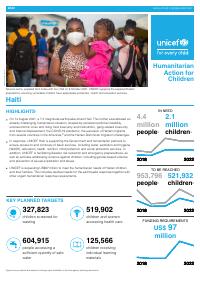
Telusca Lema, expelled from Cuba with her child on 9 October 2021. UNICEF supports the expelled Haitian
populations, ensuring vulnerable children have appropriate protection, health and education services.
Haiti
IN NEED
HIGHLIGHTS1
On 14 August 2021, a 7.2 magnitude earthquake struck Haiti. This further exacerbated an
already challenging humanitarian situation, shaped by persistent political instability,
socioeconomic crisis and rising food insecurity and malnutrition, gang-related insecurity
and internal displacement, the COVID-19 pandemic, the expulsion of Haitian migrants
from several countries in the Americas,2 and the Haitian-Dominican migration challenges.
In response, UNICEF Haiti is supporting the Government and humanitarian partners to
ensure access to and continuity of basic services, including water, sanitation and hygiene
(WASH), education, health, nutrition, child protection and social protection services. In
addition, UNICEF is facilitating disaster risk reduction and emergency preparedness, as
well as activities addressing violence against children, including gender-based violence
and prevention of sexual exploitation and abuse.
UNICEF is requesting US$97 million to meet the humanitarian needs of Haitian children
and their families. This includes residual needs for the earthquake response together with
other urgent humanitarian response requirements.
4.4
2.1
million million
people
3
children
4
2018
2022
TO BE REACHED
953,796 521,932
people
5
children
6
KEY PLANNED TARGETS
327,823
519,902
children screened for
wasting
children and women
accessing health care
2018
2022
FUNDING REQUIREMENTS
US$ 97
604,915
125,566
people accessing a
sufficient quantity of safe
water
children receiving
individual learning
materials
million
2018
Figures are provisional and subject to change upon finalization of the inter-agency planning documents.
2022
�HUMANITARIAN SITUATION AND NEEDS
Humanitarian needs abound and persist after the 7.2 magnitude earthquake that struck
south-western Haiti on 14 August 2021.10 Earthquake impact needs assessments report
more than 2,200 deaths, 12,000 people injured, and around 130,000 homes partially
damaged or destroyed,11 leaving hundreds of thousands people homeless and in urgent
need of assistance.12
With 97 partially damaged or destroyed health systems in the hardest earthquake-hit
departments,13 hospitals and clinics are struggling to keep pace with increased life-saving
needs while ensuring continued access to essential health services, including maternal and
child health, as a critical response priority. Access to safe WASH services and products and
to awareness messages and behavior change approaches remains a significant need. At
least 26,200 people remain displaced and sleeping in 68 shelters and makeshift settlements.
With 89 water systems suffering extensive damage, these vulnerable populations are
particularly exposed to the risk of waterborne diseases,14 acute respiratory infections and
COVID-19.8
The earthquake struck with Haiti still reeling from the assassination of President Jovenel
Moïse on 7 July 2021 and the escalation of gang violence affecting 1.5 million people and
displacing 19,000 people15 since the end of 2020. Humanitarian access to some of the most
affected areas remains a challenge, due to gang-related insecurity and damaged
infrastructures.
The increased repatriation of Haitian migrants from across the Latin America and Caribbean
region16 since mid-September 2021 has also been compounding humanitarian needs. More
than 10,000 migrants have been returned, among them 2,000 children who are in need of
access to basic services, including education, and have been exposed to child protection
risks such as family separation, trafficking and gender-based violence (GBV).17
The combined impact of natural hazard-related disasters, persistent political and
socioeconomic crisis, gang-related insecurity, forced returns and internal displacement as
well as COVID-19 is being felt by the most vulnerable. Prior to the earthquake, an estimated
4.4 million people in Haiti18 were food insecure and an estimated 217,000 children were
suffering from moderate or severe wasting9 and nearly 3 million people required emergency
health care, among them 1.2 million children and 400,000 pregnant women and adolescent
girls. The earthquake’s impacts and recent returns have exacerbated these vulnerabilities.19
SECTOR NEEDS21
224,891
children moderately or
severely
malnourished22
3.9 million
people in need of
health assistance23
3.3 million
people lack access to
safe water24
712,140
children in need of
protection services25
797,000
children in need of
education support26
Furthermore, over 3 million children have been unable to attend school for months at a time,
due to political and security challenges and COVID-19 lockdowns over the past two years.20
In earthquake-affected areas, preliminary Ministry of Education assessments indicate
extensive damage across 925 schools, affecting more than 300,000 children.7
STORY FROM THE FIELD
Men, women and children displaced in
Carrefour as they fled the violent clashes
between rival gangs raging in Martissant
and Fontamara, in the metropolitan area
of Port-au-Prince since 1 June.
Thousands of other displaced people are
reported to have sought refuge with host
families, or even returned to towns in
other departments.
To assist people displaced from
Martissant and Fontamara to Carrefour,
UNICEF transported by helicopter from
the centre of Port-au-Prince 200 hygiene
kits composed of soap, water chlorination
product, toothbrushes, toothpaste, toilet
paper, sanitary napkins and a tap-bucket;
200 jerrycans, 10,000 masks, 250
mattresses and 20 tarpaulins of 20
square meters.
UNICEF/Haiti/2021/Haro
Read more about this story here
In response to the earthquake, UNICEF has been on the ground with partners to provide tens of
thousands of affected people with hygiene kits and medical supplies, among other life-saving
assistance.
�HUMANITARIAN STRATEGY
UNICEF will work with partners to ensure access to and
continuity of essential health, nutrition, WASH, education,
and child protection services, while strengthening disaster
risk reduction and emergency preparedness. Additionally, a
strong focus on humanitarian cash transfers will be ensured,
both within sectoral response to improve access to basic
goods and services such as education, WASH, child
protection, health and nutrition, and through the social
protection system.28
Following the immediate response to the earthquake,
attention will focus on providing assistance and recovery
support to the population in the three affected departments
of Sud, Nippes and Grande Anse, while strengthening the
response to the internally displaced persons (IDPs) victims
of the armed gangs' activities in the capital city's
metropolitan area, as well as to returning Haitian migrants.
UNICEF will support continued access to essential health
care services, including immunization, maternal and child
health. In earthquake-affected areas, support will continue
for the resumption health care services in damaged or
destroyed health centres, as well as strengthening health
supply chain management.
UNICEF will support prevention and treatment of child
wasting with screening and providing essential nutritional
supplies, along with supporting good infant and young
children feeding (IYCF) practices. UNICEF will work to
improve coordination as the co-lead of the sector. A key
focus will be put on strengthening end-user monitoring of
supplies, information management, and supporting a
SMART survey to obtain updated data on malnutrition for
effective programming.29
WASH interventions will focus on access to sufficient safe
drinking water for vulnerable communities, while providing
emergency sanitation solutions and awareness raising and
behaviour change strategies around hygiene to prevent the
risks and spread of waterborne and infectious diseases. The
earthquake response will focus on rehabilitating damaged
WASH facilities and promoting hygiene and raising
awareness in health centres and schools.
UNICEF will promote a safe return to school through the
provision of school supplies and access to distance
learning programmes. Earthquake-affected areas will
require sustained support for the establishment of
temporary learning spaces and the rehabilitation of schools
to provide a protective environment for school children.
UNICEF will support protection of children exposed to
violence, including gender-based violence, exploitation and
family separation. Specialized services and communitybased structures will receive support to identify vulnerable
children and provide adequate care, referrals and
psychosocial support.
2022 PROGRAMME TARGETS30
Nutrition
38,512 children aged 6 to 59 months with severe acute
malnutrition admitted for treatment
327,823 children aged 6 to 59 months screened for
wasting31
62,730 primary caregivers of children aged 0 to 23
months receiving infant and young child feeding
counselling
Health32
519,902 children and women accessing primary health
care in UNICEF-supported facilities33
110,035 children under one vaccinated against measles
34
3,000 healthcare facility staff and community health
workers provided with PPE
Water, sanitation and hygiene35
604,915 people accessing a sufficient quantity of safe
water for drinking and domestic needs
230,000 people use safe and appropriate sanitation
facilities
604,915 people reached with critical WASH supplies
(including hygiene items)
Child protection, GBViE and PSEA36
57,900 children and parents/caregivers accessing
mental health and psychosocial support
40,000 women, girls and boys accessing gender-based
violence risk mitigation, prevention and/or response
interventions37
3,650 unaccompanied and separated children provided
with alternative care or reunified
484,938 people who have access to a safe and
accessible channel to report sexual exploitation and
abuse by aid workers
Education
267,000 children accessing formal or non-formal
education, including early learning38
125,566 children receiving individual learning materials
3,000 households reached with UNICEF-funded
humanitarian cash transfers 39
800 classrooms rehabilitated or reconstructed including
temporary learning centers 40
Social protection
15,000 households reached with UNICEF funded multipurpose humanitarian cash transfers41
Cross-sectoral (HCT, C4D, RCCE and AAP)42
100,000 people reached through messaging on
prevention and access to services 43
20,000 people with access to established accountability
mechanisms44
UNICEF will continue supporting sectoral and national
humanitarian coordination for disaster preparedness and
response, as lead/co-lead of the WASH, education and
nutrition sectors and the child protection sub-sector. Prepositioned supplies stocks will be maintained to respond to
future humanitarian crises.
Gender equality, accountability to affected populations
(AAP) and prevention of sexual exploitation and abuse
(PSEA) will be mainstreamed throughout the response.
Progress against the latest programme targets is available in the humanitarian situation
reports: https://www.unicef.org/appeals/haiti/situation-reports
This appeal is aligned with the revised Core Commitments for Children in Humanitarian
Action, which are based on global standards and norms for humanitarian action.
Targets based on preliminary figures of HNO/HRP 2022 (not officially approved yet) and therefore provisional,
subject to change upon finalization of the inter-agency planning documents.
�FUNDING REQUIREMENTS IN 2022
Following the humanitarian deterioration in Haiti after the earthquake, UNICEF continues to deliver life-saving assistance to the most
vulnerable children and their families. For 2022, after detailed post-earthquake sectoral needs assessments and subsequent humanitarian
response planning conducted in coordination with Government and NGO partners, UNICEF is requesting US$97 million.45 This will enable
UNICEF to continue being on the ground delivering life-saving assistance and respond to the residual needs of the most vulnerable
earthquake-affected population in line with the United Nations Flash Appeal, as well as to support the increasing number of IDPs who are
victims of armed gangs' violence in the capital city, the returned migrants and other vulnerable groups affected by continued crises,
COVID-19 and recurring natural disasters.
Despite the decrease in funding requirements in the WASH and education sectors, due to more accurate data obtained through additional
sectoral needs assessments and a significant portion of the immediate earthquake response in these sectors taking place in 2021, funding
is still urgently required. These funds are crucial to UNICEF in order to prevent further degradation of health services, including the
severely low routine vaccinations, essential emergency WASH and resilience interventions,46 life-saving care for children suffering from
severe wasting, including promoting breastfeeding, as well as allowing marginalized children to safely resume learning. UNICEF will
accelerate emergency education and distance learning programmes, preventing thousands of children from dropping out of school. Child
protection services will be scaled up for children exposed to violence, including GBV,47 exploitation and family separation, including
through cash-based interventions allowing vulnerable families to meet their basic needs.
Without sufficient and timely funding, UNICEF will be unable to support life-saving assistance and recovery for Haiti's children in need and
their families, especially those affected by the recent earthquake and IDPs. With the earthquake severely deepening the humanitarian crisis
in Haiti, UNICEF calls upon the donor community to adequately fund and expand flexible humanitarian and nexus financing in order to
sustain and elevate Haiti's continued and post-earthquake response efforts.
11%
OTHER*
2022
requirements
(US$)48
Nutrition
13,017,24049
Health
Water, sanitation and hygiene
9,595,24050
19,552,69951
Child protection, GBViE and PSEA
Education
20,550,24052
23,705,24053
24.4%
EDUCATION
9.9%
HEALTH
13.4%
NUTRITION
Sector
US$97
million
Cross-sectoral (HC, C4D/RCCE,
Operations, Communications,
M&E/Reporting, AAP)
Social protection
21.2%
CHILD
PROTECTION,
GBVIE AND PSEA
20.2%
WATER, SANITATION
AND HYGIENE
Total
4,215,72354
6,325,24055
96,961,622
*This includes costs from other sectors/interventions : Social protection (6.5%), Cross-sectoral (HC,
C4D/RCCE, Operations, Communications, M&E/Reporting, AAP) (4.3%).
Who to contact for further information:
Bruno Maes
Representative, Haiti
T +509 3624 1777
bmaes@unicef.org
Manuel Fontaine
Director, Office of Emergency Programmes (EMOPS)
T +1 212 326 7163
mfontaine@unicef.org
June Kunugi
Director, Public Partnership Division (PPD)
T +1 212 326 7118
jkunugi@unicef.org
�ENDNOTES
1. UNICEF’s public health and socioeconomic COVID-19 response, including programme targets and funding requirements, is integrated into the standalone country, multi-country and regional Humanitarian Action for Children appeals. All interventions
related to accelerating equitable access to COVID-19 tests, treatments and vaccines fall under the Access to COVID-19 Tools Accelerator (ACT-A) global appeal.
2. Among others, these include migrants returned from the United States-Mexico border, Chile, Brazil, Cuba, and the Dominican Republic.
3. The people in need (PIN) figure is based on the last updated Humanitarian Response Plan (HRP) 2021 figures, pending finalization of the HNO/HRP 2022. As per HRP 2021, prior to the earthquake (EQ), the PIN figure of 4.4 million was derived from
the 65 priority communes based mainly on the Integrated Food Security Phase Classification (IPC) analysis as per the 'Haiti: Humanitarian Needs Overview – Humanitarian Response Plan 2021’', (Haiti HNO/HRP 2021), UNOCHA. Following the EQ, the
August 2021 Flash Appeal estimated that approximately 650,000 people – 40 per cent of the 1.6 million people living in the affected departments – need emergency humanitarian assistance. The Flash Appeal covers the period from August 2021 to
February 2022. Indicators and targets were revised and adjusted to include residual needs in the three most earthquake-affected departments.
4. Ibid. This figure is based on HRP 2021 and it will be reviewed according to the revised HNO/HRP 2022.
5. Calculated as the sum of multiple key intervention targets where targeted groups do not overlap demographically, including WASH target without children under 5 years (53,475 people accessing a sufficient quantity of safe water for drinking and
domestic needs: Total 604,915 people x 88.4 per cent [% of population 5 years and above (as per EMMUS-VI 2016-17]) and nutrition sector target for children under 5 years (32,7823 children 6 to 59 months screened for wasting). UNICEF is committed
to needs-based targeting, which means covering the unmet needs of children; and will serve as the provider of last resort where it has cluster coordination responsibilities. To be reached figures have reduced following initial response to earthquake and
increased coverage by Government counterparts and partners.
6. Calculated as the sum of multiple key interventions for children without demographic overlap, including the highest sectoral target related to girls and boys (Health - number of children and women receiving essential healthcare services in UNICEF
supported facilities = 93,765 girls and 93,765 boys over 5 years) and Nutrition (- # children 6-59 months screened for wasting = 163,912 girls and 163,912 boys under 5 years). Total 521,932.
7. Source: PDNA exercise: around 307,400 school age children affected in the three EQ departments.
8. As of 7 October 2021, Haiti reports more than 125,082 cumulative COVID-19 cases and more than 649 deaths. However, limited testing and treatment capacities is likely leading to under-reporting. As of 25 September 2021, 67,023 vaccine doses
have been administered in Haiti, meaning only 0.5 per cent of the population is partially immunized.
9. While assessments were still ongoing at the time of writing, UNICEF estimates that 17,891 additional children are likely to be affected by acute malnutrition in the earthquake-affected areas.
10. The departments of Grand'Anse, Nippes and Sud were the worst hit.
11. 97 health facilities have been affected (updated data from MoH) plus 89 water systems suffering extensive damage (DINEPA) and 925 schools partially damaged or destroyed (MoE).
12. According to the Flash Appeal, over 610,000 people in the three most affected departments with acute humanitarian needs prior to the earthquake. Of these, 350,000 suffer from extreme and catastrophic levels of needs.
13. Sud, Nippes and Grande Anse.
14. The cholera epidemic is now coming to an end, with no cases confirmed since February 2019. However, prevention, surveillance and alert response efforts must be maintained, particularly in earthquake-hit communities, to keep the number of
cases at zero and officially declare the end of the epidemic by 2022.
15. OCHA, July 2021 - Available at: https://www.humanitarianresponse.info/sites/www.humanitarianresponse.info/files/documents/files/haiti_-_situation_report_nr._5_-_displacements_port-au-prince_-_final_-_eng.pdf
16. Since mid-September 2021, a surge in returnees have been arriving from the United States, Mexico, Cuba, The Bahamas and Turks and Caicos Islands.
17. More than 10,000 expelled (repatriated) migrants have already landed in Haiti as of mid-October, of whom more than 20 per cent are children and women (IOM data).
18. Haiti HNO/HRP 2021. This represents nearly 46 per cent of the population (DHS 2016-2017).
19. Based on the estimated population in the three departments, more than 18,600 women are expected to give birth in the next six months and 28,000 are currently pregnant. Around 2,800 of these will likely require caesarean sections or experience
complications, with potentially deadly consequences without available access to emergency obstetric care (14 August Haiti earthquake Flash Appeal, 2021).
20. Haiti HNO/HRP 2021. Although all schools reopened by mid-August 2020 with biosafety protocols, due to the deterioration of the political climate and socioeconomic conditions, growing insecurity and the rise of gang-related activities, a significant
number of children are at risk of falling behind on their learning and dropping out of school altogether, with estimates of 500,000 potential dropouts.
21. All sector needs have been reviewed and updated based on the ongoing HNO/HRP 2022 process, although the new figures are not yet officially disclosed (preliminary figures available).
22. Source: Review of Nutrition sector needs in the frame of Haiti HNO/HRP 2022 process (preliminary figures available) and considering August 2021 Flash Appeal.
23. This figure represents the needs of the global Health sector, while for Child/Maternal Health we consider an estimation of 40 per cent (1,540,000 people) that includes the needs of children and pregnant plus lactating women. The figure is obtained
from the ongoing HNO/HRP 2022 process (preliminary data), considering also the Flash Appeal. It corresponds to approximately 27 per cent of the Haitian population concentrated (65 per cent) in the most vulnerable departments (West, Artibonite and
North) plus the three departments affected by the EQ.
24. The WASH sector needs have been reviewed within the HNO process, by the sectoral coordination co-led by UNICEF, through a more accurate analysis at the municipality (commune) level, based on the level of vulnerability of the population. The
sector needs figure includes all the population living with a certain level of vulnerability (1 to 5), while the sector target includes only the ones living in a vulnerability level of 3 to 5.
25. This figure has been calculated in the frame of the sectoral coordination group led by UNICEF, based on the estimated number of children needing psychosocial support and/or at risk or suffering from violence in the areas affected by humanitarian
crisis. This may be subject to change once the final HRP 2022 figures will be finalized.
26. Education PIN has been reviewed and aligned with preliminary figures of HNO/HRP 2022.
27. UNICEF leads cluster coordination for the WASH, nutrition and education clusters and the child protection area of responsibility.
28. Additionally to the humanitarian cash transfers (HCT) used at the sectoral level, other multi-purpose unconditional HCT will target 15,000 vulnerable households in the frame of the Social Protection response, complementing cash with key
messages/information for women and children.
29. (https://smartmethodology.org/about-smart/)
30. The programme targets for 2022 are aligned with the residual humanitarian needs, particularly those related to the EQ, based on detailed and more accurate reviews conducted by the sectoral coordination groups (co)led by UNICEF in support of
Government partners. Humanitarian needs have been re-assessed with additional and more detailed data and information collected in the field, while a more precise/detailed multi-sectoral response planning has been elaborated. The HAC 2022 is
targeting the residual needs of the earthquake-affected areas, after the first response has been carried out during the first months after the EQ. UNICEF is committed to needs-based targeting, which means covering the unmet needs of children; and
will serve as the provider of last resort where it has cluster coordination responsibilities.
31. Based on 2021 performance for this indicator and in accordance with sector Government partners, the screening target was revised in order to reach 25 per cent of the total population (6 to 59 months).
32. The target for Child-Maternal Health sub-sector has been agreed within the Health sector coordination (led by PAHO/WHO) in the frame of the HNO/HRP process (based on preliminary figures of HRP 2022). The calculation is based on the sector
needs of children plus pregnant and breastfeeding women, corresponding to around 40 per cent of the total Health sector figures.
33. The targets for the HAC 2022 have been revised upwards, compared to the HAC 2021 due to a corresponding increase of PIN in the last year (after EQ). To be noted that in addition to 3 Southern Departments, the health sector also targets the
communes of the metropolitan area prone to urban violence, including IDPs in the various sites and host communities.
34. To be noted, that in addition to 3 Southern Departments, the health sector also targets the communes of the metropolitan area prone to urban violence, including IDPs in the various sites and host communities.
35. The WASH figures are heavily conditioned by the EQ response in the South and have been reviewed in the frame of the ongoing HNO/HRP 2022 process. The sectoral targets have been reviewed in the period between September and October
2021 based on more detailed and accurate data obtained through sectoral needs assessments conducted with Government (DINEPA) and partners in September-October 2021 (using the M-water platform).
36. Child protection targets are based on needs assessed through the MIRA carried out in the three southern earthquake-affected departments, as well as on the partners' capacity to deliver CP services.
37. Of which: 12,000 women, 8,000 boys, 20,000 girls.
38. This target includes population targeted by UNICEF's education sector EQ response, as well as IDPs and repatriated migrants' responses, and other humanitarian responses, including cash transfers beneficiaries. Out of these, around 100,000
children are already receiving in 2021 initial support to ensure they are back at school, while the rehabilitation/reconstruction phase is ongoing for the same children plus an additional 100,000 that will be attended in 2022. Additionally, another
estimated 67,000 school children affected by the other ongoing emergencies: violence and IDPs, migrant children, 2022 hurricane season, etc.
39. For the cash transfers, the most vulnerable households will be selected with school-aged children affected by the different emergency situations, including the IDPs victims of the urban gang violence.
40. Average 50 children per classroom.
41. The estimation is done based on Social Protection sectoral analysis, considering additional humanitarian cash transfers (HCT) out of Education, CP and WASH cash transfers already planned.
42. Cross-sectoral target includes AAP and C4D activities and indicators.
43. This target includes all C4D activities carried out in the frame of the response of the different sectors (WASH, CP, Health, Nutrition).
44. An AAP survey in the field (12 municipalities in the 3 EQ affected departments) is planned before the end of 2021, including among the results the establishment of accountability mechanisms. Additionally, through the U-Report platform, periodic
surveys are being carried out to engage with adolescents and youth on accountability issues.
45. The partial reduction of the budget requirements compared to the revised HAC 2021 (after August EQ) particularly for some sectors (WASH, Education) is due to more detailed and accurate needs assessments and analysis conducted by the
sectoral coordination groups co-led by UNICEF in support of government partners. Humanitarian needs have been assessed with additional and more detailed information collected in the field, and a more detailed response planning has been
conducted. It should be noted as well that the HAC 2022 is targetting the residual needs of the EQ response, after the first response carried out with the funds raised during the first months after the earthquake.
46. The sectoral target has been reviewed thanks to more detailed and precise data obtained through sectoral needs assessments conducted with Government (DINEPA) and partners (using M-water platform). The budget for the WASH EQ response
has been reviewed in detail by the UNICEF-led sectoral coordination with Government and NGO partners, based on the updated response/ rehabilitation needs and on current market costs for the water systems rehabilitation.
47. The CP budget has significantly increased because it now includes a full package of services focused on GBV (not planned in the HAC 2021) including activities for prevention, risk mitigation and response to GBV survivors: legal and medical
services plus psychosocial support (estimated cost of 40,000 persons x US$300 each).
48. The partial reduction of the budget requirements compared to the revised HAC 2021 (after August EQ) is due to more accurate needs assessments and analysis conducted by the sectoral coordination groups co-led by UNICEF in support of
Government partners. Humanitarian needs have been assessed with additional and more detailed information collected in the field, and corresponding response planning. It should be noted as well that the HAC 2022 is targeting the residual needs of
the EQ response, being that the first response was carried out with funds raised during the first months after the EQ. All sectoral budgets include a portion of the operational costs (Ops, Comms, M&E/reporting).
49. The nutrition budget and target have been adjusted to the overall sectoral planning agreed in the frame of the HNO/HRP process (preliminary figures of HRP 2022). The budget, with respect to 2021, includes additional requirements for: sector
coordination, end user monitoring and the elaboration of a SMART survey.
50. The budget and target for Child-Maternal Health sub-sector has been agreed within the Health sector coordination led by PAHO/WHO, in the frame of the HNO/HRP process (preliminary figures of HRP 2022). The calculation is based on the sector
needs of children under 5 years plus pregnant and breastfeeding women, corresponding to around 40 per cent of the total sectoral figures.
51. WASH figures are heavily conditioned by the EQ response in the South and have been reviewed within the ongoing HNO/HRP process. The sectoral target has been reviewed based on more accurate data obtained through additional sectoral
needs assessments. The budget for the WASH EQ response, initially over-estimated due to the unavailability of precise data, has been reviewed in detail (in the frame of the HNO/HRP process) by the UNICEF-led sectoral coordination with Government
and NGO partners, based on the updated response/ rehabilitation needs and on current market costs for the water systems rehabilitation. Additional WASH needs are focused on larger scale reconstruction and captured in the forthcoming PostDisaster Needs Assessment.
52. The CP budget includes: i) US$1 million for PSEA; ii) US$7.9 million for GBV, corresponding to the full service provision of prevention, risk mitigation and response to GBV survivors: legal and medical services plus psychosocial support, estimated at
US$300 per beneficiary (with 55 per cent survivors needing the full package of services and 45 per cent only benefiting from prevention and sensitization sessions).
53. Education budget is based on the sector needs and the sectoral planning within the HNO/HRP process (preliminary figures of HRP 2022). It also includes part of the schools rehabilitation as a response to the earthquake in the Southern region.
Additional education needs are focused on larger scale reconstruction and captured in the forthcoming Post-Disaster Needs Assessment.
54. The cross-sectoral budget includes the costs related to C4D/RCCE, AAP, HC.
55. Social Protection budget includes humanitarian multi-purpose/unconditional cash transfers (US$82 each) for an estimated 15,000 households for 4 months and operational costs.
�