
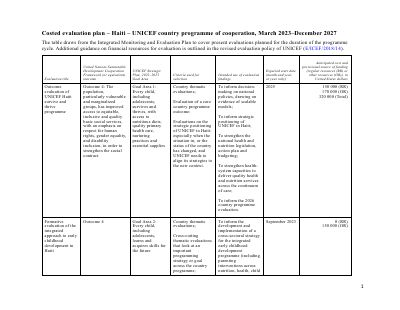
Plan d'évaluation chiffré : programme de coopération de l'UNICEF en Haïti, mars 2023-décembre 2027
Résumé — Le plan d'évaluation chiffré annexé au programme de pays de l'UNICEF en Haïti pour mars 2023 à décembre 2027, qui accompagne le descriptif de programme de pays E/ICEF/2023/P/L.6. Tiré du plan intégré de suivi et d'évaluation, il recense dix évaluations avec, pour chacune, le résultat du cadre de coopération et le domaine d'objectif du Plan stratégique de l'UNICEF qu'elle sert, les critères de sélection, l'usage prévu, la date de démarrage et le coût. Le total s'élève à 2 025 000 dollars, dont 505 000 au titre des ressources ordinaires et 1 520 000 au titre des autres ressources. Les postes les plus importants sont une évaluation des résultats du programme de survie de l'enfant pour 320 000 dollars, une évaluation du programme d'eau et d'assainissement financé par la Banque interaméricaine de développement dans l'Ouest, le Sud et le Nord pour 300 000 dollars et une évaluation du programme d'allocations pour enfants pour 225 000 dollars.
Constats Clés
- Dix évaluations prévues pour le cycle de mars 2023 à décembre 2027, pour un total de 2 025 000 dollars : 505 000 de ressources ordinaires et 1 520 000 d'autres ressources.
- Une évaluation des résultats du programme de survie et de développement de l'enfant en 2025 pour 320 000 dollars, le poste le plus important.
- Une évaluation de 300 000 dollars en 2025 du programme d'eau, d'assainissement et d'hygiène dans l'Ouest, le Sud et le Nord, au titre de la redevabilité envers son bailleur, la Banque interaméricaine de développement.
- Des évaluations formatives du programme migrants (2023), de la stratégie de lutte contre la violence envers les enfants dans l'aire métropolitaine de Port-au-Prince (2024), d'une stratégie sectorielle EAH sensible au climat menée conjointement (avril 2024) et du programme d'allocations pour enfants (2025).
- Une évaluation du programme de pays Gouvernement d'Haïti et UNICEF au premier trimestre 2026 pour 180 000 dollars, et une initiative de renforcement des capacités nationales d'évaluation dès 2023 pour 200 000 dollars.
Texte Intégral du Document
Texte extrait du document original pour l'indexation.
Costed evaluation plan – Haiti – UNICEF country programme of cooperation, March 2023–December 2027
The table draws from the Integrated Monitoring and Evaluation Plan to cover present evaluations planned for the duration of the programme
cycle. Additional guidance on financial resources for evaluation is outlined in the revised evaluation policy of UNICEF (E/ICEF/2018/14).
Evaluation title
Outcome
evaluation of
UNICEF Haiti
survive and
thrive
programme
United Nations Sustainable
Development Cooperation
Framework (or equivalent)
outcome
Outcome 4: The
population,
particularly vulnerable
and marginalized
groups, has improved
access to equitable,
inclusive and quality
basic social services,
with an emphasis on
respect for human
rights, gender equality,
and disability
inclusion, in order to
strengthen the social
contract.
UNICEF Strategic
Plan, 2022–2025
Goal Area
Goal Area 1:
Every child,
including
adolescents,
survives and
thrives, with
access to
nutritious diets,
quality primary
health care,
nurturing
practices and
essential supplies
Criteria used for
selection
Intended use of evaluation
findings
Country thematic
evaluations;
To inform decisionmaking on national
policies, drawing on
evidence of scalable
models;
Evaluation of a core
country programme
outcome;
Evaluations on the
strategic positioning
of UNICEF in Haiti:
especially when the
situation in, or the
status of the country
has changed, and
UNICEF needs to
align its strategies to
the new context.
Expected start date
(month and year,
or year only)
2025
Anticipated cost and
provisional source of funding
(regular resources (RR) or
other resources (OR)), in
United States dollars
150 000 (RR)
170 000 (OR)
320 000 (Total)
To inform strategic
positioning of
UNICEF in Haiti;
To strengthen the
national health and
nutrition legislation,
action plan and
budgeting;
To strengthen healthsystem capacities to
deliver quality health
and nutrition services
across the continuum
of care;
To inform the 2026
country programme
evaluation.
Formative
evaluation of the
integrated
approach to early
childhood
development in
Haiti
Outcome 4
Goal Area 2:
Every child,
including
adolescents,
learns and
acquires skills for
the future
Country thematic
evaluations;
Cross-cutting
thematic evaluations
that look at an
important
programming
strategy or goal
across the country
programme;
To inform the
development and
implementation of a
cross-sectoral strategy
for the integrated
early childhood
development
programme (including
parenting
interventions across
nutrition, health, child
September 2023
0 (RR)
150 000 (OR)
1
Evaluation title
United Nations Sustainable
Development Cooperation
Framework (or equivalent)
outcome
UNICEF Strategic
Plan, 2022–2025
Goal Area
Criteria used for
selection
Intended use of evaluation
findings
Evaluations on the
strategic positioning
of UNICEF in Haiti.
protection and
education);
Expected start date
(month and year,
or year only)
Anticipated cost and
provisional source of funding
(regular resources (RR) or
other resources (OR)), in
United States dollars
To reflect on UNICEF
strategic positioning
to promote integrated
programming and
service delivery to
advance child
development and
support young
children and their
families.
Summative
evaluation of the
educational radio
programme in
Haiti*
Formative
evaluation of
migrant
programme in
Haiti
Outcome 4
Goal Area 2
Country thematic
evaluation;
Evaluation of
programmes that are
to be replicated or
scaled up.
Outcome 2:
The protection and
free movement of
people, free from the
threats of gangs, is
ensured so that they
live without fear for
their physical and
moral integrity.
Goal Area 3
Every child,
including
adolescents, is
protected from
violence,
exploitation,
abuse, neglect and
harmful practices
Country thematic
evaluations;
Cross-cutting
thematic evaluations
that look at an
important
programming
strategy or goal
across the country
programme.
To provide knowledge
and lessons on the
first phase of the
UNICEF educational
radio programme;
2026
*This evaluation is
subject to the
availability of funding
for the educational
radio programme
To inform scale-up of
the key programmes
that seek to reinforce
access to and quality
of education for
children in the most
marginalized areas.
To inform UNICEF
strategic positioning
on migration in Haiti;
0 (RR)
140 000 (OR)
2023
40 000 (RR)
120 000 (OR)
160 000 (Total)
To inform the design
of the programme and
strategy to address the
emerging needs of
migrant children in
the country;
To improve
programme
implementation
modalities, cross-
2
Evaluation title
United Nations Sustainable
Development Cooperation
Framework (or equivalent)
outcome
UNICEF Strategic
Plan, 2022–2025
Goal Area
Criteria used for
selection
Intended use of evaluation
findings
Expected start date
(month and year,
or year only)
Anticipated cost and
provisional source of funding
(regular resources (RR) or
other resources (OR)), in
United States dollars
sectoral and
collaboration
mechanisms and
partnerships for
responding the needs
of children on the
move.
Formative
evaluation of the
ending violence
against children
strategy in the
metropolitan area
of Port-au-Prince
Joint formative
evaluation of the
climate-sensitive
water, sanitation
and hygiene
sector strategy in
Haiti
Outcome 2
Goal Area 3
Country thematic
evaluations;
Cross-cutting
thematic evaluations
that look at an
important
programming
strategy or goal
across the country
programme.
Outcome 5:
Information systems
and financial
mechanisms and
normative frameworks
that are sensitive to
gender, protection and
social inclusion are put
in place to help state
authorities, local
communities and other
relevant national
actors to pilot and
coordinate public
policies to strengthen
resilience based on
Goal Area 4
Every child,
including
adolescents, has
access to safe and
equitable water,
sanitation and
hygiene services
and supplies, and
lives in a safe and
sustainable
climate and
environment
Joint evaluation
(jointly managed
with national
partners);
Country thematic
evaluations;
Evaluations of the
strategic positioning
of UNICEF in Haiti:
especially when the
situation in or the
status of the country
has changed and
UNICEF needs to
To inform crosssectoral
operationalization of
the ending violence
against children
strategy and urban
violence responses;
2024
50 000 (RR)
150 000 (OR)
200 000 (Total)
To support evidencebased policy
advocacy and
mobilization of
technical and
financial partners for
implementation of the
ending violence
against children
programme.
To inform the water,
sanitation and
hygiene (WASH)
sectoral strategy and
approach appropriate
for addressing climate
change impacts in the
local context, as well
as to inform the
sector-wide common
strategy for climate
change adaptation;
April 2024
0 (RR)
150 000 (OR)
To enhance
Government and
UNICEF
3
Evaluation title
United Nations Sustainable
Development Cooperation
Framework (or equivalent)
outcome
UNICEF Strategic
Plan, 2022–2025
Goal Area
risk management,
territorial governance
and environmental
management.
Evaluation of the
programme for
strengthening
sanitation,
hygiene and
water services in
west, south and
north of Haiti
Outcome 4
Formative
evaluation of the
child grant
programme in
Haiti
Outcome 5
Goal Area 4
Criteria used for
selection
Intended use of evaluation
findings
align its strategies to
the new context.
accountability to key
stakeholders and
contribute to joint
learning and
knowledge-sharing.
Country thematic
evaluations;
To ensure
accountability to the
donor (the InterAmerican
Development Bank)
on key aspects of the
WASH programme;
Joint evaluations
(jointly managed
with partners);
Evaluations of the
strategic positioning
of UNICEF in Haiti
in a changing
context.
Goal Area 5
Every child,
including
adolescents, has
access to inclusive
social protection
and lives free
from poverty
Country thematic
evaluations;
Evaluation of
programmes that are
to be replicated or
scaled up;
Evaluations on the
strategic positioning
of UNICEF in Haiti:
especially when the
situation or status of
the country has
changed and
UNICEF needs to
Expected start date
(month and year,
or year only)
Anticipated cost and
provisional source of funding
(regular resources (RR) or
other resources (OR)), in
United States dollars
2025
0 (RR)
300 000 (OR)
2025
75 000 (RR)
150 000 (OR)
225 000 (Total)
To improve
organizational
effectiveness and
inform the design of
the next phase and
scale up of rural
WASH interventions
and improve
collaborative
partnership with key
technical and
financial partners in
the sector.
To inform evidencebased advocacy for
child-friendly social
protection policies
and the design of propoor social protection
plans and
implementation
mechanisms that
benefit the most
disadvantaged and
marginalized children
in Haiti;
To improve the child
grant programme in
4
Evaluation title
Evaluation of the
Government of
Haiti/UNICEF
country
programme
March 2023–
December 2027
United Nations Sustainable
Development Cooperation
Framework (or equivalent)
outcome
Outcomes 2, 3, 4 and 5
UNICEF Strategic
Plan, 2022–2025
Goal Area
Goal Areas 1–5
Criteria used for
selection
Intended use of evaluation
findings
align its strategies to
the new context.
Haiti using the
lessons learned from
pilot initiative.
Country programme
evaluation every
country programme
cycle as in Haiti
there are regularly
significant shifts in
the programming
context due to the
protracted and fastchanging emergency
context;
To inform the design
of the outcomes and
associated strategies
for the next country
programme;
Evaluation on the
strategic positioning
of UNICEF in Haiti;
Organizational
effectiveness
evaluations that
examine how well
the programme is
achieving results,
managing critical
enablers and/or how
well UNICEF is
adjusting to the
larger context.
Expected start date
(month and year,
or year only)
First quarter of
2026
Anticipated cost and
provisional source of funding
(regular resources (RR) or
other resources (OR)), in
United States dollars
90 000 (RR)
90 000 (OR)
180 000 (Total)
To improve
organizational
effectiveness of the
remaining period
country programme
implementation based
on evaluative analysis
of the current country
programme and Level
1 emergency
responses;
To enhance UNICEF
accountability to key
stakeholders,
including the national
Government, donors
and other United
Nations agencies;
To contribute to
UNICEF
organizational
learning;
To distil emerging
good practices and
challenges from both
development and
humanitarian
interventions during
the country
programme period,
5
Evaluation title
United Nations Sustainable
Development Cooperation
Framework (or equivalent)
outcome
UNICEF Strategic
Plan, 2022–2025
Goal Area
Criteria used for
selection
Intended use of evaluation
findings
Expected start date
(month and year,
or year only)
Anticipated cost and
provisional source of funding
(regular resources (RR) or
other resources (OR)), in
United States dollars
and draw lessons to
inform future
planning and
implementation.
Initiative on
national
monitoring and
evaluation
capacity
development
Outcomes 1–5
Goal Areas 1–5
Strengthen national
evaluation capacity
development
To inform national
policies and plans for
advancing child rights
in Haiti;
2023
100 000 (RR)
100 000 (OR)
200 000 (Total)
To strengthen national
evaluation capacities
and national
evaluation systems;
To strengthen
evidence-based
decision- making and
programming of
UNICEF-supported
national
interventions;
To enhance
government and
UNICEF
accountability to key
stakeholders and
contribute to joint
learning and
knowledge-sharing.
Total resources
505 000 (RR)
1 520 000 (OR)
2 025 000 (Total)
6
Comment citer
United Nations Children's Fund (UNICEF), 2022, Plan d'évaluation chiffré : programme de coopération de l'UNICEF en Haïti, mars 2023-décembre 2027, https://www.unicef.org/executiveboard/
- Titulaire des droits
- United Nations Children's Fund (UNICEF)