Texte Intégral du Document
Texte extrait du document original pour l'indexation.
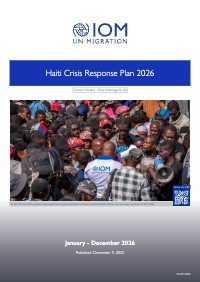
Haiti Crisis Response Plan 2026
Cohort Country - Early Warnings for All
At the "Kid" site, IOM conducts needs assessments to guide distributions of essentials like blankets, kitchen sets, and water containers. © IOM 2025
January - December 2026
Published: December 9, 2025
© IOM 2025
Access the CRP
Haiti Crisis Response Plan 20262
IOM VISION
IOM envisions a Haiti where, despite the ongoing crises, families are more secure,
institutions trusted, and communities resilient. By empowering national partners,
strengthening governance, and coordinating humanitarian, development, and
peace efforts, IOM aims to prevent and minimize displacement, foster safe
migration pathways, and restore dignity through reliable services. IOM’s strategy
emphasizes national ownership, and sustainable solutions, ensuring investments
leave lasting impact. Success means fewer humanitarian needs as stability, safety,
and opportunity become reality for all Haitians. Together with the government
and partners, IOM strives to break cycles of vulnerability, future-proof responses,
and build a foundation for long-term recovery and sustainable development.
Published: December 9, 2025
$60,000,000
Funding Required
875,000
People Targeted
15
Entities Targeted
PRIMARY TARGET GROUPS
Internally displaced person1.
Local population / community2.
Internal migrant3.
International migrant4.
Former combatant / fighter5.
CONTACT INFORMATION
iomhaitiprogramsupportunit@iom.int
IOM PROPOSED RESPONSE
Donate to
Haiti
Saving lives and protecting people on
the move
Driving solutions to displacementFacilitating pathways for regular
migration
$39,600,000
FUNDING REQUIRED
$18,500,000
FUNDING REQUIRED
$1,900,000
FUNDING REQUIRED
400,000
PEOPLE TARGETED
300,000
PEOPLE TARGETED
100,000
PEOPLE TARGETED
8
ENTITIES TARGETED
5
ENTITIES TARGETED
7
ENTITIES TARGETED
Haiti Crisis Response Plan 20263
BREAKDOWN OF FUNDING REQUIREMENTS (USD) 2026
ACTIVITY AREAS 2026
Data for action, insight and foresight $5,500,000
Camp coordination and camp management $5,000,000
Shelter and settlements $5,000,000
Water, sanitation and hygiene $8,000,000
Health $1,000,000
Mental health and psychosocial support $1,500,000
Protection $2,000,000
Peacebuilding, violence and conflict reduction $4,000,000
Livelihoods and economic recovery $3,500,000
Community stabilization and community-driven development $5,000,000
Disaster risk management $6,000,000
Humanitarian border management and search and rescue $1,500,000
Movement assistance $3,000,000
Legal identity and consular services $1,500,000
Support services for response actors $6,500,000
Accountable, inclusive, and protection-centered approach $1,000,000
TOTAL FUNDING REQUIRED $60,000,000
IOM ADDED VALUE
IOM has maintained a unique operational capacity in Haiti since 1994, and is the most
operational UN agency in the country. This presence combined with IOM’s multisectoral
expertise enables rapid, effective humanitarian response, robust mobility management, and
strong support for recovery efforts and development.
Haiti Crisis Response Plan 20264
OPERATIONAL PRESENCE IN HAITI
Haiti Crisis Response Plan 20265
CONTEXT ANALYSIS
At the border reception point, IOM provides immediate support to help people regain stability and
begin the process of reintegration after deportation from the Dominican Republic. © IOM 2025
INFORM Risk 7.4, Very high
INFORM Severity 5, Very high
Human Development Index 166 out of 193, Low
State of Fragility Extreme fragility
* Data as of publishing / update date.
Haiti remains in a state of extreme fragility, facing
overlapping political, economic, environmental, social, and
security crises. The resignation of Prime Minister Ariel
Henry in 2024 triggered a new wave of instability, with the
transitional government struggling to assert control. As of
mid-2025, over 90 per cent of Port-au-Prince is estimated
to be under gang control (UN News 2025), with 4,864
people killed between October 2024 and June 2025 (UN
News 2025).
The economy has contracted for six consecutive years
(IFAD 2025), with inflation reaching 28.4 per cent (World
Bank 2025) and nearly half the population experiencing
acute food insecurity (UN News 2025). Environmental
vulnerabilities compound the crisis. While Haiti was spared
major hurricanes in 2024, heavy rains caused flooding in
six departments. Urban overcrowding, deforestation, and
soil erosion continue to drive rural-urban migration,
particularly into the capital. Social cohesion is under severe
strain, with vigilante groups emerging in response to the
absence of state protection.
Haiti’s crisis is characterized by internal displacement,
forced returns, and irregular migration. As of September
2025, over 1.4 million people are internally displaced
(DTM 2025) —a 10 per cent increase since July 2025.
About 15 per cent of internally displaced persons (IDPs)
are hosted in more than 230 displacement sites and
collective centres. Displacement is driven by gang violence,
particularly in the Metropolitan Area of Port-au-Prince
(MAPAP). Deportations from the Dominican Republic
averaged 1,000 per day between October 2024 and
September 2025, adding 272,420 returnees—nearly 5 per
cent of the national population (ONM and IOM 2025) .
These flows overwhelm reception systems and exacerbate
protection risks. Displacement sites are overcrowded and
lack basic services, exposing residents to health risks and
gender-based violence, including sexual exploitation and
abuse. Cross-border mobility is further constrained by
potential rollbacks of Temporary Protected Status and
United States parole programmes, threatening remittance
flows that account for over 15 per cent of the country’s
gross domestic product (GDP) (World Bank 2025) . In
this context, IDPs occupying collective centres such as
schools are exposed to often forced, unpredictable and
unsustainable evictions to allow for the reopening of
schools, hence subjecting already vulnerable IDPs to
increased protection risks and secondary - and even
tertiary displacement.
Key drivers include political instability, weak governance,
Haiti Crisis Response Plan 20266
and the absence of rule of law. The collapse of public
institutions has created a vacuum filled by armed groups.
Economic collapse, food insecurity, and environmental
degradation further drive displacement and irregular
migration. Deportations and limited legal pathways for
migration increase vulnerability, while donor hesitancy and
underfunded appeals restrict humanitarian response.
The convergence of displacement, violence, and economic collapse has created a downward spiral. Mobility patterns are increasingly
involuntary and survival-driven. Displacement disrupts education, livelihoods, and access to healthcare, particularly for women and
children. The erosion of trust in institutions and the rise of vigilante justice risk tipping the country into civil conflict. Humanitarian
access is severely constrained, and aid delivery is frequently disrupted by insecurity and infrastructure breakdowns.
INTERNALLY DISPLACED PEOPLE IN HAITI
* Data: IOM. Displacement Tracking Matrix. Accessed on February 8, 2026, 9:08 am
Europe/Geneva. DTM API. Aggregated latest number of IDPs for all operations.
MISSING MIGRANTS FROM HAITI
* Data: IOM. Missing Migrants project. Accessed on February 8, 2026, 9:08 am
Europe/Geneva. Data represent minimum estimates.
COORDINATION
IOM Haiti operates within a complex landscape of governmental, inter-agency, and bilateral coordination mechanisms to ensure a
coherent and effective crisis response. At the national level, IOM is an active participant in both the Humanitarian Country Team
(HCT) and the UN Country Team (UNCT), where it engages in regular meetings, joint planning activities, and strategic information
sharing to maximize collective resources and minimize assistance duplication. IOM holds leadership and co-leadership roles, notably
co-leading the Shelter/Non-Food Items (SNFI) Cluster and the Camp Coordination and Camp Management (CCCM) Cluster
alongside the Housing and Public Construction Unit (UCLBP) and the General Directorate of Civil Protection (DGPC), and co-
leading the Migrant Protection Working Group and the Inter-Agency Working Group on Disarmament, Demobilization, and
Reintegration (DDR).
CAPACITY
Since the opening of IOM’s country operations in 1994, IOM has closely worked with the Government of Haiti (GoH) on migration
management and capacity-strengthening programmes, addressing internal displacement and international migration caused by years
of turmoil. Guided by the IOM Regional Office for Latin America, and the Caribbean, IOM Haiti supports the GoH in identifying
and addressing migration and displacement challenges. IOM has also extended its cooperation with the government to address the
effects of disasters on vulnerable people and promote resilience and coping mechanisms.
IOM Haiti coordinates its activities through its main office in Port-au-Prince, a sub-office in Cap Haitien, and four satellite offices in
Haiti Crisis Response Plan 20267
Camp Perrin, Ouanaminthe, Gonaives and Belladere. IOM maintains a robust nationwide presence, enabling the effective
implementation of interventions across the country.
To support crisis response, IOM maintains pre-positioned non-food item (NFI) stocks in partnership with the Directorate of Civil
Protection (DGPC) at key locations including Belladere, Gonaives, Jeremie, Port-au-Prince, Les Cayes, and Cap Haitien. Emergency
supplies from these stocks can be quickly deployed prior to and during disasters, ensuring early action and rapid response. As part
of the response to the displacement crisis, through direct implementation and implementing partners, IOM is implementing essential
camp coordination and camp management (CCCM) interventions in more than 50 sites in the MAPAP and through community
resource centers adopting an area-based approach. IOM has a dedicated Protection from Sexual Exploitation, Abuse, and
Harassment (PSEAH) Officer in Haiti, advising on risk mitigation within IOM operations, ensuring a survivor-centred approach, and
reinforcing inter-agency safeguarding coordination as part of the broader crisis response.
IOM has also helped establish four Border Resource Centres (BRCs) at official crossings (Ouanaminthe, Belladere, Malpasse, and
Anse-a-Pitres). Operated by state registration agents, BRCs offer emergency aid to vulnerable migrants, especially those forcibly
returned. Services include psychosocial support (with special attention to women and children), medical aid, temporary shelter, and
movement assistance. IOM also supports access to legal documents for migrants through assistance to Document Identity
Reception and Delivery Centres (Centre de Réception et de Livraison de Documents d’Identité - CRLDI).
Additionally, IOM’s initiatives bolster stability and social cohesion by strengthening local leadership, supporting public institutions,
promoting inclusive dialogue, and rehabilitating public infrastructure, especially in displacement-affected areas. IOM also promotes
livelihood opportunities to strengthen the resilience and self-reliance of vulnerable deported migrants, IDPs and host community
members, including through a focus on agriculture and green reintegration.
ENGAGING WITH GOVERNMENT
IOM is committed to supporting the Haitian Government’s leadership in crisis response, recognizing that robust government
engagement and capacity are prerequisites for sustainable recovery. At the national level, IOM provides technical assistance to key
ministries and agencies, including the National Office for Migration (Office National de la Migration, ONM), the General Directorate
of Civil Protection (Direction Générale de la Protection Civile, DGPC), the Housing and Public Construction Unit (Unité de
Construction de Logements et de Bâtiments Publics, UCLBP), the Ministry of the Interior, the Ministry of Foreign Affairs, and the
Ministry of Haitians Living Abroad (Ministère des Haïtiens Vivant à l'Étranger, MHAVE), focusing on the institutionalization of
migration governance, service delivery, and preparedness. IOM supports legislative and policy development, assists in the
management of displacement sites, and enhances government data collection and management capacities, particularly through its
longstanding partnership with the General Directorate of Civil Protection.
At the sub-national and local levels, IOM actively collaborates with municipal authorities, the Boards of the Municipal Sections
(Conseils d’Administration des Sections Communales, CASECs), and the Assemblies of the Communal Sections (Assemblées des
Sections Communales, ASECs) to strengthen localized preparedness and response mechanisms. This includes technical support for
identity documentation delivery (e.g., Reception and Delivery Centre for Identity Documents / Centre de Reception et Livraison des
Documents d’Identité), and initiatives to address education and protection for displaced children and forcibly returned migrants. In
displacement sites, IOM collaborates with the DGPC in the active management and administration of collective centres and informal
settlements. Complementarily, with IOM co-leadership, the CCCM Cluster also provides active institutional capacity strengthening
support to DGPC entities across the country.
Regionally, IOM plays a pivotal role in facilitating binational dialogue and cooperation with the Dominican Republic, organizing high-
level meetings and joint mechanisms to improve border management and counter cross-border trafficking. Through the Dialogue
Cell and coordination with platforms such as the Organization of American States (OAS), IOM ensures that government
engagement expands beyond national borders and is integrated into regional crisis management frameworks.
Haiti Crisis Response Plan 20268
IOM RESPONSE
CROSS CUTTING PRIORITIES
Data and evidence
Protection mainstreaming
Gender equality
Prevention of sexual exploitation and abuse
Disaster risk and climate change
Law and policy
KEY OPERATING MODALITIES
Participation and empowerment
Conflict sensitivity
Integrated programming
Collaboration and partnership
Localization
Cash-based interventions
UN PARTNERSHIPS
IOM is committed to supporting the Haitian Government’s leadership in crisis response, recognizing that robust government
engagement and capacity are prerequisites for sustainable recovery. At the national level, IOM provides technical assistance to key
ministries and agencies, including the National Office for Migration (Office National de la Migration, ONM), the General Directorate
of Civil Protection (Direction Générale de la Protection Civile, DGPC), the Housing and Public Construction Unit (Unité de
Construction de Logements et de Bâtiments Publics, UCLBP), the Ministry of the Interior, the Ministry of Foreign Affairs, and the
Ministry of Haitians Living Abroad (Ministère des Haïtiens Vivant à l'Étranger, MHAVE), focusing on the institutionalization of
migration governance, service delivery, and preparedness. IOM supports legislative and policy development, assists in the
management of displacement sites, and enhances government data collection and management capacities, particularly through its
longstanding partnership with the General Directorate of Civil Protection.
At the sub-national and local levels, IOM actively collaborates with municipal authorities, the Boards of the Municipal Sections
(Conseils d’Administration des Sections Communales, CASECs), and the Assemblies of the Communal Sections (Assemblées des
Sections Communales, ASECs) to strengthen localized preparedness and response mechanisms. This includes technical support for
identity documentation delivery (e.g., Reception and Delivery Centre for Identity Documents / Centre de Reception et Livraison des
Documents d’Identité), and initiatives to address education and protection for displaced children and forcibly returned migrants. In
displacement sites, IOM collaborates with the DGPC in the active management and administration of collective centres and informal
settlements. Complementarily, with IOM co-leadership, the CCCM Cluster also provides active institutional capacity strengthening
support to DGPC entities across the country.
Regionally, IOM plays a pivotal role in facilitating binational dialogue and cooperation with the Dominican Republic, organizing high-
level meetings and joint mechanisms to improve border management and counter cross-border trafficking. Through the Dialogue
Cell and coordination with platforms such as the Organization of American States (OAS), IOM ensures that government
engagement expands beyond national borders and is integrated into regional crisis management frameworks.
Haiti Crisis Response Plan 20269
Objective 1
SAVING LIVES AND PROTECTING PEOPLE ON THE MOVE
FUNDING REQUIRED
$39,600,000
ENTITIES TARGETED
8
PEOPLE TARGETED
400,000
PRIMARY TARGET GROUPS
Internally displaced person
Local population / community
Internal migrant
International migrant
LONG TERM OUTCOMES
65%
Human suffering is alleviated
15%
Threats and vulnerabilities are
reduced
20%
The quality of humanitarian
assistance is enhanced
Intended outcomes
Under Objective 1, IOM aims to reduce risks and uphold the safety, dignity, and protection of crisis-affected populations in Haiti.
The planned activities will deliver life-saving assistance and protection services to internally displaced persons (IDPs), forcibly
returned migrants, and community members. These include camp coordination and camp management (CCCM), the provision of
shelter, health care, water, sanitation and hygiene (WASH), non-food items, medical and psychosocial support, alongside
strengthened protection referral pathways and access to specialized services such as child protection and gender-based violence
/sexual exploitation and abuse response.
Through coordinated humanitarian interventions, IOM will ensure equitable access to assistance and reduce barriers for
marginalized populations. Robust mobility data will inform targeted responses, while community engagement will enhance
accountability and ensure that affected populations participate in decision-making. Humanitarian coordination mechanisms will be
reinforced to improve the quality and coherence of response efforts. Efforts will also focus on enhancing border management
systems that uphold human rights and safety, while promoting innovative and flexible mobility solutions.
Together, these activities will contribute to short-term outcomes such as improved living conditions and meaningful access to
protection, and long-term outcomes including enhanced humanitarian systems, better-quality funding, and strengthened
partnerships. This integrated approach ensures that IOM’s crisis response in Haiti is principled, inclusive, and responsive to the
evolving needs of people on the move.
Objective 2
DRIVING SOLUTIONS TO DISPLACEMENT
FUNDING REQUIRED
$18,500,000
ENTITIES TARGETED
5
PEOPLE TARGETED
300,000
PRIMARY TARGET GROUPS
Internally displaced person
Local population / community
Former combatant / fighter
Internal migrant
International migrant
LONG TERM OUTCOMES
20%
Adverse drivers of displacement
are minimized
40%
Displaced people are resilient
and self-reliant
40%
Displaced people benefit from
solutions
Intended outcomes
Under Objective 2, IOM will work to reduce displacement risks and support durable solutions for people affected by crisis in Haiti.
Haiti Crisis Response Plan 202610
The planned activities aim to address the root causes of displacement, such as violence, environmental degradation, and economic
collapse, while strengthening the resilience and self-reliance of displaced populations and host communities.
Through integrated programming, IOM will expand access to housing, land and property rights, sustainable livelihoods, and essential
services including health, education, and WASH. Transitional CCCM operations will also support initiatives to enhance IDPs access
to general and household-level sustainable solutions depending on the evolution of the security context including return, relocation
or local integration. Community-based planning and inclusive governance approaches will be used to promote social cohesion and
peaceful coexistence. Environmental sustainability and disaster risk reduction will be embedded across operations to mitigate future
displacement risks and strengthen resilience. This will be done through capacity strengthening, early warning systems, risk reduction
infrastructure, and community-based preparedness across displacement-affected communities.
These activities will contribute to short-term outcomes such as improved living conditions and access to services, and long-term
outcomes including strengthened systems for displacement prevention, recovery, and adaptation. By working with government and
local actors, IOM will ensure that solutions are safe, voluntary, and dignified, and that displaced populations are included in policy
processes and development planning.
Objective 3
FACILITATING PATHWAYS FOR REGULAR MIGRATION
FUNDING REQUIRED
$1,900,000
ENTITIES TARGETED
7
PEOPLE TARGETED
100,000
PRIMARY TARGET GROUPS
Internally displaced person
Local population / community
Internal migrant
International migrant
LONG TERM OUTCOMES
40%
Channels for regular migration
are sustainable and responsive
40%
Migration flows and cross-
border mobility are well
managed
5%
Migration policy and legal
frameworks are aligned with
international standards
15%
Migrants are protected from
violence, exploitation and abuse
Intended outcomes
Under Objective 3, IOM will support the Haitian government and regional partners to expand safe, dignified, and inclusive migration
pathways. The planned activities are designed to address and reduce the risks of irregular migration and displacement, particularly
those heightened by crisis situations that may act as drivers of irregular migration or exacerbate migrants’ vulnerabilities. By
strengthening systems for civil registration, identity management, and immigration processing, these efforts seek to mitigate the
impact of crises that can make reintegration more challenging for migrants. IOM will provide technical assistance to enhance access
to legal identity, visa services, and voluntary return and reintegration mechanisms, thereby supporting migrants affected by crises and
helping to reduce the risks associated with displacement and irregular migration.
These activities will contribute to short-term outcomes such as increased access to regular migration channels and improved
protection for migrants. Long-term outcomes include strengthened migration governance, reduced exploitation, and enhanced
development benefits through diaspora engagement and remittance flows. This approach ensures that migration is safe, orderly, and
beneficial for both migrants and communities.
Haiti Crisis Response Plan 202611
Cross-cutting priority
Accountable, inclusive, and protection-centered approach
FUNDING REQUIRED
$1,000,000
RELATED INTER AGENCY PLANS
H(N)RP UNSDCF
BREAKDOWN BY OBJECTIVE
60%Saving lives
25%Solutions to displacement
15%Pathways for regular migration
IOM Haiti’s approach will ensure the rights and well-being of crisis-affected populations are central to all operations, reflecting
institutional and global commitments to protection and inclusion. Sectoral interventions will be guided by a rights-based, “do no
harm” framework, with protection outcomes and risk reduction systematically integrated across all activities. Safeguards such as
gender and disability inclusion, accountability to affected populations (AAP), and protection from sexual exploitation and abuse
(PSEA) will be mainstreamed across every sector.
Safe and dignified programming: All interventions will incorporate protection risk analyses and “do no harm” strategies. Staff
will receive training on mitigating gender-based violence (GBV) risks and child safeguarding, ensuring meaningful access to
assistance for women, children, persons with disabilities, and other vulnerable groups.
Community engagement and accountability: Inclusive community committees and feedback mechanisms will be established,
enabling affected people—especially displaced women, youth, and persons with disabilities—to participate in decision-
making. Feedback will be collected through channels such as hotlines (e.g., the 8840 hotline) and complaint mechanisms,
ensuring the response will be adapted to the evolving priorities and preferences of those impacted.
Protection mainstreaming: Each sectoral intervention (CCCM, Shelter, WASH, etc.) will be designed to reduce protection
risks and ensure referrals to specialized support when needed. Coordination with protection actors will enable the
identification and assistance of at-risk groups, such as GBV survivors, trafficked persons, and unaccompanied children,
ensuring no one is left behind.
PSEA and ethical conduct: A zero-tolerance policy on PSEA will be enforced through regular training for staff and partners,
participation in the inter-agency PSEA Network, and the deployment of dedicated PSEA focal points. Safe, confidential
reporting channels will be maintained to address and respond to allegations promptly.
Inclusion and empowerment: Gender equality, disability inclusion, and diversity will be promoted throughout programme
design and implementation. Women’s groups, youth representatives, and disability advocates will be consulted to tailor
assistance to community needs, ensuring that affected populations will be recognized as key partners in their own recovery.
IOM teams listen directly to families’ stories and document their needs, ensuring that assistance responds to the realities they face in displacement. © IOM 2025
Haiti Crisis Response Plan 202612
ACTIVITY AREAS
Data for action, insight and foresight
TOTAL FUNDING REQUIRED
$5,500,000
RELATED INTER AGENCY PLANS
H(N)RP
IOM Haiti will strengthen evidence-based crisis response and planning by expanding its data systems and analytical tools under its
Displacement Tracking Matrix (DTM) to monitor displacement, migration (including forcibly repatriated migrants), and vulnerability
trends. This data will help the Government of Haiti and relevant actors to design and implement evidence-based interventions.
IOM’s proposed interventions include:
Conduct country-wide Mobility Tracking.
Conduct Emergency Tracking Tool (ETT) after sudden events.
Deploy Flow Monitoring at official and unofficial points of entry to track cross-border movements and migration trends.
Integrate protection indicators (GBV, trafficking, housing) into DTM datasets to support targeted interventions.
Develop post-disaster and thematic assessment tools in collaboration with government and cluster partners to guide
emergency and recovery planning.
Strengthen capacity of national institutions such as DGPC, ONM, and the DIE (Direction de l’Immigration et de
l’Émigration/Directorate of Immigration and Emigration) in data collection, analysis, and information management to ensure
sustainability and ownership.
Produce in-depth research on migration drivers, profiles, and vulnerabilities to inform policy and programming.
Conduct data collection on missing migrants for families/returnees who may wish to report.
Camp coordination and camp management
TOTAL FUNDING REQUIRED
$5,000,000
RELATED INTER AGENCY PLANS
H(N)RP
IOM will continue to support the Government of Haiti in coordinating and managing displacement sites, particularly in the
Metropolitan Area of Port-au-Prince and affected provinces, mainly two other Departments. IOM will also continue to co-lead the
CCCM Cluster together with the Government.
IOM’s proposed interventions include:
Deploy mobile site management teams in the event of acute shocks (conflict or natural hazards) for the implementation of
direct site management and work with implementing partners.
Ensure that humanitarian standards are attained to the best of the response’s abilities through service monitoring, mapping
mechanisms and referral and coordination with humanitarian services providers to improve access to humanitarian
assistance in the sites.
Haiti Crisis Response Plan 202613
Implement site care and maintenance interventions and enhance the provision of services to improve the safety and living
conditions of IDPs in the sites.
Establish inclusive site committees and strengthen their capacities to ensure meaningful participation of women, youth,
persons with disabilities, and other marginalized/vulnerable groups.
Strengthen CCCM partners' capacities, committees and DGPC volunteers through training on site management, community
engagement, protection referrals, and prevention of sexual exploitation and abuse (PSEA), as well as fire prevention and
response.
Operate Community Resource and Information Centres (CRCs) adopting an area-based approach to support IDPs in host
communities with access to multisectoral humanitarian and social services and information.
Promote community participation and empowerment in displacement settings, especially through tailored and targeted
projects for women and children.
Maintain efficient, transparent and accessible feedback and accountability mechanisms in sites and CRCs.
Facilitate access to protection services, psychosocial support, and reintegration referrals for vulnerable individuals in sites.
Support communities to access sustainable solutions if the security situation improves in certain areas.
Shelter and settlements
TOTAL FUNDING REQUIRED
$5,000,000
RELATED INTER AGENCY PLANS
H(N)RP
To address the shelter and settlements needs of displaced populations and communities in vulnerable situations, IOM will
implement a comprehensive response that spans emergency relief, stabilization, and durable solutions. Activities will be delivered
through in-kind and cash-based modalities. IOM will also continue to co-lead the SNFI Cluster together with the Government.
IOM’s proposed interventions include:
Conduct structural evaluations and rehabilitation of evacuation shelters (including schools and hospitals).
Ensure site planning, including improving site conditions through maintenance and upgrading.
Distribute shelter materials and essential household items (NFIs).
Provide rental assistance for vulnerable displaced households to access safe and dignified housing.
Support for host families that are accommodating IDPs.
Rehabilitate and construct infrastructure (water points, schools, communal spaces etc.) and shelters in newly liberated areas,
which to the extent possible are aligned with the “Build Back Better” principles and strategies to prevent or limit the impact
of hazards like earthquakes, floods, and storms.
Strengthen SNFI Cluster coordination and information management and enhance support to cluster partners.
Support humanitarian corridors and relocations from high-risk hubs, guided by Stability Index foresight.
Haiti Crisis Response Plan 202614
Water, sanitation and hygiene
TOTAL FUNDING REQUIRED
$8,000,000
RELATED INTER AGENCY PLANS
H(N)RP
IOM is focused on strengthening national WASH systems and strengthening the resilience of vulnerable communities through a
strategic partnership with authorities such as the Direction Nationale de l’Eau Potable et de l’Assainissement (DINEPA, the National
Direction for Potable Water and Sanitation) and local authorities. The approach leverages a community-centred model based on
collected data, that synergizes emergency WASH response with the development of sustainable infrastructure and hygiene
promotion, utilizing both technical implementation and cash-for-work modalities to ensure efficacy, ownership, and local economic
empowerment.
IOM’s proposed interventions include:
Rehabilitate water points and distribution pipelines.
Install solar-powered water supply systems.
Conduct water trucking (as a last resort measure for newly displaced populations).
Conduct regular monitoring of water quality using bacteriological kits, aligned with WHO standards.
Establish and train WASH committees in IDP sites.
Conduct hygiene promotion campaigns in IDP sites and host communities.
Distribute hygiene kits and menstrual hygiene management (MHM) kits, in-kind or through cash modalities.
Rehabilitate sanitation facilities (latrines, showers), desludging, and vector control.
Implement waste management and drainage cleaning through cash-for-work initiatives in IDP sites and host communities.
Reinforce drainage channels through rehabilitation and erosion protection.
Support cholera treatment centres and provide WASH materials.
Health
TOTAL FUNDING REQUIRED
$1,000,000
RELATED INTER AGENCY PLANS
H(N)RP UNSDCF
IOM will provide life-saving health services and referrals for displaced populations, returnees, forcibly repatriated migrants and host
communities, particularly in underserved areas and displacement sites.
IOM’s proposed interventions include:
Deploy mobile health clinics to provide primary care consultations, referrals, and hygiene kits in displacement hotspots and
border zones.
Assess and support cholera treatment centres as part of infection prevention and control (IPC) efforts.
Conduct health promotion and risk communication and community engagement (RCCE) to prevent cholera and other
communicable diseases, especially in overcrowded sites.
Supply medication for minor medical conditions.
Formalize referral pathways between community mechanisms (e.g., CRCs, safe spaces) and institutional services (e.g., health,
Haiti Crisis Response Plan 202615
justice).
Mental health and psychosocial support
TOTAL FUNDING REQUIRED
$1,500,000
RELATED INTER AGENCY PLANS
H(N)RP
IOM will strengthen community well-being by enhancing individuals’, families’ and groups’ psychosocial skills. These initiatives focus
on empowering people to support and maintain positive mental health through a range of strategies, including prevention, early
identification, and referral for those experiencing psychological distress. Central to these efforts are the development of abilities
such as recognizing signs of distress, facilitating access to appropriate support, managing stress and emotions, practicing positive
parenting, and fostering non-violent communication.
IOM’s proposed interventions include:
Strengthen the capacities of community actors in areas prone to displacement and migration (e.g., on positive parenting,
non-violent communication, psychological first aid) to foster a supportive and understanding environment.
Continue building the capacities of mental health committees to enable the identification, referral, and follow-up of IDPs and
affected members of host communities in the sites, ensuring appropriate psychosocial support.
Establish safe spaces for dialogue and community cohesion, helping individuals process distress and reintegrate into society.
Provide psychosocial support and information to families of missing migrants.
Protection
TOTAL FUNDING REQUIRED
$2,000,000
RELATED INTER AGENCY PLANS
H(N)RP
To support migrants in vulnerable situations and internally displaced persons, IOM will deliver protection-focused assistance in close
consultation with communities. Special attention will be given to the meaningful participation of women, children, older persons,
people with disabilities, and other at-risk groups.
IOM’s proposed interventions include:
Strengthen prevention, detection, and response to protection risks in displacement sites and host communities through
awareness-raising, community mobilization, case management, and advocacy in coordination with government actors and the
Protection Cluster.
Enhance community capacities by identifying and training focal points to respond to protection incidents. IOM will also
contribute to child protection mechanisms and promote safe environments for children in sites and border areas, in
collaboration with l’Institut du Bien-Être Social et de Recherches (IBESR, Institute of Social Well-Being and Research), site
managers, and border authorities.
Provide support to forcibly returned migrants through post-arrival protection and reintegration services. Survivors of
Haiti Crisis Response Plan 202616
gender-based violence (GBV) and victims of trafficking will receive access to temporary shelters, assistance packages, and
specialized case management, including referrals for mental health and psychosocial support (MHPSS).
Conduct awareness campaigns on trafficking and GBV that target at-risk communities and frontline providers. Community
actors and first responders will be trained to detect and respond to GBV, trafficking, and child protection risks, integrating
protection into stabilization and recovery efforts.
Strengthen government and institutional capacities to prevent and respond to human trafficking through training and the
development of multi-sectoral coordination mechanisms, enhancing national response and protection for vulnerable
populations.
Peacebuilding, violence and conflict reduction
TOTAL FUNDING REQUIRED
$4,000,000
RELATED INTER AGENCY PLANS
H(N)RP
IOM will implement targeted peacebuilding and violence reduction initiatives to restore trust, reduce tensions, and support
stabilization in communities affected by displacement, gang violence, and institutional collapse. These efforts are aligned with the
National DDR-CVR Strategy (SNDDR-RVC), to which IOM is a contributing member.
IOM’s proposed interventions include:
Facilitate inclusive dialogue platforms and community decision-making mechanisms to promote reconciliation and
participatory governance.
Strengthen coordination between DDR/RVC actors through the coordination of the DDR Working Group in order to
support the State in implementing national strategies and initiatives in this area.
Promote cultural and sports activities, as well as vocational training, to provide alternatives for youth and women.
Conduct awareness campaigns, theatre clinics on conflict prevention and armed groups recruitment awareness.
Reinsertion: Provide economic support, trainings, capital seed and psychosocial assistance for youth disengaged from armed
groups.
Community policing dialogue: Install roundtables between the community police and the community to build trust and
enhance security.
Haiti Crisis Response Plan 202617
Livelihoods and economic recovery
TOTAL FUNDING REQUIRED
$3,500,000
RELATED INTER AGENCY PLANS
H(N)RP UNSDCF
To support durable returns and reduce vulnerability to re-displacement and irregular migration, IOM will implement livelihoods and
economic recovery activities that prioritize youth, women, and displacement-affected communities. These interventions aim to
generate income, build resilience, and foster social cohesion through inclusive, locally anchored approaches.
IOM’s proposed interventions include:
Link return and reintegration assistance with cash-for-work, vocational training, and accredited skills pathways.
Establish apprenticeships and trainings with micro-grants support tailored for youth and women.
Strengthen the livelihoods of vulnerable migrant and IDP women and children through activities tailored to the specific risks
they face such as agroecology, literacy and women empowerment trainings.
Allocate grants to vulnerable women to facilitate the implementation of their income-generating activities, accompanied by
technical support tailored to their choices.
Coordinate with state authorities and private sector actors to align training with market demand and promote sustainability.
Target high-risk areas for economic recovery to reduce migration pressures and strengthen community stabilization.
Community stabilization and community-driven development
TOTAL FUNDING REQUIRED
$5,000,000
RELATED INTER AGENCY PLANS
H(N)RP
IOM supports both the state authorities of Haiti and communities affected by displacement, violence, and economic hardship,
focusing on rebuilding trust between citizens and the state and fostering long-term solutions. These efforts aim to reestablish the
social contract, strengthen, informed by the Stability Index, social cohesion, and empower local leadership. Informed by the Stability
Index, the approach prioritizes creating the conditions necessary for stability and the restoration of state services, especially in areas
hosting IDPs or welcoming returnees (former IDPs and forcibly returned migrants), to ensure the delivery of essential services and
effective governance.
IOM’s proposed interventions include:
Rehabilitate of community spaces: implementation of targeted rehabilitation projects, including the restoration of public
infrastructure and community spaces, to improve living conditions and strengthen trust between citizens and the State.
Support participatory and inclusive community planning: facilitate dialogue platforms between local authorities, returnee
populations, and host communities to ensure that reintegration projects are based on collectively identified needs and
priorities. This helps to strengthen local ownership of the projects.
Upgrade infrastructure and equipment for local authorities’ community spaces to manage stabilization and recovery activities.
Support the state’s development plan by prioritizing recovery in provincial growth poles through area-based approaches
(ABA).
Haiti Crisis Response Plan 202618
Disaster risk management
TOTAL FUNDING REQUIRED
$6,000,000
RELATED INTER AGENCY PLANS
H(N)RP UNSDCF
IOM will implement a comprehensive disaster risk management strategy to reduce vulnerability, strengthen preparedness, and
enhance resilience across displacement-affected communities.
IOM’s proposed interventions include:
Strengthen the capacity of national and local authorities (DGPC, ONM, local bodies) to anticipate and respond to hazards
through training, simulation exercises, and technical assistance.
Use community resource centres to raise awareness of disaster risks, identify and reinforce community coping mechanisms,
and promote community-led prevention and mitigation projects.
Expand early warning systems and risk information platforms in consultation with communities and authorities.
Promote anti-seismic and cyclone-resistant construction that also serve as evacuation centres.
Activate and transform COUDs (Centre Opérationnel d’Urgence Départemental / Departmental Emergency Operational
Centre) into multifunctional hubs offering several social and emergency services.
Conduct assessments of high-risk coastal areas to identify nature-based solutions such as mangrove restoration and planting
protective vegetation.
Support climate-resilient agriculture, plantations to stabilize soils, reduce flood risks, and enhance food security.
Integrate disaster preparedness into municipal planning, including evacuation drills and Build Back Safer principles.
Undertake nationwide landslide risk analyses and develop training materials to empower communities and farmers with
erosion containment techniques like the swales method.
Conduct a countrywide road and access assessment to identify critical zones where limited access intersects with high
disaster risk.
Support national hydrometeorological initiatives for disaster detection and monitoring, including collaboration with Centre
National de l'Information Géo-Spatiale (CNIGS, National Geospatial Information Centre), through equipment provision and
professional training.
Pilot innovative monitoring systems (e.g., IoT-enabled sensors) for flash flood early warnings.
Study construction material strength to inform building codes.
Rehabilitate public infrastructure such as drainage systems, water points, watersheds, and culverts.
Operationalize community alert networks (hotlines, radio trees, SMS) linked to early-warning triggers from predictive tools
such as the Stability Index.
Support disaster preparedness in border areas and COUDs through training, joint simulations, awareness campaigns, and
strategic stockpiling.
Haiti Crisis Response Plan 202619
Humanitarian border management and search and rescue
TOTAL FUNDING REQUIRED
$1,500,000
IOM will support Haitian institutions in improving infrastructure, coordination, and protection mechanisms at points of entry. These
activities aim to reduce exploitation, reinforce state presence, and improve reception capacity amid high-volume deportations and
porous borders.
IOM’s proposed interventions include:
Enhance border management and protection systems at official posts, providing border management, rights-based training
for border personnel, and integrating migration data tools into national planning.
Strengthen anti-trafficking and protection frameworks, embedding referral pathways, establishing protection desks, and
reinforcing child-sensitive, victim-centred strategies at the borders.
Improve reception and response capacity at borders by piloting cross-border cooperation packages, upgrading WASH and
municipal coordination, supporting patrols, and ensuring comprehensive services at reception centres.
Movement assistance
TOTAL FUNDING REQUIRED
$3,000,000
RELATED INTER AGENCY PLANS
H(N)RP
To support Haitian migrants, who have been affected by ongoing forced and spontaneous returns, primarily from the Dominican
Republic, IOM will provide safe, dignified, and rights-based movement assistance. Interventions will ensure that returnees have access
to immediate assistance and longer-term solutions.
IOM’s proposed interventions include:
Provide humanitarian assistance at the entry point and during onward travel, including food, water, non-food items, medical
care, protection services and referrals to address urgent needs.
Support family reunification in coordination with Haitian authorities and partners, including tailored assistance for
unaccompanied and separated children and other vulnerable individuals.
Collaborate with regional programmes to facilitate family reunification in third countries, ensuring safe and legal mobility
pathways for Haitians seeking protection or reunification with relatives abroad.
Haiti Crisis Response Plan 202620
Legal identity and consular services
TOTAL FUNDING REQUIRED
$1,500,000
To promote access to legal identity and documentation for displaced populations, returnees, and vulnerable migrants, IOM will
implement a coordinated approach that strengthens national systems, expands service delivery, and enhances protection. These
activities aim to reduce exclusion, support reintegration, and enable access to essential services.
IOM’s proposed interventions include:
Scale up the CRLDI network through mobile units and “ID corners” in reception and community resource centres.
Digitize registries in partnership with Archives Nationales, ONI, and DIE, and pilot secure digital IDs linked to service access.
Support the modernization of consular services to ensure predictable, transparent documentation processes.
Implement awareness campaigns on regular migration pathways and legal identity, targeting communities and Haitian
consulates abroad.
Promote access to birth certificates, ID cards, and passports, and improving visibility of state services through signage at key
sites.
Enhance consular support for undocumented or stateless Haitians in up to five high-return countries, including capacity
strengthening for consular staff and advocacy for migrant rights and protection.
Support Haitian consular services in the Dominican Republic to institutionalize manifest sharing, improve deportation
management, and advocate for migrant protection.
Facilitate communication with consulates and authorities for the search of missing migrants.
Support services for response actors
TOTAL FUNDING REQUIRED
$6,500,000
RELATED INTER AGENCY PLANS
H(N)RP
To ensure timely, coordinated, and effective humanitarian response in Haiti’s volatile operational environment, IOM will continue to
provide critical support services to response actors and pre-positioned humanitarian stocks in-country, enabling rapid assistance
delivery.
IOM’s proposed interventions include:
Maintain and expand the Common Pipeline for NFIs and emergency shelter kits as an efficient centralized system to
purchase and preposition stock, which is made available to partners at zero cost to respond to emergencies.
Maintain and expand contingency warehousing and pooled logistics arrangements, including cross-border stockpiles to
mitigate access constraints in border areas hard to reach from Haiti.
Provide logistics and operational support to humanitarian partners, including transport, warehousing, and distribution
services.
Strengthen rapid deployment capacity through pre-contracted surge rosters and local standby teams, enabling response
within 72 hours of displacement.
Haiti Crisis Response Plan 202621
CONTRIBUTES TO SUSTAINABLE DEVELOPMENT GOALS
CONTRIBUTES TO GLOBAL COMPACT FOR MIGRATION OBJECTIVES
GCRP
www.iom.int
rmd@iom.int
INTERNATIONAL ORGANIZATION FOR MIGRATION
17 Route des Morillons, 1211 Geneva 19, Switzerland
+41 22 717 9111