Texte Intégral du Document
Texte extrait du document original pour l'indexation.
[page 1]
Lgr AS NUL TE* HN EX SX
VPN ME
| M )E Ë ! 7 ra AS = A À s |
PTE ae — pe À ET à v
PUERTO A PR PCR) La dé
AN 0. VU NN EE FLE A
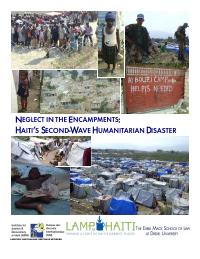
NEGLECT IN THE ENCAMPMENTS:
/
HAITI'S SECOND-WAVE HUMANITARIAN DISASTER
ù & # HAL AC
PARLE». ÿ 4 RE ÉD
D FPE one ES re
L
Institute for F à Bureau des pn}
Justice & F— #4, Avocats for THE EARLE Mack SCHOOL OF LAw
re “RSS SHINING A LIGHT IN HAITI'S DARKEST PLACES AT DREXEL UNIVERSITY
LAWYERS’ EARTHQUAKE RESPONSE NETWORK
[page 2]
[page 3]
NEGLECT IN THE ENCAMPMENTS:
LA
HAITI'S SECOND-WAVE HUMANITARIAN DISASTER
PRESENTED TO THE INTER-AMERICAN COMMISSION ON HUMAN RIGHTS
WASHINGTON, D.C.
MARCH 23, 2010
The LAMP for Haïti Foundation
The Drexel Haïti Justice Project at The Earle Mack School of Law
Bureau des Avocats Internationaux
Institute for Justice & Democracy in Haïti
Lawyers’ Earthquake Response Network
[page 4]
Neglect in the Encampments: Haïti’s Second-Wave Humanitarian Disaster
Copyright © 2010 EMSoL
All rights reserved.
Photographs: Tom Griffin
The Earle Mack School of Law at Drexel University (EMSolL)
3320 Market Street
Philadelphia, PA 19104 USA
Tel: +1 215 571 4815, Fax: +1 215 571-4730
DrexelHJP@gmail.com
The LAMP for Haïti Foundation [LAMP)
P.O. Box 39703
Philadelphia, PA 19106 USA
Tel: +1 267 295 2822, Fax: +1 267 295 2822
admin@lampforhaiti.org
The Institute for Justice and Democracy in Haïti (IIDH}/ Lawyers’ Earthquake Response Network {(LERN)
P.O. Box 745
Joseph, OR 97846 USA
Tel: +1 541 432 0597
info@iidh.org
Bureau des Avocats Internationaux (BA)
No. 3, 2eme Impasse Lavaud
Port-au-Prince
Haiti 19048 B.P.
avokahaiti@iidh.org
Haïtian Education & Leadership Program (HELP)
P.O. Box 1532
New York, NY 10159
Tel: +1 646 485 8667
HELP Center
#17 Rue Rimpel (ci devant rue O)
Turgeau, Port-au-Prince
Haiti 611 W.I.
Tel: +11 509 2943 0760, +11 509 2943 0796
info@haitianeducation.org
[page 5]
TABLE OF CONTENTS
EXECUTIVE SUMMARY rrerenrereneneomeneneneneeneneneenenecneneneneneeneneeneneneenenneneeen ne neeneeneenenenneneesneneneeenenenenee
INTRODUCTION srreerenrcrenenenmeneneneneceeneneeneneseeneneneneneneneeneneeeneeneenenen ne neenene seen een eee nenene ee eneneeneee À
METHODOLOGY rrroneoreoroneeneonomenenroneoneononenonsoncononsosceneenescenensoneneesoeneseencenneenencenesesceneesoesesencerene ressens À
SURVEY RESULTS AND DISCUSSION
SUMMARY OF KEY FINDINGS..nrnrnnrrnrrnrrrenenrereenneneneneenenenrneeeneneeneeneseneneeneneeneensneneesmenenerncnes Ô
PLACE ST. PIERRE
OVERALL DESCRIPTION srermnrrenenrreneneereneneneenenerenenennenenneneneneneneenenenneneeeneneeemeeneeseeneneneenenceeee À À
SUMMARY OF CAMP CONDITIONS snrereneermrnererenenenenenenenrenenenenerenenenmeneneneneenenenmeneeeneneemenenenenee À
FAMILY PROFILE sssssrnnsernnnrnsnneserenseeesenenesenneneonennenseceneesceseneenceneroseeneoneomeneoneecee | 2
RELEVANT BAI FINDINGSnnrrrrrnrnrnrnrrreerrnereneesmeneeereeeneneneeneneereneeneeenenereeeeneeneennseeneneneneneeeee À 2
ACRA
OVERALL DESCRIPTION sssssessresoreeressonennenemensencenensocensesoeseeeseceneeoesesseenceresrencneneoreomesrenesccee | 3
SUMMARY OF CAMP CONDITIONS smeremenenreneneeenenennereneneneenenereneeneneeeneneneneeeneneneeneesnenenemnenenee À À
FAMILY PROFILE nrrrrrnrnrerenennnneeneenenenennenenesnenennenneennenenneneneneeenenneneneensneneenneeneseeneneeneneseeeee À Ô
RELEVANT BAI FINDINGSsrrrsrnseneoroneroneonenreeoronresrencneorosneneoneononesnosseneeneonosrensescenerseceseoscenenroscoscee | Ô
DIQUINI/ ADVENTIST UNIVERSITY OF HAITI (ADUH) CAMPUS
OVERALL DESCRIPTION sermrnrenenrereneenereneneneeneneereneneenenenneneeeneneenenenneeneeneerneeneneneeneenesreeneene À /
SUMMARY OF CAMP CONDITIONS seossssossosenronmeneononsomenesmeneonensosnenmeseenenseenceneeseeseeseeneeresrescnereseesence | 8
FAMILY PROFILE nrrrrrnrnrerenennnneenreneenennenenesneneneeneneenenneneneneeeneneeneneensneneenneeneseeneneeneneseeeee À D
RELEVANT BAI FINDINGSnnnrrnrrnrnrnrnrrenerrnrnenenrrneneneneneeneeneenenenereneeneneenenereeeeneerenerseeneneorenenceeee 2 O
CHAMP DE MARS
OVERALL DESCRIPTION srermmnrerenenerenenenenenenenreneneenenenrenenenneneeeneenenenneneesnenenesneeeneseenenenneneseseenee À Ï
SUMMARY OF CAMP CONDITIONS smrrmeneereneneeonenenrereneneneenenenreneeneneeeneneneneeerenenenenereneneseneneree À À
FAMILY PROFILE ssssrsnnennnrnsnneseneneeeesennenennensenenrensesceneeseeneneenceneroseeneoneoneseoneecee 2 3
RELEVANT BAI FINDINGSnnrrrrnrnrnrnrrrenenrnereneenneeeereeeneneneeneneeeeeneesnenereeneneneereneeseeneneereneneeeee À À
Bouzi
OVERALL DESCRIPTION ssssessrersoreeresesennenemensoncenensocenseoeneeeseceneeeenesseoncenesnencneneoreosesreneccccee 2 5
SUMMARY OF CAMP CONDITIONS smrrmenenmeneneeenenenereneneneenenereneneneneneeneneneneneereneenenereneneseeneneree À Ô
FAMILY PROFILE rrrrernrnrrrenenrnrnenneneneeneneneseneneeneneneneneeneenenennenenenneneneeneneenesneneneeneneeeneneneenese À 1
RELEVANT BAI FINDINGS sr meoroseronsosenreroroeresrencneonooneneoneononrenosneneeneonenreseceneeseseeescenerosceecee 2 7
PARC LA COURONNE
OVERALL DESCRIPTION srmrmmrnrereneemenererneneeeneneeeneeeneneeenenenenenneneeemeneneenenenenenenenenenenenesesrenenee À B
SUMMARY OF CAMP CONDITIONS sossssorsosemonsoneonensoneneenenconensenenmeseenenseenceneneseeneseencenesrescenencsesee ve 2 D
FAMILY PROFILE nrrrrrnrnrerenennnnenenreneenennenenesnenenn nee neneenenene ne neneeneennsnenenesneneeseeneneereneseeee S À
RECOMMENDATIONS rerrmrrenmmenerenenenenrneneeenenenneneneneenenenneneneneneneenenenneneenneneneneneeneneneeneneeeneneenenennsee À
CONCLUSION srsrssroseeseonomenronenenrononmenreneosonnensoecenensoeseneneecenensoeseseenoeneenencenenseeceneeseesessereneesrencenenescesceeeee À À
APPENDIX A: ACKNOWLEDGEMENTS snmremmnereneneenrneneeeneneneneeneeneneeneneneeneeneneneneneeneneeeneneereneeee DS
APPENDIX B: URGENT NEEDS ACROSS COMMUNES (BAI FINDINGS) 35
[page 6]
Two months after Haïiti’s devastating January "Food deliveries have been sporadic,
12, 2010 earthquake, and despite a massive infrequent, and apparently arbitrary;
international mobilization of aid, hundreds of * Less than a quarter of people in IDP camps
thousands of earthquake survivors live without have enclosed, waterproof housing;
: ne : "_ Sanitation conditions are deplorable.
basic human necessities, especially shelter, water, .
k na Contaminated water forces many to purchase
food and medical care. These violations of Water despite meager resources.
Haïitians’ economic and social human rights have Additionally, latrines are scarce and fill
been widely reported in the press, but the problem quickly, requiring people to defecate on the
: : : ground or in plastic bags.
persists. Earthquake survivors continue to suffer . à .
. . 1: . : “ Medical care has been inconsistent and short
and die because aid is not reaching those in need. . :
term, and there is no mental health services
Experts predict a second catastrophe as the at any surveyed camp; and
impending rainy season combined with poor “There were no plans in place to help return
sanitation, overcrowded and leaky housing, and camp residents to selfsufficiency. No
inadequate food and medicine create epidemics of surveyed camps had plans to establish
di schools, employ workers, or give special
Isease. Le. . . attention to the most vulnerable: children,
Two organizations that work with Haiti’s poor, the elderly, the infirm and the disabled. With
the U.S.-based LAMP for Haïti and the Port-au- no nationwide resetilement or rebuilding
Prince based Bureau des Avocats Internationaux plan, many have resigned themselves to 1.
more permanent stay in the encampments.
(BAIÏ), undertook to measure the difference P Y P
between the aid promised to Haïti and the aid The people interviewed identified procedural
actually received on the streets of Portau-Prince shortcomings in the aid response that contributed
and nearby cities. They collected data aboutthe to substantive failures in aid delivery. Time and
current living conditions of earthquake survivors, again participants noted how aid could be
then recruited researchers, statisticians, law distributed better despite the many obstacles
students and lawyers who processed the data and imposed by the earthquake. Yet, because people
generated the current report. in the camps have not been consulted, their
The two surveys used different methodologies. suggestions have not been integrated into the aid
LAMP sent a team of U.S.-based investigators, who response. Instead, aid is delivered according to
worked with Haitian student volunteers to conduct plans drawn up outside the camps, with no
intensive interviews with 90 families in six different apparent consultation with people inside the
Internally Displaced Persons (IDP) camps from camps.
February 22-25, 2010. The BAI asked Haitian Of course, more aid is reaching Haïti’s
grassroots organizations to conduct more earthquake victims every day, so in the time it took
streamlined interviews with members of their to process the data and write this report, conditions
communities and received information from 4,528 may have improved. But all the information
families in six communes (municipalities) the week received up to the date of this report suggests that
of February 15. while the specific numbers of people receiving help
The information collected from both surveys Will have improved, an enormous gap between aid
demonstrates that far too many earthquake victims promised and aid received persists on the ground.
have not received the basic aid necessary to
sustain human life:
L
[page 7]
INTRODUCTION
Within hours of the January 12, 2010 earth- The camp appeared to hold some 5,000 peo-
quake, Haiïtian families fled their collapsed homes ple. It was bordered by a dirt road and a cement
and businesses and set up camp with their few re- wall that stretched 250 meters. At first glance it
maining possessions on the closest plots of open seemed to be an organized camp that had been
land that could meet their immediate need for shel- receiving adequate attention from relief agencies.
ter. These camps were not established with assis This view changed quickly upon entering the west
tance from the Haitian government, foreign aid or side of the camp . Hundreds of boisterous camp
relief agencies, but were spontaneous gatherings residents were being forced into a straight line
of Haitians seeking safety and survival in numbers. against the cement wall. A contingent of approxi-
Despite international pledges of aid, the eco- mately 30 U.N. soldiers from Jordan were yelling
nomic and social rights of displaced persons contin- orders and scolding the people in Arabic. They car-
ue to be violated by failures in aid distribution to ried elongated wooden batons in their hands and
those who need it most. The purpose of this report were beaïing people ifthey did not properly form
is to illustrate the systemic neglect of basic human a line. Other soldiers had their backs to the line of
needs with an aim toward improving relief efforts. people and were pointing their M-16 rifles into the
It also seeks to put a face to a few of the morethan camp, standing alongside what appeared to be
one million people displaced by the earthquake. newly-laid coils of razor wire.
Take one example: After about 25 minutes in the hot sun, a two-by-
two line was formed stretching the length of the
On February 25, 2010, the LAMP for Haiti Task cement wall, with the soldiers threatening the peo-
Force was driving just west of Port-au-Prince on the ple into stillness. None ofthe observers knew why
south side of National Route 1. A loud commotion the people were lining up, but those in line all held
and the movement of heavily-armed U.N. soldiers “tickets” and said that food was about to be dis-
drew the investigators to the camp known as tributed.
Marassa #11. A few minutes after the line had formed to the
soldiers’ satisfaction, an “all clear” call was made.
D. QAR 7 | - À bi Et En
the camp prior to food distribution.
2
[page 8]
Large trucks began to pull into the camp perimeter The Marassa #11 event witnessed by the inves-
road and set up just in front of the line of people. tigators is just one of many examples of depriva-
Some got out and stretched a massive banner, tion, neglect, and mistreatment in the camps.*
“ERA — Evangelical Relief Agency”, in front ofthe Without the input of residents themselves, aid is dis-
line of Haïtians. Once the banner was in position, tributed in irrational, even inhumane Ways. The fol-
the crew in the back of the trucks gave each person lowing data collected by and for Haïtians help
one large clear plastic bag. Observed in the bags demonstrate the disconnect between the aid that
was a liter-sized bottle of cooking oil, about two has been pledged and the actual conditions on the
pounds of rice, and about a pound of dried beans. ground. It is hoped this evidence will be used to
One resident said this was only the second time give Haïitians greater voice in how aid is distribut-
since the earthquake that food had been brought ed, as well as to put the international community
to the camp. And, even on those two occasions not on notice of the need to respect, protect, and fulfill
everyone was provided for. Some residents stated Haïitians’ economic and social rights.
that they either did not know the man who had dis-
tributed the tickets and so were left out, or they did
not want to fight for the tickets the day before.
es Li HOLD ES + — À fe - LES FA RE,
EC OERETER EEEES FT Pair Ye A BTE EN Sn ge æ À RE RS
Re ES SR une
© ) 14°? 4 1 s\' #4 Q » NN VI
f nu RES 2 1 AUS TOUR __
Concertina wire acts as a cordon between those A baton-wielding U.N. soldier removes an individual from
waiting for food and the rest of the camp. the queue.
* For recent documentation of conditions, see the 90 second
video created by the New Media Advocacy Project, which
visited several camps between March 19-21, 2010. N-MAP,
Haïti IDP Camp Commission Video, available athitp://
www.youtube.com/watch?v=rULaFfglrz8.
3
[page 9]
LAMP FOR HAITI TASK FORCE! were conducted in Creole by the bilingual volun-
teers and responses were written in English. Re-
From February 22-25, 2010, LAMP for Haiti, spondents were eligible for participation if they
together with the Haïti Justice Project of Drexel Uni- Jived at one ofthe six camps, were the head of
versity Law School and a team of Haitian university their household, and gave written consent to be
students, conducted a detailed, family-centered interviewed.
study of the conditions in several major camps of
internally displaced persons in and around Port-au-
. e 4
Prince, Haïti. A small sample were surveyed from BUREAU DES AVOCATS INTERNATIONAUX (BAI}
camps in the following communes? The Bureau of Avocats Internationaux (BAI) car-
" Place St. Pierre in Pétionville 10,330 residents ried out a survey with similar objectives of describ-
* Acra in Delmas 17,500 residents ing earthquake losses and demonstrating continu-
4
* Diquini/Adventist University 13,939 residents ing need for relief. Respondents consisted of 4,528
in Carrefour earthquake victims who were interviewed in and
" Champ de Mars in Port-au-Prince 35,602 residents around Portau-Prince during the week of February
" Bouzi in Croix-des-Bouquets 45,008 residents 15, 2010.
" Parc La Couronne in Cité Soleil 8,200 residents
. . ÎThe LAMP for Haïti/Haiti Justice Project at Drexel Law (HJP)
Ofthe approximately 99,140 displaced PErSONnS directed and supervised the investigation in the IDP camps in
in these select communes, 90 were selected at ran- and around Port-au-Prince. Thomas M. Griffin, Esq., and the
. . HJP drafted the investigative interview protocol, trained the
dom for the survey, ranging from nine to 23 per investigative team, and supervised the investigation in the
camp. This study is meant to capture data regard- camps. In-country assistance was provided by the Lamp for
. nm ne . Haiti’s in-country manager, Myrlene Dominique. The task
ing the families in the camps and their living condi- force investigators in the camps were 14 Haitian college stu-
tions: dents on full academic scholarship via the Haïtian Education &
Leadership Program (HELP) who were not then able to attend
classes due to the earthquake damage. Their names and re-
“their voluntary or forced changes in locations specive universities appear in Appendix À.
k . k . Haiti is divided into 10 départements. The départements are
" their changes in socIo-economic cIrcum- subdivided into arrondissements, which are further subdivided
stances into communes, and then quartiers [neighborhoods). For the
purposes of this survey, we will name the neighborhoods as
"the provision of aid/relief to them they were referred to by the interviewers. These may not al-
ful d ways be their official names.
* any purposelul progress toward permanent 3 Camp sizes are taken from estimates provided by the Inter-
resettlement national Organization for Migration/Camp Coordination and
. . Camp Management Cluster Haïti. CCCM Cluster in Haiti, 16-
* _the best practices of the interested 03-10 Displacement Tracking Matrix, available at: http://
governments and relief agencies groups.google.com/group/ccemhaiti?pli=1 [hereinafter CCCM
Cluster in Haïti].
* the most grave deprivations AThe Bureau des Avocats Internationaux {BAI}, an Institute for
Justice and Democracy in Haïti (IJDH) affiliate, is a human
s d d'by 14 stud | rights law firm based in Port-au-Prince, Haiti. BAI represents
urveys Were conducted by 14 student volun- Lolitical prisoners, documents human rights violations, and
teers who were split into seven teams. The teams spearheads the prosecution of human rights cases. BAI Man-
lected fifth tent in th tion É int aging Attorney Mario Joseph organized the survey and expe-
seléctea every fiih tent in The section for an inter- rienced investigators with sociology training conducted a one-
view until all the surveys for that particular team day training for two groups of survey administrators at the
leted. | : based BAI. Sarah Dougherty of IJDH coordinated the data analysis
were completed. Interviews were based on surveys & cm for both surveys. The team consisted of statisticians from
consisting of 109 uniform questions. Interviews America, Canada and Australia who were largely affiliated
With the Lawyers’ Earthquake Response Network (LERN).
4
[page 10]
Six communes were surveyed: of the limited sample size, these results should only
= Port-au-Prince 2,635 respondents be taken to illustrate conditions for the small sam-
" Carrefour 828 respondents ple of displaced persons who were surveyed at the
“ Pétionville 535 respondents various encampments. For the BAI surveys, some
" Petit Goave 130 respondents respondents were excluded because their respons-
* Croix-desBouquets 104 respondents es were too incomplete for valid analysis.
" Delmas 26 respondents
For a complete breakdown of the sixty neigh- Report Structure
borhoods canvassed, please see Summary Appen- The LAMP for Haïti surveys were designed with
dix B: Urgent Needs Across Communes [BAI Find- à detailed but conversationdl structure allowing
ings}. Interviews were conducted by 20 members ample opportunity for families to express them-
of grassroots organizations Who surveyed their selves via open-ended questions. Providing the
own communities. Each volunteer received training _ families an outlet to openly describe their living
at BAL. Respondents were told that their answers conditions, including frustrations and grievances,
would merely be used to assess their needs and worked toward the concomitant goal of gaining
would not affect their ability to get aid. The survey their confidence for long-term participation. The
consisted of uniform spreadsheets, which sought to leadership of Haitian student investigators adds
obtain the following information: strength to the study by increasing confidence in
the validity of responses for purposes of data anal-
+ the size of pre-earthquake households ysis. However, it also creates a channel of empow-
“the number of family members killed, injured, erment by and for the Haitian people.
or missing in the earthquake | The BAI surveys complement the sims and ob-
h jectives of the LAMP for Haïti surveys in several re-
* the postearthquake household composition spects. First, because of the greater sample size, it
by gender lends statistical strength to similar findings and also
* the number of children in the family provides a point of comparison with other organi-
* whether the house had been destroyed, zations’ and agencies’ needs assessments. Second,
damaged, or unharmed it illuminates another dimension of the displaced
* whether households faced urgent need for person problem by surveying many individuals
aid who did not live in camps. Finally, it similarly adds
+ whether they needed water, food, important civil society participation in gathering the
medicine, clothing, tents data and defining its uses in improving aïd distribu-
tion.
To be eligible to participate in the survey, re- The following report describes living conditions
spondents had to be mature individuals who could and aid ProvISIoN Gross SI camps surveyed by
speak on behalf of their postearthquake house- the LAMP for Haiti Task Force. Unless otherwise
hold. Each gave verbal consent to be interviewed. indicated, all data refer to that study. Each section
begins with a Summary of Key Findings followed
by an overall description of each camp, a summary
Data Analysis of camp conditions, and a profile of one of the fam-
For the respective surveys, responses were cod- ilies surveyed. Each section then concludes with a
ed and entered in Microsoft Excel format. Data summary of relevant BAI findings to provide fur-
were then exported into a Stata, SPSS or SAS sta- ther context where the data are available.
tistical database for descriptive analysis. Because
5
[page 11]
SUMMARY OF KEY FINDINGS
Children. Seventy two percent of house- Pétionville and Acra, with 73% and 53%
holds surveyed had children who are now reporting no access to sanitation facilities.
unable to attend school because of the Food. Half of respondents reported buying
earthquake. The situation was the worst their food while a quarter reported get-
at Acra, where the average family had ting food from relatives, friends, or neigh-
three to four schookaged children. bors. Nearly half reported not receiving
Deaths. Ten percent of households reported any food aid, with the greatest need at
a death. Respondents at Pétionville report- Champ de Mars and Acra (83% and 70%
ed the most deaths (42% of households). reporting no food aid, respectively}.
Losses. Ninety four percent could no longer Medical Care. Nearly half of respondents
live in their homes due to earthquake reported at least one sick person in their
damage and 73% had no access to in- household. However, 28% had not had
come or savings. access to medical care. The situation was
Shelter. At least fifteen percent lived in the worst at Acra, where 61% had not
open-air situations without tents, tarps, or had access to medical care.
sheltering materials. The situation was the Aid Provision. Just 64% of respondents re-
worst at Croix-des-Bouquets and Diquini/ ported ever having received any type of
ADUH (44% and 36% respectively]. aid, but most still needed food, water,
Water. Just half of respondents had re- shelter, and work opporitunities. Nineteen
ceived drinking Water and 39% had only percent had had to pay for some type of
received non-drinking water. The situation Adlendlo thoulbeentdenedandidiere
was the worst at Acra and Croix-des- lack of resources. The situation was worst
Bouquets, where only 35% and 44% had at Champ de Mars, with half of respond-
received any Water aid. ents having had to pay for aid.
Sanitation. Thirty five percent reported no
access to facilities for bathing, toilets, or
washing clothes. The need was greatest at
ALL ENCAMPMENTS Household Profile
Displacement Status Households often changed in size after the
thquake, either b: | killed
Forty percent of households surveyed arrived at EATAAUaRE, ERNET PECAUSE PEOP Were KE or
. because families were no longer living with the
their camp on the day of the earthquake and an- ue ke .
. D Le same individuals. In the LAMP for Haïti study, fami-
other 42% arrived within the next four days. The k
maiority chose their camp because of its proximity lies tended to get smaller. Frequenily the nuclear
p P unit remained intact but lost members of extended
to home. k
family. By contrast, the BAI study showed very
6
[page 12]
large families, possibly due to a looser interpreta- sample size. It is likely there are far fewer with ac-
tion of “household.” lt is also possible that house- cess to income.
holds gained dependents in the form of other rela-
tives or neighbors Earthquake Losses
The LAMP for Haïti study showed 72% of house Gfihe 90 LAMP for Haïti respondents, only
holds had at least one child in school before the 13% had a family member who died during the
earthquake; almost 50% had three or more chil- earthquake. Four households lost two members
dren in school. Since the schools were closed after 4 one household lostthree members. We do not
the earthquake, none of these children are nowin Lhiowthe representativeness of the six camps sur-
school. The BAI study confirmed that 50% of those veyed. Nevertheless, linear regression shows that
surveyed had at least one child and 25% had three ;b} humber of deaths per household appear gener-
or more children per household. ally consistent with national estimates: of the two to
three million Haïitians affected by the earthquake,
Employment Loss approximately 200,000 to 300,000 (or 10%) died.
Before the earthquake, nearly all households in Additionally, 42% of households had a member
the LAMP for Haïti study had some form of income, who was injured in the earthquake. The BA study
usually one unmarried adult member of the house- also showed minimal loss of life and limb. Ninety
hold. Only seven percent of households were com- P©'<ent did not report a death and 79% did not re-
pletely without earnings prior to the earthquake. port anyone injured. These findings likely un-
Yet our study shows that 64% of respondents lost derrepresent the problem because many people
employment or income as a result of the earth- who were severely injured may have been at a
quake. Only 27% currently have access to earn- hospital or other camps known to have medical
ings, donations or remittances. However, this figure "aiment. In the LAMP for Haïti study, 94% of
may be somewhat misleading because of the small homes were rendered completely uninhabitable by
the earthquake. This general finding was confirmed
Figure 1: Impact of the earthquake (% who lost employment; % with injuries in house-
holds; % with deaths in households; % whose homes are no longer habitable)
100
90
Loos
£ 70
= 60
ë 50
# 40
# 30
20
10
0 T 7 -
Employment loss At least one memberAt least one member House fully
occurred of family injured of family died destroyed
(N=75) (N= 84) (N=84) (N=90)
Impact of the earthquake by category
Note: Total employment loss occurred as a result ofthe earthquake n=58; At least one member of fam-
ily member injured during the earthquake n=35; At least one member of family member died during
the earthquake n= 16; House fully destroyed n=37 during the earthquake. 7
[page 13]
by BAI, which found 93% of homes damaged by Water
the earthquake. In the BAI study, 61% to 100% of respondents
needed water urgently. In the LAMP for Haïti study,
Shelter the most common method of obtaining drinking
Our findings show lack of adequate shelter to water was buying it (38%), followed by receiving it
be a serious concern. In the LAMP for Haiti study, from an organization (33%). Fifty-two percent of
15% lived completely exposed to the open air and respondents have had some drinking water provid-
58% only had flimsy tarps or cramped tents. Near- ed to them, and 39% have gotten only non-drinking
ly three quarters of those surveyed had not re- water. The Red Cross was the agency mentioned
ceived any shelter assistance, suggesting they had most often as providing water relief. It is worth not-
to salvage what materials they could. Similarly, in ing that even though limited water services do exist
the BAI study, from 65% to 100% of respondents in the camps, people are often buying drinking wa-
needed tents. Although at least 228,109 tarps and ter because only Doctors Without Borders and Ad-
31,000 family sized tents have already been ventist Development and Relief Agency (ADRA)
distributed by aid agencies,5 our combined findings provide treated water. People mention that there is
suggest emergency shelter aid is not reaching all plenty of water from the Red Cross, but it is dirty or
those in need. One must note, too, the complete untreated. The Pétionville families appeared to
lack of furniture in the shelters. People must siton have access to more Water than other camps but
the ground or on the cement below them or, at extremely poor access to toilets and bathing facili-
best, on a pile of clothing salvagedfromthenow ties.
destroyed home. Some lucky ones can lie down on
a piece of cardboard. Sanitation
The true misery cannot be captured in the frame More than a third of LAMP for Haïti respond-
of a camera lens. It is in the heat, the flies, the ents had no access to bathing facilities. When
stench and the lack of privacy. Heat increases as it asked where they urinated, the most common re-
becomes trapped under the tarps and between sponse Was in or near the street. People defecate in
walls of sheets. With only four, five or six foot ceil- public latrines but also in the street when the la-
ings, the hottest spot is alWays at your neck and trines are intolerably dirty or unavailable. The data
head. Inside a tent, it is a waste oftime and energy do not fully capture the privacy and safety level of
to wipe the sweat away, as it pours down your sanitation facilities for women, but the responses
back, chest, and legs. The lack of walls, windows, suggest many Women are relieving themselves in
and fences strips people of their privacy at every public areas where men are also present. This rais-
turn, so that no intimate actfrom dressing or go- es urgent questions about whether women feel
ing to the toilet to bathing or merely engaging in safe and what kind of security measures are in
conversation with another becomes intrusively pub- blace to make sure that these are not locations of
lic. The flies make for a constant hum everywhere. botential attacks.
Within a tarp shelter, without Walls or screens,
bunches of flies freely light on the food, on an un- Food
washed dish, a bucket someone had used as a toi- 5
let, and then on a child's face. Although the investi- U.N. Organization for Coordination of Humanitarian Affairs
. . ne . (OCHA), Haïti Earthquake Situation Report No. 28, March 11,
gators did not work at night, it is assumed that, like 2010 available athttp://oneresponse.info/Disasters/Haiti/
everywhere else in Haïti, the mosquitoes take over Coordination/publicdocuments/OCHA%20Situation%
the same positions When the sun sets, to trouble 20Report%20No.28,%20Haiti%20Earthquake%20-%2011%
everyone’s sleep until dawn. 20March%20201 0.pdf [hereinafter OCHA Situation Report
No. 28].
8
[page 14]
The BAI study revealed that 66% to 100% of issues. Less than a third of respondents reported
respondents urgently needed food relief. Half of that someone in their family had received medical
LAMP for Haïti families surveyed bought their food treatment for their injuries. Even if people weren't
while a quarter received food from friends, family, _injured as a result of the earthquake, many contin-
or neighbors. Seventeen percent received food ue to need treatment and medicine because of
from an aid organization and the rest reported that preexisting conditions like hypertension and diabe-
they had no food. The majority of families reported tes. The earthquake has injured some and limited
either receiving no food aid (49%) or receiving it access to proper treatment for most.
just once (31%). The food situations appeared
worst in Champ de Mars and Acra where more General Aid Provision in Camps
than three quarters reported receiving no food re-
lief. Our limited findings appear to confirm general Ofthe over 4,500 BAI respondents, the over-
figures that 70% of people living in settlements in whelming majority urgently needed some form of
earthquake-affected areas require food assistance. assistance. Similarly, LAMP for Haïti respondents
reported that they needed the following types of
Medical Care aid the most but were not receiving it: food (73%),
shelter (68%), work (31%), water (22%), money
Nearly half of LAMP for Haïti respondents re- (22%), toilets and bathing facilities (13%), medical
ported having at least one sick person in their attention [12%], security (8%), and clothing [4%].
camp household, yet this figure is likely underre- pi strongly suggests that basic living needs are
ported because the question was a write-in re- not being met, despite occasional distributions of
sponse. People reported having the following ill 4. Alarmingly, 19% of households reported hav-
nesses in camp: influenza, malaria, diarrhea or di- ing to pay for some type of aid and 10% reported
gestive illness, eye illnesses, aches and pains, stress being denied aid because they could not pay.
related illnesses, heart conditions, allergies, gen-
eral infection, vaginal infection, and respiratory
Figure 2: Aid Needed Most and Not Received
Food
; Shelter
$ Work
ÿ Money
Water
; Toilet and Bathing
ÿ Medical attention
3 Security DS
5 Clothing Je | |
Ê 0 10 20 30 40 50 60 70 80 90 100
Frequency (%)
Respondents reported that they needed the following types of aid the most but were not receiving it:
Food: 73%, Shelter: 68% Work: 31%, Water: 22%, Money: 22%, Toilets and bathing facilities: 13%, Medi.
cal attention: 12%, Security: 8%, Clothing: 4%
9
[page 15]
FRSNEA EE LA ee ee QUES
SCA STE ne 1,7. AN Na ne
PLACE ST. PIERRE IN |" mor bis LAS
\ LUCE jar. LA |! 82 F2 #
PÉTIONVILLE RS <4
A D le pe POSER. A
SUMMARY OF KEY FINDINGS be ne
Bei, =: -
Household. Half of respondents had six or É ss Sr _
more family members. Nearly 90% had chil- Pétionville camp. Rows oftents line a Walking path
dren who could no longer attend school. running through a public square.
Deaths. Forty two percent had at least one
member who died. landscaped trees are plentiful. The park slopes
P P P P
RTS NIGER QUEUES from the east down to the west side.
in their homes.
Shelter. Ten percent lived without tents or tarps. Camp Residents
Water and Sanitation. Thirty percent bought There are 10,330 total individuals living in the
drinking water and 73% had no access to toi- Place St. Pierre camp, or 2,066 families.” The LAMP
lets or bathing facilities. for Haiti Task Force surveyed 22 individuals. The
Food. Half bought their food while a quarter camp Was densely packed with a combination of
: : : adjoining tents and makeshift tarp and bed sheet
got food from relatives, friends, or neighbors. n
À third had never received any food relief shelters. Many families had set up on the grass or
from aid agencies. the cement plaza areas. Readily observable was a
k . six-inch wide trench, about two inches deep, that
Medical Care. More than 60% had a family : :
b h cck wound around the edges of many shelters in a gi-
MmemPer WA Was SIeK. ant snake-like maze. The residents explained that
Aid Provision. Fourteen percent reported hav- they catch the water coming down the slope of the
ing had to pay for aid. land, and redirect it around each shelter, until it
reaches the street on the west end of the park.
OVERALL DESCRIPTION
Camp Management
Camp Location The camp is a spontaneous setilement that is
The main site name is Place St. Pierre, a tradi- not managed by an outside agency. The residents
tional public park surrounded by hotels, a police surveyed stated that there is a “camp committee”
station, a large women's prison, the mayor’s office, Which is in charge of maintaining the massive wa-
and a church, Legliz St. Pierre. It is located in ter bladders that had been set up in two locations
Pétionville, section 7ème Bellevue Chardonnière, of the camp on wooden platforms by the interna-
and the area name is Ri Lamarre ot Moise. The tional NGO called CARE (which also has a large,
main part of the park is a square of about 200 me- gated office complex just two blocks from the
ters on each side. It is a mix of cement walkways camp}. No one, however, could say how that com-
that wind through the otherwise grassy park, and
7 The CCCM Cluster in Haïti, supra note 3.
10
[page 16]
mittee came into being. Security, they stated, was jured. Additionally, 90% of homes were rendered
provided by the police, many of whom are easily uninhabitable; 45% were completely destroyed.
observed sitting by the dozens in the shade of their
large station house just off the east, or upper, end Shelter, Water, Food and Medical Care
ofthe park. One out of every 10 families surveyed lived
without any shelter whatsoever. The rest had a
SUMMARY OF CAMP CONDITIONS tarp or tents, but more than half had not received
any sheltering materials from aid agencies, sug-
Household Profile gesting they had to forage for materials them-
The 22 families surveyed ranged in size from selves. Additionally, four out of 10 families did not
one to 15 people. Half had at least six members to have a single mat to sleep on. Thirty percent
provide for in the camp and nearly 90% had chil. bought water while 40% received water from an
dren who were no longer able to attend school. organization. Nearly three out of every four re-
One family had nine children under age 17. Before spondents stated they had no access to bathing fa-
the earthquake, 10 families had owned their cilities. Additionally, half of the families bought
homes. This relatively high rate of home ownership their food while a quarter received food from
contrasted sharply with the other camps surveyed friends, family, or neighbors. Although 67% had
and seemed to reflect the relative affluence of Pé- received some food aid at some point, 33% had
tionville. Further interviewing revealed that many never received any food aïd at all. More than 60%
of the families had inherited their houses, had no of families had at least one member who was cur-
money to rebuild, and did not have homeowners’ rently sick.
insurance. Most had lost employment or income as
a result of the earthquake. Aid Provision
More than three quarters of households report-
Earthquake Losses ed receiving aid, but 14% reported paying for aid.
Households surveyed in Place St. Pierre suf- The types of aid people most frequenily reported
fered more deaths and injuries than households in needing but not receiving were food and shelter,
other camps. Forty two percent had at least one indicating their most basic needs had not been met.
family member who died in the earthquake and
62% had at least one family member who was in-
RES CRUE EM, T STSRNL- 0 HORVNENN JR 757 rm
à - TNT PPT nl de Dr LE
Children clean themselves in a makeshift bathing station Manasse Elusma, investigator, speaks with residents ofthe
11
[page 17]
FAMILY PROFILE: THE JOASSAINT KETNA FAMILY Toilets and Bathing. Men and women bathe,
The Family Before urinate, and defecate behind any housing
structures left standing around the camp.
Joassaint lived in Nazon with her husband, They have no access to toilets.
daughiter, brother, and cousin. Her daughter is two Medical Aid. There is a health clinic set up near
years old and attended school. They rented a the camp by the Red Cross, adjacent to the
home in Nazon in six month increments at the cost police station.
of US$230. She lived in the home for over two Sleeping Conditions/Privacy. The family has
years and was the only member of her household no mats to sleep on. There is no place for pri-
who earned an income. Prior to the earthquake, vacy.
Joassaint was a self-employed merchant, earning Future Plans. The family does not know how
US$270 per month. The family had no access to a long they plan to stay in the camp. There is
vehicle and had no savings or property insurance. no plan to move to a permanent home be-
cause they have no money.
Who and What They Lost
No one in the family was killed or injured by Urgent Needs
the earthquake. The house Was partially destroyed Joassaint stated that the policemen are some-
and is unsafe for habitation. All their goods were times violent with the people in the camp. The fami-
lost inside the home. They believe there is no possi- ly’s current most urgent needs are food and tempo-
bility for them to return to their home because there rary shelter, which they have not yet received. She
is no shelter for them there anymore. said that if she could change anything at the camp,
she would organize the aid distributions better.
The Family Now
The family unit remains the same. They came to RELEVANT BAI FINDINGS
live at Pétionville on January 13, 2010 due to BAI surveyed 535 households in Pétionville. House-
homelessness. They are currently living on the hold size ranged from one to 21 and the number of
bare ground under a tent built from a tarp and children ranged from zero to 13. The average
wooden poles. The family states that the materials household had five people and fewer than two chil-
used to build the camp were not obtained through dren. There were no reports of injured, killed or
aid agencies. When the rainy season begins, they missing people. 61% of houses were destroyed
plan to ‘stand up” under the tarp. and 26% were damaged. All households urgently
need assistance: water (63%), food (93%), medi-
Food. The family purchases their food and cine (68%), clothing (65%), and tents (98%).
stores it in a corner of their tent. They re-
ceived food aid on only one occasion from a
distribution by World Vision, an NGO. They
cook their own food over a kitchen using char-
coal. The family members eat once a day,
sometime twice.
Drinking Water. The family drinks Water that is
brought to them. The Water they use for bath-
ing and washing clothes arrives at the camp
on a daily basis from CAMEP, the Haitian gov-
ernment’s Water authority.
12
[page 18]
SUMMARY OF KEY FINDINGS Era = LA ES PCuuRe, : Gt
DORE ME CRETE
Household. Half of respondents had five or L re ae Ps es Ve +
more family members. Seventy eight percent Ÿ © DRE T je, © <a
had children who could no longer attend LE CRT ee - ad HET, | LE
school. Most shelters in this vast encampment are cobbled
Injuries. Forty one percent had at least one together from whatever materials families can muster.
member who was injured.
Losses. Ninety six percent could no longer live Nod” and to the right of the road is “Acra Sud” -
in their homes. North and South Acra.
Shelter. Forty three percent lived with just a
tarp and 4% lived fully exposed. Camp Residents
Water and Sanitation. Forty four percent Approximately 17,500 people were residing in
ÉSTETUTe Late (ta te UNE) ACCESS the camp on the date of the investigation, com-
to toilets or bathing facilities. riseda of approximate n amilies. The investi-
il bathing Faciliti prised of approxi ly 3,160 families. The i î
Food. Half bought their food while a quarter gators surveyed 23 families. Pre-quake incomes of
got food from relatives, friends, or neighbors. the surveyed families in Acra, as in most other |
Seventy percent had never received any food EU LA CL extremely low, demonstrating that it
relief from aid agencies. is the very poor that have gone into and remain in
Medical Care. Twenty percent had a famil the camps. The largest pre-quake family income
member who was 0 y was US$400 per month for a driver with a family
° of eight. The smallest income recorded was US$71
Aid Provision. Only a third of people had ever per month for a money changer who supported 11
received any type of aid. in his household. Several families had no regular
OVERALL DESCRIPTION source of income.
Camp Location Camp Management
The people have named this camp after the Although there is said to be a “committee” of
Acra family that owns the land. Acra is located select de te that manaes the camp, no one
near the Delmas 33 neighborhood, which suffered could identify how the re Nav At
severe losses of life and property in the quake. lt is . D °
tthe police station and close to the former Fort least two committee members identified themselves
pas ” ”
k . k as “pastors” and one had set up a covered wor-
rison. Upon entering the camp on a dirt road that : .
u lits the pee into eo hill rer one is faced ship space at the bottom of the hill at South Acra.
P P Y . The survey revealed there to be no formal security
With a stark and brutal scene of makeshift shelters at the camp, and no identifiable camo rules. one
set on steep, dry, grey barren hills. To the left of the resident ue onded. ‘only God ae s there
road is what the people have come to call “Acra P É 77e PRE
was no police force and security Was “maintained
13
[page 19]
F ' SENTE EE 7 - 1
SUMMARY OF CAMP CONDITIONS pr | OP RTL ST] RUTT "4 ti
» ” 7
Household Profile ; Z À > # V4
The 23 families surveyed ranged in size from É _ ns f =”, : _,
two to nine people. Half of the families surveyed Kai ESR, D rev) JET
had at least five household members to provide for Ms = | . ”
and 78% had children who were no longer able to sil \ / D
attend school. One family had seven children un- + ! FL. jee à
der age 17. Before the earthquake, the overwhelm- À Ve.
ing majority of those surveyed had been extremely } = RSS
poor and survived on subsistence-level incomes CE. TC +
without savings, insurance, or other economic secu- er _ : Tr m .
rity. Since the earthquake, they have had no source Each family received materials for building a shelter,
including two tarps, a 12’ beam, saw and shovel.
of income and survive by sharing resources with
others. Of those with savings, all reported to have
lost their monies in the earthquake, either in their the camp or establishing a permanent home else-
destroyed home or because their bank was de- where.
stroyed.
Shelter
Earthquake Losses The families and their temporary shelters were
The majority of the families surveyed did not evenly distributed along the slopes of both North
lose anyone in the quake, but 41% had family and South Acra. Unlike the downtown camps, the
members who sustained injuries. Property damage shelters were relatively spread out. At the top of
was substantial and 96% of homes were rendered North Acra, families were living in approximately
uninhabitable by the earthquake. Generally, those 80 large ten-person tents given to them by the Is-
surveyed in Acra rented their homes, and believe lamic Relief Agency. This tight cluster of neaïly-
thot return is impossible because the landlord is not ordered khaki colored tents contrasted sharply
rebuilding. The few that did report owning their With the remainder of North Acra and all of South
home all stated that they will not return because Acra, where makeshift shelters of scrap wood and
they have no money to rebuild. No one surveyed twigs and plastic tarps or bed sheets randomly cov-
at Acra had any concrete plan for relocating out of ered the hills. Sixty-seven percent of respondents
SR indicated they had not received any kind of shelter-
1 TURS ae ee à a ing material.
DAT ASE e- On the date of the investigation, women were
=. 4 É 4 TA Re pi 2 FE sighted carrying two folded tarps on their heads, a
Es aise À D ARE 4 1 2-foot plank in one hand dragging along the
1. Ka AA a , - .
A Ga Ne s op ground, and a sack containing a shovel and a saw.
>. Es Ve 2 ee & > VIOL D Further investigation found that people were run-
t FN : ts * is t ning to a site where the Red Cross was giving out
Ÿ hi 4 < * | à these “sets of material” to whoever could get
5 … A. JM md + AA , through the crowd and reach the back of the truck
3, Qué V: 3 for a handout. Later, the investigators observed the
: recipients cutting the single plank lengthwise and
Camp residents arrive too late for the distribution of cross-wise, sculpting a small horizontal plot out of
building materials. Le : :
the hillside, and planting the boards in the ground
14
[page 20]
to make the four corners of a shelter. No relief TI} ‘4 Fe 1
workers were observed providing assistance or en / 1
instruction in the use of these items for the building ä |
of shelters. | | x & ÿ
Water \ Âsr f | /
Only 35% of families surveyed reported being | D ) y
provided with drinking water. Sixty percent of wa- | &
ter relief was provided by the French Red Cross, A: pe" l
but it was described by residents as “lou” or heavy À PE AN ,
water that stuck in their chest all day. The water \ LE Æ
was said to “goute lame a” or “taste like the sea.” EEE EEE EE
Many used this Water only for bathing (filling a
bucket and taking it back to their shelters to bathe)
and washing clothes. If residents wanted palatable that they had never received food aid. Further in-
drinking water, they had to purchase it, as 44% re- vestigation revealed that when the food aid did
ported doing. come, it was preceded by the distribution of
“tickets” on the day before, which had to be shown
Sanitation in order to receive a food package. There were far
fewer tickets than families in Acra and, according
The French Red Cross built latrines at the camp, à, some, the single resident chosen to distribute the
but all reported that the hole in the ground was too à Lei first allotted them to friends and family. Half
shallow and filled up too quickly. Residents then of respondents were forced to spend meager re-
tore down the latrines, made a row of planks and urces buying food and an additional 25% re-
tarps for privacy, and rebuilt the latrines over a ceived handouts from friends, relatives, or neigh-
much larger hole that they dug themselves. Privacy Lors.
was minimal, with only tarps dividing the latrine
into four-sided “stalls”. À total of four latrines were} dial Care
seen in the camp.
There were no supplies or equipment to main- There had never been any medical aid at the
tain the latrines. With over 17,000 men, women, camp and 20% of respondents had at least one
and children in Acra, the latrines quickly became member who was currently sick. Given the unsani-
revolting and unsanitary. As a result, it was widely tary conditions, lack of food and clean water, and
reported that the people refused to use the latrines sheer density of population, this figure is likely un-
and instead urinated and defecated somewhere derreported.
near their shelters, on the ground, in buckets, or in
plastic bags. More than half of respondenits stated Aid Provision
they had no access to baïhing facilities. Only a third of people ever reported receiving
Food any type of aid, yet nearly all needed food and
In the course of the 42 days that the camp had 8As a result of this finding (as well as the observation of a
been in existence, those surveyed overwhelmingly child too sick to stand and a woman with two amputated
reported that relief in the form of food aid had fee in fes bandages], the LAMP for Haïti, which runs a
ree medical clinic in Cité Soleil, instituted a mobile clinic
been provided only one time, in the form of dry which began on Monday, March 1, 2010, and which re-
rice and beans for cooking. Seventy percent stated re to je era camp for free medical services every Mon-
ay and Friday afternoon.
15
[page 21]
shelter relief. Nevertheless, several residents indi- Food. Food has come from “friends” and twice
cated aid cards were not being distributed to the from a distribution by an NGO she could not
entire camp, and that when aïd arrived, it was fre- name. They eat approximately one time per
quenily seized by “dreadful men” who took all of day, cooking with tree branches that one of
the provisions. This is corroborated by a series of her sons cuts from nearby trees.
focus groups conducted by HELP. People in Acra Drinking Water. The family drinks, bathes, and
urgently needed housing, food, education, com- washes their clothes with water from the tank
merce, health care, agriculture, security, and job set up by the French Red Cross.
creation.? Toilets and Bathing. The males and females
baïhe and urinate “in the street.” They use a
FAMILY PROFILE: THE ADRIENNE RADIUS FAMILY hole at the camp to defecate.
Medical Aid. They do not know of any place to
The Family Before receive medical aid.
Adrienne lived in Delmas 33 with her 65 yÿear- Sleeping Conditions/Privacy. There is one
old common law husband and their five children. sleeping mat in Adrienne’s family’s shelter.
The children range from age four to18 and all at- There is no place for privacy.
tended school. They rented a home in Delmas 33 Future Plans. They have no plans for leaving
for US$210, payable every six months, in advance. the camp or moving into any permanent
She was the only employed person, working in a housing.
factory and earning approximately US$4 per day.
They owned a vehicle and had US$60 saved in a Urgent Needs
bank account. They had no property insurance.
Adrienne stated that the camp needs food, shel-
Who and What They Lost ter, and medicine most of all. She stated that only
. . : . : very limited aid has come to her from NGOs and
No one in the family was killed or injured in the Le Gid has come from the Haitian government. If
earthquake. The house was rendered uninhabita- pe could change anything at the camp, Adrienne
ble by the quake. They are unable to access their à 5.4 2[she] would provide food to the people,
savings because the bank was destroyed. They have good, drinkable water, psychological ser-
believe that there is no possibility of returning to vices, and tents.”
their home because the house is destroyed. lt has
rot been re-built and there is no money to pay the RELEVANT BAI FINDINGS
rent,
BAI surveyed 26 households in Delmas. House-
The Family Now hold size ranged from two to 11 people and the
number of children ranged from one to seven. The
The family unit remains the same. They set up in average household had five people and three chil-
Acra on January 20, 2010, having wandered for dren. Most households reported no injured or
days and not found space in any other camps. At killed people and there were no reports of missing
one camp, they were not given a tent though many bersons. No homes were destroyed but every
tents had been distributed to the camp's inhabit- house was damaged. All households urgently
ants. At Acra, they are living in a shelter built from needed some form of assistance: Water (99%),
twigs and tarps. There is no income because the food (99%), medicine (100%), clothing (100%), and
factory where Adrienne had worked was de- tents (100%).
stroyed in the earthquake. Their plan for when the Results from five focus groups conducted by HELP in
rainy season begins is to “stand up” in their shelter. Champ de Mars. Interview dates from 26 February to 27
February, 2010. lé
[page 22]
OF HAITI CAMPUS IN os
CARREFOUR , — |”
SUMMARY OF KEY FINDINGS :
Makeshift tents erected on ADUH's campus grounds.
Household. Half of respondents had six or
more family members. Eighty two percent
had children who could no longer attend
school. Camp Residents
Injuries. Ten percent had at least one family There are 13,939 residents in total living in the
member who was injured. camp, or 2,825 families. !° With the exception of
Losses. Ninety one percent could no longer some shelters in small clusters in other clearings on
live in their homes. the campus, the majority of the residents were liv-
ST OL ing in a clearing the size of several soccer fields.
without a tarp or tent Investigators estimated that the size of the area is
approximately 34 hectares.
Water and Sanitation. Eighteen percent Camp Management
boughit drinking Water and several respond-
ents indicated toilets were too dirty to use. At the entrance road was an “administrative”
. tent where employees of ADUH have set up tables
Food. Twenty seven percent bought their food : :
. . , and chairs. They appeared to know the details of
while 9% got food from relatives, friends, or . . .
. : 1 the camp and its residents very well, but admitted
neighbors. Thirty percent had never received . un
: . . they were unable to improve conditions or ensure
any food relief from aid agencies. . ne .
access to basic necessities. The camp residents re-
Medical Care. About half had a family mem- ported that there was a security committee that pa-
ber who was sick. trolled at night, making sure everyone was in their
ENCRTO ETCIMaCuE eCueecuccie\e shelters by 10:00 p.m. As to rules, the residents
ing had to pay for aid. stated that the committee made it known that there
were designated places for discarding garbage.
OVERALL DESCRIPTION People could not urinate or defecate except in the
k latrines/portable toilets. If these rules were broken,
Camp Location : : :
the residents stated that the committee would eject
The investigative team was at the camp 43 days them from the camp.
after the earthquake struck. It is in the Carrefour
area west of Portau-Prince in a neighborhood
called Diquini. The camp is on, and circumscribed
by, the Adventist University of Haiti (ADUH).
19 The CCCM Cluster in Haïti. supra note 3.
17
[page 23]
SUMMARY OF CAMP CONDITIONS DE | D | NE = rs —
TP é AS
Household Profile ln | ct LT d A
The 11 families surveyed ranged in size from bat a «a LRT A4
four to 11 people. Half had at least six family mem- NB ee. Et À n
bers to provide for in the camp and 82% had chil. [ON VU D
dren who were no longer able to attend school. ù AS >:
One family had five children under age 17. Most N )\ Ée VER. =
were either unemployed before the earthquake or | : 1 de , TR
lost their source of income afterwards. TA:
'
Earthquake Losses Marie Michele Montout, investigator, collects data from a
Although no deaths were reported in our small RÉCCRLETEE TOC
group of respondents, about one in ten reported
someone had been injured. Additionally, 91% re- Wat d Sanitati
ported they could no longer live in their homes due ”"°"°" 91€ Santaflon
to destruction or damage. Most in the camp reported obtaining water
from “pipes” that belonged to the university or pur-
Shelter chasing water for drinking. One resident indicated
Most residents live on one major field in orga- that they sometimes received Water aid: however,
. ; . “we never find [it] because we are not strong. Peo-
nized rows of makeshift shelters of twigs, wood, É . :
ple in good health only.” As for bathing, one resi-
bed sheets, and tarps. Although the shelters were Res k Ÿ
: dent indicated that they bathed in the river.
in neat rows of about 100 meters each, the shelters . .
themselves were makeshift in the extreme, com- The investigators observed several sets of port-
: " able toilets, and Adventist Development and Relief
posed of twigs, found boards, bed sheets and the '
. . Agency (ADRA) was having them cleaned and
occasional plastic tarp. Most were very small, less . . on
than two meters by two meters and seemed to be emptied on a regular basis. Some respondents indi-
. LR cated the toilets were so dirty that they continued
separated by function. That is, a tiny shelter for . . .
. : . to urinate and defecate in the street instead.
sleeping was adjacent to another tiny shelter for
either sleeping or cooking, each divided by a bed Food
sheet and all for the same family unit. Approxi- °°
mately one third of those surveyed indicated that Food has been sporadically provided. One sur-
they had no tarp or tent to sleep under. Eighty per- _ veyed family stated that food has been distributed
cent had no sleeping mats. every few weeks since the quake by ADRA or an
Exposure to the rain is an urgent problem for NGO managed by ADRA. Others stated that food
those with and without tents and tarps. One resi- could be obtained more regularly, but one had to
dent said, “l’m in misery in the center. Rainisthe have first been the recipient of a “ticket” in ad-
big problem. Sometimes we get up at 1 ambythe Vance in order to qualify for that particular distribu-
rain.” Another said, “We have no tent/shelter. tion. Many suggested that different groups should
When it rains we [are obliged] to stay because we distribute the food cards, so that all would have a
don’t know exactly what we can do. l have a small fair chance. This suggested that if you were not
child, l’m afraid because 1 don't have [a] house to known to the group who had been charged with
sleep with him.” card distribution, you had a lesser chance of get-
ting food. Generally, the residenits in the camp com-
18
[page 24]
plained of the lack of food, most stating that they FAMILY PROFILE: THE ROSENA FRANCOIS FAMILY
had only been provided food once or twice. The Family Before
Medical Care Rosena is 25 years old and currently pregnant.
She lived in Bizoton 53 with her 26 year-old hus-
About half of the 11 families had at least
. ou arorne am 168 Aa af least one band, father, three brothers, sister and two sons.
sick family member. According to the respondents, Her sons are four and six in age and both attended
ADRA had also set up a permanent medical clinie school before the earthquake. They lived in a fami-
that was staffed by Dominican and Cuban doctors. I home that they owned for over 25 vears. Rose
The general complaint was only that the lines for 7 was a “elEemployed clothing erders who
the clinic were very long and that many delayed earned about US$7 per day. Her husband was em-
addressing their medical needs because they could ployed in construction earning US$8 per day. Às a
not Wait in the long lines. A UNICEF tent provided family, their income was approximately US$ 108
daily health services for children in the camp. per month. They owned no vehicle and had no sav-
ings or property insurance.
Aid Provision 95 97 proper
ADUH administrators admitted they had not Who and What They Lost
arranged or advocated for food distribution, medi- Rosena’s husband was killed by the earth-
cal care, water, or sanitation for the camp. The quake and another family member wos injured.
camp has only been provided services at the discre- H,. house and all of her belongings were com-
tion of NGO providers. Food has been distributed pletely destroyed by the earthquake. They believe
sporadically while water was consistently provided ;bée is no possibility for them to return to their
by ADRA. The UNICEF clinic had established itself Lome as everything was destroyed. Rosena be-
Without input from the camp administration. There | 4 that it may be possible for them to return to
was a common complaint that the Haitian govern- their home if they receive aid that helps them to
ment has never been a presence at the camp and build.
has provided no services.
All camp administrators ssemed overwhelmed 4. Family Now
with the situation and stated that there was no plan , .
by the university to move the residents or to ensure The family unit has been separated throughout
: different parts of the camp. They arrived at the
the welfare of people on the campus. There is also
no plan to reopen the school which was closed due le ps K 201 0, a week after ne carie
to the development of the camp and not a result of ing to make her “+ entr ae ho buste formel tent LE
earthquake damage. The administrators were ° L à
asked if they had advocated for the camp residents her own, She lives with two other family members.
: h di : fth There has been no income for the family since the
in any manner, such as attending sessions of the iboucke and h jedto becci
daily meetings of U.N. Organization for Coordina °%MaUare ane Koséna Nas résortec io 9eggng-
tion of Humanitarian Affairs (OCHA), to ask for When rainy season begins, Rosena will be soaked
food, supplies {tents), or services (sanitation). They pence her EU dbyneichborsinth
replied that they had no information about any ex- or °° de Ébued ar orsint ro
isting logistical organizations set up by the U.N. or Re Was disiribute Ne y an np ; N
other NGOs to provide for the camps. osena cannot name. She received no foo
p p from the distributions because she doesn't have
the necessary “card.” She can only cook when
she receives money from her begging. Rosena
and her family eat once a day.
19
[page 25]
Drinking Water. The family drinks, bathes, and cause she arrived after those Who have the cards.
washes their clothes from water supplied by the Distribution is poor because it is conducted mainly
Adventist University where the camp is located. between friends and those who do not have the
Toilets and Bathing. Both men and women bathe necessary cards receive no aid. She said that if she
in a nearby river. They urinate and defecate in could change anything at the camp, she would
an area of the camp where portable toilets change distribution practices.
have been set up.
Medical Aid. There is a health clinic on the camp
run by foreign doctors and ADRA. RELEVANT BAI FINDINGS
Sleeping Conditions/Privacy. Rosena has no BAI surveyed 828 households in Carrefour.
tent, shelter, or sleeping mat. There is no place Household size ranged from one to 21 people and
for privacy. the number of children ranged from zero to eight
Future Plans. The family has no idea how long children. The average household had five to six
they plan on staying in the camp. Eventually, people and half of all households had at least two
when they have the money to do so, they want children. The number of injured people per house-
to build a small house in the place where they hold ranged from zero to seven and on average,
lived before the earthquake. one out of every 10 households reported an in-
jured person. The number of deaths per household
Urgent Needs ranged from zero to three but most households did
not report a death or missing person. Forty-nine
Rosena stated that she is in most urgent need of percent of houses were destroyed, 48% were dam-
food and a tent. She has not received either be- aged, and 3% were unharmed,. Eighty percent of
20
[page 26]
FT
CHAMP DE MARS IN ee
PORT-AU-PRINCE Ne RE der Vs
, Ep aus ar : :
SUMMARY OF KEY FINDINGS L 4,
Household. Half of respondents had six or x x x
famil b Eigh , ; Residents gather near the Bicentennial Tower on the
more family members. Eighty nine percen Champ de Mars for water.
had children who could no longer attend
school.
Losses. Al respondents could no longer live in Champ de Mars is baking under a continuous
arbore. patchwork of plastic tarps, bed sheets, and the mis-
f famili d in fli d d ing i
Shelter. Eighty three percent lived with just a STY 9° amies covers M Tles ane ErEUWRINg IN
tarp. their powerlessness to change their circumstances.
Water and Sanitation. Half bought drinking Camp Residents
Water.
The investigators found seven major “camps” in
Food. Forty two percent bought their food the area, divided by roadways, that held from
while 25% got food from relatives, friends, or 1,300 people in the smallest zone to 9,000 in the
SUR AMENER never largest. There are 35,602 total individuals living
received any food relief from aid agencies. there, or 5,850 families."
Medical Care. A third had never received
medical care. Camp Management
Aid ienEtn Half reported having had to The residents reported that there was no camp
pay for aid. leadership or camp committees. There have been
no rules established. One head of household de-
OVERALL DESCRIPTION scribed it as ‘anarchy.” The atmosphere is marked
Camp Location by the constant, almost calm buzz of people trying
“Champ de Mars” is the name given to the pop- 1° Keep Ioir shelers clan bathing babies, wesh.
ular, central downtown area of Port-au-Prince that "9 © oi Le $ ny n ’ Ne or pe
is a mixture of pedestrian parks, street vendor pla- ns to nt still'an de es or Nora <
zas, and wide boulevards. The clustered area in- pue | “ set : ! Fe us Y SeMg very
cludes national and iconic landmarks such asthe °°" 1 - They Me. ' die Nr oer
presidential palace, the national museum, the bi- patrol. One resident explained that “if a police of-
: LA ficer finds someone stealing, he either hits him or
centennial tower, and government buildings. The . k ns
displaced have b : . puts him in jail.” Another resident indicated that
isplaced persons camps have been established in . ;
. .. there were no rules, just anarchy. Still another stat-
every part of the massive area that was otherwise
flat and open. Champ de Mars was a point of inter-
est and source of Haïtian national pride. Now 11 The CCCM Cluster in Haïti, supra note 3.
21
[page 27]
ed that the situation was very bad: “People are in FRS
danger. We have no security.” ; À ke
SUMMARY OF CAMP CONDITIONS 1. LE à
- tn aute Ÿ
Household Profile ST ve = DES & $ à
" L 1 hr 1% |
The 12 families surveyed ranged in size from da _ ‘" fs _<tii: l |: an (fee À
two to 11 people. Half had at least six family mem- EE
bers in the camp to provide for and 89% had chil. M Se
dren who were no longer able to attend school. —
Most lost their source of income due to the earth-
quake. Half did not answer the question about eur-
rent employment. suagesting an absence of such Sheliers filling a public square. Portable toilets provided
p'oy ? sugg g J by aid organizations sit on the eurb.
Earthquake Losses
Two households had at least one person who charge of the trucks. À quick and random inspec-
died during the earthquake. A total of nine injuries tion of conditions showed that they are dirty and
were reported. Additionally, all 12 respondedthat disgusting to use, as there are far too few of these
their homes were rendered uninhabitable. devices for the tens of thousands of people who
need them. Toilet paper was lacking in most, alt-
Shelter hough the investigators did see some distribution of
toilet by the workers who w il
Shelters are built on all of the grassy areas he : rs y the workers who were emptying
(except the several acres of lawn immediately sur- e lorers. k Le
. Further investigation revealed that there was
rounding the palace) and along the cement parks . .
. . ample water for bathing and washing, and even
and cobblestone walkways. A helicopter view ne ne
. . . treated Water for drinking, set up and maintained
would see the shelters covering the entire public . | à .
pe . by ACF, known in English as Action Against Hun-
area, divided into odd shaped puzzle pieces by the .
. , . ger. The people seemed well aware that it was ACF
major boulevards all of which have remained open
sp: Le which was the source.l2
to traffic. Eighty three percent are living under tarps
and only 8% live in tents. Nearly all stated they
had not received any help finding sheltering mate- Food
rial and most did not have anything to sleep on. An The residents surveyed stated that since the
investigator summarized one resident’s description: quake they had only received food aid twice and it
“Too many big flies, mosquitoes which give trou- came from a distribution effort led by the United
ble. In short they live a bad life.” States Army. Almost half of the camp’s residents
purchased their food, although it was unclear how
Water and Sanitation they were able to do so.
Plastic portable bathrooms are placed in sets of |
twelve along the sidewalk or along the roadside at Medical Care
the perimeter of the different camp zones. The in- IlInesses reported by the respondents included
vestigators observed several of the bathrooms be- malaria, diarrhea, infections, aches and pains, and
ing emptied by trucks with large vacuum hoses in stress. Most reported that they accessed medical
the hours of the investigation. CAMEP, the Haitian
, g hori É dtobei 12 Although ACF's website states that it is providing food aid in
government’s Water authority, appeared to be in Haïti, no resident ofthe Champ de Mars camp reported any
food aid from ACF.
22
[page 28]
treatment at the nearby General Hospital, which Who and What They Lost
has been run by NGOs and foreign doctors since Two of Marie’s brothers were killed in the
the earthquake. Others stated that they had been quake. The house was completely destroyed. Be-
to a clinic set up by Cuban doctors at the nearby use they have no money, they have nowhere to
Frère Andre School. go. Marie is trying to raise money to move her fam-
| : ily to a safe place, but for now she has no plans
Aid Provision and no resources.
Most striking at the Champ de Mars encamp-
ment was the lack of aid distribution. When aid The Family Now
has come, like the bottled drinking water distribu-
tions the investigators observed, it is in the form of Marie and her family arrived in this camp on
a large cargo truck pulling up near a site. The peo- January 13, 2010. They went to this camp because
ple have to run into a line and wait in hopes that it was the closest to their home. One of her broth-
there is something left when their turn comes. ers suffers from malaria. Marie bought a tarp for
Residents reported that no one from any relief US$23 to create a shelter, although they stand all
organization had come into the camp to meet the night when it roins. No one in the family is currently
people or to ask them what they needed, or for able to earn an income.
their suggestions on how to better serve their press-
ing needs. They did not come into the shelter area Food. The family must cook their own food, but
to pass out food or Water in person. To get food or they have no money to buy it. They use a char-
bottled drinking water, residents, including the coal cooking source. They get food donations
many women and children in households without from friendk in the camp and share and ration
an adult male, had to be alert to the imminence of the food rather than store it. They eat once a
a distribution and have the means to run to the dis- day.
tribution site and struggle for and hold position. Drinking Water. The family buys water to drink
Many, of course, resigned themselves to the impos- when they can. Water for bathing and wash-
sibility of this and often stayed behind to supervise ing clothes is obtained from ACF each day.
their children under their shelters during the distri- Toilets and Bathing. The people in the camp uri-
butions. nate next to the streets. They defecate in the
public toilets which are unsanitary. Men bathe
FAMILY PROFILE: THE PIERRE MARIE YOLANDA aroundthe camp, while the women bathe in
FaMur the shelter.
Medical Aid. There is a health clinic set up in the
The Family Before camp, but aid and medicine is limited. Because
Marie lived next to Fort National, at Impasse Marie has no money, she cannot get
Jean Charles #66. She lived with her mother [58 healihcare if someone gets sick.
years old), four brothers (22, 22, 26 and 27 years Sleeping Conditions/Privacy. There is no mat
old), and her daughier (14 years old). They had for the family to sleep on. They have wood and
been renting property for two years. Her daughter blankets in addition to the tarp Marie boughit.
went to school full time. The family had no vehicle Future Plans. Until she can get some money, Ma-
and no insurance. She had savings in the bank but rie has no plans for herself or her family.
is no longer able to access her funds.
23
[page 29]
Urgent Needs to 13. The average household had six people and
Marie says that they need food, money and half of all households had at least two children. On
work or school the most. Other than Water, the average, four out of every 10 households reported
agencies are doing nothing. Marie recommended °° injured person while two out of every 10 house-
that distributions of money, food, and clothes be holds reported a death. The number of missing
made to the camp’s inhabitants. people per household ranged from zero to 11 but
most households did not report a missing person.
Ninety-seven percent of houses suffered significant
RELEVANT BAI FINDINGS domage during the earthquake, including 35% that
BAI surveyed 2,635 households in Port-au- were destroyed. Seventy-five percent of house-
Prince. Household size ranged from one to 33 peo- holds urgently needed some form of assistance:
ple and the number of children ranged from zero Water (68%), food (66%), medicine (47%), clothing
24
[page 30]
BOUZI CAMP IN pren Sr 5 à
CROIX-DES-BOUQUETS LL LR ÉE 1
SUMMARY OF KEY FINDINGS M Dir
Household. Half of respondents had six or À ee D TS
more family members. Eighty nine percent Bouzi camp. The shelters are constructed without any
had children who could no longer attend materials from aïd organizations.
school.
Injuries. More than half had at least one famni- : PTE
b h iniured and was surrounded by bustling activity in the
member who was injured.
y Ù streets and people selling food items, water, and
Shelter. Forty four percent lived in open air soft drinks.
and forty four percent had tarps.
Water and Sanitation. Forty four percent Camp Residents
bought Fe Water; no water relief was There are 45,008 total individuals living in the
JC IUSEE area, or 8,041 families.1% The Bouzi camp Was the
RIT AE SEE OT TE ETS ET NES host deprived of any observed during the week. It
33% got food from relatives, friends, or is a cluster of neighborhood shelters in open fields,
neighbors. Cu? HEC had not received separated by dirt roads and stone Walls. The shel-
any food relief from aid agencies. ters lie about a half mile from the busy downtown
Medical Care. Eleven percent had never re- area and the Parc Rony Colin and down a winding
ceived medical care. side street, the camp is far removed from the gen-
Aid Provision. Eleven percent reported having eral public conscience. In one plot of land, sur-
had to pay for aid. rounded by a short stone wall, not far from small
cement houses that were still standing, were about
OVERALL DESCRIPTION 20 makeshift shelters housing 80 people.
Camp Location
Camp Management
The investigative team surveyed one camp in a . Le
cluster of camps in Croix-des-Bouquets, a large In this cluster of small camps, no aid in any form
: : has been reported to have arrived. There was a
town just east of Port-au-Prince. The team entered É .
the town, observing various camps and asking blank look in many of the adult faces, not knowing
nn : where to go to fulfill any basic needs. The busier
people to identify other camp locations off of the b ved “d and had ab £
main streets. As a result, the team stopped to sur- "291 CAMPS réceivéc More aid ane AAC a BUZZ 9
vey one large camp at Pare Rony Colin and then a activity, energized by frustration that things were
cluster of smaller camps off the main road. This not progressing fast enough. In Bouzi, however, .
cluster is called Bouzi, named after the area’s larg- the desolation felt like resignation - as if a return in
! . a few months would reveal dried human bones
est landowner. The Parc Rony Colin camp covered
a grassy area about the size of two soccer fields, 13 LL
The CCCM Cluster in Haïti., supra note 3.
25
[page 31]
and the remnants of bed sheets hanging fromthe dicated they had not received any sheltering mate-
occasional twig stuck in the ground. rial from relief agencies.
Water and Sanitation
SUMMARY OF CAMP CONDITIONS
Water for bathing and washing clothes came
Household Profile and Losses from a public source in the area, but safe drinking
The nine families surveyed in the Bouzi camp Water had to be purchased. Water conditions were
ranged in size from four to eight people. Half had the worst at this camp, with most respondents re-
at least six members to provide for in the camp and porting that they had not received any Water aid.
89% had children who were no longer able to at- Camp residents stated that they left the field to uri-
tend school. Questions about employment and in- nate and defecate behind houses in the area, or
come were largely unanswered. No deaths were sometimes in a house that Was still standing, but
reported, but more than half had at least one per- damaged. There were public latrines set up that
son Who had been injured. were used by many. Some, however, took care of
their toilet needs by defecating into a bag and
Shelter throwing it in a garbage pile.
Nearly half lived in the open air. The rest lived
crowded under shelters fashioned from twigs, Food
tarps, and bed sheets. Some (11%) had received Food was given by area residents and shared
pup-tents from the U.S. Army. Some shelters were within the camp. They depended on people from
made with only one sheet, barely forming a partial the surrounding area to bring food to share. Here,
“roof” or wall, and most looked like they served unlike other camps surveyed, all of the residents
only to provide a few square meters of shade. Fur- surveyed stated that they ate once per day, at
ther investigation, however, revealed that these most. Food had reportedly been delivered only
bed sheet and twig shelters were all that the peo- once to the camp, by an NGO called World Vision.
ple had. They were in a field of dried weeds which Stated one resident, “we were still hungry after we
constituted their shelter floor. Some mothers had ate it.” Another resident stated, ‘We are in [a] bad
actually gathered cinderblocks from fallen build- situation because we cannot eat. | don’t find food
ings and shaped them into a cement “mattress” for for the children.”
the children to sleep on. Nearly all respondents in-
Medical Care
STE S Residents reported that a health clinic was tem-
tt tTITIt titttttt ur ; ag Lai je porarily in the camp and staffed by Dominicans,
AAA RAA ARAE LA AS LAN RARE À at ut it was not there when the investigators visited.
Q AT BQUZ] CAM Paie le "M Some said that residents had to travel to St. Cathe-
HEL PIS NE EDED Ven A D rine’s Hospital in Cité Soleil (staffed and managed
4 11] (a HE M ES = by Doctors Without Borders since the earthquake)
F AR for treatment.
Li ee 5 me Aïd Provision
A 7. Pr CR There was no water, medical care, sanitation
__—_—_ _—_—_—_——— mms facilities, or food anywhere. Water was obtained
À painted sign meant to direct assistance to the Bouzi SRE TENTE lacking was any school or
daycare facility for the children, or any aid to get
26
[page 32]
the people - many of whom were street merchants canned food from World Vision. To cook, they
— back on their feet with some start-up cash. Gener- use a stove or boiler and vegetable oil as a
ally, the men were not in the camp at the time of cooking source. They eat ‘sometimes one [time]
the survey, and the women were with the children, in a day.”
just sitting and talking. The most common com-
plaints were that no agency or government had Drinking Water. The family must buy water to
provided any substantial aid, that the children drink; water for bathing and washing clothes is
needed to be cared for, and that jobs were sorely from the public water pump.
needed. Toilets and Bathing. Men and women urinate on
the ground. They use a public toilet to defecate.
Bathing occurs ‘around the camp.”
FAMILY PROFILE: THE BARBARA MAURICE FAMILY Medical Aid. There was a health clinic set up in
The Family Before the camp, but they no longer provide medical
Barbara lived in Lilavois 58, Bon Repas with aid. If someone is sick, they go to St. Catherine
three cousins {ages 15 to 22), two sisters (ages 26 Hospital. They do not know where to receive
to 28), one nephew [age 10) and one niece [age medicine. H . .
three). Barbara owned her property and had lived Sleeping Conditions/Privacy. There is one sleep-
in that home for eight years before the earthquake. ing mat in the family’s shelter.
She was a self-employed merchant, the only one Future Plans. They have no plans to leave the
employed in her family. Three of the children at- camp or establish a new home.
tended school full time. The family had no vehicle.
While she had savings, it was all stolen. They had Urgent Needs
no insurance. Barbara said the camp needs tents, food, tarps,
and medicine. Food aid has come only once, and
Who and What They Lost that was canned rice; they “eventually” received
. . un. water. They have gotten nothing for shelter. If she
No one in the family was killedl mn the earth- could change anything, Barbara stated she would
quake, although her nephew was injured. The ensure: better organization of aid distribution,
house ie desroyed Because their ut WETE make the block safe, make a brigade corps, and
tolen, t ï n ,
possibility of returning to their home. RELEVANT BAI FINDINGS
The Family Now BAI surveyed 104 households in Croix-des-
B ts. Household si d from two to 15
The family unit remained intact. They arrived at people an d He uber oË ren renge Fr
the camp on January 12, 2010, and have re- . .
mained because they believe it to be their safest 7810 to one child. The average household had five
. to six people. On average, four out of every 10
option. They have created a shelter through a com- h hold red an iniured 4h
bination of tarp, wood, blankets, and blocks. When SURENIIES TEPOTEC ON IMIUTEE person: Me same
ns . … held true for deaths. On average, two out of every
it rains, they stay under a shelter of blankets until it de
stops. They have no income 10 households reported a missing person. Forty-
° ° nine percent of houses were destroyed, 48% were
Food. They must buy their food, and either “use it damaged, and 3% were unharmed. Ninety-four
y u Lu. . percent of households urgenitly needed some form
well [or] share with other people”; there is no . L.
way to store food. They sometimes receive of assistance: water (94%), food (94%), medicine
y vney (94%), clothing (91%), and tents (94%).
27
[page 33]
PARC LA COURONNE nd pre
SUMMARY OF KEY FINDINGS * ad:
Household. Half of respondents had six or je £ re
more family members. Eighty five percent : —— — =
had children who could no longer attend A view of a small section of La Couronne camp.
school.
Losses. Ninety three percent could no longer
live in their homes. younger siblings, and playing with distributed
Shelter. Ninety two percent lived under tarps food. One 1 1-year-old boy had found some type of
and eight percent had nothing. ready-to-eat meal in bag that could be manipulated
Water and Sanitation. Thirty nine percent in such a way that it heated and cooked the con
boudhit drinki tents. Curious friends gathered around to watch it
ought drinking water. .
. | | work. When the boy opened it, steam shot out, and
Food. Sixty GIE FETE bought their food then he reached in to eat what looked like beef
while 2 % got food from restes friends, " stew on rice. When he had his fill, he passed the
nelgnsors. on six percent a nof receive bag around. Although it was as much nourishment
any food relief from aid agencies. : Là : .
as it was curiosity, one is reminded that such meals
Medical Care. Fifteen percent had never re- in individual bags are not how Haitian’s eat. Simi-
ceived medical care. larly, another boy had a single-serving tube of
Aid Provision. Eight percent reported having some high protein peanut butter-like substance in a
had to pay for aid. squirt packet made for emergency nutrition. But he
was observed gathering his friends who had been
OVERALL DESCRIPTION playing in the dirt and had them put their hands out
Camp Location for him. He squeezed a portion into everyone's
| | | palm. In such a fashion, not only did the first benefi-
Camp Pare La Couronne IS a soccer field situat- ciary not get the full nutrient benefit, but it made for
ed next to a soda factory which makes La a quick way to pass bacteria and parasites from
Couronne soda. The area name is National Route dirty hands to the mouth.
#1 Sarthe 51. Itis on the eastern edge of down-
town Port-au-Prince, on the road toward Croix-des- Camp Management
Bouquets. . . k .
Upon entering, there is an immediate sense of
Camp Residents organization and the feeling that aid groups have
been present. La Couronne was the only camp
There are 8,200 total individuals living there, or here NGO officials were present and walking
262 families. !# The most striking feature of this through the camp and registering people. À small
camp Was the number of children. They seemed to team from the Mexican Red Cross had split up from
b here, fetchi ter, ing, bathi
< evene, eng Wen, running, Sang T4The CCCM Cluster in Haïti, supra note 3.
28
[page 34]
their Haitian translators and were recording each À = € |
tent’s position, its head of household’s name, and = eû “
the number of residents. Before leaving the brief - 7 . Pl
interview, the workers marked each shelter with a >
number, and gave the head of household a card + #1 ss.
With his registration number and the number of his { e
tent. There was also an extremely large tent setup lE ) 4 Î
in the back of the park for church services, includ- x +} LÉ
ing a large public address system. 3 ù “fi : ê
SUMMARY OF CAMP CONDITIONS LP 1 MR ES PER #
Household Profile and Losses
spending her day in the dirt.
The 13 families surveyed ranged in size from
three to nine people. Half had at least six members Food
to provide for in the camp and 85% had children Most reported that they had never received any
who were no longer able to attend school. Nearly gd aid, but some reported receiving food from
all respondents lost their income source as a result ;p, Red Cross, the United Nations, or Doctors With-
of the earthquake. One household lost at least one Lt Borders. No one reported to have received
family member while a few others reported inju- £cq consistently and most reported having to pur-
ries. Ninety-three percent stated they could not live se their food.
in their homes because of earthquake damage.
Medical Care
Shelter
Upon entering the camp, the investigators saw
Shelter materials ranged from tents to bed and visited a large tarp structure that had been
sheets to tarps. Some had nothing more than a built earlier that day by an American evangelical
couple of sticks dug into the ground with sheets tied group of doctors and nurses who had set up a
between them. The ground was black dirt, andthe 5 dical clinie and stated that they planned to be
edges by the perimeter walls were full of raw gar-_ base for wo weeks. The “field hospital” was led
bage. Flies, as in most urban camps, were every- by an American man, with no Creole language
where. Most said they had never received any skills, who walked along the line of patients with a
sheltering material from agencies. wooden baton, adding an unnecessary feeling that
the group had come to provide aid to savage
Water and Sanitation beasts, not needy people.
All residents stated that they had plenty of ac-
cess to clean Water and attributed this to both the Aid Provision
Red Cross and Doctors Without Borders. Although All of the respondents reported having received
the Red Cross provides half of all water relief, re- eine form of aid, but provision seems to be spo-
poris suggest the Water is not treated. Respondents die. One resident stated that they heard about
indicated thot there are toilets but they are so dirty {he aid but could never locate it. Another indicated
that people are still urinating and defecating onthe ;hetifhe had more say in how things were run, he
streets. would ensure that aid cards were shared with eve-
ryone.
29
[page 35]
FAMILY PROFILE: THE G'HAITI LUCKNIE FAMILY # FE | d
The Family Before | 4 F x 0 : À Fm | }
G'Haiïti lived in #7 Lacour Betane Sarthe with \ D : Lai ” x .
her husband {age 28), two brothers [ages 11 and LE AA | . a : =
19), daughter {age 11) and cousin (age 28). G'Hai- 220 } # 2
ti and her husband owned their home, and the fam- Ven 4 D. Où *
ily had lived there since 2004. They were self S2/7 (. 6 ÉY Mer :
employed. One of her children attended school full À æ S2> | ET
time. The family had no vehicle or insurance. They 85 és C2 D SES Re
had saved US$405 in their home. Their savings ; À NES. di: A + cm
were lost in the destruction of the house. . . —
The majority of camp populations are comprised of
No one from G’Haïti’s home was killed or in-
jured in the earthquake. The house was completely aid but cannot get in to the clinic she just stays
destroyed and there is no possibility of return . at home.
Sleeping Conditions/Privacy. There is one sleep-
. ing mat in the family’s shelter.
The Family Now Future Plans. G'Haiïti would like to leave and es-
G'Haiïti is living in the camp with her husband, tablish a new home, but this requires money.
daughter, and one of her brothers. The family ar- She is looking for work. She plans on leaving in
rived at the camp on January 12, 2010. They are a month, if she can get money, and going to
at this camp because it was the closest to their live in Port-au-Prince.
home. They received a tarp when they arrived for
sheltering material. G'Haiïti is no longer able to Urgent Needs
sarn an Income: G'Haiti says they need food, good water and
Food. When organizations come with food, vas oi the camps: À major probleme poor dis
G'Haiti takes some; however, she must also buy k dk 7e A Hotoidis n ! N
her food. She cooks the food using wood char- SA 1e recommence Her ae workers 99 0
. . every tent to provide medical aid, food and treated
coal and stores the food in her tent. The family Water.
eats once a day.
Drinking Water. The family buys treated water
to drink, and uses Water from the ‘Water Wag-
on” for bathing and washing clothes.
Toilets and Bathing. The family bathes in the
street. The Red Cross set up public bathrooms
near the woods where they urinate and defe-
cate.
Medical Care. There is a health clinic set up in the
camp, where G’Haiïti has received care from a
medical professional. She does not know where
to receive medicine, and if she needs medical
30
[page 36]
RECOMMENDATIONS
Based on these findings, we urge donors, * Provide materials for keeping the sanitation
international organizations, and NGOs to: facilities clean, and employ camp residents in
ADOPT A RIGHTS-BASED APPROACH maintenance and clean-up teams.
* Respect human rights and follow the United * Employ teams of workers who have the
Nations Guiding Principles on Internal strength and know-how to build shelters for
Displacement at all stages of planning, the women with children, the elderly, and the
implementation, and evaluation of disabled.
humanitarian assistance: " Provide aid workers to walk the camps and
* Adopt a rights-based approach, ensuring the personally meet with people, especially the
goals of transparency, accountability, capacity elderly, infirm, and disabled, to make an
development, participation, and non- individualized plan for meals, medical care,
discrimination; and sanitation and water.
- Incorporate long-term planning and ensure all " Provide schools and daycare centers for the
assistance is coordinated with the government children.
of Haiti, focusing on building a stronger Haïti * Provide money to the many women who were
with a government able to guarantee human street merchants so they can begin to access
rights to all Haitian people. income again.
IMPLEMENT A RIGHTS-BASED APPROACH * Eliminate the ‘’one off” distributions of relief
à . supplies and food that require an armed
* Coordinate and mandaïe the full “adoption” of it lely because ofthe poor
military presence solely P
every camp by a single managing relief planning.
agency. This will provide the NGO an incentive .
to not just compete with other NGOs for ° Ensure that the people in the camps fully
donations, but to compete where it matters: to participate in the decision-making and
have the most successful camp outcomes. A coordination of programs and policies.
single NGO can take pride in assuring that its PROMOTE HAITIAN PARTICIPATION IN AID
camp residents are not dying from preventable DISTRIBUTION
diseases; are receiving clean water; have This investigation is the first step in a
healthy and regular meals; have programming longitudinal study. The families surveyed here will
for children and adults; have clean and be followed as Haïti responds to the crisis,
dignified toilet facilities; and are on the Way to recovers, and rebuilds in the months and years
restoring their lives and finding permanent ahead. Meanwhile, this study will track changes in:
housing. 1} the living conditions in the camps; 2} access to
* Provide large kitchens/canteens for bulk aid, basic supplies, and services; 3) forced or
cooking of meals at the camps. This would voluntary relocation; and 4] changes in socio-
keep costs down, permit camp residents to economic circumstances. Ifthese most basic
stop buying expensive charcoal in small, problems are not addressed quickly, disease,
personal quantities, eliminate the need for starvation and homelessness are sure to Wash in
each camp shelter to have a cooking space, With the impending rainy season.
and employ residents as kitchen staff.
31
[page 37]
CONCLUSION
The LAMP for Haïti investigative team’s most Aïd is uncoordinated and this need not be the
disturbing finding is that they were the first people case. No agency or government has taken formal
to have spoken and listened to displaced persons responsibility for any single camp sur-
as equals. The investigators inquired about their veyed. Therefore, the ad hoc provision of occasion-
losses, their current situation, their needs, and their al aid comes with an escape hatch to accountability
ideas for surviving the crisis. It was obvious that all and opens the door for one organization to blame
aid distribution was designed, planned and imple- others for a camp’s overall condition. This slows
mented by outsiders. Almost universally, those sur- progress and gives no aid provider an incentive to
veyed in the camps stated that the distribution of dedicate service for overall improvement of a
aid was totally lacking, incomplete, or seeminglÿ camps conditions.
arbitrary. The gulf between the generous aid donated to
Because aid is not coming from the Haïtian Haïti by the international community, and the lethal
government but instead from members of the inter-_ dearth of aid received by earthquake victims is
national community who have not consulted the filled, in part, with unavoidable obstacles erected
people they aim to serve, aid has not met the camp by the earthquake itself. But the gulf is also filled, in
-dwellers’ needs in a meaningful way. From drinka- too large a part, by completely avoidable obsta-
ble water to more collective or economical medal cles erected by people who refuse to consult with
provision, from medical care to the most basic sani- and respect the earthquake victims, coordinate
tation provision, everything is either severely lack- well amongst each other or effectively implement
ing or provided in a way foreign to what Haïtians their initiatives. These refusals comprise a clear vio-
know and need most. There continues to be no pro- lation of the economic and social human rights of
gramming for children, no special care for the el. earthquake victims who have already suffered too
derly or handicapped, no programs to build shel- much, and a violation of donor state’s human rights
ters for these vulnerable populations. Even then, obligations.
most ‘shelters” are makeshift and are not suitable
to protect against the elements.
32
[page 38]
APPENDIX A: ACKNOWLEDGMENTS
LAMP FOR HAITI TASK FORCE INVESTIGATIVE TEAM
Thomas M. Griffin, Esq., Legal Director, LAMP for Haiti Foundation, Investigation Supervisor
Myrlene “Mimi” Dominique, Manager, LAMP Clinic, Bois Neuf, Cite Soleil, Haïti, Investigative Assistant
Mario Joseph, Av., Managing AHorney, Bureau des Avocats Internationaux, Haïti
Brian Concannon, Esq., Director, Institute for Justice and Democracy in Haïti, United States
Blaine Bookey, Esq., Legal Fellow, Institute for Justice and Democracy in Haïti, United States
Sarah Mi Ra Dougherty, JD/MPH candidate 2010, Northeastern University and Tufts University, Institute for
Justice & Democracy in Haiti, Lawyers’ Earthquake Response Network, United States
HAITIAN EDUCATION & LEADERSHIP PROGRAM INVESTIGATORS
Cleefton Belizaire, Ecole Superieur d’Infotronique d'Haiti
Manasse Elusma, Universite Quisqueya
Jude Altema, Universite d'Etat d'Haiti, Faculte de Medecine et de Pharmacie
Marie Michele Montout, Univesite Quisqueya
Polidor Samuel Accius, Univesite Quisqueya
Weaventz Fargette, Univesite Quisqueya
Michel-Ange Dagrain, Universite d'Etat d'Haïti, Faculte de Droit et des Sciences Economiques
Pierre Claude Dumeus, Universite Quisqueya
Indieu Jules, Ecole Superieur d’Infotronique d'Haiti
Joseph Junior Pierre, Centre Technique de Planification et d'Economie Appliquee
Dimitri Cayard, Univesite Quisqueya
Jaque Auguste, Universite d'Etat d'Haiti, Faculte Odontologie
Bastien Joseph, Universite Quisqueya
Louse Esther Beauplan, University Quisqueya
REPORT AUTHORS
Thomas M. Griffin, Esq., Legal Director, LAMP for Haiti Foundation, United States
Sarah Mi Ra Dougherty, JD/MPH candidate 2010, Northeastern University and Tufts University, Institute for
Justice & Democracy in Haiti, Lawyers’ Earthquake Response Network, United States
Lydia Abdo, JD candidate 2012, Earle Mack School of Law, United States
Yuan Tang, JD candidate 2011, Earle Mack School of Law, United States
Ted Oswald, JD candidate 2011, Earle Mack School of Law, United States
REPORT EDITORS
Aseel Rasheed, Morley, Surin & Griffin, P.C., United States
Sarah Mi Ra Dougherty, JD/MPH candidate 2010, Northeastern University and Tufts University, Institute for
Justice & Democracy in Haiti, Lawyers’ Earthquake Response Network, United States
Blaine Bookey, Esq., Legal Fellow, Institute for Justice and Democracy in Haïti, United States
Ted Oswald, JD candidate 2011, Earle Mack School of Law, United States
33
[page 39]
DATA ANALYSTS
Sarah Mi Ra Dougherty, JD/MPH candidate 2010, Northeastern University and Tufts University, Institute for
Justice & Democracy in Haiti, Lawyers’ Earthquake Response Network, United States
Rebecca L. Ruthenburg, MA, Zagat Survey, United States
Isabelle Bollendorf, MDRC, United States
B. Witkind Davis, MPH 2010, Tufts University School of Medicine, United States
Deborah Karasek, MPH, University of California, San Francisco, United States
Kent Kroeger, MA in Quantitative Methods, Consultant, United States
Kei Owada, MPH, University of Melbourne School of Population Health, Australia
Margaret Boittin, Ph.D candidate 2011, University of California, Berkeley, JD candidate, Stanford University
School of Law, United States
lhotu Ali, MPH candidate 2011, Department of Population and Family Health and Forced Migration,
Columbia University, United States
Jihae Hong, MA candidate 2010, Quantitative Methods in Social Science, Columbia University, United States
Emma Garcia, MA in Quantitative Methods, Ph.D candidate 2012, Economics and Education, Columbia
University, United States
Purvi P. Patel, JD, MPH, Equal Justice Works Fellow, Health and Disability Advocates, United States
Allison Brook Garren, JD/MPH candidate 2010, Northeastern University School of Law and Tufts University
School of Medicine, United States
Laura ltzkowitz, MPH, Tufts University School of Medicine, United States
Amanda Buenz Makulec, MPH. USAID Analysis, Information Management, and Communications (AIM)
Activity, United States
Andrew R. Simmons, BA, Center for Human Genetics Research, Massachusetts General Hospital,
United States
Jeffrey Abbott, BA candidate 2014, Seattle University, United States
RESEARCH TEAM
Sarah Mi Ra Dougherty, JD/MPH candidate 2010, Northeastern University and Tufts University, Institute for
Justice & Democracy in Haiti, Lawyers’ Earthquake Response Network, United States
Max M. Nelson, JD candidate 2010, University of Miami School of Law, United States
Moneeza Walji, MPH, MD candidate 2013, University of Toronto, Canada
Régine D. Mondé, JD, United States
Jeffrey Abbott, BA candidate 2014, Seattle University, United States
Aseel Rasheed, Morley, Surin & Griffin, P.C., United States
Anne Kelsey, JD candidate 2012, Fordham University School of Law, United States
Evan Sutton, BA, University of Washington, Organizing for America, United States
Cristina F. Freitas, JD, MPH, Graduate Legal Fellow, Northeastern University School of Law, United States
Debbie F. Freitas, JD, MPH, Graduate Legal Fellow, Northeastern University School of Law, United States
34
[page 40]
L]
APPENDIX B: URGENT NEEDS ACROSS COMMUNES
[TOTALS __[Percentages per # surveyed 7
[Commune [Quartier [Besoins [Eau [Nourriture |MedicamentdVetements [Tentes |
CCE ES EE EE EE EE PE
[17 (Gautier) | 100.00%] 100.00%[ 100.00%[ 000%] 12.50%[ 100.00%]
[22 (Massalie) | _100.00%[ 100.00%| 10000%[ 000%! 722%] 10000%]
[23 (Martissant) | 100.00%] 100.00%] 10000%] 100.00%[ 100.00%[ 100.00%]
31 (St Bernadette) 800%] 067%] 100.00%
[32 (Terrain Herman) | 100.00%| 100.00%] 10000%| 100.00%[ 100.00%[ 10000%]
40.80%] 16.00%] 100.00%
100.00%] _100.00%| 100.00%
100.00%] ___ 100.00%| 100.00%
[43 (Fontamara Mahotiere 79) | 100.00%|] 100.00%| 10000%| 000%] 100.00%| 10000%]
[44 (Fontamara Mahotiere 81) | 100.00%] 100.00%[ 10000%| 000%] 100. 00%| 100.00%
Dow oe | ue mon) sum ma] sal room
Prolonge 100.00%) 100.00% 100.00% 100.00%| 100.00% 100.00%
(B{PettGoave) 150 (Chemin Prolongee) _" ] 100.00%[ 100.00%[ 10000%[ 100 00%] 100.00%[ 100 00%|
(5 (Petit Goave) 51 (Lovate) | 100.00%] 100.00%[ 10000%] 100.00%| 100.00%| 10000%|
(B{PettGoave) 52 (Rue des Vignes) | 100.00%[ 100.00%[ 10000%[ 100.00%| 100.00%| 10000%|
[53 (Bois Moquette)" ] 100.00%] 100.00%[ 10000%[ 000%] 000%[ 100.00%]
55 (Fessard Zone Desriviere)
100.00%] 0.00%] 100.00%
[58 (Impasse Peñcies) [ 100.00%] 100.00%[ 10000%[ 000%] 000%| 100.00%
[33 (Turgeau) | _100.00%| 100.00%[ 10000%| 100.00%| 95.91%] 9245%|
[19 (Impasse Georges) | 100.00%| 3467%] 10000%| 1467%] 400%| 9333%]
[54 (Duvañer) | _100.00%| 21.05%] 10000%| 5038%] 59.40%[ 9323%]
[46 (Zone Tesso) "| 100.00%] 000%! 10000%] 100.00%[ 100.00%[ 100.00%]
[1 (Rue Acacia) | _9923%] 2923%] 9923%] 9923%] 923%| 99234]
(4 (Damas) 48 (Pis Zon 6) | _100.00%[ 98.72%] 9872%] 100.00%] ___ 100.00%| 100.00%
[18 (Haut Sanitanum) | 98.72%] 98.72%] 9872%[ 7436%] 83.33%[ 9872]
[25 (Prosper | 981%] 981%] 98.11%] 981%] 981%] 98.11%]
[59 (Pelenn) | 97.89%] 96.84%] 97.89%] 9789%] 95.84%] 9579%]
[21 (Impasse Sore) |] 96.59%] 63.64%] 96.59%] 2273%[ 7.95%[ 77.27%]
[20 (Impasse Eddy) | 9474%] 76.32%] 9474%] 7105%] 8158%| 9474%]
[3 (Croix de Bouquets) [47 (Molard) "| 9423%] 423%] 9423%] 9423%] 9135%[ 9423%]
[42 (Fontamara Mahotiere 75) | 88.40%] 55.80%] 88.40%] 7569%[ 38.67%] 88.40%]
56 (Grande Savane [100.00%] 18.84%] 81.16%] 6232%] 622% 100.00%
24 (Montaigne des Olviers) | 86.54%] 26.92%[ 5192%] 2788%| 25.00%] 99.04%]
[36 (2eme Cite Louverture) | 100.00%] 000%! 5000%| 000%! 000%! 8636%]
[34 (Tunnel Carrefour Feuilles) | 40.58%] 40.58%] 4058%| 4058%] 4058%[ 4058%]
[8 (Bei Air - Rue Macajou) | 3421%] 32.89%] 3158%] 3289%] 11.84%] 31.58%]
[16 (Fort National) | 7895%] 78.51%] 2456%|] 2325%] 2237%| 2325%]
5 (Be Air - Rue de Lucelles) | 5385%] 3462%[ 2308%] 1154%| 0.00%] 7.69%]
eee | nel zæl ml use] oo oc
Fort) 0.00%
[12 (Bel Air - Rue Tiremasse) | 1923%] 11.54%] 385%] 385%] 000%[ 000%]
6 œu ar: Rue gr utouo| 640% sw] 200] 130%] 130%] 0.00)
ses] on] ove4
Mylaie [ses] ses] 19%] ooo 1œu] 107
[15 (Fontamara 43) 7" | 4220%] 4162%] 058%| 173%] 173%[ 0.00%]
10 (Bel Ar - Rue Geffrad [769%] 7.69%] 000%] 000%] 000%[ 000%]
[3 (Bet Air - Rue Houlle) | 385%] 3.85%] 000%] 000%! 000%| 0.00%]
2 (Bel Air - Rue de Cesars) [000%] 000%! 000%] 000%! 000%[ 0.00%]
[9 (Bei Air - Rue St. Martin) | 000%] 000%! 000%] 000%[ 0.00%[ 0.00%]
[11 (Ba Air - Rue Pavee) | 000%] 000%! 000%] 000%! 000%| 0.00%]
13 (Bel Air - Rue de Peuple) | 000%] 000%! 000%] 000%] 000%| 0.00%]
[14 (Bel Air - Rue dr Aubry) | 000%] 000%! 000%] 000%[ 000%[ 0.00%]
[30 (Rue Pean) | 000%] 000%] 000%] 000%! __ 000%| 000%]
M
M A EE EE
[1 [_7577%] 68.42%] 6562%| 4688%] 4423%[] 6535%]
[1 8021%] __ 60.76%| _ 7905%] 5729%| 63.08%] 77.55%]
[2 fADelmas) NN |’ 10000%[ 98.72%] 98.72%] 100.00%] __ 100.00%| _ 100.00%|
[2 J5APettGoave) "| "100. 00%[ 100.00%[ 10000%] 100.00%] __ 100.00%| 100.00%
[2 9966%| __ 6284%] 9257%| 6791%] 6537%| 97.80%]
35
[page 41]