Texte extrait du document original pour l'indexation.
“Living a Nightmare”
Haiti Needs an Urgent Rights-Based Response to Escalating Crisis
HUMAN
RIGHTS
WATCH
“Living a Nightmare”
Haiti Needs an Urgent Rights-Based Response
to Escalating Crisis
Copyright © 2023 Human Rights Watch
All rights reserved.
Printed in the United States of America
ISBN: 979-8-88708- 061-1
Cover design by Rafael Jimenez
Human Rights Watch defends the rights of people worldwide. We scrupulously investigate
abuses, expose the facts widely, and pressure those with power to respect rights and
secure justice. Human Rights Watch is an independent, international organization that
works as part of a vibrant movement to uphold human dignity and advance the cause of
human rights for all.
Human Rights Watch is an international organization with staff in more than 40 countries,
and offices in Amsterdam, Beirut, Berlin, Brussels, Chicago, Geneva, Goma, Johannesburg,
London, Los Angeles, Nairobi, New York, Paris, San Francisco, Sydney, Tokyo, Toronto,
Tunis, Washington DC, and Zurich.
For more information, please visit our website: http://www.hrw.org
AUGUST 2023 ISBN: 979-8-88708- 061-1
“Living a Nightmare”
Haiti Needs an Urgent Rights-Based Response to Escalating Crisis
Map ....................................................................................................................................... i
Glossary .............................................................................................................................. iii
Summary ............................................................................................................................... 1
Recommendations ................................................................................................................ 7
Methodology ....................................................................................................................... 13
I. Soaring Insecurity ............................................................................................................ 16
Applicable Legal Standards .................................................................................................... 16
Killings, Sexual Violence, and Kidnappings by Criminal Groups ................................................ 16
Rise of a Violent “Self-Defense Movement” ............................................................................. 22
Port-au-Prince Communities Most Affected by Violence ............................................................ 25
II. Catastrophic Humanitarian Situation ..............................................................................45
Humanitarian Conditions in Areas Controlled by Criminal Groups ............................................. 47
Thousands of Haitians Flee Violence and Chaos....................................................................... 53
Applicable Legal Standards .................................................................................................... 56
III. Politics, Crime, Police Complicity, a Dysfunctional Judiciary ......................................... 58
Political Brinksmanship .......................................................................................................... 60
Decades of Criminal Influence in Politics ................................................................................. 64
Police Complicity in Criminal Activity ....................................................................................... 69
Increased Flow of Arms and Ammunition ................................................................................. 72
Dysfunctional Judicial System and Overcrowded Prisons .......................................................... 75
IV. The International Response to the Crisis ........................................................................79
Targeted Sanctions .............
.................................................................................................... 82
Calls for an International Force ................................................................................................ 84
Failures and Abuses of Past International Interventions ........................................................... 89
Acknowledgments ...............................................................................................................97
i
Map
The metropolitan area of Port-au-Prince, Haiti, highlighting the communes where abuses were documented. Data © CNIGS.
Graphics © Human Rights Watch
ii
Haiti is administratively divided into 10 departments, which are subdivided into districts,
each of which has communes . The communes are in turn divided into community sections ,
and these are made up of neighborhoods.
1
According to Haitian and international humanitarian and human rights organizations
working in Haiti, this administrative structure may vary and there can be additional or
different subdivisions in some places, for example in densely populated or large
communes, where residents often refer to subdivisions called “areas” to identify
specific zones.
The “metropolitan area of Port-au-Prince” refers to the region encompassing the commune of
the capital Port-au-Prince and surrounding areas, including at least seven other communes
(Cité Soleil, Croix-Des-Bouquets, Cabaret, Pétion-Ville, Delmas, Carrefour, and Tabarre) that
are closely connected and have a total estimated population of 3 million people.
2
1
1987 Constitution of Haiti, http://www.oas.org/es/sla/ddi/docs/ha1%20constitution.pdf; United Nations Office for the
Coordination of Humanitarian Affairs (OCHA), January 9, 2013,
https://www.humanitarianresponse.info/es/operations/haiti/document/administrative-division-haitixls (accessed August
4, 2023).
2
Information based on official Haitian publications, documentation from the United Nations, nongovernmental
organizations, and other experts, and 12 in- person and virtual interviews with representatives of Haitian and international
humanitarian and human rights organizations, government officials, and security experts working in Haiti.
iii
Glossary
BINUH: Bureau Intégré des Nations Unies en Haïti, United Nations Integrated Office
in Haiti
CARDH: Centre d’analyse et de recherche en droits de l’homme, Center for Analysis and
Research in Human Rights
CARICOM: Caribbean Community
CERP: Center for Economic and Policy Research
EU: European Union
FAO: Food and Agriculture Organization
IOM: International Organization for Migration
MINUJUSTH: Mission des Nations Unies pour l'appui à la justice en Haïti, United Nations
Mission for Justice Support in Haiti
MINUSTAH: Mission des Nations Unies pour la stabilisation en Haïti, United Nations
Stabilisation Mission in Haiti
MSF: Médecins Sans Frontières, Doctors without Borders
OCHA: United Nations Office for the Coordination of Humanitarian Affairs
OHCHR: United Nations Office of the High Commissioner for Human Rights
RNDDH: Reseau National De Défense des Droits Humains (RNDDH), Rezo Nasyonal Pou
Defann Dwa Moun, National Human Rights Defense Network
UN: United Nations
UNHCR: United Nations Office of the High Commissioner for Refugees
UNDP: United Nations Development Programme
US: United States
WOLA: Washington Office on Latin America
WFP: World Food Programme
WHO: World Health Organization
1 H
UMAN RIGHTS WATCH | AUGUST 2023
Summary
They rape us because they are in control, because they have guns, because
there is nobody to defend us. There is no police or state.
— Survivor from Cité Soleil
3
Josephine T., 29, and her sister were walking home with some men to the Port -au-Prince
neighborhood of Brooklyn on April 15, 2023, when they were stopped by members of the
G9 criminal group at a place called Carre
four la Mort, or Block of Death. The G9 members
lined up the men and killed some with machetes, others with gunshots. “The criminals cut
open some of the men’s bodies before gathering them all together and setting them on
fire,” Josephine said.
4
They then raped the two sisters repeatedly. A few hours after
Josephine made it home, she learned that her 27-year-old brother was among those who
had been killed.
5
Josephine’s violent experience is not unique. Brooklyn, on the outskirts of Haiti’s capital
Port-au-Prince, has been mostly cut off from clean water, electricity, and health care since
clashes between the G9 and a rival criminal group, G- Pèp, began in July 2022. Despite the
risks, residents have to leave the neighborhood in search of food and to meet other basic
needs. The two groups agreed on a truce in late June 2023, which led to a shaky ceasefire,
but neighborhoods remain under their control and reports of abuses continue to mount.
Residents still struggle to send their children to school, and many can often only eat one
meal every two or three days.
The United Nations Integrated Office in Haiti (BINUH) estimates that criminal groups in
Haiti killed more than 2,000 people between January and June 2023, an increase of almost
125 percent compared to the same period in 2022.
6
BINUH also reported 1,014 kidnappings
3
Human Rights Watch interview with Josephine T., Port-au-Prince, May 4, 2023. The names of all witnesses and victims
quoted in this report have been changed to protect their privacy and avoid potential retaliation by criminal groups.
4
Ibid.
5
Ibid.
6
United Nations Security Council and United Nations Integrated Office in Haiti (BINUH), Report of the Secretary-General,
S/2023/492, July 3, 2023, https:// documents-dds-
ny.un.org/doc/UNDOC/GEN/N23/183/33/PDF/N2318333.pdf?OpenElement (accessed July 31, 2023); Information provided to
Human Rights Watch by BINUH via e-mail on July 25, 2023 (on file with Human Rights Watch).
“L
IVING A NIGHTMARE” 2
during this time period, as well as “pervasive rape,” as criminal groups use sexual
violence to terrorize the population and demonstrate their control. Family members of
victims and survivors described suffering or witnessing these and other abuses in the Port -
au-Prince metropolitan area since January 2023. Various forms of violence have often been
accompanied by the burning of homes and looting, forcing people to flee.
The Haitian government has failed to protect people from the violence of criminal groups.
To those living in affected areas, the police and other authorities scarcely exist.
In response, some residents have turned to “popular justice,” forming the Bwa Kale
movement that gained traction in late April 2023. According to BINUH, as of June 2023 the
movement had reportedly killed more than 200 people suspected of being members of
criminal groups, often in collusion with police officers.
The dire security situation is exacerbated by intense political deadlock, a dysfunctional
judicial system, and long- running impunity for human rights abuses. Prime Minister Ariel
Henry has controlled all executive and parliamentary functions since the assassination of
President Jovenel Moïse in 2021, and he has not reached a consensus with Haitian
political actors to enable a democratic transition. Based on available information, there
have been no prosecutions or convictions of those responsible for the killings,
kidnappings, and sexual violence committed since the start of the year.
Meanwhile, the UN estimates that n early half of Haiti’s total population of 11.5 million
people is acutely food insecure. Over 19,000 people living in the Cité Soleil commune of
Port-au-Prince faced catastrophic hunger in late 2022 for the first time on record in Haiti
and in the Americas. Haiti is now one of the countries with communities most at risk for
starvation, alongside Afghanistan, Burkina Faso, Mali, Somalia,
South Sudan, Sudan, and
Yemen. The Food and Agriculture Organization of the UN (FAO) and the World Food
Programme (WFP) elevated Haiti to “the highest concern level” for food insecurity for the
period from June to November 2023.
7
In addition, about 5.2 million people currently need
humanitarian assistance.
7
“Hunger Hotspots, FAO-WFP Early Warnings on Acute Food Insecurity June to November 2023 Outlook,” World Food
Programme (WFP), Food and Agricultural Organization of the United Nations (FAO), May 29, 2023,
https://www.fao.org/3/cc6206en/cc6206en.pdf (accessed July 31, 2023).
3 H
UMAN RIGHTS WATCH | AUGUST 2023
Almost 195,000 Haitians are internally displaced due to violence since 2022, and many
others have left the country, often undertaking dangerous journeys they hope will lead to
safety. In the first half of 2023, more than 73,000 people were forcibly returned to Haiti,
often in abusive conditions, mostly from the Dominican Republic and other countries,
despite the high levels of risk to their lives and physical integrity.
This report documents some of the abuses committed by criminal groups in four
communes of the metropolitan area of Port-au-Prince—Cabaret, Cité Soleil, Croix-des-
Bouquets, and Port- au-Prince itself— between January and April 2023. In total, Human
Rights Watch documented 67 killings, including of 11 children and 12 women, and 23 cases
of rape, including 19 cases in which victims were raped by multiple perpetrators. This
count only includes cases where Human Rights Watch interviewed victims or their family
members and other witnesses, and not cases reported by other organizations. Many of
those Human Rights Watch interviewed were forced to flee their homes following this
round of violence.
The report is based on interviews with 127 people, before, during, and after a Human
Rights Watch visit to Haiti in late April and early May 2023. Those interviewed included 58
victims and witnesses of violence, all interviewed in person in Haiti, as well as members of
Haitian civil society, human rights and diaspora groups, representatives of the United
Nations and humanitarian agencies, Haitian political actors and government officials,
including Prime Minister Henry, and international officials working on Haiti. In addition,
Human Rights Watch reviewed data and reports by the UN, international nongovernmental
organizations, Haitian civil society groups, and the media.
Human Rights Watch also verified 15 videos and 5 photographs of violent incidents and
used satellite imagery to geolocate key footage of specific cases in the metropolitan area
of Port- au-Prince.
Some of the most egregious abuses occurred in and around the Brooklyn area of Cité
Soleil, where Josephine lives. From mid-March 2023, clashes escalated between two of the
main criminal coalitions, the G- Pèp federation, which at time of writing controls Brooklyn,
and the G9 alliance, which controls all surrounding neighborhoods and is attempting to
expand and take control of Brooklyn. The G9 has blocked off all exit routes from Brooklyn,
except Carrefour la Mort. Its members positioned themselves there, and during a month-
“L
IVING A NIGHTMARE” 4
and-a-half of extreme violence from mid-March through late April, routinely shot at, killed,
and gang- raped Brooklyn residents trying to go to the city center or return home. Most of
the violence occurred at a place known as Dèyè Mi (Behind the Wall). None of the victims
from Brooklyn interviewed by Human Rights Watch had denounced the abuses publicly,
reported them to the police, or filed judicial complaints because they feared reprisals and
lacked confidence in or access to judicial authorities.
This violent struggle for control—fueled by elite and criminal groups’ electoral and
economic interests in the area—has severely restricted the ability of Brooklyn residents to
access critical services and basic necessities, as markets and h
ealth centers have closed.
Nearly all victims and witnesses from Brooklyn said they faced daily challenges finding
food for their families and living amid filthy wastewater, due to the accumulation of
garbage in the city’s sewage canals that run through the neighborhood and into the sea.
The G9 cut off electricity approximately two years ago and did not allow water delivery
tanks or sanitation workers to enter Brooklyn during the clashes. Some whose homes were
burned down in the clashes struggle to find a place to sleep at night.
A community organization working in Brooklyn documented the killings of around 100
people, as well as around 100 instances of sexual violen ce during the seven-week period
in March and April 2023. Since May, only a few sporadic abuses have been reported on
Carrefour la Mort and at Dèyè Mi, but violence continues in other parts of Brooklyn due to
attacks by G9 members who still surround the neighborhood.
Haiti is party to core human rights treaties, including the International Covenant on Civil
and Political Rights (ICCPR) and the American Convention on Human Rights, that protect
the rights to life, physical integrity, and liberty, among others. Haitian authorities are
obligated to protect these rights effectively, including by taking adequate measures to
protect people from reasonably foreseeable threats to their lives by non-state actors,
including criminals and organized crime.
In late 2022, Prime Minister Henry called on the international community to deploy a
specialized armed force to assist the Haitian National Police in addressing the country’s
insecurity. The United Nations secretary-general echoed this call. After months of inaction,
the United Nations Security Council on July 14, 2023 , gave the secretary-general 30 days to
present an options paper, outlining possibilities for a multinational force, peacekeeping
operation, or other international response. On July 29, Kenya announced that it would
5 H
UMAN RIGHTS WATCH | AUGUST 2023
“positively consider” leading a multinational force in Haiti and deploying 1,000 police
officers to “help train and assist Haitian police restore normalcy in the country and protect
strategic installations.”
Nearly all Haitian civil society representatives and victims of abuse interviewed by Human
Rights Watch said that the situation has deteriorated so drastically this year that some
form of urgent international response is needed to restore basic security and the rule of
law and to ensure that all Haitians have access to basic necessities. Many said that the
dire security situation and extreme hunger and poverty is worse now than at any time
they remember.
Civil society representatives also told Human Rights Watch that meaningful change will
likely only happen with the establishment of a new, more legitimate transitional
government, ideally led by technocrats who do not have links to criminal groups and who
would not run in upcoming elections. They urged that any international force deployed in
the country should not in effect prop up Prime Minister Henry, whom they see as heading
an illegitimate and corrupt government with alleged links to criminal groups, and the
political establishment that accompanies him in power.
Many also highlighted the continuing impact in Haiti of the legacies of slavery,
colonialism, racism and anti-Blackness, forced debt, and poverty. They caution that,
alongside the historical harms and abuses that resulted directly or indirectly from the
intervention in H aiti of outside powers and entities, many Western countries and the UN
can still have a significant impact on Haiti’s economy and politics.
Since the early 19
th
century, when the US, France and other countries refused to recognize
Haiti’s independence in order to protect their own slave- owning interests, the country has
suffered violent occupation, interference in the control of its public finances and polit
ical
processes, and forced debt . Haitians in the mid-20
th
century also endured almost 30 years
of dictatorship characterized by violence, corruption, and human rights abuses, during
regimes that received support from the US and France. In the 2000s, UN peacekeepers
were responsible for sexual exploitation and abuse of women and girls, and a deadly
cholera epidemic, which the current cholera epidemic can in part be traced back to.
“L
IVING A NIGHTMARE” 6
While those interviewed largely said that some form of international force is now needed to
support the Haitian national police in addressing violence, they said that steps must be
taken to avoid repetition of past harms and to support implementation of a Haitian-led
reparations process.
Human Rights Watch calls on the UN Security Council to heed these calls and, if it
authorizes the consensual deployment of an international force in Haiti, ensure that it is
based on clear human rights protocols and has adequate funding and robust oversight
mechanisms. These should be complemented by strong measures to ensure accountability
that include Haitian civil society groups, as well as the provision of humanitarian aid and
other basic services to those in need.
Human Rights Watch also calls on the US, Canada, France, Caribbean Community
(CARICOM) members and other governments to support the facilitation of the
establishment of a transitional government that would work to re -establish rights-
respecting rule of law and provide access to basic necessities for all Haitians, until
democratic elections can provide the basis for the formation of a regular government.
Urgent action is needed to address the extreme levels of violence, lack of security and
near-total impunity, and the palpable feelings of terror, fear, hunger, and abandonment
that so many Haitians experience today.
7 H
UMAN RIGHTS WATCH | AUGUST 2023
Recommendations
To the United Nations Secretary -General
• Ensure that BINUH’s activities support the establishment of a transitional
government, including through the provision of technical and financial resources
and by strengthening interactions with Haitian civil society representatives and
political actors (including the opposition) and taking into account their proposals.
• Ensure that OHCHR, BINUH, and other UN agencies support the implementation of
a vetting mechanism for the Haitian National Police, under the authority of the
transitional authorities, with the goal of identifying, investigating and as
appropriate prosecuting, police officers implicated in human rights violations,
corruption, support to criminal groups, or other crimes.
• Ensure that OHCHR and other UN agencies work to provide training and technical
support to a specialized pool of Haitian judicial investigators, prosecutors, and
judges focused on ensuring accountability—including for crimes by members of
violent criminal groups and police officers, politicians, and others supporting them
—with a view toward reform of the judicial system.
• Support the implementation of measures to address the humanitarian situation
and severe overcrowding in prisons, primarily because individuals are held for
extensive periods in pre-trial detention, and to have prisons where members of
criminal groups allegedly responsible for serious abuses, and their supporters, can
be detained in secure and humane conditions.
• S
efforts to ensure that those arrested or detained for their alleged
involvement in criminal acts are guaranteed rights-respecting trial procedures that
include access to legal counsel and deprivation of liberty only as a last resort; a
humane, rights-respecting, and functioning pre-trial facility; a rights-respecting
criminal trial process that includes the right to judicial review; and a functioning
prison with humane conditions.
• Support the provision of trauma-informed specialized health care, legal support,
and psychosoc
ial support, including during criminal proceedings, for survivors of
sexual violence, including through support to Haitian organizations.
• Work with the transitional government to implement specialized programs for the
disarmament, demobilization, and social and economic reintegration of people
“L
IVING A NIGHTMARE” 8
associated with violent criminal groups, with special attention paid to trauma-
informed support for children associated with such groups.
• Rigorously apply the Human Rights Due Diligence Policy to any planned cooperation
with the Haitian National Police and other security forces in the country.
To the United Nations Security Council
• Any authorization of the consensual deployment of an international force, as
requested by Haitian authorities and the UN secretary-general, should be primarily
composed of police officers and should support the Haitian National Police’s
efforts to restore basic security. The force should be mandated to patrol and secure
access to the country’s main roads to ensure the transport of food and
humanitarian aid and to allow residents to circulate freely; secure key locations
such as ports, airports, courts of justice, and hospitals to allow services to be
provided to the population; and provide technical, logistical, and intelligence
support to the Haitian authorities as they seek to investigate, arrest, and prosecute
abusive leaders of criminal groups and those backing these groups through rights-
respecting procedures, including by creating conditions to allow members of these
groups to safely surrender their weapons. The Security Council should also:
o Require the creation of an independent mechanism, with the involvement
of Haitian civil society groups, to monitor and report on the international
force’s conduct and performance. This mechanism should include a plan to
publicize its existence to the Haitian public; accessible, confidential, and
independent complaints procedures for the public; an independent
investigation branch with a gender perspective; and procedures to share
evidence with other countries’ judicial systems to better ensure
accountability in the countries of origin of forces responsible for breaches
of international norms and UN codes of conduct.
o Reiterate the expectation that the force’s leadership will not tolerate
misconduct of any kind, including sexual exploitation and abuse by the
force; will promptly investigate all allegations of misconduct; and will
appropriately address incidents of confirmed misconduct.
o Remind the United Nations that it must rigorously apply the UN’s Human
Rights Due Diligence Policy and refrain from cooperating with units or
commanders of the international force or the Haitian National Police that
9 H
UMAN RIGHTS WATCH | AUGUST 2023
have credibly been implicated in serious human rights abuses or support to
criminal groups.
o Urge robust efforts led by Haitian entities focused on: investigating and
prosecuting those most responsible for serious violent crimes; resolving
the country’s political deadlock and facilitating a transitional government;
ensuring the safe delivery of urgent humanitarian aid and access to other
basic services; curbing the flow of weapons and ammunition to violent
criminal groups; and providing jobs, education, and other opportunities for
those in communities previously controlled by violent criminal groups.
• Expand the existing arms embargo to include a prohibition on all weapons and
materiel transfers to Haitian territory, with an exemption for the Haitian National
Police, as long as a strict control mechanism is implemented to ensure delivery and
non-diversion.
• Direct the Panel of Experts to produce a specific report to identify states and other
actors that violate or circumvent the arms embargo with a special focus on
transfers of small arms.
• Impose further targeted sanctions, including travel bans and asset freezes, on
tho
se responsible for killings, kidnappings, sexual violence, and other serious
abuses, as well as those Haitian and foreign actors responsible for providing
support to abusive criminal groups.
• R
regular 30-day reporting from the UN secretary-general on the situation
in Haiti.
• Urgently call for a briefing about Haiti by the Special Representative of the
Secretary-General on sexual violence in conflict; and for the immediate deployment
of a women’s senior protection advisor who should work closely with BINUH,
OHCHR, and other UN agencies.
To all concerned Governments, Institutions, and Donors
• Stop supporting political actors in Haiti who are credibly implicated as responsible
for supporting criminal groups.
• Support, including through technical and financial resources, facilitation of the
establishment of a transitional government to restore basic security and ensure
adherence to fundamental human rights, re-establish rights- respecting rule of law,
“L
IVING A NIGHTMARE” 10
and provide access to basic necessities for all Haitians, until the formation of a
regular government on the basis of democratic elections.
• Call for any consensual deployment of an international force to be based on clear
human rights protocols, have adequate funding and robust oversight mechanisms,
and be complemented by strong measures to ensure accountability, curb the flow
of weapons and ammunition to violent criminal groups, and provide humanitarian
aid and other basic services, education, and jobs in areas that have been most
affected by violent criminal groups.
• Support efforts by the transitional government and any international force to
effectively dismantle criminal groups and their criminal networks by ensuring that
those responsible for large-scale killings, sexual violence, and kidnappings, and
for providing support to criminal groups, including outside Haiti, are held
accountable through rights-respecting procedures. Such support should include
steps by foreign governments to examine and improve their domestic actions to
address any links existing in their own countries to violent criminal groups
operating in Haiti.
• Ensure that immigration policies and measures comply with international human
rights laws, in particular with the non-refoulement principle, and where such
policies and measures exist, keep them in place and expedite their implementation
to achieve protection for Haitians. All governments, particularly the Dominican
Republic, the United States, the Bahamas, and Cuba, should stop removing,
expelling, or deporting people to Haiti as long as conditions of violence and other
exceptional conditions present a real risk of serious harm. This suspension of
returns should include children born of Haitian parents abroad who face a high risk
of violence in Haiti and have no effective access to protection or justice.
• Consider directing additional emergency humanitarian aid to Haiti, in particular
toward strengthening the functioning of humanitarian agencies to ensure that
Haitians can freely receive this assistance and access basic services while a
transitional government puts in place a sustainable plan of assistance for those in
need. Ensure measures are in place or improved to guard against sexual
exploitation in the delivery of all services and assistance.
11 H
UMAN RIGHTS WATCH | AUGUST 2023
To the United States, Canada, and the European Union
• Impose, fully enforce, continuously update, and adopt additional targeted
sanctions, including travel bans and asset freezes, against those responsible for
killings, kidnappings, sexual violence, and other serious abuses, as well as those
Haitian and foreign actors responsible for providing support to abusive criminal
groups, as necessary, to ensure they are tailored to evolving circumstances
in Haiti.
• Adopt stronger measures to stop the illicit flow and sale of weapons and
ammunition to violent criminal groups
operating in Haiti.
To the United States and France
• Explicitly recognize, with guarantees of non-repetition, the responsibility of the US
and France for their historic harms and abuses with ongoing impacts and work
towards the development of an effective and genuine reparations process led
by Haitian people.
To Members of the Caribbean Community (CARICOM)
• Continue supporting political negotiations among Haitian civil society
representatives, political actors, and government officials towards the
establishment of a transitional government that should work to restore basic
security and ensure adherence to fundamental human rights, re-establish rights-
respecting rule of law, and provide access to basic necessities for all Haitians.
• Adopt measures to stop the illicit flow and sale of weapons and ammunition to
violent criminal groups operating in Haiti, including strengthening control of
seaports and maritime traffic.
To Prime Minister Ariel Henry’s Administration
• Engage meaningfully and urgently with a diverse group of Haitian social and
political actors to craft a solution to the country’s multifaceted crisis with clear
objectives and a precise timetable.
• Support a process that will allow a transitional government to form, reestablish
basic security and ensure adherence to fundamental human rights, re-establish
[... middle sections omitted for long document ...]
95 H
UMAN RIGHTS WATCH | AUGUST 2023
Most Haitian civil society representatives and international human rights officials who
spoke with Human Rights Watch said the current crisis will not end until the Haitian people
can choose their own leaders and the country experiences a true democratic transition.
301
Many also noted that the harms and abuses associated with previous international
interventions, the legacies of slavery and colonialism, and continuing anti-Black racism
have contributed to the insecurity, corruption, and poverty in Haiti, and repeatedly
shattered the Haitian people’s democratic aspirations.
302
Haiti’s economy and politics are
affected to this day by Western countries, mainly the US. Some international responses to
the present crisis, including the migration-related abuses on the border with the
Dominican Republic, are rooted in anti-Blackness.
303
These are the reasons why Haitian civil society representatives argue that support for a
democratic transition and for the rule of law, while critical, is only one part of future
international engagement with Haiti. The other part, they say, has to encompass
acknowledgment of and accountability for ongoing harms caused by historic legacies and
support from France and the US to a reparations process led by the Haitian people.
304
UN Secretary-General Guterres also recognized at a CARICOM meeting in early July 2023
that “it is impossible to look at the [Haitian] crisis without seeing the long shadow of
centuries of colonial exploitation, extortion, dictatorship and other screaming
injustices.”
305
Attempting to Sideline the "Montana Accords," The Canada- Haiti Information Project, November 13, 2021, https://canada-
haiti.ca/content/nou-pap-domi-denounces-binuh-and-core-group-attempting- sideline-montana- accords (accessed August 2,
2023).
301
Ibid.
302
Human Rights Watch interviews with four Haitian civil society representatives, Port-au-Prince, April 29, 2023; Human
Rights Watch interview with a Haitian human rights representative, Port- au-Prince, May 2, 2023; Human Rights Watch
interview with a Haitian civil society representative, Port-au-Prince, May 5, 2023; Human Rights Watch telephone interview
with a Haitian women rights’ leader, June 5, 2023.
303
Ibid.
304
Human Rights Watch interview with a Haitian civil society representative, Port-au-Prince, April 29, 2023; Human Rights
Watch interview with the Special Representative of the UN Secretary General in Haiti, May 1, 2023; Human Rights Watch
interview with a Haitian human rights representative, Port- au-Prince, May 2, 2023; Human Rights Watch interview with an
international human rights official, Port-au-Prince, May 4, 2023; Human Rights Watch interview with a Haitian civil society
representative, Port-au-Prince, May 5, 2023.
305
“Secretary-General’s remarks to the 45
th
regular meeting of the Conference of the Heads of Government of the Caribbean
Community,” United Nations, July 3, 2023, https://www.un.org/sg/en/content/sg/statement/2023-07-03/secretary-
generals-remarks-45th-regular-meeting-of-the-conference-of-the-heads-of-government-of-the-caribbean-community
(accessed August 2, 2023); @UN_Spokesperson post to Twitter, July 3, 2023,
https://twitter.com/UN_Spokesperson/status/1675993071471796225 (accessed August 2, 2023).
“L
IVING A NIGHTMARE” 96
Haiti needs a multi- faceted and rights-based response to address the longstanding,
ongoing, and escalating crisis. Despite the efforts of the Haitian government, Haitian civil
society, political actors, and other stakeholders to find a solution to the crisis, the security
and humanitarian situation in the country continues to worsen, and millions of Haitians
are bearing the cost. Haiti needs help now. The failures and abuses of past international
interventions should not be an excuse for inaction; it should instead be a call to action to
do what it takes to right past wrongs and help Haiti
get back on the path towards true
democratic governance, the rule of law, basic security, and respect for fundamental rights.
The victims of the abuses documented by Human Rights Watch are calling for concrete
actions that will enable them to live a life free from violence and fear, where they can meet
their basic needs, work, send their children to school, choose their government and
elected leaders, and finally, where they can live in peace.
“We suffer a lot in Cité Soleil,” said Rosie P., a 42-year-old mother of five. “There’ s no
water, no electricity, no food, no peace. There are gunshots all the time, and the kids can’t
go to school. I want the international community to bring peace if they can.”
306
306
Human Rights Watch interview with Rosie P., a victim from Cité Soleil, Port -au-Prince, May 4,2023.
97 H
UMAN RIGHTS WATCH | AUGUST 2023
Acknowledgments
This report was researched and written by Nathalye Cotrino, crisis and conflict division
researcher, and Ida Sawyer, crisis and conflict division director. The report was edited by
Anagha Neelakantan, senior editor in the c risis and c onflict division. Nīa Knighton, crisis
and conflict division associate, provided research, editing, and production support.
Devon Lum, research assistant, and Lèo Martine, senior analyst for the digital
investigations lab, and Robin Taylor, open-source research assistant for the crisis and
conflict division, provided research support. Fred Abrahams, associate program director,
provided programmatic review, and Michael Garcia Bochenek, senior legal advisor,
provided legal review. Specialist reviews were provided by Juanita Goebertus, director of
the Americas division; César Muñoz Acebes, associate director in the Americas division;
Nicole Widdersheim, deputy advocacy director in Washington; Akshaya Kumar, advocacy
director in New York; Bruno Stagno, deputy executive director for advocacy; Alison Leal
Parker, deputy director of the US program; Mark Hiznay, associate director in the Arms
division; Sam Dubberley, managing director of the digital investigations lab; Bill Frelick,
director of the refugee and migrant rights division; Kayum Ahmed, special advisor on
health and human rights; Margaret Wurth, senior researcher in the children’s rights
division; Almaz Teffera, researcher in the Europe and Central Asia division; Cristina
Quijano, researcher in the women’s rights division; Hanna Gros, researcher in the
disability rights division; and Elizabeth Campa, director in the development and
outreach department.
The report was prepared for publication by Travis Carr, publications officer; Fitzroy
Hepkins, administrative manager; and Jo sé Martínez, senior administration coordinator.
Johan Romero, Americas division associate, provided the Spanish translation of the report.
The French and Creole translations of the report were provided by David Boratav and
Remixon Guillaume, respectively. Léa Pernot, officer in the communications department,
provided logistical and editing support for the French version.
“L
IVING A NIGHTMARE” 98
We would like to thank the National Human Rights Defense Network (RNDDH) and other
Haitian civil society, human rights, diaspora, and community organizations, as well as the
international agencies, who provided critical advice and support for this research.
Above all, we are deeply grateful to the victims and their families who generously shared
their stories with us.
hrw.org
(above) Smoke rises between houses in the
Debussy neighborhood during clashes
between criminal groups in Port-au-Prince,
Haiti, April 24, 2023.
© 2023 Ralph Tedy Erol / REUTERS
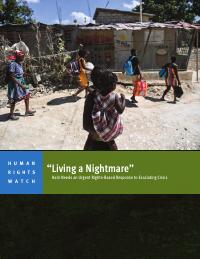
(front cover) Families leave their homes in the
Pétion-ville commune in Port-au-Prince,
Haiti, on March 23, 2023, as criminal groups
take over areas of Haiti.
© 2023 Richard Pierrin/AFP via Getty Images
Haiti is gripped by an unpreceden
ted security, human rights, humanitarian, and political crisis.
Killings, kidnappings, sexual v
iolence, and other abuses by criminal groups occur daily.
Thousands fell victim to these abuses in the first h
alf of 2023 and hundreds of thousands are
internally displaced or have been forced to flee the country. The insecurity compounds a dire
humanitarian situation, with nearly half the population acutely food insecure.
Haitian authorities have been unable to stop criminal groups from taking over swathes of the
country and have failed to protect people from the violence. Some residents have turned to
“popular justice,” forming the Bwa Kale movement.
“Living a Nightmare”: Haiti Needs an Urgent Righ
ts-Based Response to Escalating Crisis
documents abuses committed by criminal groups and the state’s inaction in four communes of
the metropolitan area of Port-au-Prince between January
and April 2023. It describes the context
in which the violence is occurring, with alleged collusion between criminal groups and political
and economic actors, a profound political deadlock, a dysfunctional judicial system, long-running
impunity for human rights abuses, alleged police complicity in criminal activity, an increase in
arms trafficking from the US, and the ongoing legacies from past international interventions.
The United Nations, the US, and other concerned governments should urgently respond to the
call from many Haitians for a rights-based int
ernational response to the crisis, including by
facilitating establishment of a transitional government to restore the rule of law and ensuring
that any deployment of an international force is based on clear human rights protocols.
“Living a Nightmare”
Haiti Needs an Urgent Rights-Based Response to Escalating Crisis