Description Complète
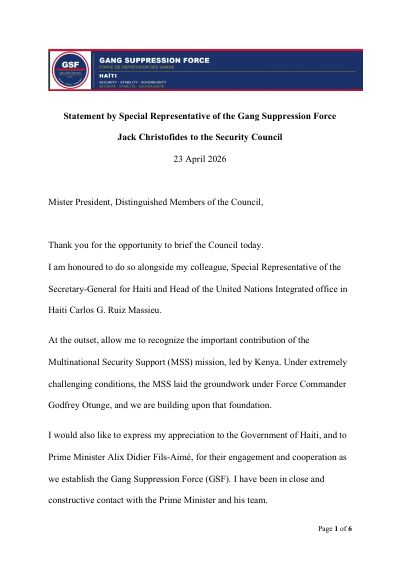
Prononcée devant le Conseil de sécurité le 23 avril 2026, trois semaines après que la Force de répression des gangs a succédé à la Mission multinationale d'appui à la sécurité et avant le début des opérations. Christofides reconnaît d'emblée l'apport de la MSS sous le commandement du Kenyan Godfrey Otunge et remercie le Gouvernement haïtien et le Premier ministre Alix Didier Fils-Aimé de leur coopération.
Le fond porte sur l'état de constitution de la mission. Un plan de déploiement a été élaboré avec les autorités haïtiennes et cible des zones prioritaires en utilisant les capacités spécialisées des pays contributeurs. L'objectif annoncé est de réduire la capacité opérationnelle des gangs à un niveau que les institutions haïtiennes peuvent gérer durablement. Le concept d'opérations est finalisé, le déploiement civil et les structures de planification fondée sur le renseignement se mettent en place, et la formation préalable au déploiement est priorisée. La génération de forces progresse ; un dispositif initial de déploiement a été approuvé dans la limite du plafond autorisé, avec des déploiements échelonnés. Les dimensions maritime et frontalière sont désignées comme particulièrement importantes, y compris l'appui à la gestion des ports et des points d'entrée commerciaux.
Sur la coordination, la déclaration cite le Bureau d'appui des Nations Unies en Haïti et l'équipe de pays, salue la nomination de Daniela Kroslak à la tête de l'UNSOH, et décrit le dialogue avec la République dominicaine sur la gestion des frontières ainsi que la planification conjointe avec la Police Nationale d'Haïti sur la détention, le transfert et le traitement judiciaire. Sur les risques, elle s'engage sur la protection des civils, la prévention de l'exploitation et des abus sexuels et le respect du droit international des droits de l'homme. La phrase de cadrage est que l'efficacité sans redevabilité ne construira pas la confiance, et que la redevabilité sans efficacité n'apportera pas la sécurité.
Texte Intégral du Document
Texte extrait du document original pour l'indexation.
Statement by Special Representative of the Gang Suppression Force
Jack Christofides to the Security Council
23 April 2026
Mister President, Distinguished Members of the Council,
Thank you for the opportunity to brief the Council today.
I am honoured to do so alongside my colleague, Special Representative of the
Secretary-General for Haiti and Head of the United Nations Integrated office in
Haiti Carlos G. Ruiz Massieu.
At the outset, allow me to recognize the important contribution of the
Multinational Security Support (MSS) mission, led by Kenya. Under extremely
challenging conditions, the MSS laid the groundwork under Force Commander
Godfrey Otunge, and we are building upon that foundation.
I would also like to express my appreciation to the Government of Haiti, and to
Prime Minister Alix Didier Fils-Aimé, for their engagement and cooperation as
we establish the Gang Suppression Force (GSF). I have been in close and
constructive contact with the Prime Minister and his team.
Page 1 of 6
�I further acknowledge the strategic guidance and support of the Standing Group
of Partners, as well as the important role of the Organization of American States
in advancing coordinated efforts, including through its work on security and
institutional strengthening.
Mister President,
We are at a critical early phase of establishing the GSF. We remain acutely
aware of the suffering endured by the Haitian people, particularly those living
under gang control. There is an urgent need for concrete action to restore
security and hope.
We are not starting from zero. But we are starting differently. The GSF is being
built as a disciplined, accountable, and partnership-driven mission, designed to
deliver targeted security results while upholding the highest standards of
conduct and full respect for Haitian sovereignty.
The mission is taking shape in a structured and deliberate manner. A
deployment plan has been developed in consultation with the Haitian
authorities, focused on priority areas and leveraging the specialized capabilities
of contributing forces. The objective is clear: to degrade the operational
capacity of gangs to a level that Haitian institutions can sustainably manage,
Page 2 of 6
�thereby creating the time and space necessary for the State to reassert its
authority.
In parallel, we are advancing civilian deployment and establishing the core
structures necessary to support intelligence-led mission planning, coordination,
and oversight. The Concept of Operations has been finalized, providing a clear
framework for how the mission will operate in practice, including integration
with Haitian counterparts. Pre-deployment and induction training are being
prioritized to ensure that all incoming personnel are prepared to operate
effectively in a complex and sensitive environment, and in full compliance with
international standards.
Mister President,
Force generation is progressing, with impressive pledges from Member States.
An initial deployment package has been approved in line with the authorized
ceiling, and deployments will take place in phases over the coming months.
Efforts continue to broaden participation and ensure that the mission is equipped
with the capabilities required to fulfill its mandate. Maritime and border
dimensions for the mission will be particularly important, including support for
Haiti’s capacity to manage its ports and commercial entry points.
Page 3 of 6
�Expectations remain high. Many view the GSF as a potential turning point.
It will be essential not only to deliver results, but also to communicate clearly
with Haitian stakeholders – particularly the Haitian National Police and other
national institutions – on how the mission will operate and how it will reinforce
national efforts.
Mister President,
The success of the mission will depend on effective coordination. We are
working closely with the United Nations system, including the United Nations
Support Office in Haiti (UNSOH) and the United Nations Country Team, to
ensure coherence across political, operational, and support functions. I welcome
the appointment of Ms. Daniela Kroslak as Head of UNSOH.
We are also engaging regional partners, including the Dominican Republic, to
strengthen cooperation on border management and address shared security
concerns. At the national level, we are advancing joint planning with the Haitian
authorities, particularly with the Haitian National Police, to establish clear
procedures for operations, including detention, transfer, and judicial processing.
These arrangements will be critical to ensure that operational gains are
translated into sustainable rule-of-law outcomes.
Page 4 of 6
�This is, at its core, a concerted international effort to strengthen security
partnerships with Haiti on multiple levels.
Mister President,
We are fully aware of the risks inherent in this mission, and we are addressing
them from the outset. Civilian protection, the prevention of sexual exploitation
and abuse, and adherence to international human rights law are central to our
planning and operations. Clear guidance, training, and oversight mechanisms
are being put in place to ensure that all personnel operate in accordance with the
highest standards of conduct and accountability.
We are working closely with the Haitian authorities to ensure that arrangements
related to detention and the treatment of individuals are consistent with legal
standards and operational realities. Particular attention is being given to the
capacity of national institutions, so that apprehensions can be effectively
sustained through the judicial process.
We know that effectiveness without accountability will not build trust. But
accountability without effectiveness will not deliver security. Both are essential.
Page 5 of 6
�Mister President,
The people of Haiti have endured far too much for far too long. The scale of
violence and displacement are simply unacceptable. The space for violence and
impunity must now close. Those who continue to fuel instability will face
increasing constraints, while those who choose to step away from violence will
find that there is a different path forward.
This is a focused and time-bound effort to support Haiti in addressing urgent
security challenges. It will require sustained international support, disciplined
implementation, and realistic expectations.
The GSF is designed not as an end in itself, but as a means to enable Haitian
institutions to regain control and to create the conditions for longer-term
stability.
We remain committed to working in close partnership with the Government and
people of Haiti, with the United Nations system, and with Member States and
regional groups.
I thank you.
Page 6 of 6
�